




Abstract
This study explored the effects of long-term bathing in radon hot springs on oxidative damage and antioxidation function in humans. In this study, blood was collected from residents in the Pingshan radon hot spring area (RHSA), Jiangzha RHSA, and control area (CA). 8-Hydroxydeoxyguanosine (8-OHdG) and thioredoxin reductase (TrxR), representing oxidation and antioxidant levels, respectively, were analyzed as indices. Compared to the CA group, the RHSA group in the Pingshan and Jiangzha areas showed significantly decreased 8-OHdG levels (Z = −3.350, −3.316, respectively, P < .05) and increased TrxR levels (Z = 2.394, 3.773, respectively, P < .05). The RHSA and CA groups in Jiangzha had lower levels of TrxR and 8-OHdG compared to those in Pingshan. This finding may be related to the different radon concentration levels, bathing time and other factors. Results suggested that long-term bathing in radon hot spring may activate antioxidant function and reduce oxidative damage in the body.
Introduction
In Japan, people often go to radon hot springs for relief of osteoarthritis 1 and bronchial asthma. 2 In Europe, radon therapy is known to be effective against inflammatory diseases 3 -5 and pain. 6,7 In China, most residents living in radon hot spring areas (RHSAs) believe that bathing in hot spring water can cure diseases. With the development and utilization of hot spring resources, the number of people bathing in radon hot springs is increasing. However, radon and its decay products can produce radiation, directly affecting the body and indirectly damaging DNA molecules by generating reactive oxygen species (ROS). 8 Radon is a radioactive gaseous element that emits α particles, which have low penetrating power and high linear energy transfer. Alpha particle exposure can generate free radicals. When these free radicals interact with biological molecules, they may cause cellular lipid peroxidation and DNA damage. 9 Active oxygen radicals attack the eighth carbon atom of the guanine base in the DNA molecule to produce 8-hydroxydeoxyguanosine (8-OHdG); 8-OHdG is believed to be one of the predominant DNA lesions, resulting from free radical-induced oxidative stress in nuclear and mitochondrial DNA, and is widely used as a sensitive biomarker of DNA oxidative damage. 10,11
An antioxidant is a substance that acts as free radical scavenger and protects the body from oxidative damage. 12 Thus, appropriate levels of antioxidants may reduce the harm of free radicals and protect against radiation damage. 13 The thioredoxin (Trx) system is an important participant in ROS elimination. 14,15 It is an oxidative stress response system that includes Trx, thioredoxin reductase (TrxR), and nicotinamide adenine dinucleotide phosphate. 16 Thioredoxin reductase is the only enzyme known to catalyze Trx reduction 17 and is an important factor conferring resistance to irradiation. 18 This study aims to detect 8-OHdG and TrxR levels in the plasma of residents who bathed in radon hot springs for a long time and explore the effects of radon exposure in these springs on the oxidative damage and antioxidation function in the body.
Materials and Methods
Background Information
The Pingshan RHSA is located in Wentang Town, Pingshan County, Shijiazhuang City, Hebei province. The radon concentration in the hot spring water was 102 (102 ± 11.4) Bq/L. The average radon concentration level of 60 measurement sites in spring, summer, and autumn was 42.4 (42.4 ± 18.6) Bq/m3, and the equilibrium factor was 0.61. Indoor and outdoor γ-irradiation rates were 165 and 125 nGy/h, respectively. Residents were mainly exposed to hot spring water by using showers indoors. The radon concentration level rapidly increased from the normal background value (<50 Bq/m3) to more than 200 Bq/m3 during shower, 19 which is 5 times higher than the background. World Health Organization proposes reference level of 100 Bq/m3 to minimize health hazards. 20 Three hours after the shower was turned off, the radon concentration level gradually reduced to the background level. 19 The additional annual effective dose caused by radon and its decay products was approximately 0.09 mSv. 21 The control area (CA) of Pingshan is located in Huishe Town, Pingshan County, Shijiazhuang City, Hebei Province, which is 12 km from Wentang Town and 40 km from Shijiazhuang City. The background radon concentration level in the CA was about 31.8 Bq/m3 referring to Shijiazhuang City. 22
The Jiangzha RHSA is located in Jiangzha Town, Ruoergai County, Aba Prefecture, Sichuan Province. Around the hot springs, indoor and outdoor mean radon concentration level were 11 065 and 699 Bq/m3, respectively, 23 which exceeded the Chinese indoor radon concentration guidance action level (300 Bq/m3). 24 The indoor and outdoor γ-irradiation rates were 3461 and 9630 nGy/h, respectively. 23 The CA of Jiangzha is located in Axirong Town, Ruoergai County, Aba Prefecture, Sichuan Province, which is 120 km away from Jiangzha Town and 250 km from Aba Prefecture. The background radon concentration level in CA was about 185 Bq/m3 referring to Aba Prefecture. 25 Residents are mainly exposed to hot spring water by bathing outdoors. The outdoor bath was conducive to radon proliferation, and the concentration of outdoor radon was significantly lower than that of indoor radon. A previous study showed that if one lives near a hot spring, assuming that he/she stays in a room for 12 hours per day, the additional dose that he/she receives would be 82.7 mSv (82.1 mSv for internal exposure, 0.6 mSv for external exposure) every 20 days. 23
Participant Selection
Pingshan area
Forty-two residents who lived in RHSAs in Pingshan County and often bathed in hot springs comprised the RHSA group. Thirty-five residents with similar living habits and education levels but never bathed in the hot springs were selected from the CA.
Jiangzha area
Thirty-eight residents who lived in RHSAs of Jiangzha Town and often bathed in hot springs comprised the RHSA group. Thirty-nine residents with similar living habits and education levels but never bathed in the hot springs were selected from the CA.
Inclusion criteria
The inclusion criteria were as follows: The selected residents should have lived in the villages for more than 15 years, with no migration during the period. In addition, they should have no viral or bacterial infections, no malignant tumors, no severe chronic diseases, no acute infectious diseases, no serious tobacco dependence, no excessive alcohol consumption, and no hospital X-ray examination within 6 months. The research protocol for this study was approved by the Ethics Committee of the National Institute for Radiological Protection, China Center for Disease Control and Prevention. All participants signed informed consent.
Questionnaire
A self-designed questionnaire was used to collect basic information of the study participants through one-to-one inquiry and recorded by qualified investigators. The main contents of the questionnaire include gender, age, use of hot spring bath (yes or no, frequency, time, and ways), and living habits (smoking, alcohol consumption, and tea drinking history). Height, weight, and blood pressure were also measured.
Blood Sampling and Biochemical Analysis
The EDTA-K2 anticoagulant vacuum blood collection tubes were used to collect venous blood from the elbows. In addition, we separated the upper plasma for use through centrifugation at 500 × g for 10 minutes. The levels of 8-OHdG and TrxR in plasma were measured using the enzyme-linked immunosorbent assay kit (Cusabio Biotech Co, Ltd, Wuhan, China). All samples and standards were assayed in triplicate. Based on the enzyme-linked immunosorbent assay kit instruction, standards and plasma were added to the wells that were coated with the corresponding antibody. Enzyme-linked polyclonal antibodies specific for 8-OHdG and TrxR were added to each well after washing away the unbound substances. Substrates were added to the wells after removing unbound antibodies. Adding stop solution to each well, the colors developed were in proportion to the amount of 8-OHdG and TrxR bound in the wells. The optical density of each well was determined using a Multiskan FC microplate spectrophotometer (Thermo Fisher Scientific Inc, Shanghai, China) at 450 nm. And their concentrations were calculated according to the standard curve.
Statistical Analysis
All statistical analyses were processed with IBM SPSS statistics 21.0 (SPSS Inc, Chicago, Illinois). A χ2 test was conducted to explore the distribution of basic data (including gender, alcohol consumption, smoking, tea drinking, and body mass index [BMI]) in the 2 groups. Multiple linear regression was used to analysis the influencing factors of 8-OHdG and TrxR in 2 regions. Descriptive statistics (age, bathing time, and levels of 8-OHdG and TrxR) were analyzed by using the median. Significant differences in medians were identified using the Mann-Whitney U test. P values < .05 were considered significant.
Result
Plasma 8-OHdG and TrxR Levels in Residents Around Pingshan Hot Springs
Basic data analysis
The age of residents in the RHSA group was between 26 and 60 years, and the average annual radon hot spring bathing time (short for bathing time) was 40 to 150 (P50 = 70) h. The age of residents in the CA group was between 29 years and 70 years, and bathing time was zero. The composition ratios of basic data (gender, alcohol consumption, smoking, tea drinking, and BMI) in the 2 groups were compared, and their distribution was not different.
Detection of 8-OHdG and TrxR in plasma
Bathing time and age were subjected to multiple linear regression analysis. Table 1 shows that the regression coefficients of age for the differential expression of 8-OHdG and TrxR were not statistically significant (P > .05). The bathing time of residents affected the differential expression of 8-OHdG and TrxR (t = −2.323, 2.161, respectively, P < .05). The level of 8-OHdG decreased by 0.62 times, whereas that of TrxR increased by 1.38 times in the RHSA group than in the CA group. The difference was statistically significant (Z = −3.550, 2.394, respectively, P < .05; Table 2).
Multiple Linear Regression Analysis 8-OHdG and TrxR in Pingshan and Jiangzha.
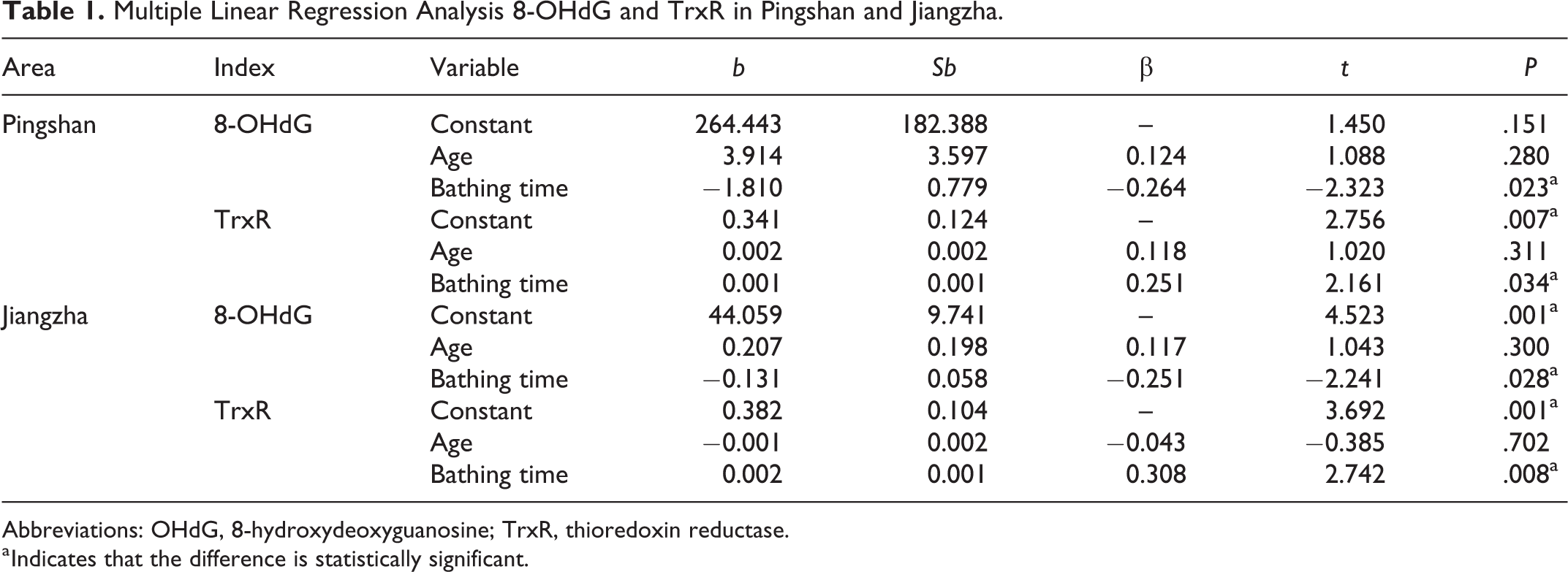
Abbreviations: OHdG, 8-hydroxydeoxyguanosine; TrxR, thioredoxin reductase.
a Indicates that the difference is statistically significant.
The Comparison of 8-OHdG and TrxR Results From Mann-Whitney U Test.

Abbreviations: CA, control area; 8-OHdG, 8-hydroxydeoxyguanosine; RHSA, radon hot spring area; TrxR, thioredoxin reductase.
a Indicates that the difference is statistically significant.
Plasma 8-OHdG and TrxR Levels in Residents Around Jiangzha Hot Springs
Basic data analysis
The age of residents in the RHSA group was between 20 and 67 years, and the bathing time was 6 to 144 (P50 = 72) hours. The age of residents in the CA group was between 22 and 66 years, and the bathing time was zero. The composition ratios of basic data (gender, alcohol consumption, smoking, tea drinking, and BMI) of the 2 groups were compared, and their distribution was not different.
Detection of 8-OHdG and TrxR in plasma
Table 1 shows that the regression coefficients of age for the differential expression of 8-OHdG and TrxR were not statistically significant (P > .05). The bathing time of residents affected the differential expression of 8-OHdG and TrxR (t = −2.241, 2.742, respectively, P < .05). In the RHSA group, the 8-OHdG level decreased by 0.57 times, whereas the TrxR level increased by 2.35 times. The difference was statistically significant (Z = −3.316, 3.773, P < .05; Table 2).
Discussion
Takahiro et al found that radon inhalation at 2000 Bq/m3 for 24 hours inhibited CCl4-induced oxidative damage in mice; inhaled radon produces superoxide dismutase (SOD), catalase (CAT), and glutathione peroxidase (GSH-Px) in the liver 26 and kidney. 27 Kojima et al 28 treated patients with ulcerative colitis using a special room with radon concentration of 9800 Bq/m3, twice a week for 40 minutes, together with ingestion of 200 mL of radon-containing water (330 Bq/L) with each meal and exposure to a radon sheet during bedtime. After 1 year, the symptoms of the patients greatly improved. Kuciel-Lewandowska et al 29 found that the conditions of patients with degenerative joints and disc disease who underwent treatment with radon water improved after 5 days. Moreover, the total antioxidant levels of patients also increased. In their study, radon induced the activation of the biological defense system. In our study, we investigated the effects of long-term exposure to radon hot springs on oxidative stress in the body.
The composition of gender, alcohol consumption, smoking, tea drinking, and BMI was consistent between the RHSA group and the CA group. The age and bathing time were incorporated into the multiple linear regression equation, and the results showed that the difference in 8-OHdG and TrxR levels was influenced by bathing time and not by age. The 8-OHdG levels decreased significantly in the RHSA group compared to the CA group; however, the TrxR levels increased significantly in the Pingshan and Jiangzha areas. The oxidative damage levels were reduced, and the scavenging capacity to ROS was improved after long-term bathing in the radon hot springs. These results coincided with the findings of several studies. 26 -29 Yamaoka et al 30 reported that after 10 days, young men who bathed once a day for 40 minutes and inhaled 2080 Bq/m3 of radon showed enhanced antioxidation function in the body as evidenced by increased SOD and CAT activities and inhibition of lipid peroxidation and total cholesterol production. The study participants’ exposure patterns of radon and results in Yamaoka’s study were very similar to our study. Chen et al 31 investigated the effects of low-dose radiation on oxidative damage and antioxidation function in populations from high background radiation areas in Guangdong. Their results showed that the concentrations of 8-OHdG and TrxR in peripheral blood significantly decreased and increased, respectively, which are similar in our study. Nie et al 32 exposed Wistar rats to radon gas at 100 000 Bq/m3 for 12 h/d for 30, 60, and 120 days. Their results revealed an increase in 8-OHdG and ROS levels and a decrease in total antioxidant capacity levels. The results were different from our study, under the same radiation source of α particles, possibly due to different radon concentrations, exposure time, and study subjects.
In our study, the plasma TrxR and 8-OHdG levels of the RHSA and CA groups in Jiangzha were lower than those in Pingshan. The difference between the 2 areas may be related to the difference in background radon concentrations level in CA (31.8 Bq/m3 in Huishe Town and 185 Bq/m3 in Axirong Town). Moreover, the characteristics (gender, age, alcohol consumption, smoking, tea drinking, and BMI) of the study participants in the 2 areas were different. Environmental and physical factors, such as altitude, air quality (Jiangzha hot springs are located at high altitudes, indicating good air quality, whereas Pingshan hot springs are located at low altitudes and often exposed to hazy weather), 33 -35 and antioxidant vitamin supplements, may have also affected the residents’ condition (in Jiangzha RHSA and CA, residents often eat Hippophae rhamnoides products). 36 The impact factors and related mechanisms still need to be further studied and verified.
Overall, given the indirect effects of ionizing radiation on the body in this 2 RHSA, radon can activate antioxidant function, scavenge oxygen free radicals, and reduce oxidative damage. We supposed that this phenomenon may be related to the hormesis effect of low-dose radon exposure, which need to be further explored.
The limitations of our study were as follows. The sample size was not large enough. Therefore, a large sample size is needed in future studies. Several relevant indicators, such as malondialdehyde, 4-hydroxynonenal, SOD, CAT, and GSH-Px, should be researched to evaluate the oxidative damage and antioxidant function in the body.
Footnotes
Declaration of Conflicting Interests
The author(s) declared no potential conflicts of interest with respect to the research, authorship, and/or publication of this article.
Funding
The author(s) received no financial support for the research, authorship, and/or publication of this article.
