



Abstract
The purpose of this study was to investigate the effects of Chahuangjing, a novel traditional Chinese medicinal compound, on decorporation and radiation protection against tritiated water (HTO). Sixty male specific-pathogen-free-grade C57BL/6J mice were randomly divided into 12 groups: mice in 4 control groups were intraperitoneally injected with sterile water; mice in 4 HTO groups were intraperitoneally injected with 11.1 × 10⁵ Bq/g of HTO; and mice in the other 4 groups were administered with HTO and a Chahuangjing compound (0.2 mL, once daily). After 1, 7, 14, and 21 days, the mice were killed and samples were collected. A liquid scintillation counting method was used for tritium measurement. A fully automated hematology analyzer was used to assess blood samples. The superoxide dismutase (SOD) and malondialdehyde (MDA) content was analyzed using commercial kits. Chahuangjing significantly increased decorporation and shortened the effective half-life of tritium. To a certain extent, Chahuangjing alleviated the HTO-induced reduction in white blood cells and elevated red blood cells after HTO exposure. Moreover, Chahuangjing alleviated the HTO-induced reduction in SOD activity and reduced MDA. Our study demonstrated that Chahuangjing can enhance the elimination of tritium and reduce free radicals to alleviate HTO-induced radiation injury.
Introduction
Tritium is a radioactive isotope of hydrogen that decays to helium through β emission. The average and maximum energies of the β-ray of tritium are 5.68 keV and 18.6 keV, respectively. The maximum range for the β-ray of tritium is 5 mm in air and 0.56 μm in water. Thus, the radiobiological effect of tritium is induced by internal irradiation after entry into the human body, rather than by external irradiation. As one of the most critical radionuclides in the environment produced by nuclear power plants, tritium is transformed and recycled with hydrogen in different environmental media. Tritium is introduced into organisms through inhalation, skin penetration, and diet as tritium gas, tritiated water (HTO), and organic bound tritium (OBT).
As early as the 1960s, many researchers have investigated the biological effects of HTO on organisms. These studies have shown that chronic exposure to a low dose of HTO induces leukemia and other malignancies, repeated exposure to HTO increases the incidence of several cancers, and the incidence of leukemia is closely related to the radiation dose of HTO. A low dose of intrauterine radiation reduces body weight, induces developmental retardation, and damages the reflexes and sensory function. 1 –3 These findings provide evidence for the internal radiation effect of HTO from different perspectives. The reviews published by Little et al. summarized experimental and epidemiological studies on the relative biological effectiveness (RBE) of tritium. 4,5 These studies revealed that the RBE of HTO was greater than 1, despite its low energy. A recent study published in The International Journal of Radiation Biology reported improvements in the accuracy of absorbed dose calculations for the in vitro measurements of the RBE of HTO in a clonogenic cell survival assay: the COmputation Of Local Electron Release program was applied to calculate the cell geometry and the tritium full β-decay spectrum impact on the S-values, and subsequently for the measurement of the RBE of HTO for clonogenic cell survival at high dose rates. For adherent cells, an RBE of 1.6 was found when HTO cell survival curves were compared with acute γ-ray exposure; irrespective of the geometrical configuration, the RBE was 2.0 when compared to similar dose rates. 6 These findings revealed that RBE values of 1.6 to 2.0 for HTO were evenly distributed in cells, even with the exclusion of the long-term effect of direct tritium incorporation in the DNA, which might be attributable to end-of-track low-energy electrons.
The aforementioned studies suggest that the methods and techniques for the decorporation and radiation protection of HTO warrant further attention. Therefore, this study was conducted to observe the effect of Chahuangjing, a traditional Chinese medicine compound, on tritium decorporation and free radical scavenging in mice exposed to HTO.
Materials and Methods
Components of Chahuangjing
Chahuangjing is composed of tea polyphenol extracts and astragalus extracts (astragalus root extract ratio, 20:1). The conventional astragalus extraction process includes water extraction and alcohol precipitation, 70% to 95% alcohol extraction, and refluxing. Although the contents of astragalus polysaccharides and astragaloside obtained using these methods differ slightly, all astragalus extracts can be used for study. The astragalus extracts used in this experiment were obtained from astragalus roots through water extraction and alcohol precipitation. Tea polyphenols are extracted from the buds of various types of tea, such as Chinese red tea and green tea. The tea polyphenols used in this experiment were extracted from the buds of Longjing green tea produced in Hangzhou, Zhejiang Province, China, which has high levels of catechins.
The compounds obtained from astragalus and tea polyphenol extracts (2:1) were dissolved to final concentrations of 50 and 25 mg/mL for astragalus and tea polyphenols, respectively, which were administered by gavage to mice.
Reagents
Tritiated water was purchased from HTA Co., Ltd (Beijing, China). Protein, superoxide dismutase (SOD) activity, and malondialdehyde (MDA) assay kits were purchased from Jiancheng Bioengineering Institute (Nanjing, China).
Animals
Sixty male specific-pathogen-free-grade C57BL/6J mice weighing 20 ± 2 g were provided by the Experimental Animal Center of Soochow University. The mice were randomly divided into 12 groups, with 5 in each group. Four groups of control mice were injected intraperitoneally with sterile water (0.2 mL). Four HTO groups, the mice were intraperitoneally injected with 11.1 × 10⁵ Bq/g of HTO. In the other 4 groups, the mice were administered with a single injection of 11.1×10⁵ Bq/g of HTO and once daily with 0.2 mL of Chahuangjing by gavage thereafter. After 1, 7, 14, and 21 days, the mice in each group were killed after collecting blood by cardiac puncture and organ samples were obtained.
Liquid Scintillation Counting of Tritium in Liver Tissue
Liver tissue (100 mg) was placed at the center of the bottom of liquid scintillation cups. Perchloric acid (0.2 mL) and 30% H2O2 (0.4 mL) were then added. The cups were heated in a water bath at 80°C for 1 hour and then cooled to room temperature and mixed with the scintillation solution for measurement of tritium levels.
Effective Half-Life Calculation
The hepatic tritium data were collected based on the assumption that HTO was evenly distributed in body fluids and organs, such as the liver. Water metabolism was determined using a one-compartment model:


where A is the specific activity of hepatic tritium; A 0 is the initial hepatic specific activity; λ is the discharge rate of hepatic tritium; and T 1/2 is the effective half-life of hepatic tritium.
For measurement of the specific activity of hepatic tritium, A 0, λ, and T 1/2 were calculated using Equation 2 after the background subtraction based on the control group data. The deviation of the estimated value of λ was the standard deviation (SD). The deviation of the estimation value of T 1/2 was asymmetric and indicated by the interval.
Peripheral Blood Cell Detection
Blood samples were collected by cardiac puncture and placed in an anticoagulant tube. A fully automated hematology analyzer was used to assess white blood cells, red blood cells, lymphocytes, neutrophils, and platelets.
Hepatic SOD and MDA Measurement
The liver tissues were homogenized, and the supernatants were collected after centrifugation at 4°C for 20 minutes. The protein concentration was then measured using the Bradford method with a commercial kit (Jiancheng Bioengineering Institute, Nanjing, China) in accordance with the manufacturer’s protocol. The SOD levels in the supernatants were detected using the xanthine oxidation method with a commercial kit (Jiancheng Bioengineering Institute) in accordance with the manufacturer’s protocol. The MDA content was measured using the thiobarbituric acid method with a commercial kit (Jiancheng Bioengineering Institute) in accordance with the manufacturer’s protocol; specifically, the samples were placed in a water bath (95°C) for 40 minutes and centrifuged for 10 minutes. The supernatants were collected, and the MDA content was determined based on the measured absorbance at 532 nm.
Statistical Analysis
These data are presented as mean±SD. The peripheral blood measurements were assessed using an analysis of variance (ANOVA) and the differences between the groups were assessed using a one-way ANOVA. A P value of <.05 was considered to be statistically significant.
Results
Tritium Quantity in the Liver Tissue of Mice
The hepatic tritium levels after exposure to HTO are shown in Table 1. We found that HTO exposure significantly increased hepatic tritium levels at different time points. However, after 7 days, the mice administered with Chahuangjing exhibited a clear decrease in tritium quantity, suggesting that Chahuangjing significantly promoted tritium clean up after mice exposed to HTO.
Tritium Quantity in the Liver Tissue of Mice.

Abbreviation: HTO, tritiated water.
a Compared to HTO group at the same time point, P < .05.
b Compared to control group at the same time point, P < .05.
Chahuangjing Increased Tritium Removal After Exposure to HTO
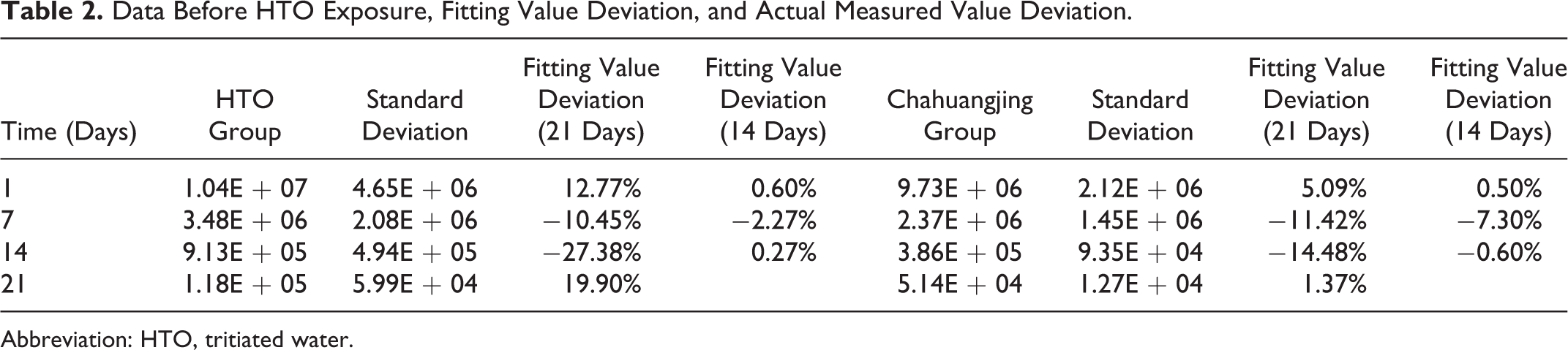
The measured value and the deviation between the fitting value and measured value were shown in Table 2. The parameters, including A 0, λ, and T 1/2, were shown in Table 3. The deviation of the estimated value of λ was the SD. The deviation of the estimated value of T 1/2 was asymmetric and is indicated as the interval.
Data Before HTO Exposure, Fitting Value Deviation, and Actual Measured Value Deviation.
Abbreviation: HTO, tritiated water.
Estimated Parameter Values.

Abbreviation: HTO, tritiated water.
The sample size was slightly insufficient for the estimation of linear parameters, and the relative SD of single data points was large. However, parameter estimation was effective for the data from day 21 and day 14. The deviation of the fitting value (Table 2) was the relative deviation of the specific activity of the liver calculated from the fitting parameters and the actual measurement. Although the data on day 14 exhibited a good fit with the exponential function, it should be analyzed with caution because of the relatively small quantity of data. Given the large individual differences in mice, tracking the measurement with a single mouse may mitigate the individual metabolic differences and allow for more accurate data on the effect of experimental drugs on HTO metabolism. Collectively, the administration of Chahuangjing significantly accelerated the discharge rate of tritium and shortened its effective half-life.
Effect of Chahuangjing on Blood Cells After HTO Radiation
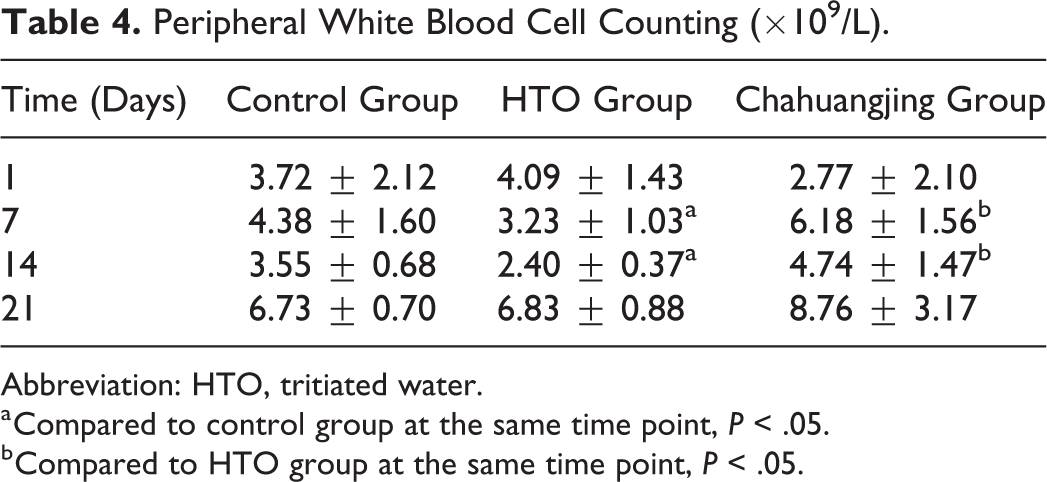
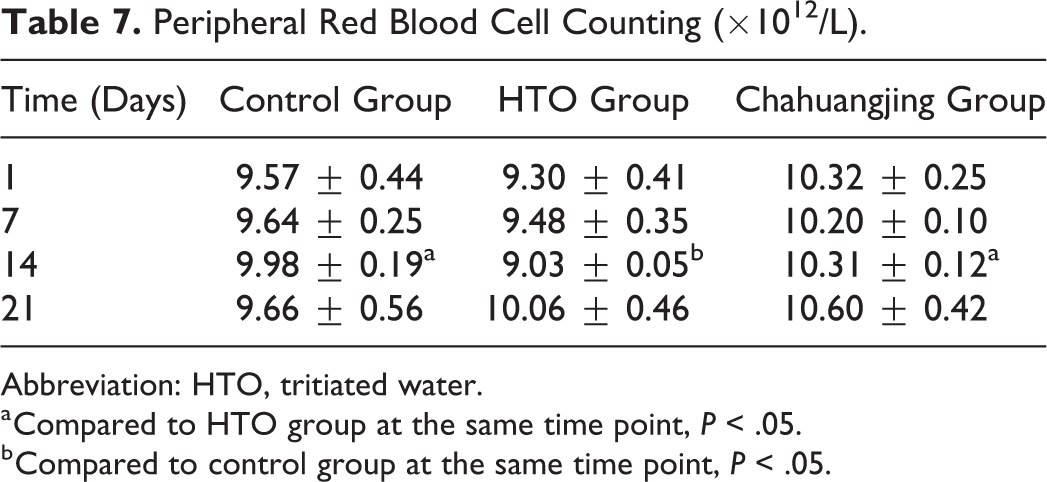
The effects of Chahuangjing on blood cells exposed to HTO radiation were shown in Tables 4 to 8. As shown in Table 4, the white blood cell count clearly decreased after HTO exposure for 7 or 14 days, whereas Chahuangjing increased the white blood cell count. As shown in Table 5, no significant changes were observed in lymphocytes, except for an increase on day 7. No significant changes in neutrophils were observed (Table 6). As shown in Table 7, red blood cells decreased only on day 14 in the HTO group. No changes were found in platelets (Table 8). These results suggested that, to a certain extent, Chahuangjing alleviated the HTO-induced reduction of white blood cells and elevated red blood cells in the HTO-treated mice.
Peripheral White Blood Cell Counting (×109/L).
Abbreviation: HTO, tritiated water.
a Compared to control group at the same time point, P < .05.
b Compared to HTO group at the same time point, P < .05.
Peripheral Lymphocyte Number Counting (×109/L).

Abbreviation: HTO, tritiated water.
a Compared to control group at the same time point, P < .05.
Peripheral Neutrophil Counting (×109/L).

Abbreviation: HTO, tritiated water.
Peripheral Red Blood Cell Counting (×1012/L).
Abbreviation: HTO, tritiated water.
a Compared to HTO group at the same time point, P < .05.
b Compared to control group at the same time point, P < .05.
Peripheral Platelet Count (×109/L).

Abbreviation: HTO, tritiated water.
Hepatic SOD and MDA Measurement
The detection of SOD activity was summarized in Table 9. Hepatic SOD activity began to decrease 7 days after HTO exposure and remained lower than that in the control group despite an increase on day 21. On days 7 and 21, the administration of Chahuangjing promoted the activity of SOD in the liver. These results suggest that Chahuangjing alleviated the HTO-induced reduction of SOD activity in the liver tissue.
Hepatic SOD Activity (U/mg protein).

Abbreviations: HTO, tritiated water; SOD, superoxide dismutase.
a Compared to control group at the same time point, P < .05.
b Compared to HTO group at the same time point, P < .05.
As shown in Table 10, the MDA content in the liver tissue was significantly increased 21 days after HTO exposure. On days 14 and 21, the hepatic MDA content in the Chahuangjing group was reduced, suggesting that it eliminated free radicals after HTO exposure.
Hepatic MDA Content (nmol/mg protein).

Abbreviations: HTO, tritiated water; MDA, malondialdehyde.
a Compared to HTO group at the same time point, P < .05.
b Compared to control group at the same time point, P < .05.
Discussion
Tritiated water can be absorbed through the gastrointestinal tract, respiratory tract, and skin. Tritiated water in the body is systemic and relatively uniform in distribution and drowning HTO is removed through urination, exhalation, or sweating. Tritium can be incorporated into the organic molecules of plants and animals to form OBT. Organic bound tritium that is combined with the carbon in organic molecules is relatively stable because it is bound by an enzymatic reaction and is not easily exchanged. Organic bound tritium plays a role in stochastic effects.
Tritium is a radionuclide contaminant, and effective methods should be adopted to prevent it from damaging organisms. When internal HTO contamination occurs, the most widely used strategy is to apply diuretics and drink plenty of water (initially 1-2 L/day and 5-10 L/day thereafter) for 1 to 2 weeks, which is the most natural and healthy method. However, this method is not feasible in patients with diseases that render them unable to drink much water. Diuretics can effectively clean HTO and are classified as carbonic anhydrase inhibitors, loop diuretics, thiazide diuretics, potassium-sparing diuretics, and osmotic diuretics based on their mechanism of action and clinical efficacy. Carbonic anhydrase inhibitors are rarely used in clinical practice because of the weak diuretic effect, loss of bases, and metabolic acidosis. Loop diuretics, such as furosemide, inhibit sodium reabsorption in the medullary loop. The most common potassium-sparing diuretic is spironolactone, and mannitol is the most common osmotic diuretic used in clinical practice. In addition, thiazides, such as dihydrothiazide, are the most common diuretics that act primarily on the distal tubules of the kidney and inhibit the reabsorption of sodium and water. The adverse reaction and side effects of diuretics should not be ignored: furosemide induces low sodium/potassium, hypotension, blood suppression, and ototoxicity; spironolactone causes hyperkalemia and blood suppression; hydrochlorothiazide induces kidney injury and is not used for patients with kidney disease. Because of these side effects of diuretics, the search for efficient, nontoxic radioprotective agents for HTO is critical.
This study evaluated Chahuangjing, a traditional Chinese medicinal compound composed of tea polyphenols and astragalus extracts. Tea polyphenols are a mixture of more than 30 phenolic compounds isolated from tea, which account for approximately 30% of the dry weight of tea. Based on the chemical structure, tea polyphenols are divided into flavanones, anthocyanidins, flavonols, anthocyanins, phenolic acids, and phenolic acids. Catechins consist of epigallocatechin gallate, epigallocatechin, epicatechin gallate, and epicatechin. Studies have shown that tea polyphenols have diverse biological activities, such as anticancer, free radical scavenging, antiaging, antihypertensive, and antiviral activity, which are widely used in the food and pharmaceutical industries. 7,8 Astragalus membranaceus is the most widely used herb for tonic drugs in traditional Chinese medicine and is the main component in many traditional Chinese medicine compounds. Chinese medicine practice over thousands of years has confirmed that A. membranaceus functions to replenish qi, which strengthens body resistance, promotes diuretic detoxification, heals sores, and prompts muscles. 9 –12 It contains many chemical components, such as polysaccharides, saponins, flavonoids, amino acids, and certain trace elements. Our study found that Chahuangjing exhibits diuretic, tritium-removing, and free-radical-scavenging effects, which reduce internal HTO radiation injury.
In summary, Chahuangjing predominantly contains plant extracts such as tea polyphenols and astragalus polysaccharides, which can be applied for tritium cleaning and radiation protection because of its nontoxicity and the absence of side effects.
Footnotes
Authors’ Note
Xueyong Zuo and Qiu Chen contributed equally to this work. Fengmei Cui and Qiu Chen conceived and designed the experiment. Xueyong Zuo, Ke Zhang, Mingjiang Hu, Fengmei Cui, and Kongzhao Wang performed the experiments. Yu Tu, Yulong Liu, and Houwen Li analyzed the data. Fengmei Cui and Qiu Chen wrote the article.
Declaration of Conflicting Interests
The author(s) declared no potential conflicts of interest with respect to the research, authorship, and/or publication of this article.
Funding
The author(s) disclosed receipt of the following financial support for the research, authorship, and/or publication of this article: This work was supported by ITER (2014GB112006) and the National Natural Science Foundation of China (grant numbers 30800922 and 81172706) and the Priority Academic Program Development of Jiangsu Higher Education Institutions.