




Abstract

Introduction
Despite common dose–response curves, a compound may have the opposite effect in small doses as in large doses. This phenomenon is named hormesis. Calabrese et al have reported that many toxic substances, environmental hormones, inorganic compounds, and even irradiation induce hormesis. They modulate the growth of cultured cells in a biphasic fashion, either stimulating or inhibiting the growth of cultured cells at low and high concentrations, respectively. 1,2
There are 2 hormetic models: overcompensation stimulation and direct stimulation. Overcompensation stimulation is based on observations that the hormetic stimulatory response in the low-dose zone (ie, below the traditional toxic threshold) can result from an overcompensation following an initial disruption in homeostasis. 3 With respect to the time component of this model, the dose response is a series of time-based snapshots. 3
Contrary to overcompensation stimulation, direct stimulation model employs multiple doses with only 1 time point. It can happen by 2 mechanisms: receptor-mediated or cell-signaling-mediated. In several studies, researchers identified an essential cell-signaling pathway as well as the receptor. 4
Umbelliprenin (umb) is a naturally sesquiterpene coumarin, which is synthesized by ferula species. Apoptosis induction is one of the umb effects. Ziai et al investigated the properties of this effect. 5 -7 Based on our previous findings, 7 part of our previous data will be reanalyzed with respect to hormetic dose–response relationship.
Materials and Methods
In our previous study, 7 we incubated Jurkat T-CLL cells with different concentrations (10, 25, 50, and 100 µM) for different times (16, 20, 24, and 48 hours). The cytotoxicity and apoptosis induction (total apoptosis, total necrosis, early apoptosis, and late apoptosis) were measured by annexin V-FITC/PI double staining flow cytometry. Part of the study was published 7 ; here, part of the previous data is presented by Microsoft Excel 2010 and interpreted based on hormesis phenomenon.
Results
Based on our previous findings, 7 we found the hormetic phenomenon for some of the times of incubation (but not for all of them). The best hormetic effect is found for total and late apoptosis after 48 hours of incubation (Figure 1).
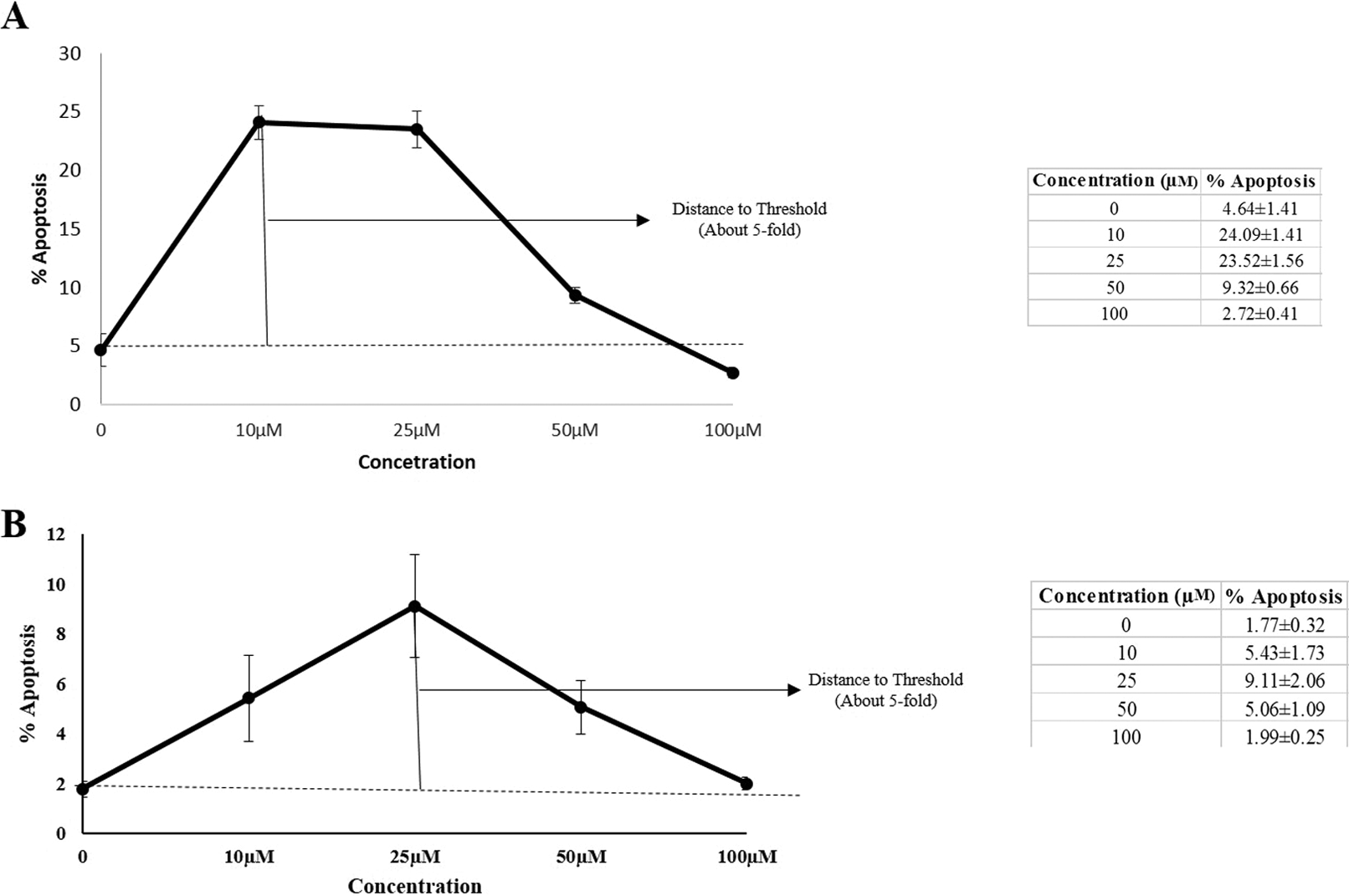
Total (A) and late (B) apoptosis induction by umbelliprenin after 48 hours incubation in Jurkat cells. Umbelliprenin induces and inhibits apoptosis by hormetic effect. In low doses, umbelliprenin increases the percentage of apoptosis, and in high doses, it decreases the percentage of apoptosis. Data are shown as mean ± standard deviation. Error bars represent 95% confidence interval.
Discussion
The hormetic dose–response relationship has become the object of considerable investigation across the broad range of biological/biomedical disciplines concerned with dose/concentration–response relationships over the past 2 decades. 4 Hormetic models are overcompensation stimulation and direct stimulation. While overcompensation is tested based on multiple doses with multiple time points, direct stimulation employs multiple doses with only 1 time point.
Because of umb-induced/inhibited apoptosis in multiple doses with only 1 time point, we can conclude that total and late apoptosis induction by different concentrations of umb followed direct stimulation hormetic model (Figure 1).
In our previous findings, we showed that umb activates intrinsic and extrinsic pathways of apoptosis by the activation of caspase-8 and -9, respectively. 5,6 The extrinsic pathway of apoptosis is mediated by tumor necrosis factor receptor. Therefore, based on professor Calabrese’s findings, umb has a hormetic mechanism for both receptor and signaling pathway. 4
Szabaldi documented numerous examples of biphasic dose responses in the pharmacological literature. He showed that it was mediated by a single agonist acting upon 2 receptor subtypes, one affecting a stimulatory pathway and the other an inhibitory pathway. Although the subtype affecting the stimulatory pathway had far fewer receptors with considerably greater affinity for the agonist, the subtype affecting inhibition typically had far less affinity for the agonist but much greater capacity (ie, more receptors). 8 We can conclude that umb mediates its hormetic effect by 2 subtype receptors. This hypothesis requires further analysis in the future.
In conclusion, hormetic phenomenon was observed in the apoptosis induction/inhibition by umb at different times of incubation. However, the present data may not suffice for the complete interpretation of its hormetic effect and requires further elucidation.
Footnotes
Declaration of Conflicting Interests
The author(s) declared no potential conflicts of interest with respect to the research, authorship, and/or publication of this article.
Funding
The author(s) received no financial support for the research, authorship, and/or publication of this article.