



Abstract
The purpose of this study is to identify visual cues for distinguishing circular knit structures in on-body garment images within online environments and to empirically analyze the perceptual relationships among knit structures. Two experiments were conducted. In Experiment 1, eight experts with more than 7 years of experience were presented with 48 woven and knit garment images in random order and asked to freely describe their rationale when identifying circular knits. Analysis of the collected descriptors revealed that knit perception was systematized into three dimensions: Form, Drape, and Feel, from which 23 adjective pairs were derived. In Experiment 2, 20 experts evaluated 36 garment images composed of 12 types of circular knit structures on a 7-point scale for the 23 adjective pairs. Analysis through multidimensional scaling (MDS), hierarchical cluster analysis (HCA), and correspondence analysis (CA) revealed that knit structures were classified into four perceptual categories—flat-dense, linear-structural, patterned-ornamental, soft-cozy—and two perceptual dimensions were derived: structure cue priority versus texture impression priority (MDS: 25%, CA: 48%) and softness versus distinctness (MDS: 17%, CA: 25%). This study systematically identified the visual perceptual structure of knit structures in on-body garment images in online environments and provides foundational data for textile recognition in online fashion environments, digital merchandising, and the development of AI-based textile recognition systems.
Keywords
Introduction
In the fashion industry, image-based trend analysis that examines runway, online retail, and social media images to identify styles, colors, and silhouettes is increasing.1 –3 Market research that identifies the product composition and fabric structures used by competing brands has become a key element in establishing seasonal strategies, and the method of evaluating products based on visual information in online environments is expanding. 1 As the transition from OEM to ODM methods accelerates,4 –8 design and production functions have moved to suppliers, and cases where the early stages of product planning proceed with only image information without physical samples are increasing.9,10 In this context, the ability to visually and accurately read fabric structures used in garment images has become an important capability that determines planning accuracy and practical efficiency.11,12
In the seasonal planning process, fashion retailers and buyers design seasonal product compositions by combining attributes such as product categories, price ranges, styles, and materials, and such assortment planning is a core decision directly linked to sales and profitability.13 –16 While price range, color, and category can be identified relatively stably from online garment images, materials, and fabric structures are often not explicitly provided online or are difficult to visually distinguish.17,18 Recent studies highlight that this ambiguity in fabric perception significantly impacts consumer decision-making and planning accuracy in digital retail contexts.17,19 In practice, methods are used to quantitatively compare the fiber composition and knit structure distribution between competing brands and target brands to establish seasonal product planning and sourcing strategies (Figure 1). This analysis functions as a core step in the “Market Intelligence” process, and fabric structure usage proportion and distribution are directly linked to seasonal concept setting, material selection, and sourcing strategy establishment. Therefore, the ability to read fabrics based on online images is considered an essential foundational capability for performing Market Intelligence.

Example of market intelligence analysis quantifying competitor brands’ fiber contents and knit fabrication distributions for data-driven seasonal assortment planning and sourcing decisions.
In online market research, the ability to clearly distinguish cut-and-sew woven, cut-and-sew knit, and sweater knits is considered an essential basic capability. However, academic evidence is lacking regarding what visual cues are actually used to identify fabric structures in garment images and how these cues contribute to judgment accuracy.
Textile research has long focused on identifying the visual properties inherent in materials, such as structural organization, yarn density, and surface texture. Visual properties such as surface irregularities, pattern repeatability, and light reflection characteristics have been reported to play important roles in forming emotional and esthetic impressions of fabrics.20 –26 Research has also confirmed that emotional properties such as softness, luster, and expected tactile feel perceived from fabric appearance play key roles in quality judgment and preference formation.27 –29 Recent studies have reported that fabric textures evoke emotional responses through visual and tactile perception, and that visual perception alone can form emotional impressions of fabric texture. 30 However, these studies have been limited to flat material states where fabric structure information is clearly exposed.
As demand for knitted apparel products increases, the proportion of cut-and-sewn knit in major product categories is rising. 31 Cut-and-sewn knit undergoes cutting and sewing processes similar to woven fabrics, but requires structure and pattern design that considers different sewing equipment and methods. The hand feel of knit fabrics serves as a key factor determining garment wearing comfort, 32 and circular knits in particular exhibit large deformations during wearing, such as extension, drape, and body surface curvature, resulting in different appearances between flat material states and on-body garment images. Therefore, it is important to understand how structural characteristics are visually revealed in on-body garment states. However, research systematically identifying the visual cues used to identify circular knit structures in on-body garment images has rarely been conducted.
The purpose of this study is to analyze how circular knits are visually perceived in on-body garment images and to establish a basis for circular knit structure judgment based on on-body images by collecting and classifying descriptive expressions used in this process. Through this, the study aims to present basic guidelines for distinguishing circular knit structures and to provide visual judgment criteria applicable to design practice in online-based planning and market research environments. This study is conducted around the following two research questions: (1) Through what visual cues are circular knit garment images perceived? (2) Can these perceptual cues be systematically distinguished according to circular knit structures?
Methods
Participants
This study was conducted after receiving approval (2507/004-01) from the Institutional Review Board (IRB) of Seoul National University, and all participants were provided with explanations about the purpose and procedures of the study, the manner of data use, anonymity guarantee, and the right to withdraw from participation, and submitted written consent. Participants were provided with compensation for participation, and information that could identify individuals was not collected or used during the analysis process.
The expert group was composed of participants with practical experience in visually distinguishing structural differences in circular knit structures. For Experiment 1, eight experts with 7–15 years of experience in fashion or textile design who had extensive experience in circular knit and apparel planning were recruited. They are current practitioners who have performed circular knit apparel design, sourcing, and material planning work at apparel vendors and brands.
For Experiment 2, to quantitatively verify the visual impression differences among circular knit structures, 20 experts with at least 3 years of design and planning practical experience majoring in clothing & textiles or fashion-related fields were recruited. Some of them were industry professionals who also participated in Experiment 1, and the remaining participants were master’s and doctoral students with specialized knowledge in knit fabric structures, and apparel materials. Detailed characteristics of participants, including age, major, occupations, years of practical experience, and whether they had circular knit design/planning experience, are presented in Table 1.
Characteristics of the participants.

Note. Exp. 1: qualitative description task; Exp. 2: quantitative evaluation using Likert scale.
The recruitment of an expert group was strategically intended to identify subtle visual cues and structural differences that require specialized knowledge and practical experience. Experts are known to exhibit higher cognitive consistency in visual perception tasks compared to non-experts, which is crucial for deriving a stable and reliable perceptual map in multidimensional scaling (MDS) and hierarchical cluster analysis (HCA).
Stimuli
The knits in this study refer to circular knits based on weft knitting structures (Figure 2). Knits are classified into weft knits and warp knits, and weft knits are divided into circular knits and flat knits. Circular knits form continuous loop structures with circular knitting machines, are produced in roll form, and are used for garment production through the cut-and-sew method after tubular opening and finishing. Circular knits, produced via continuous-loop weft knitting on circular machines, possess unique properties of form-fitting and elastic recovery based on the ability of knitted loops to change shape when subjected to tension. 33 Plain single-jersey, for example, has a potential recovery of up to 40% in width after stretching, 33 allowing the fabric to conform closely to body curvature and exhibit dynamic drape behavior in on-body garment images. In contrast, flat-knitted garments produced on V-bed machines were originally designed to knit garment-length blanks of constant width, and fully-fashioned knitwear relies on shaped panel construction with comparatively greater dimensional stability and less body-reactive behavior. 33 Since circular knits exhibit these distinctive visual characteristics in on-body states due to their high extensibility, this study specifically limited the analysis target to circular knit structures.

Classification of knit fabric types and focus of this study.
The research stimuli consisted of on-body images. Of the total 48 images, Experiment 1 presented 36 circular knits and 12 woven garments in random order, and Experiment 2 used only 36 circular knit garments. Knit images were evenly distributed with 9 images each in four categories—tops, bottoms, dresses, and outerwear—to prevent item bias (Table 2).
Distribution of image stimuli by garment category and fabric structure.

The circular knit structures used in the stimuli consisted of 12 types: 6 single knit types (single jersey, pique, French terry, pointelle, velour, sherpa) and 6 double knit types (baby rib, variegated rib, interlock, ponte, waffle, knit jacquard). Structure selection was finalized by consensus of three experts with more than 7 years of experience in circular knit design and planning, after establishing a primary candidate group of structures with high usage frequency in mass-produced apparel. The stimuli were sourced from 12 representative circular knit structures commonly utilized in the online fashion market. While physical specifications—such as yarn count, fiber blend, and knitting density—are significant factors influencing fabric perception, direct numerical control over these variables was inherently limited due to the nature of utilizing authentic images from online retail environments. To address this, a cross-verification process involving three experts with over 7 years of industry experience was employed. These experts evaluated and selected images that best represent the standard industrial appearance of each structure, ensuring that the stimuli reflect the typical visual characteristics encountered in commercial contexts rather than idiosyncratic production specifications.
All images were collected in high resolution from online retail websites such as Nordstrom, Bloomingdales, and Shopbop. Each stimulus consisted of a pair of on-body front view image and detail image (Figure 3). The on-body image used a front-view cut that allowed confirmation of silhouette, wrinkles, and body interaction, and the detail image used a magnified image that allowed confirmation of material texture. All images were adjusted to the same pixel size, and the background color was unified to white to minimize visual distraction.

Representative examples of knit stimuli by fabric structure and items: (a) baby rib top, (b) single jersey bottom, (c) waffle dress, and (d) ponte outer. Each pair shows a frontal on-body image (left) and a corresponding detail view (right).
Experiment 1
Procedure
In Experiment 1, participants were asked to classify each garment image as “knit” or “woven” and to freely describe the rationale for judgment for images judged as knit. Through this, classification accuracy was confirmed, and the visual cues and verbal expression methods that participants focused on were captured.
Analysis
The collected free-response descriptions were coded through qualitative analysis. In the initial coding, all responses were segmented and organized by meaningful units, and categorized around repeated expressions. Judgment rationales were classified into three categories: form, drape and feel.
Frequency analysis was performed to select major visual cues, and the data refinement criteria were as follows: (a) expressions that appeared repeatedly at least 6 times in all responses, (b) expressions commonly mentioned in 2 or more circular knit structures. Additionally, expressions not directly related to knit fabric perception, such as color, print, and styling, were excluded. Final adjective selection was determined by consensus through comparison and discussion of independent coding results from three researchers, and these were used as components of the Semantic Differential Scale in Experiment 2.
Experiment 2
Procedure
Experiment 2 was conducted to quantitatively evaluate how visual impressions of knit garments are perceived, based on the adjective expressions derived from Experiment 1. It was also designed to verify whether perceptual cues for recognizing knit structures can be distinguished according to structure types.
The refined 23 adjectives were constructed as semantic differential scale evaluation items and were classified into three perceptual dimensions: form, drape, and feel. This classification is an operational distinction to include various aspects of visual impression in a balanced manner. Form includes both structural patterns (e.g. vertical wale, grid structures) and surface characteristics (e.g. flatness, patterned surface) of the knit fabric itself. Drape includes characteristics that appear in an on-body garment state, such as body hugging, stretch, and flow according to gravity. Feel includes tactile impressions and emotional responses inferred visually without physical contact. Participants evaluated the degree to which each adjective pair applied to the image on a 7-point Likert scale (1 = not at all, 7 = very much). The experiment was conducted individually in a quiet environment with uniform illumination, and all participants observed high-resolution images on the same monitor. No time limit was imposed on responses.
Analysis
Multidimensional Scaling (MDS)
MDS was performed to analyze perceptual similarity among knit structures. 34 MDS is a technique that exploratorily visualizes perceptual structure by arranging objects in low-dimensional space based on perceptual distance. In MDS results, the shorter the distance between two fabrics, the more perceptually similar they were recognized, and the greater the distance, the more mutually dissimilar they were recognized. An adjective × fabric structure matrix was constructed from participants’ responses, and mean values were calculated at the fabric structure level without distinguishing garment item types. Matrix rows represent 12 knit structures (single jersey, pique, F/terry, pointelle, velour, sherpa, baby rib, variegated rib, interlock, ponte, waffle, knit jacquard), and columns represent 23 adjectives. After averaging all participants’ individual matrices to generate an integrated average matrix, Euclidean distances between structures were calculated by treating each structure as a 23-dimensional vector. Through this, a 12 × 12 dissimilarity matrix was derived.
MDS was performed with this dissimilarity matrix. After estimating solutions from 1 to 4 dimensions, the optimal number of dimensions was determined by comparing Stress values and RSQ values (coefficient of determination). Stress values referred to Kruskal’s criterion, 35 which considers values below 0.15 as acceptable fit, and higher RSQ values were interpreted as indicating better explanatory power for perceptual structure. As a result of comprehensively considering model fit and interpretability, the 2-dimensional solution was finally adopted. Analysis was performed using IBM SPSS Statistics 29.
Finally, the 12 fabric structures were arranged on a 2-dimensional coordinate plane, and the clustering patterns and spatial distribution shown in the MDS map were used as a basis for exploratorily interpreting the relationship between structural characteristics of knit structures and visual impressions. The analysis procedure is presented in Figure 4.

The flow chart of the MDS analysis.
Hierarchical cluster analysis (HCA)
To additionally explore the hierarchical relationships of perceptual similarity among knit structures, HCA was conducted using the dissimilarity matrix used in the MDS analysis. 36 HCA is a technique that can more explicitly explore hierarchical organization among fabric structures by stepwise clustering objects according to distance-based similarity. In this study, HCA was performed as an auxiliary analysis to MDS to verify whether the perceptual structure derived by MDS forms hierarchical cluster patterns beyond simple spatial arrangement. While modern machine learning or deep learning models demonstrate high performance in automated classification, this study employed HCA to prioritize the interpretability and structural transparency of the expert’s perceptual framework. Unlike AI-based models that focus on maximizing predictive accuracy, HCA provides a hierarchical visualization (dendrogram) that explicitly represents the psychological proximity and similarity distances between knit structures based on distance metrics. As emphasized by Kaufman and Rousseeuw, the primary strength of HCA lies in its ability to discover the inherent structure of a dataset and reveal the multi-layered relationships between objects, which is more suitable for identifying underlying cognitive dimensions than black-box algorithms. 36 Ward’s method based on Euclidean distance was applied, 37 and the analysis was performed using IBM SPSS Statistics 29. The generated dendrogram visually shows how knit structures are hierarchically grouped based on perceptual similarity. In the dendrogram, the vertical axis represents the degree of dissimilarity between clusters, and the horizontal axis represents fabric structures and their groupings. The dendrogram cutting height was determined by simultaneously considering the stability and interpretability of the number of clusters, and through this, knit structure clusters sharing similar perceptual characteristics were identified. These hierarchical clustering results were used as evidence to statistically supplement and support the spatial distribution patterns observed in the MDS map.
Correspondence analysis (CA)
Correspondence analysis was conducted to explore the associations between adjective expressions and knit structures. CA is an exploratory multivariate technique that visualizes relationships between rows and columns of a contingency table in low-dimensional space. 38 A contingency table was generated with adjectives as rows and knit structures as columns based on the mean scores from Experiment 2. The analysis was performed using IBM SPSS Statistics 29, and CA was additionally performed to complementarily identify direct association patterns between adjectives and structures that are difficult to confirm with MDS and HCA, which only reflect distance-based perceptual structure, since CA allows comparison of correspondence relationships between rows (adjectives) and columns (structures) in the same coordinate space.
The derived 2-dimensional biplot visualized the relative positions of adjectives and knit structures in the same coordinate plane. Through this, it was possible to confirm which adjectives are closely associated with specific knit structures and how visual impressions are distributed across the adjective dimensions. Additionally, CA results contributed complementarily with MDS and HCA results to explain how perceptual relationships among knit structures are reflected in verbal expressions.
Results and discussion
Experiment 1
In Experiment 1, participants classified each image as “knit” or “woven” and freely described the rationale for judgment for images judged as knit. The accuracy of knit–woven binary classification was 98.7%, accurately identifying circular knits and wovens in most stimuli (approximately 98.7% of 384 trials: 48 stimuli × 8 participants). This high accuracy is consistent with the participants’ professional expertise. On the other hand, accuracy decreased somewhat to approximately 93.8% in the task of distinguishing detailed knit structures, and confusion between some structures was observed. For example, misclassification occurred intermittently between knits with smooth surfaces and high structural density, such as ponte and interlock, or jersey and F/terry. This suggests that when certain knit structures appear similar in surface form in on-body garment states, subtle structural differences may not be visually clear.
As a result of performing an inductive categorization procedure that coded free-response answers and integrated them into higher-level semantic categories, visual cues of knits were classified into three perceptual dimensions. First, the Form dimension encompasses both structural patterns and surface characteristics of the knit fabric itself, which are observable independent of an on-body state. This dimension encompasses both structural and surface elements, such as repeatability and arrangement of knitting patterns, surface conditions, and structural density and thickness. The Form dimension encompasses the “structure” and “surface” of knit structures, meaning that participants perceived knitting patterns and surface characteristics as a single visual whole rather than as separate elements. Second, the Drape dimension refers to the behavioral characteristics that appear in an on-body garment state. It includes body conformity and stretch, drape and flow according to gravity, and shape changes during movement. This dimension captures dynamic characteristics that appear through interactions among fabric, body, and gravity. Third, the Feel dimension includes tactile feel and emotional impressions inferred only visually without tactile contact. This dimension includes not only tactile characteristics of fabric such as softness, warmth, and comfort, but also overall quality feel and emotional evaluation of fabric such as naturalness and sophistication.
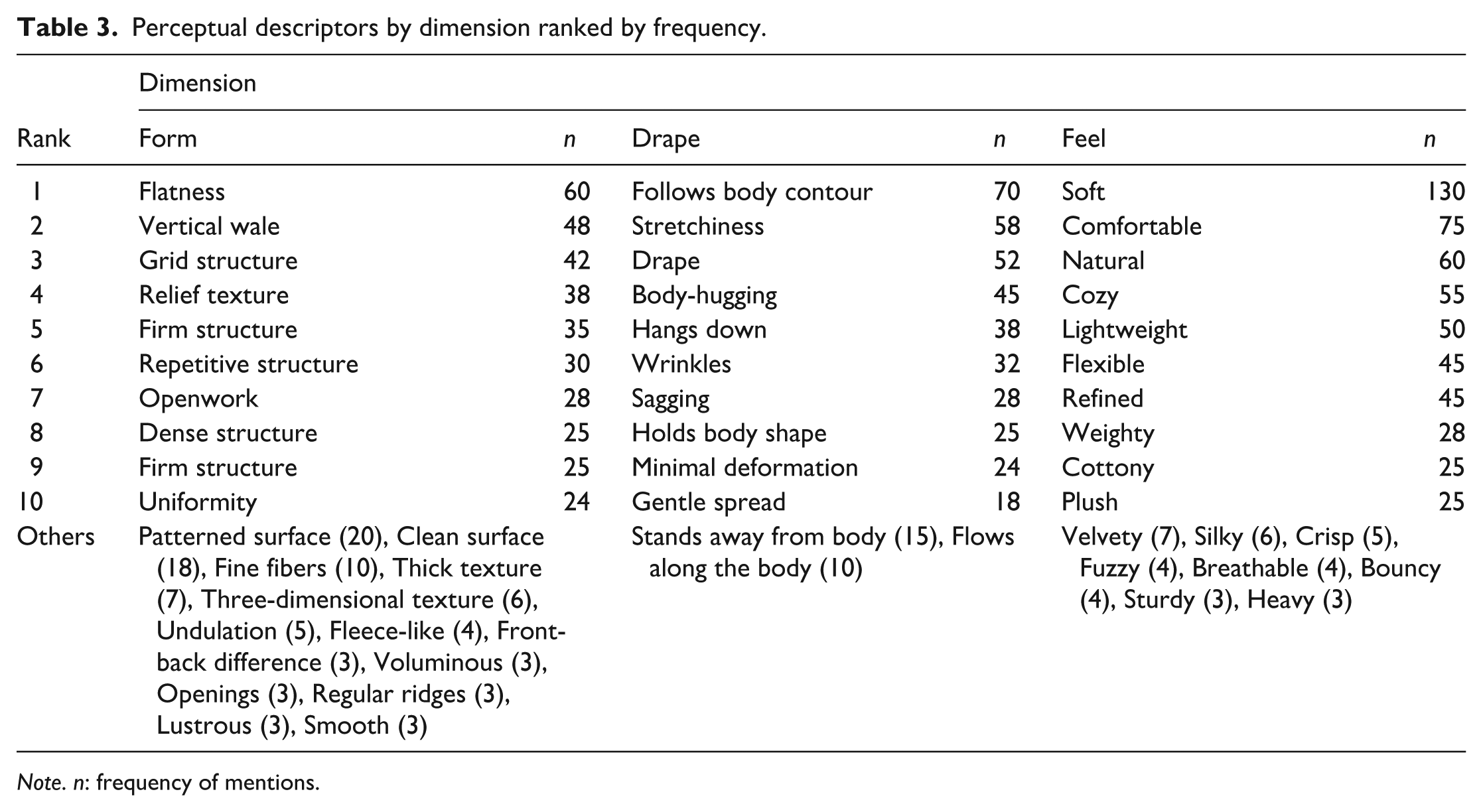
The following responses were excluded during the analysis process: (1) design elements such as color and print, (2) garment construction elements such as sewing methods and trim details, (3) descriptors related to style or esthetic impression such as “casual” or “feminine,” (4) factors external to fabric such as personal experience or brand recognition. Since this study aims to identify visual perceptual cues of circular knit structures, it focused on characteristics directly observable in the structures themselves. For example, descriptors such as “feminine” were excluded as they represent esthetic impressions formed by external factors (e.g. item type, color) rather than fabric structure or feel. Through these exclusion criteria, the study sought to clearly separate visual cues unique to knit structures. Table 3 shows the top 10 most frequently mentioned descriptors and their frequencies for each of the three perceptual dimensions.
Perceptual descriptors by dimension ranked by frequency.
Note. n: frequency of mentions.
The descriptors showing the highest frequency in the Form dimension were “flatness (n = 60),” “vertical wale (n = 48),” and “grid structure (n = 42),” indicating that participants used structural repetitive patterns as primary visual cues when identifying circular knits. This dimension included both structural patterns and surface characteristics. The former encompassed descriptors such as ribs, grids, and openwork, while the latter included flatness, relief texture, tight/dense surfaces, and luster. Additionally, low-frequency descriptors unique to specific structures were observed, such as “patterned surface (n = 20),” “three-dimensional texture (n = 6),” and “fleece-like structure (n = 4).”
The descriptor showing the highest frequency in the Drape dimension was “follows body contour (n = 70),” followed by “stretchiness (n = 58),” “drape (n = 52),” and “body-hugging (n = 45).” This means that the characteristic of knit fabric adhering to or stretching along body curves in on-body states was perceived as the most prominent visual cue. Descriptors in this dimension were divided into two main aspects. The first is descriptors related to body fit and stretch, including “follows body contour,” “body-hugging,” “stretchiness,” and “holds body shape,” and the second is descriptors related to flow according to gravity, including “drape,” “hangs down,” “soft draping,” and “wrinkles.” This shows that the wearing behavior of knit fabric is perceived through two visual cues: the degree of adherence to the body and the degree of naturally flowing downward. Descriptors related to shape retention, “holds body shape (n = 25)” and “minimal deformation (n = 24),” showed relatively low frequency, but these were mainly mentioned for knits with high structural density and low drape, such as ponte and interlock. This contrast suggests that two opposing wearing characteristics according to knit structure—the characteristic of stretching well and adhering along body curves (e.g. jersey, rib) and the characteristic of maintaining shape and deforming less (e.g. ponte, interlock)—are visually clearly distinguished.
Differences according to garment items were also observed. In top items, descriptors related to body fit and stretch such as “follows body contour,” “stretchiness,” and “body-hugging” were frequently mentioned, while in bottom items (pants, skirts), descriptors related to gravity flow such as “drape,” “hangs down,” and “wrinkles” appeared relatively more often. In dress items, body fit characteristics in the torso area and gravity flow characteristics in the skirt area were observed simultaneously, showing that the two aspects appeared in combination within a single garment. In outer items (cardigans, jackets), shape retention descriptors such as “holds body shape” and “minimal deformation” were mentioned more frequently than in other items, which is interpreted as being due to the functional characteristics of outer garments requiring structural feel and silhouette maintenance. This suggests that the drape characteristics that participants focus on can vary according to the wearing area and purpose of the garment.
In the Feel dimension, “soft (n = 130)” showed an overwhelmingly high frequency, which is almost twice that of the second-ranked “comfortable (n = 75).” This indicates that tactile characteristics are strongly inferred from visual information alone, and that softness in particular is a core tactile cue for knit fabric perception. Descriptors in this dimension can be divided into three subcategories. First, descriptors related to tactile inference such as “soft,” “cottony (n = 25),” “plush (n = 25),” and “velvety (n = 7)” represent the surface feel of fabric. Second, descriptors related to temperature feel and weight feel such as “cozy (n = 55)” and “lightweight (n = 50)” infer physical characteristics. Third, descriptors related to emotional impression such as “comfortable,” “natural (n = 60),” and “refined (n = 45)” represent overall wearing feel and quality feel.
Interestingly, “weighty (n = 28)” represents a firm and heavy feel contrasting with “soft,” and low-frequency descriptors such as “silky (n = 6)” and “crisp (n = 5)” reflected tactile impressions unique to specific knit structures. This shows that tactile perception of knit fabric is not limited only to softness but includes a diverse tactile spectrum.
The results of Experiment 1 empirically show that visual recognition of circular knit structures is integrally composed of three perceptual dimensions—structural and surface characteristics (Form), wearing behavior (Drape), and tactile inference (Feel). Comparing the frequency distribution among the three dimensions, “soft (n = 130)” in the Feel dimension showed the highest frequency among all descriptors, followed by “follows body contour (n = 70)” in the Drape dimension, and “flatness (n = 60)” in the Form dimension ranked third. This suggests that participants use not only the unique structural characteristics of fabric but also the behavior that appears during wearing and tactile expectations as important judgment grounds when evaluating knits. It particularly emphasizes that tactile inference plays a very prominent role in visual perception of knit fabric.
The frequency distribution of descriptors within each dimension also differed. The Form dimension showed a relatively distributed frequency range of 24–60 for the top 10 descriptors, showing that various structural and surface cues were used evenly. On the other hand, the Feel dimension showed “soft (n = 130)” and “comfortable (n = 75)” overwhelmingly higher than other descriptors, indicating that softness and comfort are dominant impressions in tactile perception. The Drape dimension showed a moderate level of dispersion, with descriptors related to body fit (follows body contour, stretchiness, body-hugging) concentrated in the top ranks.
The descriptors derived from Experiment 1 became the basis for composing adjective pairs for the Semantic Differential Scale used in Experiment 2. The criteria for selecting the semantic differential scale were as follows: (1) descriptors with high frequency were preferentially selected, (2) descriptors that could represent each dimension were included, (3) contrast pairs that could form bipolarity were constructed, (4) descriptors commonly mentioned in two or more knit structures were selected, and (5) items expected to have high discriminatory power among knit structures were selected. Specifically, 10 adjective pairs from the Form dimension (e.g. flat–relief, tight–loose, dense–sparse), 7 from the Drape dimension (e.g. follows body contour–stands away from body, stretchy–rigid, drapes well–does not drape), and 6 from the Feel dimension (e.g. soft–firm, lightweight–weighty, cozy–crisp) were extracted to construct a total of 23 pairs of evaluation items. This was used as a tool to quantitatively measure the perceptual structure of knit structures based on participants’ actual verbal expressions, and each adjective pair was selected by comprehensively considering the frequency, representativeness, generality, and capacity to distinguish among structures observed in Experiment 1.
Experiment 2
Multidimensional Scaling (MDS)
In Experiment 2, Multidimensional Scaling (MDS) was conducted to quantitatively analyze visual similarity among 12 types of circular knit structures based on the adjectives derived from Experiment 1. This analysis was performed based on a data matrix (structure × adjective) with evaluation values averaged at the fabric structure level rather than at the individual stimulus image level, and Euclidean distance between structures was calculated by treating each structure as a 23-dimensional vector. MDS analysis was performed using the 12 × 12 dissimilarity matrix generated in this way as input.
Model fit review results showed a Stress value of 0.08 and RSQ of 0.95, confirming that the MDS model of this study has an excellent fit. These robust fit indices suggest that the perceptual structure was consistently captured, providing a statistically stable basis for analysis even with a focused group of 20 experts. Dimension 1 and Dimension 2 explained 25% and 17% of the total variance, respectively, capturing a total of 42% of perceptual variance. Additionally, the Stress plot showed an “elbow” form where the curve stabilizes in two dimensions, reconfirming that the two-dimensional solution is optimal in both statistical and interpretive aspects. This means that the two perceptual dimensions presented in this study are sufficient to explain participants’ visual perception.
As a result of MDS, Dimension 1 (variance explained: 25%) was interpreted as an axis distinguished by what visual information operates as the dominant cue when perceiving structures. On the left side were positioned structures where “structure is seen first” with repeated vertical ribs or grid-like structures, such as baby rib, variegated rib, and waffle. On the other hand, on the right side were distributed structures where “the textural and atmospheric impression formed by the entire structure is perceived first” rather than detailed loop patterns, such as velour, sherpa, pointelle, and knit jacquard. That is, Dimension 1 reflects the difference in whether visual perception “starts from structural repetitive patterns” or “starts from overall texture impression.” This does not mean a sequential process of visual perception, but rather what visual information operates as the dominant cue when participants perceive structures.
Dimension 2 (variance explained: 17%) was interpreted as an axis reflecting the visual soft–distinctness. At the bottom of the axis were positioned structures providing soft and cozy visual impressions, such as velour and sherpa, and at the top were distributed structures that evoke visually clear and ornamental impressions with distinct openwork, motifs, and pattern contrasts, such as pointelle, pique, and knit jacquard. Meanwhile, rib, waffle, and variegated rib were positioned near the bottom, showing characteristics of providing soft visual impressions while maintaining structural feel, and single jersey, interlock, and ponte were positioned in the center of Dimension 2, showing neutral visual impressions balancing softness and distinctness. This neutrality suggests that these structures are recognized as basic knits that can be universally utilized in various garment items.
Summarizing the cluster patterns based on quadrant distribution is as follows. In the upper left quadrant, pique, French terry, and interlock were positioned, forming a “uniform and orderly texture group” with relatively uniform surfaces yet with weak texture. In the upper right quadrant, pointelle and knit jacquard constituted the “clear and ornamental texture” category, and in the lower left quadrant, baby rib, variegated rib, and waffle formed a “linear and grid structure group” where repeated linear structures become the center of perception. In the lower right quadrant, velour and sherpa corresponded to the “soft and cozy texture group.” Additionally, single jersey and ponte were distributed densely near interlock, suggesting that they were perceived similarly in that neither the repetitive pattern nor surface texture of the structures is strongly dominant, forming a moderate visual impression.
In summary, the MDS results empirically show that visual recognition of circular knit structures is composed not of a single element but of two perceptual dimensions—“whether the starting point of recognition is structural cues or overall texture impression (Dimension 1)” and “the degree of softness–distinctness (Dimension 2).” In other words, the process of recognizing knit structures in garment images is a process in which texture-based visual information that evokes tactile and emotional impressions operates integrally, as well as structural visual cues such as repetitive patterns and directionality (Figure 5).

Two-dimensional MDS perceptual map of 12 circular knit structures. Proximity between points indicates perceptual similarity. Dimension 1 (25%): structure-oriented versus texture-oriented perception; Dimension 2 (17%): softness versus distinctness. Inset shows stress plot confirming excellent model fit (stress = 0.08).
Hierarchical cluster analysis (HCA)
To more structurally verify the visual relationships among knit structures confirmed in the MDS results, Hierarchical Cluster Analysis (HCA) was conducted based on the dissimilarity matrix derived from MDS (Figure 6). The analysis used Ward’s method and Euclidean distance. 37

Hierarchical Cluster Analysis (HCA) of the 12 circular knit structures based on the perceptual dissimilarity matrix. Four perceptual clusters emerged, corresponding to the four MDS quadrants: flat-dense surface (Cluster 1), linear-structural (Cluster 2), patterned-ornamental (Cluster 3), and soft-cozy (Cluster 4). Lower linkage heights indicate greater perceptual similarity.
As a result of HCA, the 12 types of circular knit structures were classified into four major clusters according to perceptual similarity. Dendrogram analysis results showed that the four clusters were most clearly distinguished at a cutting height of approximately 55–85, and the interior of each cluster showed a very dense (linkage height 0–40) homogeneous structure. This 4-cluster structure corresponded with the four perceptual quadrants identified in MDS. The vertical axis of the dendrogram represents perceptual distance between structures, and lower linkage heights indicate that the structures were recognized as more visually similar.
Cluster 1 included French terry, Single jersey, Interlock, Ponte, and Pique. These were grouped as structures where smooth and uniform surface characteristics operate as the starting point of perception and form an overall flat and stable appearance impression. French terry, Single jersey, Interlock, and Ponte were densely clustered at very low linkage heights (0–40), and Pique joined them at a slightly higher linkage height (approximately 60). This suggests that Pique shares smooth-uniform characteristics while having subtle differences due to its honeycomb structural pattern. This cluster corresponds to the upper left quadrant of MDS (flat-dense surface quadrant) and was recognized as forming the most basic and similar visual category for participants.
Cluster 2 consisted of Variegated rib, Baby rib, and Waffle. These were perceived as having strong visual cues of directionality and regularity in repetitive structures (vertical wale, grids, honeycomb structures, etc.). This cluster had low internal linkage heights (0–30) in the dendrogram with a densely gathered interior, corresponding to the lower left quadrant of MDS (Linear-structural quadrant), meaning that participants used linear repetitive structure as a very firm and consistent classification basis.
Cluster 3 included Pointelle and Knit jacquard. These are characterized by visual clarity and distinctness due to openwork, pattern motifs, and ornamental elements. The two structures were densely clustered at a low linkage height (approximately 30), showing that clear pattern structure acts as a powerful perceptual cue. This cluster corresponds to the upper right quadrant of MDS (patterned-ornamental quadrant) and shared motif-related characteristics.
Cluster 4 consisted of Velour and Sherpa. These are structures where soft and cozy texture impressions due to brushed feel and volume are perceived dominantly. The two structures were clustered at a moderate linkage height (60), sharing characteristics of tactile softness and coziness. This cluster corresponds to the lower right quadrant of MDS (soft-cozy quadrant).
In summary, HCA perfectly reconfirmed the perceptual structure identified in MDS in hierarchical classification form, and knit structures were organized into four distinct perceptual categories: (1) flat-dense category characterized by uniform and flat surfaces (Cluster 1: French terry, Single jersey, Interlock, Ponte, Pique), (2) linear-structural category with prominent repetitive linear structures (Cluster 2: Baby rib, Variegated rib, Waffle), (3) patterned-ornamental category characterized by clear patterns and decorativeness (Cluster 3: Pointelle, Knit jacquard), (4) soft-cozy category dominated by soft and cozy texture (Cluster 4: Velour, Sherpa). This 4-cluster structure corresponded with the 4-quadrant distribution of MDS, empirically confirming that the two analysis methods captured the same perceptual structure. Participants hierarchically classified knit structures based on four visual cues: surface uniformity, structural repeatability, pattern clarity, and tactile softness.
Correspondence analysis
Correspondence Analysis (CA) was conducted to confirm the associations between knit structures and descriptive adjectives (Figure 7). A contingency table composed of 23 adjectives and 12 knit structures collected in Experiment 2 was used for the analysis, and two dimensions explained 73% of the total variance (Dimension 1: 48%, Dimension 2: 25%). This means that the two dimensions efficiently reflect the major perceptual variance among knit structures.

Correspondence analysis (CA) biplot of 12 circular knit structures and 23 perceptual adjectives. Dimension 1 (48%): structure-oriented versus texture-oriented; Dimension 2 (25%): softness versus distinctness. Four quadrants correspond to MDS/HCA clusters.
Dimension 1 (48%) was interpreted as the structure-oriented versus texture-oriented axis, reflecting the same perceptual dimension as Dimension 1 of MDS. On the left side of the axis were positioned adjectives such as firm structure, dense structure, tight structure, flat, and body hugging, corresponding to F/terry, Interlock, Ponte, and Single jersey. These are structures with uniform surfaces and structurally stable appearances, corresponding to the “flat-dense” category where structural characteristics become the starting point of visual perception. Meanwhile, on the right side of the axis were positioned velvety, substantial, cozy, fuzzy, plush, heavy (lower right) and uniformity, openwork, relief texture, patterned surface, repetitive structure (upper right), corresponding to Velour, Sherpa (bottom) and Pointelle, Knit jacquard (top). These structures share “texture-oriented” characteristics where overall texture impression or visual clarity of patterns is perceived first rather than structural details.
Dimension 2 (25%) was interpreted as the softness versus distinctness axis, reflecting the same perceptual dimension as Dimension 2 of MDS. At the bottom of the plot were positioned soft, stretchiness, follows body contour, hangs down, drape, lightweight, corresponding to Baby rib, Variegated rib, Waffle (lower left) and Velour, Sherpa (lower right). Lower left structures are characterized by flexible and body-following drape characteristics, while lower right structures are characterized by soft and cozy texture impressions. On the other hand, at the top were positioned uniformity, openwork, relief texture, patterned surface (upper right) and firm structure, dense structure, body hugging (upper left), corresponding to Pointelle, Knit jacquard (upper right) and Pique, Ponte, Interlock (upper left). Upper right structures clearly reveal patterns and motifs, while upper left structures provide a uniform yet dense stable impression.
Summarizing the quadrant distribution, CA results reconfirmed the four perceptual categories identified in MDS and HCA at the adjective level. In the upper left quadrant were positioned French terry, Ponte, Interlock, Single jersey, and Pique, which were closely associated with adjectives such as firm structure, dense structure, tight structure, flat, body hugging, and holds body shape. This quadrant formed visual impressions of the “flat-dense” category with uniform surfaces, density, and stable body wrapping. In the upper right quadrant were positioned Pointelle and Knit jacquard, associated with adjectives such as uniformity, openwork, relief texture, patterned surface, and repetitive structure. This quadrant showed visual impressions of the “patterned-ornamental” category where patterns and motifs are clearly revealed. In the lower left quadrant were positioned Baby rib, Variegated rib, and Waffle, associated with adjectives such as soft, vertical wale, stretchiness, follows body contour, drape, hangs down, and grid structure. This quadrant reflected visual impressions of the “linear-structural” category that is flexible, follows the body, and has repeating linear structures. In the lower right quadrant were positioned Velour and Sherpa, strongly associated with adjectives such as velvety, substantial, cozy, fuzzy, plush, and heavy. This quadrant formed texture impressions of the “soft-cozy” category that is soft, cozy, and voluminous.
In summary, correspondence analysis results reconfirmed the two perceptual dimensions derived from MDS—structure-oriented versus texture-oriented (48%) and softness–distinctness (25%)—and the four quadrants of the biplot corresponded with the four perceptual categories of MDS and HCA. Correspondence analysis identified which adjectives are associated with each perceptual category, linguistically supporting the MDS/HCA results.
Conclusion
This study was conducted with the purpose of identifying how knit fabrics are visually perceived and distinguished through on-body garment images in online environments, and what linguistic cues form the basis of that perceptual process. To this end, free-response evaluation (Experiment 1) and quantitative evaluation (Experiment 2) were conducted with expert participants, and perceptual relationships among knit structures were analyzed using multidimensional scaling (MDS), hierarchical cluster analysis (HCA), and correspondence analysis (CA). As a result, participants distinguished knits and wovens with very high accuracy (98.7%) even though they judged fiber structures based only on online garment images, and also discriminated detailed structures within knits at a considerable level (93.8%). However, since this high accuracy is a result attributable to the characteristics of expert participants, it is necessary to confirm whether similar perceptual tendencies are maintained in non-expert consumer groups.
Experiment 1 confirmed that visual and tactile cues used in knit fabric perception can be systematized into three perceptual dimensions: form, drape, and feel. Participants mentioned not only structural indicators such as “vertical wale,” “rib,” and “grid structure,” but also wearing-based cues such as “follows body contour” and “drape,” and tactile and emotional impressions such as “soft” and “cozy.” Therefore, it was confirmed that knit fabric perception is not limited to simple surface information but is a complex cognitive process in which characteristics that appear during wearing, shape changes according to gravity, and tactile and emotional cues inferred visually operate integrally.
Experiment 2 confirmed that the three analysis methods of MDS, HCA, and CA captured consistent perceptual structure. The 12 knit structures were classified into four perceptual categories: (1) flat-dense surface category characterized by uniform and stable surfaces (F/terry, single jersey, interlock, ponte, pique), (2) linear-structural category with prominent repetitive linear structures (baby rib, variegated rib, waffle), (3) patterned-ornamental category characterized by clear patterns and decorativeness (pointelle, knit jacquard), (4) soft-cozy category dominated by soft and cozy texture (velour, sherpa). Additionally, the same two perceptual dimensions were derived from MDS and CA: Dimension 1 represented the structure-oriented versus texture-oriented axis (MDS: 25%, CA: 48%), and Dimension 2 reflected the softness versus distinctness axis (MDS: 17%, CA: 25%). HCA reconfirmed this perceptual structure in hierarchical classification form, and CA identified which adjectives are associated with each category, specifying the linguistic characteristics of perceptual categories.
This study has the following significance in academic and practical aspects. First, while existing textile research was swatch-centered based on physical properties, this study reflected the fashion context mainly encountered by designers, merchandisers, and consumers by using actual on-body garment images as stimuli. Second, it systematically collected and refined descriptors used in knit perception and proposed a set of core adjectives that can be used for knit perception evaluation in online environments. Third, the knit structure perceptual structure constructed in this study can be used as an objective judgment basis for market intelligence processes, including online market research, alternative material exploration, product planning, and supplier selection, as well as for textile structure recognition educational materials, digital merchandising, and dataset construction for AI-based textile and garment recognition models.
Nevertheless, this study has several limitations for follow-up research. First, stimuli were limited to 12 types of circular knits and did not include other textile structures. Future research needs to verify the generalization of perceptual structure by including modified knit structures, blended yarn-based structures, and special knits. Second, since stimuli were limited to 2D static online images, there is a possibility that surface detail information may be over- or under-represented depending on shooting conditions, styling, lighting, etc., and in situations where physical touch is excluded, sensory properties such as elasticity, weight, and softness can only be inferred visually. Therefore, in the future, it is necessary to verify whether online–offline perceptual differences exist through comparison of images and actual samples of the same garment. Third is the absence of precise physical data, such as specific yarn counts or fiber compositions, for the images sourced from digital environments. Consequently, the independent effects of these yarn-level variables on the three perceptual dimensions could not be isolated. However, this methodological approach was intentionally adopted to prioritize ecological validity, reflecting the real-world professional context where fashion practitioners must interpret textile properties based solely on visual information. Future research utilizing swatches produced under strictly controlled conditions could further refine the current model by verifying the influence of individual physical variables. Fourth, while the MDS model yielded a high explanatory power with a Stress value of 0.08 and RSQ of 0.95, the current sample size and the focus on an expert group may limit the broad statistical generalizability of the findings. Future research should investigate whether these expert-defined perceptual structures are consistently maintained among a larger and more diverse consumer population. Finally, while this study provides a quantitative analysis based on expert subjective assessments, integrating objective computational methods—such as image-based feature extraction or computer vision algorithms—could further refine the characterization of knit fabrics. Objective methods can provide precise metrics on surface irregularities or pattern density that complement human sensory evaluation. Establishing the correlation between these objective computational values and subjective perceptual dimensions remains a vital task for future research. The adjective scales and perceptual categories identified in this study can serve as a reference framework for developing automated textile recognition systems that more closely align with actual human professional judgment.
In summary, this study empirically identified how knit fabrics are perceived and distinguished in the actual fashion context of on-body garment images in online environments. The four perceptual categories, two perceptual dimensions, and adjective set derived from this study can be extended as a foundation for digital fashion planning, online product information strategy, fabric structure recognition education, and AI-based textile recognition system development. Furthermore, the expansion and advancement of knit perception research is expected through future exploration including more diverse textile structures and user groups.
Footnotes
Acknowledgements
This research was supported by Basic Science Research Program through the National Research Foundation of Korea (NRF) funded by the Ministry of Education (RS-2023-00245538).

Ethical considerations
This research was conducted under the approval and supervision of the Seoul National University Institutional Review Board (IRB Approval No: 2507/004-01).
Consent to participate
Informed consent to participate was obtained from all participants prior to the study.
Consent for publication
All research participants were informed about the publication of their personal data (including individual details and images) and provided written informed consent for publication.
Funding
The authors received no financial support for the research, authorship, and/or publication of this article.
Declaration of conflicting interests
The authors declared no potential conflicts of interest with respect to the research, authorship, and/or publication of this article.