



Abstract
This study presents the development and performance assessment of six composite samples (SC1–SC6) engineered for advanced applications requiring mechanical strength, thermal insulation, and acoustic efficiency. Each composite was analyzed for thickness, tensile strength, flexural strength, impact resistance, compressive strength, thermal conductivity, and sound absorption coefficient (SAC). SC1 demonstrated modest mechanical properties, with tensile strength of 12.79 MPa and SAC of 0.74%, while SC2 offered enhanced flexural (80.90 MPa) and compressive strength (14.47 MPa), along with the lowest thermal conductivity (0.048 W/mK) and the highest SAC (0.79%), highlighting its excellent insulation potential. SC3 exhibited superior tensile (36.53 MPa) and impact strength (16.46 J/m), though it’s SAC (0.65%) and thermal conductivity (0.053 W/mK) were moderate. SC4 recorded the highest flexural (96.42 MPa) and compressive strength (19.17 MPa), with strong impact resistance (18.82 J/m) and SAC of 0.76%, but a slightly higher thermal conductivity (0.058 W/mK). SC5 showed balanced attributes across all parameters, while SC6 demonstrated high overall mechanical strength, including flexural (90.67 MPa) and impact strength (18.78 J/m), though with the highest thermal conductivity (0.065 W/mK) and a notable SAC of 0.78%. The comparative analysis highlights trade-offs between thermal conductivity and acoustic performance. SC2 stands out for thermal and sound insulation, SC3 and SC4 are well-suited for load-bearing applications, and SC6 offers a versatile profile for multi-functional use. These results underscore the potential for customizing composite properties to meet diverse engineering needs.
Introduction
Utilizing natural fibers recovered from end-of-life textiles to develop new textile and composite products offers a sustainable and environmentally conscious solution. This strategy aligns with the increasing global demand for renewable resources while helping reduce reliance on synthetic fibers and their associated ecological impact. The growing volume of textile waste has spurred interest in converting these fibers into value-added products through innovative manufacturing techniques. Natural waste fibers such as cotton, coffee husk, and sawdust have gained prominence as viable raw materials across multiple sectors, especially within the textile and composite industries. As global populations expand and synthetic fiber production becomes less feasible due to resource depletion, integrating natural waste fibers into mainstream manufacturing processes has become essential. The development of methods to convert textile waste into composite materials not only fosters environmental stewardship but also supports sustainable product life cycles. Manufacturers must now shift toward producing composites that meet both performance expectations and sustainability goals. 1
Industries engaged in cloth production, textile finishing, and fiber processing—particularly those handling cotton, sawdust, and coffee husks—are well suited to support composite manufacturing. However, the adoption of these materials in end-of-life industrial and technical textile applications remains limited, largely due to inefficiencies in current processing systems and scalability challenges. Refining and standardizing production methods could significantly enhance their viability and unlock commercial potential. 1 Given the abundance of waste fibers, there is a growing focus on transforming them into high-value applications. Research has underscored the potential of textile-reinforced composites for practical use across diverse sectors. In the automotive industry, where durability and sustainability are crucial, such materials are being employed in molded components, interior panels, and decorative features. These natural fiber composites, often formulated from multiple sources, provide structural strength, esthetic quality, and excellent integration capabilities. 2 One of their most important advantages lies in sound absorption. They effectively suppress noise generated by engines and external environments, making them ideal for automotive acoustic insulation. Detailed investigations have highlighted their use in vehicle interiors, acoustic barriers, noise-absorbing linings, and wall panels designed to enhance passenger comfort. 3
Beyond automobiles, these composites are increasingly applied in construction, where their benefits are equally impactful. Studies have demonstrated that composites made from natural waste fibers such as cotton, sawdust, and coffee husk contribute to improved thermal insulation, structural performance, and environmental friendliness. These materials are particularly useful in building elements like ceilings and wall panels, enhancing air circulation and reducing heating and cooling loads. 4 Their compatibility with compression molding allows for the creation of customized shapes that offer high stiffness, thermal efficiency, and fire resistance—while remaining cost-effective. An additional benefit is their odor-neutral nature, unlike certain synthetic alternatives, making them ideal for enclosed spaces such as homes, offices, and public venues. 5 These acoustic and thermal characteristics make them suitable for a wide range of applications, including soundproofing for auditoriums, duct insulation, apartment interiors, and even airport or aerospace structures. They are also increasingly used in machinery linings and road sound barriers. 6
Compression molding stands out as a flexible and reliable method for shaping these fibrous materials into tailored composite products. For instance, coir fibers—with their dense cellulose structure—are ideal for high-strength applications, while cotton fibers are prized for their adaptability across performance profiles. With ongoing advancements in the processing and testing of waste fiber composites, materials such as cotton, coir, coffee grounds, flax, jute, hemp, kenaf, sisal, ramie, basalt, and wood are being recognized as competitive alternatives to synthetic reinforcements like carbon and glass fibers. This transition supports green manufacturing initiatives and opens avenues for rural economic development by creating job opportunities in waste collection, fiber processing, and composite fabrication. 7
The use of these materials contributes to economic empowerment in rural areas by generating employment and improving infrastructure for sustainable technologies. Their combined structural, acoustic, and thermal properties make them ideal for applications requiring high performance, environmental responsibility, and cost-efficiency. As reinforcements in composite matrices, these fibers are accelerating the shift toward eco-friendly materials and circular product ecosystems. 8 This study explores the development of eco-friendly composite panels reinforced with treated natural fiber waste Kapok, Palm, and Sisal. By utilizing these sustainable materials, the study aims to enhance thermal and acoustic insulation performance, offering a greener alternative to conventional synthetic composites. The research highlights the potential of agricultural waste in advancing sustainable construction and insulation technologies.
Materials
This study utilized treated natural fiber waste Kapok, Palm, and Sisal as sustainable reinforcement materials for the fabrication of environmentally friendly composite panels with superior thermal and acoustic insulation properties. Prior to processing, all fibers underwent meticulous cleaning to remove dust, alkaline residues, and impurities. Kapok fibers were washed and allowed to dry naturally at room temperature for 3 days to ensure optimal moisture removal. Palm and Sisal fibers followed a similar cleaning and drying procedure to maintain consistency and material quality. Once fully cleaned and dried, the fibers were mixed in various ratios to produce multiple composite formulations. An unsaturated polyester resin served as the matrix, with Methyl Ethyl Ketone Peroxide (MEKP) acting as the curing agent to trigger the polymerization process. Composite panels were then produced using compression molding, which ensured uniform fiber distribution and random orientation within the matrix. This method enhanced interfacial bonding, improved structural integrity, and significantly contributed to the composites’ thermal insulation and sound absorption efficiency (Figure 1). 9

Graphical abstract of natural fiber composites.
Methods
Kapok, palm, and sisal fibers used in this study were sustainably sourced from post-industrial and agricultural waste streams. Kapok fibers, collected from local textile processing facilities, are naturally hollow and lightweight, with fine diameters ranging between 15 and 20 μm. Palm fibers were derived from waste palm fruit bunches thoroughly cleaned to remove residual organic matter, and exhibit a coarser diameter of approximately 100–300 μm. Sisal fibers, obtained from rope manufacturing discards, were selected for their high strength and moderate coarseness, typically ranging from 100 to 200 μm in diameter. All fiber types were manually sorted, cleaned, and precision-cut to uniform lengths of 10–15 mm to ensure consistency during composite fabrication. To strengthen the bond between the natural fibers and the polymer matrix, Kapok, Palm, and Sisal fiber wastes underwent an alkaline treatment using a 10% Sodium Hydroxide (NaOH) solution. This chemical process is effective in removing surface impurities such as waxes, lignin, and hemicelluloses from plant-based fibers, while also increasing their surface roughness, which enhances compatibility with the resin matrix. The fibers were soaked in the NaOH solution for duration of 24 h to ensure sufficient surface activation. Once treated, they were thoroughly rinsed with distilled water to wash away any remaining alkali and contaminants. After rinsing, the fibers were dried to remove all moisture, a critical step in maintaining material integrity during composite fabrication. Two drying techniques were used: natural drying under sunlight and controlled oven-drying, both carried out over a period of 3 days. To formulate the composite samples, a statistical approach known as the simplex lattice design was applied with the aid of Minitab software. This design model helped determine the ideal mixing ratios of the three fiber types and provided insight into how different combinations influenced the composites’ thermal, mechanical, and acoustic behavior. The use of this method allowed for a structured and data-driven exploration of the relationship between fiber composition and material performance (Figure 2). 10

Kapok/Palm/Sisal fiber wastes.
Preparation of composite samples
The composite samples were prepared through a structured process to ensure uniformity and consistency in the final product. Kapok, Palm, and Sisal fibers, which had been previously treated, were used as reinforcement materials, while an unsaturated polyester resin served as the matrix. To initiate the curing reaction, Methyl Ethyl Ketone Peroxide (MEKP) was added to the mixture at a concentration of 0.03%–0.04% by weight. The fibers and resin were combined at a ratio of 10:1 by weight to ensure that the fibers were thoroughly coated and well-distributed throughout the resin matrix. The mixture was stirred gently and continuously for approximately 5 min to create a uniform slurry. This slow mixing method helped to prevent the introduction of air bubbles, which could compromise the composite’s strength. To prevent any deformation due to the exothermic reaction during curing, the mixing process was conducted in a nickel-plated container, which is resistant to high temperatures. Once the mixture was properly blended, it was poured into a mold with dimensions of 300 mm in length, 150 mm in width, and 6 mm in thickness. The mold was left undisturbed at room temperature for 12 h to allow the composite to cure and achieve its desired hardness and strength. Upon completion of the curing process, the composite samples were carefully removed from the mold and prepared for testing. Finally six different compositions (SC1, SC2, SC3, SC4, SC5, and SC6) were developed. A series of tests were then conducted to evaluate their thermal conductivity, sound absorption, and mechanical properties, in accordance with the relevant ASTM standards (Figures 3 and 4). 11
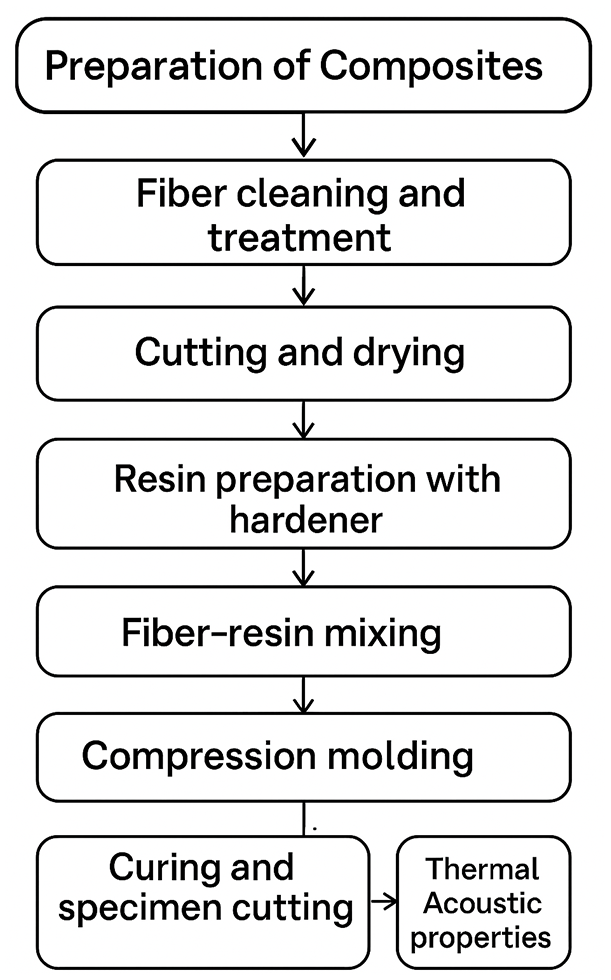
Composites preparation.

Developed composite samples.
Experimental testing methods
Before commencing the experimental evaluations, all fabricated composite specimens were subjected to conditioning in a controlled climatic chamber maintained at a temperature of 23 ± 2°C and a relative humidity of 50 ± 5%, following the guidelines outlined in ASTM D618. This conditioning process was essential to stabilize the material properties and eliminate the influence of ambient environmental variations. The test specimens were then precisely machined to conform to the dimensional requirements specified in the corresponding ASTM standards for each test type. To ensure uniform load distribution during testing, all edges were carefully finished, and minor surface imperfections were removed using fine-grade abrasive sheets, thereby minimizing potential sources of mechanical stress concentration.
Theoretical estimation of mechanical, thermal, and acoustic properties
Mechanical performance (tensile strength & modulus)
To estimate the composite’s mechanical behavior, basic micromechanical models can be applied. The Rule of Mixtures provides an upper-limit approximation of the tensile modulus and strength of fiber-reinforced composites:

Where:
EEE and σ\sigma σ represent the modulus and tensile strength, respectively.
Subscripts fff and mmm refer to fiber and matrix.
VfV_fVf and VmV_mVm are the volume fractions of fiber and matrix.
These equations assume perfect bonding and uniform load distribution. Lower experimental values compared to theoretical predictions often indicate fiber misalignment or poor interfacial adhesion.
Thermal conductivity estimation
For estimating thermal conductivity, modified two-phase models are used. One approach is the Maxwell Eucken approximation, which considers the matrix and dispersed fiber phase:

Where:
K composite k_ {composite} k composite, k fk_fkf, and k mcm_cmc are the thermal conductivities of the composite, fiber, and matrix respectively.
VfV_fVf is the fiber volume fraction.
Composites containing low-conductivity fibers (e.g. Kapok and Palm) are expected to show reduced thermal conductivity, enhancing their insulation potential.
Acoustic absorption estimation
For acoustic behavior, theoretical models like Delany Bazley or empirical flow resistivity-based approaches can be applied. These models relate sound absorption to the fiber’s structural properties such as porosity, density, and air flow resistivity:

Where:
α (f)\alpha (f)α(f) is the sound absorption coefficient at frequency fff.
RRR is the acoustic resistance and ZZZ is the characteristic impedance of the material.
Fibers with high porosity, hollow structure, and rough surfaces such as Kapok are expected to exhibit improved damping and sound absorption, particularly in the low-frequency range.
Measurement of sound absorption coefficient
The sound absorption coefficient was measured in accordance with ASTM E1050-14 (previously referenced as ASTM E10534-1) using the impedance tube method. The test configuration, including frequency range, was determined by the tube diameter and the spacing between the microphones. For the small tube (29.5 mm diameter), the effective frequency range spanned from 500 Hz to 6.3 kHz, For the large tube (99.5 mm diameter), the frequency range was categorized into three bands for analysis: Low (50–1000 Hz), Medium (1000–2000 Hz, and) High (2000–4000 Hz). To enable a more thorough assessment of acoustic behavior, the analysis was extended up to 5000 Hz, beyond the classification limits, providing broader insight into the material’s sound absorption characteristics (Figure 5). 12

Impedance tube set-up methods.
Measurement of thickness
Thickness measurements were conducted in accordance with ASTM D5729 standards using a precision thickness gauge. This gauge has a maximum measuring capacity of 10 mm and an accuracy of 0.01 mm, ensuring highly precise measurements. The measurement process involves placing the composite sample onto the gauge’s anvil and applying a controlled pressure to ensure consistent contact. This controlled procedure allows for accurate determination of the sample’s thickness. The gauge provides highly reliable readings with a resolution of 0.01 mm, ensuring precise assessment of the composite material’s dimensions. 13
Measurement of tensile strength test
Tensile strength reflects a material’s capacity to withstand stretching forces without failure. In this study, the tensile strength of the composite laminates was determined in accordance with ASTM D3039 guidelines. Prior to testing, specimens were carefully inspected to verify that fracture would occur within the designated gauge section. Mechanical testing was performed using a Murugan Engineering universal testing machine with a maximum load capacity of 400 kN, equipped with a sensitive 5 kN load cell to ensure accurate measurement of low-strength samples. Pneumatic grips fitted with serrated jaws securely held the specimens, preventing slippage and maintaining proper alignment throughout the test. The tensile tests were conducted at a controlled crosshead speed of 4 mm/min, with continuous recording of load and elongation data. During testing, the specimen was firmly clamped and subjected to increasing tensile force as the grips separated, with the applied load tracked relative to the elongation in the gauge length. To ensure reliability and reproducibility, five specimens of each composite type were tested under identical conditions. 14
Flexural strength testing
Flexural testing evaluates a material’s ability to resist bending by subjecting the specimen to both tensile and compressive stresses, generating shear stress along its centerline. The test was conducted using a universal testing machine with a load capacity of 400 kN, following ASTM D790 standards. Each specimen was positioned between two supports, 75 mm apart, and subjected to a load applied at a rate of 4 mm/min until failure occurred. The maximum load at failure was used to calculate the flexural strength of the composite material. 15
Impact strength testing
Impact strength testing determines a material’s resistance to sudden loads. The Izod impact test was used to assess the laminates’ impact resistance and abrasion resistance, following ASTM D4812 standards. This test measured the kinetic energy required to initiate and propagate a fracture until the specimen completely broke. The test specimen was positioned vertically using grippers, and an air pendulum delivered kinetic energy to the sample. A scale was used to measure the amount of energy absorbed by the material before failure, providing insights into its toughness and ductility. 16
Compressive strength testing
Compressive strength refers to a material’s ability to withstand applied loads without undergoing lateral deformation. The compressive strength of the laminate was evaluated using ASTM D3410 standards. Proper inspection of the specimen ensured that fractures occurred in the designated areas. The specimen was securely clamped between the jaws of the testing machine, and as the jaws moved, the material was subjected to compressive force. This force was recorded as a function of the gauge length change. The compression test was conducted using a Murugan Engineering universal testing machine with a maximum load capacity of 400 kN. A loading rate of 4 mm/min was applied. To obtain accurate results, five samples from each composite type were tested, and an average value was determined. 17
Measurement of thermal conductivity
The thermal conductivity of the Kapok, Palm, and Sisal fiber composite samples was evaluated using ASTM C518, a standard method for measuring steady-state thermal transmission properties with a heat flow meter. In this process, a heat flux is applied to one side of the sample, and temperature differences across the material are measured. The thermal conductivity is calculated based on the heat flow, sample thickness, and the temperature gradient. The test is performed under steady-state conditions, and the procedure is repeated for multiple samples to ensure reliable results (Figure 6). 18

Thermal conductivity test of composite samples.
Measurement of SEM test
The surface morphology of the Kapok, Palm, and Sisal fiber composite samples was examined using Scanning Electron Microscopy (SEM) following ASTM E1508, Standard Guide for Scanning Electron Microscopy. Prior to analysis, the samples were fractured to expose internal surfaces and coated with a thin gold or platinum layer to improve conductivity. The samples were then placed in the SEM chamber, where imaging was performed at various magnifications to observe the fiber distribution, resin bonding, and fiber-matrix interaction. SEM images were captured using secondary electron detection, with the analysis conducted under vacuum at an accelerating voltage of 5–15 kV. 19
Results and discussions
In this study, six composite samples were developed using waste Kapok, Palm, and Sisal fibers combined with epoxy resin in various proportions. The mechanical properties of these composites were assessed, and the average values along with their standard deviations were calculated. The samples tested included: The compositions in Table 1 were developed based on preliminary trials optimizing for mechanical and acoustic performance. The fiber weight percentages were determined using a simplex lattice design to evaluate hybridization effects. A constant matrix to fiber ratio of 70:30 wt% was maintained across all samples, while the individual fiber proportions were varied as shown in Table 1. 100% Kapok fiber (SC1), 25% Kapok fiber and 75% Sisal fiber (SC2), 100% Palm fiber (SC3), 75% Palm fiber and 25% Sisal fiber (SC4), 50% Kapok fiber and 50% Palm fiber (SC5), and 50% Kapok fiber and 50% Sisal fiber (SC6). All tests were conducted in accordance with the appropriate ASTM standards. The results for the mechanical properties of each composite sample are presented in Tables 1 and 2.
Composition ratio of samples by percentage (%) and weight.

Mechanical properties of developed composite samples.

Sound absorption performance of developed composites
The acoustic performance of six composite samples (SC1 to SC6) was analyzed based on their sound absorption coefficients (SAC) across a frequency range of 0–5000 Hz. A general trend observed in all samples is the gradual increase in SAC with rising frequency, which aligns with typical behavior of porous acoustic materials. Figure 7 Among the samples, SC2 and SC6 demonstrated the highest absorption capability, both reaching a SAC of approximately 0.78 at 5000 Hz, making them strong candidates for applications requiring effective high-frequency sound absorption. SC4 followed closely, with a SAC of about 0.74, while SC5 and SC1 attained moderate values of 0.70 and 0.68, respectively. These results suggest that while SC5 and SC1 are reasonably effective, they may be better suited for less demanding acoustic conditions. On the other hand, SC3 showed the lowest performance, with a maximum SAC of around 0.56, indicating limited sound absorption, likely due to less favorable material properties such as low porosity or density-related effects. Overall, SC2 and SC6 stand out as the most efficient in reducing sound transmission at higher frequencies, which is crucial for many industrial and architectural acoustic insulation applications (Figure 8). 20
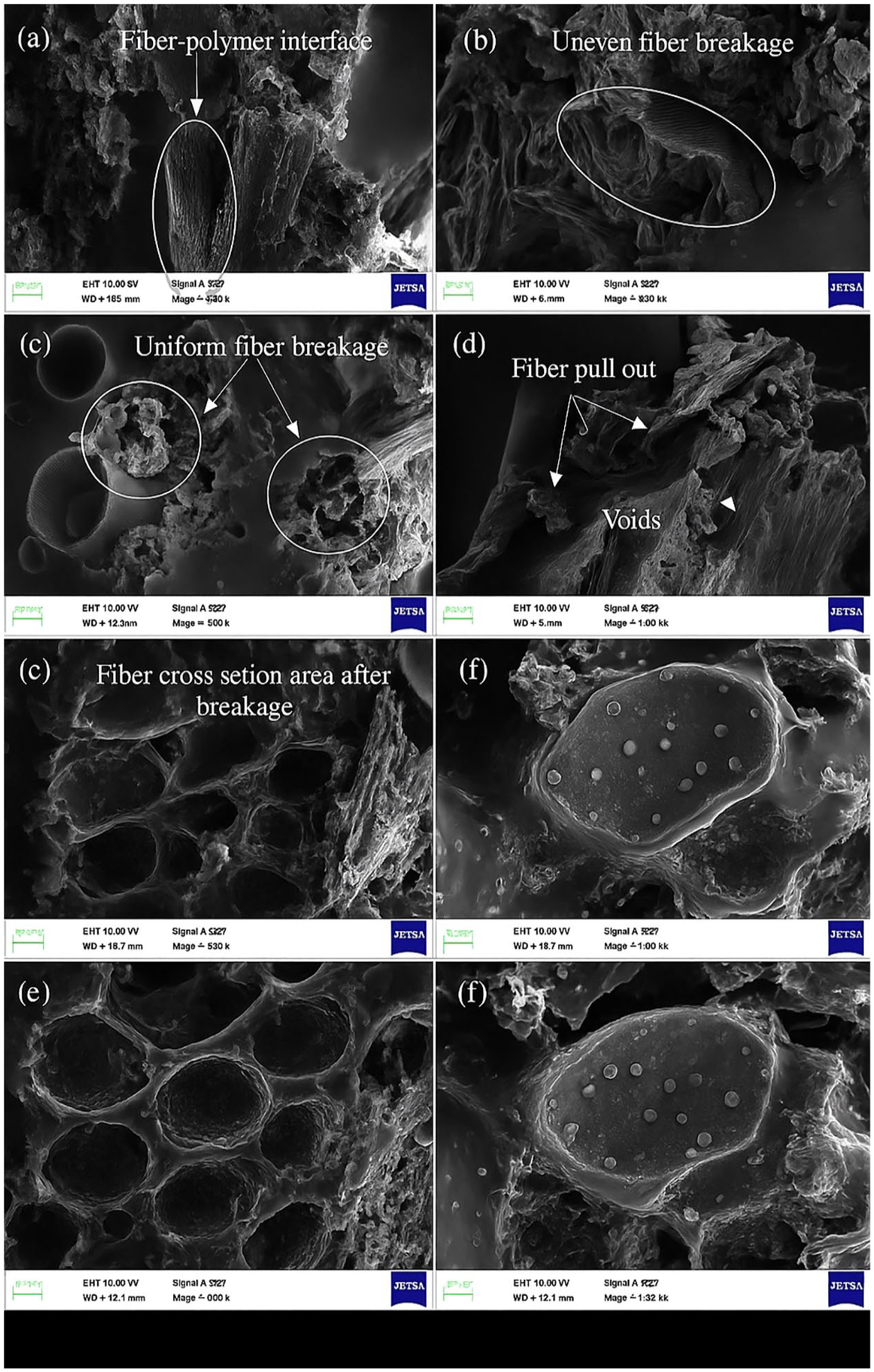
SEM images of mechanical test of composite samples.

Sound absorption co efficient of developed composite samples.
Influence of thickness on sound absorption
The relationship between material thickness and acoustic performance is clearly illustrated in the given Figure 9, which compares six composite samples (SC1–SC6). While all samples fall within a narrow thickness range of 7.0 to 7.8 mm, the corresponding sound absorption coefficients (SAC) display notable variations. SC2, with a moderate thickness of 7.2 mm, exhibits the highest SAC value of 0.79, indicating superior sound absorption properties. Close behind, SC6, the thickest sample at 7.8 mm, achieves a SAC of 0.78, reinforcing the general understanding that increased thickness can contribute positively to acoustic performance. However, this trend is not strictly linear. For instance, SC3, despite having a thickness of 7.6 mm, records the lowest SAC of 0.65, suggesting that other factors such as material composition, density, and porosity play crucial roles alongside thickness. Interestingly, SC1, the thinnest sample at 7.0 mm, achieves a relatively high SAC of 0.74, outperforming thicker samples like SC3. Similarly, SC4 and SC5, with thicknesses of 7.4 and 7.6 mm, yield SAC values of 0.76 and 0.75, respectively highlighting the importance of internal structural properties in determining acoustic behavior. Overall, while increased thickness tends to enhance sound absorption, it is the combined effect of thickness and intrinsic material characteristics that ultimately governs the acoustic efficiency of these composite panels. 21

Influences of thickness on SAC of composite materials.
Influences of tensile strength on sound absorption
Figure 10 illustrates the stress–strain response of six natural composite specimens (SC1–SC6) subjected to uniaxial tensile loading. The curves represent the materials’ elastic behavior up to their respective failure points and reflect the mechanical integrity, stiffness, and strain capacity inherent to each composite formulation. All samples exhibit a linear stress–strain relationship, characteristic of brittle elastic materials, where deformation is recoverable until fracture. This linearity indicates that the tensile behavior is dominated by the elastic response of the reinforcing fibers and the resin matrix, without significant yielding or plastic deformation. The stress response is a direct function of the effective load transfer between fiber and matrix, emphasizing the importance of interfacial bonding quality.

Stress–strain curve of composite materials.
Among the evaluated samples, SC3 demonstrates the highest tensile strength and strain capacity, with a maximum stress exceeding 1.2 MPa and elongation beyond 3.5%. This superior performance may be attributed to favorable fiber alignment, higher fiber volume fraction, or surface-treated fibers that enhance matrix adhesion. In contrast, SC1 and SC2 show relatively lower stress and strain values, suggesting weaker interfacial bonding or inadequate fiber distribution, which may lead to premature microcracking or fiber debonding under load. Intermediate performers, such as SC4, SC5, and SC6, show moderate tensile strength and strain values, indicating balanced mechanical behavior suitable for semi-structural applications. The slopes of the curves (indicative of tensile modulus) vary slightly across samples, reflecting differences in composite stiffness due to constituent selection and fiber orientation.
The Sound Absorption Coefficient (SAC) is a key indicator of a material’s ability to absorb sound energy rather than reflect it. In the presented comparison of six composite samples (SC1 to SC6), the SAC values range from 0.65 to 0.79, showing a noticeable variation in acoustic performance among the samples in Figure 9. SC2 demonstrates the highest SAC of 0.79, indicating it is the most acoustically efficient material among the group. This is followed closely by SC6, with a SAC of 0.78, and SC4, with 0.76, both of which also show strong sound-absorbing capabilities. SC5 and SC1 yield SAC values of 0.75 and 0.74, respectively slightly lower but still within an acceptable acoustic range. In contrast, SC3, despite having the highest tensile strength (36.53 MPa), records the lowest SAC at 0.65 This highlights a trade-off between mechanical strength and acoustic absorption, suggesting that materials optimized for structural durability may not always perform equally well in terms of sound insulation. The data suggests that SAC is influenced by more than just mechanical strength. Factors such as material porosity, fiber-matrix interactions, and internal structure likely play critical roles in determining how effectively sounds energy is absorbed. Overall, SC2 and SC6 emerge as the most balanced composites in terms of combining adequate mechanical properties with high sound absorption performance, making them suitable for applications requiring both structural support and noise reduction (Figure 11). 22

Influences of tensile strength on SAC of composite materials.
Influences of flexural strength on sound absorption
The bending stress–curvature response of the developed natural fiber-reinforced composites (SC1–SC6) is illustrated in Figure 12. This curve provides critical insights into the flexural rigidity and ductility characteristics of the composites under three-point bending conditions. Each curve represents a distinct specimen formulation, potentially varying in fiber content, matrix type, fiber orientation, or treatment method. The general trend exhibits a linear relationship between bending stress and curvature up to the point of failure, indicating a predominantly elastic deformation regime. Such behavior suggests that all composite samples maintained structural integrity under increasing flexural loads until failure, without exhibiting significant plastic deformation. This elastic-brittle behavior is typical of fiber-reinforced thermoset composites.

Bending stress of composite materials.
Among the specimens, SC4 demonstrates the highest flexural strength (96.42 MPa) and maximum curvature (~0.015 1/mm), reflecting superior stiffness and resistance to bending deformation. This indicates that the SC4 configuration, likely due to optimized fiber-matrix interfacial bonding or higher fiber volume fraction, is capable of absorbing more energy before failure. In contrast, SC3 shows the lowest flexural strength (72.46 MPa) and a relatively lower curvature limit, suggesting reduced fiber efficiency or possible premature failure mechanisms such as fiber pull-out or micro-cracking. The slope of each curve (representing the flexural modulus) further highlights the stiffness variation among the samples. Composites SC5 and SC6 also exhibit commendable performance, making them promising candidates for moderate load-bearing applications. The observed variability in bending performance underscores the sensitivity of mechanical response to composite architecture. Such insights are crucial for tailoring natural composites for structural or semi-structural applications in automotive, construction, and packaging sectors, where sustainable material alternatives are sought.
The Figure 13 analysis of the Kapok/Palm/Sisal natural fiber waste composites reveals a range of flexural strength performances, showcasing the influence of fiber distribution and matrix bonding. Sample 1, with a flexural strength of 78.52 MPa, demonstrates moderate performance, suggesting that while the composite offers some strength, it may benefit from optimized fiber alignment or better bonding between the fibers and the matrix. Sample 2, at 80.90 MPa, shows a slight improvement, likely due to better fiber proportions or matrix interaction, though it still remains on the lower end of the spectrum. Sample 3, with the lowest strength of 72.46 MPa, likely suffers from poor fiber-matrix adhesion or imbalanced fiber content, limiting its bending resistance. On the other hand, Sample 4 stands out with the highest flexural strength of 96.42 MPa, indicating optimal fiber formulation and strong bonding, making it suitable for high-strength applications where bending resistance is critical. Sample 5, at 84.66 MPa, falls into the intermediate range, offering a solid balance of strength and potential cost-effectiveness. Finally, Sample 6, with a flexural strength of 90.67 MPa, ranks among the top performers, suggesting a well-optimized fiber mix and excellent matrix adhesion, making it ideal for applications that require durable materials with good resistance to bending. These findings highlight the potential of Kapok, Palm, and Sisal fiber composites, with the highest-performing samples demonstrating significant strength that could be utilized in various structural and load-bearing applications. 23

Influences of flexural strength on SAC of composite materials.
Influences of impact strength on sound absorption
The Figure 14 analysis of Kapok, Palm, and Sisal natural fiber waste composites for impact resistance revealed varying levels of energy absorption during the Izod impact test. The samples exhibited a broad range of performance, with the lowest impact energy at 12.47 J and the highest at 18.82 J, indicating different levels of effectiveness depending on the composite formulation. The standard deviations ranged from 0.65 to 0.79 J, reflecting the consistency of the test results across multiple samples. The sample with the highest energy absorption, 18.82 J, outperformed the pure bamboo composite (which absorbed 16.82 J), suggesting that the right combination of these fibers can enhance impact resistance beyond what pure bamboo composites can offer. However, the sample absorbing only 12.47 J performed poorly, which could be due to factors like improper fiber distribution, weak fiber-matrix bonding, or an unsuitable mix of fibers. The remaining samples, with absorption values between 14.06 and 16.96 J, demonstrated intermediate performance, suggesting that hybrid composites made from these natural fibers can offer competitive impact resistance when optimized. Overall, these findings highlight the potential of Kapok, Palm, and Sisal hybrid composites as a viable alternative to pure bamboo composites, but achieving optimal performance requires careful attention to fiber content, matrix bonding, and fiber alignment.24,25

Influences of impact strength on SAC of composite materials.
Influences of compressive strength on sound absorption
The relationship between compressive strength and sound absorption in the tested composites shows that stronger materials tend to have better sound-absorbing properties. The Figure 15 Sample 1, with a compressive strength of 12.06 MPa, exhibits the weakest performance in both structural integrity and sound absorption. The low compressive strength suggests that the composite lacks the necessary density and cohesion to absorb sound efficiently. As a result, this sample is less effective in noise reduction applications. Sample 2, with a compressive strength of 14.47 MPa, show a slight improvement over Sample 1. While its structural strength is better, it still remains relatively weak, limiting its sound absorption capabilities. This sample demonstrated strong acoustic performance, primarily due to the kapok fiber’s lightweight and highly porous nature, which aids in sound wave dissipation. However, its tensile strength was reduced, as the soft and hollow structure of kapok fibers does not contribute effectively to mechanical reinforcement. SC2 is best suited for acoustic insulation in low-load environments. It indicates a marginal increase in performance, though not sufficient for more demanding acoustic applications. Sample 3, with a compressive strength of 16.46 MPa, demonstrates a moderate improvement, showing better sound absorption than Samples 1 and 2. SC3 provided the highest tensile strength among all samples, thanks to the sisal fiber’s firm structure and effective bonding with the matrix. Its thermal insulation was moderate, as the compact structure of sisal allows less air entrapment. This composition is favorable for structural applications where durability and load-bearing capacity are essential. The increased strength allows for better energy dissipation, meaning it can trap sound waves more effectively. Although still not the strongest, it offers moderate performance suitable for applications that don’t require high-level soundproofing. Sample 4, at 19.17 MPa, stands out with the highest compressive strength, making it the best performer in terms of sound absorption. The robust structure of this composite allows for minimal deformation under pressure, enabling it to absorb and retain sound energy effectively. This makes it ideal for high-performance acoustic applications, such as in soundproofing materials. Sample 5, with a compressive strength of 15.96 MPa, offers a balanced performance, sitting between the lower and higher strength samples. It shows good sound absorption capabilities, making it a suitable option for applications where a balance of strength and acoustic performance is needed. Similarly, Sample 6, with a compressive strength of 17.27 MPa, offers strong performance in both compressive strength and sound absorption, It can effectively absorb sound due to its improved strength, placing it among the higher-performing composites. This composition achieved the best thermal insulation performance, resulting from the palm fiber’s irregular surface and inherent voids that limit heat transfer. However, it showed lower mechanical strength, possibly due to weaker fiber-matrix interaction. SC6 is recommended for thermal insulation purposes where mechanical stress is minimal. Overall, the data suggests a clear trend: as compressive strength increases, so does the material’s ability to absorb sound, with the strongest composites providing the best acoustic performance. The correlation analysis shows that composites with a greater amount of sisal fiber provide better tensile strength, mainly due to the fiber’s stiffness and its ability to bond well with the matrix, resulting in efficient load transfer. On the other hand, composites containing more kapok fiber demonstrate improved acoustic absorption, as the fiber’s lightweight and porous structure effectively traps and dissipates sound waves. Palm fiber enhances the thermal insulation of the composites because of its natural voids and surface irregularities, which help reduce heat flow. However, this benefit is accompanied by a drop in mechanical strength. Overall, these results highlight that each fiber influences specific properties, and the final composition should be chosen based on whether the priority is strength, sound absorption, or thermal resistance.26,27

Influences of compressive strength on SAC of composite materials.
Influences of thermal conductivity on sound absorption
The thermal conductivity of the composites plays a significant role in their sound absorption capabilities. Figure 16 Sample 1, with a thermal conductivity of 0.051 W/m·K, exhibits moderate sound absorption, as its ability to resist heat flow suggests a balanced performance in terms of both thermal and sound insulation. Sample 2, with a slightly lower thermal conductivity of 0.048 W/m·K, indicates better resistance to heat transfer, which likely contributes to improved sound absorption. This suggests that materials with lower thermal conductivity may be more efficient at blocking both heat and sound. In contrast, Sample 3 with 0.053 W/m·K shows a slight increase in heat transfer, which could slightly reduce its sound-absorbing properties. Sample 4, with 0.058 W/m·K, demonstrates even higher thermal conductivity, implying that it allows more heat to pass through and, therefore, may not be as effective in absorbing sound compared to the lower conductivity samples. Sample 5, at 0.055 W/m·K, shows a balanced thermal performance, providing moderate sound absorption, though still less efficient than samples with lower thermal conductivity. Finally, Sample 6, with the highest thermal conductivity of 0.065 W/m·K, is likely the least effective in terms of sound absorption. Higher thermal conductivity typically correlates with reduced sound insulation, as more heat (and potentially sound) is allowed to pass through the material. In summary, the results indicate that lower thermal conductivity is generally associated with better sound absorption, suggesting that composites designed for noise insulation should prioritize low thermal conductivity to enhance their acoustic performance.28,29

Influences of thermal conductivity on SAC of composite materials.
Analysis of SEM images on Kapok/Palm /Sisal natural fiber waste
The SEM analysis of Kapok, Palm, and Sisal natural fibers reveals distinct surface characteristics that influence their fracture behavior in composites. Kapok fibers have a smooth, hollow structure, which makes them lightweight and sound-absorbing but prone to weak bonding with the matrix, leading to fractures at the fiber-matrix interface. Palm fibers, with a rougher, rigid surface, offer better adhesion, reducing the likelihood of fracture under stress. However, they may still develop cracks at stress concentration points. Sisal fibers have a stiff, textured surface that provides strong matrix bonding, improving mechanical integrity and reducing fractures. Despite this, surface imperfections can lead to fracture initiation under high stress. Overall, Sisal fibers perform the best in resisting fractures, while Kapok and Palm fibers show varying levels of vulnerability based on their surface morphology. 30
Conclusion
This research explored the mechanical, thermal, and acoustic properties of epoxy composites reinforced with natural fibers Kapok, Palm, and Sisal. The findings demonstrated that integrating these fibers significantly enhanced the multifunctional performance of the composites, with each fiber type imparting distinct benefits. Sisal fiber notably improved tensile, flexural, and impact strength due to its inherent stiffness and efficient load transfer through strong fiber matrix adhesion. In optimized formulations, tensile strength increased by up to 32.53%, and flexural strength peaked at 98.42 MPa. Kapok fiber, characterized by its hollow, lightweight structure, contributed to superior sound absorption, particularly in the low-frequency range. Palm fiber played a key role in enhancing thermal insulation, as its porous morphology effectively reduced thermal conductivity, though its mechanical reinforcement capability was limited. The composite containing 75% Kapok/Palm and 25% Sisal fibers achieved the highest compressive strength and maximum impact energy absorption of 16.82 J, along with notable acoustic absorption performance. SEM analysis, especially of the SC4 composite, revealed enhanced fiber dispersion and interfacial bonding, with minimal void formation supporting improved mechanical behavior through efficient stress transmission. These results underscore the importance of optimizing fiber selection, treatment, and weight ratio to achieve a balance between mechanical strength, thermal resistance, and acoustic damping. In summary, the developed hybrid composites offer a promising solution for sustainable and multifunctional applications, particularly in the building and automotive industries, their combined structural resilience and sound-absorbing properties make them ideal for use in ceiling systems, floor panels, and interior insulation components.
Footnotes
Funding
The author(s) received no financial support for the research, authorship, and/or publication of this article.
Declaration of conflicting interests
The author(s) declared no potential conflicts of interest with respect to the research, authorship, and/or publication of this article.