



Abstract
This study aims to identify appropriate pressure levels for supporting key thigh muscles in late middle age women by analyzing muscle fatigue responses using surface electromyography (EMG). Functional leggings were developed for Korean women in their 50s using 3D human body data, focusing on targeted reinforcement of the vastus medialis and vastus lateralis within the quadriceps femoris. Leggings patterns were created with region-specific reduction rates derived from preliminary evaluations and virtual simulations. The final garments were assessed through quantitative clothing pressure measurements, EMG-based muscle fatigue analysis, and subjective comfort evaluation. Results showed that clothing pressure was lowest at the waist and highest at the back of the calf, ranging from 0.77 to 1.98 kPa. Notably, muscle fatigue in the vastus medialis and vastus lateralis significantly decreased when wearing the leggings compared to loose-fit control pants. Furthermore, reductions exceeding 20% were observed in the vastus medialis and biceps femoris. Subjective evaluations indicated high satisfaction across all items, particularly in muscle support and suitability for exercise. These findings suggest that the developed leggings apply optimal pressure to key muscle areas, effectively reduce fatigue, and offer a comfortable and supportive option for activewear among late middle age women.
Keywords
Introduction
The musculoskeletal system weakens with age, which reduces muscle strength, the motion ranges of joints, and flexibility, increasing the risk of injury. As the musculoskeletal system ages, quality of life can decline. In particular, weakened femoral muscles can reduce stride length, walking speed, and balance—ultimately, these changes increase fall risk.1,2 Degenerative knee osteoarthritis, most common in elderly women, is linked to the weakening of the quadriceps, especially the vastus medialis. 3 This muscle’s early atrophy and slow recovery can cause patellar misalignment, leading to patellofemoral pain syndrome. 4
Thus, there has been an emphasis on exercise to strengthen muscles, especially in the femoral region; in particular, cycling—a popular daily exercise in addition to running and walking—is recommended to strengthen the thigh muscles. 5 Accordingly, older adults are increasingly considering and engaging in exercise to strengthen and maintain their physical and psychosocial health.6,7 Given the high rates of degenerative knee osteoarthritis in older women, older adult women’s quadriceps femoris muscles must be strengthened as their muscles weaken with age.
Assistive accessories or high-performance active sportswear that provide direct support while engaging in these exercises would be highly beneficial. Specifically, studies on the physiological,8–10 kinetic, 11 and psychological effects 12 of wearing sports compression accessories and clothing (both at home and outside of the home) have shown that compression garments can directly reduce muscle vibrations,13,14 stabilize joints 11 to promote blood flow and delay fatigue, 15 and aid in fatigue recovery. 16 Such functional advantages enable late middle age women to engage in physical activity more effectively by compensating for age-related physical decline. In particular, compression leggings can provide direct muscular support to the femoral region by applying appropriate pressure levels. The functional effects of compression wear are closely associated with clothing pressure levels. In medical applications, pressure grades are standardized based on the treatment and prevention of lower extremity vascular diseases. According to Mikucioniene et al., 17 the French AS-QUAL classification defines Grade 1 as 1.33–2.0 kPa, Grade 2 as 2.0–4.0 kPa, Grade 3 as 4.0–4.8 kPa, and Grade 4 as >4.8 kPa. Similarly, Liu et al. 18 proposed a classification for garment pressure where light pressure (Grade 1) is 1.33–1.9 kPa, mild (Grade 2) is 2.5–2.8 kPa, moderate (Grade 3) is 3.3–4.3 kPa, and strong (Grade 4) is 4.9–6.2 kPa. However, in the case of tight sportswear, pressure grading standards are not universally defined and may vary depending on garment type and intended use. Mitsuno and Kai 19 further investigated perceived pressure thresholds and reported average comfort levels of 1.0 ± 0.2 kPa for the abdomen and hips, 1.5 ± 0.5 kPa for the upper legs, and 2.5 ± 0.8 kPa for the lower legs. These findings suggest that light to mild compression may offer the most comfortable and effective pressure range for active wear.
However, most products currently available on global markets are designed for young and middle-aged adults. Additionally, while numerous studies have been conducted on ergonomically designed compression leggings for younger individuals, there is a lack of in-depth research focused specifically on older adults. No studies have yet explored how active sportswear may be developed specifically for late middle age women based on muscle function data from this demographic. It is important to examine the functionality of compression wear for late middle age women whose body types notably differ from those of younger women. Compression leggings tailored to the body shapes of older women and their subjective comfort may better support older women’s physical activities than existing compression leggings. For example, such leggings may reduce muscle fatigue.
Therefore, this study aimed to determine the optimal pressure levels applied to key lower extremity muscles to reduce muscle fatigue, as assessed via electromyography (EMG). Specifically, sports leggings were developed for late middle age women to support the quadriceps femoris, particularly the vastus medialis and vastus lateralis, during cycling. Recent 3D technology—widely used in apparel studies20–22—is an excellent method for creating close-fitting garments; specifically, this technology accurately reflects body characteristics using 3D body scanning, 3D-to-2D pattern making, and 3D virtual fitting techniques. We applied this technology to design leggings based on the anatomical characteristics of the lower extremities and the 3D skin shape of older women. The leggings applied region-specific compression using differential pattern reduction rates, with pressure levels set as an independent variable to examine their physiological effects. Ultimately, the goal was to design leggings that enable more effective and comfortable exercise for late middle age women by improving muscle efficiency and reducing fatigue.
Literature review
Muscle fatigue-reducing effects of compression wear
Electromyography (EMG) is a commonly used index that measures muscle response or electrical activity in response to nerve stimulation. Surface electrodes capture the electrical activity of superficial muscles, allowing analysis of the signal’s amplitude and power spectrum. Since EMG recordings are useful for studying muscle fatigue, specific muscles are measured and analyzed during physical activity.23–25 Several studies26–28 have measured EMG during cycling and treadmill running to evaluate exercise function. For example, Hsu et al. 26 found that participants wearing compression pants experienced reduced muscle activity and fatigue compared to those in loose-fit control pants, indicating increased muscle efficiency. Moreover, research has quantitatively assessed the effects of different garment pressures, showing that higher clothing pressures can lead to a notable decrease in muscle fatigue.
A notable study assessed the difference in EMG signals depending on the pressure level; specifically, the study measured muscle fatigue among participants performing calf raises wearing experimental compression pants and found no difference based on compression wear—muscle fatigue decreased only when the participants wore pants with a relatively high pressure (a pressure of 4.00 kPa at the ankle, 2.80 kPa at the calf, 3.33 kPa below the calf, and 1.33 kPa at the knee) compared to control pants. 27 Similarly, another study measuring the EMG of the vastus lateralis while wearing four types of compression pants with different pressures on the thigh (0-, 0.27-, 0.80-, and 2.00 kPa) found that a relatively high pressure can delay muscle fatigue by lowering muscle activity. 28 The researchers attributed the reduction in muscle activation to the decreased muscle oscillation and enhanced joint stability facilitated by the compression garment; this effect reduced the need for muscle recruitment during movement, thereby enhancing muscle efficiency and reducing fatigue. Compression pants with pressures of 4.3 ± 0.3 kPa at the shank and lower pressures at the thigh and hip resulted in significantly lower muscle activation and higher median frequency (MDF) during treadmill running at 75% VO₂ max, suggesting enhanced muscle efficiency. Conversely, Moreno-Pérez et al. 29 found that compression calf sleeves with lower pressures did not significantly affect muscle function or fatigue, highlighting the importance of garment pressure in determining effectiveness. As such, pressure levels may influence the positive impact of compression wear.
Market status of sports compression wear
Compression wear has established itself as a distinct category in the sportswear market. Recently, it has also gained popularity as an “athleisure” item (athleisure is a blend of athletic and leisure wear).30,31 This trend satisfies the need for functional active sportswear that incorporates casual elements that make it suitable for activities like running, walking, Pilates, yoga, and cycling. Currently, the compression wear market is rapidly expanding in North America and Europe, especially in the United States, with sportswear and athleisure brands such as CW-X, Nike, 2XU, and Adidas, and casual brands like lululemon and Under Armour gaining popularity. The popularity of these brands is expected to continue to grow both domestically and internationally.
A brief examination of the features of several prominent brands reveals distinct approaches to compression wear. For example, CW-X 32 incorporates taping techniques into many of its products to support muscles and joints, enhancing stability. These products are generally divided into categories for running, weight training, marathons, and skiing, and further segmented into base layer, performance, and recovery wear. Under Armour 33 has simplified its sports categories into running and training, using reflective materials to enhance visibility and 4-way stretch fabrics to increase mobility. Nike, 34 on the other hand, segments its products into performance, running, training, and gym categories. Meanwhile, women’s sports bras are divided into subcategories for dance, yoga, training, and performance, with high-support products designed to minimize movement during high-intensity workouts, thereby enhancing athletic performance. Adidas 35 offers form-fitting sportswear categorized by activity and use, including yoga, swimming, cycling, and running. Notably, Adidas cycling wear features body-mapping designs that utilize different materials for various body areas. The Aeroready technology optimizes temperature control by balancing performance for riding in cool weather while effectively managing heat and moisture. 2XU 36 focuses on “road running” and “training” and particularly promotes its running products that include muscle containment stamping (MCS) technology, which targets major muscles, tendons, and fascia groups to support key muscles during intense exercise and alleviate fatigue and tension.
As outlined above, compression sportswear products are categorized by activity and intended use into light support, medium support, and high support. The different levels of compression and fit are adjusted to regulate intensity. Each brand employs unique technologies to support specific muscles and joints according to the activity, enhancing safety and performance while promoting blood circulation to facilitate recovery post-exercise. However, although compression garments have established a market presence across various products and sports, most are still designed for younger consumers. Because older adults experience physical and physiological changes, customized compression garments designed with their needs in mind need to be created. The next section will discuss the importance of health care and sportswear for late middle age individuals.
Healthy living and activewear for late middle age individuals
Scholars share the common opinion that degenerative knee osteoarthritis is caused by the weakening of the quadriceps femoris muscles. In particular, among these muscles, vastus medialis is physiologically the weakest, shows muscle atrophy before others, and has a low recovery speed; therefore, once the muscles are weakened, the patella shifts outward due to strength imbalance of the quadriceps femoris muscles, causing patellofemoral pain syndrome. 4 Cycling is a cardio exercise with many complex effects, such as improving cardiorespiratory fitness and lower extremity strength as well as preventing osteoporosis. 37 However, the repeated contraction and relaxation of muscles during exercise cause muscle fatigue, and the accumulation of long-term fatigue may lead to musculoskeletal injuries and muscle damage. 38 Therefore, late middle age people must pay attention to whether they experience localized muscle fatigue during exercise.
As previously mentioned, sportswear designed to directly benefit late middle age individuals who participate in sports is not common. Several studies have noted that compression wear designed for late middle age people can help support their muscles and reduce fatigue, making their health management activities more effective. Notably, Lee 39 analyzed 20 commercially available leggings to assess their fit for late middle age women and found that waist size coverage decreased with age, highlighting the need for size systems tailored to this demographic. Additionally, as late middle age people experience gradual declines in physical strength and muscle mass, changes in body balance are evident, with waist circumference and abdominal width, thickness, and girth all increasing—often resulting in abdominal obesity. This shift underscores the necessity of developing sportswear specifically for late middle age women (age range of 45–64 years). 40 Similarly, Dunbar 41 emphasized that activewear with customized fits for older adults with a variety of body shapes and sizes would improve accessibility and comfort. Additionally, López and Soto 42 stressed the importance of comfort and support in activewear for older adults, highlighting ergonomic clothing design for this age group.
Research method
This study developed compression leggings based on the physical characteristics of women in their 50s using a 3D scanning-based pattern design. The effectiveness of the leggings was verified through clothing pressure measurements, assessments of their wearing comfort, and EMG evaluations.
Selection of participants
The participants of this study comprised 12 women (age range 52–59, height 156.7 ± 5.4 cm, weight 59.5 ± 4.3 cm) whose measurements were within ±1 of the standard deviation for the average measurements of women in their late 50s in Size Korea 43 and who had no orthopedic disorders (IRB No. 201705-SB-022-01). This study was adopted because it provides three-dimensional body scan data from 2015 Size Korea, characterized by high-quality 3D data with minimal missing areas. The differences of body measurements ranged from −2.18% to 2.98%. The appropriate size for adult women’s sportswear bottoms, as defined by KS K 0051 44 fitting standards, corresponds to size “73-91.” The participants met before the experiment and received a sufficient explanation about the research purpose and measurement items. Those who expressed their willingness to participate were ultimately selected as the participants for the experiment.
Procedure for developing the 3D leggings pattern
Development of the basic pattern
The basic pattern for the experimental wear was created using Geomagic Design X software (3D systems, USA) on a 3D human body model using the average measurements of women in their 50s provided by the Korean Agency for Technology and Standards. 43 The human body was divided into specific sections, including the waist, abdomen, hip, knee, and lower leg, when considering the clothing construction line. To select the location (panel) of the functional cutting line in each region, we explored the locations of muscles, bones, and tendons considering the human anatomy (Figure 1(c)) and human body curvature distribution map (Figure 1(b)) and selected multiple panels focusing on the location and shape of the muscles (Figure 1(a)).

Factors to consider when selecting a design line: (a) clothing construction line, (b) human body curvature distribution map, and (c) human anatomy.
The surface of each design panel was divided and extracted from the 3D human body model and saved as a dxf file. We loaded the blocks of the 3D triangle mesh saved on the Pepakura Designer 3 program (Tama Software Ltd., Japan) with reference to Hong’s 45 study and converted them into 2D triangle pieces. We employed Yuka CAD (Youth Hitech, Japan) software to connect the vertices of the triangle pieces and developed a flat pattern of panels divided by the baselines, after which we combined them. The human body consists of double-curve surfaces, naturally generating overlaps and gaps between patterns when combined. Moreover, when neighboring patterns are combined, they become smaller or larger than the length and circumference of the 3D panel in the process of curving the straight lines of the outermost lines, causing a change in area. When developing a 2D basic pattern from a 3D panel, we established an acceptable area limit of ±0.5%. According to Jeong and Hong, 46 the area error demonstrated optimal fit when maintained within ±0.5%. The basic pattern was obtained by revising and supplementing the initial 2D pattern.
Selection of reduction rates for each lower extremity area and development of reduced patterns
We developed a design panel in the form of differential pressure for each region of the body considering the anatomical structure of the human body to support the muscles of lower extremities. There were multiple seam lines because all the panels were separated in the 3D nude pattern design stage earlier.
The changes in body dimensions due to movement are particularly noticeable in the circumferential direction. Additionally, because pressure is exerted circumferentially in cylindrical structures, it is common practice in compression wear pattern design to maintain the wale while applying a reduction pattern only to the course. In this study, pattern reduction rates were intentionally varied across the vastus medialis, vastus lateralis, and calf regions as an independent variable to assess EMG-based fatigue response. Referring to Kim et al., 47 we selected a reduction rate of 0% for the warp and 10% for the weft for the initial basic experimental wear. Based on the reduction rate of the first basic experimental wear, we developed the second experimental wear in three types—the A-type reduced to 15%, the B-type reduced to 20%, and the C-type reduced to 25% only in the weft direction (Table 1). This variation in reduction rates was planned as an independent variable to apply different levels of compression to specific muscles, particularly the vastus medialis and vastus lateralis, in order to analyze the relationship between pressure distribution and muscle fatigue through EMG.
Mechanical and digital properties of the fabric and stitch/seam specifications.

To determine the pattern reduction rate for the third study, we conducted a preliminary assessment of the three types of the second experimental wear on three participants. Each participant was asked to try on each type of experimental wear and select the one they felt was most suitable for daily exercise of 30–60 min to maintain physical health, 48 such as walking, running, and cycling. The participants were asked to make their selections based on perceived pressure, muscle support, and satisfaction for the pressure level applied to each body part. The experimental wear (the third study) was then developed by combining the reduction rates applied to the experimental wear with which the participants were most satisfied with each panel based on the second preliminary assessment. The final pattern reduction rate was determined based on the participants’ subjective evaluations of wearing the third experimental garment.
Materials
Warp-knitted tricot has been widely utilized in numerous studies20,22,28 and markets,32–36 especially for compression garments. It is predominantly found in markets for athleisure, swimwear, and leggings. Consequently, this study adopted this material due to its established benefits and applicability for creating effective compression wear. The material used to produce the experimental wear had a mixing ratio of 78.8% nylon and 21.2% polyurethane, thickness of 0.36 mm, and weight of 166 (g/m2). For mechanical properties of materials, we requested the Korea Apparel Testing and Research Institute to collect data such as tensile strength, elongation, fabric stretch, and recovery (Table 1). The elongation was measured based on the KS K 0642 standard using a tensile strength test that quantifies the maximum elongation under controlled tension. In contrast, fabric stretch (%) was evaluated using ASTM D 2594-2004(2006), which measures the extension of fabric under a specified load to reflect stretchability in practical wearing conditions. Fabric elongation (%) was measured according to the KS K 0642 standard (grab test method), which involves clamping a fabric specimen (approximately 100 mm × 150 mm) in a universal testing machine and applying tensile force at a speed of 300 ± 10 mm/min until the fabric breaks. Elongation was calculated based on the change in gauge length at the point of rupture. In contrast, fabric stretch (%) was evaluated following ASTM D 2594-2004(2006), which measures the extension of a 150 mm × 50 mm specimen under a fixed load of 11.1 N (1.13 kgf). The difference in values arises from the test conditions, with elongation reflecting the material’s mechanical limit and fabric stretch representing functional extensibility under simulated wear conditions.
Using this fabric, we created experimental garments through pattern cutting and sewing techniques. Specifically, the waistband and pant hems were finished with a needle bottom coverstitch, while the pants’ outseam, inseam, and design panel lines utilized a needle 6 thread coverstitch, with seams constructed as a serged seam. The sewing machine used was the Sunstar SC7800 (Mobase Sunstar Co., Ltd).
Meanwhile, we measured digital properties using a CLO fabric kit for the same materials to check the virtual pressure distribution and measured digital properties such as thickness, stretch stiffness, weight, sheer stiffness, and bending stiffness (Table 2).
Mechanical properties of materials using CLO 3D fabric kit.

Assessment of experimental wear
Clothing pressure measurement
Clothing pressure was measured under two environments: virtual fitting and actual wearing. First, during virtual fitting, we applied the digital properties of the experimental wear material to increase the reliability of pressure distribution. It in actual wearing was measured using an inflatable pressure gauge (AMI 3037-2, AMI Techno, Co, Ltd, Japan). The air-pack sensor used in this equipment had a diameter of 15 mm. Calibration was performed using the pressure corresponding to a given water depth, where 102 mmH2O equates to 1.00 kPa and produces a DC output of 0.100 V. In this study, dynamic clothing pressure was not measured because airbag sensors carry the risk of bursting when pressure increases during excessive movement. As shown in Figure 2(b), the clothing pressure measurement locations included the waist (Mp-1), abdomen (Mp-2), upper thigh (Mp-3), vastus lateralis (Mp-4), vastus medialis (Mp-5), and knee (Mp-6) in the front and the waist (Mp-7), hip (Mp-8), thigh (Mp-9), calf (Mp-10), and ankle (Mp-11) in the back. All locations added up to a total of 11 points, measured for 1 min each in a standing position. For clothing pressure data analysis, we processed data within 10 sec before and after the measured value as noises and analyzed the means of 40 sec.

Locations at which clothing pressure was measured: (a) generating an avatar and (b) locations of clothing pressure measurement.
Alternatively, clothing pressure sensors can check the pressure at specific measurement points but cannot check the overall distribution of clothing pressure. Accordingly, this study checked the distribution of clothing pressure using a virtual fitting program—CLO 3D software (CLO Virtual Fashion INC., Korea). We automatically converted the 3D human body model using the average body model of a woman in her 50s provided by the Korean Agency for Technology and Standards (KATS) 43 into an avatar in the CLO 3D program and adjusted the size on the size editing page to fit the average body measurements of those in their 50s (Figure 2(a)).
EMG (electromyogram) measurement experiment and analysis
In this study, EMG measurements were used during cycling exercises to assess the effects of wearing leggings on muscle fatigue,26–31 similar to previous research that analyzed muscle fatigue using a central frequency analysis. The original electrical muscle activity of EMG is highly variable depending on measurement conditions, and accurate measurement values cannot be obtained when used as is because the EMG amplitude is different between muscles or participants. Thus, normalization must occur to control unnecessary impacts as much as possible using the ratio of the measured value to a specific reference value rather than using the initial measurements. Normalization is a method of reference voluntary contraction (RVC), which standardizes muscle contraction in certain motions to a reference contraction. It is mostly used in studies on elderly people or patients who cannot exert maximum contraction or are adopted to increase sensitivity when doing exercises with little muscle activity. 49
We used the 8-channel Noraxon wireless surface EMG System (TeleMyo 2400T G2, Noraxon Inc., USA) to measure surface EMG, and obtained data using Noraxon’s MyoResearch XP Master Edition 1.04 device operating software (Noraxon, Scottsdale, AZ, USA). As the right leg was dominant for all participants, the sensors were placed on the muscles of the right leg that are most involved in ergometer exercises, as identified in prior research, such as the rectus femoris (RF), vastus lateralis (VL), vastus medialis (VM), and biceps femoris (BF; Figure 3(a)). EMG sensors were placed according to the direction of the selected muscles (Figure 3(b)), and the reference electrode was attached to the anterior superior iliac spine.
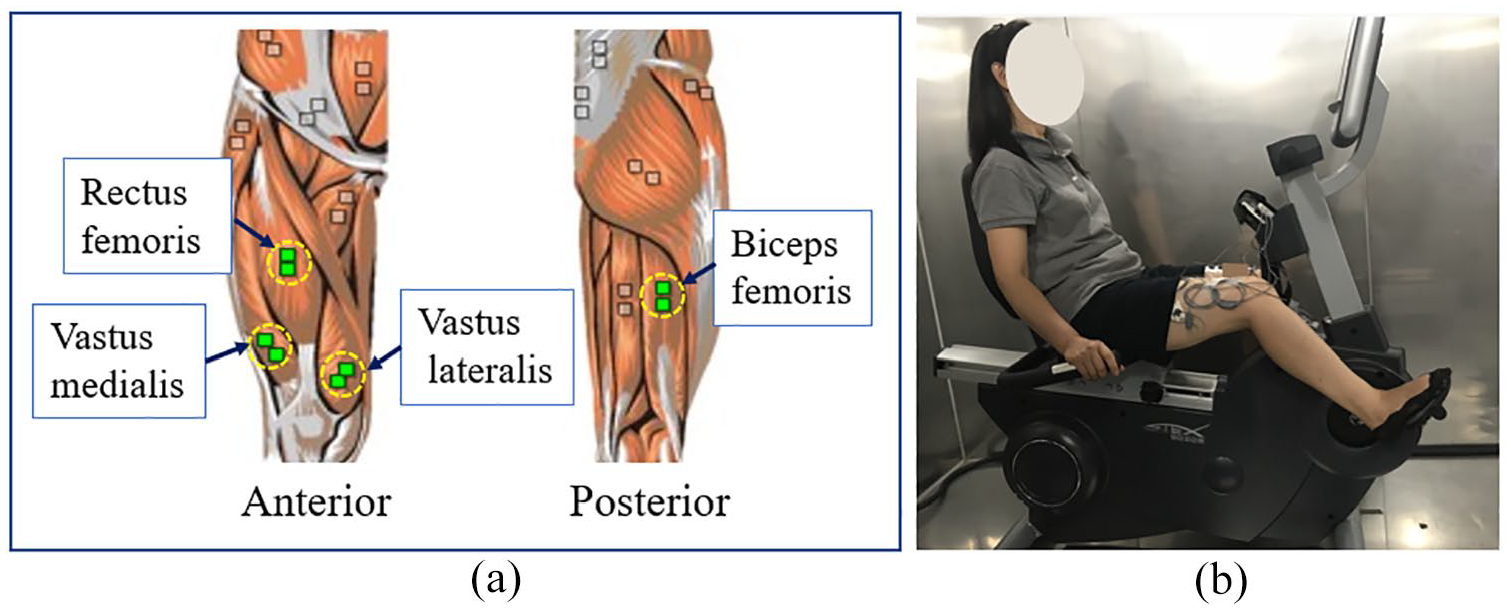
Muscle selection using attached EMG sensor and ergometer exercise: (a) location of sensing and (b) ergometer exercise.
EMG measurements were taken in the order of the experimental protocol in Figure 4. Because there were two types of experimental wear, the participants visited the laboratory twice, participating in the experiment for two consecutive days considering that the intensity of the experiment was not significantly high. The participants stabilized their breathing by relaxing for 10 min upon arriving at the laboratory and freely did some stretching exercises for 10 min to relax their muscles and joints. Then, they wore the third experimental leggings or 100% cotton shorts (control pants) randomly provided depending on the participant, and attached EMG sensors. On the second day of the experiment, participants were asked to wear clothing they had not worn on the first day and to participate in the same experiment.

Experimental protocol for EMG measurement.
The experimental protocol is shown in Figure 4. The ergometer speed was 30 rpm when measuring RVC in Session 1, and the participants performed the exercises for 2 min and relaxed for 10 min. In Session 2, participants were asked to perform the ergometer exercise for 20 min at a speed of 60 rpm. Session 1 required a standardization process of % RVC, which was conducted accordingly. For RVC, EMG information was collected under conditions of low intensity, low speed, and short duration. Therefore, the experimental conditions for the first session of this study were based on the research of Kim et al., 5 with a measurement of RPM 30 for 2 min. Session 2 involved a period of measuring EMG information while the subjects exercised at maximum effort. During the repetitive exertion of maximum muscle contraction, muscle fatigue accumulates; thus, according to Ball and Scurr, 50 the angular velocity of the cycle was set to RPM 60. Median frequency normalization for analysis was recorded in percentage using equation (1), following Kim. 51

Assessment of wearing comfort
The wearing comfort from the developed leggings was assessed during and after the cycling exercise depending on the assessment items. The exercise conditions for the comfort evaluation were kept identical to those for EMG measurement, with a cycling speed of 60 rpm for 30 min.
Comfort and satisfaction with clothing are influenced by both intrinsic attributes (physical characteristics of the fibers and materials from which the garment is constructed, its sensory characteristics, and garment design features) and extrinsic attributes (brand labels, information on fabric/garment care, price, etc.), as well as by attitudinal and cognitive factors of the wearer. 52 In this study, comfort was evaluated by asking participants to assess their specific satisfaction with some intrinsic attributes using a Likert scale.21,53,54 In other words, during exercise, four items were assessed: perceived pressure, muscle support, abdominal comfort during breathing, and sensation of pressure for different body parts. 1 After the exercise, items such as the ease of putting on and taking off the leggings and exercise fitness were assessed. The participants were asked to rate six items: “Is the perceived pressure adequate?,” “Is the muscle support adequate?”, “Is it easy to move?”, “Is it easy to breathe on abdomen?”, “Is it easy to put on and take off?”, and “Is it appropriate for exercising?” The items were rated on a 7-point Likert scale (1: Very poor/Not satisfied, 4: Neutral, 7: Very good/Highly satisfied).
Data analysis
The collected data were statistically analyzed using SPSS Ver. 26.0 (IBM®). To assess clothing pressure and subjective comfort, the mean and standard deviation were obtained using descriptive statistics. For muscle fatigue, we conducted a paired t-test for wearing and not wearing experimental wear, one-way analysis of variance (ANOVA) for differences between muscles, and Duncan’s test for post hoc testing. Moreover, we analyzed the difference in muscle fatigue (%) between wearing and not wearing experimental wear.
Results
Development of the basic pattern and first basic pattern
Basic pattern
The basic pattern was developed into a 2D pattern using a 3D human body model to maintain the shape of the curve and improve the fit. Figure 5 illustrates the first basic experimental wear pattern and pressure distribution using the CLO 3D program. As a result of digital pressure distribution, it was found that the color mapping was generally distributed from light blue to light green, confirming a low level of pressure (Figure 5(b)).

Images of the reduced pattern for first experimental wear and virtual fitting: (a) basic experimental wear pattern and (b) pressure distribution in virtual fitting.
Reduced patterns for the second experimental wear
The three types of second experimental wear were reduced to 15% (A-type), 20% (B-type), and 25% (C-type) only in the weft direction (as shown in Figure 6). Three participants in the preliminary assessment were asked to select and assess the satisfied pressure level for each panel. The participants were most satisfied with the A-type experimental wear with a reduction rate of 15% in regions such as the waist, hip, knee, and front and back bones of the ankle. The regions where they were most satisfied with the C-type applying the highest reduction rate were the vastus medialis, vastus lateralis, anterior calf muscle area, and posterior calf area. For other regions, they were most satisfied with the reduction rate at the B-type level.

Merged image of three types of reduced patterns for the second experimental leggings: (a) basic experimental wear pattern and (b) pressure distribution in virtual fitting.
In addition, during the preliminary assessment, the participants commented on the overall comfort, stating that too many panels constituting the experimental wear irritate the skin along the seams during exercise, creating an unpleasant sensation. Accordingly, we combined all panels aside from functional cutting lines to support the vastus medialis and vastus lateralis in the third experimental wear. Figure 7 illustrates the length variation due to the difference in reduction rates when connecting the outermost lines of the neighboring panels, which was adjusted slightly to complete the final pattern.

Final leggings pattern.
Clothing pressure
In checking the pressure distribution during the virtual fitting of the final third experimental leggings, there were clear differences in each part of the lower extremities (Figure 8). The area where pressure was intended to be strengthened, such as the vastus medialis and vastus lateralis, as well as the side panel connected to these two muscles and the back of the waist, signaled mostly red, indicating relatively high clothing pressure. The calf area also revealed high pressure. However, the waist indicated the lowest level in light blue, and the abdomen, knees, and ankles were generally light green, indicating a medium level of pressure.

Virtual pressure distribution for the experimental leggings.
The assessment of the actual clothing pressure showed significant differences between measurement locations (Figure 9). Clothing pressure was the lowest in the waist area, ranging from 0.77 to 0.86 kPa, with an even higher measure in front of the waist. This may be because the participant had abdominal obesity; therefore, the experimental wear was tight in the front waist area. The clothing pressure on the abdomen during cycling varies highly depending on breathing, 55 therefore, it should be kept relatively low when developing or purchasing a compression product. The product developed in this study had a clothing pressure of 1.09 kPa on the abdomen, appearing in light green in the virtual fitting, thereby proving to be adequate.

Quantitative clothing pressure (kPa) during actual wear: (a) front, (b) side, and (c) back.
Muscle fatigue
This study analyzed muscle fatigue in various aspects using muscle differences when wearing the control pants to identify the tendency in which muscles are mobilized during ergometer exercise in addition to the effect of the developed product.
Differences in muscle fatigue between the clothes worn
We compared muscle fatigue when wearing the leggings developed for late middle age women with muscle fatigue when wearing loose-fit wear (control pants). Table 3 presents the results. The median frequency increased in the vastus medialis and vastus lateralis when wearing leggings compared to when wearing loose-fit control pants, demonstrating a significant decrease in muscle fatigue. However, the rectus femoris and biceps femoris did not show a statistical difference.
Paired t-Test of developed leggings before and after wearing them (N = 12).

VM: vastus medialis; VL: vastus lateralis; RF: rectus femoris; BF: biceps femoris.
p < 0.05.
Analysis of muscle fatigue between muscles
We statistically analyzed the median frequency to determine the muscle fatigue in the vastus medialis, vastus lateralis, rectus femoris, and biceps femoris when doing ergometer exercise wearing loose-fit control wear; the results are presented in Table 4. When the participants exercised for 20 min at an ergometer speed of 60 rpm, muscle fatigue showed significant differences depending on the muscle measured. The highest median frequency value was found in the rectus femoris, followed by the biceps femoris, vastus lateralis, and vastus medialis. However, in a statistical post-hoc test, the vastus medialis and vastus lateralis were in the same group, thereby demonstrating no difference between the two groups. Meanwhile, when wearing the developed leggings, the average EMG median frequency was highest in the rectus femoris, followed by the biceps femoris, vastus lateralis, and vastus medialis, indicating that muscle fatigue was lowest in the rectus femoris. Wearing the developed leggings indicates that a higher average value of the central frequency of the EMG correlates with lower muscle fatigue. The results showed that the vastus rectus, biceps femoris, vastus lateralis, and vastus medialis exhibited this trend (these muscles are listed here in order of the lowest to highest levels of muscle fatigue), with the vastus rectus demonstrating the lowest level of muscle fatigue.
Comparison of muscle fatigue when wearing control pants versus leggings (N = 12).

VM: vastus medialis; VL: vastus lateralis; RF: rectus femoris: BF: biceps femoris.
Means with same superscript letter are not statistically significantly different (Duncan’s ranking at P < 0.05).
However, in a post-hoc test, the vastus medialis and vastus lateralis turned out to be in the same group, thereby indicating that there was no difference between these muscles. This tendency was also observed with the rectus femoris and biceps femoris. Next, in analyzing the difference in muscle fatigue for each muscle when wearing control pants and leggings, fatigue decreased by 23.2% in the vastus medialis and by 22.3% in the biceps femoris. This indicates that wearing the developed leggings during ergometer exercise improves muscle efficiency by reducing fatigue by at least 20% compared to wearing loose-fit wear, and at least 15% for the vastus lateralis and rectus femoris.
Assessment of subjective comfort
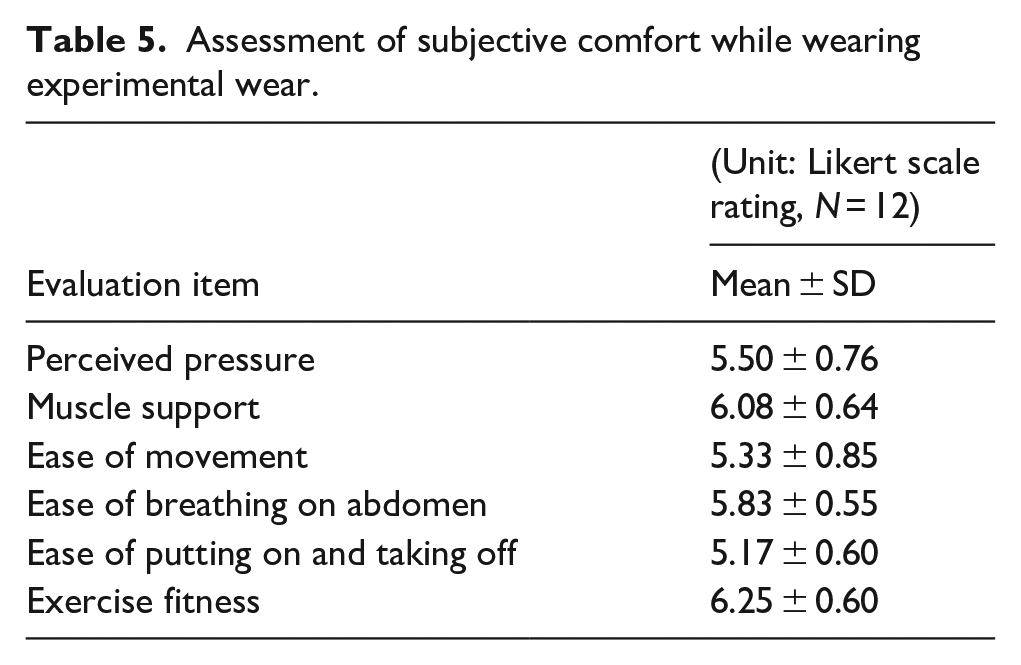
For subjective comfort, we assessed perceived pressure, muscle support, ease of movement, and ease of breathing while the participants were wearing experimental wear after the ergometer exercise, considering that the experimental wear was sportswear. Meanwhile, the leggings must be easy to put on and take off to be suitable for compression sportswear; therefore, the ease of putting on and taking off was assessed immediately after taking off the experimental wear. For exercise fitness, the participants were asked to assess whether the wear was fit for exercise, including the five items assessed earlier. The results showed that all items were rated at five points or more (Table 5), indicating that the participants liked and were satisfied with the comfort of the developed product. In particular, muscle support scored 6.08 points, suggesting that the developed product could improve the exercise effect by supporting the thigh and calf muscles mainly involved in ergometer exercise. Meanwhile, exercise fitness, a comprehensive assessment item that considers wearing comfort as well as the five items assessed earlier, scored a significantly high score of 6.25 points. Based on the above results, it is believed that the developed product will be useful as sportswear due to its excellent fit during cycling exercise.
Assessment of subjective comfort while wearing experimental wear.
Discussions
This study developed sports leggings for Korean late middle age women and assessed muscle fatigue and comfort. It is necessary to use basic patterns and apply adequate reduction rates to develop reduced patterns for compression clothing products. In this process, the reduction rate not only serves as a variable that affects quantitative clothing pressure but also affects subjective comfort such as perceived pressure, range of motion, and fit depending on the level of pressure. Thus, it is necessary to select reduction rates considering the purpose and use of the product as well as the wearer. In particular, late middle age women have more abdomen obesity compared to the younger generation in their 20s and 30s and generally lack experience wearing compression clothing products, indicating the need to assess comfort according to reduction rates in advance when developing compression clothing products. This study assessed comfort according to reduction rates in advance on three participants with similar body types as the standard body types and developed a leggings pattern with excellent comfort by applying the satisfied reduction rates for designated sections of the body.
Comfort based on quantitative clothing pressure is a highly subjective sensation, and preferred pressure ranges may vary greatly across wearers.21,54 Clothing pressure can fluctuate depending on posture, breathing, and exercise type. For instance, pressure in the abdomen may vary with respiration, and pressure around the hips or thighs can change depending on peddling position or seating during cycling and ergometer exercises. Therefore, selecting appropriate clothing pressure for compression sportswear must consider the nature of the physical activity.
Like many previous studies, this study measured clothing pressure in a static standing posture, which may not reflect dynamic conditions. However, using this standardized position allows for meaningful comparisons across participants and aligns with measurement protocols used in earlier research. For example, Luo et al. 55 estimated dynamic pressure during cycling by applying interpolation techniques to static data obtained using an air pack sensor. Within these constraints, the quantitative pressure data in this study suggest that the leggings were effectively designed to balance comfort and functional muscle support. Prior research has identified 0.85 kPa as a comfortable pressure level for late middle age women. 54 Following Liu et al., 18 pressure values in this study were classified as light (0–1.3 kPa), mild (1.3–2.7 kPa), moderate (2.7–4.3 kPa), and strong (>4.3 kPa). The leggings applied light pressure to the ankle and abdomen (1.0–1.3 kPa), and mild pressure to the thigh and lower leg (1.4–1.6 kPa), targeting key muscle regions such as the vastus medialis, vastus lateralis, and gastrocnemius. These pressure levels fall within the light-to-mild comfort range reported in prior studies targeting older or middle-aged populations, 19 and align with the previously suggested optimal value of approximately 0.85 kPa for late middle age women. 54 The distribution of pressure was strategically planned to enhance muscle activation while minimizing discomfort in more sensitive areas. This region-specific approach likely contributed to the observed reduction in muscle fatigue, as indicated by EMG results. These findings support the notion that applying anatomically targeted, mild levels of compression can be effective in improving performance and comfort for late middle age women engaged in physical activity.
The exercise effect when wearing compression pants is mostly verified in relation to exercise functionality and fatigue during exercises such as ergometer, cycling, bike riding, and running (field, treadmill). Particularly, indicators related to fatigue are mostly evaluated through EMG measurement or lactate analysis. Muscle fatigue is defined as the loss of the ability to maintain maximal muscle tension. 56 Broatch et al. 13 indicate that wearing compression pants during exercise can reduce muscle vibration as well as unnecessary energy consumption, thereby allowing the wearer to use the muscles efficiently and potentially reducing muscle fatigue. 57 When muscles get tired, the median power frequency (MPF) shifts from high to low in the EMG signal. This is because the mobilized motor units are fatigued, decreasing the nerve conduction velocity so that there is no more neural radiance except for the remaining slow twitch motor units because they are known to have low nerve conduction velocity. 58 Other studies5,58,59 also found that muscle activity in the vastus medialis and vastus lateralis was relatively lower than that in the rectus femoris during high-speed isokinetic cycling, 5 thereby possibly accumulating muscle fatigue. 59 Reich-Schupke et al. 60 had men in their 20s wear compression pants with a clothing pressure of 2.93 ± 0.27 kPa on the calf and 2.16 ± 0.27 on the thigh and undertake a treadmill workout for 40 min. The results demonstrated that the compression pants significantly reduced muscle activity and muscle fatigue compared to the loose–fit control pants. The results of Hsu et al. 26 showed that compression pants with a clothing pressure of 4.40 kPa on the ankle, 2.40 kPa on the calf, and 1.70 kPa on the thigh significantly reduced lactate and hematocrit—known as fatigue-inducing substances—compared to those not wearing them. In existing studies, the garment pressure levels that elicited positive responses in the human body varied among researchers. These studies indicate that the appropriate pressure applied by compression garments reduces fatigue during exercise. When organized by body part, the pressure for the thigh is defined as mild at 1.7 kPa and that for the lower leg as mild at 2.7 kPa while the pressure for the ankle is defined as strong at 4.4 kPa. The mild pressure level of the experimental garments derived from this study was consistent with these findings. Furthermore, as discussed earlier in relation to comfort, it was confirmed that compression garments that exert mild pressure on the leg region are not only satisfied but also beneficial for reducing fatigue. However, while the ankle displayed a different trend in garment pressure, it does not seem to have significantly impacted the fatigue of the quadriceps muscles that we measured. The low garment pressure observed at the ankle appears to reflect the wear comfort experienced by the participants during the design process. This difference from existing literature may be attributed to the higher age group of the participants in this study. Notably, this distinction further confirms the need to develop garments specifically for late middle age adults.
Conclusions and suggestions
To develop functional sports leggings for late middle age women, this study aimed to determine the optimal pressure levels to be applied to key muscles by designing a differential pressure pattern based on anatomical structure and curvature distribution. The effectiveness of the pressure design was evaluated through clothing pressure measurement, electromyography-based muscle fatigue analysis, and subjective comfort assessment.
The study applied different reduction rates to specific bodily regions to develop a differential pressure pattern that assists muscle function. For the waist and abdomen, 15% was applied considering the respiratory and digestive organs, 25% was applied to the vastus medialis and vastus lateralis where the muscle function is relatively weak in the thigh area, and 20% was applied to the posterior thigh. Because it is a product for sports, a greater reduction rate was applied to the calf area than the ankle. The pressure was less than 1.10 kPa on the waist and abdomen and highest at 1.98 kPa on the posterior calf. In the thigh area, the pressure was 1.21 kPa on the rectus femoris muscle, 1.19 kPa on the posterior thigh, 1.49 kPa on the vastus medialis, and 1.53 kPa on the vastus lateralis, differentiated for each area. The results indicated that participants who wore the developed leggings for cycling had significantly lower muscle fatigue in the vastus medialis and vastus lateralis compared to those who wore loose-fit control pants. The leggings were also generally highly rated in the assessment of subjective comfort, proving that they are highly suitable as sportswear.
This study is significant in that it selected the border between the muscle area and bone as a functional boundary for differential pressure on each area, considering the anatomical characteristics of the wearer. Specifically, it systematically developed the experimental wear based on continuous feedback through the 3D virtual fitting program in each stage of the leggings design and the preliminary assessment of the participants. Moreover, the developed experimental leggings had a positive effect on muscle fatigue as intended by the researchers. This study has significance in that it: (1) developed leggings for late middle age women based on comfort assessment depending on the design and pressure levels considering their body characteristics, (2) derived pleasant levels of clothing pressure by measuring quantitative clothing pressure and EMG and assessing subjective comfort, and (3) developed leggings that reduce muscle fatigue, thereby providing comfort.
Footnotes
Acknowledgements

Ethical considerations
This study was approved by the Chungnam National University Institutional Review Board (Ethics Code: 201705-SB-022-01). All participants provided written informed consent prior to enrollment in the study. This research was conducted ethically in accordance with the World Medical Association Declaration of Helsinki.
Author contributions
NK proposed the research idea, while NK and HL conducted the research. NK and HL were mainly responsible for data analysis and experimentation with the preparation of the manuscript and were also involved in the manuscript version. By data analysis and experiment. All authors read and approved the final version of the manuscript.
Funding
The author(s) disclosed receipt of the following financial support for the research, authorship, and/or publication of this article: This research was supported by Basic Science Research Program through the National Research Foundation of Korea(NRF) funded by the Ministry of Education(No. 2017R1A6A3A01012958).
This work was supported by the National Research Foundation of Korea (NRF) grant funded by the Korea government (MSIT; Ministry of Science and ICT) (RS-2023-00211608).
Declaration of conflicting interests
The author(s) declared no potential conflicts of interest with respect to the research, authorship, and/or publication of this article.
Data availability statement
The datasets used and/or analyzed during the current study are available from the corresponding author on reasonable request.