



Abstract
The measurement of dynamic deformation and pressure distribution of the human body is crucial for advancements in 3D body measurement, modeling, and the optimization of clothing patternmaking for both fit and comfort This study focuses on assessing the dynamic changes in pressure and deformation of the waist-abdomen region during posture transitions in young women wearing tight-fitting pants of different sizes and compared the dynamic deformability of real human body and virtual simulated models. Clothing pressure was measured in both standing and sitting postures, while 3D models of the waist-abdomen region were generated using 3D body scanning to capture body deformation patterns. The research examined the relationship between pressure distribution, circumference, and volume, along with their dynamic variations under different levels of pressure. A novel under-clothing bump grid method was introduced to measure and analyze the horizontal and vertical skin deformation of the waist-abdomen. A dynamic virtual human body model was constructed to compare and analyze its dynamic deformation. The findings revealed that clothing pressure distribution on the waist-abdomen is closely related to the physiological morphology of the body. Notably, the skin’s vertical deformations are more significant when sitting, with clothing pressure playing a significant role in the elastic deformation of the waist-abdomen. Additionally, the changes in circumference and volume follow a consistent pattern. This research offers novel insights for optimizing clothing design, enhancing the functional design and comfort design, and contributes to improving the body and clothing simulation.
Keywords
Introduction
Compression clothing is widely used in several applications in sports, 1 medicine, 2 and shaping fields, 3 especially popular with young women in the fields of sport and shaping. Tight clothing is a common type of compression clothing. The impact of compression clothing on the human body is manifested in the pressure on the skin surface and the anisotropic deformation of subcutaneous tissues. 4 The anthropometry of soft tissue deformation is important in functional clothing design. While dress forms designing, the shape of the human body must be accurately reflected in the different postures. 5 When people wear compression clothing, the pressure distribution on the surface of the clothing changes with different postures and movements, which in turn affects the deformation of tissues to varying degrees. 6 It can be used to optimize clothing design,7,8 and enhance the comfort and functionality of flexible wearable devices9,10 to meet the needs of different groups of people by measuring and exploring the dynamic deformation of the human body.
The measurement of clothing pressure and its effect on human deformation is an important research topic in the field of clothing function, especially for designing compression clothing with functionality and comfort. 11 The measurement and prediction of dynamic clothing pressure are an important foundation for the design and development of compression clothing. 12 The clothing virtual simulation system has been widely used in clothing design and the prediction of clothing pressure, 13 but the accuracy of the dynamic pressure deformation of the human body model in the system has yet to be proved. Researchers used wearable sensors, FE (Finite Element) analysis accurately measured the distribution of clothing pressure on the body to explore the effect of clothing pressure on human surface deformation.14–16 Ye et al. 17 constructed a new FE model to simulate the interface pressure between elastic compression stockings and the lower limb with validation. The simulated results contribute to explore stress distributions and tissue deformation exerted by elastic compression stockings. Yu et al. 18 developed a highly accurate flexible pressure sensor for monitoring knee joint pressure in sports pants. In the field of dynamic human surface deformation measurement, the skin deformation caused by joint twisting has been widely studied and used in the design and development of related tight-fitting clothing.19,20 He et al. investigated the effect of Kinesio taping and taping methods on skin deformation during knee joint flexion and extension motion and further explore its possible functional mechanisms, and the results indicate that the usage of the Kinesio taping had an effect on the biomechanical changes of the skin, resulting in changes in skin deformation. 21 The compression deformation of the human body under clothing pressure was studied using CT scanning and numerical simulation methods on the static conditions. 22 A regression equation between clothing pressure and compression displacement within a single cross-section of the human body was constructed, providing important reference for pressure comfort and clothing style optimization.23,24
The exploration of clothing pressure and human deformation studies mostly only considers the two-dimensional deformation of the skin,25–27 without taking into account the multidimensional morphological changes of human soft tissues and the deformation of the skin under dynamic clothing pressure and few researchers have explored the accuracy of dynamic deformation of human model in virtual simulation systems. The waist-abdomen regions, as the core area of the human body, contain complex tissue types, and various shapes. 28 There is limited and insufficient research on the pressure deformation of the waist and abdomen regions.
This study focuses on young women aged 20–24, and integrates ergonomics and clothing physiology to systematically explore the soft tissue multidimensional deformation including horizontal and vertical of skin deformation, 2D circumference change, and 3D volume change in the waist-abdomen under different clothing pressures from standing to sitting posture change. Using a clothing pressure tester, we measure the dynamic clothing pressure exerted by tight pants on the waist-abdomen. Additionally, we introduce the under-clothing bump grid method to estimate the skin deformation in both horizontal and vertical of the waist-abdomen as the posture shifts. Three-dimensional human body scanning is employed to precisely capture the multidimensional deformations of circumference and volume, allowing us to analyze the morphological changes of the waist-abdomen under different conditions. A virtual human model was constructed in the virtual simulation system. By comparing the deformation extents in the waist-abdomen regions between real experiments and virtual simulations, the deformation differences between virtual humans and real humans were analyzed. The findings on dynamic clothing pressure and deformation pattern of the waist-abdomen will offer insights into future research on clothing comfort, optimization of virtual simulation systems and provide a scientific foundation for functional clothing design.
Methods
Experiment of dynamic clothing pressure measurement on waist-abdomen
Participants and materials
Ten young women, aged 20–24, were selected as participants, and their height, weight, BMI, and circumference data were measured. The anthropometric results are shown in Table 1.
Basic information of the participants.

To accurately measure and analyze the dynamic deformation in clothing pressure on the waist-abdomen, two identical styles of tight pants (TP1 and TP2) without a crotch seam in the front and with a crotch seam in the back in different sizes were chosen based on the average height, weight, and circumference data of the participants. The size of TP1 is smaller than TP2, the patterns and circumferences sizes of the tight pants are shown in the Table 2 and Figure 1. By comparing the effects of tight pants with different sizes, we gained a comprehensive understanding of the morphological changes in the waist-abdomen of young women under different clothing pressures and postures.
Sizes of tight pants.


Pattern of tight pants. (a) Front; (b) side; (c) back.
Clothing pressure measurement
The AMI3037-2 contact pressure tester (AMI-Techno Co Ltd., Japan) was used to measure the clothing pressure. The waistline was set as the measurement baseline, 12 pressure measurement points were set on the baseline, at 15° from the center point with 30° intervals counterclockwise (Figure 2). Each participant was measured in a standing posture with feet apart and body naturally upright for 1 min. Then they are asked to sit with their body perpendicular to the ground, knees bent at about 90°, and their feet flat on the ground for 1 min. The experiment codes for different postures and clothing pressures are shown in Table 3.

Clothing pressure measurement points.
Experiment condition sets.

Dynamic multidimensional deformation measurement of waist-abdomen
Measurement of skin deformation using the under-clothing bump grid method
The lineation on body method 29 is one of the most common methods for measuring the dynamic skin deformation. To address inaccuracies in measuring skin morphology under clothing, the under-clothing bump grid method was proposed in this study. The under bust line (UBL) and middle hip line (MHL) of each participant were set as the upper and lower boundaries of the waist-abdomen region, and the center front line (CFL) and center back line (CBL) were selected as the region boundaries. The grid was divided in this region, with five parts horizontally, three parts vertically from the side line to CFL, and three parts to CBL (Figure 3). At the intersections of the grid lines, 5 mm diameter smooth hemispherical plastic particles were attached. The length of each bump grid line was measured under six conditions in Table 2. Each participant was measured three times, and the average was calculated to ensure the data accuracy.

Grid division.
Measurement of waist-abdomen circumference and volume deformation
Using the Human Solution 3D body scanner (Humanetics Digital Europe GmbH, Germany), 10 participants were scanned six times to get the waist-abdomen model. The scanned 3D body surfaces were smoothed utilizing Geomagic Control (3D Systems Inc., USA), and the waist-abdomen part of each participant under the six conditions (SD0, ST0, SD1, ST1, SD2, ST2) were truncated (Figure 4).

Three-dimensional models of standing and sitting posture. (a) Standing posture model; (b) sitting posture model.
To investigate the dynamic volume deformation of the waist-abdomen, the extracted model was accurately divided into 30 segments 16 (coordinate axis in Figure 4). The volume of each segment was calculated to explore the pattern of dynamic volume change of the waist-abdomen.
When the volume is divided into 30 parts, there will be 31 cross sections. Due to the elasticity of human skin and the movement of soft tissues (Figure 8), the cross-sections of the waist-abdomen models in standing and sitting models shifted relatively. In sitting posture, the longitudinal distance from the UBL to the MHL compressed about 6 cm compared to the standing posture. To correct this displacement, the region between UBL and MHL was divided into five segments (Figure 3). The rate of skin elasticity in various regions was calculated. Twenty-five cross-sections of the waist-abdomen model in the sitting posture were obtained based on the skin elasticity rate in each segment. Twenty-five cross-sections were used to ensures that each sitting section corresponds exactly to a specific anatomical location in the standing position, making an effective biological comparison of circumference and volume.
Virtual simulation of dynamic pressure deformation of human waist-abdomen
To investigate the differences of dynamic deformation between virtual simulation systems and experiment conditions, virtual human models were constructed in the CLO3D System (CLO Virtual Fashion LLC., Korea) based on the average height, weight, and BWH (Bust-Waist-Hip) of 10 participants. By altering the posture of the human models from standing to sitting, dynamic deformation of the waist-abdomen was obtained. The human models were exported in OBJ format, and the same region as shown in Figure 4 was cropped. The same segmentation operation was performed to obtain the deformation of the human models in the virtual simulation system (Figure 5).

Virtual human body constructed in virtual simulation system. (a) Standing; (b) sitting.
Results and discussion
Distribution and variation of pressure in the waist-abdomen
As shown in Figure 6, the clothing pressure in the waist-abdomen follows a normal distribution, with a median of around 1.65 kPa and an average value between 1.6 and 1.7 kPa under each condition. Compared to wearing small-sized tight pant (TP1), there is a more concentrated distribution of pressure when wearing large-sized tight pant (TP2). However, compared to sitting posture, there is a more concentrated distribution of pressure in standing posture, and ST1, ST2, and SD1 have no abnormal values, only SD2 showing abnormal values., but its pressure values are the most concentrated. With the pressure of clothing, the surface curvature of the waist-abdomen further affects the magnitude of pressure. Secondly, fat transfer in sitting position causes changes in the thickness of soft tissues in the human waist-abdomen, affecting the cross-sectional shape and surface curvature of the waist and abdomen, resulting in a more dispersed distribution of pressure magnitude.

Clothing pressure for each condition.
The pressure values at 12 measurement points along the waistline of 10 participants in four conditions (ST1, SD1, ST2, SD2) were averaged, and the pressure distribution of the tight pants is shown in Figure 7. The pressure distribution pattern of waist-abdomen from standing to sitting posture remained consistent: The distribution of clothing pressure on both sides are approximately symmetrical about the center front and center back of the human body.

Clothing pressure distribution.
From the center front to the body side, the curvature of the body surface increases with the accumulation of fat on the waist, causing a gradual increase in pressure. Conversely, from the body side to the center back, the pressure gradually decreases due to the concave shape body surface.
This consistent pressure distribution pattern suggests that there is no significant change in the shape of the waist-abdomen cross-section during the dynamic process from standing to sitting posture. According to the t-test results (Table 4), there was no significant change in clothing pressure on the waist-abdomen during the posture transition. However, with the same posture, there is a significant difference in clothing pressure between different sizes, with the effect being more pronounced in sitting posture compared to standing posture. Therefore, changes in posture tend to amplify the differences in clothing pressure between different sizes.
T-test results of pressure values in different conditions.

Note. The significance of change is indicated by * and its level, *: 0.05 level, **: 0.01 level.
Skin elasticity in the waist-abdomen
The lengths of each skin grid of the waist-abdomen part with different postures were compared, and the difference between the horizontal and vertical lengths was calculated (Figure 8). In the sitting posture, compared to the standing posture, the skin on the back extends vertically from UBL to MHL, and the position at the waistline of the center back has the largest vertical stretch. The skin on the front side of the waist-abdomen contracts to varying degrees, and the maximum contraction is at the waistline. Compared to the unstressed condition, deformation decreases with less pressure, while it increases with greater pressure, with notable changes in areas such as V4, V6, H3–H4, and H4–H5 under higher pressure.

Skin dynamic stretching and contraction changes of the waist-abdomen region.
According to the biomechanical theory of human sitting posture,30,31 the pelvic bone will slightly tilt backwards compared to standing posture during sitting, resulting in a decrease in the physiological curvature of the lumbar spine. When standing, the muscles in the waist-abdomen need to maintain a certain level of tension to keep the body balanced and upright. After sitting down, the tension of these muscles decreases, especially the erector spinae and rectus abdominis muscles. The activity of some core muscle groups such as transverse abdominis and rectus abdominis decreases, and the flexor muscles in the waist such as hip flexors are stretched when sitting down, while the extensor muscles in the back such as erector spinae undergo slight contractions. With changes in the activity of the waist and abdominal muscles, fat is transferred and accumulates in the abdomen, which in turn affects the lateral, and longitudinal expansion and contraction of the skin (Figure 9).

Changes in physiological structure of sitting.
The transverse abdominus, rectus abdominus, and obliques in the waist-abdomen region have quite small changes in horizontal while the body shifts from standing to sitting posture. 32 Similarly, horizontal changes in skin deformation remain small across six conditions. As clothing pressure increases, the horizontal deformation initially increases and then decreases, with significant changes observed in regions of V5–V6 and H2 under greater pressure.
In summary, the skin on the front side of the waist-abdomen contracts vertically, while the skin between UBL and MHL stretches vertically. The position near the center back waistline has the greatest vertical stretch, which is caused by the contraction of the transverse abdominus, and rectus abdominus, of the latissimus dorsi in sitting posture, and skin sliding along with the muscles. 33
A correlation analysis was conducted to explore the relationship between pressure changes and skin deformation, the results are shown in Table 5. When wearing TP1 in both standing and sitting postures, the skin deformation in this region is constrained by the waistband of pants. As the pressure increases, the vertical contraction of the skin is more restricted, leading to a smaller change in vertical skin stretch. Therefore, a significant negative correlation was found between the pressure changes at the six points on the right side of the waist-abdomen with the clothing pressure are approximately symmetrical about the sides of the body, and the vertical length changes at H1–H2, H2–H3, H3–H4, and H4–H5. The numerical relationship between the five sets of values is illustrated in Figure 10.
Correlation test between pressure changes and skin elasticity.
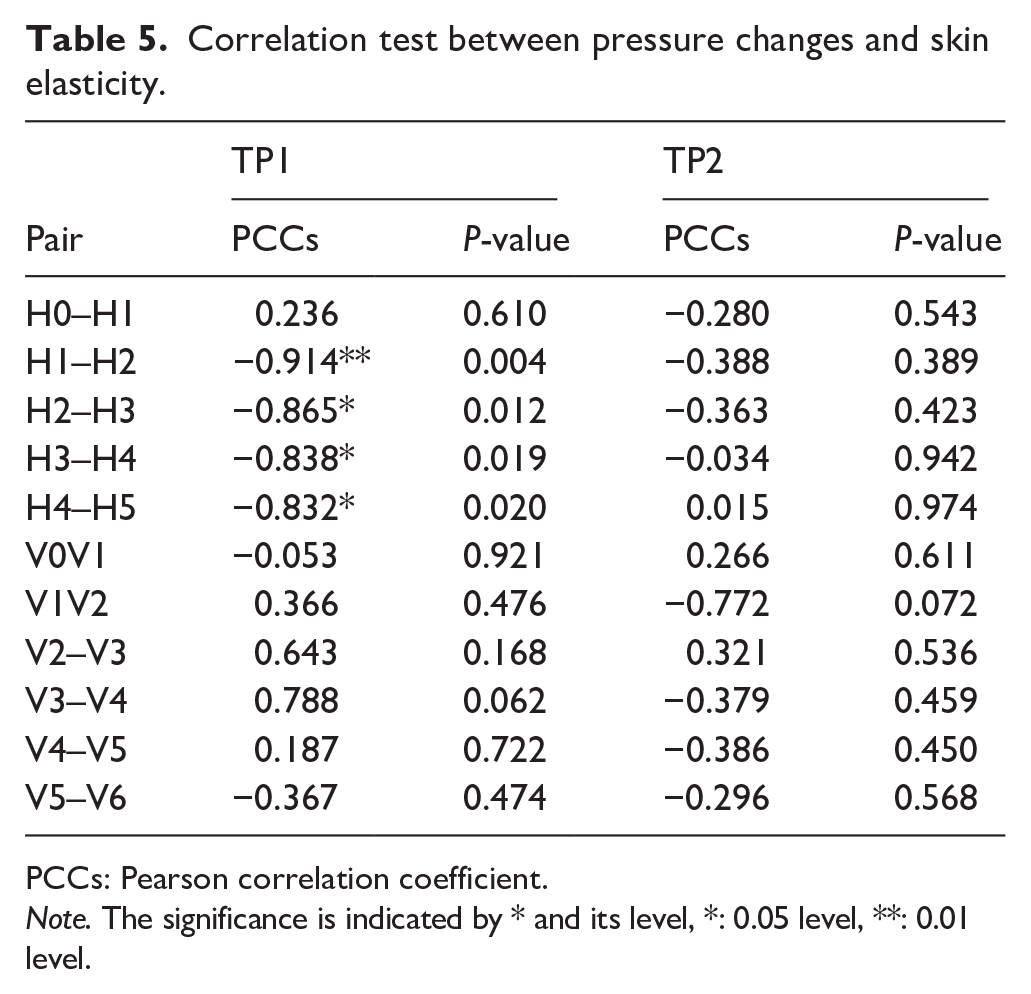
PCCs: Pearson correlation coefficient.
Note. The significance is indicated by * and its level, *: 0.05 level, **: 0.01 level.

The relationship between skin horizontal change and pressure change.
Circumference and volume deformation of waist-abdomen
In sitting posture, the circumference of the waist-abdomen shows a trend of initially decreasing, then increasing, and decreasing again from MHL to UBL, as shown in Figure 11(a). The circumference significantly increases near the waistline, while it significantly decreases near MHL. These posture changes lead to the relative movement of fat near UBL and MHL, along with muscle and skin stretching, causing changes in waist-abdomen circumference. In the sitting posture, the compression of the skin on the front side and the stretching of the skin on the back side near MHL, cause the cross-section tilts diagonally upwards compared to the standing posture, reducing the horizontal circumference near MHL.
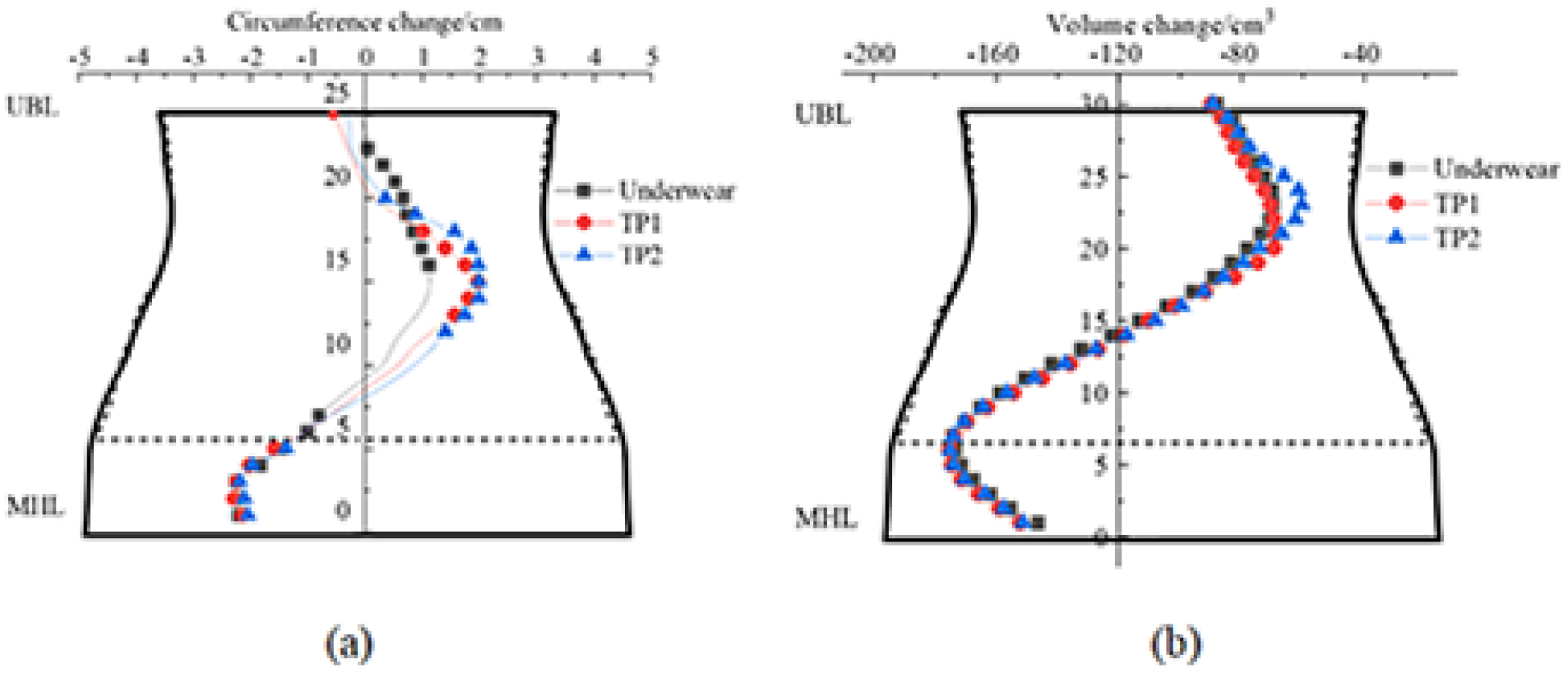
Circumference change (a) and volume change (b) in waist-abdomen region.
In unclothed condition, fat accumulates around the waist-abdomen, with less accumulation above the waistline without the constraints of pants. Above the waistline, the degree of change gradually decreases without reaching negative values. When wearing tight pants, the waistband of the pants restricts the upward movement and accumulation of fat. concentrating most of the fat around the waistline, leading to a greater change and peak in circumference when wearing tight pants. However, as the clothing pressure increases, the fat accumulation effect decreases.
The volume change in the waist-abdomen shows a consistent trend with circumference change as shown in Figure 11(b). The MHL moves upward and soft tissues accumulate with the support of the hip muscles and pelvic cavity. In sitting posture, the volume of the waist-abdomen within MHL shifts downward into the pelvic cavity, resulting in the total volume decrease in the waist-abdomen, and the volume of each segment in sitting posture is smaller than that in standing posture. As the change value gradually increases and the volume difference decreases, the increase in volume of that region increases is minor compared to the transferred volume. Therefore, the total change is negative, with the volume gradually decreasing above the waistline as the overall value increases near the waistline.
Based on the above analysis, we further analyzed the influence of different clothing pressures on dynamic deformation. As shown in Figure 12(a), the difference in dynamic changes in circumference between wearing different sizes of tight pants and the naked condition shows the same trend from UBL to MHL, with negative values in the upper and lower abdominal areas and positive values in the abdominal area. The difference in dynamic changes under high clothing pressure is smaller than that under lower clothing pressure. When sitting, the abdomen is generally convex, and fat transfers upward and accumulates downward, causing an increase in circumference. After wearing tight pants, the upward transfer is restricted and the downward accumulation increases. As the pressure increases, the fat further compresses, and the change in circumference decreases.

The difference in circumference variation (a) and volume variation (b) under tight pants of different sizes.
Based on volume change analysis, as shown in Figure 12(b), the difference in dynamic volume changes between pressure conditions and the naked condition shows the same trend from UBL to MHL, with negative values in the upper and lower abdominal regions and positive values in the abdominal region, with two peaks. Compared to high clothing pressure condition, the difference curve of volume changes under lower clothing pressure condition is generally shifted downwards toward the human body. The reason for this finding is uneven thickness of soft tissues in the lower abdomen, and the pressure on the tight waistband is greater. From standing to sitting position, abdominal fat is transferred downwards, and small-sized tight pants exert greater pressure, limiting its compression and transfer.
Comparison of dynamic pressure deformation between real and simulated model
The constructed standing and sitting posture models were superimposed for comparative analysis as shown in Figure 13(a). It can be observed that the upper body segments of the models exhibit nearly complete overlap, indicating an absence of deformation in the waist-abdominal region during postural transition from standing to sitting. To investigate the dynamic deformation characteristics of the virtual human model in the simulation system, comparative analyses were conducted against the real human model from both circumferential and volumetric perspectives.

Comparison of experimental and simulated body deformation. (a) Overlapping of standing and sitting model. (b) Circumference change between simulation and experiment. (c) Volume change between simulation and experiment.
Regarding circumference measurements, dimensional variations were quantified at key torsional joints: UBL, MHL (Figure 3), TL (thigh line), UKL (under knee line), and AL (ankle line) during postural transition. As demonstrated in Figure 13(b), the virtual model shows significantly smaller dimensional changes compared to biological counterparts, particularly at MH, T, and LK.
Volumetric analysis divided the human body into four anatomical regions: UBL–MHL, MHL–TL, TL–UKL, and UKL–AL. Comparative results in Figure 13(c) reveal critical discrepancies: the UBL-MHL region exhibits insufficient volumetric variation, while the MHL–TL region demonstrates substantial volume loss. These anomalies stem from the rigid physical properties inherent in the virtual simulation model, where extra-articular regions maintain static surface characteristics during limb movement, a marked contrast to the complex nonlinear elasticity of biological systems. As illustrated in Figure 9, human tissues undergo multifaceted deformations during dynamic postural changes, a critical biomechanical property absent in current virtual human modeling paradigms.
Conclusion
This study explored the changes and deformation patterns of clothing pressure on the waist-abdomen of young women under dynamic conditions. The dynamic pressure distribution of the waistline was measured, and the multidimensional morphology of the waist-abdomen in six different conditions was measured and discussed using the under-clothing bump grid method and 3D body scanning. The multidimensional deformation patterns including horizontal and vertical deformations of skin, 2D circumference change, and 3D volume change of the waist-abdomen of young women from standing to sitting posture were identified as follows:
1) The pressure distribution on the waist-abdomen region of young women under different pressures in standing and sitting postures is related to the physiological characteristics. The pressure distribution pattern remains consistent throughout the dynamic process, indicating no significant change in the shape of the waist-abdomen cross-sections from standing to sitting.
2) Skin elasticity in the waist-abdomen region is associated with muscles relaxation and stretching of body during the posture transition from standing to sitting. The skin on the front side of the waist-abdomen contracts vertically, while the back side stretches vertically, with the most significant stretch near the waistline. The horizontal skin deformations are minor and have no specific pattern, while clothing pressure does affect the skin deformation in the waist-abdomen region.
3) The circumference and volume of the waist-abdomen changes from MHL to UBL in both standing and sitting postures, following a pattern of initial decrease, subsequent increase, and another decrease. This pattern is influenced by the movement of fat distribution and skin stretching in the waist-abdomen region.
4) A comparison of the dynamic deformation of the virtual human body model and the real human body reveals that the deformation observed in the virtual simulation system significantly differs from actual human body dynamics, the virtual model fails to accurately reflect real dynamic deformation.
By analyzing the dynamic pressure distribution on the waist-abdomen region of young women, this study provides essential data and a theoretical foundation for studying clothing pressure under dynamic conditions. Furthermore, measuring the dynamic deformation of the waist and abdomen offers valuable insights for optimizing clothing design, enhancing the functional design and comfort design. This research establishes a new data benchmark that accounts for the human body’s natural deformation, and contributes to improving the body and clothing simulation.
Footnotes
Acknowledgements
The authors would like to thank those subjects who have participated in the experiments and those who have given valuable advice in preparing the experiments.

Ethical considerations
Not applicable.
Author contributions
Funding
The author(s) disclosed receipt of the following financial support for the research, authorship, and/or publication of this article: This work was supported by the 2024 Wuhan Textile University Special Fund Project (Grant No. 2024454), and the Wuhan Textile and Garment Digital Engineering Technology Research Center, and The Textile and Garment Industrial Research Institute of Wuhan Textile University and Gongqingcheng City (Grant No. JJXC2023024).
Declaration of conflicting interests
The author(s) declared no potential conflicts of interest with respect to the research, authorship, and/or publication of this article.
Data availability statement
The datasets used and/or analyzed during the current study are available from the corresponding author on reasonable request.