



Abstract
Selection of the right size and comfortable bra is very important as the wrong bra selection may lead to many problems like skin irritation, pain, and in extreme cases can induce breast cancer. This study consists of two phases, in the first phase a survey was conducted to investigate factors affecting wrong bra selection leading to health problems, in the second phase a mobile application “Bra Guide” was developed to create awareness in women related to health issues, extraction of breast measurement, and bra sizing system. The collected data was analyzed with factor analysis using SPSS, IBM AMOS 26.0, and the mobile application was developed by using the Flutter framework. Results showed that 84% of women don’t have awareness related to bra sizing system and they also fall behind with bra style feature knowledge. The second most important factor is the nonexistence of bra fitting services which causes most women to use ill-fitted bras for their complete life, furthermore, 79% of women wear bras 24 h a day which causes health issues. A mobile application “Bra Guide” has been developed which helped in delivering awareness and solutions regarding bra size, style, and breast health issues as 91.2% of respondents rated this application as highly satisfied.
Introduction
A bra is a body-fitted garment with main functionalities to cover, support, and elevate women’s breasts. It is an important part of women’s garments as it is the foundation for any outfit. Fitting complications are more noticeable in bras due to their close relationship with the body and the body’s complex construction. Wearing the right size and comfortable bra is very important as the wrong size or uncomfortable bra may lead to many problems like skin irritation, breast pain, and back pain, shoulder or neck pain. 1 The issues raised due to poor bra fit may lead women to seek reduction mammoplasty. 2 In extreme cases, continuously wearing smaller-sized bras blocks the flow of blood to the breast and can induce breast cancer. 3 Women are an integral part of society, and any health issue caused by bra fitting can affect the overall society.
The bra’s performance and functionality are deeply linked with its fitness. An incorrectly fitted bra may trigger the discomfort and ultimately fail to provide support.4 –8 It can even cause long-term health issues including shoulder pains and posture change if not taken care of.9,10 Most importantly, commercial bra fitting tests are performed on a standard model size, universally designed, that cannot cover all customers and vary with various geographical factors. 11 They are not designed for diversity in breast volumes, body shapes and anatomical variations found across geographic regions and different ethnicities.12,13 These are main issues; most women wear incorrectly fitted bras that not only compromise comfort and user experience but also biomechanical performances.8,14
Intimate apparel is fundamental components of women daily clothing, it is often overlooked and not considered good to discuss in the society, especially in conservative societies like mostly developing countries. This causes women to wear ill-fitted bras for their whole life, that ultimately impact the comfort, physical health as well as physiological wellbeing.8,14 Current practice in these societies is use of standardized sizing systems developed by developed western countries. These standards most often fails to accommodate the unique anthropometric and lifestyle factors of other part of the world, even in various areas of same country. Breast shape, posture, socio-economic background, climate and cultural practices should be considered for fitting protocols and bra design. 15 Similarly, lack of awareness, privacy concerns in various cultures, and stigmatization surrounding intimate wear also discourage women from looking proper fitting solutions in these societies. 16
To date, there is need of proper research-based analysis of bra design parameters designed for the need of targeted areas that are lacking in awareness and causing women health issues. Daily challenges women face in most conservative societies during the purchase and use of bras, that include fit issues, discomfort, and lack of design diversity based on the body postures, should be investigated. Current work aims to delve into the difficulties realized by the user during buying and utilizing the apparel on a diurnal basis, and the importance of a well-fitted undergarment. This research is planned to investigate and find out the most appropriate issues being faced by the set of targeted women and finally, development of mobile application to enhance the awareness in women and possibility for them to find the best possible bra type and size based on their breast shapes and body postures. To investigate the concerned issues, a questionnaire is planned to develop, and interviews will be conducted by group of women of various ages and bra sizes. Bartlett’s test of Sphericity will be performed to examine the null hypothesis that the correlation matrix is an identity matrix.
Literature review
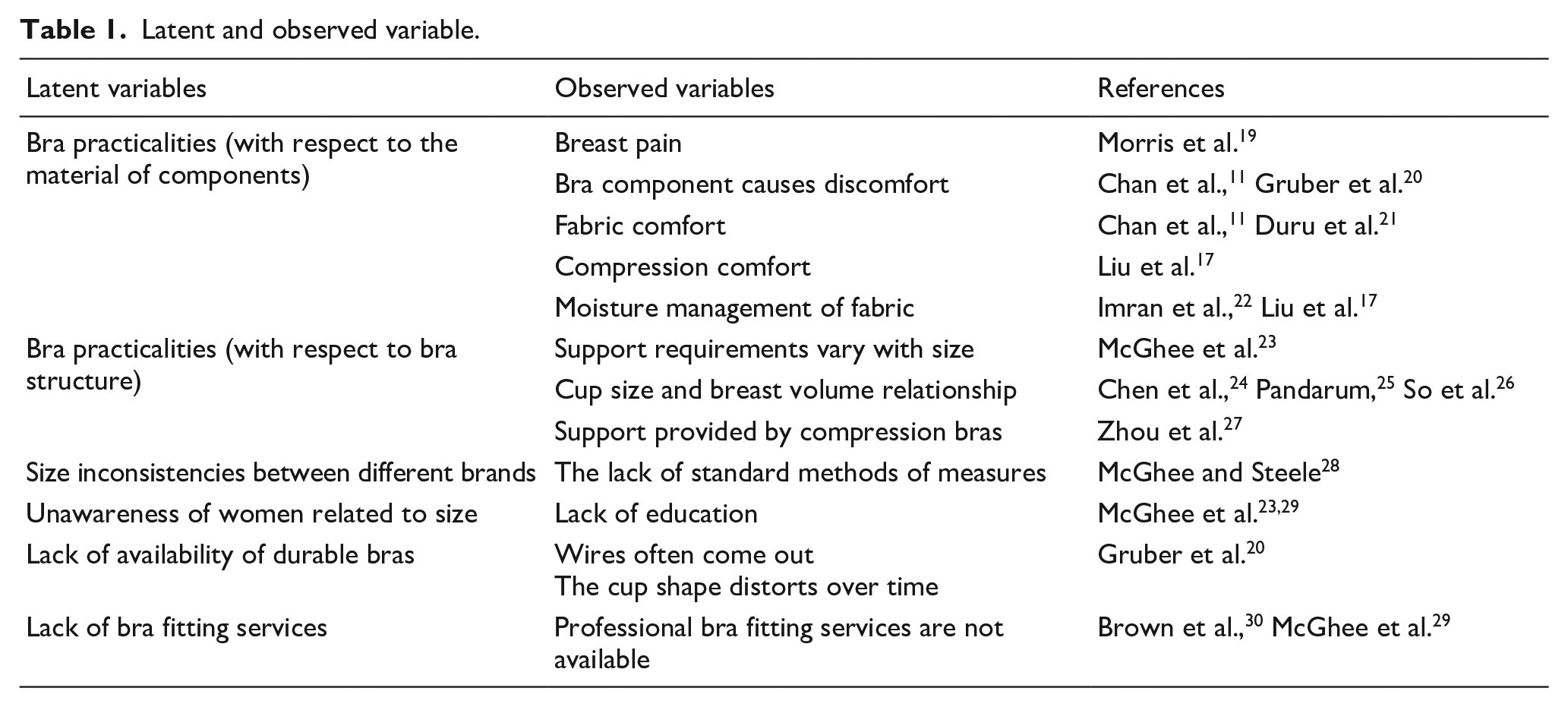
Bra comfort and functionality are influenced by body size, material content, pattern,17,18 and so on. Several factors have been marked as contributing to the high dominance of incorrect bra fit, which are given below in Table 1.
Latent and observed variable.
Incorrect bra fit can negatively impact women’s health, several strategies have been established to try to resolve this problem. These strategies have included the development of resources to educate women on how to correctly fit their bras and recommendations for women to use professional bra fit services. Women are, however, reluctant to use such services. In fact, 75% of adolescent females have reported that they have never used professional bra fitting services, and 66% of women reported choosing to independently fit and purchase their own bras.28,29 Therefore, there is a need to facilitate women by providing bra fitting services in the form of a mobile application, so that they can select right size and style of bra independently without any fear or privacy concerns.
Hypothesis generation
Based on the above literature, the proposed hypotheses of this study are as follows:
H1. There is a significant connection between the lack of accessibility to a variety of bras and the wrong bra selection
H2. There is a significant connection between brand inconsistencies and wrong bra selection
H3. There is a significant connection between unawareness related to bra sizing and wrong bra selection
H4. There is a significant relationship between a lack of bra fitting services and the selection of the wrong size
H5. There is a significant connection between the lack of practicalities in currently available bras and breast health
Methodology
This study consists of two phases, in the first phase a survey was conducted to investigate factors affecting wrong bra selection and based upon findings, in the second phase a mobile application “Bra Guide” was developed to create awareness in women related to breast health issues, extraction of breast measurement, and bra sizing system.
Participants
A survey was conducted to investigate problems related to awareness of women, availability of bra types, bra size, bra fitting services, the bra components that may cause discomfort, and assessment of women’s desires regarding different bra design factors.
The proposed study was advertised broadly on social media sources (WhatsApp, Instagram, Facebook, etc.), across all divisions of the National Textile University, Faisalabad, and women’s educational institutes as well as health care centers. Women having a broad range of breast sizes (32B–42F), ages ranging from 18 to 50 years, were recruited to contribute to the study. Two hundred fifty women volunteered and were selected to participate in the study. Health care centers were targeted as this problem was raised by a doctor, who comes across women’s health issues related to breasts regularly. The purpose of targeting women’s education institutes was the availability of the large number of women there and secondly, they can share their views in a much more comfortable way due to the absence of men in that area.
Procedure
Interviews followed by a survey were conducted between August 2023 and November 2023. All the interviews were recorded using a Digital Voice Recorder and Participants were aware of this practice during initial communication and again informed before the discussions. This information was also available in the information sheets. Questions started with a broader conversation focusing on bra size and availability of comfortable bras and became more specific about bras-associated problems as the discussion moved on. Conversational probes were used during the discussions to boost the obtained data volume and quality (e.g. for which reasons they answered in the way). Interviews were organized in a secure separate room without any external interference. After interview, an expert took measurements in order to verify that stated size of participants was right or wrong. It was found that 60% women were not right about their size especially cup size. Table 2 shows the questions linked with each factor,
Factors and linked questionnaire.

The Likert scale used in this analysis is ranging 1–5 (1 for strongly disagree. 2 for disagree, 3 for undecided, 4 for agree, and 5 for strongly agree). SPSS (Statistical Package for Social Sciences) and IBM AMOS 26.0 software were utilized to investigate the data quantitatively.
Results and discussion
Factor analysis is the technique in which observable and measurable variables can be lowered to fewer latent variables that share a common variance and are unobservable, which is known as reducing dimensionality. 31
Kaiser-Meyer-Olkin (KMO)
Kaiser-Meer-Olkin (KMO) coefficient and Bartlett’s test were used to define the suitability of the data for EFA (Exploratory factor analysis). KMO is a test performed to investigate the strength of the partial correlation between the variables. Kaiser-Meer-Olkin coefficient values near 1.0 are considered ideal values while readings below 0.5 are not acceptable. Most scholars claim that a KMO of a minimum of 0.80 is good enough for the commencement of factor analysis. Table 3 shows that the KMO value was 0.854, which is good enough for factor analysis to commence.
KMO and Bartlett’s test.

Bartlett’s test of Sphericity
Bartlett’s test of Sphericity is performed to examine the null hypothesis that the correlation matrix is an identity matrix. It means that your variables are not ideal for factor analysis, and they are unrelated to this matrix. A significant statistical test, which is usually less than 0.05, demonstrates that the correlation matrix is not an identity matrix (rejection of the null hypothesis). Bartlett’s test of sphericity explains that data is suitable for factor analysis.
Structural equation modeling (SEM)
In the next step, a structural model was prepared using particular constructs, and Structural equation modeling (SEM) was used for analysis. Common practice is to construct the construction from left to right. The arrow to link the constructs is defined by the direction of the hypotheses. The single-headed arrow is used to test the causal effect or direct effect, while double double-headed arrow is used to test the correlational effects among constructs. Structural equation modeling is helpful for modeling and analyzing the several relationships among the constructs simultaneously. 32
Figure 1 explains the structural model with factor loadings and fitness indexes. Concerning the parsimonious fit (chi-square/df), the value is below 5.0 as shown in Table 4. Hence, this structural model is acceptable.
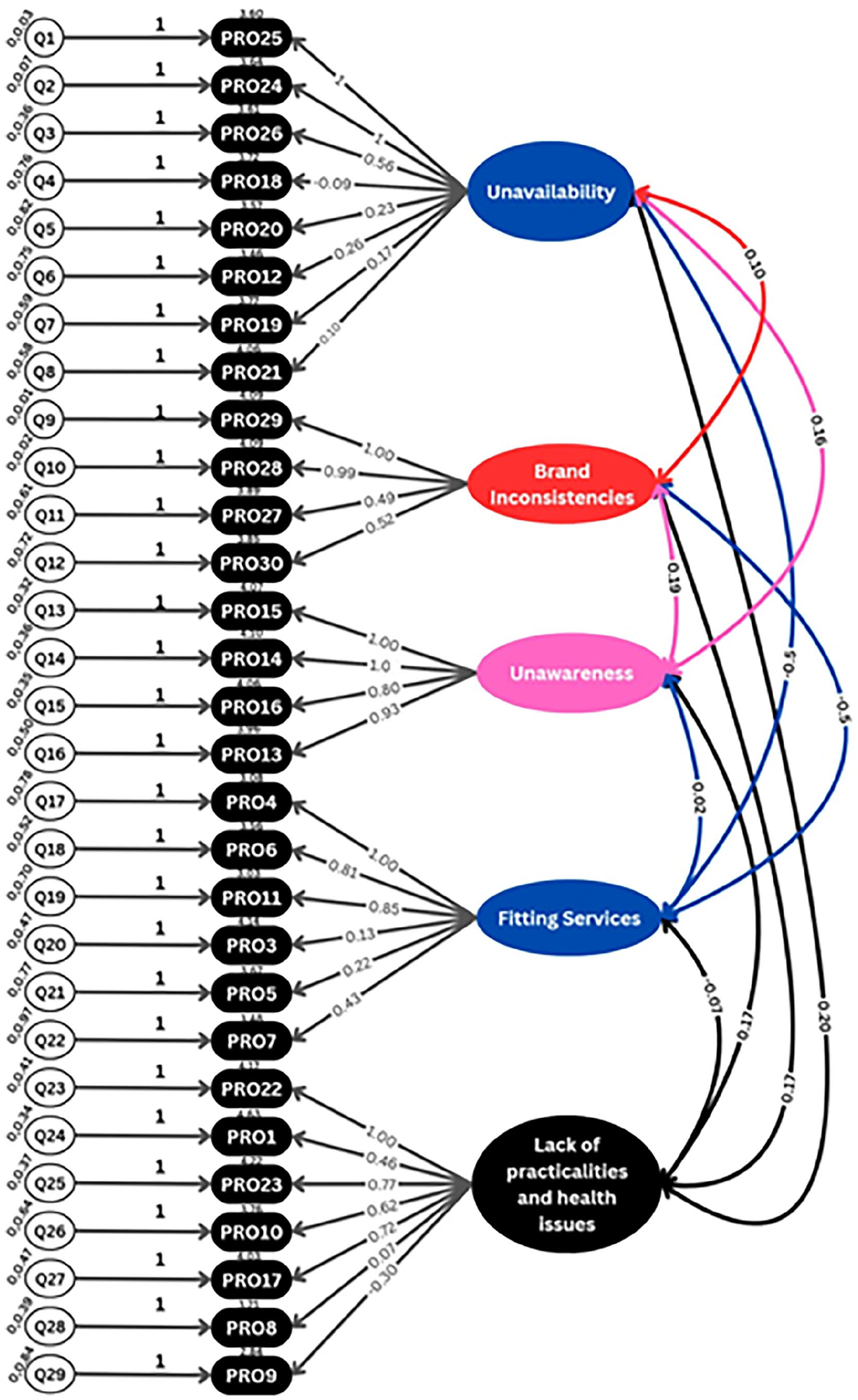
Path diagram and sub-dimensions (e = question).
SEM (Structural equation modeling) analysis.

p = 0.001.
In our study, we have outlined five research hypotheses that will be addressed in the modeling of mediation using Structural equation modeling
The whole latent construct’s findings are described in Table 4. The first part was related to the acceptance or rejection of our hypothesis. The p-value less than 0.05 will be considered significant. Explicitly, the achieved findings propose discarding the null hypothesis and accepting all hypothesis 1 2, 3, 4, and 5 as for all hypothesis the p-value is less than .001. A composite reliability (CR) value of greater than 0.7 is required to achieve construct reliability, in our study, it is greater than 0.7 for all hypotheses. The term “Supported” was used by authors to classify the presented research hypothesis as noteworthy.
The diagonal covariance between factors should be less than 0.8, in our study it is less than 0.8 for all factors. All the factors correlate to each other. Values between observed and latent variables should be above 0.7, Table 5 shows the factors that have values above 0.7.
Correlation between observed and latent variables.

Many women rely on a trial-and-error method to find their bra size due to a lack of awareness about the proper bra sizing system. This can lead to discomfort and health issues. As the result shows in Figure 2, 84% of women didn’t have awareness related to the bra sizing system and they also lacked bra style feature knowledge.

Unawareness related to the bra sizing system.
Wearing a bra 24 h a day can lead to various health issues. Women must understand when and how to wear a bra properly to avoid problems like restricted blood flow, skin irritation, breast pain, and back pain as well. About 79% of women wear bras 24 h a day which causes health issues as shown in Figure 3.

Unawareness related to bra wearing need and duration.
Addressed to the direct effect constructs, lack of availability of bras in large bands as well as cups leads toward wrong bra size selection. In our survey, it was found that 84% of women respondents faced this problem of lack of availability of the required size as shown in Figure 4. Different breast shapes require different bra styles, which are not commonly available in the market. Lack of availability of large sizes and appropriate styles of bras women have to buy whatever is available in the market, which leads to serious health issues like breast pain and lumps.

Unavailability of availability of required sizes.
Brand inconsistencies with respect to size as well as quality are another reason for wrong size selection. As per our survey results, 79% of women said that brand inconsistencies are the main reason for wrong bra selection as shown in Figure 5.

Brand inconsistencies lead to wrong bra selection.
It was found that 95% of women didn’t know the functionality of different bra styles as shown in Figure 6, therefore they were choosing bra styles just by intuition, in most cases which was negatively affecting women’s breast health.
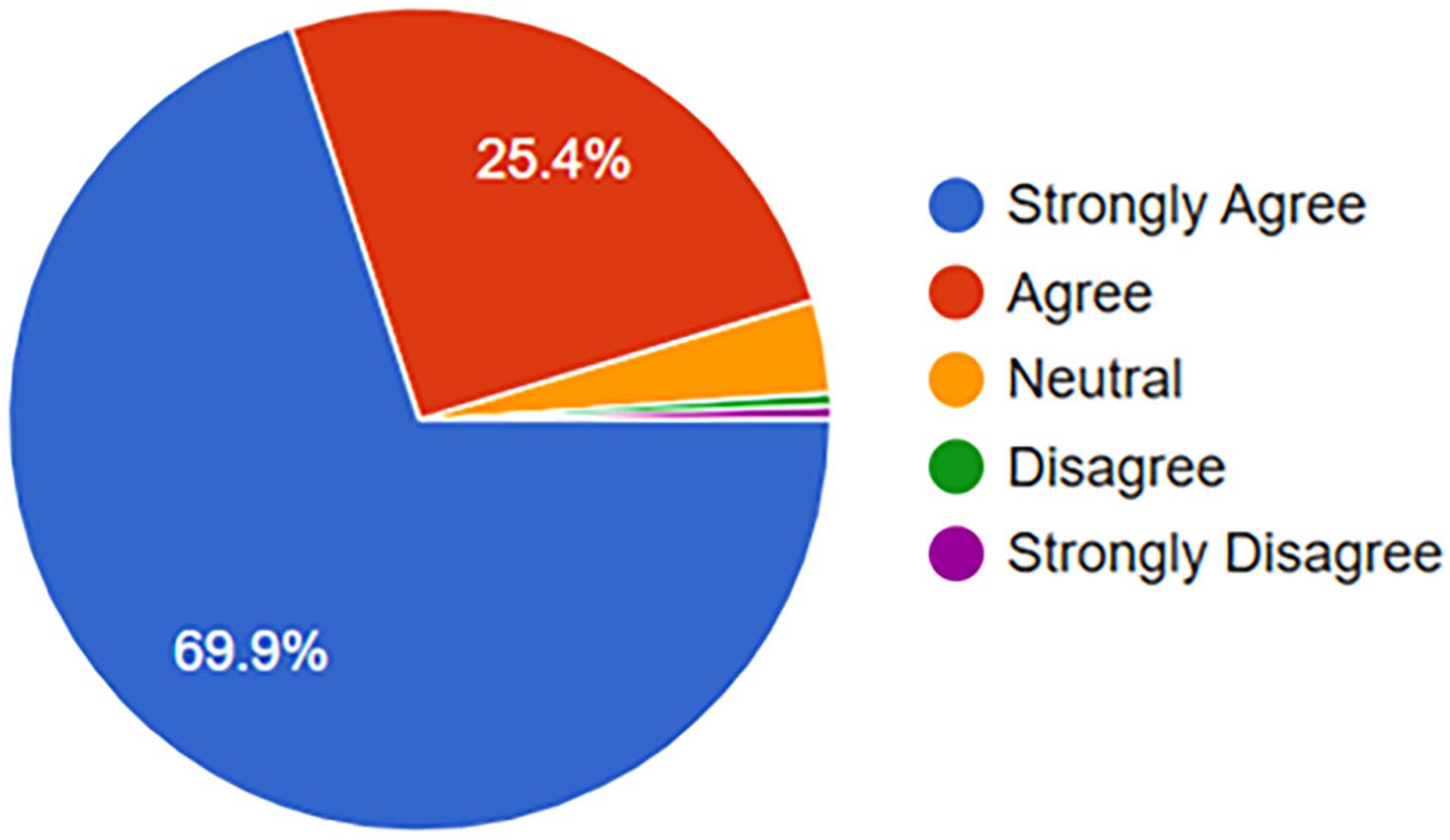
Unawareness related to the functionality of different bra styles.
Another major reason is the nonexistence of fitting services as shown in Figure 7. It was found that sales representatives were unaware of the bra sizing system as well as the functionality of different bra styles, therefore women were unable to get any guidance from them to choose the right size and style.

Lack of fitting services.
The lack of practicalities concerning bra components in currently available bras reduces bra comfort and functionality to a greater extent. Ultimately this results in serious breast health issues in most cases. Considering the above analysis, it was decided to develop a mobile application to guide women regarding how to extract breast measurements, functionality of different bra styles, sizing system, and components of bras that cause breast health.
Application development
After data analysis, a mobile application “Bra Guide” as shown in Figure 8, was developed in Android Studio using the Flutter framework. In our application, we used the following flutter packages:
Google fonts
Firebase core
Firebase auth
Cloud fire store

Mobile application “bra guide.”
Development of the application consists of the following steps:
The first screen uses dart language code which contains a gradient background, a logo, and one button.
The second screen was made using dart code and some widgets like text fields, buttons, texts, forms, and some container widgets
Login auths and signup is done using Firebase auth.
On the home screen there is a column widget in which there are two rows and each row contains two buttons. On the top right corner, we have a logout button that signs out the user from Firebase.
In problem mapping screens we use list builders to build buttons and circular avatar having images of buttons. Every problem screen has an image container and some text widgets.
Then we developed a bra-size calculator screen, and this screen contains some text field widgets, some alert boxes, and a calculator button. The calculate button uses logic and formulas and then calculates the bra size and then passes this result on to the other screen. For bra size calculation, we need to give two measurements as input, one is band size (circumference under breast circumference), and the other is cup size (circumference of body at fullest point).
Lastly, for a suitable bra screen, it contained a list builder to build lists of body type widgets. For selection purposes, we used a gesture detector to select the desired body type from the list.
After selection, we use a navigator to navigate to another screen and show the desired results according to selection.
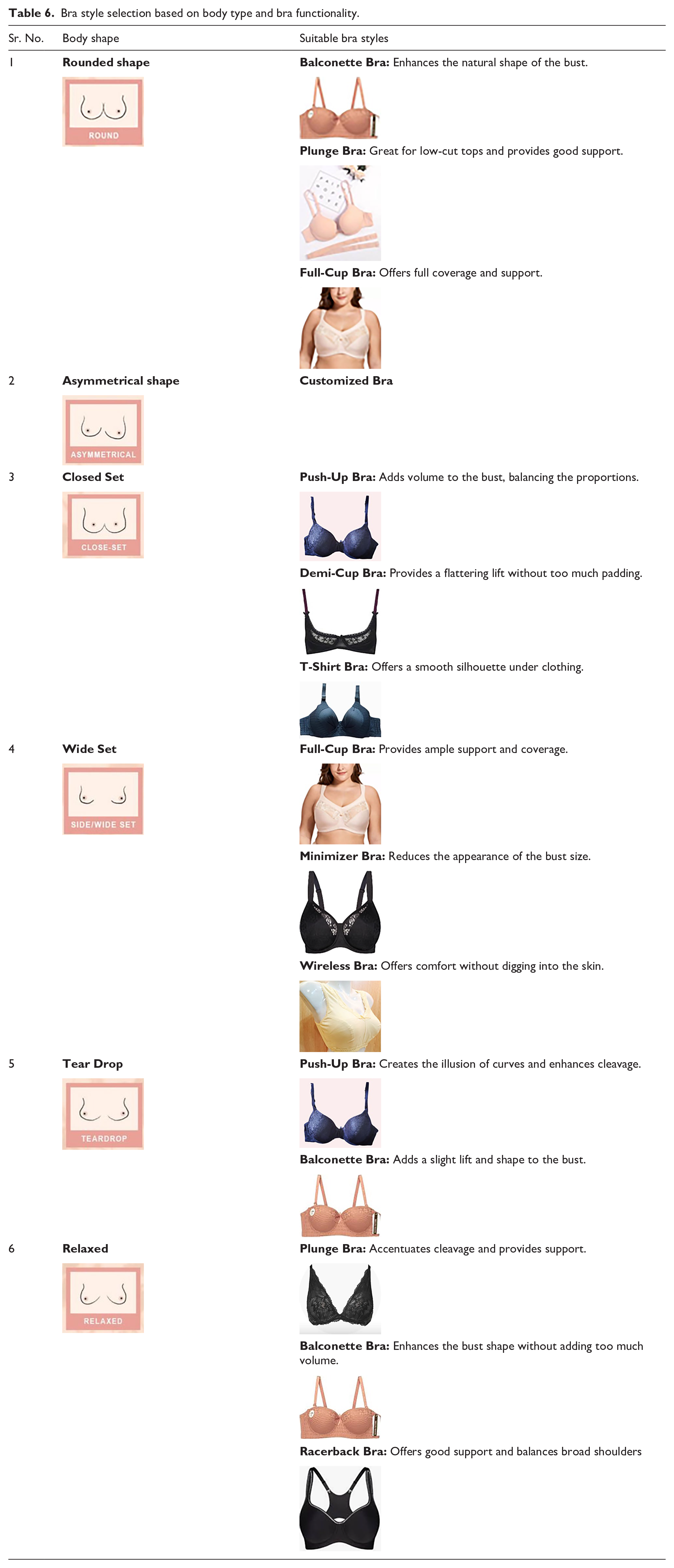
Selection of bra style is based upon selection of body type 33 and required functionality of the bra as shown in Table 6. There are multiple suitable bra styles for one body shape based on user requirements of functionality and esthetic needs.
Bra style selection based on body type and bra functionality.
After mobile application development, it was shared with doctors and garment engineers for a pilot study. After successfully conducting a pilot study, it was shared with our survey respondents. Out of 250 respondents 228 which is 91.2%, said they were highly satisfied, they rated it with five stars, because by using this application they got to know how to extract their sizes accurately, which helped them to select correctly fitted bras. They further added that it created awareness to select, the best suitable bra style as per their body types. It provided a better understanding of different international bra sizing systems that are being followed by different local manufacturers. Furthermore, it helped them to understand the interrelationship between different brand sizes and to identify fitting problems in bras that they were currently using. This application enabled them to identify bra component causing problem that is, shoulder straps, cups or under band, which was leading to health problems like breast pain, shoulder pain, and skin damage. Out of 250 respondents, 15 which is 6%, rated the application with four stars and seven respondents didn’t rate the application.
Conclusion
Selection of the right size and style of bra is very important as it is a body-fitted garment and wrong selection leads to serious health issues. In the current study, factors were analyzed that led to wrong bra selection. It was observed that the main reason behind wrong bra selection was the unawareness of women regarding extraction of breast measurements and selection of the right size. The second most dominant factor was the unavailability of bra fitting services. Therefore, our approach by developing a mobile application was not to rely on the tape measure to establish bra size, but to educate women and give them the power to assess their bra fit. Mobile Application “Bra Guide” helped in educating women about selecting accurate bra sizes and styles by providing awareness regarding, how to extract body size and suitability of the best bra type as per their body shape. This mobile application literate women of Pakistan about breast health problems that were caused by wrong bra selection, and it ultimately helped in improving their breast health and quality of life.
Women’s breast motion is not properly supported in currently available bras in markets and thus leads to physical discomfort and shoulder/neck aches caused by the straps hurting into the shoulders of the users. It is planned to collaborate with different brands of intimate apparel for possible integration of this application so that women can select better sizes and styles and the risks of various medical diseases be reduced. In the future, studies regarding bra shoulder strap design should be focused on the development of material that is dynamic in nature and further can respond to stresses by enhancing the material thickness in the shoulder area. Furthermore, researchers should also consider physical changes in women’s bodies during bra design-related research activities. These changes include the menstrual cycle, pregnancies, and medication impacting the body’s condition.
Footnotes

Funding
The author(s) received no financial support for the research, authorship, and/or publication of this article.
Declaration of conflicting interests
The author(s) declared no potential conflicts of interest with respect to the research, authorship, and/or publication of this article.