



Abstract
This study assesses the feasibility of utilizing an invasive and inedible pufferfish species (Lagocephalus sceleratus) for non-food purposes, aiming to help control its population in the Mediterranean Sea. Previous research suggests that the skin of the pufferfish holds promise for yielding valuable and environmentally friendly exotic leather. We investigate various tanning methods to convert pufferfish skin into leather, providing the first comparative analysis of its kind. Our primary focus is to characterize the properties of this leather and offer essential insights for its utilization across different product categories. Industry-standard tests were conducted to assess the quality of the leather, which was then compared with conventional leather. We illustrate how such products can be developed through interdisciplinary collaborations. Our findings clearly demonstrate the high potential, quality, and feasibility of converting invasive pufferfish skin into leather and related products, thus opening avenues for its integration into the fashion industry. Furthermore, we showcase the creation of leather accessories and shoes to highlight potential applications, alongside an analysis of sewing and processing capabilities. In conclusion, this study meticulously presents a successful case study for managing one of the most severe marine invasive species in the Mediterranean Sea under a blue economy framework, while also introducing it as a new textile option for the fashion industry as a novel eco-friendly exotic fish leather alternative.
Keywords
Introduction
As global human populations continue to grow, the demand for the Earth’s finite resources exceeds what can naturally replenish. This phenomenon is evidenced by the global ecological footprint, which quantifies the natural resources consumed to sustain human activities, including waste generation. Presently, the ecological footprint mirrors the Earth’s capacity in 1970, yet by 2023, it indicates a necessity for the natural resources produced by 1.75 Earths to support the current population. 1 Such an imbalance is alarmingly high and poses significant unsustainability concerns for the near future. Among the leading contributors to environmental degradation is the fast fashion industry, highlighting the urgent need to validate and integrate sustainable alternatives within the textile and fashion sectors.
Biodiversity is a cornerstone of human health and well-being, which is currently facing a global crisis. 1 Consider the underwater world in the coral triangle, so teeming with life that the loss of one or two species would go unnoticed; But with an already degraded ecosystem that has already lost all the buffers it could afford, the loss of a few additional species could trigger a tipping point, and the rapid decline or even collapse of ecosystem function. 2 Invasive species are one of the main drivers of biodiversity loss, and this threat is strongly increasing with time as the topic is better investigated. In fact, about 60% of land and marine species extinctions are attributable to alien species, as they often outcompete native species for space and nutrients. 3 Alien species are those that are transported by human mediation to a new region. They can become invasive after they successfully establish new populations, and have negative effects on the biodiversity, human health, or the economy. 4
In the Eastern Mediterranean Sea, most invasive species arrive through the Suez Canal, which artificially connected two very distinct bodies of water- the very faunal rich Red Sea with the nutrient deficient Eastern Mediterranean Sea. 5 Most marine invasive species arrive from Indo-Pacific origin to the Mediterranean through shipping vectors such as ballast water or biofouling. 6 The Eastern Mediterranean Sea in particular suffers from both its ultra-oligotrophic nature (devoid of nutrients), 7 and excessive overfishing, which has removed most of the top predators that have a very important role in ecosystem regulation. 8 With an already compromised Eastern Mediterranean ecosystem, there is some space for newcomers to thrive. In the Turkish portion of the Mediterranean Sea for example, as of 2020, there were 419 marine alien species recorded 9 with approximately four new species arriving through the Suez Canal each year. 6
The silver-cheeked toadfish (Lagocephalus sceleratus) stands out as one of the most detrimental invasive species in the Eastern Mediterranean region. 10 Its presence was first documented in Türkiye in 2003, 11 and since then, it has proliferated across the entire Mediterranean basin, even infiltrating the cooler and less saline Black Sea. 12 This species imposes numerous negative impacts, including: (1) posing a severe toxicity risk when consumed, resulting in numerous human fatalities in the Eastern Mediterranean due to poisoning incidents 10 ; (2) attaining considerable sizes, with individuals reaching weights of up to 10 kg, thereby diminishing native biodiversity as they establish themselves 13 ; (3) displaying aggressive behavior toward swimmers in rare instances; 10 and 4) developing a habit of preying on fish already ensnared in nets and longlines, leading to significant losses for fishers in terms of gear damage and reduced catches from depredation.14,15 The species faces minimal predation, likely attributable to its toxicity and its ability to inflate and erect spikes when threatened.13,16-18
Given the impossibility of eradicating established alien species in marine environments due to the three-dimensional nature of the sea and the widespread dispersal of larvae, the only viable option to mitigate their impacts is population control. Both Türkiye and Cyprus have initiated bounty programs to incentivize fishers to capture silver-cheeked toadfish. However, while bounties can serve as an effective control measure if funding is unlimited, this is rarely the case. Consequently, once funding diminishes, so does the control effort.18,19 Therefore, the most prudent and practical approach for managing invasive species, particularly the most severe cases, is to commercialize them. This strategy ensures ongoing removal efforts can sustain themselves over the long-term. 13
Although the practice of tanning fish skins into leather has ancient roots spanning from the Canadian Arctic to Ancient Egypt—where the oldest evidence of organic tanning dates back approximately 5000 years 20 —the fish leather market is experiencing growth, accompanied by an expanding range of fish species utilized within the industry. Among the most commonly utilized fish species in terms of sales are salmon, perch, wolfish, and cod, while numerous other species, including stingray, shark, seasnake, grouper, eel, and dolphinfish, are also present in the market. With sustainability considerations becoming increasingly integral for fashion brands, a novel niche industry and market are emerging. These ventures utilize invasive species targeted for control, offering the fashion industry leather that is genuinely eco-friendly and environmentally positive. Notably, the removal of these invasive species yields tangible benefits for the marine ecosystem, local communities, and the economy.
In a prior study conducted by the second author, an investigation into Pufferfish Leather (PFL) involved a comparative analysis with lamb and ostrich leather, focusing on their physical, chemical, and thermal characteristics. 21 The study revealed variations in pufferfish skin properties across different areas, primarily attributable to surface characteristics. Despite this variability, the thickness of PFL remains relatively consistent post-tanning, ranging between 0.4 and 0.6 mm. Notably, despite its thinness, PFL exhibits considerable strength. Furthermore, it demonstrates dimensional stability even under humid and high-temperature conditions, meeting the criteria for an alternative leather material. The strength and rigidity of PFL could potentially be enhanced through tailored tanning methods in future applications. These findings, representing the first comprehensive exploration of PFL properties across various tanning methodologies, establish a crucial foundation for ongoing research and the production of end products in this domain.
In this study, we devised specialized tanning techniques tailored for pufferfish leather (PFL) and investigated its dyeing capabilities across a spectrum of colors. Our research endeavors encompassed achieving a diverse color palette and scrutinizing the influence of novel tanning and dyeing methods on the physical and mechanical attributes of PFL. Additionally, we leveraged the resultant leathers to fabricate various product designs and prototypes. These exemplar product designs serve as pivotal demonstrations, illustrating the potential applications and guiding future trajectories of such investigation.
Using pufferfish leather (PFL) turns its burdens into benefits, from controlling and negating some of its negative impact on native biodiversity, fishing gear, and human health, to kickstarting a new blue economy sector. The World Bank definition of the blue economy is “the sustainable use of ocean resources for economic growth, improved livelihoods and jobs while preserving the health of the marine ecosystem,” a vision perfectly embodied by this endeavor.
Materials and methods
The research primarily revolves around the capture, tanning process, and the impact of different tanning methods on the properties of pufferfish leather (PFL; Figure 1). Several fishers were recruited for this project and were first trained in proper skin removal techniques, waste disposal and salting techniques. The fish skins were first sun dried to remove most of the moisture before they were generously salted with coarse lake salt.
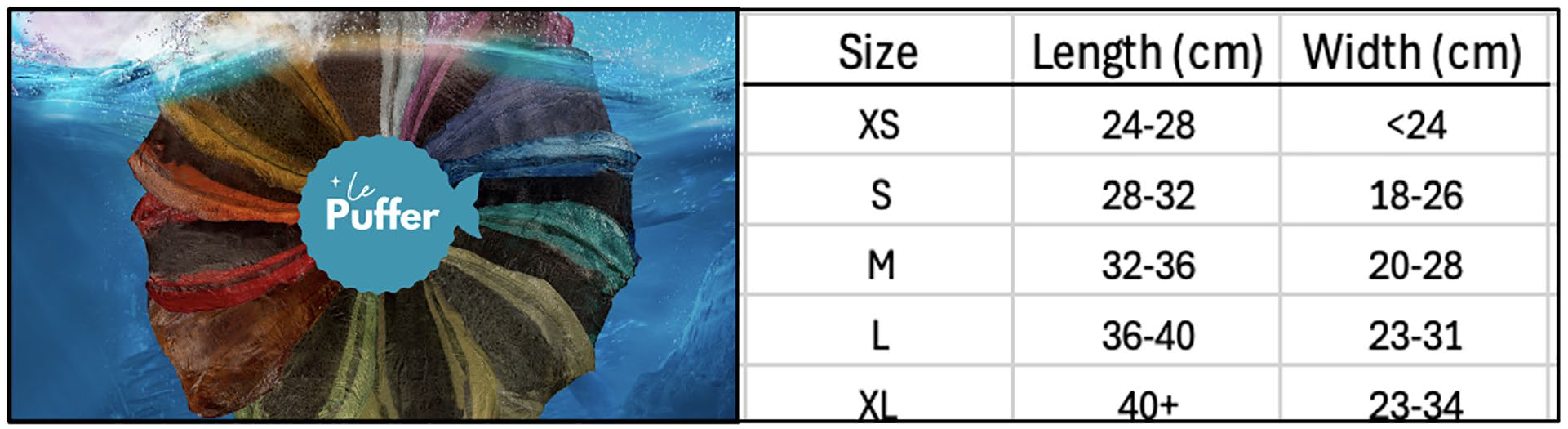
Various different colors of tanned PFL (left), and a size scale that was applied to the PFL samples (right).
After salting, the skins were personally deliverd to a professional leather tanning facility in Usak, Turkiye. A specialized tanning technique for pufferfish skins was trailed and developed within 15 months of the study’s scope from late 2022 to January 2024, and this distinctive resultant methodology was employed using various tanning formulations. The tanning process for pufferfish skin was standardized and scaled up to industrial level, resulting in consistent and efficient production with uniform quality. Through these initiatives, efficient and industrially viable formulations were identified, and an analysis of skins exhibiting optimal properties was conducted as part of this study. Both traditional chrome-based tanning and fully organic tanning methods were trialed. The traditional chrome-tanned PFL samples were tested and analyzed for comprehensive technical analysis, paving the way for potential commercialization. A series of tests were conducted to assess the suitability of PFL as a novel material for accessory and footwear production, as well as its broader applicability within the fashion industry. All tests described below were conducted at room temperature, meticulously following international industry standards to ensure the reliability and consistency of results. Various product designs were conceptualized and brought to life through collaborations with industrial companies in Istanbul. Additionally, our team conducted production experiments led by leather-making experts in Fethiye, Türkiye. This dual approach allowed for a comprehensive exploration of design possibilities and manufacturing techniques, combining the expertise of both industrial partners and skilled artisans to achieve innovative and high-quality products. Direct collaboration with industry professionals facilitated the evaluation of the leather’s performance, particularly in terms of shaping and sewability. This collaboration serves as a notable example of university-industry cooperation’s and underscores the value of expert assessment in evaluating material characteristics.
These results following industry standard tests are presented here in the following order: Determination of Azo colorants, chemical determination of Chrome VI, determination of leather-flex resistance, color fastness, abrasion resistance, water permeability, leather-tear determination, and tensile strength and elongation percentage.
Results and discussion
Exotic leather denotes hides sourced from rare and non-industrial animal species, characterized by unique textures, patterns, and colors, rendering them prized and opulent materials. Extensive literature explores various types of exotic leathers, delving into their attributes, processing techniques, applications, and sustainability considerations. Among the array of exotic leathers examined are those derived from crocodiles, snakes, alligators, and other rare animal species, commonly utilized in the crafting of footwear, handbags, wallets, apparel, and upscale accessories. However, the trade and utilization of exotic leathers are fraught with controversy stemming from legal complexities, supply chain sustainability concerns, and ethical considerations regarding animal welfare. The sustainability and ethical implications surrounding the use of exotic leathers stand as focal points of ongoing research within this domain, underscoring the necessity for further studies to elucidate and address pertinent issues.
The comprehensive findings of the study are summarized in Table 1. For more in-depth analyses, particularly regarding thermal performance, readers are directed to our previous study. 12 As these properties are unaffected by tanning, they were not retested with the newly developed tanning method. Visual representations of the obtained leathers are presented in Figure 2. As evidenced by the images, the leathers exhibit distinct patterns, rendering them unique and possessing considerable potential as raw materials. These patterns offer endless natural design opportunities, thereby constituting a valuable asset within the contemporary fashion accessory design space.
General PFL test results.


Different colored PFL leathers (Azul, Sunset and Pink Fondant, exclusively).
The tensile test results for PFL leather, considering its directional orientation, demonstrate considerable promise. An average breaking strength of 30 N/mm² was achieved when tested along the length of the fish, while a tensile value of 20 N/mm² was obtained when evaluated across the width of the skin (Figure 3). Considering the average thickness of 0.4 mm, it becomes evident that PFL leather possesses an ideal strength profile. Furthermore, it can be inferred that the strength properties remain unaffected by the tanning process.

Strength and abrasion testing result photographs (after 10.000 rubs).

(a) Thickness measurement areas and (b) fibriallar structure of the PFL. 12
An interesting finding during the study is the fibrillar structure of the leather. This fibrillar structure enables the leather to exhibit high levels of expansion and contraction, providing exceptional flexibility. This flexibility is crucial for product design as it allows for 360° design possibilities, enhancing the versatility and usability of the leather in various applications.
In the final phase of the study, innovative designs were presented to illustrate the transformation from the ecological challenge posed by pufferfish to the fashionable and sustainable potential of the resulting leather products. The primary emphasis was placed on designing and manufacturing various shoe models (Figures 5 and 6), which hold significant potential for widespread use and customer appeal. Additionally, diverse leather accessories such as cardholders, and purses were made by local leather experts to illustrate various applications of PFL (Figures 7 and 8). The principal objective of these endeavors is to address the considerable environmental and biodiversity impact stemming from invasive pufferfish populations by commercializing them, thereby curbing their proliferation for native biodiversity and fishers. Another advantage lies in potentially empowering the fashion industry, a significant contributor to rapid consumerism, to make a positive environmental-friendly contribution. The design examples were conceived with different designers, to showcase the potential for infiltration into fashion by this invader. Effective design possibilities were explored by integrating PFL with traditional leather, textile structures, and metal accessories. PFL was reinforced with other materials (especially cow leather for the leather accessories) to ensure the requisite thickness the products demand across various designs. All processes were meticulously monitored, with PFL demonstrating robust structural integrity, particularly during shoe fabrication.

Soccer (football) cleat samples made for this study in collaboration with LIG Shoes, Istanbul, Türkiye.
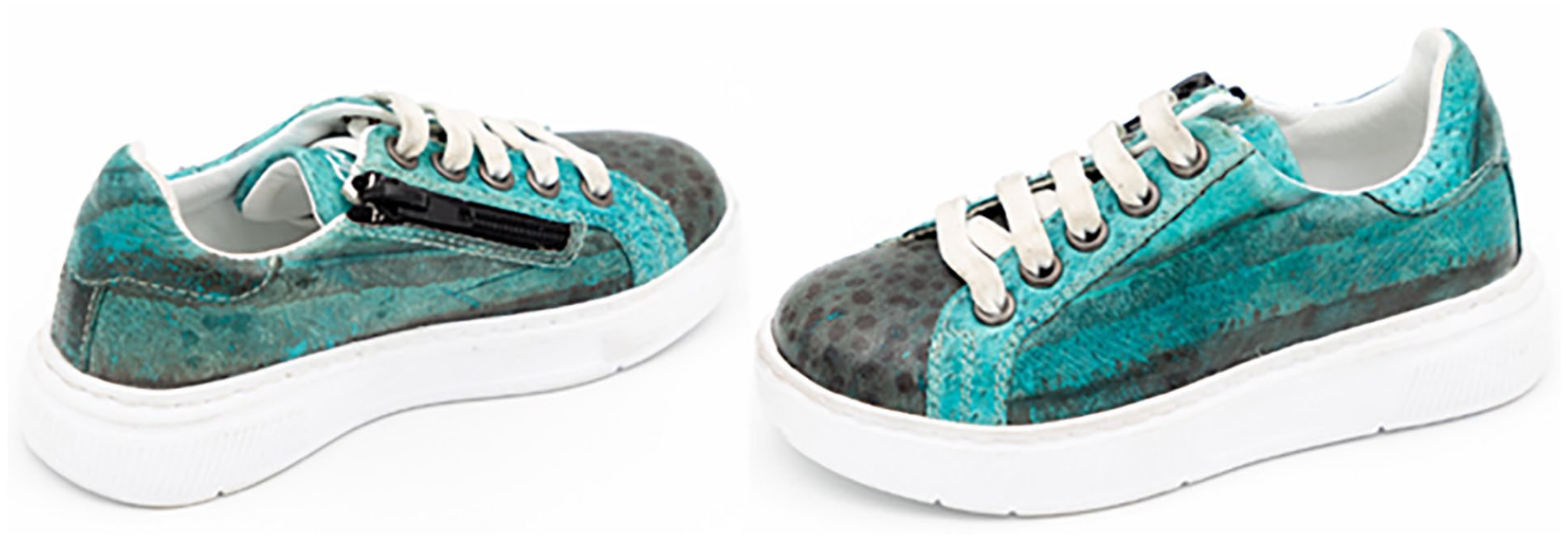
Children’s shoes made by Turkish Footwear Research Institute (TASEV).

Three designs of children’s shoes (size 34) were crafted using pufferfish leather at Erfe Group in Istanbul (top runners, middle boots and bottom leather high-top runners).

An assortment of leather accessories made from PFL (from left to right: jewelry case, cardholders and clutches).
Both hand and machine-based sewing experiments were conducted in this study (Figure 10) with the shoes all sewn by machine, and the accessories all sewn by hand here (Figures 8-10). Throughout the research, considering all sewing techniques and designed samples, it was observed that various sewing techniques and geometries can be applied to PFL leather effectively with the appropriate selection of thread. The flexible nature of the material enhances the performance of these stitches, contributing to improved outcomes.

An assortment of leather pouches made using pufferfish leather with local leather designers in Fethiye to showcase the PFL natural design, PFL combined with cow leather here for reinforcement. From top left in a clockwise direction, sand, pink, turquoise, and blue tanned PFL leather were used.
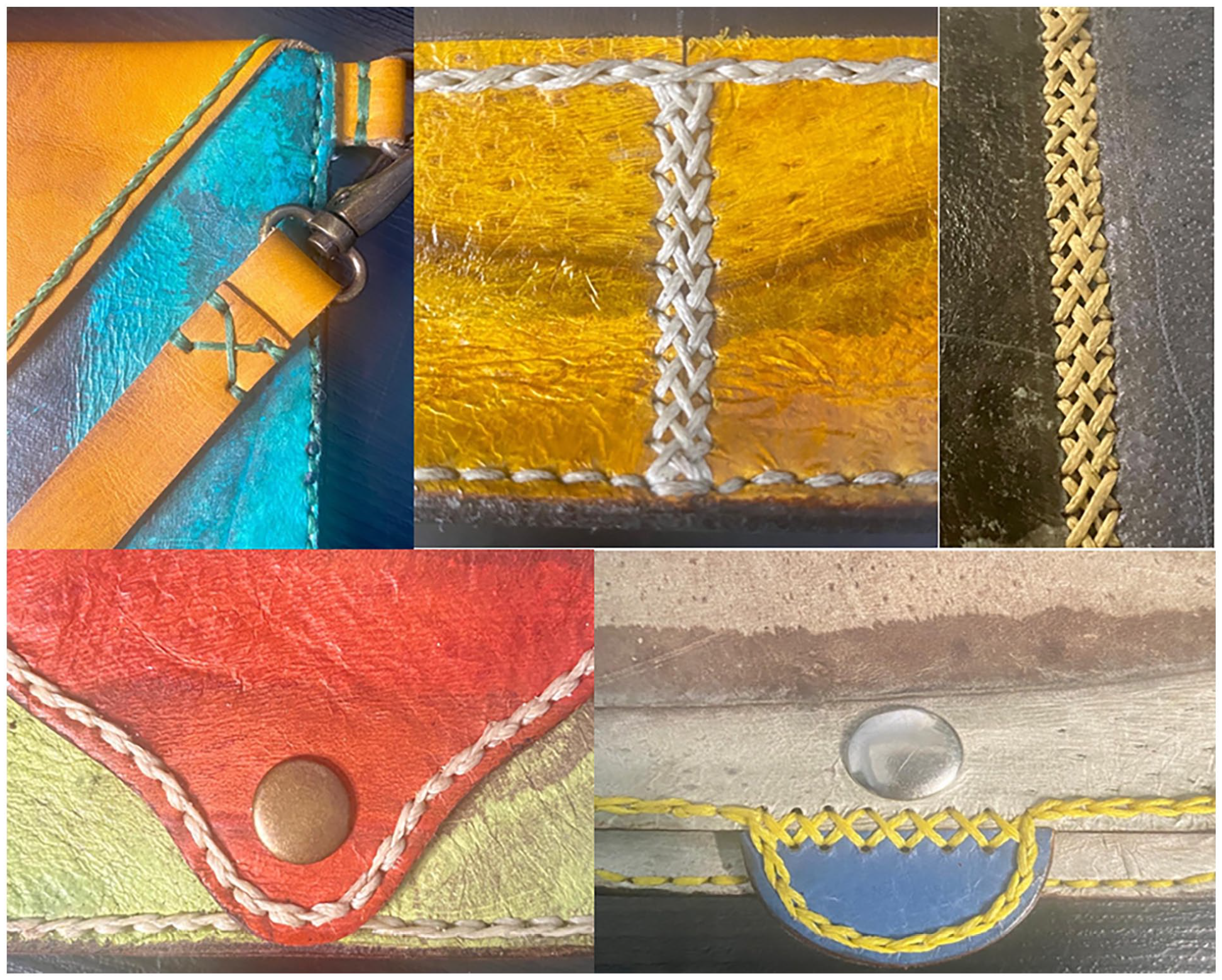
Various types of stitchings applied to the PFL.
In general, the performance of seam openings was found to be quite high, indicating robust and reliable stitching. There was no observed seam slippage or separation in the seam areas. Additionally, the stitching process resulted in the formation of a closed structure with minimal pores in the stitch area. This closed structure further contributes to the durability and quality of the sewn products.
Conclusion
Upon reviewing the test results conducted within the study’s framework, it is evident that PFL leather fulfills the requisite criteria for a new leather type meeting the global industry standards. This study encompasses the entire process, from sea to final product, amalgamating fisheries, science and design, thereby contributing to biodiversity preservation and sustainable fashion. The comprehensive evaluation of all processes, particularly the implementation of industrial production in the product manufacturing phase, holds paramount importance in assessing the leather’s potential. The successful establishment of a full color palette has paved the way for endeavors aimed at enhancing sustainability through the adoption of natural and artificial dyes. The concept of fashion derived from waste presents a more robust and forward thinking framework than conventional approaches. The introduction of pufferfish into the fashion industry represents a bold stride, considering that the textile, leather, and fashion sectors rank among the world’s most polluting industries. The creation of products and positive reception from colleagues as potential future customers stand as additional positive outcomes of this study. In summary, this article delineates the culmination of a project that transforms harmful fish from burdens to a new textile choice for the fashion industry with many novel valuable benefits that are passed on to the consumer.
Footnotes
Acknowledgements
We would like to express our gratitude to TASEV, İçten Spor Ayakkabi San.Tic.Ltd.Şti. and Erfe Group Company for their collaborations for the shoe samples and their continual support of the project.

Funding
The author(s) received no financial support for the research, authorship, and/or publication of this article.
Declaration of Conflicting Interests
The author(s) declared no potential conflicts of interest with respect to the research, authorship, and/or publication of this article.