



Abstract
Textile and fiber materials lead in combination with nanomaterials to innovative and functional products of high scientific interest. However, also industrial and consumer products are based on this combination. With this background, the current review presents and categorizes different nanomaterials in respect to their application on textiles. The main goal of the current review paper is to present nanomaterials and its possibilities in combination with textiles for achievement of new and functional materials. For this, several types of materials are presented in detail, as sol-gel coatings, effect pigments, electro spinning and many more. Also, a view on several applications and functionalities is given, as photoactivity, luminescence, antimicrobial properties etc. Altogether a structural paper is supported guiding the reader through this topic concerning those innovative materials.
Introduction
The combination of nanomaterials and textiles seems in the first and common view to be the combination of an innovative future oriented technology together with a traditional and conventional material as a textile. However, this first view is not justified by facts. Nanomaterials were already discussed and described more than 100 years ago by the German chemist Wolfgang Ostwald. Mister Ostwald 1 described colloidal particles in his famous book “Die Welt der vernachlässigten Dimensionen.” Also, textiles are not simple conventional. Many textiles and fiber materials exhibit high performance or advanced functional properties finding applications in demanding environments.2–6 Examples are automotive textiles, fiber bases filters, flame-retardant clothes, high strength ropes, and many more.7–11 For first conclusion, if nanomaterials are combined with textiles, none of both materials is inferior against the other. It is more like that, two materials with high potential are combined to gain finally a new product with innovative and advantageous properties.
After this short introductive statement, it should be defined what are really nanomaterials and what are textiles. According to the Oxford dictionary, a textile is defined as “A type of cloth or woven fabric.” 12 More generally a textile could be defined as a fiber based two-dimensional object. This two-dimensional object can be for example, a woven or knitted fabric but also a non-woven fiber felt. However, beyond this traditional two-dimensional approach also three-dimensional objects are realized by knitting or weaving of fiber materials and used for industrial applications.13–15
Different definitions are given to specify, what a nanomaterial is. Following a broad and simple approach, a nanomaterial is a material with at least one length scale of nanometer size. 16 However, often materials with a size up to 100 nm are named as nanomaterials. Of course, such materials could be also named as sub-micrometer materials. 17 Historically the time period from 1995 to 2010 can be identified as boom era for development and new applications for nanomaterials.18–20 During this optimistic era, the term “nano” was also used as marketing tool to promote products. In consequence, also quality labels for nanotechnology containing textiles were implemented. 21 Unfortunately, after that optimistic period the public view on nanomaterials changed especially in Europe, so in public discussion more the possible health risks of nanomaterials are discussed instead being fascinated by excellent material properties.22,23 For this reason, nowadays many products containing nanomaterials are not specified as nano containing product. Impressive examples for this change are cosmetic products with antimicrobial effects, which were some years ago promoted as nanosilver containing. Today, products are offered with the statement “containing microsilver.” 24
Next it should be discussed, how in principle a nanomaterial can be combined with a textile (Figure 1). In a first simple approach, a nanomaterial with new properties is deposited onto a surface of a textile transferring the nanomaterial properties to the textile substrate. Examples for this approach are the deposition of silver nanoparticles for realization of antibacterial textile fabrics or the deposition of carbon nanotubes to realize textile materials with electric conductivity.25–27 The deposition on the textile surface is only one method to make the contact of nanomaterials to textiles. The nanomaterial can be also embedded inside the textile fiber during the spinning process. 28 Also, nanomaterials can be embedded in a coating on the textile surface or they can be even the coating agent itself leading to a three-dimensional network deposited on the textile surface.29,30 This approach is related to the sol-gel technology and the application of nanosols on textiles.31–34 Finally, a fiber can be built up by a nanomaterial itself. Examples for this are fibers spun from carbon nanotubes (CNT) or graphene, which are also set into the category of new carbon based fibers.11,35,36 Even fibers with nanometer scaled diameters can be produced by electrospinning procedures, starting from fiber diameters around 10 nm up to diameters of several 100 nm.37–40 The different variations are schematically presented in Figure 1.
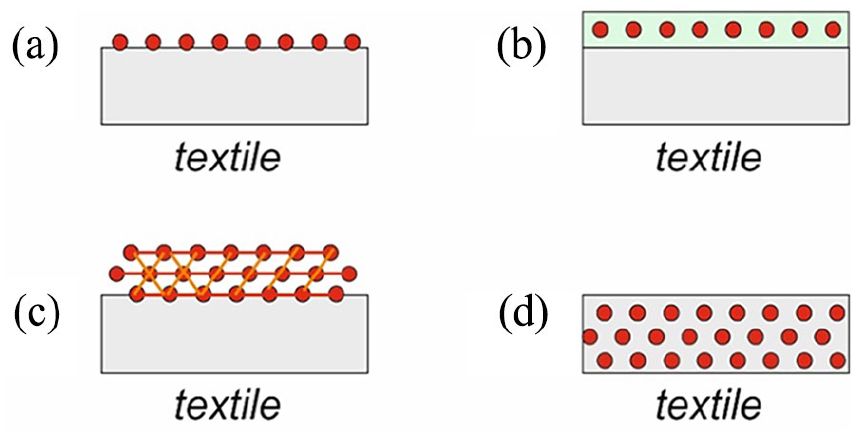
Schematic view on the combination variations of nanomaterials (here nanoparticles) with textile fiber materials: (a) deposited particles, (b) particles in a coating, (c) coating forming particles, and (d) particles embedded in a fiber.
In the relation of the three terms nanomaterial, textile and functional property it should be distinguished if the nanomaterial is the carrier of the functional property or if the application of the nanomaterial leads to the implementation of nanostructures leading to new and final properties. An example for the first case is the nanosilver particle, which is itself antimicrobial.25,26,41 The second case is demonstrated, for example, by applied silica particles leading to higher roughness on the textile surface, which are responsible for self-cleaning properties.42,43 Also, improved functional properties by deposited nanostructured films fit in this second case. If the nanomaterials are the carrier for the functional property, it has to be distinguished, whether this property is caused or is at least influenced by the nanosize of the material. 44 A schematic overview on different relations of nanomaterials and functional properties is presented in Figure 2.
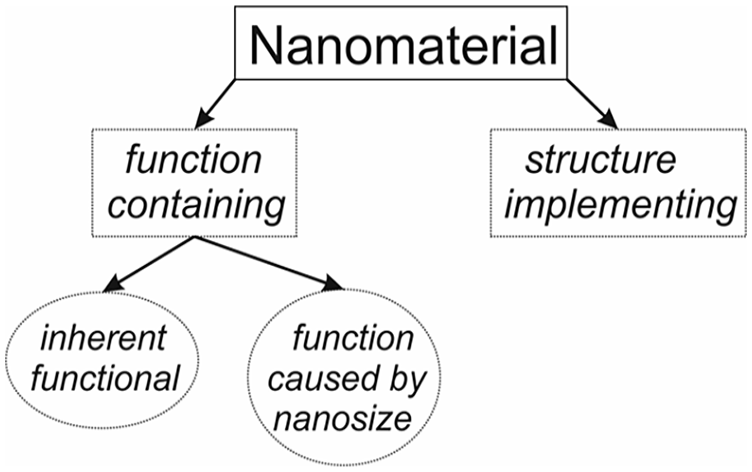
Schematic overview on the relation of nanomaterials and functional properties.
To support the reader a structured overview for nanomaterials and textiles, the following presentation is separated in two main sections. The first section is related to materials and how they are combined with textiles and fibers. The second section is related on functional properties and fields of applications.
Nanomaterials and combinations on textiles
This chapter supports an overview on different types of nanomaterials and how they are combined with textile and fiber materials. For each category of nanomaterial following a sub-section is supported. Hints on possible fields of application are given but mainly the fields of application are presented in following Section 4.
Nanoparticles
The nanoparticles are the classical and typical nanomaterial. Historically, before the naming as nanoparticles became popular, nanoparticles are often named as colloidal materials or solutions. 1 Even today the term “colloidal” is used to describe special products for advantageous applications as for example, colloidal silver or colloidal gold.45–50 Few decades ago also the terms “cluster,” “metal cluster” or “nano cluster” were more often in used.51–54
Nanoparticles stabilized in solution can be applied on textiles and fibers by simple dipping of the textiles into this solution.55,56 Alternatively, it is also possible to create nanoparticles directly on textile surfaces or in pores of fiber materials by reaction of ionic or molecular precursor compounds. A very prominent example for application of nanoparticles on textiles is the application of silver nanoparticles aiming for antimicrobial properties. Such silver nanoparticles can be easily produced in aqueous solution by reduction of silver nitrate AgNO3 in presence of a stabilizer limiting the growth of formed silver particles to keep nanometer size.25,57,58 By dip-coating these nanosilver particles can be deposited on a textile surface. A following drying process removes the adjacent solvent. Alternatively, the textile substrate can be impregnated with silver nitrate and the reduction leading to the in situ formation of silver nanoparticles is done on the textile itself.59,60 This in situ formation has the advantage that the silver ions (originally from the silver nitrate) can penetrate deeper in the pores of the textile fibers and the finally gained silver nanoparticles are placed more in the interior of the fiber. Finally, a better protection of the nanoparticles against abrasion or other external influences is supported.
An advantageous technique to prepare nanoparticular materials is the microwave technology which can be also used in combination with solvothermal processes.61–65 By this microwave synthesis, silver nanoparticles can be prepared with short process duration and used for application on textiles by dip-coating.66–68 Alternatively, this technique can support the formation of silver particles or titania particles in situ on textile substrates.69,70
Sol-gel technology
Excellent overviews on the complete field of sol-gel technology are given by Brinker and Scherer 71 and Hench and West. 72 For application of sol-gel coatings on textiles one first starting point is given by the German patent of Böttcher et al. 73 Around one decade later, the book Nanosols&Textiles supported a comprehensive overview on the possibilities of sol-gel technology for functionalization of textiles. 33
The main part of the sol-gel process is the liquid sol which can be described as liquid solution of meta-stable nanoparticles up to a size of 80 nm. This solution can be used as coating agent to apply the particles on a textile substrate, for example, by dip-coating, padding processes or spraying. A following thermal treatment leads to drying and fixation of the sol. By drying in a first step the solvent is removed. By fixation the deposited particles are grown together forming a three-dimensional network of inorganic particles leading to the final sol-gel coating. In some cases, this is also named as nanosol coating, due to the nanoscale of the particles in the liquid coating agent. Such nanosols can be easily produced by hydrolysis and condensation of metalorganic compounds like tetraethoxysilane TEOS (compare Figure 3). 74
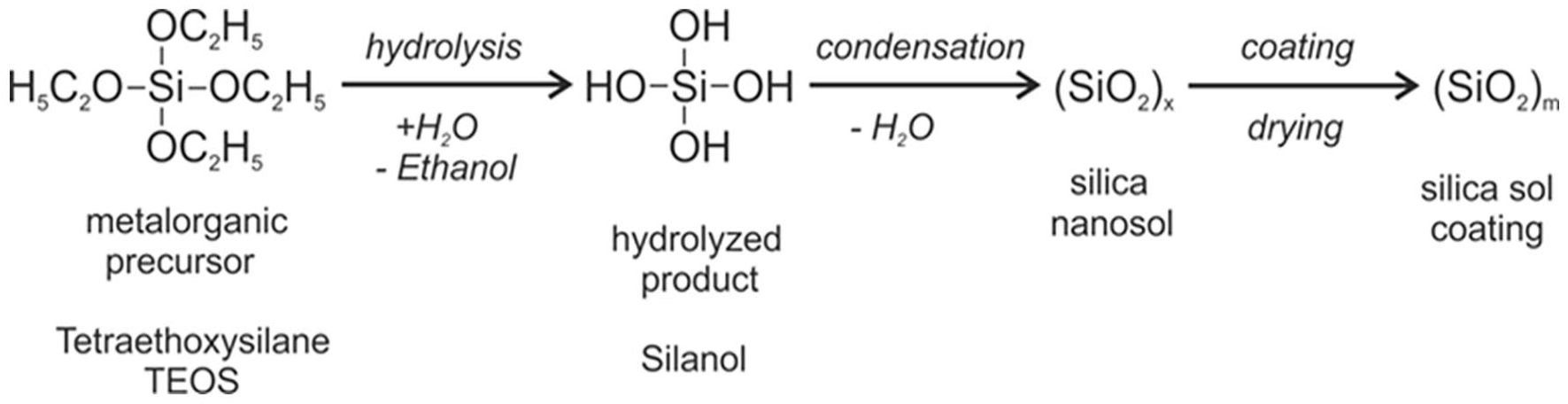
Schematically description of the sol-gel process with the example of a silica based nanosol prepared by reaction of the precursor tetraethoxysilane TEOS.
In a first step the alkoxy group is hydrolyzed under acidic or alkaline conditions. Second, the hydrolyzed components condensate and growth up to meta-stable particles which are part of the nanosol. These particles form the silica coating after coating process and thermal treatment on the textile substrate. The resulting metal oxide coating can be self-functional and this function is transferred to the coated textile. Appropriate examples for such self-functional sol-gel coatings are photoactive titania coatings or silica coatings improving the abrasion stability of a textile fabric. 33 However, in most cases the inorganic nanosol is modified to implement functional properties. In a simple manner for this modification a categorization can be done into chemical, physical, or biological modification.31,75
The physical modification can be described as embedding or encapsulation of a functional component into the sol-gel matrix. In such a way, dye molecules, carbon nanotubes or antimicrobial silver particles can be embedded into sol-gel coatings.76–78 The embedded component is not chemically bonded, so it can be also used to implement controlled release applications. A good example in this field is the release of fragrances from sol-gel coatings to realize textiles with an aroma therapeutic approach. 79
In chemical modification of sol-gel coatings, functional components are chemically bonded to the sol-gel matrix. This modification can be for example, done by co-hydrolysis and condensation of various organosilanes.31,75 The biological modification of a sol-gel coating is related to a combination of the sol-gel matrix to a biological system, as for example, biopolymers, enzymes, proteins or even complete cells.80,81 For such bio-modified sol-gel materials, the term biocers was implemented.82,83
Spin doping
Man-made fibers are produced by different spinning processes as melt spinning, wet spinning or dry spinning.84–86 In case of melt spinning, the fibers are gained from the polymer melt. If it is not possible to a gain a stable polymer melt, also spinning from polymer solution is performed – wet spinning or dry spinning processes. A prominent example in this field is the production of regenerated cellulosic fibers by using the Lyocell process.87,88 The modification of the fibers in the spinning process is possible by adding components to the spinning mass (either polymer melt or polymer solution). This type of modification is also named as spin-doping. The probable most often used spin-doping is the addition of titanium dioxide pigment particles to polyester and nylon fibers to realize opaque effects. 89 The embedding of higher content of titanium dioxide TiO2 leads to textile materials with protective properties against UV light. A prominent product example in this field is the Tencelsun fiber.90–92
By incorporation of components like barium sulfate BaSO4, barium titanate BaTiO3 or bismuth oxide Bi2O3 also a certain protection against X-ray and cosmic radiation can be implemented93–97
Lanthanum hexaboride LaB6 and cesium tungstate Cs2WO4 are absorbing components for near infrared light. Nanopigments of those substances can be embedded into PET fibers with the aim to realize IR-marked sewing and embroidery yarns useable for safety marking applications. 98
Finally, some advantages and disadvantages of spin-doping should be summarized. Most advantageous is probably that the nanopigments are embedded in the fiber materials – resulting to high stability against washing and rubbing processes. Disadvantageous is that the functionalization by spin-doping stands at the beginning of the complete production process for a textile product. This issue is similar for colored fibers produces by spin-dyeing processes. Here, a limitation of flexibility to react on the demands of the market is mentioned as disadvantageous. 99 For this, spin-doping with nanomaterials has also not the flexibility of alternative methods which are modifying already produced fabrics or even functionalize a readymade piece of clothing.
Effect pigments
Effect pigments are commercially available products mainly used to realize special optical effects, those are high reflectivity, special metallic or shining appearance. Usually it is distinguished between metal effect pigments and pearlescent effect pigments.100–104 The main structural feature for all effect pigments is their plain geometry, which is responsible for the high reflectivity – best described as a kind of mirroring effect. The diameter of plain effect pigments can be up to 50 μm or more, while the thickness of the effect pigment is several orders of magnitude smaller (<100 nm). For this, by view on the small thickness of effect pigments, it is justified to name them as a kind of nanomaterial. 105 An example for a metal effect pigment is shown in Figure 4. Here, an aluminum based effect pigment with so-called “silver-dollar shape” is presented, which is used to realize high reflective coatings. Metal effect pigments can be made from pure metals. However, mainly they are made from alloys as for example, gold bronze pigments. Important is also the surface treatment of effect pigments or their coating, which is often necessary to stabilize the pigment and avoid corrosion.106–109
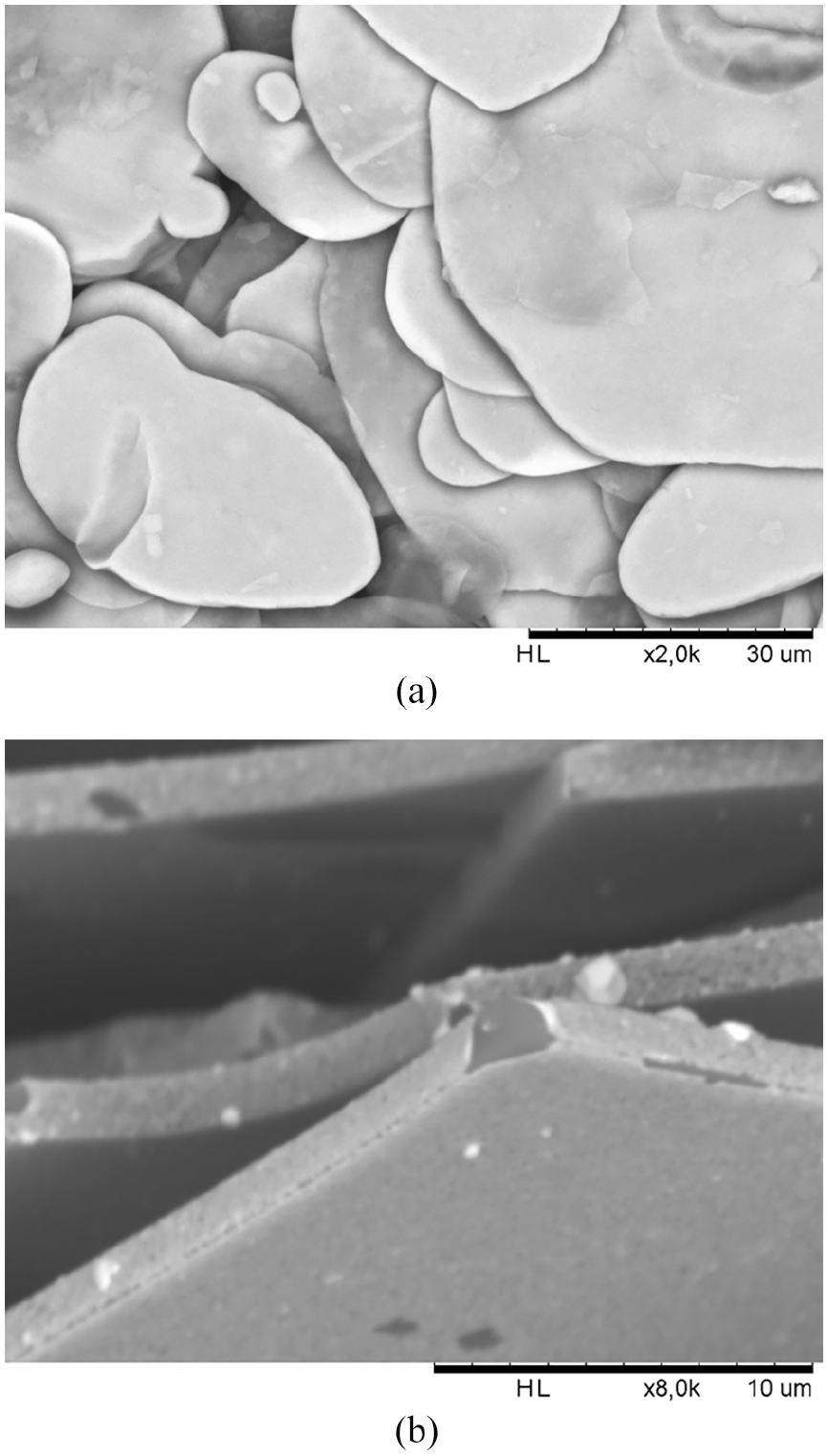
SEM images presenting different types of effect pigments. Metal effect pigment from aluminum with high reflectivity for visible and infrared light (a) and effect pigment from glass with silver layer on top (b).
From structural point of view, pearlescent pigments are totally different compared to metal effect pigments. Pearlescent pigments are made from metal oxides and semi-metal oxides. They contain a plate like core on which one or more metal oxide coatings are deposited. The color effect of pearlescent pigments is caused by interference effects of light in interaction with these coatings.100,103,110 These interference effects can be used for adjustment of protective properties against UV- and IR-radiation of pigment containing coating on textile substrates. 111 Due to the thickness of these coatings, pearlescent effect pigments can be also named as nanomaterials.
Figure 4 shows the microscopic image of a product which is an effect pigment but neither a metal effect pigment nor a pearlescent pigment. This pigment can be described as micro glass plate containing a nanosilver coating. This is shown in the microscopic image for the edge of the pigment, there this silver layer is damaged.
The application of effect pigments on textile fabrics can be used to implement different functional properties. 105 Traditional applications are related to special color effects as for example, a metal like appearance. However, also antimicrobial properties, antistatic or even electric conductive properties can be implemented by effect pigment on textiles. 112 Interesting are also applications in the field of electrosmog shielding, UV protection, or reflection of infrared light. 112
By view on all these reported applications, it should be kept in mind that effect pigments have themselves only a low adhesion to textile fibers. For this, they have to be applied together with a binder as coating application or as print. Such a coating application may change the mechanical properties of the treated textile substrate and by this even the textile character of the final product can be diminished. Also, the amount of embedded effect pigment used in a coating is limited, because of the mechanical stability of the coating decreasing with increasing loading ratio. Depending on the type of binder and effect pigment, the content of an effect pigment in such a textile coating should not exceed a ratio of 10–20 wt%.
Surface structuring
The implementation of a microscaled or nanoscaled structure can lead to new or advanced functional properties of fiber materials. A prominent example in this field is given by the lotus effect, where hydrophobic and self-cleaning properties of a surface are implemented by a surface structuring using a combination of micro and nano structures.113–115 Textile materials usually exhibit by themselves already a microstructure from fiber and yarn, so often only an additional nanostructure has to be added to realize self-cleaning properties and high contact angle values against water. 116 The nanostructures can be gained by deposition of inorganic particles, inorganic fibrous structures or organic polymeric structures.117,118 Alternatively to the deposition of nanostructured materials, also a surface structuring can be realized by etching from polymer fiber surface, for example, by treatment with laser or plasma.119–121
Electrospinning
Electrospinning is the method for producing fiber based nanomaterials which is most often reported in scientific literature during the last decades.122–125
Prominent books describe the use of electrospinning and the properties of gained fiber materials.126,127 Roughly spoken by using an electric field fiber are forced out from a polymer solution and are deposited on a substrate, which is by this modified by the electrospun fibers.126–128 Fibers realized by electrospinning contain diameters below those from microfibers. However, diameters of electrospun fibers are usually in the range of 50–200 nm and by this significantly larger than 1 nm. Beside the broad scientific awareness in the field of electrospinning, nowadays electrospinning procedures are implemented in continuous production processes and semi-industrial scale. 129 A simple electrospun fiber material has related to the fiber volume a large specific surface area, so excellent filtration properties can be expected from those materials. 130 Further, electrospun fibers can be modified by spin-doping with nanoparticles, as for example, metallic nanoparticles to implement additional antimicrobial properties in filter materials. 131 The introduction of gold nanoparticles can for example, lead to red colored electrospun fiber materials. 132 By implementation of titanium dioxide TiO2 nanoparticles, photocatalytic, and self-cleaning fibers can be deposited.133,134 The combination of electrospun nanofibers with chitosan and graphene oxide can be use for the preparation of membranes for removal of dye stuffs from waste water.135,136 An interesting field is also the combination with biopolymers like for example, gelatine, keratin or chitosan.137–140 By this, fully or partly biopolymer-based nanofibers can be realized which may offer the change for realization of new bio-compatible materials for example, used in the field of tissue engineering.137,141,142
Functional properties and related applications
This section supports an overview on often mentioned functional properties realized by application of nanomaterials onto textiles. To enable a better understanding of different functional properties it is helpful to distinguish mainly three categories where the functional properties can be sorted in. These categories can be simply named as biological, optical and surface active (compare Figure 5). The biological category stands for any functional property causing a demanded effect on a living organism. The main prominent application in this field is the antimicrobial application, which works against microorganism and viruses.143–146 Also, effects against larger organism like insects or spiders could be put into this category leading to textile materials supporting a protective effect against those species.147,148 In contrast to those “anti-functions,” the biological function can be also “pro,” for example, as promoting the growth of useful cells as kind of a biocompatible property.149,150 The optical category stands for any functional property which is related to the interaction with light or general with radiation. Main applications are related to protection against a certain type of radiation – mostly UV protection.151–153 However, also camouflage applications or applications based on light emission are relevant.154,155 Photoactive materials support a certain activity in case of illumination with light, these can be self-cleaning processes, oxidative processes or antibacterial properties.69,156–159 The category “surface active” summarize functionalization influencing the wettability of textile materials leading for example, to water repellent materials. 160

The three categories of functional properties.
Antimicrobial
Antimicrobial functional textiles can be realized by combination of fiber materials with nanoparticles containing the elements silver, copper or zinc.144,161,162 For silver, these are almost elementary silver particles, which release silver ions Ag+ from their surface as antimicrobial active component.55,163,164 Also, applications with silver chloride AgCl particles or silver ions embedded in inorganic matrices are possible.58,165,166 Silver nanoparticles exhibit high antimicrobial effectivity which is often advantageous compared to the performance of other antimicrobial agents. However, for practical applications, the use of silver nanoparticles is limited due to their strong yellow/brown coloration.167–169 This type of coloration is inherent for spherical metallic silver nanoparticles and explained by surface plasmon effects.170–172 In contrast, for anisotropic silver nanoparticles a range of different colorations can be determined depending on size and shape of the nanoparticles. 173
Antimicrobial applications based on copper or zinc, are mostly related to the oxidic components of those metals like the copper oxides CuO and Cu2O or zinc oxide ZnO.56,174,175 Particles from zinc oxide exhibit a white coloration and absorptive properties for UV light, so their use as UV absorber is also possible. 176
Additional, metal containing particles also organic agents can be used as antimicrobial additives.177,178 Such antimicrobial agents as quaternary ammonium compounds are from their structure not nanomaterials but they can be part of a nanomaterial based coating and controlled release system deposited on textile surfaces. A controlled release of an active substance can be an effective and fast application for antimicrobial activity.177,179,180
UV protection
UV protection in general means that a person or a material is protected against the exposure with harmful UV light.181,182 Usually the protection against UV light from a spectral range from 280 to 400 nm is demanded, because this is the spectral intensity from sun light. 183 A material offering UV protective properties is able to decrease the transmission for UV light drastically. Mostly this is reached by absorption of UV light and such properties can be implemented by application of UV absorbers. A UV absorber is a colorless substance absorbing electromagnetic radiation below 400 nm.183,184 Further, the UV absorber has to be stable under exposure of UV light.
Prominent inorganic UV absorbers are based on titanium dioxide TiO2 and zinc oxide ZnO which are often applied as nanoparticles during coating application on textiles or as spin-doping agents. 29 TiO2 particles from nanosols can be as well used as coating forming agent themselves. Alternatively used are organic UV absorbers. They can be embedded and permanently fixed inside an inorganic nanosol coating.185–187
Photoactive
Photoactive textiles summarizing types of textiles exhibiting a response to light. This can be luminescent textiles – which are discussed in the following sub-section. 188 However, photoactive textiles are mainly related to photocatalytic or photooxidative properties. 189 By this, photooxidative effects, antimicrobial properties and self-cleaning effects can be implemented on textile surfaces.157,190,191 Also, cleaning of waste water form dye stuffs and the cleaning of air are useful applications.192–194
The probable most often described photoactive material on textiles is titanium dioxide TiO2 in its crystal modification anatase. Many studies report on the modification of anatase to improve it photoactivity and implement also an activity under illumination with visible light.190,195 For this, doping of TiO2 particles with different chemical elements like nitrogen, iron or copper are reported.190,196–198 Other approaches use the combination with metal oxides from manganese MnO2 or silica SiO2.157,199,200
Luminescent materials
Luminescent materials emit light in case of an external stimulation. This external stimulation can be exposure to UV-light or blue visible light in case of fluorescence and phosphorescence.201–204 Also, temperature, mechanical or electrical influences can stimulate a luminescent effect.205,206 Particles from zinc sulfide ZnS or doped strontium aluminates SrAl2O4 can be set as phosphorescence materials.201,207 Applications can be implemented as printing additives or inks on textile surfaces or realized in composite nanofibers.207–209 Examples for a commercial product in this field are presented in Figure 6. Here, in case of illumination with UV-light a lasting emission of blue/green light up to 30 min can be observed. 210

Product example for a commercially available phosphorescent home textile. Magnified photography taken by a light microscope with UV light illumination (a) and photographic image under illumination with UV-light (b).
Repellent materials
Repellent materials are able to repel different types of liquids like water, alcohol, organic solvents, or oil. 211 This is related to applications as repellency of rain, soil repellency as for example, coffee or red wine or separation of oil from water.212,213 Often used terms are hydrophobic and oleophobic properties. Hydrophobic and amphiphilic particles or hydrophobically modified coating agents can transfer water repellent properties on textiles.214,215 By this, also the repellency against water based stains as coffee, tea or red wine is implemented. A suitable method is the application of alkyl-modified sol-gel systems.216–218 An interesting and commercially successful approach in this field uses hydrophobic dendrimers.219–222 Improved repellent effects may be reached if the applied hydrophobic agent is combined with an agent or a method introducing micro- and nanostructuring leading to additional self-cleaning effects.223,224
Filtration
Filter materials can be either improved or created by application of nanomaterials on textiles.225–228 Figure 7 presents microscopic images of a commercial non-woven filter material. The filtration properties are improved by deposition of electrospun nanofibers. 229 Additionally to simple improvement of filtration properties by influencing the surface area or modification of pore size, also the addition of further functional properties can improve filter materials.230,231 Functional properties in this field can be antimicrobial, soil-repellent or photooxidative232–236

SEM images in different magnifications of a commercial non-woven filter material from acrylic fibers exhibiting electrospun fibers on the surface. Low magnification (a) and high magnification (b).
An antimicrobial filter will be less effected by contamination with germs and microbes. The realization is possible by use of silver particles.237,238 A soil-repellent filter can be easier to clean and by this an increased life-time or reusability is possible. 239 Filters with photooxidative properties may find applications in waste water treatment due to enhanced photooxidative decomposition of agents or dye stuffs in waste water. 240
Conclusions and future perspectives
Nanomaterials and textiles are fascinating materials influencing our life by presence in consumer products and technical materials. Here is a broad range of nanomaterials which can be implemented to textiles using very different methods and approaches. By this, functional textile materials with new and advantageous properties can be realized, as for example, antimicrobial, luminescent or photoactive materials. With view on the recent years with the COVIP-19 pandemic situation, a special future perspective might be given and state that especially textile based and nano-modified filter materials can be a strong issue for future development and coming investigations. However, it should be stated that the application of nanomaterials is not automatically the best method to reach a new functional property for the demanded textile application. Also, conventional textile finishing procedures or new methods like plasma polymerization or functionalization from supercritical carbon dioxide are powerful tools and competing with nanomaterial application for functionalization of textiles. This competition of different processes is either driven by the performance of the realized functional materials but also by economic concerns, legal restrictions and health concerns.
Footnotes
Acknowledgements
All product and company names mentioned in this article may be trademarks of their respected owners, even without labeling.
Declaration of conflicting interests
The author(s) declared no potential conflicts of interest with respect to the research, authorship, and/or publication of this article.
Funding
The author(s) received no financial support for the research, authorship, and/or publication of this article.
