



Abstract
The use of knitted structure pressure sensors in wearable applications and health monitoring systems has attracted a great deal of attention. This study aims to assess the single jersey and double jersey knitted structures as well as the electromechanical characteristics of electrically conductive yarns (ECY). The knitted structures were made with two different types of electrically conductive yarn, including the (i) fully drawn yarn (FDY) and the (ii) drawn textured yarn (DTY). FDY had higher tensile strength than DTY in reference to their drawing and twisting processes. Based on the results in terms of tensile strength, conductive yarns of 280D-FDY and SPFX25070-FX were chosen from seven available conductive yarns for the further production of knitted structures. Additionally, the knittability of the conductive yarn was also considered. Due to the knit-tuck stitch assembly, which increases the thickness of the structure, it was found that the double Lacoste, popcorn, and milano ribs had the necessary compression resistance. The compression properties of the knitted structures were tested using the kawabata evaluation system (KES FB-03). It was found that the recommended knitted structure sensing technology can be easily expanded into a scalable and affordable solution for the production of smart socks and related applications.
Introduction
Through the perception and response to a specific stimulus, smart textiles communicate with the environment using various electronic components/parts in the form of yarns or fabrics embedded in various shapes and compositions of woven, nonwoven, and knitted structures. 1 Two types of health monitoring include construction (structure) and individual (human) bodies. There are various techniques/approaches 2 in the field of structural health monitoring research, such as the acoustic emission approach used for structural defects detection, whereas the wearable health monitoring system provides real-time medical monitoring services. 4 Wearable healthcare systems need electrodes that are skin adhering to provide maximum comfort to patients and to process and carry signals with low resistance. 3 The ability to carry information in smart textiles allows patients and medical staff to communicate with ease and reliability. 4 Modern health monitoring devices containing conductive fibers/yarns/fabrics process the signals from one end to another end/portion of the structure according to the requirements. 5 The monitoring system continuously collects data from the body of humans by changing their health status over time. Additionally, health monitoring system sensors are extremely adaptable and friendly to preserve a natural connection with the human body. 6 Smart textiles are considered the future of the industry by developing many emerging products in various stages of life as per demand. To conduct complex computations and discover efficient information, more improvements in health monitoring devices are being made by improving their size. 7 The sensing capabilities of textile structures comprised of electrically conductive yarns are being improved through a number of experiments.8–10 However, currently, available conductive yarns contain variations in resistance as reported in breathing sensors developed by Pfeiffer. 11 The researchers have worked on the performance evaluation of sensors having conductive yarns with different geometries, which affect sensitivity and hysteresis minimization. 12 Calvert et al. worked on piezoresistive sensors for smart textiles. 11 Perrier et al. 13 investigated the production of socks for foot pressure and gait analysis. Özdıˆl et al. 14 worked on socks to observe fabric strength against abrasion. Perrier et al. worked on the technical features of socks for a diabetic person to prevent foot ulceration. An initial sample of socks has been prepared using eight sensors at different positions. The measured pressure is collected during gait and shown on the smartphone through a Bluetooth connection. 15 E-textiles have an enormous market growth of 33% in different fields.16–18 Regarding e-textiles, knitting has become a widespread technology for wearables.19–22 Extensive work has been done on strain sensors,23–29 and reinforcement30–33 made of knitted structures, but still, there is a lack of information published in the literature in the field of electromechanical properties of knitted structures for potential socks sensing systems. These components represent a significant step toward enhancing work capacity and overall well-being through smart, wearable technology. The present study examines the electromechanical properties of electrically conductive yarns (ECY), as well as the architecture of knitted pressure sensors made from single and double jerseys for e-textiles applications.
Materials and methods
Seven different types of electrically silver coated conductive yarns (ECY) were purchased from Kazhtex, the China company, including 70D-DTY, 70D-FDY, 150D-DTY, 40D-DTY, SP25070FX-250, 280D-FDY, and 78D-FDY. Based on the tensile strength of ECY, an ASTM D2256 was used and, for electrical properties, AATCC 76 was utilized for the selection of yarns. Knitted structures made on a flat knitting machine, tested on Kawabata KES-FB03 evaluation system and selected based on compression behavior. Furthermore, the static charge of selected knitted structures having optimized conductive yarns of SP25070FX-250 was measured using the BSEN-1149-1 standard on the static charge meter as shown in Figure 1. The pressure sensing properties were measured by applying load on the selected knitted structures using a two-probe digital multimeter as shown in Figure 2. Pressure in grams was applied on the selected knitted structures like double lacoste, popcorn, milano rib, and spacer fabric of 20 cm × 20 cm. The method of an experiment, which describes factors, input variables, and output variables is provided in Table 1. This methodical approach allowed for the assessment of how different knitted patterns and yarn compositions, such as double lacoste, popcorn, milano rib, and spacer fabric, responded to applied pressure, with each structure standardized to a dimension of 20 cm × 20 cm.
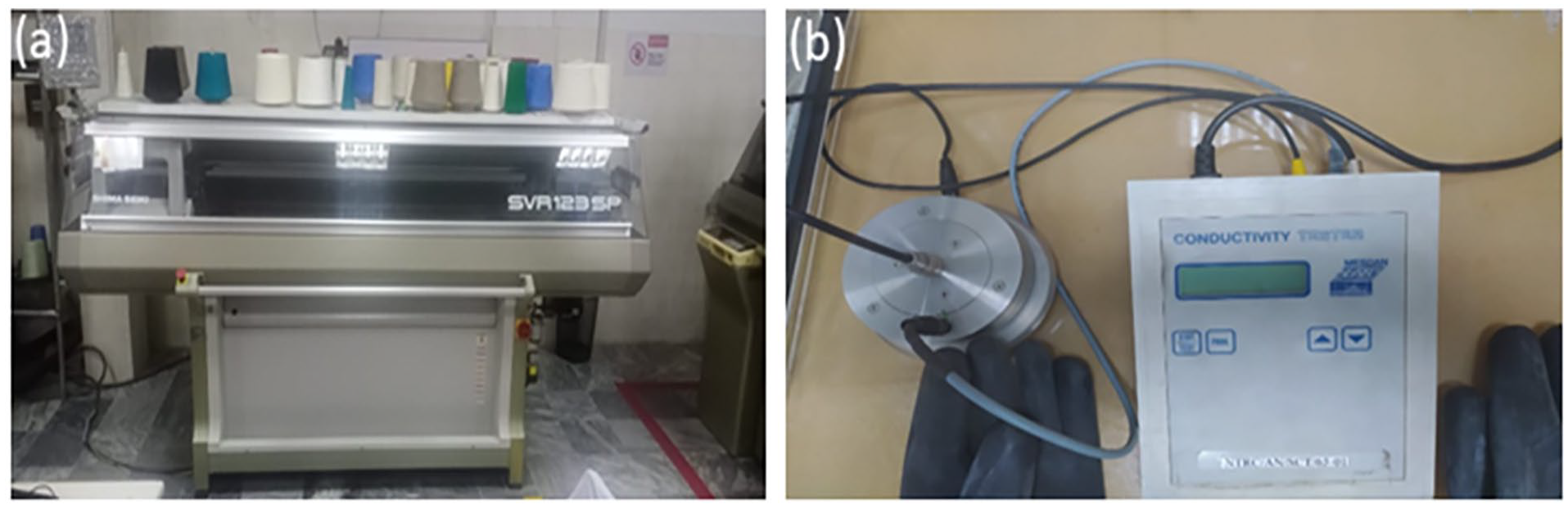
(a) Flat knitting machine and (b) static charge meter.

Setup (multimeter) for measuring pressure and resistance dependencies.
Input and output variables for conductive knitted structures.

Results and discussion
The values of tensile strength and electrical resistance for seven different counts of conductive yarns are shown in Table 2 along with elongation. A tensile test is a mechanical test in which a material specimen is subjected to a controlled and increasing tensile (pulling) force until failure, to measure properties such as tensile strength, elongation, and Young’s modulus. The tensile strength tests using ASTM D2256 were conducted using an Instron universal testing machine, with samples prepared according to standard procedures, and each test was repeated five times to ensure statistical reliability. From Table 2, it is indicated that SP25070-FX-250 (S5) and 280D-FDY (S6) have high single yarn tensile strength as compared to the rest of the yarns.
Tensile strength and electrical resistance of different conductive yarns.

From the values given in Table 2, it was quite observed that the yarn obtained at high spinning speed has a greater tensile strength like FDY yarn than the DTY yarn. The tensile strength and elongation are directly proportional to the count of yarn. Because there are more fibers in each cross-section of the coarse yarn, it will initially lengthen as much as possible against the applied force. Because more fibers per cross-section can withstand more stress and slide apart to straighten, yarn has demonstrated better tensile strength in both the FDY and DTY cases. SP25070-FX-250 (S5) has a higher tensile strength than DTY yarns as this yarn is a sewing thread, which is a special class of yarns and is made from two yarns twisted yarns. This yarn is soft, high-strength, and did not break easily during the knitting process due to the less effect of friction, tension, and bending forces. However, because of the increased number of fibers per cross-section, 280D-FDY (S6) yarns were found to be the most suitable in terms of tensile strength when compared to FDY yarns. This is because the greater fiber density in the cross-section allows for better distribution of stress and more effective load-bearing capacity, resulting in enhanced durability and reduced likelihood of yarn breakage during high-stress applications. Electrical resistance is a measure of the opposition to the flow of electric current through a conductor, quantified by the ratio of voltage applied to the current flowing through it. The electrical resistance of the yarns was measured using the AATCC 76 procedure, which involved a calibrated digital multimeter setup under controlled temperature and humidity conditions, with yarns selected based on achieving the lowest consistent electrical resistance values. Electrical resistance depends on the manufacturing process and coated techniques. Both SP25070-FX-250 (S5) and 280D-FDY (S6) yarns have less obstruction to the path of free electrons due to better manufacturing and coating process. Therefore, SP25070-FX-250 (S5) and 280D-FDY (S6) were selected for the manufacture of knitted structures from seven different counts of available conductive yarns based on tensile strength as shown in Figure 3 and electrical resistance.
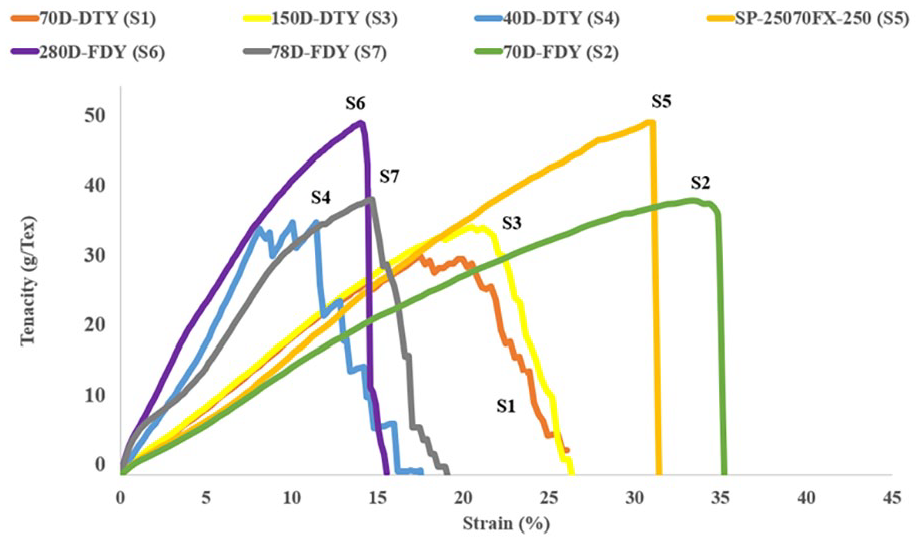
Tenacity (g/tex) versus strain (%) for conductive yarns of different counts.
Optimizing knitted single-jersey and double-jersey structures
Tables 3 and 4 display the compression findings for single-jersey and double-jersey knitted structures, respectively. In Table 3 for a single jersey knitted structures, it is indicated that only double lacoste and popcorn-knitted structures have high compression resistance. The resilience of compression is the area under the compression/pressure curve divided by the area of the whole triangle. These structures have a low value of linearity of compression. Linearity of compression shows the softness of the fabric/structure. It is calculated by dividing the volume under the recovery curve. Both double-lacoste and popcorn were selected from single jersey knitted structures based on their high compressional behavior due to fabric architecture and knit-tuck assembly. The compression for both double lacoste and popcorn was 44.00%, and 45.557% respectively. In, mock rib with a knit-miss stitch has the lowest compression properties. Because the wales are drawn closer together, knit-miss stitch tendss to have smaller horizontal lines, reducing width-wise elasticity and increasing fabric stability. In case of double-lacoste and popcorn knitted structures the compressional behavior was due to knit-tuck loops.
Compression results for single jersey knitted structures.

Compression results for double jersey knitted structures.

Knit tuck has the properties of an increase in width of fabric, due to which the wales density decreases. The tuck stitch has high yarn tension, and the thickness of the fabrics increases, so therefore these knitted structures have high resilience of compression. This enhanced resilience and compression resistance in double-Lacoste and popcorn-knitted structures can be attributed to the interplay between increased yarn tension and structural density, which effectively redistributes applied stress and minimizes deformation under load. The compression and recovery curves for the selected single jersey knitted structures are shown in Figure 4. The figure contains three zones – the first zone of low pressure of 0.5 g.f/cm2, the protruding fibers on the fabric surface are compressed and the behavior of the structure is considered as stretchy. Applying the pressure causes the internal fiber friction and slippages in the yarn to rise. Due to an increase in force in the second zone, the fabric thickness reduces non-linearly. A highly packed fiber assembly was taken into consideration in the third zone because a further increase in the force or pressure on the structure causes the fibers to compress laterally. Both optimized knitted structures with knit-tuck structures demonstrate more surface thickness (ΔT) while possessing high compression resistance. This is due to the fact that tuck loops decrease fabric length and longitudinal flexibility in knit-tuck structures like double lacoste and popcorn, while increasing density naturally. It appears that the nearby knitted loops become smaller as a result of the higher yarn tension on the tuck and retained loops, resulting in better stability and shape preservation. This structural composition contributes to their superior compression resistance and resilience, effectively distributing stress and preserving fabric integrity under load.

Compression and recovery curves for single jersey knitted structures: (a) double lacoste and (b) popcorn.
From Table 5, it was observed that only the milano rib double jersey knit has a high resilience of compression value of 49.55% comparable to the spacer knit structure tested under Kawabata evaluation system FB-03. This structure was found to be the best compressional behavior of all single jersey and double jersey knitted structures. 34 All four knitted structures respond to pressure by decreasing their electrical resistance, making them suitable for applications in pressure sensing. Among them, Milano Rib shows the highest sensitivity, while Spacer, despite starting with the highest initial resistance, still shows a significant response to pressure changes. These properties make these fabrics potential candidates for wearable sensors and smart textiles where pressure sensing is required. The milano rib double jersey knit structure obtained using two sets of needles and high resistance against force was due to the fabric thickness. When applied load on the milano rib their thickness decreases and such structure has the properties of more compressibility and recovers to its original position when pressure is removed. From Figure 5, it is examined that in the case of the milano rib, a rise in pressure against the thickness of the fabric gave the highest recovery rate after the removal of the load due to the structure network. In the very first course, the tuck-tuck architecture gave thickness to the structure because the fabric showed an elastic behavior. Therefore, from single- and double jersey knitted structures, only three knitted structures were optimized based on compressional properties. From single-jersey knitted structures, double lacoste and popcorn were selected based on the high resilience of compression and milano rib from double-jersey knitted structures. The compressibility of knitted structures or the compression properties of fabric depends on the type of fiber, yarn count, yarn twist, loop length, loop density, and loop geometry that has a major impact contributed toward the structure. Compression is a reduction of fabric thickness brought on by a rise in exerted force or pressure. The yarn arrangement in a fabric structure and structural parameters dominate more in terms of compression properties of knitted fabric. Double Lacoste and popcorn have the highest resilience value (RC) value among all single jersey knitted structures because of the contributing factors and fabric architecture as explained earlier. The work of compression (WC) is the ability to work to the change in fabric thickness during the compression test. The yarn count, the height of the dial, and the surface of the material all significantly impact the compression qualities of the double jersey knitted structure. With an increase in dial height, spacer fabric with polyester surfaces and monofilament spacer yarn has a high RC value. For spacer fabric, the RC value of 50.48% was found to be the highest among all double jersey knitted structures. The milano double knit has also a high RC of 49.50%, which is comparable to spacer structure. 35 This distinction underscores the importance of structural parameters, such as loop density and geometry, in enhancing the compressional resilience of knitted fabrics, thus making them suitable for applications requiring high durability and elasticity.
Optimized knitted structures pressure sensing properties.


Compression and recovery curve for milano rib double jersey knitted structure.
Optimized knitted structures static charge
A static charge test was performed with a static charge meter using BSEN 1149-1 standard on optimized knitted structures. The purpose of this test was to verify the charges at rest that may deteriorate the structure’s conductivity. Static charge measurement determines the amount of static electricity accumulated on a material’s surface. The static charge of knitted structures was measured using the standard by placing the samples in a controlled environment, charging them using a standardized method, and recording the static discharge using a calibrated static charge meter. Optimized structures like double lacoste, popcorn of single jersey popcorn, and double jersey rib and spacer fabric were manufactured by inserting a conductive yarn. The purpose of this test was to observe the charges that are at rest. Due to the performance of this test on these structures, both surface resistivity and vertical resistance of less than 100T (105–1012 Ω) were found at 100 V for all optimized samples. Using a digital multimeter, the vertical surface resistance and the horizontal surface resistance for optimized knitted structures of an area of 4 inch 2 were 3.1 and 2.1 k.Ω, respectively. This means that the developed structures have good electrical properties and are suitable for smart socks applications.
Optimized knitted structures pressure sensing properties
As indicated in Table 5, pressures of 0, 25, 53, 81, 131, 199, 311, 424, and 540 g were applied, with resistance (Ω) measured against each applied pressure. The experiment was repeated five times for applied pressure.
From Table 5, it is clearly indicated that the milano ribs have suitable pressure sensing properties from all single jersey and double jersey knitted structures. Milano ribs have a maximum value of 8.89 Ω when no pressure was initially applied to the structure and a sminimum value of 8.51 Ω 540 g pressure. When the applied pressure is increased, the electrical resistance is reduced because it compresses the fibers, allowing a continuous flow of electrons to occur. It means that obstruction to the path of free electrons decreased and knitted structures showing the properties of carrying a signal from one portion to another.
The pressure-electric resistance curve for the knitted structures is shown in Figure 6. The Milan rib knit structure began at 8.89 Ω at 0 g-force and gradually decreased as continuous pressure was applied. Milano rib has a knit-tuck assembly, which adds thickness to the structure and increases the yarn tension in the tuck stitch. The primary relationship between compression and electrical properties depends on the type of materials, the assembly of stitches, and the thickness of the structure.
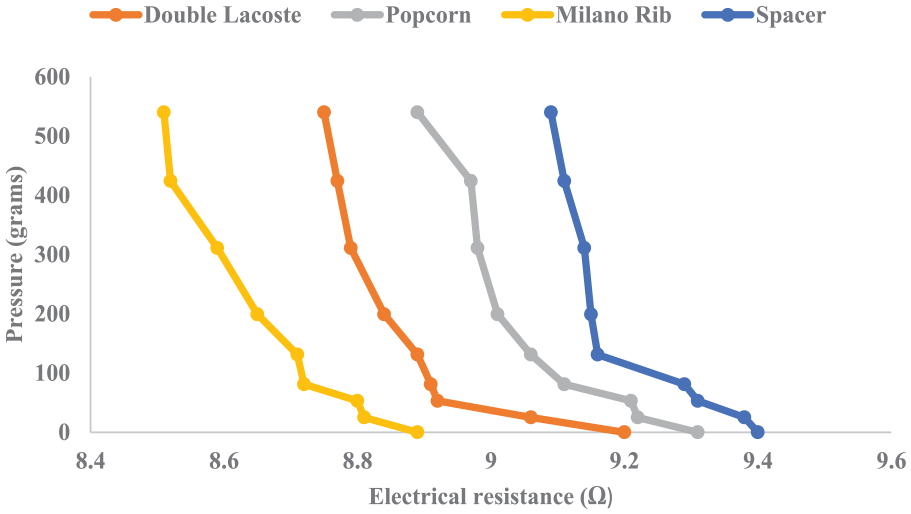
The pressure versus electric resistance curve for the knitted structures.
All the knitted structures considered in this graph have a lower electrical resistance. This decrease in electrical resistance is well for the incorporation of such structures into socks. As a result of the applied pressure, the electrical resistance changes and the pressure is converted into an electrical signal for data transmission.
Conclusions
Based on their electromechanical properties, single jersey and double jersey knitted designs were compared and the best knitted structures were picked in this research. The spacer structure was considered as the reference sample and then all the single and double jersey knitted structures were observed to exhibit compression behavior. A conductive yarn of 280D-FDY and SP25070FX-250 was selected/optimized in terms of its tensile strength and electrical properties. Fully drawn yarn (FDY) has high tensile strength due to simultaneous drawing and twisting during the manufacturing process as compared to drawn textured yarn (DTY). Double Lacoste and popcorn were found to have improved electromechanical behavior in single jersey knitted designs. Double jersey has simply one order, called milano rib, having better compression value due to structure architecture along with the best pressure sensing properties. The fabric design or architecture along with yarn count, loop length, loop density, loop-shaped factor, yarn twist, fiber length, and yarn structures are the important parameters that have a significant influence on the compression properties of the knitted structure. With the increase in the loop-shaped factor (fabric dimension), the loop length and loop density also increase the resilience of compression (RC) and linearity of compression (LC) that indicates better fabric softness. The compression, surface, and bending properties of the fabric are important factors when deciding the quality attributes. The surface resistivity for the selected knitted structures showed a vertical resistance value of 3.1 and 2.1 k.Ω horizontal resistance, which means prepared samples have good electrical properties. Optimal conductive knitted structures with better electromechanical properties were subsequently found suitable for smart sock applications. Future works recommend the anticipation of conductive yarn breakage during the process of knitting, microscopic analysis of conductive yarns, integration of knitted structure pressure sensors using electrically conductive yarns (ECYs) into composite materials can enhance mechanical properties, provide real-time health monitoring, and offer customized performance. By combining ECYs with reinforcing fibers, hybrid composites can be created for applications in aerospace, automotive, and medical devices. These smart composites can monitor stress and strain, making them suitable for structural health monitoring, wearable technology, and flexible electronics. This innovative approach could lead to significant advancements in both smart textiles and composite materials.
Footnotes
Credit authorship contribution statement
Data availability statement
The authors confirm that the data supporting the findings of this study are available within the article.
Declaration of conflicting interests
The author(s) declared no potential conflicts of interest with respect to the research, authorship, and/or publication of this article.
Funding
The author(s) received no financial support for the research, authorship, and/or publication of this article.
Ethics approval statement
Not applicable.
Patient consent statement
Not applicable.
Permission to reproduce material from other sources
Not applicable.
Clinical trial registration
Not applicable.
