



Abstract
This study presents a comprehensive analysis of some key manufacturing parameters of Sports Compression Socks (SCS), aiming to optimize their performance characteristics for athletic applications. We investigated the interplay of material selection (Polyamide and Polyester), knitting structures (Pique and Drop Needle), and processing methods (E-wash, Dip wash, and Direct Press) on the functional properties of SCS. Our experimental design employed a full factorial approach, utilizing the Taguchi method for robust data analysis and the VIKOR (VlseKriterijuska Optimizacija I Komoromisno Resenje) technique for multi-criteria optimization. Key performance indicators assessed included compression pressure, fabric thickness, breathability (air permeability and Overall Moisture Management Capacity), and serviceability (pilling resistance and dimensional stability). The collected data underwent rigorous scrutiny using one-way analysis of variance (ANOVA) to assess their significance, validated by p-values (p < 0.05). Further insight into the significance and contribution percentages of each factor was gained through ANOVA (α = 0.10) and visualized using a pie chart. Results demonstrated significant influences of knitting structures and processing methods on the physical and performance characteristics of SCS. Particularly, the Nylon E-wash Pique (NEWP) combination emerged as the most effective, providing a balanced profile of breathability, compression, and durability. Overall, the study contributes to the optimization of SCS performance characteristics for athletic applications, through a comprehensive analysis of key manufacturing parameters, with practical implications for manufacturers. These insights are pivotal for guiding manufacturers in producing high-quality, effective SCS that meet diverse consumer needs. The study advances the understanding of SCS design, proposing strategic approaches that consider important material and manufacturing perspectives. Future research directions include comparing pressure values in yarn-dyed and sock-dyed processes to further enhance the quality of compression garments.
Introduction
For over two millennia, the field of compression therapy has seen a myriad of methods periodically emerge and evolve, marking significant advancements over the time. 1 These therapies encompass a range of tools including elastic and nonelastic bandages, boots, hosiery, stockings, and pneumatic devices. 2 Notably, modern compression stockings, which emerged in the 1940s and 1950s, represent a relatively recent advancement in this field. 3 Initially, compression socks found their application in the medical sector, primarily utilized for over half a century to address various forms of venous insufficiencies. In recent years, the sports industry has capitalized on the premise that compression socks help in enhancing blood circulation, reducing fatigue, minimizing muscle tremors, and facilitating muscle recovery, thereby preventing cramps. 4
The use of compression socks has gained traction across various sports disciplines. Athletes in running, basketball, soccer, cricket, and baseball frequently utilize these garments. The soccer segment, in particular, dominates the market and is projected to grow at a Compound Annual Growth Rate (CAGR) of over 24% during the forecast period. 5 Compression garments are available in different forms, catering to specific body parts or encompassing larger areas like the lower body or arms. Their fundamental property is the application of pressure to the body surface, which varies according to the garment’s design and intended use. In sports, low grade compression sock provides better results and performance as compared to high grade graduated compression socks (GCS). 4
The effectiveness of compression garments hinges on their fabric composition, typically involving stretchable materials with elastic properties. The structure of these garments often comprises two types of materials: ground yarn for thickness and stiffness, and inlay yarn to ensure compression. 6 However, the practical application of Graduated Compression Socks (GCS) often reveals variable pressure distribution and magnitude due to various factors. For optimal performance, GCS should possess excellent elastic recovery, a comfortable fit, and moisture-wicking capabilities. 7 Studies by researchers like Kumar et al. 8 have explored how applied tension, knitting structures, and material types of influence interface pressure, finding that fabrics with elastic yarns provide more uniform pressure. Some other researchers also studied the effect of structure, linear density on compression pressure and comfort properties.9,10
Research by Maleki et al. 11 has further contributed to our understanding of how fabric types and structures influence compression effectiveness over time and in response to external factors like washing. Investigations into the effects of washing on the compression pressure of compression socks (CS) reveal significant impacts on interfacial pressure and pressure reduction. 12 For instance, Harpa et al. 13 noted a decrease in compression pressure after repeated wearing and washing cycles. Similarly, Gohar et al. 14 investigated the influence of washing on pressure and dimensional stability and concluded that shrinkage occurred in CS. From the mentioned research, it can be seen that the influences of wear and wash on the performance of CS are mainly focused on the compression pressure.
Washing temperature is also an important parameter, few researchers also studied its effect on compression pressure. Siddique et al. 15 investigated the compression pressure on wearing and washing cycles that is, 20 times and the effect of temperature that is, up to 100°C. They concluded that effect of washing cycles on compression pressure is inconsistent while pressure increased with rise in temperature from 30°C to 100°C. 15 Similarly, another researcher, Akcagun studied the effect of washing and washing temperature on three different combinations of main and inlaid yarns, developed with two different knitted structure. In addition, after wearing and washing cycles it was seen that the pressure values increase with the increase in washing temperature (30°C–40°C–50°C). 16 Siddique et al. 17 investigated the performance of CS by washing them at 30°C, 50°C and 75°C, which showed that as the temperature level of washing increases, there is a significant increase in compression pressure. In this study, the products were washed without being worn between washes. This line of research has been pivotal in understanding the dynamic nature of compression garments in practical use.
The current market offers a variety of compression socks, each designed to meet specific needs. However, manufacturers sometimes struggle to identify the optimal knitting structure and process type for achieving desired pressure and breathability levels. While existing literature covers the impact of knitting structures and washing processes on compression stocking pressures, there is a paucity of studies focusing simultaneously on the breathability and performance characterization of sports compression socks (SCS) based on materials, structure, and processing type.
Given the growing global demand for compression garments, there is a clear need to establish correlations between knitting and processing types and compression values. This study aims to fill a gap in the existing literature by manufacturing SCSs with an eye toward evaluating material, fabric structure, and processing type in relation to interface pressure and other properties such as breathability and serviceability. To aid manufacturers technically, this study will employ the VIKOR technique, a multi-criteria optimization and compromise solution method, for selecting the most effective parameters. 18
Experimental
Materials
For this study, three types of yarns, as depicted in Figure 1(a), were utilized. Two primary materials, namely polyamide (Nylon 6,6) and Polyester, were selected to develop different structures. Both Polyamide and Polyester were employed in plating and inlay yarns. The inlay yarns were specially crafted as double covered yarn (DC), where a core of polyurethane (PU) (Lycra®) is enveloped by either polyamide or polyester, corresponding to the respective combination. In these yarns, the linear densities of the elastane PU (Lycra®) in the core of the plating and inlay yarns were 20 Denier and 140 Denier, respectively. These yarns were procured from South Korea.

Yarn images. (a) Schematic diagram of yarn, (b) lycra yarn air covered with polyester yarn, and (c) lycra yarn air covered with polyamide yarn.
The linear density of polyamide and polyester in the Body/main yarn and plating yarn was 140 Denier and 150 Denier, respectively. In contrast, the sheath materials of the inlay yarn, comprising polyamide and polyester, had a linear density of 70 Denier. The sourcing of these materials was globally diversified, with the polyamide yarn being obtained from the Li Shyang company in Taiwan and the polyester yarn procured from the Thaii Company in Thailand. A microscopic view of the plaiting air-covered yarns is presented in Figure 1(b) and (c), offering a detailed visual representation of the yarn structures used in this study (can be removed).
Methods
Knitting
The potential factors and sub-factors influencing the properties of the knitted structures are explained in Table 1. The experiments were strategically structured around three factors: two factors at two levels and one factor at three levels, constituting a comprehensive full factorial design as depicted in Table 2. In this study, we focused primarily on the main effects, assuming interaction effects to be minimal.
Detail of factors and their levels.

Design of experiment.

Knitted samples of the compression socks were developed using the Lonati GL616DF3 168 SC CL single cylinder knitting machine, as illustrated in Figure 2. This machine has a diameter of 3.75 inches, a gauge of 14.2 (E), and a single feeder, which were kept constant across all combinations. Renowned for its versatility, the machine can produce intricate engineered patterns, drop needle and pique structures, and is equipped with classic linking capabilities. A crucial feature for this study is the machine’s inlay insertion program, which is instrumental in achieving the targeted compression effects.

Knitting machine, and its single cylinder.
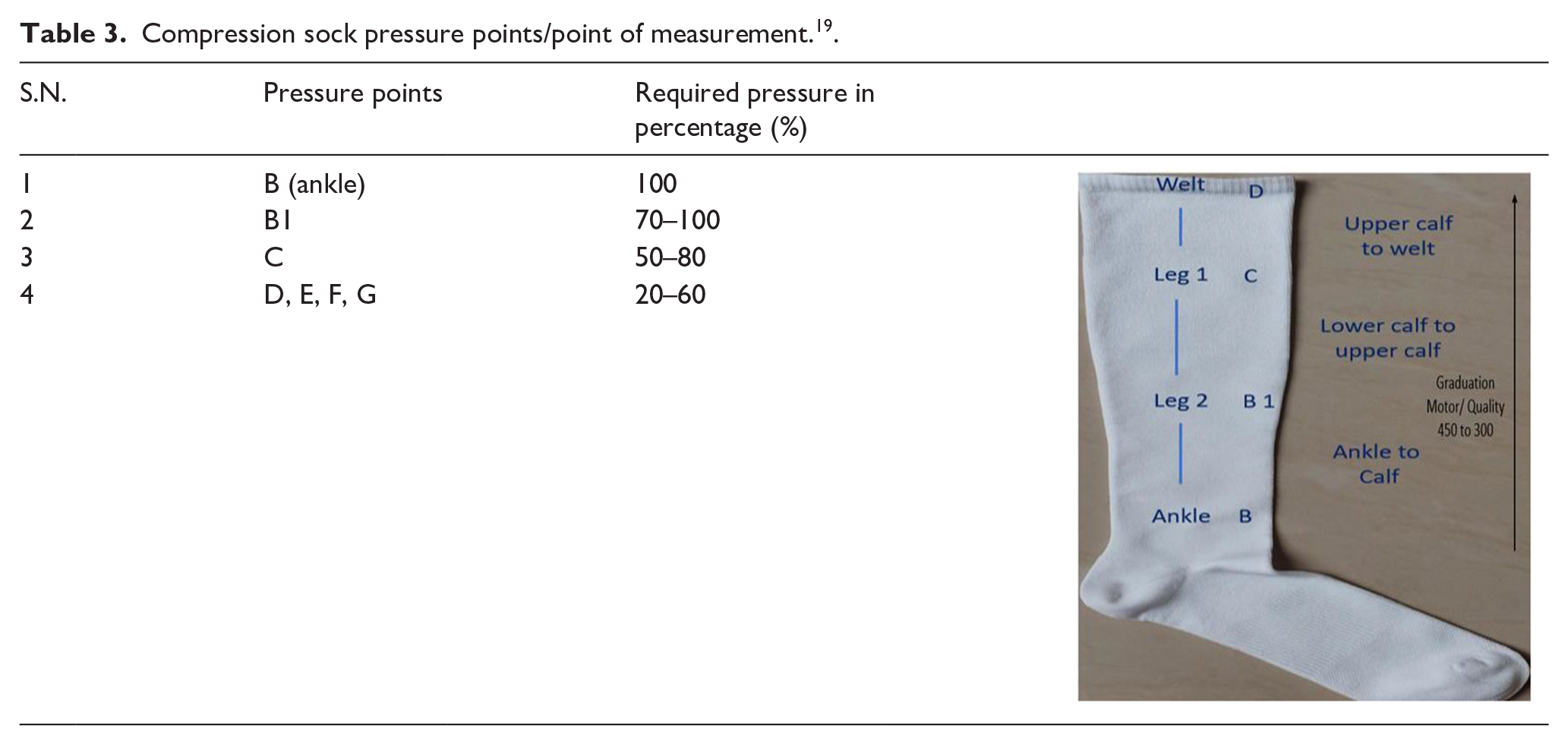
To meticulously analyze the impact of the selected variables, the knitting of the socks was carried out in a controlled environment. A consistent yarn feed at a constant tension was maintained for both the main yarn (ground/body yarn) and the plating yarn, facilitating the creation of various sections of the socks. The knitting process began with welt formation, followed by the development of specific regions marked as “C,” “B1,” and “B.” This was achieved by progressively adjusting the feeding tension from low to high moving towards the ankle portion, as visualized in Figure 3. These designated regions—B (ankle), B1 (Mid-calf), and C—correspond to graduated compression points, effectively decreasing compression from the ankle upwards to the calf. 19 The finished circumference of ankle area was kept constants that is, 7.5 + 0.1 for all combinations.

Nahm board fitting of a SCS.
All combinations had the same parts of sock as shown in Table 3. Two Knitting constructions were chosen for this study, that is Pique knitted structure and Drop needle structure as shown in Table 4. These structures were produced by using the software SDS APEX 3 to understand the difference between Pique and Drop needle. Main yarn which is also called as body yarn shown in red color whereas plating yarn (supportive yarn) in yellow. Inlay insertion was constant in both structures, so it was indicated as blue. In all samples sample inlay yarn was inserted in alternate course. Microscopic images of both types of structure are also shown in Table 4.
Compression sock pressure points/point of measurement. 19 .
Structure representation.

Processing
The knitted socks underwent three distinct processing techniques: E-wash, Dip wash, and the Direct Press process. The E-wash process, executed on the Jeanologia (Spain) e-flow system, employs innovative Nano-bubble technology. This eco-friendly method is characterized by its use of nanobubbles of air as a carrier to efficiently transmit chemicals into a garment with minimal water usage and zero discharge. The e-flow process is divided into three stages: steaming, showering, and drying. It remarkably reduces water consumption by up to 98%, energy usage by up to 47%, and minimizes chemical and water waste. The process features an exceptionally low liquor ratio of 1:1 and adheres to Stokes’ law, ensuring a slow rise velocity for extended reaction times and uniform reaction fields. 20 The e-flow machine could process up to 10 kg of material per batch, utilizing a liquor ratio of 1:1 and 1 g/l of the softener Tubingal RGH to impart a soft hand feel to the garments within just 1 h.
The Dip wash process, executed on the TSP 2-C Tupesa machine (Italy) is more time-consuming and costly. This method required a higher liquor ratio of 1:10 and took 2 h for washing, followed by drying in a separate dryer. The process utilized 6 g/l of the softener Tubingal RGH to achieve the desired softness in the fabric.
Finally, the Tecnopea Steam Boarding Machine (Italy), a rotary-style machine, was employed for the boarding of the samples. This steam press method is particularly suitable for synthetic materials. To assess the impact of different knitting structures and processing types, boarding parameters were kept constant across all combinations. For the Direct Press process, as well as the E-wash and Dip wash methods, the SCS were shaped using the boarding machine under uniform conditions. This machine is equipped with two chambers: a steaming chamber that delivers steam at a pressure of 1.5 bar for 2 s, and a drying chamber where the socks are exposed to a temperature of 180°C for 4 s.
Testing
Finished samples were conditioned before testing in controlled environment at 21°C and 65% R.H.
Fit of SCS
The fit of a compression socks is crucial for their effectiveness. A well-fitted pair of socks consistently applies the prescribed level of compression, which is pivotal for achieving the intended therapeutic outcomes. Essential to this is selecting the correct size, which depends on the appropriate stretch and recovery characteristics of the socks. The Nahm fit, a critical factor, plays a significant role in the therapeutic efficacy, comfort for the wearer, and overall satisfaction with the compression socks. In developing these samples, special attention was given to sizing and achieving an optimal fit, as illustrated in Figure 3, which demonstrates the method used to check Nahm board fitting. The socks were designed for the unisex category in a medium size, with Nahm 11 being the chosen standard to assess fit. It has been observed that SCSs with superior stretch values offer a snug and comfortable fit to the body. 21 For example, N-DWDN and P-DWDN compression socks provided a tight, form-fitting experience, whereas N-DPP and P-DPP socks were characterized by a comparatively looser fit.
Physical and performance testing
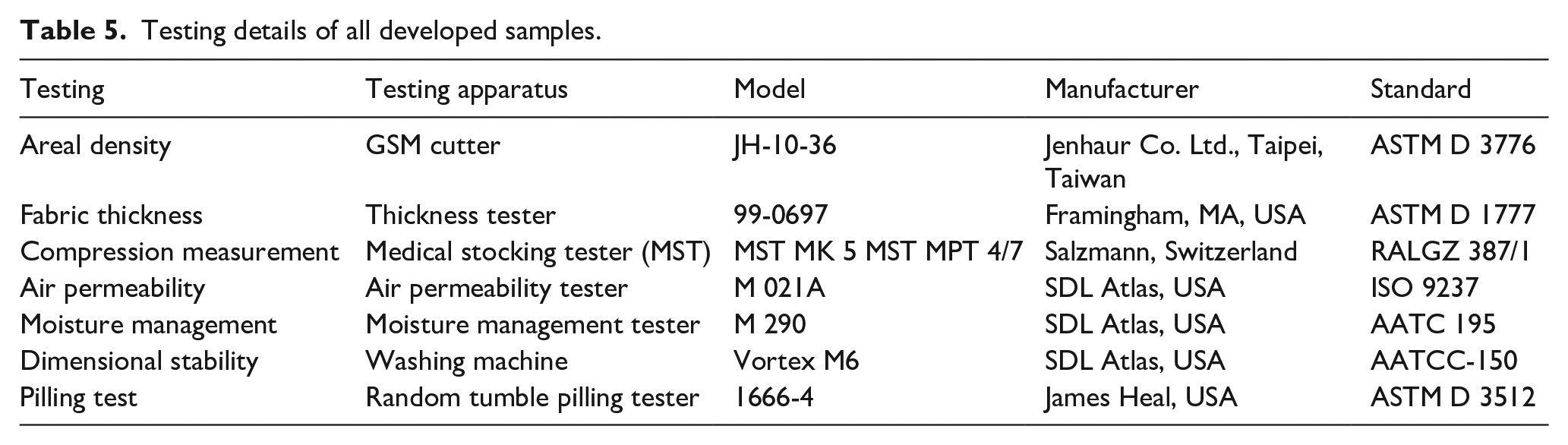
All samples underwent rigorous testing at point B (ankle) for a range of physical and performance properties, including compression measurement, breathability, and serviceability. Table 5 entails the performed characterizations, and output units with employed standard test methods. These tests were conducted to ensure a comprehensive understanding of each sample’s characteristics. To maintain consistency and reliability in the results, each test was repeated five times per developed sample.
Testing details of all developed samples.
Statistical analysis of data
The Taguchi method, a powerful tool in experimental design and optimization, aims to improve product quality and performance by systematically optimizing process parameters. It involves a structured approach to designing experiments and analyzing the effects of various factors on product attributes. One key aspect of the Taguchi method is the calculation of Signal-to-Noise (S/N) ratio values for each response variable. 22 These ratios quantify the relationship between process parameters and product quality characteristics, providing valuable insights into the optimal settings for achieving desired outcomes. By analyzing S/N ratios, practitioners can identify which factors have the greatest impact on product performance and prioritize efforts to optimize those parameters. 23
In manufacturing, products are often evaluated based on multiple characteristics, necessitating optimization across various responses influenced by a set of controllable variables. While setting parameters for optimization of a single response is relatively straightforward, optimizing multiple responses concurrently presents a more complex challenge. This complexity arises from the need to identify optimal process parameters that simultaneously optimize multiple conflicting responses.
Various methods have been developed to address multi-response optimization within the Taguchi framework. These include Grey Relational Analysis (GRA), Weighted Signal-to-Noise (WSN) ratio, Principal Component Analysis (PCA), VIKOR (VlseKriterijumska Optimizacija I Kompromisno Resenje), Multiple Response Signal-to-Noise (MRSN) ratio, and Fuzzy Logic approaches. In this research, the test outcomes were analyzed using Minitab software and R code. Our choice fell on the Taguchi-based VIKOR method, renowned for its capability to efficiently handle multi-response optimization challenges. This method facilitates the simultaneous optimization of multiple responses by considering the trade-offs between conflicting objectives. It offers a comprehensive and systematic approach to decision-making in complex scenarios, making it a valuable tool in our analysis. 24
This sub-section illustrates step-by-step the theory and methodology of VIKOR.
Step 1: Compute the SN ratios,
The SN ratio, is the ratio of mean to variation of the quality characteristics of the response. There are three types of SN ratio—the lower the better, the higher the better and the nominal the better and can be expressed as follows:
For lower-the-better:

For higher-the-better:

For nominal-the-better:

Where,
Step 2: Normalize SN ratios as Zij (0 ⩽ Zij ⩽ 1) of all the responses using equations (4)–(6) as per quality characteristic.
For lower-the-better:

For higher-the-better:

For nominal-the-better

Where,
Step 3: Compute the positive (ideal) and negative alternative solutions corresponding to higher and smaller input variables, Let


Step 4: Compute the utility (


Where,

Step 5: Compute the VIKOR indices,

Where,
Step 6: Ranking Alternative
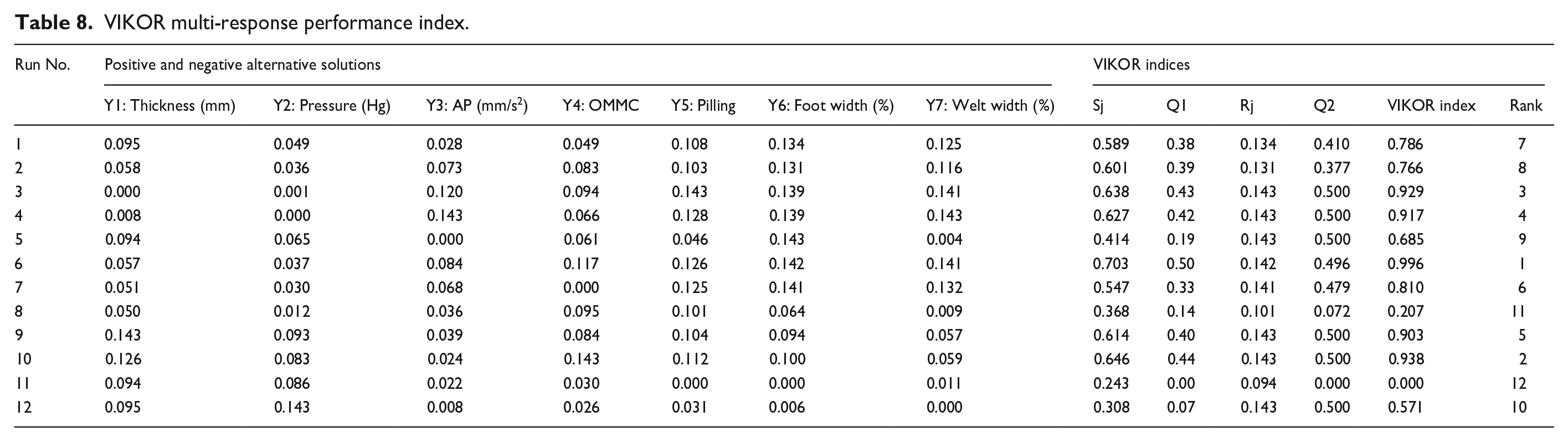
Determine the ranking and select the best compromise solution. After calculating the VIKOR indices for each alternative, rank them based on their Q_i values. The alternative with the lowest Q_i value represents the best compromise solution, balancing both utility and regret measures effectively. Make a decision based on this ranking to select the most suitable alternative for further action or implementation.
Analysis of variance
Analysis of Variance (ANOVA) is another essential statistical technique employed in our study to assess the significance of various factors on product performance. ANOVA enables us to partition the total variance observed in the response variable (Interface Pressure Change) into different components attributable to individual factors, their interactions, and random error. By quantifying the contribution of each factor to overall performance variance, ANOVA helps us understand which factors have the most significant influence on product performance. In our analysis, ANOVA revealed that factors such as material composition and structural design exerted substantial effects on Interface Pressure Change, with certain factors accounting for a significant portion of the observed variance.
Results and discussion
The experiments were meticulously conducted in accordance with the experimental runs outlined in Table 6. Our primary objective was to capture a comprehensive set of results, reflecting the impact of various factors. These factors included the types of materials used, the knitting structures employed, and different processing methods applied. The outcomes of these experiments were systematically recorded and analyzed.
Full factorial factor levels and experimental results.

The graphical representation provided in Figure 4 offers a detailed analysis of the effects of each factor—materials, structures, and process types—on the various responses observed. These responses encompassed several key aspects:
Physical Properties: Here, we specifically focused on measuring the thickness of the knitted samples. Thickness is a critical parameter as it directly influences the comfort level and efficacy of the compression socks.
Compression Pressure: This parameter is central to the functionality of compression socks. Our analysis aimed to evaluate how each factor influenced the compression pressure exerted by the socks, which is vital for their therapeutic effectiveness.
Breathability: The air permeability and Overall Moisture Management Capacity (OMMC) of the socks were assessed. These factors are essential for ensuring comfort, particularly during prolonged use, by facilitating air circulation and moisture management within the fabric.
Serviceability: This involved evaluating the pilling resistance and dimensional stability of the socks. Ensuring that the socks maintain their shape and texture over time is crucial for both aesthetic and functional purposes.
Through this analysis, we aimed to gain insights into how each factor individually and collectively contributes to the final characteristics of the compression socks. This understanding is pivotal for optimizing the design and manufacturing processes to produce high-quality, effective, and comfortable compression garments.

Factor effects on (a) Thickness , (b) Compression Pressure, (c) Air permeability, (d) OMMC, (e ) Foot width %, (f) Welt Width %, and (g) Pilling
Thickness
The main effect plot, illustrated in Figure 4(a) and in Table 6 shows the average thickness values corresponding to each level of the experimental factors. A careful examination of the results reveals a noticeable variance in thickness based on the processing technique applied. Specifically, samples processed using the Direct Press method exhibited the lowest mean thickness value. In contrast, those undergoing the Dip wash process demonstrated the highest mean thickness, reaching
This notable increase in thickness can be attributed primarily to an increase in wales density, a factor closely associated with the reduction in loop length post Dip wash and E-wash processes. The presence of Lycra in the fabric composition plays a significant role in this alteration. 25 Furthermore, the structure of the knit also emerged as a critical determinant of thickness. Structures comprising entirely of knitted loops typically exhibit greater thickness. Conversely, the inclusion of miss stitches tends to reduce the overall thickness of the fabric. 26
These findings underscore the importance of processing methods and knit structures in influencing the physical characteristics of compression socks, particularly in terms of fabric thickness. Understanding these relationships is vital for optimizing the design and manufacturing of compression garments to meet specific requirements and standards.
Compression pressure
A fundamental characteristic of compression socks is their ability to exert graduated pressure, which typically diminishes from the ankle upwards to the calf. Our experimental results affirm that the pressure is most intense at point “B” (the ankle area). Throughout the knitting and testing phases, it was consistently observed that the compression gradient in all samples maintained a gradual decrease: highest at point B (100%), followed by a decrease to 80%–90% at point B1, further reducing to 50%–70% at point C, and reaching approximately 40% at point D. 27
Upon analyzing the data from multiple trials, it became evident that among the various materials, structures, and processing methods evaluated, certain combinations were more effective in enhancing compression levels. Specifically, it was found that both the Dip wash and E-wash processes contributed to an increase in the pressure exerted by the socks. Notably, compression socks made from Nylon, processed with a Dip wash, and constructed using a pique knitting structure, consistently demonstrated the highest-pressure values. This finding suggests that the Dip wash process not only increases the pressure exerted by the sock but also ensures the retention of its shape and the integrity of its compression gradient. Additionally, the drop needle knitting technique, characterized by its unique stitch pattern through the creation of a miss stitch effect, was observed to augment the compression capabilities of the socks. 9
These insights into the relationship between processing methods, materials, and knitting techniques, and their impact on compression pressure, are invaluable for the design and manufacturing of effective compression garments. Understanding these dynamics allows for the optimization of compression socks to meet specific therapeutic and performance standards.
Breathability
Air permeability
Air permeability is a crucial property of textiles, particularly for garments like compression socks, as it directly influences their breathability and thermal comfort. The main effect plot, displayed in Figure 4(c), details the air permeability values across different experimental factors. Our findings reveal that the combination involving the Direct Press process and Drop needle structure yields the highest air permeability. In contrast, samples processed with Direct wash and constructed using a Pique structure exhibit the lowest air permeability. The presence of missed stitches in knitted fabrics, which leads to a reduced surface area, facilitates easier air passage through the fabric. 9 Additionally, our results indicate a significant correlation between fabric thickness and air permeability, aligning with existing literature. 21 Thinner fabrics generally demonstrate higher air permeability.
OMMC
In addition to air permeability, moisture management properties play a crucial role in breathability. If the skin remains wet, it can lead to discomfort due to fabric clinging. OMMC is a measure of a fabric's ability to transport moisture away from the skin and facilitate its evaporation into the atmosphere. This capacity is influenced by various factors, including the absorption rates of the fabric's top and bottom surfaces, water spreading speeds, wetting time, wetted radius, and accumulative one-way transport index. The moisture management properties of the studied SCSs were evaluated using the MMT manual scale, (0–0.2: very poor, 0.2–0.4: poor, 0.4–0.6: good, 0.6–0.8: very good, >0.8: excellent). 28
All the SCSs in this research exhibited 'good' moisture management capabilities (OMMC). From the main effect plot for OMMC in Figure 4(d), it was observed that thicker structures generally correlate with higher thickness values. 29 However, the moisture management properties varied across different processes. The E-wash process showed a decrease in moisture management properties, potentially due to the high penetration tendency of chemicals (softener) delivered through nanobubble technology. This resulted in reduced vapor transmission, increased wetting time, and decreased spreading speed. 30 Conversely, the Drop Needle structure, with its alternating knit and miss stitch arrangement, created inter-yarn micro spaces and capillaries, enhancing moisture transportation. This observation aligns with findings from previous research. 31
Serviceability
Dimensional stability test
This study assessed the dimensional stability of 12 samples of SCS, following the AATCC-150:2018 standard for home laundry. Post-washing, all samples exhibited shrinkage, but importantly, this was within the acceptable limit. Notably, shrinkage levels below +6% are deemed insignificant as per the guidelines in reference. 32 The analysis revealed that yarn misalignment predominantly contributed to wale-wise shrinkage in the knitted samples. This shrinkage is attributed to the compaction of yarns, a phenomenon consistent with existing literature. 33 A comparative analysis as shown in Figure 4(e) suggested that SCS samples undergoing the wet process exhibited superior dimensional stability compared to those subjected to the direct press method. This observation aligns with the established understanding that fabrics tend to relax and achieve near-stable states during the washing process. 34
Pilling test
The pilling resistance of all Polyester and Nylon-based SCS combinations was evaluated. Across all tested combinations, the level of pilling was found to be within acceptable limits as shown in Figure 4(f). Notably, SCS samples treated with the direct press process (N-DPP and P-DPP) demonstrated minimal pilling. This suggests their enhanced capability in maintaining fabric integrity and appearance over prolonged use. It was observed that washing reduced the porosity and pore size of the fabrics, which in turn influenced the pilling resistance. Specifically, N-DWDN and P-DWDN, with their higher stitch density, exhibited a lower propensity for pilling. 35 Furthermore, the drop needle structure was associated with a higher pilling grade, attributable to the alternation between missed and knit stitches, leading to a balanced structure. As per the literature 36 such a balanced and compact structure inherently possesses greater pilling resistance.
Statistical analysis
The Taguchi method offers a systematic approach to designing and analyzing experiments aimed at enhancing product quality. This technique streamlines the optimization of process parameters for various performance characteristics. 37 The S/N ratio values for each response were determined using equations (1) or (2) based on the specific quality characteristic. These S/N ratio values are outlined in Table 7, expressing a higher-the-better trend for Pressure, AP, OMMC, and Pilling, and a lower-the-better trend for Thickness, Foot width, and Welt width, aligning with the significant quality attributes of concern (Table 8).
Signal to noise and normalized signal to noise ratio values of all run.

VIKOR multi-response performance index.
Analysis of variance
This study employed ANOVA to ascertain the impact of various factors on the performance characteristics of Interface Pressure Change. The ANOVA results, presented in Table 9, along with the percentage contributions illustrated in Figure 5, reveal that the composition of the material (specifically Nylon), the structural aspect (Drop Needle), and the process of Direct Press/Boarding are the significant parameters influencing the performance characteristics. Notably, the structural component (Drop Needle) emerges as the most influential parameter, accounting for the highest percentage contribution of 48%. This indicates that the structure of the material plays a pivotal role in determining the overall performance, underscoring the criticality of structural considerations in the design and manufacture of these materials. This analysis provides a comprehensive understanding of the factors that are most impactful in affecting the multiple performance characteristics of the product.
Analysis of variance of VIKOR PRPI values.


(a) Factors effects on grade values. (b) Percentage contribution of factors in the VIKOR grade.
Conclusions
This study aimed to identify optimal material, structure, and processing method for Sports Compression Socks (SCS). This study provides valuable insights into the optimization criteria for Sports Compression Socks (SCS), and highlights the importance of considering material selection, knitted structure, and processing methods to achieve desired performance characteristics that cater to the specific needs of athletes and individuals seeking therapeutic benefits. This study aims to provide insights that can guide manufacturers in producing high-quality, effective SCS that meet the diverse needs of consumers.
It involved a comprehensive analysis of three different processes, knitted structures, and materials. The primary finding was that the knitted structure significantly influences SCS properties. This conclusion was drawn from rigorous statistical analyses, including ANOVA and VIKOR Analysis. The main effect plots, depicting the mean values for each factor, highlighted that the Direct Press (DP) process yielded better breathability and pilling grades. In contrast, the Direct Wash (DW) method excelled in delivering higher pressure and dimensional stability but scored lower in other aspects. Notably, samples processed via E-wash demonstrated the most balanced properties, aligning well with German guidelines for compression socks.
A critical insight from the VIKOR analysis is that the Nylon, E-wash, Pique (NEWP) combination emerges as the most effective. This finding underscores the minimal impact of material choice, as both Nylon and Polyester-based SCS exhibited comparable properties. This reassurance is vital for consumers and manufacturers, affirming that compression stockings crafted from these materials will retain their quality and appearance even under regular wear. Furthermore, this paper proposes a strategic approach for manufacturing processes of compression garments, considering both economic viability and product quality. For future research, exploring the comparison of pressure values in SCS produced from yarn-dyed and sock-dyed processes is recommended. This investigation will further enhance the understanding and development of high-quality, serviceable compression garments.
Footnotes
Declaration of conflicting interests
The author(s) declared no potential conflicts of interest with respect to the research, authorship, and/or publication of this article.
Funding
The author(s) received no financial support for the research, authorship, and/or publication of this article.
