



Abstract
Texture represents the surface quality of fabrics, which is one of the key factors for textiles design. Fabric texture can be perceived via sensory perceptions, like vision and touching, causing different psychological feelings and emotions. This paper aimed to model the correlation between fabric textures and the evoked emotions through different sensory perceptions. Firstly, 20 subjects were required to make sensory evaluation on 10 fabric samples, rating fabric textures and the induced emotions via visual and visual-tactile perceptions. Then, the differences in sensory evaluation on fabric textures and the evoked emotions were analyzed. The results showed that only by visual perception, the visual effects dominate the evaluation on fabric textures and emotions. Pile fabrics that look warm can induce positive emotions. By visual-tactile perception, the sensation of contact between fabric and skin accounts due to the intervention of tactile perception. Soft and smooth fabrics, like coral fleece and velvet can stimulate positive emotions. Finally, the emotion-fabric textures model for pleasure and arousal was established using stepwise regression analysis. It’s revealed that only by visual perception, cold/warm had a significant positive effect on pleasure, while no textures were found that have a significant impact on arousal. By visual-tactile perception, both hard/soft and rough/smooth had significant positive impact on pleasure, while thick/thin had a significant negative influence on arousal. The present findings can help direct textiles design, production and sales, so as to meet the specific requirements.
Introduction
Textures appear on the surface of all objects and characterizes the surface of objects. People feel smoothness, roughness, softness and hardness of textures by visual and tactile sense. 1 Objects can be perceived and distinguished by observing and touching the surface textures.2,3 Texture is a sort of visual and tactile dual perception. 4 Scholars or designers have classified textures from different perceptual perspectives. They are divided into tactile textures and visual textures. 5 Tactile texture refers to the tangible surface of a substance that “we can feel using our fingertips.”5,6 It is actual and refers a physical quality that can be felt by touching.7,8 It is a surface feature created by the material or the artist. 5 The tactile texture of the original material represents the characteristic surface of the material itself. 9 Visual texture is the sensation perceived visually from the surface of substances, but without the actual touch. It is the imagination of a physical texture, essentially a graphic feeling, also referred to as illusory texture. 10 Every material has its own visual texture. The characteristic of a product relies heavily on visual and tactile perception from its surfaces, texture research is broadly used in art, architecture, interior, fashion, textile, and other creative fields.11 –15
In textile industry, texture generally refers to the quality and the surface of fabric. 14 It is an integrated part of the physical property of a fabric or textile, exerting a great influence on perceived quality. Various fabric textures, like light and smooth quality, hard and semi-smooth, firm and rough, etc. can be created through textile processing technology. They have been influenced by material characteristics, manufacturing techniques and finishing technologies. 16 Different fibers show different physical properties, affecting fabric textures. For example, silk feels soft and smooth, while linen feels rough and hard. Fabric weave involves the way of yarn interweaving and the yarn density, which can produce different fabric textures. For instance, plain weave has a tight and hard texture, while satin weave has a smooth and soft texture. The density characteristics of fabric can also affect the physical properties of fabric, such as strength, elasticity, rigidity, etc. The higher the warp and weft density, the thicker and the tighter the fabric. If the density is low, the fabric becomes thin and soft. 17 Through finishing, it can produce a variety of different textures from the original fabric. Smooth finishing provides the fabric smooth and bright surface, while suede finishing offers short or long fine Plush on the surface of fabric.
For a given object, stimulating human emotions through the sensory perception is very important.18,19 Touching and observing the surface of the object generates an emotional response, and we can explain this psychological and emotional reaction from the intuitive and emotional perspective of textures.20,21 Bertheaux et al. 22 studied the emotion generated by touching materials based on the assessment of emotional value and the activity of autonomic nervous system. The information of valence and intensity, and the variation of pupil diameter were collected during the experiment. The results showed that pupil size was much larger when touching materials that were considered as pleasant or unpleasant than when touching neutral materials. It’s indicated that the autonomic nervous system was initially sensitive to high arousal stimuli. Besides, after a certain period, pupil size changed according to the induced cognitive interest and the emotional regulation taken. Ebe and Umemuro 23 investigated the relationships between characteristics of texture and emotions that can be evoked or conveyed by the textures. It’s shown that some texture features can be associated with emotions that were evoked or conveyed, and textures can be used to convey emotional information.
When we observe and touch woven fabrics or knitted fabrics, we detect the surface structure and texture are different from each other. Simultaneously, it can evoke emotional information, like feeling of comfort or beauty through different types of visual and tactile information. 24 According to present studies on fabric texture, for visual texture, it mainly focuses on surface defect detection in textile quality control, 25 surface roughness inspection, 26 and texture classification 27 ; while, for tactile texture, the texture sensor by imitating human touching, 28 the tactile mechanism of the fabric, 29 and the objective evaluation for tactile sensation using advanced technologies, such as EEG (electroencephalography), 30 ERP (event-related potentials), 31 and fMRI (functional magnetic resonance imaging) 32 were studied. In addition, some studies investigated the emotional information caused by textile textures. Gong and Shin 33 analyzed the important role of textile texture played in fashion and textile design, and also presented its various applications. It’s supposed that texture could stimulate certain feelings and emotions in designing innovative and interesting products. Kodžoman et al. 34 investigated the visual texture of fabrics semantically and determined a semantic explanation of fabric visual texture preferences. The results could help customers to evaluate textile quality and would have potential application in textile design, fashion industry and e-commerce. However, little research has been done on the relations between surface texture and the evoked emotions in textiles. It’s important to investigating how textures influence emotions for the application of textiles in interior decoration, art and fashion design, and other fields.
The purpose of this study was to model the correlation between fabric textures and the evoked emotions via different sensory perceptions. The subjects were asked to make sensory assessments on the textures and emotions evoked by the fabric samples, through observing alone, observing and touching the fabric. The differences in sensory evaluation on textures and the emotions via visual and visual-tactile perception were analyzed. Furtherly, the emotion-fabric textures model was established using stepwise regression analysis.
Materials and methods
Fabric texture samples
The fabric texture samples used in our experiment consisted of 10 types of commercially available fabrics with different textures, as shown in Figure 1. All samples were mostly white, avoiding the effect of color. The samples were manufactured by various textile processing technologies: knitting, weaving and leather processing. The raw materials of the samples used natural fibers, such as cotton, silk, or synthetic fibers, such as polyester, polyacrylonitrile, producing different textures. The textures and their influential factors were summarized in Table 1.

Fabric texture samples.
Factors influencing texture: raw material composition, production technology, and fabric structure.

Sensory evaluation
This study focused on sensory evaluation on fabric textures and the subjective emotions they stimulated. A total of 20 subjects, 10 males and 10 females, aged 20–26 years old, with normal visual and tactile sense, participated in this experiment. They were undergraduate students or master students. In addition, all of them had an education background of textile engineering. All subjects took part in the experiment voluntarily and were informed of the purpose of the sensory evaluation.
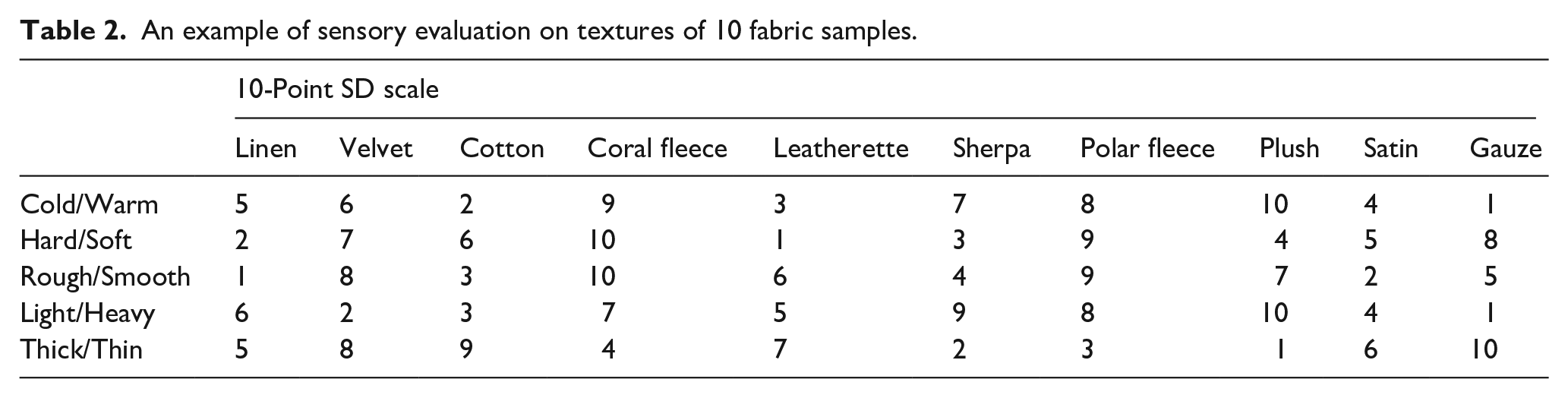
We determined five adjective pairs in the sensory evaluation on fabric textures. The adjective pairs were selected corresponding to fabric evaluation, 35 namely cold/warm (thermal conductivity), hard/soft (hardness/softness), rough/smooth (surface friction), light/heavy (mass), thick/thin (thickness). Before the experiment, the definitions of the adjective pairs were explained to the subjects. The sensory evaluation on textures was performed with a combination of semantic differential method and ranking method, 36 in 10-point SD scale (from 1 to 10). The lower the score, the colder/harder/rougher/lighter/thicker the fabric, while the higher the score, the warmer/softer/smoother/heavier/thinner the fabric. For example, rating 1 represents the coldest, while rating 10 represents the warmest. It’s required that the subjects should not make the same score of fabric samples to help rank them. An example of fabric textures evaluation for 10 fabric samples was shown in Table 2. Participants would be explained well about it before the formal experiment, and all answered it.
An example of sensory evaluation on textures of 10 fabric samples.
Sensory evaluation on emotions was assessed via a self-report judgment, to collect information on emotional dimensions (pleasure and arousal) based on two-dimensional emotional model (PA or VA model).37,38 Pleasure refers to the enjoyable nature of emotion, ranging from “positive, pleasant” to “negative, unpleasant.” Arousal corresponds to the level of excitement elicited by emotional stimulus, ranging from “calm” to “excited” of the emotion. The emotion assessment was conducted using a scale from 1 (the most unpleasant, the calmest) to 10 (the most pleasant, the most excited). Participants were asked to make different score of the emotional impact of fabric textures to rank them. Table 3 showed an example of the assessments on emotion for 10 fabric samples. It’s well informed to participants before the experiment and answered by all of them.
An example of sensory evaluation on emotions evoked by 10 fabric samples.

For sensory evaluation, every sample was cut into 10 cm × 10 cm, and labeled from 1 to 10. The subjects were sitting on a comfortable chair, in a silent and artificially lighted room with suitable conditions (T = 20℃ ± 5℃, RH = 60% ± 5%). Before the experiment, an experimenter introduced the experiment procedures to the participants. In addition, the participants were asked to go through the procedures using test sample. The sensory evaluation was performed through visual perception and visual-tactile perception. 39 For visual perception, 10 fabric samples were put on a table randomly and evaluated only in vision. Participants were required to make seven assessments on textures (five adjective pairs) and emotions (two emotional dimensions). For each assessment, they observed 10 fabric samples (one fabric for 5 s) and did the assessment. The whole process for 10 samples took about 10 min, as shown in Figure 2(a). For visual-tactile perception, participants perceived the samples one by one randomly, by visual and tactile sense, then made assessments on the samples. The operating techniques of visual-tactile perception were developed. The subjects were asked to observe and (i) touch the surface of fabric by hand for the assessment on cold/warm; (ii) bend the fabric by hand with pressure for the assessment on hard/soft; (iii) rub the fabric surface by fingertips with pressure for the assessment on rough/smooth; (iv) gently lift the fabric from the side by hand for the assessment on light/heavy; (v) gently pinch fabric from the side by hand for the assessment on thick/thin. For one fabric, each operating technique took 10 s. After that, subjects made assessments on two emotional dimensions. During the experiment, it’s prohibited for the subject to significantly shift the fabric sample. Figure 2(b) illustrated the visual-tactile perception procedure.
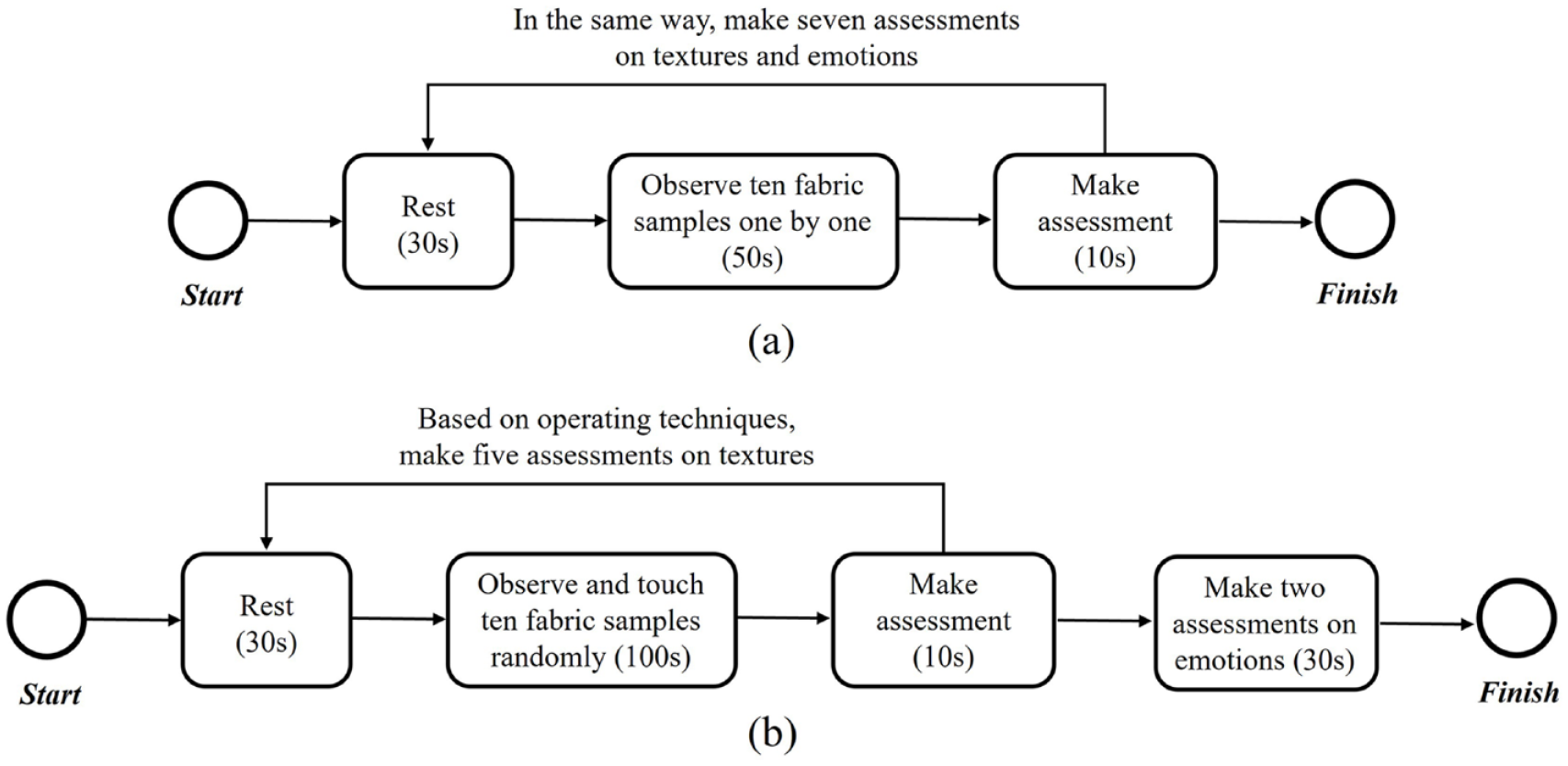
Sensory evaluation process for fabric samples: (a) visual perception and (b) visual-tactile perception.
Results and discussion
Sensory evaluation on fabric textures
Figure 3 illustrated the results of sensory evaluation on fabric textures via visual sense: (a) cold/warm; (b) hard/soft; (c) rough/smooth; (d) light/heavy; (e) thick/thin. To investigate whether the difference between the assessments on fabric samples was significant, T-test was applied. T-test is suitable for independent samples with small sample sizes. 40 The test results were shown in Figure 3 using letter labeling. 41 As seen in Figure 3(a), coral fleece, Sherpa, and plush got top scores for warmth, while the differences among them were not significant. Compared with other samples, coral fleece and sherpa were remarkably warm, while cotton and gauze were significantly cold. There was no significant difference between linen and leatherette, polar fleece and plush, and the differences between other fabric textures were significant. As shown in Figure 3(b), linen and leatherette were significantly hard with the lowest scores among all samples. Plush, cotton, gauze, satin, and coral fleece were soft with higher scores, while the differences among them were not significant. From Figure 3(c), it’s observed that linen and sherpa were significantly rough with the lowest scores, while there was no significant difference between them. Satin and velvet were remarkably smooth, while the difference between them was not significant. In addition, no significant differences were observed among other fabric samples. In Figure 3(d), it’s shown that cotton and gauze were remarkably light with the lowest scores, while the difference between them was not significant. Coral fleece and sherpa were significantly heavy, while there was no significant difference between them. As seen in Figure 3(e), it’s obvious that the differences among fabric samples were significant. Gauze was significantly thin with the highest score. Sherpa and plush were significantly thick, while the difference between them was not significant.

The results of sensory evaluation on textures of 10 fabric samples by visual perception: (a) cold/warm, (b) hard/soft, (c) rough/smooth, (d) light/heavy, and (e) thick/thin.
Figure 4 described the results of sensory evaluation on fabric textures via visual-tactile sense: (a) cold/warm; (b) hard/soft; (c) rough/smooth; (d) light/heavy; (e) thick/thin. Similarly, t-test was adopted to examine the differences among fabric samples, with test results labeled in Figure 4. As seen in Figure 4(a), plush, coral fleece, Sherpa, and polar fleece were significantly warm with higher scores, while the differences among them were not significant. Gauze and cotton were remarkably cold, and significant difference was observed between them. As shown in Figure 4(b), linen was significantly hard with the lowest score. Coral fleece was remarkably soft with the highest score, however there were no significant differences among coral fleece, satin and gauze. As seen in Figure 4(c), linen was remarkably rough with the lowest score. Satin, velvet, coral fleece and gauze were smoother, while the differences among them were not significant. From Figure 4(d), it’s obvious that gauze was significantly light with the lowest score. Plush, Sherpa, and coral fleece were heavier with higher scores, while no significant differences among them were observed. In Figure 4(e), it’s shown that gauze was significantly thin with the highest score. Plush and sherpa were remarkably thick, while the difference between them was not significant.

The results of sensory evaluation on textures of 10 fabric samples by visual-tactile perception: (a) cold/warm, (b) hard/soft, (c) rough/smooth, (d) light/heavy, and (e) thick/thin.
The comparison results of sensory evaluation on fabric textures by visual perception and visual-tactile perception were given in Figure 5: (a) cold/warm; (b) hard/soft; (c) rough/smooth; (d) light/heavy; (e) thick/thin.

The comparison results of sensory evaluation on fabric textures by visual perception and visualtactile perception: (a) cold/warm, (b) hard/soft, (c) rough/smooth, (d) light/heavy, and (e) thick/thin.
As shown in Figure 5(a), the cold/warm ratings ranking of fabric samples via visual sense (from cold to warm) was: gauze, cotton, satin, linen, leatherette, velvet, polar fleece, plush, coral fleece, sherpa; while the ranking via visual-tactile sense was: gauze, cotton, satin, linen, leatherette, velvet, polar fleece, sherpa, coral fleece, plush. The results showed that the cold/warm ratings ranking via visual perception was nearly consistent with that via visual-tactile perception. The pile fabrics: velvet, coral fleece, sherpa, polar fleece, and plush were warmer with higher scores, while linen, cotton, leatherette, satin and gauze were colder with lower scores. However, with the intervention of tactile perception, the ranking of coral fleece, Sherpa, and plush changed. It may be due to that the surface of plush was fluffier, which could store more still air and felt warmer when touching. 42 In addition, the surface fluff of coral fleece was more delicate. When people touch the delicate fluff, the contact between fabric and skin becomes point contact. Thus, the heat exchange reduces, offering a warmer feeling. 43 By visual perception, sherpa was the warmest. It may be attributed to that sherpa was a kind of imitation cashmere fabrics with thick and full fluffy; moreover, there was no difference in heat exchange under visual conditions, therefore the visual effect of fabric surface texture was dominant. The feature of visual perception is widely used in e-commerce, fashion design 34 and other fields.
As seen in Figure 5(b), the hard/soft ratings ranking of fabric samples via visual sense (from hard to soft) was: linen, leatherette, velvet, polar fleece, sherpa, coral fleece, satin, gauze, cotton, plush; while the ranking via visual-tactile sense was: linen, leatherette, sherpa, plush, velvet, cotton, polar fleece, gauze, satin, coral fleece. It’s obvious that there was a great difference between visual perception and visual-tactile perception in the hard/soft ratings ranking. In only visual perception, cotton and plush were significantly soft with high scores. While, after tactile perception was involved, coral fleece and satin were softer with higher scores. This may be due to that the fluff of coral fleece was thinner and had lower flexural rigidity, which made it softer hand feel. Satin fabric had longer floating lines than plain fabric, which provided it softer hand feel. Although velvet, coral fleece, sherpa and plush all belonged to pile fabrics, there were differences in the evaluation under different perceptual conditions. It’s probably because that sherpa and plush had fluffy and plump surfaces, which looked softer when visual perception was dominant. The surfaces of velvet and coral fleece were delicate, and tactile perception can highlight their softness. It’s supposed that the length, thickness and fluffiness of fluff were closely related to the sensory evaluation of pile fabrics under different perceptions.
As shown in Figure 5(c), the rough/smooth ratings ranking of fabric samples via visual sense (from rough to smooth) was: linen, sherpa, polar fleece, coral fleece, plush, leatherette, gauze, cotton, velvet, satin; while the ranking via visual-tactile sense was: linen, sherpa, plush, polar fleece, leatherette, cotton, gauze, coral fleece, velvet, satin. The results showed that the ratings ranking via visual perception was different from that via visual-tactile perception. What’s more, the scores of coral fleece and plush via visual and visual-tactile were significantly different. Due to the intervention of tactile perception, coral fleece felt smoother with higher score, while plush felt rougher with lower score. This may be attributed to that the surface fluff of coral fleece was finer, reducing the friction with fingers, which made it feel smoother; the surface fluff of plush was thicker and longer, increasing the friction with fingers, which made it feel rougher.
As seen in Figure 5(d), the light/heavy ratings ranking of fabric samples via visual sense (from light to heavy) was: gauze, cotton, satin, velvet, linen, leatherette, polar fleece, plush, coral fleece, sherpa; while the ranking via visual-tactile sense was: gauze, cotton, satin, velvet, linen, polar fleece, leatherette, coral fleece, sherpa, plush. It’s indicated that the light/heavy scores ranking via visual perception was relatively consistent with that via visual-tactile perception, except for coral fleece and sherpa. After the involvement of tactile perception, coral fleece and sherpa were lighter with lower scores. This may owe to that the surface fluff of coral fleece and sherpa were dominant, when only via visual perception. The surface fluff of coral fleece and sherpa was full and plump, offering a strong sense of heavy.
As shown in Figure 5(e), the thick/thin ratings ranking of fabric samples via visual sense (from thick to thin) was: plush, sherpa, coral fleece, polar fleece, velvet, leatherette, linen, satin, cotton, gauze; while the ranking via visual-tactile sense was: plush, sherpa, polar fleece, coral fleece, leatherette, velvet, linen, satin, cotton, gauze. It’s observed that the thick/thin ratings ranking via visual perception was almost the same as that via visual-tactile perception. This may be because the thick/thin of fabric was relatively intuitive, which can be accurately evaluated by a single sense.
In summary, the scores and rankings of cold/warm, light/heavy and thick/thin were consistent through different sensory perceptions, while the scores and rankings of hard/soft and rough/smooth were quite different, indicating that tactile intervention had a greater impact on the sensory evaluation of these two texture characteristics. Hard/soft represents the flexural rigidity of fabric, and rough/smooth evaluates the surface friction properties of fabric. Tactile perception, which directly touches the fabric with hands, is more sensitive to the evaluation of these two characteristics and plays a greater role. The conclusion could help guide fabric design in practical production. For clothing, especially underwear, more attention should be paid to the feeling of the contact between fabric and skin, and tactile perception evaluation should play a dominant role. For interior textiles, fashion design, etc., we should pay more attention to the visual effect of fabrics, and visual perception evaluation should lead the design direction.
Sensory evaluation on emotions
Figure 6 showed the results of sensory evaluation on emotions evoked by fabric textures via visual sense: (a) pleasure; (b) arousal. In the same way as Section 3.1, t-test was adopted to examine the differences among fabric samples, with test results labeled in Figure 6. As seen in Figure 6(a), the pile fabrics: velvet, coral fleece, sherpa, polar fleece, and plush induced significantly high pleasure, and no significant differences were observed among them. Non-pile fabrics such as linen, cotton, satin and gauze stimulated significantly low pleasure, and no significant differences were found among them. As shown in Figure 6(b), plush induced significantly high arousal with the highest score, followed by coral fleece. Cotton induced the lowest arousal, however there was almost no significant difference in the arousal activated by other fabrics. According to Section 3.1, it’s concluded that pile fabrics gave a warm feeling when only in vision, which could induce high pleasure and stimulate positive emotions potentially. Significant differences were observed in cold/warm, light/heavy, and thick/thin between plush and cotton, indicating that arousal may be influenced by these three texture characteristics.
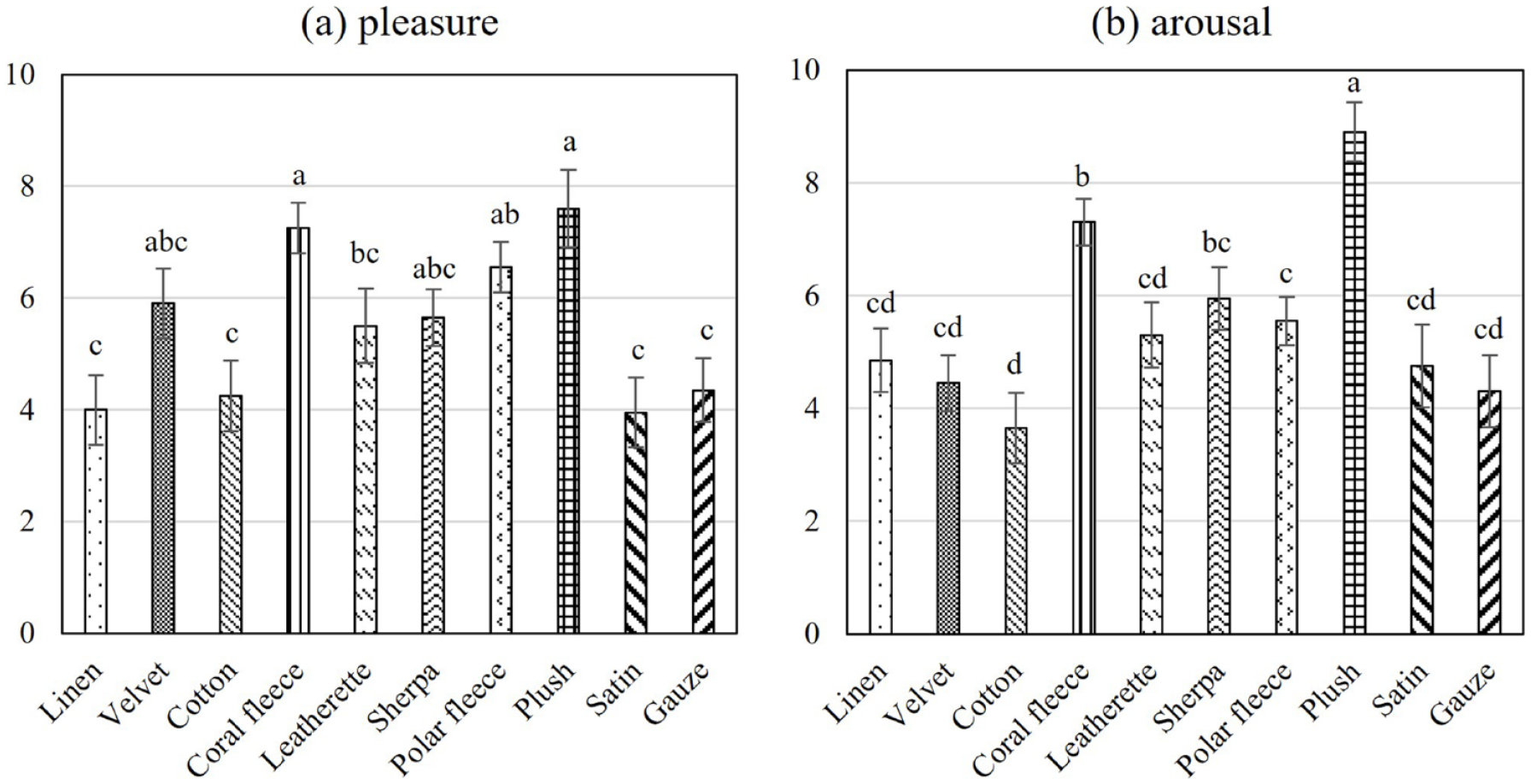
Measured results of visual sensation on emotions evoked by fabric textures of 10 samples: (a) pleasure and (b) arousal.
Figure 7 showed the results of sensory evaluation on emotions evoked by fabric textures via visual-tactile sense: (a) pleasure; (b) arousal. Similarly, t-test was adopted to examine the differences among fabric samples, with test results labeled in Figure 7. As seen in Figure 7(a), coral fleece and velvet induced higher pleasure, however the difference between them was not significant. Linen induced the lowest pleasure, but it was not significantly different from cotton, sherpa, and plush. As shown in Figure 7(b), linen, cotton, and gauze induced lower arousal, and there was no significant difference among them. Coral fleece evoked the highest arousal, but it was not significantly different from leatherette and plush. Based on Section 3.1, after the intervention of tactile perception, coral fleece and velvet offered significant softness and smoothness, which could induce high pleasure and stimulate positive emotions. The obvious common feature of linen, cotton, and gauze was thin, indicating that the thick/thin of fabric may have the greatest impact on arousal.

Measured results of visual-tactile sensation on emotions evoked by fabric textures of 10 samples: (a) pleasure and (b) arousal.
The comparison results of sensory evaluation on emotion evoked by fabric textures by visual perception and visual-tactile perception were given in Figure 8: (a) pleasure; (b) arousal.
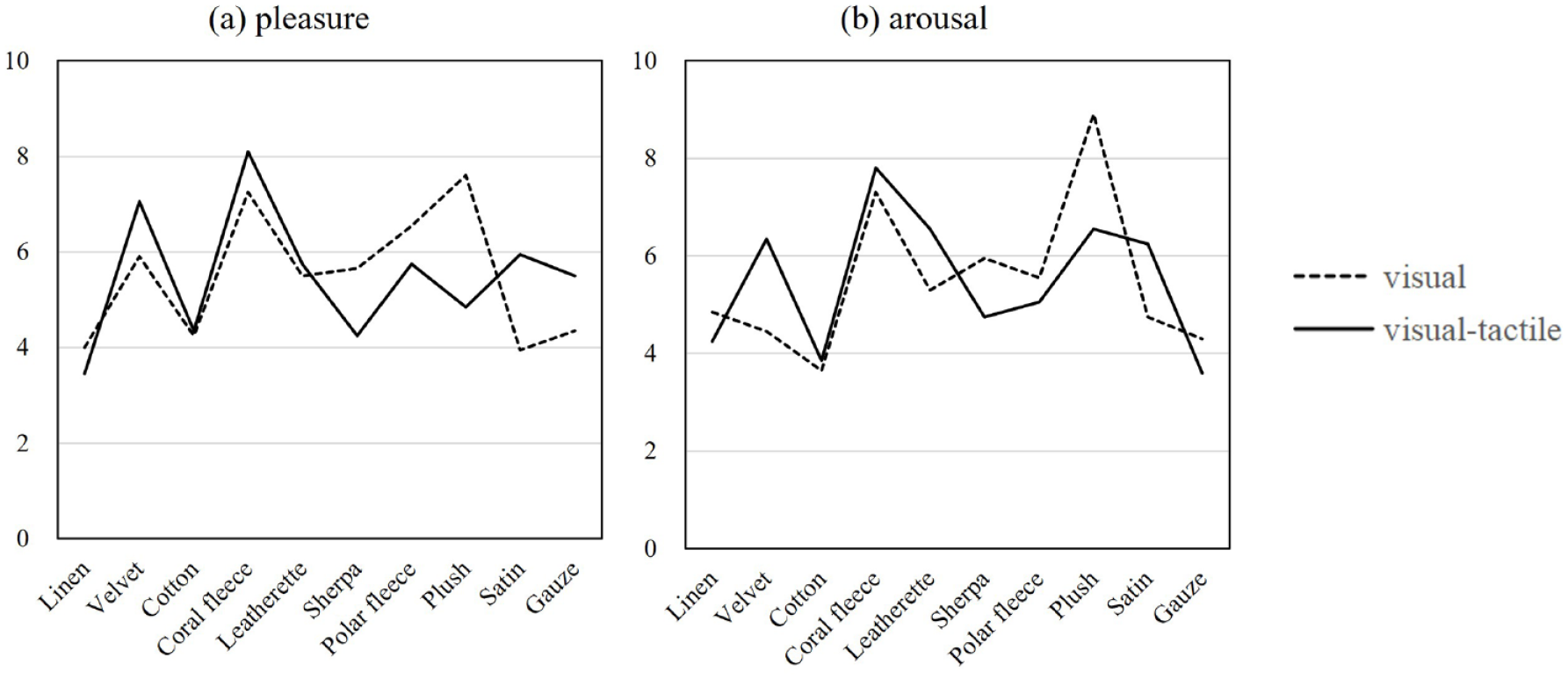
The comparison results of sensory evaluation on emotions evoked by fabric textures by visual perception and visual-tactile perception: (a) pleasure and (b) arousal.
In Figure 8(a), the pleasure ratings ranking of fabric samples via visual perception (from low to high pleasure) was: satin, linen, cotton, gauze, sherpa, leatherette, velvet, polar fleece, coral fleece, plush; while the ranking via visual-tactile perception was: linen, sherpa, cotton, plush, gauze, leatherette, polar fleece, satin, velvet, coral fleece. The results showed that the ratings ranking of pleasure induced by fabric textures via visual perception was different from that via visual-tactile perception. After the involvement of tactile perception, satin induced higher pleasure, while sherpa and plush induced lower pleasure. According to Section 3.1, after the intervention of tactile perception, softness and smoothness of satin were highlighted, which may contribute to the evoked higher pleasure. On the other hand, sherpa and plush became harder and rougher, which may explain why they induced lower pleasure. It’s deduced that after tactile perception was involved, hard/soft and rough/smooth greatly influenced pleasure. What’s more, softness and smoothness can induce high pleasure and stimulate positive emotions.
In Figure 8(b), the arousal ratings ranking of fabric samples via visual perception (from low to high arousal) was: cotton, gauze, velvet, satin, linen, leatherette, polar fleece, sherpa, coral fleece, plush; while the ranking via visual-tactile perception was: gauze, cotton, linen, sherpa, polar fleece, satin, velvet, leatherette, plush, coral fleece. The results showed that the ratings ranking of arousal induced by fabric textures via visual perception was different from that via visual-tactile perception. After the intervention of tactile perception, velvet, leatherette and satin induced higher arousal; while sherpa and plush activated lower arousal. As seen from Figure 5, after the intervention of tactile perception, the texture features except for hard/soft of velvet and satin were scored almost the same. All texture features of leatherette were rated consistently. There were differences in cold/warm, hard/soft and light/heavy scores of sherpa, while there were differences in hard/soft, rough/smooth scores of plush. It’s regarded that hard/soft may have influence on arousal via visual-tactile perception.
To sum up, there were differences in the ratings ranking of pleasure and arousal evoked by fabric textures via visual perception and visual-tactile perception. When only in vision, the pile fabrics seemed warm, which could induce higher pleasure and bring positive emotions. It’s concluded that cold/warm had an impact on pleasure. On the other hand, arousal may be influenced by cold/warm, light/heavy, thick/thin. After the intervention of tactile perception, the contact between skin and fabric played a dominant role. It’s observed that soft and smooth fabric can activate high pleasure and make people pleasant. Therefore, hard/soft and rough/smooth had great influence on pleasure. While thick/thin and hard/soft may have influence on arousal.
Stepwise regression analysis
To model the correlation between fabric textures and the evoked emotions, stepwise regression analysis was adopted. 44 Simultaneously, the significant factors of textures influencing emotions via different perceptual ways were find out. Stepwise regression analysis, one of regression analysis methods, is to find significant factors from many factors. By establishing an optimal regression equation, only significant factors are included in the equation, while the other insignificant factors are eliminated. 45 In this study, with emotional dimensions (pleasure and arousal) as the dependent variables, five fabric texture features: cold/warm, hard/soft, rough/smooth, light/heavy, thick/thin, were taken as independent variables: x1, x2, x3, x4, x5. The regression model was established by SPSS.
For visual perception only, with pleasure as the dependent variable (y1), the analysis results by stepwise regression analysis were obtained as Table 4. The emotion-fabric textures model for pleasure was:

Results of stepwise regression analysis for pleasure evoked by fabric textures via visual perception.

p < 0.01.
In general, the positive and negative signs in the equation indicate the direction of the dependent variables change with the independent variables, and the absolute value of the coefficient indicates the influence degree. According to the regression equation, when only by visual perception, the significant texture affecting pleasure was cold/warm (p < 0.01). Cold/warm can significantly positively affect pleasure, that is, the warmer the fabric, the higher pleasure it evoked.
With arousal as the dependent variable (y2), all independent variables were removed after stepwise regression analysis, indicating that fabric texture features in this experiment had no significant effect on arousal when only in vision.
For visual-tactile perception, with pleasure taken as the dependent variable (y1), and the analysis results by stepwise regression analysis were described as Table 5. The emotion-fabric textures model for pleasure was:

Results of stepwise regression analysis for pleasure evoked by fabric textures via visual-tactile perception.

p < 0.05. **p < 0.01.
According to the regression equation, the significant texture features that affect pleasure were hard/soft (p < 0.05) and rough/smooth (p < 0.01), after tactile perception was involved. Both hard/soft and rough/smooth had a significant positive influence on pleasure, that is, the softer and smoother the fabric, the higher pleasure it stimulated. The absolute value of rough/smooth coefficient was greater than that of the hard-soft coefficient, indicating that rough/smooth had a greater influence on pleasure.
Taking arousal as the dependent variable (y2), the analysis results by stepwise regression analysis were shown as Table 6. The emotion-fabric textures model for arousal was:

Results of stepwise regression analysis for arousal evoked by fabric textures via visual-tactile perception.

p < 0.01.
According to the regression equation, the significant texture feature that affected arousal was thick/thin (p < 0.01), after the intervention of tactile perception. Thick/thin could significantly negatively affect arousal, that is, the thinner the fabric, the lower arousal it induced.
Above all, with different perceptual methods, emotion induced by fabric textures was different, and the significant factors influencing emotion were also different. When only visual perception, the surface of pile fabric had fluff and looked warm, which might induce high pleasure and provide positive emotions. It’s found that cold/warm had a significant positive influence on pleasure using stepwise regression analysis. However, there was no significant difference in arousal induced by most fabrics. Regression models showed that the fabric textures had no significant influence on arousal in this experiment. In visual-tactile perception, soft and smooth fabrics could induce high pleasure. It’s observed that both hard/soft and rough/smooth had significant positive influence on pleasure, and the influence coefficient of rough/smooth was greater, from the regression model. After the intervention of tactile perception, it’s thought that thick/thin, hard/soft may affect arousal. Through regression analysis, it’s shown that thick/thin had a significant negative influence on arousal.
Conclusions
The focus of this work was to model the relationship between fabric textures and the evoked emotions through different perception methods. To achieve this purpose, 20 subjects were asked to make sensory evaluations on fabric textures and the evoked emotions using 10 fabric samples, via visual perception and visual-tactile perception. In the experiment, five adjective pairs related to fabric textures were selected: cold/warm, hard/soft, rough/smooth, light/heavy, thick/thin, and two emotional dimensions: valence and arousal were decided. As a result, the differences in the sensory evaluation of fabric textures and the induced emotions through different perceptual methods were analyzed. It was found that when only in vison, the visual effect of fabric surface was dominant, and the seemingly warm pile fabrics could induce higher pleasure and positive emotions. After the intervention of tactile perception, the skin was in direct contact with the surface of the fabric, and the soft and smooth fabric could evoke higher pleasure. Through both two perceptual ways, there was no obvious rule of fabric textures on the influence of arousal. Furtherly, stepwise regression analysis was adopted to model the correlation between fabric textures and the evoked emotions. It’s revealed that with only visual perception, cold/warm had a significant positive impact on pleasure, while no textures were found that have a significant impact on arousal. With visual-tactile perception, due to the involvement of tactile perception, both hard/soft and rough/smooth had significant positive influence on pleasure, and the influence coefficient of rough/smooth was greater. While, thick/thin had a significant negative influence on arousal.
The findings of this study might help guide textiles design. For clothing, especially underwear, more attention should be paid to the contact feeling between fabrics and skin. The evaluation of tactile perception should play a dominant role, and efforts should be made to improve the bending properties and surface friction properties of fabrics. For interior textiles, fashion design, e-commerce and other fields, the visual effect of fabric surface should be concerned. The visual illusion of the fabric takes first, which should be designed with great efforts.
Footnotes
Declaration of conflicting interests
The author(s) declared no potential conflicts of interest with respect to the research, authorship, and/or publication of this article.
Funding
The author(s) disclosed receipt of the following financial support for the research, authorship, and/or publication of this article: This work was funded by A Project Supported by Scientific Research Fund of Zhejiang Provincial Education Department (22200112-F); Science Foundation of Zhejiang Sci-Tech University (21202239-Y)
