



Abstract
The understanding of preferences toward fabrics is an important step of understanding consumer behavior of apparel. This article presents a work to study the preferences toward summer-shirt fabrics and their characteristics, particularly the gender impact, visual impact, and tactile impact toward the preference of fabrics are separately studied. Furthermore, the stability of the preference from different genders was investigated as well. To achieve these goals, the visual system and the tactile system were employed for testing male and female preferences of fabrics and the characteristics of fabrics. The two contributions of this work are as follows: (1) the factors which impact the preference of a fabric were figured out, and their relationship become a good reference for an apparel designer, and with them, a piece of apparel with preferred fabrics is able to be produced; and (2) the textile development regarding the visual sense and tactile sense will become more targeted and customized in favoring different customers.
Introduction
Preference is a psychological term that refers to an individual’s attitude toward an object and is reflected in a decision-making process.1–3 The preference toward a piece of apparel is essential in determining the consumer behavior.2,4 Generally, the preference toward apparel is mainly influenced by silhouette, fabric, color, brand, price, comfort, function, and trend of apparel.5–9 Among them, fabric is one of the most significant factors as it can influence price, comfort, function, silhouette, and even trend of apparel.10–12
Characteristics of fabric are many, such as composition, structure, finishing, surface contour, color, and yarn of a fabric. 13 Composition, structure, finishing, and yarn are more in the aspect of tactile sense, while surface contour and color are in the aspect of visual sense. 14 Both tactile sense and visual sense of fabric are important for constructing a customer’s preference. 15 Quite a few methodologies in studying customer’s preference of apparel and textile have been investigated. There are four major methodologies. First is to recall participants’ memories regarding their apparel experiences. For example, Cho and Workman 16 have studied consumers’ apparel shopping preference by asking participants to fulfill questionnaires, where multiple choices related to apparel characteristics are given; Brock et al. 17 conducted a face-to-face interview toward participants regarding the apparel preferences of tween girls and their mothers. Second is to display images of apparel or textile for participants. For example, Zhao et al. 18 set up an online questionnaire by asking participants to watch a dynamic apparel picture and select their preferred words to describe the picture. Third is to view apparel or textiles in person without any touching experiences. For example, Moody et al. 19 had conducted an experiment to study clothing preference by asking participants viewing different styles of apparel and then selecting their favored ones. Fourth is to have a tactile experience with apparel or textile. For instance, an experiment was conducted by Moody et al. 19 to find participants’ preference through trying on different clothes. These previous studies have showed that people’s preferences toward apparel or textile have connections with their memories, visual experiences, and touching experiences. It has been found that employing people’s memories to study their preferences toward apparel or textile has been well investigated, while visual experience and touching experience of apparel or textile are still undergoing. Many studies are simultaneously applying people’s touching and visual experience to work on apparel’s preference. An example is Moody et al.’s 19 work, which had difficulties in telling whether the contribution for forming the preference is from touch or vision of people. Thus, in this study, tactile sense and visual sense from people, and their impacts to the preference of textile, are separately investigated and discussed.
The relationship between the preference of apparel, textile, and their features have been investigated. For example, Chan et al. 20 have found that thermal comfort and tactile comfort are important factors affecting a worker’s preference toward the cooling vest. The work by Kim and Na 21 showed that the bending property and shearing property of a fabric toward a men’s suit affect the tactile preference. Ikiz et al. 15 detected that both Turkish and Japanese consumer’s preference toward a towel are associated with its fiber content and thickness. It has been found from the aforementioned studies that most of them worked on the preference of apparel or textile from their generic features, such as thermal comfort, tactile comfort, and fiber content. The generic features of apparel or textile, however, are not able to accurately illustrate the characteristics of apparel or textile, and thus make the usage of the relationship between preference of apparel or textile and their characteristics impractical in the apparel development. In this study, the generic features of textile have been decomposed into many characteristics as decomposers, such as finishing and fabric structure. The relationship between preferences toward fabrics’ characteristics was decided to be studied, and this outcome will be regarded as a good reference for an apparel designer to select a proper fabric for making apparel.
Many studies have showed that different genders have different preferences toward apparel or textile. For example, Workman and Cho16,22 found that the gender has a great effect on the apparel shopping preference that female has more frequency on shopping than male does. Kweon et al. 23 discovered that female feels better tactile sensation toward satin weave fabrics than male. Sondhi and Singhvi 24 investigated the gender’s influences on apparel purchase and found that females care more about the comfort and fit of apparel compared with males. The aforementioned works are detailed in interpreting the relationship between gender and apparel or textile, which makes apparel design more targeted. However, it seems that very few studies covered the stability of female and male preference regarding apparel or textile, which is also necessary to be considered before conducting an apparel design. It is therefore decided in this work to investigate the stability of the two genders’ preferences toward different fabrics.
In terms of reviewing aforementioned studies, this article aims to discuss a customer’s preference toward different fabrics. Different types of summer-shirt fabrics were decided to be preliminary investigated in the study. The reason of working on summer-shirt fabric is that (1) fabric type of summer-shirt can be quite various and (2) because of the thin fabric, the tactile experience of summer-shirt fabric is easier to be observed. This study also investigated the impact of gender and visual system regarding the fabric selection. The outcomes of this study is expected to provide implications to the apparel designers who are making decisions in selecting fabrics that are favored by the potential consumers, and it also can provide an reference for studying other types of fabrics in the future.
Experiment
Fabrics used
A total of 18 pieces of fabrics which are commonly used in making summer-shirt were employed in this study. 21 These fabrics were provided by Turkish textile company Bez Tekstil. Details of fabrics are in Table 1.
The details of fabrics.
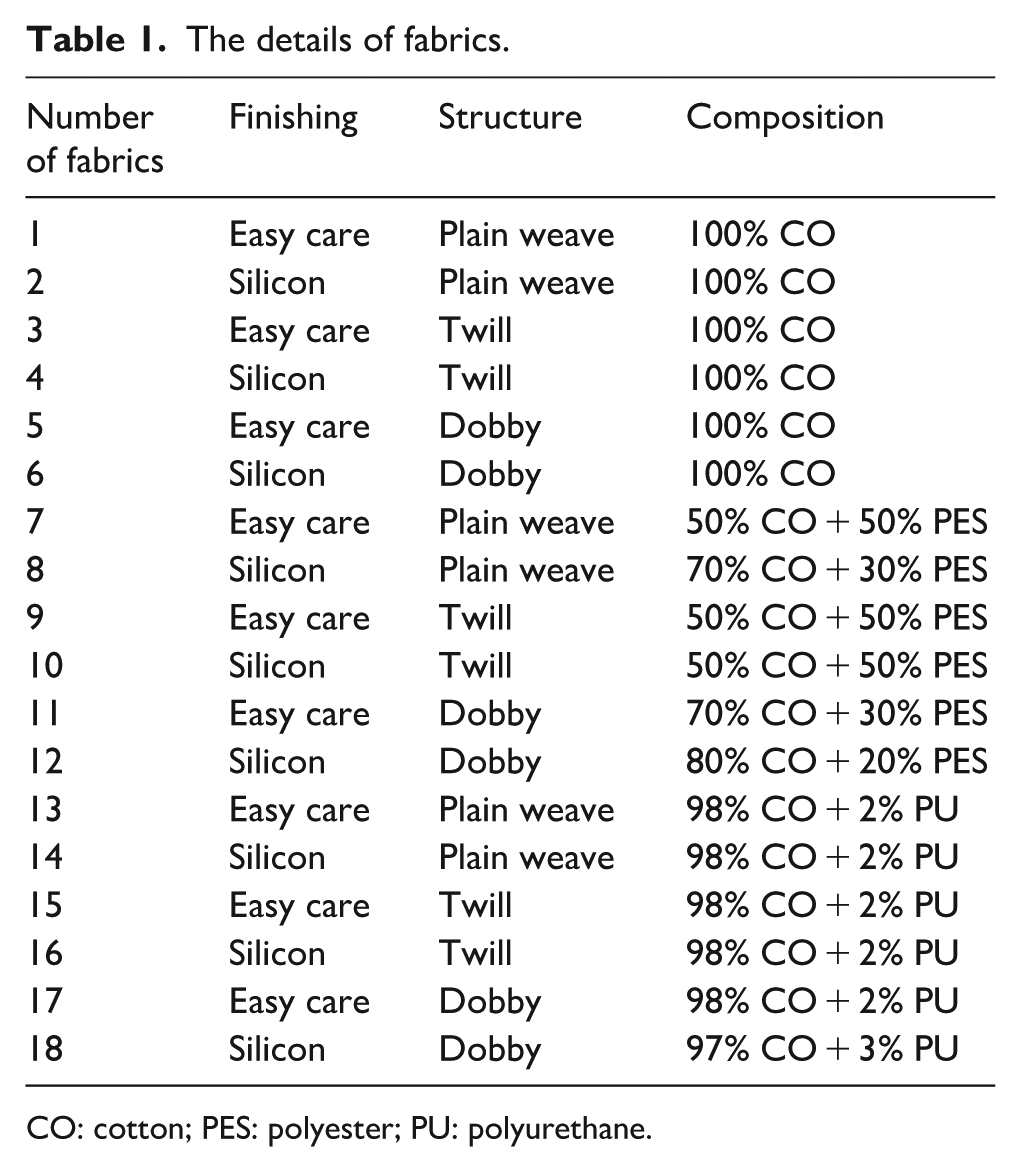
CO: cotton; PES: polyester; PU: polyurethane.
Determination of the characteristics of fabrics
A simple vote for selecting the characteristics of the summer-shirt fabric was conducted. Six common characteristics of fabrics including finishing (silicon and easy care), design (color, casual and classic), fabric structure, composition of the fabric, yarn (twisted or single), and yarn count were initially provided for the selection. Eight experts in the apparel and textile areas were asked to rank these properties, and in the end, finishing (silicon and easy care), fabric structure, and composition of fabric were ranked as the top three. They are selected for the further investigation. The reason of selecting these top three properties is that others are either hard to control or lack meaning. For example, design is quite spread and hard to control, which can include a large number of colors and styles. Different types of yarn and numbers of yarn count are difficult to tell through either visual sense or tactile sense.
Test bed establishment
The general methodology is to have a test bed on which test samples (i.e. summer-shirt fabrics) are given to participants for their selections by employing the visual system and the tactile system. Visual system, in the experiment, enables participants to access the visual details of a fabric through the visual observation. Tactile system provides with information about touch sensations during a participant’s touch experience. The test bed includes supports of fabrics and mask. The supports (Figure 1) of fabrics carry test samples, which detail the fabrics’ characteristics and are used for participants’ selection. The mask (Figure 2) is required to disable the visual system throughout the participants’ selection in the experiment.

Example of fabrics’ support.

The mask used in the experiment.
In the 18 pieces of summer-shirt fabrics, every two of them were combined into a group and were put on a support, and each fabric was combined with five different ones. In total, 45 supports (18 fabrics × 5 times/2 = 45 supports) were generated (Table 2). The reason to have five-time combination for a single fabric was that many fabrics share the same characteristics with others (details in Table 3), and this number of combinations is able to reduce the study of overlapped characteristics of fabrics. It is noted that the combination of two fabrics was not random, but they were manually made to have a single different characteristic with each other. For example, in Table 3, No. 1 fabric was paired with five different fabrics, and each pair illustrates only a different characteristic. Furthermore, the experiment recruited 50 participants, which include 25 females and 25 males. The criteria for recruiting these participants were as follows: (1) they must be Chinese residents and (2) their age must be in the range of 18–35 years.
45 fabric supports.

CO: cotton; PES: polyester; PU: polyurethane.
An example of combinations.

CO: cotton; PES: polyester; PU: polyurethane.
Tests with and without the visual system
The experiment was divided into two sections. The first one was without the visual system applied, but only with the tactile system, whereas the second one applied both the visual system and the tactile system. The test procedure for the first section is as follows.
Step 1: participants were asked to be in a summer-simulation circumstance, where temperature was controlled between 26°C and 30°C, and humidity was between 63% and 67%.
Step 2: participants were asked to cover his or her eyes with the provided mask, which was to disable the visual system.
Step 3: by conducting the tactile system, participants freely touched two fabrics on a single support and picked out a preferred one, and then, the experimenter recorded it.
A total of 45 supports were randomly given to participants one by one, and for each support, a preferred fabric was selected by participants. During the experiment, there are nine supports related to finishing, and thus, 450 choices (50 participants × 9) were made. There are 18 supports related to composition and structure, respectively, and thus, 900 choices (50 participants × 18) for each of them were made. In total, 2250 choices were made by participants (for data, see Baidu cloud 25 ). The test procedure in the second section was similar to the first one, except without step 2 (wearing the provided mask). Thus, the choices made by participants in the second section came along with their visual sense.
Results and discussion
Gender impact
Table 4 gives the p value of chi-square test for the gender impact in terms of three different parameters (finishing, fabric structure, and composition). It can be found that gender only associates to structure with the visual system enabled, as the p value of the chi-square test is 0.009 (less than 0.05). Gender has a slight connection to finishing when the visual system is disabled, as its p value is close to 0.05. Thus, only these two conditions will be analyzed with their relationships to the gender.
The result of chi-square test between gender and parameters of fabric.

Gender and structure
As shown in Figure 3, plain weave seems to be the least selection for both female and male when the visual system is enabled. Female has similar tastes for dobby and twill, whereas male has similar taste for plain weave and twill. Generally, female’s choice regarding fabric structures fluctuates more than male does when the visual system is enabled. It can be inferred that female is more sensitive in terms of the fabric structure than male when they can personally see the fabric.

Comparison of choices toward different fabric structures for two genders when the visual system is enabled.
Gender and finishing
Figure 4 interprets how people’s selection connects to the fabric finishing when they are not able to see the fabrics. It can be seen from the figure that male and female have totally opposite preferences toward fabric finishing. Female prefers silicon, while male prefers easy care. Moreover, it is quite obvious that female is quite sensitive to the fabric finishing, as their choices toward two types of finishing dramatically fluctuate. However, as the above mentions that the connection between gender and finishing is not as strong as gender and structure. Thus, more analysis should be carried out to give a better explanation.
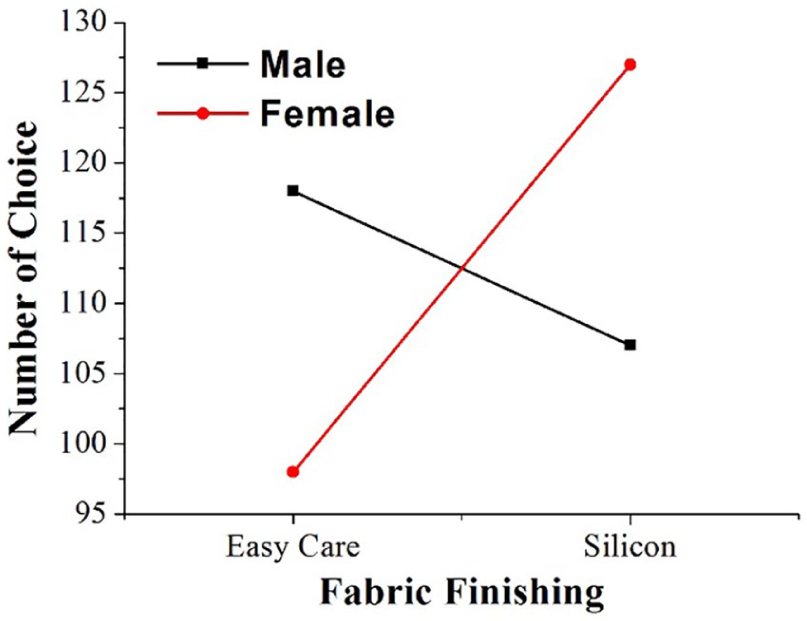
Comparison of choices toward different fabric finishings for two genders when the visual system is disabled.
Visual impact
Table 5 gives the p value of chi-square test for the visual impact in terms of three different parameters. It can be found that the visual system associates with fabric structure for both female and male, as the p values of the chi-square test are 0.01 and 0.003, respectively. This is quite consistent with the result between gender and fabric structure in section “Gender and structure.” In Table 5, other parameters have quite large p values, which indicates lesser connections. Thus, in this case, the relationship between visual impact and fabric structure will be studied.
The result of chi-square test between the visual system and parameters of fabric.

In Figure 5, the visual system shows the influence of the preference of the characteristics of fabric structure. It can be found that the selection of plain weave and twill increased when the visual system was applied. It may due to that these two characteristics are more vision-friendly, and they may add value to the aesthetics of the fabrics. However, dobby has the opposite situation. The number of selections toward dobby dramatically dropped when the participants can see the fabrics. It can be inferred that the dobby has a better touching experience than its visual experience. Moreover, its visual sense seems not very welcomed by participants.

Comparison of choices toward different fabric structures in two visual systems.
Stability of the selections
Figure 6 shows the box plot for fabric selection among six different sceneries, including male without the visual system, female without the visual system, male with the visual system, female with the visual system, all males (with and without the visual system), all females (with and without the visual system), all participants without the visual system, and all participants with the visual system. It can be detected from Figure 6 that female’s fabric selection is more scattered when the visual system is disabled. However, the selection becomes more concentrated and stable when female is able to see the fabric. It can be inferred that female’s preference toward a fabric may largely rely on their visual effect rather than tactile effect. However, male seems to have an opposite response on fabric selection regarding the involvement of the visual system compared with female. As the ranges of two bars regarding male in Figure 6 do not change much before and after applying the visual system, male seems to be more robust on the visual system toward fabric, which is consistent with the aforementioned results that female is more sensitive to the characteristics of fabrics. Figure 6 also shows that female’s selection toward fabric has a wider range than male and the bar for all females share more range than the bar for all males.

Fabric selection in different sceneries.
Conclusion and future perspective
In this article, male and female preferences toward the characteristics of summer-shirt fabrics have been studied. A total of 18 types of summer-shirt fabrics were tested by 50 participants under the visual system and the tactile system. The relationship between people’s preference and fabric structure has been studied. The following conclusions can be drawn from the results: (1) fabric structure is the significant factor to influence customer’s preferences toward a fabric; (2) visual details are essential factors to affect customer’s preferences, particularly female is more sensitive to visual effect; and (3) the findings between customers’ preferences and the characteristics of a fabric in this study make sense for being a reference to conduct a customized apparel design in satisfying customer’s preferences.
There are several limitations with this work. The first limitation is the simple selection toward characteristics of fabrics, where there was a small sample size (i.e. eight experts). This made the selected characteristics of fabrics have less statistic soundness. The future work is warranted to overcome this limitation, to have a bigger sample size and to conduct a better statistical analysis. The second limitation is that not too many characteristics of a fabric were selected and studied. The future work should consider more characteristics and then find their relationships with customers’ preferences.
Footnotes
Declaration of conflicting interests
The author(s) declared no potential conflicts of interest with respect to the research, authorship, and/or publication of this article.
Funding
The author(s) disclosed receipt of the following financial support for the research, authorship, and/or publication of this article: The study was supported by the Venture & Innovation Support Program from Chongqing Overseas Returnees (grant no. cx2019124), Chongqing Social Science Funds (grant no. 2018QNYS72), Fundamental Research Funds for the Central Universities (grant no. XDJK2019C082), and Council of Higher Education—Turkey (grant no. MEV-2016-087).
