



Abstract
There is a growing trend where footwear is considered a fashion item by increasing in this way the number of footwear products in the market. This is translated to carbon footprints which is a global issue. Reducing the number of footwear can be achieved by focusing on customization. Shifting from mass production to customization is highly supported by digital technologies. A case study of shoe customization in the mass production mode is presented. Implemented in a shoe manufacturing environment, the possibility of using one node of the bottom in combination with various options for the shoe not only results in success in terms of fit and comfort but at the same time promotes sustainable production. This methodology aligns with the sustainability goals in the footwear industry while expanding the range of shoes.
Introduction
Footwear products are among wearable products not only covering and protecting our feet but also impact our health. Due to the known fact that we spend most of our life wearing shoes and the biomechanics of our body are linked with properly fitted shoes, the design, and materials used in their manufacture must offer comfort and enhance the wearer’s performance. Inappropriate shoes lead to many problems as causing plantar fasciitis 1 or other injuries. From the evidence, researchers propose that ensuring comfort can be reached by applying the biological design of footwear or anatomically shaped shoes. 2
Design of footwear as well as fashion products design and production are mainly a manpower-based industry. However modern progress and sustainable fashion requirements force us to implement innovative technology such as 3D design, virtual prototyping, and digital methods of obtaining initial information for design. The current virtual product development tools for fashion products are helping to provide reliable manufacturing solutions today. 3 Integration of CAD/CAM systems in the footwear industry in different steps of product development as modeling, simulation, visualization, and so on, offers digital tools, that improve the whole process regarding costs, time, waste reduction, etc. In addition, the increased focus on sustainability is perceived as a boost in the adaptation of these new technologies, which are a sustainable enabler in footwear manufacturing. 4 As a result, there has been an increased awareness of different companies around the world to focus on the integration of sustainable processes and materials in the footwear industry. In this scenario, product design becomes a decisive factor in producing footwear with adequate comfort and sustainable production.
Modern increased demands for convenience and ergonomics of fashion industry products are caused by the trend to improve the quality of life of consumers. Therefore, many works are devoted to studying the shape of the human body and its parts to create rational, correct forms of products based on anthropometry and biomechanics. 5
Customization is a rapidly growing approach to tailoring mass-produced items to the needs of consumers. Not only linked to the high costs required for footwear production, but customization also brings an important solution to all the consumers seeking custom products. Various research papers have been conducted to evaluate the effect of personalized parts of the shoe as the insoles, which are useful for alleviating pain caused by foot problems. 6 3D scanning technology in combination with CAD modeling offers the possibility to direct manufacturing of custom-made products. 3D scanners assure to obtain the initial information and make possible that is combinations with CAD software to effectively apply anthropometric information about the foot as a reference point when designing ergonomic lasts according to individual parameters. 7 The combinations of 3D printing onto textile materials presents new ways for producing custom-made products, as customized orthopedic devices. 8
Footwear customization in a mass production mode presents advantages in terms of fit, and comfort and promotes sustainable production. This methodology aligns with the sustainability goals in the footwear industry while expanding the range of shoes.
The initial idea of developing shoes with the possibility of replacing some parts was further developed in the direction of the possibility of adapting shoes to the parameters of the customer’s foot. Such an idea is relevant based on numerous requests and feedback from a Ukrainian customer and the results of the Ukrainian men`s feet study. 9
Traditionally shoes are produced on standard lasts of the same width, which results that between 63% and 72% of participants were incorrectly sized footwear. 10
Purpose of the paper: to develop a method for customizing shoes that allows us to adjust the shoes to the consumer’s needs at the stage of purchase in a store or warehouse. In this work, this type of production is implemented in a shoe manufacturing environment. The structure is organized with the introduction part about product design in the footwear industry and following with sustainability as an emerging need in footwear production. The methodological part introduces an attempt to customize comfortable mass-produced shoes in a shoe manufacturing company. The results of the proposed model and discussion about the comfort it offers to consumers are depicted. At the end, the conclusion part is presented.
Sustainability as an emerging need in footwear production
Sustainability is a common problem present all over the world and various definitions have a common task to make people aware of their actions to not harm the future. The United Nations has defined various goals that should be considered to secure sustainable development. Among them, the goal related to industries, innovation, and infrastructure plays a key role in sustainable production including the footwear sector 11 which represents approximately 1.4% of global climate impacts. 12 The volume in the footwear market is growing and the forecast is expected to grow at a Compound Annual Growth Rate or CAGR of 1.9%. 13 Due to the increased focus on sustainability, it is perceived as a boost in the adaptation of new technologies, which are sustainable enablers in footwear manufacturing. At first, their integration was mainly focused on 2D patterns, but have evolved through time by including 3D technologies for the process of product development in the footwear industry. Modeling, simulation, visualization, and so on, offers digital tools that improve the whole process regarding costs, time, waste reduction, etc. Due to the nature of the footwear manufacturing sector which is still mainly power-based, the integration of digital tools has facilitated this process. Step-NC standard used as a tool to interconnect all the sub-systems needed in the footwear industry can improve the shoe manufacturing process. 14
There is an increase in the number of well-known companies operating in footwear production that are trying to push further the integration of sustainable processes and materials in the footwear industry. In this scenario, product design becomes a decisive factor in producing footwear with adequate comfort and sustainable production. Understanding consumer behavior and including them in the production process have resulted in a new paradigm of Social Manufacturing for customized production in the footwear industry. 15 This is supported by the use of digital technologies that drive product customization 16 and the case study from the Portuguese footwear companies shows the industry’s interest in co-design and customization where I4.0 is a key driver. 17 The buying decisions of consumers play an important role in sustainability which is the focus of research work. The findings may differ with a low interest in fashion brand sustainability 18 or ranked as last factors 19 or not reflected by new generations in terms of footwear. 20 Among the three pillars of sustainability, studies have found that social sustainability has resulted in the most important in the supply chain for the footwear company. 21
Solutions can be found by focusing on design principles and circular economy to come out with the reduced value of waste and negative impact at a high level. 22 Changes in footwear production are even related to the materials used, as they contain a high number of plastics, rubber, leather, textiles, etc., which in most cases makes impossible the recycling process. Leather processing as chrome tanning presents waste that hurts the environment. Developing a new tanning technology and further use of generated waste as auxiliaries for applications in cosmetics, agriculture, etc. 23 is an attempt to achieve sustainable production in the footwear industry.
To have a more sustainable production of shoes, Spahiu et al. 24 used plantar pressure maps and topological optimization schemes to develop soles with the best least material design according to the feet’s pressure while maintaining biomechanical performance and esthetics. Customization is an added value to sustainability, and in the fashion industry, evidence shows that 75% of consumers prefer to buy personalized products. 25
In this work, an attempt to introduce customization for comfortable mass-produced shoes in a manufacturing company is presented.
Methodology
The methodology of shoe design is a transformer model with a removable upper part, which is attached to the bottom of the shoe with a zipper.
Participants
Based on the problems with finding the right shoes research was conducted to see the difference in feet measurements. Based on this, a group of people comprised of 12 men are selected to be measured. The feet and their foot length varied from 267 to 273 mm and they had no pathologies or significant deformities on their feet. To create the digital replicas of the feet models a 3D foot scanner Infoot 3D is used for both feet.
Anthropometric data
All the feet models are analyzed with Powershape software and the anthropometric data of the feet are taken with the use of Foot3d software, to evaluate the differences in girth and widths of the foot. Based on changes in these dimensions, comparisons with the basic 3D last model used in a company are conducted. The bottom part of the foot is realized by analyzing the footprint taken of each participant with CorelDraw.
Digitalization
In order to evaluate the differences between 3D foot models and the standard last used in the company comparing 3D last and foot models is taken. The same scanner is used to digitize the standard last model. By following, flattening the side surfaces and comparing both forms of them to calculate the needed area of editing the initial pattern of the upper part. At the end designing the pattern for both lasts and brings together to the common shape of the unified piece of the upper part. The following pictures present the methodology followed in this work (Figure 1).
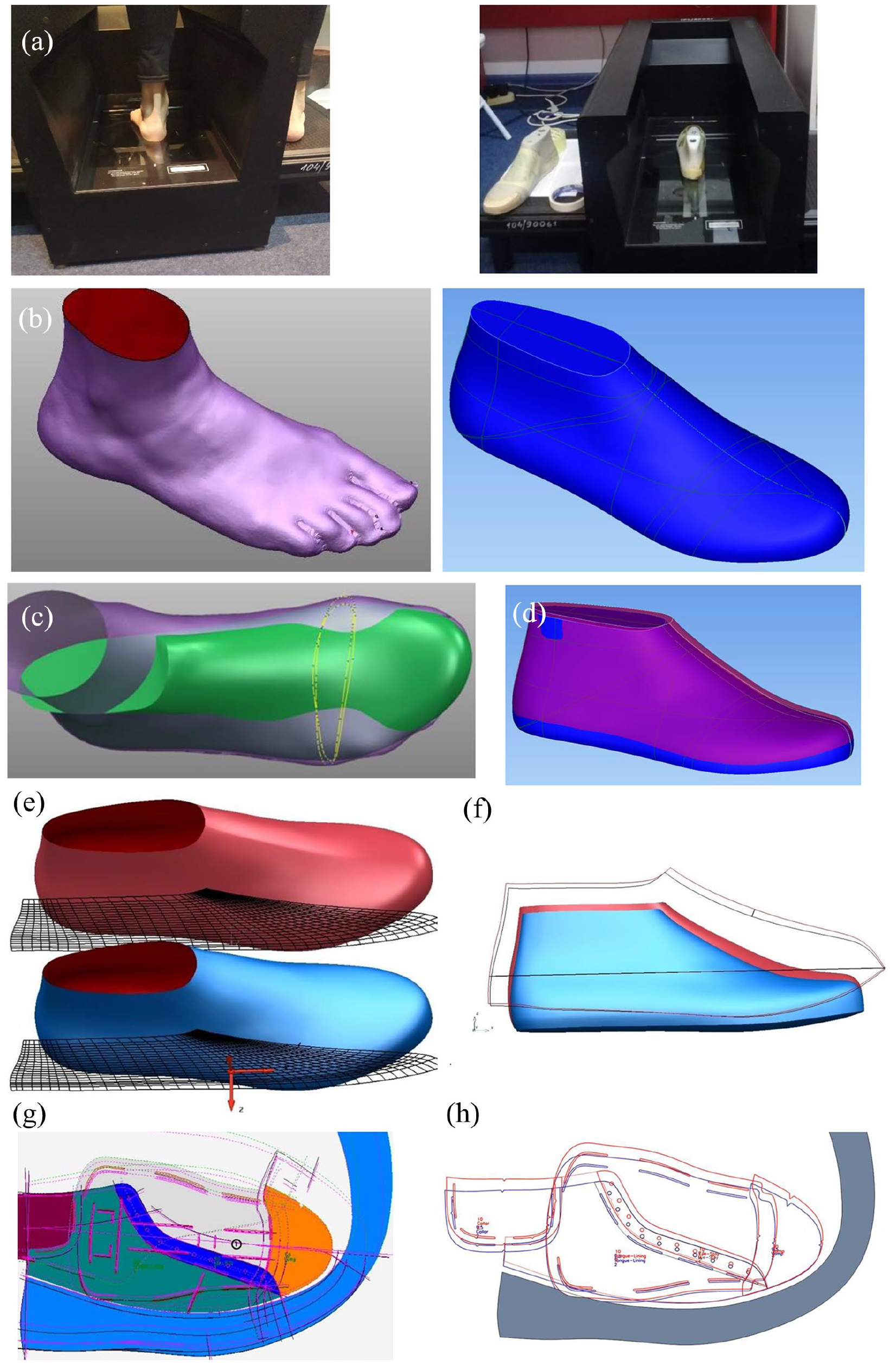
Methodology followed in this work.: (a) foot and last scanning, (b) 3D models of foot and last, (c) comparing last with foot models, (d) developing shape of the custom shoe last, (e) flattening the side surface of both forms of shoe lasts, (f) comparison of the last flattening, (g) designing the patterns of upper parts for two options of the last widths, and (h) both patterns on the common shape of the unified piece of the upper part.
Results and discussions
Comparing 3D foot model results with differences in the girth parameters, that reached 17 mm in the ball area, and 21 mm in the instep area. At the same time, the width differences of the feet in the widest zone did not exceed 3 mm. Figure 2 depicts the comparison of 3D foot models with a length of 270 ± 3 mm.
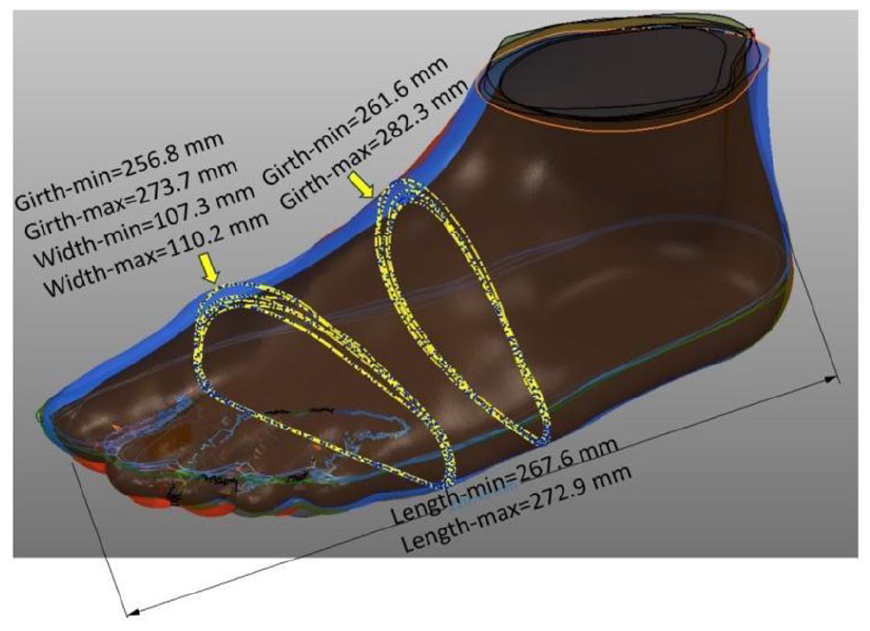
Comparing the 3D shapes of the feet with the length 270 ± 3mm.
This suggests the possibility of developing comfortable shoes for feet of various girths with a unified shape of the bottom part of the shoe. Therefore, a comparative analysis of feet with standard width and girth in the ball area of 260 mm with the standard last is conducted. Figure 3 presents the 3D feet with the standard last which are aligned together and the section view of data comparisons where three contours of the ball girths are taken for the average foot, the wide foot, and the basic last.

Comparing shapes of the average and wide feet with the standard last; left) 3d shapes and right) section view of data comparison.
There is an acceptable level of deviation in shape and measures between the wide and the average foot. However, this is different when comparing the parameters of the standard last with the parameters of wide feet, where the deviations in shape and measures prove the need to use a different last of adapted parameters.
Other comparisons are performed between the 3D models of the wide foot shape, first with a standard last and after with the new customized last shape. The color-coded map shows deviations between models. Comparison of the 3D model of the wide foot with the standard last depicted on the left of Figure 4 shows an unacceptable level of difference. In the case of the new customized last presented on the right of Figure 4 has wider dimensions in the ball area and increased height over the entire area of the last bottom. This last shape with increased dimensions allows the 3D model of the wide foot to be comfortably accommodated without putting pressure on it.

Comparing analysis of the 3D shape of the wide foot with the standard last and with the wide shoe last.
Apart from the 3D model comparison, the dimensional features of the lasts and feet models are analyzed, and the results where dimensional features of a medium and wide foot with standard and customized/improved last are presented in Table 1. All these dimensional features serve for designing the needed shape of the wide shoe last based on the initial standard shoe last.
Dimensional features of the foot and the last.

However, when trying to implement the process of manufacturing shoes of an expanded width range, we faced the problem of an inevitable increase in production costs and environmental impact. Therefore, in order to increase the efficiency of the parts used and production efforts, forms of shoe last of standard and wide widths, which have a unified shape of the bottom surface, are developed. This is to enable the use of uniform components for the bottom of the shoe. The shape was developed based on the feet shapes of the participants, by taking into account the comfort requirements. After analyzing the footprints of the studied feet, an averaged contour of the bottom surface of the customized/improved shoe last was developed. Figure 5 depicts the footprints of the studied feet and the created contour given in red color. This is the base for developing the shape of the bottom part of the comfort shoes.

Footprints of the studied feet and the averaged contour (red color).
While exploring the perspective of customizable shoe manufacturing, the customization options for the style and type of shoe upper are included. One of the most popular designs of men’s comfortable shoes is developed with low shoes and lace-up boots. It can be transformed by detaching the upper option and attaching another option. At the same time, the consumer’s assortment may include the desired number of top designs that differ in color, material, design, etc. Figure 6 depicts different shoe models designed using the same last.
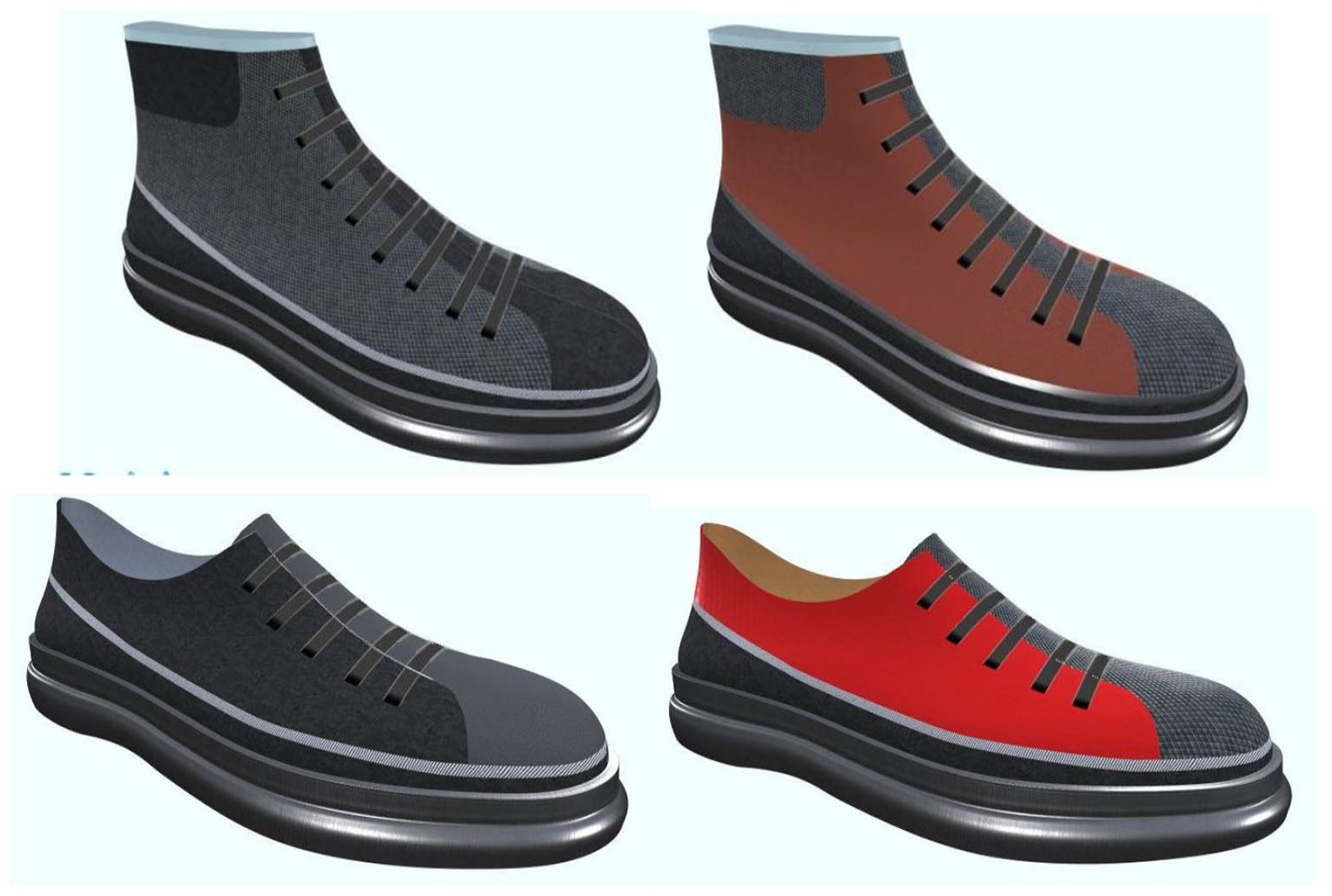
Different men’s shoes are modeled on the same last.
The shoe design proposed in this work greatly facilitates the task of adjusting the shoes in accordance with the customer’s foot by attaching the upper part of the shoe with increased girth parameters. Thus, this design allows you to adjust the width of the shoe by attaching the appropriate version of the shoe upper. This methodology of customizing shoes is much easier to implement than of shoe production in additional widths. Figure 7 presents shoe customization according to foot parameters after comparing the basic last with the customer foot, which is translated with the increase of the shoe width.
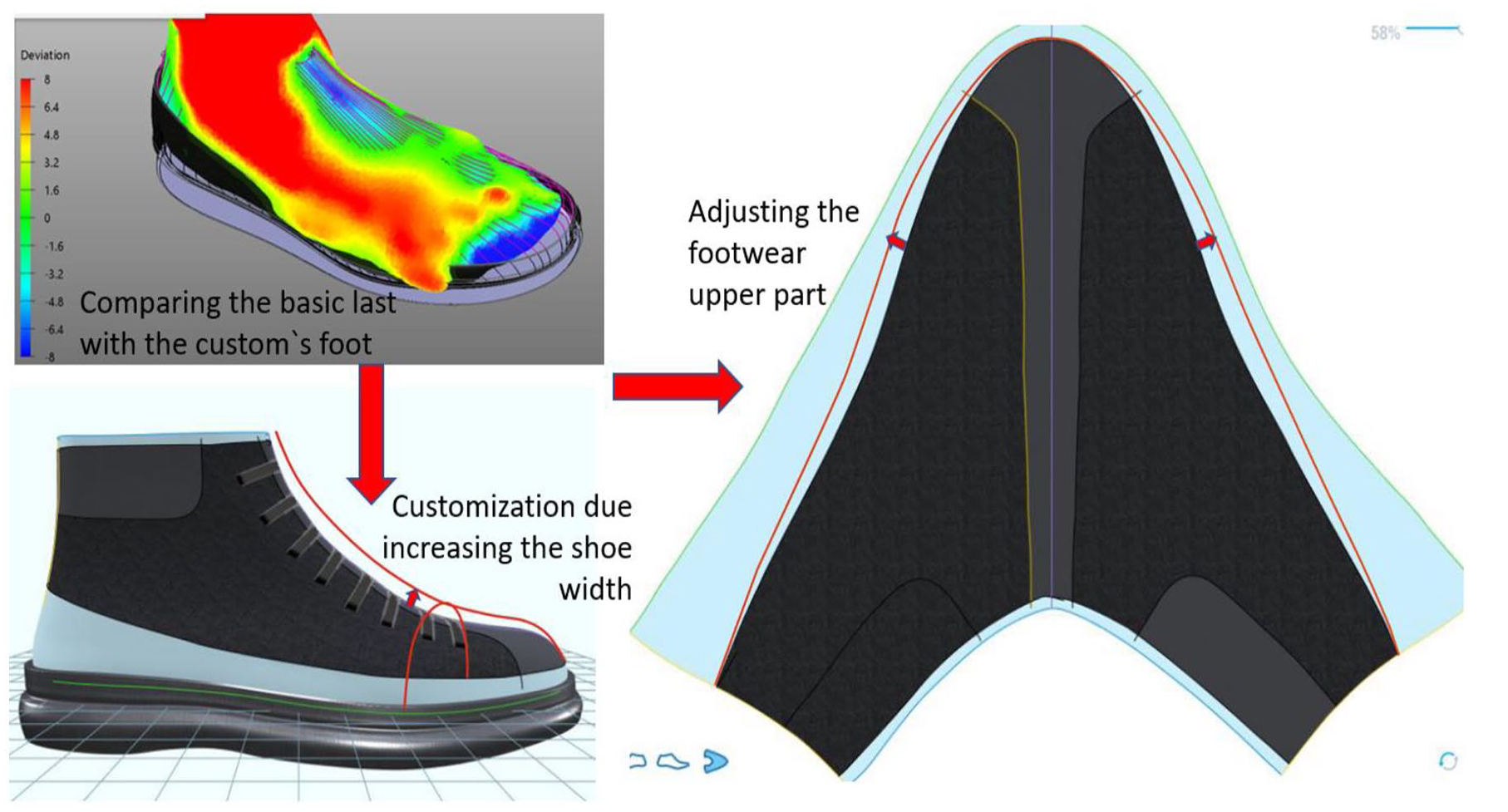
Customizing shoes according to the parameters of the foot.
Different variants of interchangeable shoe uppers with different dimensional parameters can also be achieved by the ability to adapt this shoe to the necessary orthopedic inserts of the consumer. For example, removable orthopedic or prophylactic insoles have a significant thickness and cannot be inserted into the shoes of standard parameters. Figure 8 presents orthopedic inserts for interchangeable shoe uppers.

Orthopedic inserts for interchangeable shoe uppers.
To show the method to change the shoe upper in this work, two versions of men’s shoes were modeled based on one bottom part, to which two different upper designs can be attached. The bottom part of the shoes, which is the basis of the transformer, is a sole with an insole and an attached mudguard (bumper)part, to which one zipper tape is attached. The second zipper tape is attached to each of the interchangeable upper versions. The zipper is located along the perimeter of the shoe, in the heel part at the level of the height of the stiffener, and in the ball area just below the widest line of the shoe last. This arrangement of the zipper is due to anatomical and technological requirements. The high back part allows you to place a rigid stiffener, which is an important frame detail that ensures the shape stability of the shoes.
The low location of bumpers in the ball area makes the shoe more comfortable by avoiding the pressure of the zipper chain on the protruding ball areas. On the inside, the zipper is isolated from the foot with a soft leather flap. In the heel part, the design has a special valve for fixing the assembled shoe structure and for hiding the zipper slider. In Figure 9 are presented images of the customized shoes by using one unified bottom part.

General scheme of the customization possibility using unified bottom part of factory produced footwear.
A general work sequence for manufacturing customized shoes following the needs of the customer is shown in Figure 10. In addition, the manufacturer can always leave room for the consumer’s fantasies by providing other versions of the upper part that can be designed or adapted according to their taste.

Steps followed to manufacture customized shoes.
The proposed shoe design is a transformer model with a removable upper part, which is attached to the bottom of the shoe with a zipper. The reasons by which are justified the expediency of this type of transformation are as follows:
1) Attaching the bottom (sole, insole, and rigid parts) to the upper part is the most complex, energy-consuming, and non-environmental process of the entire technological process of shoe production. Therefore, the possibility of using one node of the bottom in combination with various options for the shoe upper will significantly reduce the consumption of material, and energy of the shoe making, and also reduce the burden on the environment while expanding the range of shoes.
2) The sole is the most unified part of the shoe, which is made mainly by injection molding in large factories in molds, and is not very suitable for customization, despite using additive manufacturing technology. Therefore, we took the sole as the initial stable element, to which other mobile elements of the shoe will join (shoe upper versions).
3) The zipper is convenient to use, it provides quick attachment of the two separate parts and a tight connection of them.
However, this study has some limitations regarding the sample sizes taken. The number of feedbacks taken is only from four pairs of samples and the research will continue to include more samples. Taking into account the feedbacks of consumers wearing these shoes regarding fit, comfort, and functionality, by bearing in mind not only the shoe model but even the material used for their production.
Conclusions
The idea of shoes with replaceable details is now especially relevant in the context of sustainable fashion. The practical implementation of this idea is caused by the search for solutions for mobile adaptation of the form and design of the manufactured shoe to the needs of consumers. The ability to combine separate shoe elements following the customer’s request is a good way to sell shoes while simultaneously reducing the number of leftovers in the warehouse. At the same time, it is important to consider the possibility of effective use of those shoe elements whose manufacture is the most complex, expensive, or environmentally unsafe.
In this work, a case study of footwear customization in the mass production mode was presented. Implemented in a shoe manufacturing environment, the possibility of using one node of the bottom in combination with various options for the shoe upper resulted in success. This is not only in terms of comfort and esthetical part but even in terms of fit and comfort. Besides this as an important factor for reducing waste for mass-produced footwear and offering consumers personalized fit, it promotes a sustainable way of production. This is achieved by decreasing significantly the use of material, energy consumption for the shoe-making process, etc. while expanding the range of shoes. Promoting and recommending this methodology that introduces customization for comfortable mass-produced shoes in a shoe factory environment is an added value for footwear companies to fulfill consumers’ requirements in terms of fit comfort, esthetical parts, and at the same time a sustainable way of production.
Footnotes
Declaration of conflicting interests
The author(s) declared no potential conflicts of interest with respect to the research, authorship, and/or publication of this article.
Funding
The author(s) received no financial support for the research, authorship, and/or publication of this article.
