



Abstract
In prevailing simulations of garment thickness, typically characterized by uniform pressure filling, variations in thickness across different sections of the garment are commonly not addressed, and the aspect of elasticity is regularly omitted. In this paper, the garment thickness is simulated by constructing a multi-layer spring-mass model, where the garment thickness is determined by the fabric properties, for example, cotton, pink ribbon brown, royal target, etc. Specifically, the spring coefficients of the multi-layer spring-mass model represent the garment thickness, which is obtained by computing the physicochemical properties of the fabric through a heat transfer equation. Meanwhile, the fabric properties also determine the upper and lower limits of the garment thickness (i.e. the limitation of spring deformation), which can be simulated as a single-layer garment or garment with thickness. With computer simulation verification, fabric properties and the multi-layer spring-mass model can simulate single-layer, multi-layer, and garments with different thicknesses. The simulation effects are similar to those of real-world garments.
Introduction
As the animation industry, 3D gaming, and virtual reality rapidly advance, 3D garment simulation has become integral to film production and interactive gaming. The technical prowess of physical simulation methods is vividly showcased in the visual effects of garments in 3D animated movies. In recent years, films like the “Kung Fu Panda” series and “Alita: Battle Angel” have pushed the realism of 3D virtual garment simulation to new heights.1–4
The fundamental problem of garment thickness simulation is that the thickness is reasonable, which is subject to both upper and lower limits, rather than being set to a specific, unchanging value or adjusted manually within the simulation. Mainstream methods predominantly focus on simulating single layers, essentially the space between the human body and the garment, yet these methods are inadequate for accurately simulating garment thickness. Additionally, while some research attempts to simulate double-layer garments using external factors such as pressure or wind, these methods often fail to accurately represent the thickness observed in real-world garments. This discrepancy largely arises from a failure to adequately account for the relationship between garment thickness and its fabrics.5–8
The reasons why current computer garment thickness simulation methods do not work well are two-folds. First, these methods of garment thickness simulation do not consider the physicochemical properties of fabrics, resulting in inapplicability and lack of realism in the thickness simulation. Second, most of these methods simply extend the simulation techniques used for single-layer garments to multi-layer garments without adequately addressing the complexities involved. Typically, these methods simulate single-layer garments by focusing on factors such as pressure and wind speed between the garment and the body, but they are not capable of applying these simulation factors effectively to the interactions between layers in multi-layer garments.6,9–11
To this end, we propose a method that computes garment thickness based on the physicochemical properties of fabrics through a heat transfer equation. Additionally, thickness simulation is achieved by constructing a dynamic multi-layer spring-mass model, as discussed in Vo et al. 12 This model is specifically designed for simulating the thickness between garment layers. Through computing fabric properties, we determine a garment thickness that ensures the realism of our simulation.
Considering the properties of the garment fabrics, the equation for the parameters (thickness) between the inner and outer layers of double-layer spring-mass models is computed based on the heat conduction equation, which provides a theoretical and practical verification of the garment thickness;
The model in this paper applies to multiple single-layer garments or multiple garments with thickness simulation. Through experimental verification, this paper realizes realistic simulation of multiple garments with thickness or single-layer garments with thickness.
Related Works
Garment dynamic simulation techniques primarily encompass geometric model-based,
13
physical model-based,
14
and hybrid model-based simulations.
15
Geometric model-based simulations utilize geometric equations to depict fabric deformations, such as wrinkles and draping states
In summary, while these methods have shown efficacy in single-layer garment simulation, they do not ensure realism in thickness for multi-layered garments. Currently, there is a lack of effective computer simulation methods for modeling garment thickness. Therefore, this paper proposes a dynamic multi-layer spring-mass simulation model for realistic simulation of garment thickness. The calculation method is developed from the perspective of fabric physicochemical properties.
Our Methodology
In this paper, a double-layer spring-mass model is proposed based on the single-layer spring-mass model for garments with a thickness or multiple single-layer garments to be simulated, as shown in Figure 1. The double spring-mass model divides each single-layer garment into a quadrilateral grid, and each vertex (i.e. mass) on the grid is connected by three properties of springs, which are assumed to have 0 mass, and the spring force is computed based on the spring length. The three properties of the springs are structural springs colored in red, shear springs colored in blue, and bending springs colored in green. The different springs have different flexibility coefficients, among which the bending spring is used to simulate the bending resistance of the garment when it is bent or folded and represents a small flexibility coefficient. The connection between the inner and outer layers of the double-layer spring-mass model is constructed by structural springs and shear springs due to the small flexibility coefficients of the bending springs. The key point for the double-layer spring-mass model is that the spring coefficients of the connection inner and outer layers are the same as the coefficients of the structural springs and shear springs in the single layer. In the paper, we present various spring coefficients for the double-layer spring-mass model in the next subsection.

Double layer spring-mass model.
Definition of spring parameters
Spring parameters of single-layer spring-mass model
In the spring-mass model, the phenomenon of “hyperelasticity” is easily generated, which is closely related to the setting of the spring parameters. The elastic curves (Elongation-Stretch curve) of common garments are shown in Figure 2(a). Its slope is the elasticity coefficient of the garment, and the elasticity coefficient curve is nonlinear.

Elongation and stretch curves:. (a) elongation-stretch curves of different garments and (b) elongation-stretch curves of different spring-mass models under cotton garments.
In contrast, the spring-mass model generally uses a fixed spring coefficient, as shown in the following Figure 2(b), where the elastic curve behaves as a straight dotted line. The spring coefficient is related to the material, cross-sectional area, and length of the spring. In general, the higher the material strength of the spring, the larger the cross-sectional area, and the shorter the length, the bigger the spring coefficient
The computer simulation of the spring-mass model does not simulate the appearance of the spring, so the cross-sectional area is ignored. The spring coefficients in the spring-mass model are determined in this paper concerning the length and the garment fabrics. The longer the length, the smaller the coefficient of elasticity, and vice versa. Meanwhile, the harder the garment fabrics are, the smaller the spring parameter and the lower the degree of deformation, and vice versa.
Considering the efficiency of the simulation, the spring coefficients are divided into four segments.
17
according to the spring length and the maximum
The spring coefficients between the mass points of the single layer are computed by the following equation1.

where
Spring parameters (garment thickness) of double-layer spring-mass model
The equation for computing the spring coefficients of the single-layer in the double-layer spring-mass model is shown in equation (1). For the inner and outer mass points, the spring coefficients are related to the length of the springs, which also determines the garment thickness. Different garment fabric densities affect the thickness. In this paper, the thickness is determined based on the heat transfer equation.
18
and the thickness constraint between the garments (e.g. the limitation on the amount of down-filling in the down jacket). The spring parameters between the double layers are then determined based on the elasticity curve and the thickness (i.e. spring length) of
For example, in the case of a down jacket, the amount of down filling determines the jacket thickness as well as the heat insulation performance. The total filling amount is computed by multiplying the area of the cutting piece by the filling amount of the corresponding cutting piece. Accordingly, without changing the area of the down jacket in the paper, The amount of down filling for a cut piece can be approximated as a multiple of the thickness of the cut piece of the down jacket, and the total amount of down filling can be approximated as a multiple of the overall down jacket thickness. The specific explanation is detailed in Appendix 1.
According to the heat transfer equation, the temperature of a point

where
The cutting piece of the down jacket can form a closed smooth surface

Upon the entry of heat, the temperature of the region


The equation (4) is equivalent to the equation (3). From the Gaussian equation, it follows that,

Assume that the current model is homogeneous and isotropic. Also in this paper heat is transmitted perpendicular to the human skin direction. Therefore the equation (5) is simplified as follows.

where
In this paper, the gap between the inner garment and the body is ignored. Meanwhile, the heat transfer from the body and the garment to the environment and the heat transfer from the environment to the garment are not considered. The system of equations with the right boundary is given below by considering only the thickness between the double-layer garments.

where
Then the above partial differential equation is solved based on the finite difference method, and the above range of values of

Through equation (8) to solve equation (7) and the result is shown below.


Finally, the algorithm 1 gives the garment thickness and the spring parameters between the double layers in the spring-mass model.


In equation (10),
It is worth noting that algorithm 1 works equally well for the computation of spring coefficients between multiple single-layer garments.
Garment dressing method based on spectral clustering segmentation and point alignment
It is a critical task, in which a given garment is put into a human model in any pose and any body size. The paper gives an observation. In the real world, the human wears a piece of garment, starting from the sleeve, to complete the operation of aligning the garment and the human body. Therefore, the dressing problem is converted into a segmentation and alignment problem.
Human body and garment segmentation
First, define a graph adjacency matrix

where
Next, the Laplace matrix

Finally, the

Segmentation results of a human mode (a) and garment model (b) based on spectral clustering.
Human model and garment matching method
Assuming that the current segmentation of the human body and clothing are rigid transformations, the alignment problem can be transformed into a point cloud alignment problem.
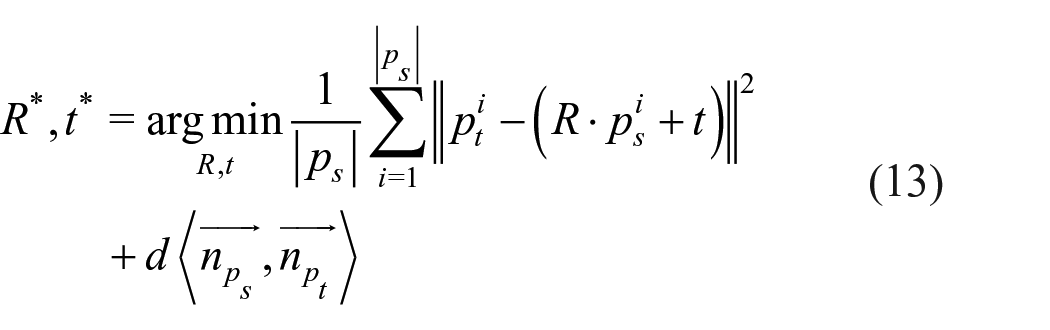
where
The above equations are solved iteratively, similar to the ICP algorithm, 19 to obtain the transformation and translation matrices. The matching results of the human model and the garment are completed accordingly.
Simulation and experimental results
The simulation implementation of this paper is performed on a PC with Intel(R) Core(TM) i7-7700 CPU @ 3.60 GHz. Firstly, we give a verification of the reasonable thickness of different fabrics. Secondly, we verify the simulation effect of garments with different thicknesses. Thirdly, we evaluate the matching effects of different garments and human models.
Garment thicknesses with different fabrics
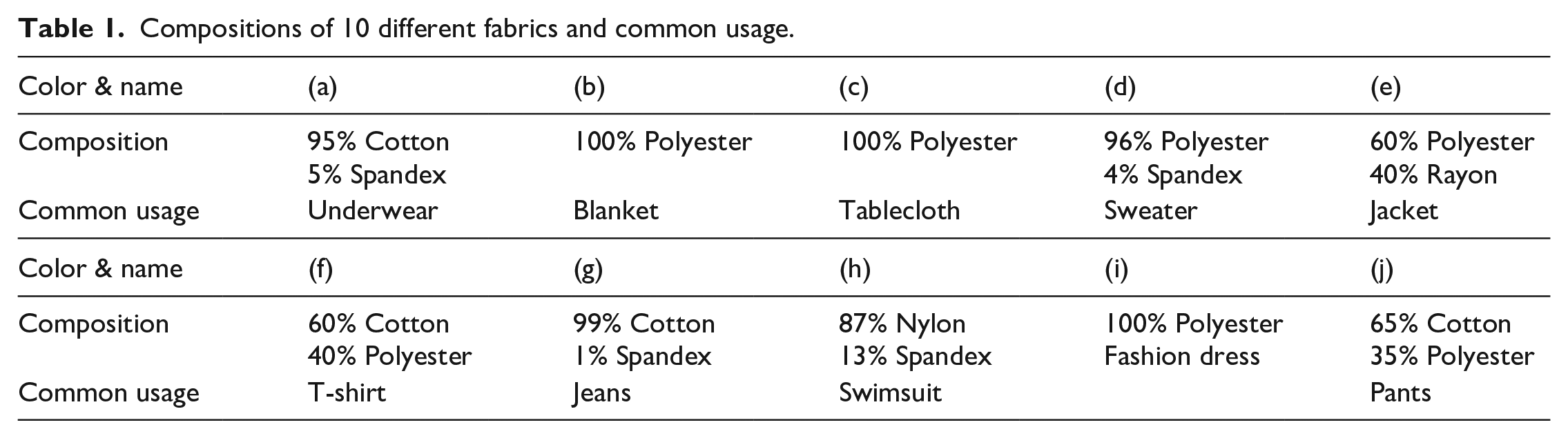
In this paper, a dynamic multilayer spring-mass model is constructed. The dynamics mean that the model is simulated with different thicknesses depending on the fabrics, that is, the spring parameters are determined according to different conditions, and the corresponding number of layers of the garment is determined. Figure 4, Table 1, and Table 2 give the presentations and the properties of 10 fabrics.

Ten different fabrics representations Wang et al. 17 : (a) ivory rib knit, (b) pink ribbon brown, (c) white dots on black, (d) navy sparkle sweat, (e) camel Ponte Roma, (f) gray interlock, (g) 11oz black denim, (h) white swim solid, (i) tango red jet set, and (j) royal target.
Compositions of 10 different fabrics and common usage.
Physical properties of compositions of 10 different fabrics.

By setting the skin temperature to 37ºC and the outside temperature to −10ºC, the temperature function
As shown in Figure 5(a) and (b), there are clear differences in the Temperature Variation Surfaces due to the change in conditions. These differences stem from the distinct compositions of the fabrics, with Figure 5(a) being made of 95% Cotton and 5% Spandex and Figure 5(b) of 100% Polyester. In contrast, Figure 5(b) and (c) have compositions that are almost identical. For instance, Figure 5(c) is composed of 96% Polyester and 4% Spandex, leading to less noticeable variations in the Temperature Variation Surfaces. Consequently, the thickness simulation is reasonable for all fabrics at different temperature parameters. From the physical properties of fibers and the experimental results, the composition of fibers with similar physical properties, and they have approximately equal thickness under the same conditions. For example, Figure 4(a), (e) and (h) have the cotton fiber with different proportions, and hence their thickness ranges from 10.7 to 11.5 units. And their difference is less than 1 units. Figure 4(b) to (d) has Polyester fiber with different specific gravities, and the thickness of these materials are all above 12 units. Figure 4(h) contains nylon fibers with excellent thermal conductivity, where the nylon fiber (White Swim Solid) is common used to make swimwear. When it is required to have thermal insulation properties, our calculations show that their thickness is approximately three times greater than that of other fabrics. Subsequently, we give an equation
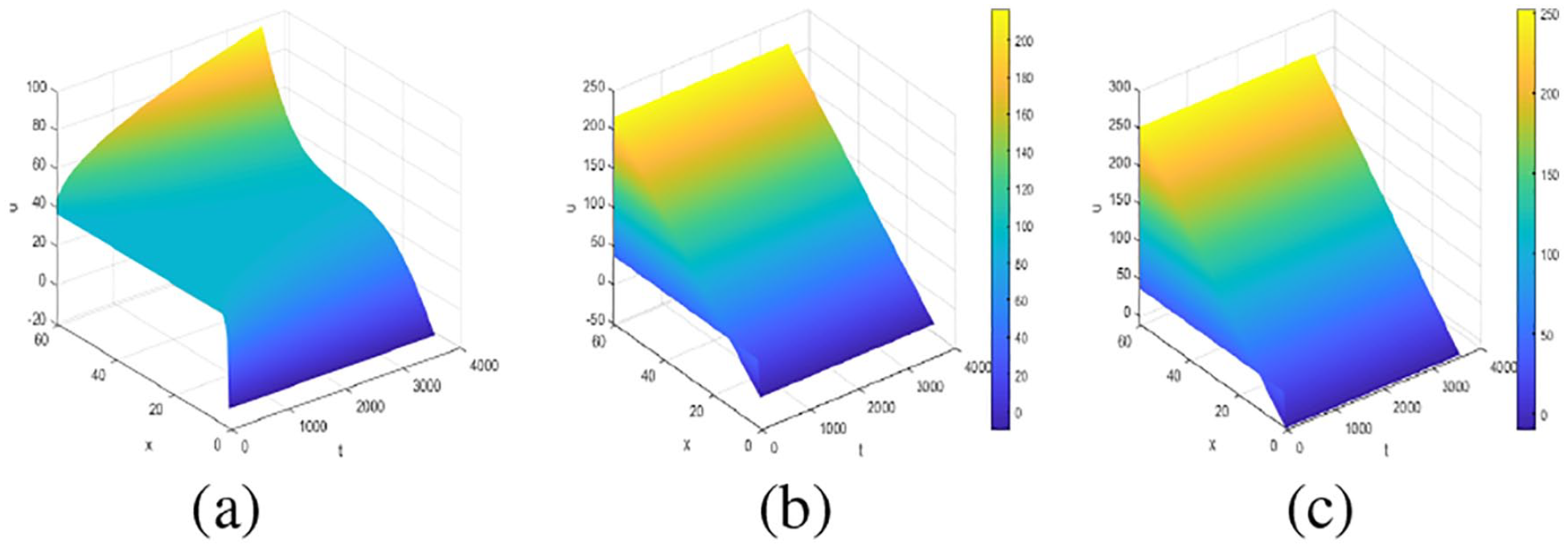
Temperature variation surfaces of three selected different fabrics: ((a) 95% Cotton and 5% Spandex, (b) 100% Polyester, and (c) 96% Polyester and 4% Spandex) under different boundary conditions.
The simulation results of garment fabrics with different stiffness and thicknesses are considered in this paper. Four materials in Figure 4 are selected for experiments, and the results are shown in Figure 6(f) has large wrinkles compared to Figure 6(a) to (c), which its stiffness is set to 10. Figure 6(a) and (b) show similar wrinkles with the approximate value of stiffness. Figure 6(c) shows a large fold with the five stiffness. Moreover, Figure 6(a) features a fabric made of 87% Nylon and 13% Spandex, which results in a softer simulated spring constant. Conversely, Figure 6(b) showcases a fabric composed of 65% Cotton and 35% Polyester, leading to a stiffer simulated spring constant.

The effect of covering sphere with different stiffness fabrics (the first column is a single-layer fabric simulation, the second and third columns represent simulations of double-layer fabrics with thickness): (a) white swim solid, (b) camel Ponte Roma, (c) ivory rib knit, and (d) royal target.
Simulation of garments with different thicknesses
The garment thicknesses are simulated based on the heat transfer equation under different threshold and boundary conditions. According to Table 2, 60% Polyester and 40% Rayon fiber as the basis for the simulation of different thickness effects will be shown in Figure 7. Figure 7(a) is the garment with no thickness under the boundary values of 37ºC which is simulated by the single-layer spring-mass model. Figure 7(b) produces a simulation with a thickness of 10.7 units by setting the initial values of the boundary to 37 and −10, and the stiffness to 5, which is simulated by a double-layer spring-mass model.
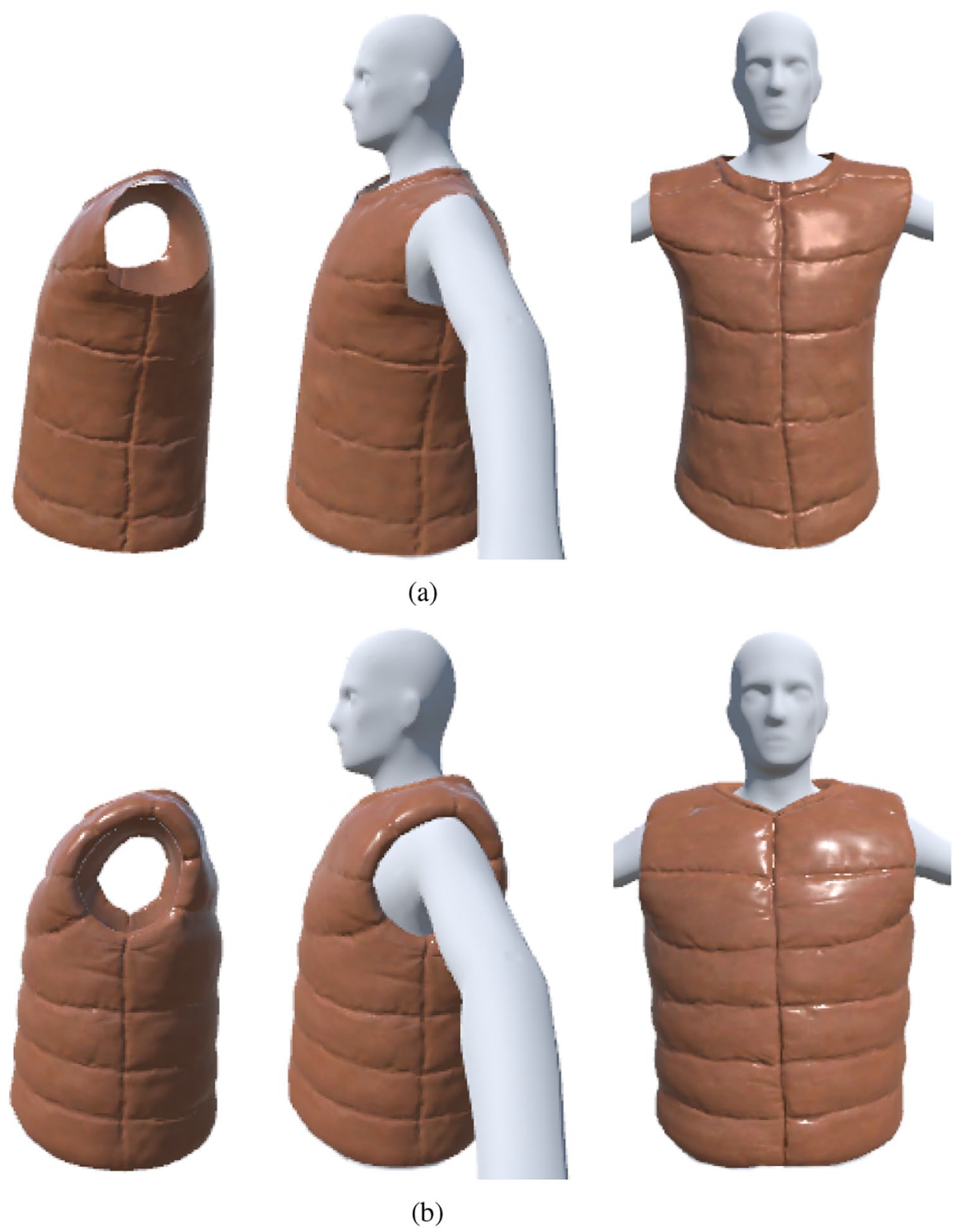
Garment thickness simulation effect: (a) single layer garment (no thickness) simulation and (b) double-layer garment simulation (thickness 10.7 units).
Garments simulation on human models
We first perform the segmentation of the human model and garment based on Laplacian spectral transformation, then compute the matching matrix of the garment and human segmentation part, and finally complete the garment-to-human body dressing process based on the matching matrix. Meanwhile, the computation of collisions between the inner spring mass points and the human body bounding box is obtained by the relevant components in Unity3D to produce wrinkles of garments in different postures of human body.
First, this paper gives the simulation results under different human postures. As shown in Figure 8, the human model in Figure 8(a) is the state of hands down, and the garment has no wrinkles. Figure 8(b) shows the wrinkles produced by stretching the arms on both sides. Figure 8(c) shows many wrinkles due to the thickness. Figure 8(d) is the result of Chen et al. 6 In this paper, we argue that Figure 8(d) lacks stiffness and thickness constraint, which produces unnatural (e.g. small) wrinkles.

Garment simulation under different postures: ((a) Ready Pos, (b)T-Pos, (c) and (d) A-Pos).
Second, the dressing effect of various body models is shown in Figures 9 to 12. Through the simulation results, there are different wrinkles in the proper position with the changing of the postures and habitus of the human model. Also, we simulate different garments with thicknesses. It means that a three-layer spring-mass model consists of a single-layer spring-mass model and a double-layer spring-mass model, the results are shown in Figures 13 and 14. In Figure 13, the garments are simulated by the single-layer spring-mass model and a double-layers spring-mass model. In Figure 14, the garments are simulated by the two single-layer spring-mass models and a double-layers spring-mass model.

Simulation results of a kid model: ((a) model front and (b) model back).

Simulation results of a women model: ((a) model front and (b) model back).
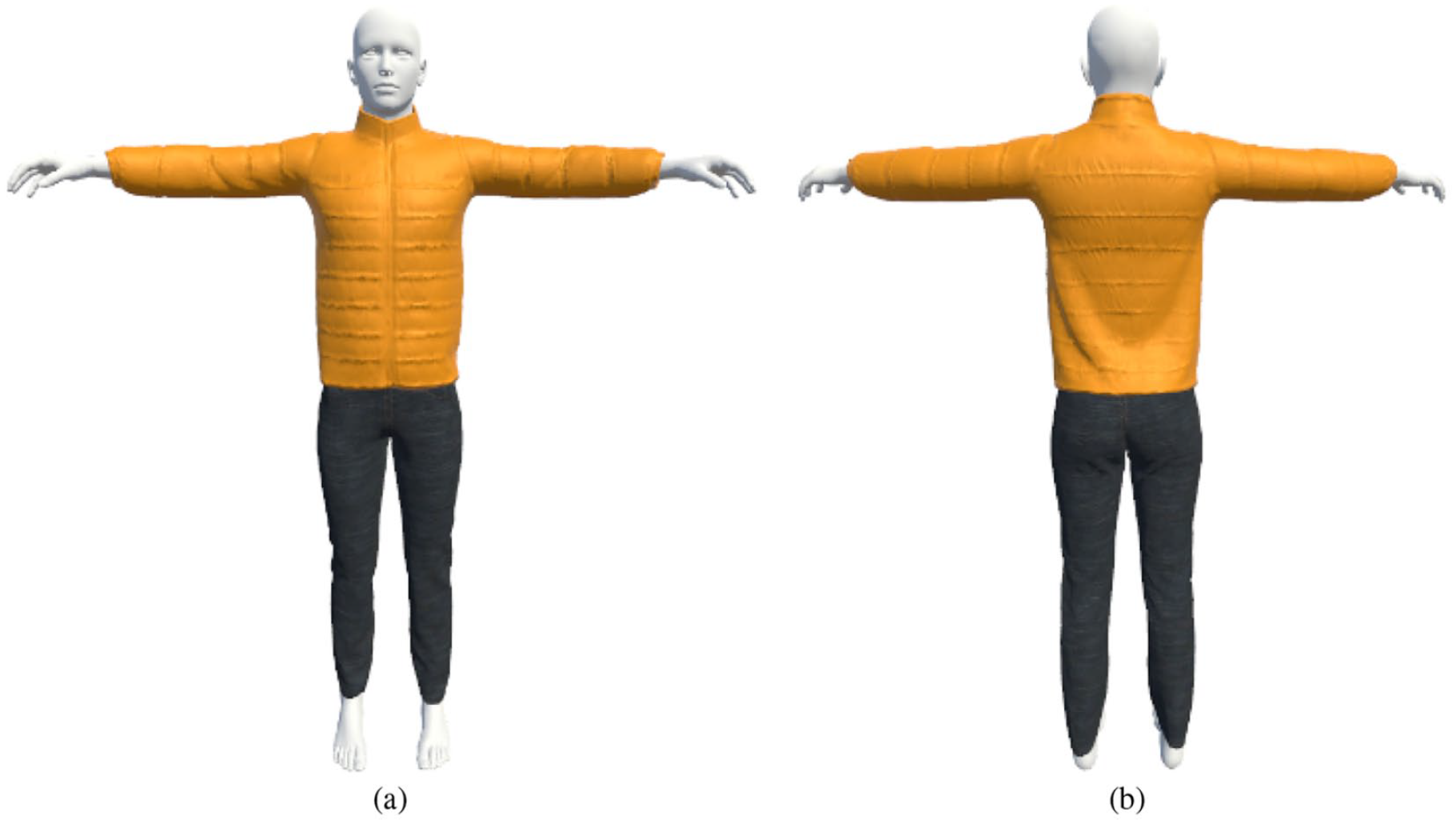
Simulation results of a tall men model: ((a) model front and (b) model back).
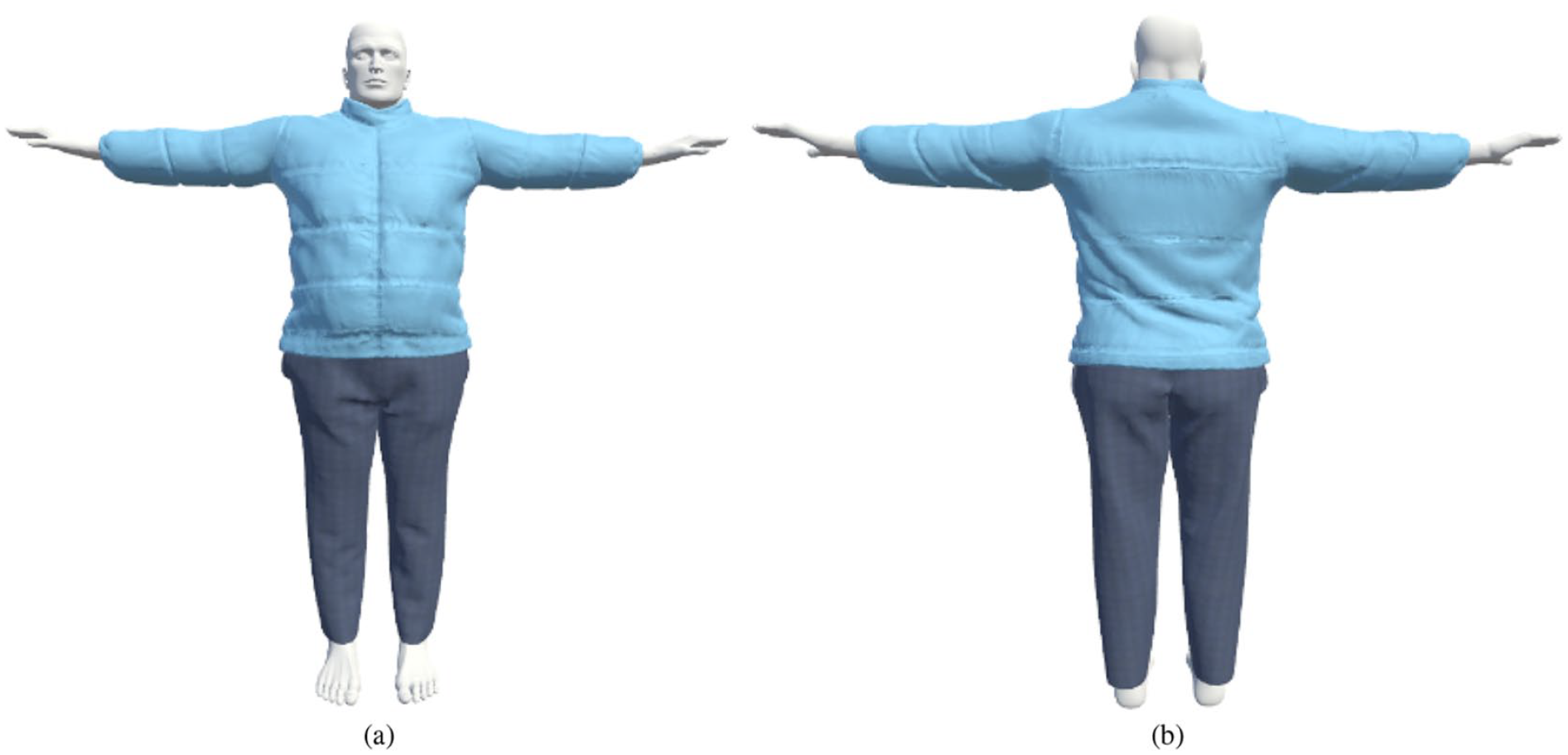
Simulation results of a fat men model: ((a) model front and (b) model back).

Simulation results of a single-layer garment and a down jacket: ((a) model front and (b) model back).

Simulation results of two single-layer garments and a down jacket: ((a) model front and (b) model back).
Finally, we compared a simulated down jacket with one being actually worn to highlight the realistic representation achieved by our method in simulating garment thickness, as shown in Figure 15. Additionally, we applied the Structural Similarity Index (SSIM) for similarity assessment, obtaining a value of 0.614, which is close to the maximum of 1, and suggests a high level of similarity between the simulated and the actual jacket.

Computer simulation results compared with real-world down jackets fitting effects: (a) our simulated results and (b) realistic down jacket fitting results.
Moreover, the pillow thickness is simulated, as shown in Figure 16. The material is assumed to be nylon 66, and the initial values are set to 37 and −20. The stiffness of the material is set to three, and the pillow thickness is computed as 60.4 units after 3600s. Figure 16(a) shows our results, Figure 16(b) is the result of Chen et al. 6 and Figure 16(c) is the result of actual pillow. As observed in the figures, our simulated result has large wrinkles than the result of Chen et al., 6 which is more similar to the result of actual pillow.

Comparing the results of a small ball placed on a computer-simulated pillow with the performance of an actual pillow: (a) our simulated results, (b) simulated results of Chen et al., 6 and (c) realistic pillow results.
Conclusion
In this paper, a dynamic multilayer spring-mass model is applied to simulate the garment thickness, and a matching algorithm is used for garment fitting. The elasticity coefficient in the multilayer spring-mass model represents the thickness computed by the heat transfer equation. The experimental results show that the thickness simulation model can obtain the upper and lower limits of the garment thickness, and the simulated effect of garment thickness is similar to the garments in the real world. Meanwhile, the proposed method is also applicable to simulate single-layer garment and different garment thicknesses. It is essential that the garment thickness is not solely determined by a computer model. Instead, more fabric characteristics should be taken into consideration. This will enable the development of a reliable garment thickness simulation system. Furthermore, we have not yet identified a reliable and objective method for evaluating the effects of our simulations. This issue of finding an appropriate evaluation metric remains a key focus for our future research works.
Footnotes
Appendix 1
Assuming that the down filling amount is proportional to the jacket thickness, we can write,
where
The total filling amount
where
The overall jacket thickness
Substituting the expression for
Since
Thus, the total filling amount is approximately equivalent to a multiple of the overall jacket thickness, with
Author contributions
Concept and design: Shengwei Qin and Songshuang Duan, experiments varication: Shengwei Qin, writing and editing: Shengwei Qin and Songshuang Duan. All the authors approved the final article.
Data availability statement
All data that support the findings of this study are included in this manuscript.
Declaration of conflicting interests
The author(s) declared no potential conflicts of interest with respect to the research, authorship, and/or publication of this article.
Funding
The author(s) disclosed receipt of the following financial support for the research, authorship, and/or publication of this article: This work was supported by the Zhejiang A&F University Research Development Fund Talent Startup Project under Grant 2023LFR128 and the Zhejiang University of Water Resources and Electric Power.
