



Abstract
An antenna is a medium of communication in electronic systems and one of its branches is known as wearable antenna (embedded in clothing or other wearables). Antennas are found in a wide range of applications such as medical, military, sports, safety, fitness, satellite communication etc. Textile based antennas are considered a replacement of conventional communication systems in E-textiles as they are more flexible and comfortable as compared to their metallic counterparts and more efficient than transmission wires. Electronic wiring which is commonly used for data transmission is susceptible to damage because of bending or stretching in wearables and may cause interferences between signals and time delays. One of the most significant advantages of wearable antennas is the reduction of bulk of electronic components as they can act as a sensor and communicator at a time. The cost can also be reduced this way. The current work focuses on the review of different manufacturing techniques for wearable antennas. The scope of this review is to highlight main techniques, their advantages and limitations in comparison with each other as well as to describe the available solutions of associated problems. The findings of this review could be fruitful for researchers to find out the best manufacturing technique for antennas in their perspective.
Visual Abstract

Introduction
Textiles are part of our lives in different aspects, either as clothing, protective wear, lifesaving products (such as air bags in automobiles), medical products (gauzes etc.) and smart wear. Initially the purpose of textiles was to cover and beautify human bodies, but as the time passes many advancements have been incorporated to enhance the functionality and sustainability of textiles. Smart textiles with special functionalities are topics of research now a days. These are used for sensing, actuation, transmission as well as for energy harvesting and widely employed in wearable electronics, robots, biomedical, sports and high-tech industries. 1 There are many materials such as sensors, electrodes and antennas that are incorporated or integrated into textiles to convert them into smart textiles. Antennas are used to receive or transmit electromagnetic waves and act as a way for communication. Conventionally antennas were made by using metals but because of their heavy weight, stiffness, and difficulty in washing their use is restricted in wearable electronics. So, there was a need to find out other materials that can overcome the mentioned issues, so textiles were used for antennas development because of their low weight, high flexibility and softness, easy washability that make them a good candidate for wearables. The first antennas were made by Heinrich Hertz to prove the existence of electromagnetic waves. Researchers continued their work to overcome the problems in Initially proposed antennas. In 1920s Yagi-Uda antenna was developed by a Japanese scientist while microstrip antenna was originated in 1953. Since 1970, efforts were made to improve the characteristics of antennas and finally in 1973 a practical microstrip antenna was developed by Munson. 2 First combination of textiles and electronics was introduced by Philips in late nineties. 3 After that a lot of research have done to make sensors, antennas and electrodes by using textiles. There are different techniques that can be used to make textile-based antennas including fabrication methods (weaving and knitting) and surface modification methods (printing and embroidery).4,5 In a recent research Hassan worked on dual band textile antenna by printing on an artificial heart bag. 6 In another research Shah and Patel developed an embroidered antenna for knee effusion diagnosis treatment. 7
To put it simply, this paper provides an overview of antenna theory and literature, covering antenna components, classifications, types, materials, and common design challenges. The primary objective of this paper is to introduce readers to textile-based wearable antennas. Consequently, the next section explores the fabrication and manufacturing techniques for these antennas, detailing various structures, their benefits, associated issues, and potential solutions.
Theory of antennas
An antenna is a mean to radiate or receive the radio waves and it can act as receiver or transmitter of electromagnetic waves. 8 A regular antenna consists of four main elements: a dielectric substrate, radiation patch, a ground plane, and a feed line for transmission. Dielectric substrate acts as a barrier between radiation patch and ground plane. The radiation patch is provided with an incident signal via a feed line. The radiation patch reflects or transmits input signal. Reflection coefficient (ratio of reflected power to incident power) is measured to analyze return loss of antennas. The radiation characteristics of an antenna is determined based on its resonant bandwidth and resonant frequency. The operating frequency of antennas is the frequency at which reflection coefficient has the lowest value; which means a little amount of energy is reflected while most of the power is radiated.9,10
The performance of antenna is normally analyzed by its efficiency. Efficiency is the ratio of useful power to total power which describes how efficiently an antenna can receive or transmit the signals. There are different factors that can affect the efficiency of antennas. They are discussed as follows.
The antennas can be classified based on different factors. One of them could be geometry or shape. Antennas are designed in different geometries (shown in Figure 1) such as wire antennas (dipole, monopole, loop, and helical antennas) and aperture antenna (microstrip, reflector, slot and horn antennas). Wire antennas are made by using conducting wires. They are easy to make and have a low cost. Different types of wire antennas are elaborated as follows; Dipole is the simplest and widely used antenna which is made of two metal wires of equal length while the monopole antenna is half of the dipole antenna. Loop antennas are simple and available in different configurations such as circular, square, rectangular, triangular, elliptical, and other shapes. The helical antenna may be viewed as a derivative of the dipole or loop antenna. The Yagi–Uda antenna has a simple design. It is low cost, presents high gain and found application in ultra-high frequency bands. The other group of antennas is known as aperture type antennas that are made of plates instead of wires to form certain configurations for efficient energy transfer. These antennas are used for higher frequency applications than wire-type antennas. The types of aperture antennas are discussed as follows: horn antennas are one of the simplest and widely used. They are strongly integrated with the feed line and have controllable performance. Reflector and lens antennas are easy to make and have higher gains than horn antennas. They are used for high gain and high-frequency applications. Slot antennas have low-profile and can be conformed to basically any configuration. They find applications in aircraft and missiles. A microstrip antenna, also known as a patch antenna, consists of a metal patch that radiates signals. This patch is positioned on a substrate above a ground plane. The patch can be of different shapes such as rectangular, square, circular, and circular ring. This antenna has a low-profile, easy to conform to different surfaces, simple and easy to make.17 –20

Geometries of antennas.
Antenna material can be another factor that can be used for classification. Antennas can be made by using hard and flexible materials. Hard antennas are usually made from rigid substrates or metals such as copper, gold etc. while soft antennas are made by using soft, bendable, and flexible materials such as polymeric sheets or textiles (conductive yarns or fabrics). Selection of material is dependent on the end use and area of application. The soft antennas made of flexible materials are easy to integrate into clothing, used for wireless communication and are termed wearable antennas. This article is more focused on the wearable antennas. These antennas are usually used to transmit signals from body worn sensors to external devices/receivers.21 –23 The applications of wearable antennas are elaborated in Figure 2.

Application areas of wearable antennas.
Hard metals and substrates are not suitable for wearables antennas. Because hard antennas have high mass and rigid structure and can be attached only at limited spots in clothing. Therefore, they can become uncomfortable for the wearer. Another reason point is that metals tend to crack and peel off from substrates during bending and stretching which is unavoidable for the clothing. Therefore, it can affect the conductivity of the track, which makes them unsuitable for this application. A wearable antenna must have flexibility and robustness therefore, textile-based antennas are the best choice for wearable applications. Textile-based antennas are easily bendable and integrated into clothing. Further, there is no restriction of areas which provide more freedom for antenna designing. Textile antennas have flexibility, low weight, and mechanical strength for their use in wearables and other applications. 24
The integration of such an antenna system into a garment does not affect the movement and working of the wearer.22,23 Textiles are a good choice as substrates for wearable antennas because they are easy to make, production is high (because not too much accuracy in structure is required) and they are also comfortable for human body. 21 Textile antennas are composed of two elements; one is the radiating element (conductive part) and the other one is non-radiating (non-conductive part used as substrate) element. Because of the flexible nature of textile-based antennas, they can easily bend and adapt human body shape to provide comfort for the wearer. But it is extremely important that the antenna performance must not be effected during bending. There are two approaches to use textiles for antennas; a) antenna is completely based on textile i.e. substrate and radiating parts all made by textile materials, b) only substrate is made with textile fabric ((fleece, jeans, Dacron) and conductive tracks and components are non-textile. 23
Wearable antennas are used near the human body. Therefore, various important factors, such as polarization mismatch, structure deformation, and specific absorption rate, need to be analyzed while designing. 25 Metal-coated polymeric fibers, usually known as E-fibers, offer promising alternatives with better mechanical strength, fatigue tolerance, and low manufacturing cost. 24 It is essential to consider the electromagnetic properties of textile materials, including permittivity and loss tangent. Conductive textiles (such as Zelt, Flectron, and pure Copper) are used as radiating elements, while non-conductive textiles (like silk, fleet, and fleece) and materials like PF-4 foams, polydimethylsiloxane, or felts serve as substrates.26,27 Silver-coated conductive threads are a preferred choice for embroidering antennas on wearables due to their greater flexibility, strength, and high radiation performance when compared to brass or copper-coated materials. 28 In the context of wearable antennas, it’s crucial to ensure that the antenna’s radiator does not pose any risk to human body tissues. 29
Designing and manufacturing textile-based antennas comes with several challenges, outlined as follows.
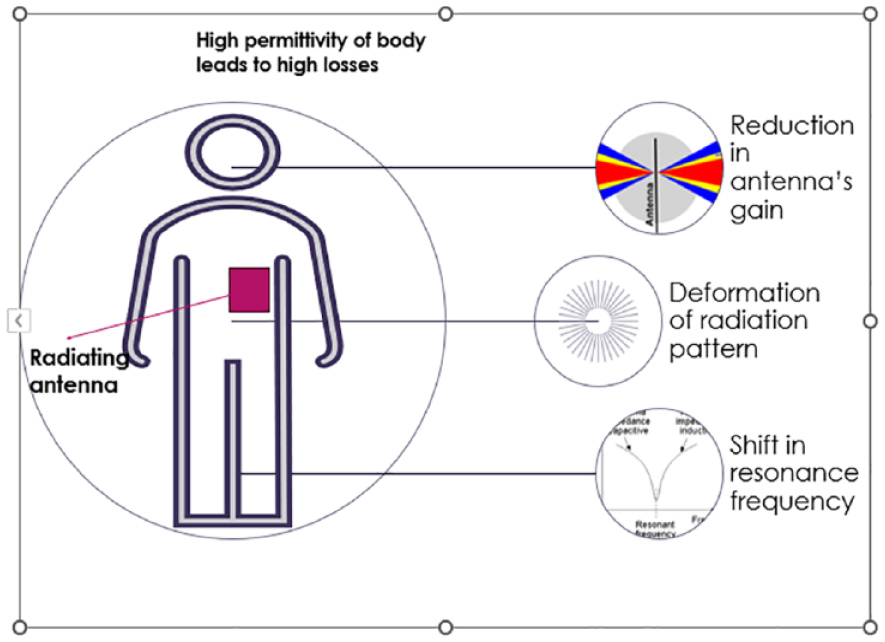
Effects of human body on the performance of wearable antennas.
Understanding how different characteristics of textile materials affect antenna performance is crucial to prevent undesirable and parasitic effects. Wearable antennas should be durable, compact, and possess excellent radiation properties with high efficiency. The following are important properties to consider when designing textile-based antennas. 32
The fabric’s dielectric permittivity is a key factor influencing antenna signal transmission. It also impacts the reflection coefficient and operating frequency. 33 Factors like moisture content, frequency, temperature, and surface properties (roughness) are dependent on the fabric’s dielectric properties, which are influenced by the constituent fibers and polymers.9,34
Surface resistance affects the electronic performance of fabrics and is the ratio of applied voltage to current. 35 It’s defined as the ratio of the DC voltage drop per unit length to the surface current per unit width. Importantly, it’s a property of the fabric (with constant thickness) and is not influenced by the electrode’s design.9,36
Moisture absorption by the fabric alters its properties, including mechanical rigidity and permittivity. Therefore, it is essential to consider this factor when designing and characterizing antennas. 36
Textile fabrics offer flexibility and elasticity, allowing them to conform to the human body’s shape when worn. However, after adopting the body’s surface contours, the fabric structure may bend or deform. These changes in geometry affect antenna performance and alter the electromagnetic properties of textiles. 37
The fabric’s bending capability and elongation impact thickness and effective permittivity, which, in turn, affects the antenna’s resonant frequency. Compression and elongation of textile sensors reduce geometric accuracy, affecting antenna behavior.
Fabrication methods for textile antennas
Wearable textile antennas are needed for continuous monitoring of patients, the general well-being of humans and so many other applications. The most well-known methods for the development of textile-based flexible antennas are knitting, weaving, screen printing, inkjet printing, and embroidery as shown in Figure 4.8,38 This review will discuss the potential applications as well as limitations of different manufacturing techniques. Some examples of antennas are shown in Figure 5. Details of mentioned methods are described in the following sections:


Textile based antennas.
Knitting
Knitting is a fabrication technique where yarn(s) is/are used to make a structure of loops. Knitted fabrics, mostly, have flexible structures and can be used to make elastic and stretchable antennas. Knitted antennas are better than woven for sportswear applications because of their comfort and high flexibility. Woven antennas have better electric properties than knitted counterparts because of their geometrical accuracy and low sheet resistance. 37
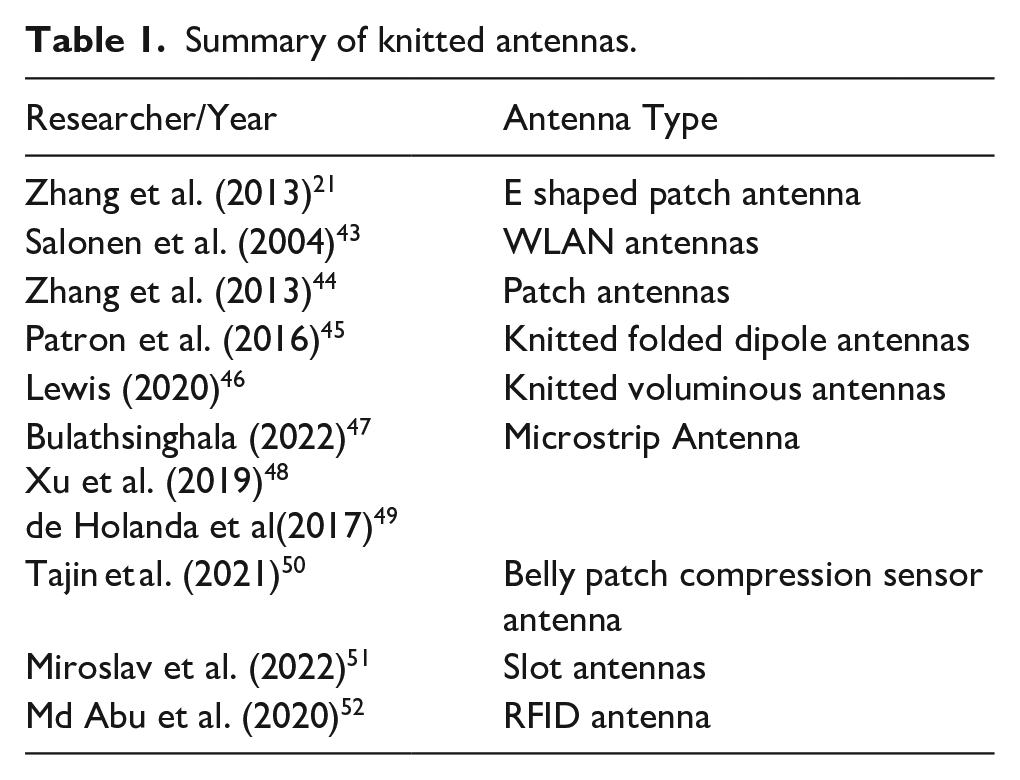
Salonen et al. studied the effect of conductive materials on the performance of WLAN wearable antennas. Six antennas were made by using knitted fleece fabric which are as follows; A (solid copper tape antenna), B (copper based knitted fabric), C (antenna patch made of vertically cut copper tape), D (antenna patch made of horizontally cut copper tape glued together), E (antenna patch made of horizontally cut copper tape soldered), F (high strength fabric made of metal coated Kevlar named as Aracon). A, C and E have the same results and their impedance was matched at the desired frequency. Antenna B had a wider bandwidth as compared to copper made antennas. Antenna D and F had the worst results. The results showed that both conductive fabrics and copper tapes can be used based on impedance matching and bandwidth, but all configurations are not suitable. 43 Zhang et al. fabricated a fully knitted antenna. Four different variations were used a) conducting nylon fabric b) fabric with high fiber density c) fabric with medium fiber density, d) patch fabric with coarse fiber density. The S11 and bandwidth results showed that samples made with nylon fabric showed the smallest losses. The results showed that the return loss of knitted fabric radiator improved by increasing the density of fabric. 44
Patron et al. designed a knitted sensor for wearable biomedical application. This strain sensor was enabled to analyze the contraction, respiration and limb movements. The non-conductive part was composed of wool and Lycra blended fabric and for conductive part silver coated nylon yarns were used in fabrication. It was observed that tightly knitted antennas show better performance because of their good conductivity. 45 Lewis worked on disobedient antennas. Normally textile antennas are hidden because of their flat surface laying in the embedded clothing. But there are antennas that were developed as textile interactions to make them voluminous and sculptural wearable objects. Antennas were knitted in different structures like plain, plain with floats, and pique by using wires (copper and stainless steel) and lycra yarns. These antennas act as moderators between human body and the electromagnetic fields. 46 Bulathsinghala et al. worked on “3D flatbed-knitted textile antennas. In this study, optimization was done to make slotted antennas, but results proved that optimization of antenna design adversely affect the performance as slotted antenna and they performed poorly as compared to unslotted antennas under bending conditions. 47
Xu et al. conducted a study to analyze the effects of different factors such as wrinkling, pilling, laundering and abrasion on resistivity performance of antennas. Two types of structure were studied: (a) “copper-nickel yarn-coated nylon rip-stop” (b) “single jersey fabric with silver yarn-coated cotton/polyester.” For direct current DC performance analysis, it was observed that that pilling has negative impact on the resistivity, while wrinkling and laundering have no impact on the surface resistance of antenna. 48 de Holanda et al. developed a microstrip knitted antenna based on biodegradable synthetic fibers. Three compositions such as “polypropylene and soybean protein (PP+SPF)”, “polypropylene and polylactic acid from corn (PP+PLA)”, and “polypropylene and bamboo (PP+BAM)” were used to make synthetic fibers. These fibers were used in next processes to make Single Jersey knitted fabrics. Three layers of fabrics were overlapped and sewed together to make the substrate of antennas and copper sheet was used to make patch and ground plane. The results revealed that the structure with PP + PLA was highly stable and have maximum gain of around 2.17 dB, and PP + SPF was after it. 49
Patron et al. worked on the 3D knitted fabrics for the designing of polarized integrated antennas. The feeder of textile-based antenna was developed by using screen printing with conductive material and embroidery with conductive thread. Antenna was etched as a circular slot radiator on the top layer of conductive fabric. 3D knitted Cotton or polyester fabric were used as substrates for antenna. To make conductive walls sewing was done with conductive thread of low resistance and high mechanical strength. To achieve good conductivity tightly knitted structure was used. 45 Tajin developed a wearable ultra-high frequency knitted sensor antenna for respiratory monitoring. The belly patch antenna was employed to analyze the breathing activity of a baby mannequin. The antenna was composed of conductive and non-conductive knitted fabric, compressible substrate of polyethylene and an RFID chip. Blended yarn (85% Modal and 15% Nylon) was used in knitting fabric which surrounds the conductive transmission lines while non-conductive fabric was made of polyester and a double-knit structure was made for antenna. The advantage of proposed antenna was that because of its structure it was capable to retain radiations in the proximity of human body as compared to other strain sensors. 50 Miroslav et al. worked on slot antennas by using 3D knitted fabrics. The radiating element was a circular slot designed on the conductive top wall of textile waveguide. Inside the circular slot there was a cross slot that can rotate and change the polarization of antenna. The feeder of antenna was made through screen printing and sewing with conductive threads. As 3D knitted fabric was porous so the silver ink penetration was high which restricted the conductivity of antenna. To overcome this problem fabric was initially covered with iron foil to enhance the smoothness and reduce the porosity of fabric. 51
Md Abu Saleh et al. worked on the optimization of knitted antennas by checking the sheet resistance. Fabric based transmission lines were used instead of textile antennas to check the effect of sweat to avoid the soaking of RFID tag of antenna. The sheet resistance was measured by using the S-parameter of transmission lines and then simulated these results for textile-based antennas. It was observed that the sheet resistance measurements can be used to predict the performances of antenna and eliminate the process of lengthy prototyping. HFSS simulation showed the disturbance in the performance of antenna as sheet resistance increased with immersion of sweat, washing, and drying processes. 52 Ouyang et al. conducted a study to examine the electrical conductivity of antennas made from knit fabric (made from 100% X-static conductive yarn) and woven fabric (satin weave). The outcome showed that woven structure was more efficient than knitted because of better yarn alignment with the direction of current. Then different satin weave designs were made and analyzed the impact of weave pattern on the electrical performance of antenna. This research revealed that effective conductivity was not increased by increasing thread density but it was effected by loose connections of conductive yarns because of high weaving ratio that can cause longer current path. 53 A summary of all mentioned antennas is presented in Table 1.
Summary of knitted antennas.
After reviewing the literature, following are some findings related to the knitted antennas.
Weaving
Weaving is an interlacement of yarns and conductive yarns are used to make antennas through this method. Woven structures are stable and less stretchable.
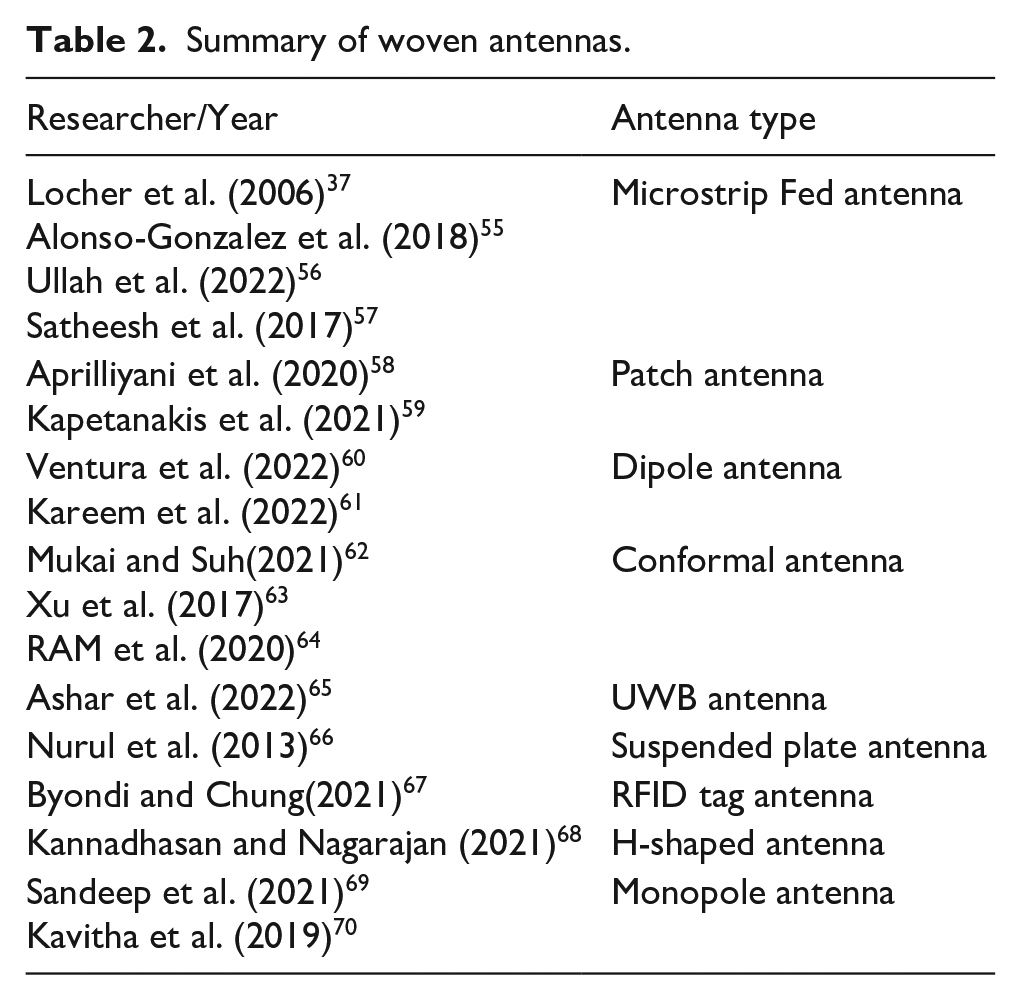
Locher developed micro-strip patch antenna based on woven fabric by using polyamide yarn plated with (silver, copper, and nickel mixture). This study compared woven and knitted antennas and results revealed that woven antennas have better electric properties than knitted counterpart because of their geometrical accuracy and low sheet resistance. 37 Sreemathy et al. developed micro-strip wearable antennas by using wash cotton and denim fabric with four different designs (without slits, V shaped slit, square shaped slit and with truncated corners). Copper tape was used to make conduction paths on fabric patches. The findings showed that the insertion of slits did not show any adverse effects on gain, radiation pattern and VSWR. It was also observed that antennas without slits showed linear polarization while circular polarization with the presence of slits. 54 Alonso-Gonzalez et al. fabricated a woven micro-strip antenna for communications of short-range. The weaving technique helped to integrate conductive components into fabric without need of any subsequent process (sewing, embroidery, coatings etc.). A three-step model (filament model, monof model, layers model) structure was chosen to avoid the problems associated with woven antennas. Silver coated conductive yarns were used. The layers of the antenna were joined by using one conductive thread. It was concluded that conductive yarn should be used in weft direction to reduce yarn fuzziness and filamenting. 55 Ullah et al. developed a microstrip patch textile-based antenna to measure moisture content in the fabric. The patch antenna with a feeding line was implemented on double layered polyester felt substrate. Two types of prototypes were designed; in the first one polyimide laminate was used for patch, ground and microstrip while in second type copper fabric was used for all parts. The reflection coefficient of antenna was measured. The resonance frequency of both protypes antenna goes down to lower frequency for moisture content range moves from 20% to 100%. This was due to the loss tangent and change in dielectric constant because of moisture. It was observed that full fabric antenna was more sensitive to moisture content as compared to other one made with polyimide laminate. 56 Satheesh et al. fabricated an E-shaped microstrip patch antenna with polyester fabric suitable for WiMAX applications. Different properties of substrates such thickness, surface uniformity and wettability are important to consider while designing the antenna. Three fabric layers were joined and then dip-coated with polyvinyl butyral (PVB) solution to enhance hydrophobicity and reduction of roughness of fabric. After that screen printing was done to add conduction paths on antenna. The designed antennas have flexibility, light weight with low cost which make them enable for use in wearables such as polyester jackets. The measured results of return loss and gain were matchable with simulated which confirm the usefulness of the fabricated prototype. 57
Aprilliyani et al. analyzed the effects of different weaving and finishing parameters on the performance of textile patch antennas. Felt was used as substrate and silver printed polyester fabric as patch and ground plane. Polyester fabric was exposed to different weaving and finishing treatments (tentering, scouring, and calendaring) and it was observed that the antenna performance changed in terms of resonance frequency, radiation efficiency, bandwidth, and peak gain with same geometry and printing. It was concluded that radiation efficiency and gain of plain-woven fabrics were higher than that of matt fabrics because of the dense structure of plain weave which reduced the dissipation. Moreover, the scouring and tentering processes increased the gain and radiation efficiency; however, the calendaring decreased the efficiency and gain of the antenna. 58 Kapetanakis et al. developed textile patch antennas in circular, triangular and rectangular shapes for ISM applications. Thirty-six samples were prepared by changing patch geometries, patch and substrate materials. Three types of conductive materials for example, conductive fabric, graphene sheet and copper sheet were used to make active patch while four types of textiles (thick and thin felt, thick and thin denim) were used for substrates. Thermoplastic adhesive was layered between conductive patch and substrate to join them together. All antennas showed lower SAR values than the safe limit. 59
Ventura worked on embroidered half wavelength dipole antennas. Six types of woven substrates were used: (1) cotton–polyester blended jeans fabric, (2) 100% Cotton satin fabric, (3) Cotton/Elastic fabric, (4) Cotton based heavy canvas fabric, (5) technical fabric made from acrylic–cotton, (6) fabric made from acrylic–cotton–polyamide (RIPSTOP) mixtures. Embroidery was done by using conductive thread and fixed contour fill pattern. It was found that all the fabrics were feasible to be used as substrates for antennas. Even fabrics with low dimensional stability, low-crimp and having elastic fibers did not have much effect on the antenna performance. 60 Kareem et al. conducted research to prepare two textile-based folded dipole antennas to mount at different human body positions for monitoring of Covid 19 effects. One antenna (worked at 2.45 GHz) was placed on chest to monitor the breathing rate and heart rate of patient and another one (worked at 2.4 GHz) designed to place on mouth inside the surgical mask to detect different viruses and bacteria through the breath of human. Dielectric textile felt was used as substrate and Textile ShieldIt was used as conductive material that possessed a hot melt adhesive back to joined it with felt through ironing. 61
Mukai designed a textile conformal antenna with polyester fabric substrate and copper plated polyester fabric as radiating patch and ground. This, light weight and flexible antenna, was found comfortable for breast hyperthermia treatment (non-invasive cancer treatment). For study a model of synthetic breast form was used, and results showed the elevation of temperature occurred after heating of 15 min. This polyester based woven antenna was found useful for the treatment of superficial cancer cells in breast. 62 Xu et al. developed cylindrical conformal single-patch antennas with different radii of curvature of 25, 45, 60 and mm to mimic the conditions for conforming to the human body parts such as torso, shoulder or arm. Copper yarn was used for woven patch and ground while E glass yarn was used for weaving of 3D orthogonal fabrics. The resonance frequency of theses antennas was stable even at low Radii of 25 mm because of stable structure of 3D woven fabric. 63 Ram et al. developed a circularly polarized (CP) conformal antenna with jute fabric. Jute has high durability, eco friendliness, and skin-friendly nature and is considered as an effective substrate because of low level of impurities and its antistatic properties. The radiating structure had a semicircular shape and was coated with copper paint. The proposed antenna had resonance frequencies of 3.5, 4.9, and 5.8 GHz for different applications. 64
Ashar et al. worked on the development of ultra-wide band (UWB) flexible antennas for wearable applications. Two types of dielectric materials were used; one was polyamide based Cordura woven fabric while other was FR4 substrate. The Cordura fabric has high tensile and tear strength as well as low surface wave losses (because of its low dielectric constant). These properties make this fabric a good choice for wearable antennas. Both substrates were compared in terms of frequency versus return losses, and it was observed that Cordura based antenna has same resonating frequency band as FR4 but with a slight change in cut off frequency. The proposed antenna showed bidirectional radiation pattern and can also perform under bending conditions. 65
Rais presented a dual band wearable antenna for ISM and HiperLAN applications. The design of antenna was named as suspended plate antenna because a radiating element in form of rectangular plate was suspended over ground by using a foam substrate. The textile ShieldIt was used as conductive material and attached to substrate with an adhesive. The prepared antenna had an efficiency between 67% and 89% with a gain of 8.33 dB. 66 Byondi and Chung worked on the designing and development of ultra-high frequency RFID fabric tag antenna for access control application. Silver coated woven conductive fabric was used. Fabrics in two different shapes and four different sizes were analyzed. The conductivities of different shapes were measured and added in CST simulation program to simulate different tag antennas. It was observed that the conductivity of the fabrics changed by changing the size, shape, and frequency of operation. For plain shapes conductivity value was high while impedance was low and for non-plain shapes conductivity value was low while impedance was high. Two RFID tag antennas were prepared with a T-matching structure. These antennas were designed to resonate at 920 MHz frequency. These flexible antennas are easily integrated into fabrics and clothes for wearable applications. 67
Kannadhasan and Nagarajan fabricated a dual frequency H-shaped antenna. The substrate of the antenna was made with cloth and knitted copper was used to make radiation portion and ground plane. The patch of antenna and ground plane were manufactured from conductive woven fabric. A Zener diode was used to achieve the dual frequency. The prepared antenna had operating frequency range of 2.5–4.5 GHz. 68
Sandeep et al. developed and analyzed monopole antenna on Jute fabric. The proposed antenna worked in tri bands of WLAN, WiMAX, and ISM bands at the frequencies of 4.9, 3.8 and 5.8 GHz. The on-body performance of antenna was checked by employing a three-layer phantom body model (made by considering the muscles, fat and skin of human body). The conductive tracks were made by applying copper paste with brush. The results revealed that the radiation performance of antenna was comparable with simulated results. The SAR values of antenna were in the safe range set by IEEE standards. 69 Shah worked on textile-based monopole antenna, by using different substrates such as FR4, Teflon and jeans cotton. A copper sheet was used as the radiating element and the designed prototype had frequency band of 2.45 GHz ISM. 70 A summary of described woven antennas is shown in Table 2.
Summary of woven antennas.
After a thorough and careful review about the woven antennas, the finds are illustrated as follows.
Printing
Printing methods such as screen and inkjet printing are widely used for production of electronic components and antennas because of their economical mass production and ability to create fine details of conductive pattern. 71 Amin et al. worked on the development of ultra-high frequency RFID antennas by using different printing techniques (inkjet printing, screen printing, rotary printing, and dry phase patterning). Polyimide, PEN and paper substrates were used with two silver polymer inks and one silver nanoparticle ink. Rotary printing offers higher throughput than screen printing. Another technique known as dry phase patterning was used for antennas development in which metals were placed on flexible substrates. This technique is environmentally friendly because of low energy consumption. Moreover, no chemicals are used, and residual products are in dry and recyclable form. Inkjet printing was also employed in this research work where tiny droplet of conductive ink (consists on silver nano particles) directly transfer on the kodak photopaper substrate, this method is ecofriendly and have zero wastage. 72 Shin worked on the characterization of screen-printed antennas. Two RFID tag antennas (straight dipole and meandered dipole) were made with silver conductive ink. The developed antennas were compared with copper etched ones in terms of radiation performance. It was observed that the surface roughness and AC resistance was increased by the application of silver paste but the shift in overall resonant frequency shift was only 1%. 73
Tekcin et al. investigated the performance of pad printed antennas. For the development of flexible antenna, silver conductive ink was pad printed on the polyamide based taffeta fabric. To check the effect of sintering on the performance of antenna, one sample was sintered while the other was not. For impedance both antennas showed almost similar results. Upon examining the reflection coefficient, it was discovered that the resonance frequency for the non-sintered and sintered samples were 254 MHz, and 943 MHz respectively. The reflection coefficient for non-sintering was -34.87dB and -9.86dB for sintered antenna. 74 Zheng et al. studied the impact of different fabric structures on the performance of RFID tag antenna. The antennas were screen printed on three different woven fabrics (plain, 2/1 twill and 5/3 warp satin. The influence of different fabric parameters (roughness, porosity, cover factor and wetting time) was studied on the energy harvesting properties of antenna. Eight different types of ink formulations (PUA, TMPTA, TPGHDA, II73, KH-560, BYK-333, BYK-065 and Ag) were used for screen printing of conductive tracks on antenna. The results revealed that the transmission distance of plain-woven antenna was longest. It was observed that the surface roughness and porosity of fabrics have negative correlation with antenna performance related to energy harvesting. 75 Amin et al. worked on the designing of flexible ultra-high frequency RFID tag antennas. Kapton was used as a substrate which was screen printed by using Asahi conductive ink. It was observed that the proposed antenna showed good performance with small area, high gain and better return loss. 76
Arno et al. worked on the development and characterization of flexible antennas (folded dipole and loaded folded dipole) by using spray coating technique. Two substrates polyimide Kapton and polyethylene-naphthalate and silver nanoparticles ink were used. The spray-coating technique is mainly used for small antennas because of the manual process and its efficiency is dependent on type of stencils used. It was concluded that although the designed antennas were flexible and able to conform different shapes but they were not stretchable and their efficiency was poor in bending conditions. 77 Li et al. worked on the fabrication of flexible antennas for wearables by using inkjet printing direly on textiles. The conductive ink used for printing was based on silver nanoparticles. Three types of substrates were used (a) Kapton sheets (b) Polyurethane coated stretchable textile and (c) pretreated 65/35 polyester/cotton textile. After analyzing the bending behavior of these flexible antennas it was observed that there was a slight frequency shift up under bending conditions. 78 Zichner and Baumann discussed the potential of screen printing technique for the designing of dipole antenna. The main challenge of the research was to design an antenna that can be used near dielectric materials without affecting its performance because of electromagnetic interaction between these two can cause problems. It was found that printing helped to reduce the size and cost of antenna as compared to etching process. 79
Tiiti et al worked on the fabrication of RFID textile antennas through screen printing. Two different fabrics (A:100% cotton plain weave and B: 35% cotton, 65% polyester interlock) were screen printed and compared for their performance in laundry and soaking. Fabric A was found to be more even than fabric B because of the loops in interlock structure. This causes uneven spread of ink on the fabric also the penetration of ink through fibers is also low. Six types of coatings (Acrylic, epoxy, latex, silicone, PVA1, PVA2) were used in this study. The application of epoxy resin made the textile material stiffer because of uncontrollable absorbance in the structure. Moreover. Epoxy also changed the inductance and impedance of antenna. It was observed that silicone and latex were flexible after drying while PVA1 and PVA2 glues became hard. 80
Špurek designed planar slot loop antennas by using 3D textile substrate. Screen printing with silver ink was done to make the conductive part of antenna. The main lobe was divided into two lobes to distribute signals from the upholstery roof to neighboring seats. The proposed antennas had impedance bandwidth (from 5 GHz to 11 GHz). 81 Whittow designed an inkjet-printed antenna by printing on 65/35 polyester cotton woven fabric. To increase the uniformity of the printing process the fabric was initially pretreated with polyurethane. The structure of antenna was composed of nylon rip stop ground plane attached with felt, then inkjet-printed fabric was glued with felt layer. The results showed that the addition of ink layer on fabric enhanced antenna’s efficiency and radiation performance. 82 Duman et al. presented screen printed RFID tag antennas. The conductive ink contained micro particles of stainless steel. Different textile materials including polypropylene, polyethylene and cotton were used as substrates for printing. The antennas made with PP fabric had better read ranges than others made from cotton and PE and it is because of the high surface resistivity of PP fabric. 71 Khirotdin et al. used the syringe-based deposition technique for printing fabrics to make micro strip patch wearable antennas. Silver based conductive ink was used to print antenna tracks on polyester fabric substrate and curing was done by using oven. It was observed that the thickness of ink track increased by increasing the pressure and speed of printing. 83
Xinyao et al. presented a flexible paper-based meander line dual band antenna developed with screen printing. Conductive ink was based on nanoflakes of graphene. After printing paper antenna was heated up to volatize dispersant. Compression was applied to overcome the resistance of graphene based porous layers and to enhance the smoothness of conducting surface. The prepared antenna was a candidate for application in wearables for health monitoring and military because of its flexible and non-harmful nature. 84
Krykpayev et al. worked on the inkjet printing of an inverted F-antenna. A complete circuit was designed on the polyester/cotton T shirt. Conductive ink based on silver nano particles was used. Three types of woven fabrics (65%/35% polyester/cotton, 85%/15% polyester/cotton and 100% cotton) were used as substrates. Initially an interface layer which was dielectric ink was applied by screen printing on textile surface prior to printing the antenna and circuit on the fabric. The resultant product was tested and showed the communication distance up to 55 m and localization accuracy of about 8 m while being body worn. The prepared prototype was able to comfortably integrated into different wearables. 85 Khaleel developed flexible inkjet-printed UWB antenna for wearable applications. Kapton polyimide film substrate was used which was plasma treated before printing to make it hydrophilic to allow printability. The CPW-fed design was selected because of its compactness and easy fabrication. It was observed that there is a minor degradation in the resonance frequency and return loss at high bending levels. The resultant product was found compact, robust with good radiation and flexibility to integrate into wearables. 86
Meghana et al. worked on the development of fractal monopole textile based antenna on flannel fabric. The conductive paths were drawn on the surface of substrate by screen printing through conductive ink. The washability of the prepared antennas was tested against commercial detergents. The application range of the proposed fractal antenna was 1–40 GHz and it was found flexible for use in wearables. 87 Kazani et al. worked on washable screen-printed antennas for wireless communication applications. Two types of fabrics (polyester and cotton/polyester) were printed by using silver based conductive ink. Four to six layers were joined together, and screen printing was done on top and bottom layer (for ground plane). The results of the study revealed that printed antennas showed stable performance before and after application of five washes. The reflection coefficient and radiation efficiency of antennas were tested with and without application of TPU coating. Performance was stable for both scenarios. 88
Ram et al. worked on the graphene-based screen printed antennas for energy harvesting applications. Two flexible substrates (wax coated paper and polyester) were printed by using graphene conductive ink. The geometry of circular patch was selected because of its simple structure and easy fabrication. The results showed that there was a good correlation among the simulated and measured results of designed antennas. 89 Goh et al. worked on inkjet-printed antenna for wireless communication applications. Two patch antennas were fabricated on FR4 substrate by using silver nanoparticle ink. Micro-strip multi-input and multi-output antenna was designed. The fabricated antennas were light weight and compact which make them suitable for use in different applications such as aerospace. 90 A summary of printed antennas is given in Table 3.
Summary of printed antennas.

After thoroughly studying the existing literature, the following are the findings about the printed antennas.
Embroidery
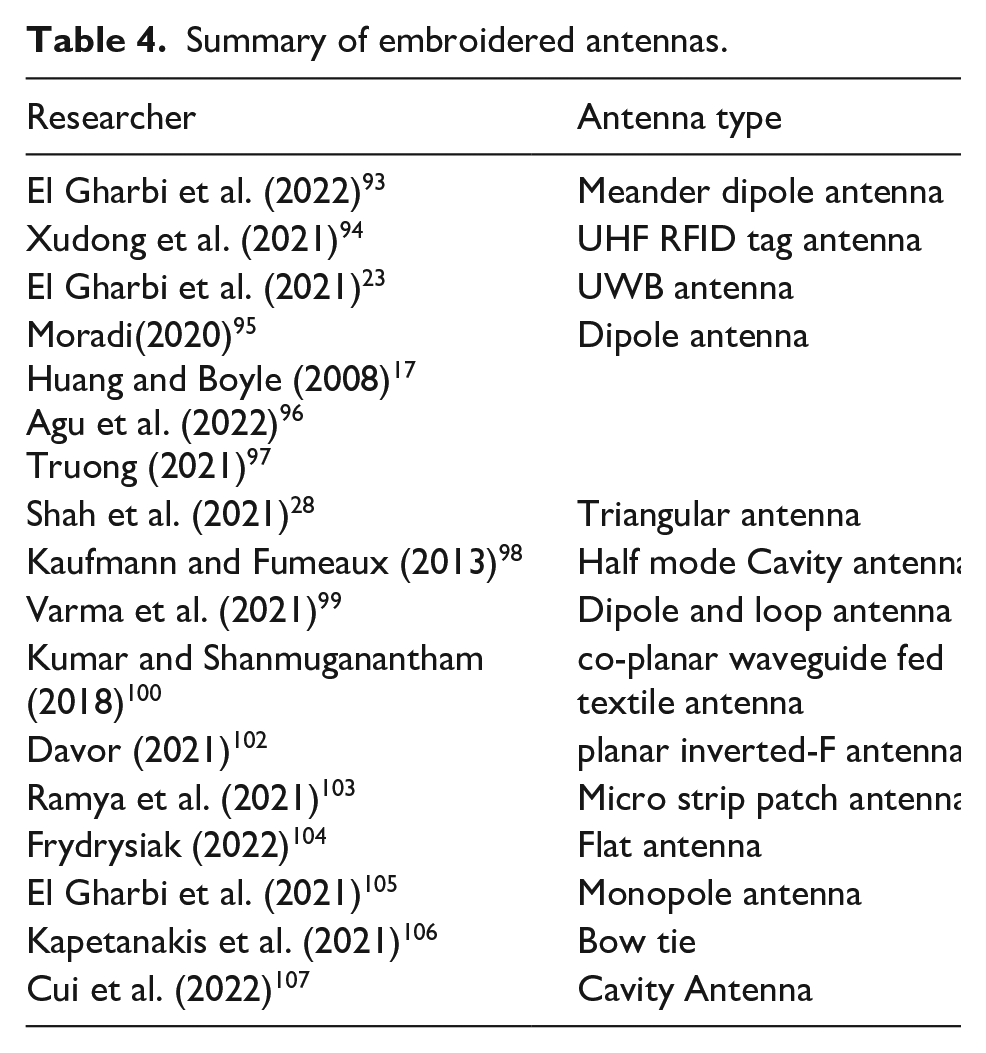
Embroidery is a progressive technique for the creation of conductive paths onto textiles. It is a simple and cost effective method in terms of design customization, mass production and repeatability.23,92 El Gharbi et al. developed a fully embroidered dipole antenna by using silver coated nylon thread with operating frequency of 2.4 GHz on a t-shirt to monitor real time breathing pattern. The antenna consisted of conductive (Shieldex® embroidered with silver coated nylon yarn) and nonconductive (cotton fabric) parts. The resonance frequency was measured at two different positions of volunteer (sitting and standing) with four different breathing patterns (apnea, eupnea, hypopnea and hyperpnea). The proposed antenna integration in clothing was associated with lower dimensions and highly associated comfort. 93
Xudong et al. developed and analyzed an UHF RFID embroidered antenna by changing thread and stitch length. Polyester nonwoven fabric was used as substrate. Copper- polyester Conductive thread was used on bottom and non-conductive polyester was used on the top of thread. It was observed that the resistance of antennas was influenced by change in stitch length. The resistance of antenna decreased by changing the stitch length from 0.9 to 1.7 mm but after 2 mm, the line resistance got a stable level. 94 El Gharbi et al. worked on embroidered UWB antenna by using felt substrate. The operating frequency of antenna was from3.1 GHz to 11.3 GHz with fractional bandwidth of 114%. The performance of antenna was analyzed in terms of 3D electromagnetic simulation, reflection loss, efficiency, and gain bending effect. The results validated confirm the use of embroidered antennas for wearable devices (El Gharbi et al. 2021). Moradi embroidered a meander dipole antenna with operating frequency of 310–330 MHz band. Metal coated polymeric yarns were used for embroidered circuits, but it is difficult to achieve homogeneous structure with these yarns as they are more disposed to damage during bending and stretching. 95 Agu studied the effect of three embroidery parameters (stitch type, conductive thread location and stabilizer) on the performance of dipole antennas to optimize the combination for best antenna. Fifty-four samples (with 18 different combinations and three repetitions) were prepared and their resonance frequency and transmission gain were measured and analyzed for comparison. The used conductive thread was made of nylon polyamide (1%) and silver (99%). It was found that the antennas made with satin stitches have low frequency as well as transmission gain as compared to contour stitched antennas. In terms of conductive thread location thread only in bobbin and both in top and bobbin showed better results in matching and robustness. 96
Truong developed and compared embroidered and printed antennas. Silver based conductive ink was used for printing while X-Static (silver plated nylon) conductive thread was applied on the basketweave cotton fabric. The results of the research revealed that the structure of conductive thread created parasitic capacitance and changed the resonance frequency. The performance of the embroidered antennas showed that it can be a replacement for printed antennas. 97
Moradi et al. made meander dipole antenna to miniaturize straight antennas. The dipole gain of these antennas was similar as that of the straight dipole antenna. The sullen yarn was used as top thread while the conductive threads as lower bobbin threads. A satin pattern was used for embroidery of pattern. 22
Thomas et al. worked on half-mode semicircular cavity antenna with working frequency of around 5 GHz. Silver-coated fabric was used as ground and top plane of antenna, while the walls were made by using conductive yarn. The conductive circuit was embroidered. A thin aperture was used as radiating patch which creates a magnetic dipole above the ground plane. The ground plane will provide a good isolation for the human body in wearable applications. 98
Varma developed dipole and loop antennas for communication applications. Cotton fabric was used as substrate and radiating patch was made by embroidery with copper threads. It was observed that the presence of the human body altered the radiation pattern and a slight deviation in resonance frequency. The overall performance verified the use of antennas for on body and free space communication. 99 Kumar developed a co-planar waveguide fed textile antenna for wearable application. The logo shaped antenna was embroidered on denim fabric which was coated with Teflon to make it waterproof and reduce the environmental impacts. This antenna has a better performance with a s11 of − 19 dB at the frequency of 2.45 GHz. 100
Zheyu et al. developed a planar multiband embroidered antenna by using silver coated polymer fibers. The designed antenna worked on three different frequency ranges including 850–900 MHz for global system for mobile communication, 1800–1900 MHz for personal communication services and 2450 MHz for wireless local area network. The embroidered patch was used to make the radiating patch, ground plane and transmission lines in antenna. After testing at real human body it was found that to retain all bandwidths antenna must be placed at least 10 mm apart from human body tissues and shoulder position is best to mount antenna for better radiation performance. 101 Davor et al. analyzed the impact of moisture on planar inverted-F (PIFA) and monopole antennas. Antennas were made by embroidery with conductive yarn on denim fabric. It was observed that monopole antennas were less affected with moisture than inverted-F antennas. High moisture content can affect the communication through antennas therefore, a waterproof antenna was proposed. 102 Ramya et al. worked on the development of embroidered antennas. Different textile materials including cotton, nylon, jeans and polyester were used as substrate and radiating element was consisted of embroidered track made with copper based conductive thread. Reflection coefficient S11 and center frequency against each substrate antenna was measured and it was observed that nylon with −13.66 value of S11 which is lowest than all other was found best choice as substrate. 103
M. Pawel made a textile based flat antenna by using embroidery technique. Polyester multifilament yarn with silver top layer was used as conductive thread. Three different connecting methods between textile antennas and transmitter were proposed such as with a metal stud, a connector and textile pins. All antennas were prepared by using cotton (100%) based twill fabric. Three antenna parameters for example, gain, VSWR, and impedance were measured. It was observed that there was a discrepancy in test results of few ohms per meter which was linked to non-homogeneous structure of textiles materials, variation in weight along the length of yarn. Another finding was that the use of textile connectors showed positive effect on the integration of antennas into wearables. 104
Gharbi et al. designed a textile-based embroidered monopole antenna for monitoring blood glucose levels in diabetic patients. A square ring was incorporated into the antenna that can detect different concentrations of glucose for different diabetic conditions. Different glucose solutions were prepared to cover Hypoglycemia, Normoglycemia and Hyperglycemia conditions. The conductive paths were made by embroidery by using Shieldex® conductive yarn (silver plated nylon yarn). The satin pattern was selected for embroidery because of its suitability for narrow path. 105
Kapetanakis et al. developed an SPK bow tie embroidered antenna. Seven antennas were fabricated by using Nomex meta-aramid fabric (93%Nomex, 5% Kevlar, 2%Carbon). Samples were made by using two conductive threads that is, Clevertex silver hybrid and Clevertex brass hybrid and three stitch pattern; low (0.1 mm), medium (0.2 mm), high (0.3 mm) distance between seam lines. The antennas were also tested under bending conditions which showed the shift in resonance frequency and this shift was more prominent with silver thread samples. Washing performance was also analyzed under 10 washing cycles and results proved the stability of antennas for this mechanism. It was also found that the material of thread and stitch pattern did not affect the radiation performance of the antennas. 106 Cui developed a textile-based bandwidth enhanced coupled mode cavity antenna. The prototype was made by using conductive thread through computerized embroidery. The SAR values of antenna are lower than the limits set by IEEE and other standards. The maximum gain of antenna was 5.5dBi and radiation efficiency was 86% in free space. 107 All discussed antennas are summarized in Table 4.
Summary of embroidered antennas.
After a comprehensive review of the available literature, following are the conclusions regarding embroidered antennas.
Conclusion
Antennas serve the crucial function of wireless communication and signal transmission. Conventionally metal-based electronics were embedded in the clothing to make them smart or intelligent. Notably, textiles have emerged as a promising alternative to traditional metal-based electronics, offering advantages like lightweight construction, flexibility, and enhanced comfort, particularly when integrated into clothing. This review primarily focuses on shedding light on research endeavors related to diverse fabrication techniques for textile-based antennas.
Various techniques, including knitting, weaving, printing, and embroidery, are employed to create textile-based antennas. Weaving and knitting are noted as intricate methods for crafting antennas with complex geometrical designs. Knitted antennas, for instance, exhibit superior flexibility, softness, and mobility as compared to woven antennas, although their mechanical stability is relatively lower. In response to this challenge, innovative 3D woven, and knitted structures are being devised to overcome the limitations of traditional designs. Other techniques, such as surface modification, involve applying or depositing a conductive layer onto the textile substrate, involving techniques such as printing, plating, and coating. While these methods can offer desirable isotropic resistivity with a slim profile, concerns persist regarding the stability of the applied materials under varying environmental conditions. Embroidery is another surface modification technique which is efficient, relatively straightforward and cost effective for antenna fabrication. The performance of embroidered antennas hinges on the characteristics of used conductive threads. Each manufacturing technique has its own set of strengths and weaknesses. The ongoing research endeavors aim to enhance the performance of textile-based antennas and mitigate associated issues.
In a nutshell, textile-based antennas are gradually replacing metallic antennas due to their flexibility, lightweight construction, and comfort. However, they still grapple with certain limitations. For instance, textile-based antennas lack the longevity, dimensional stability, and washing resilience exhibited by their metallic counterparts. Consequently, further research is warranted in this domain.
Supplemental Material
sj-pptx-1-jef-10.1177_15589250241226585 – Supplemental material for A review on the manufacturing techniques for textile based antennas
Supplemental material, sj-pptx-1-jef-10.1177_15589250241226585 for A review on the manufacturing techniques for textile based antennas by Muntaha Rafiq, Aqsa Imran, Abher Rasheed and Shahood uz Zaman in Journal of Engineered Fibers and Fabrics
Footnotes
Declaration of conflicting interests
The author(s) declared no potential conflicts of interest with respect to the research, authorship, and/or publication of this article.
Funding
The author(s) received no financial support for the research, authorship, and/or publication of this article.

Supplemental material
Supplemental material for this article is available online.
References
Supplementary Material
Please find the following supplemental material available below.
For Open Access articles published under a Creative Commons License, all supplemental material carries the same license as the article it is associated with.
For non-Open Access articles published, all supplemental material carries a non-exclusive license, and permission requests for re-use of supplemental material or any part of supplemental material shall be sent directly to the copyright owner as specified in the copyright notice associated with the article.
