



Abstract
Up to now, when measuring the cleaning effect of ultrasound, it has generally been only possible to record combinations of different influencing variables corresponding to the parameters of Sinner’s circle. These parameters are temperature, chemistry, mechanics, and time. In order to evaluate the ultrasonic effect, a new experimental design was developed making it possible to separately measure the influence of these parameters. This approach was used to determine the cleaning of three hand-held ultrasonic devices intended for the pretreatment of stains on textiles before washing in household washing machines. For six difficult to remove stains, the contributions of soaking, friction, and ultrasound were experimentally investigated separately. The cleaning effect was measured as increased brightness. In case of all stains, the contribution of ultrasound was the maximum, followed by friction and soaking. Since it was observed that the temperature of the transducer increased during ultrasonic operation, the ultrasonic effect was further divided into an effect of temperature and ultrasound. This was done with one device and one sebum stain as an example. Analysis of the temperature influence showed that the soaking process in particular was temperature dependent, while the influence of temperature on the ultrasonic action and friction was negligible. The experiments showed that the experimental design could be used to separate the effects according to Sinner’s circle. This information enables a better understanding of the effect of devices using ultrasound and opens up new possibilities for optimizing such processes.
Introduction
Textile cleaning in households is usually done with washing machines. Efforts are continuously made to improve the efficiency of the washing process, such as the well-established use of low-temperature programs with prolonged cycle times or the experimental use of ultrasound. 1 To facilitate stain removal, a manual pretreatment of visible stains can also be applied.
Textile cleaning in a washing machine is a complex process, traditionally characterized by the
Temperature works in a number of ways to improve cleaning, that is, it reduces the viscosity of the stain and washing liquid, reduces the stiffness of the fibers, speeds up surfactant-soil interaction by increasing diffusion, the partial solubility of the stain matrix and helps other ingredients in the detergent formulation, such as enzymes, to act faster.
Most of the energy in the washing process is consumed by heating the suds. The main task of saving energy is therefore to achieve a sufficient cleaning effect at a lower temperature. According to the Sinner’s circle, if the value of one of the parameters is increased, the washing performance usually increases as well, and vice versa. Therefore, if one parameter, such as temperature, is decreased, it may be replaced with a higher value of another, such as mechanics. In conventional low-temperature programs, the mechanics are enhanced due to a longer circle time. Ultrasound can be regarded as a special form of mechanical action. The resulting cavitation, small imploding bubbles in the vicinity of the textiles, help to loosen the soil from the textile fibers by means of local high temperatures, pressure gradients, and fluid jets. 4
Many experiments on a laboratory scale were conducted to see whether ultrasound could be used for cleaning textiles.5,6 A few studies systematically investigated the influence of process parameters like frequency 7 and the state of degassing. 4
The possible damaging effect of ultrasound on textiles was also studied. No change in tensile strength 7 or abrasion resistance was observed, but there was an alteration in the thermophysical properties.8,9 The use of ultrasound on delicate textiles such as wool 10 and silk 11 was studied and considered less damaging than the traditional washing of wool by hand 12 or machine washing of silk.
Different traditional methods are available for pretreatment, such as an additional soaking step in a conventional detergent solution, the use of a special detergent like bile soap, or mechanical procedures like brushing. In this study, we used new devices that deploy ultrasound for the pretreatment of stains in the household. They have a form similar to that of a pencil and are brushed over the wet stain several times. The end of the device, which is in contact with the textile, is called a transducer; it emits ultrasound. Cavitation occurs at the phase boundary between the transducer and the wet textile, which enhances the cleaning effect.
There are only a few studies on comparable devices. Gallego-Juarez et al., conducted experiments wherein flat textiles in industrial textile processing were cleaned by ultrasound with a prototype. 13 The experimental arrangement was comparable with the experiments in this study, as the flat transducer was very close to the textile. The cleaning performance was assessed in comparison to a short washing program in a household washing machine.
The same devices used in a study by Kimmel et al., were examined. 14 A pretreatment followed by a cotton program at 20°C in a household washing machine led to the same mean cleaning effect as a program at a higher temperature of 40°C without pretreatment. It was clear that there was a strong cleaning effect that could be used for pre-treatment. However, it has not been clear how the cleaning effect was achieved because the different contributions from effects such as friction and ultrasound are usually not separated during the experiment. Therefore, the aim of this study was to distinguish them.
One study took a similar approach, attempting to break down the complex washing process into individual steps and discussing the impact on individual stains. 15 However, only the mechanical effects of washing in household appliances were considered, such as soaking stains without movement, moving stains in the liquid, and finally textile-textile friction leading to abrasion. Another difference is that the effects were not mathematically modeled as building on each other.
In this study a different experimental design was chosen, which allows distinguishing between different modes of action of the pretreatment devices using ultrasound. The different modes of action could be separated in a manner analogous to the Sinner’s circle. When the textile is treated, it is wetted or submerged into a detergent solution (chemistry), and the transducer rubs (mechanics) over the surface as it emits ultrasound (additional mechanics). Since both the pretreatment of stains with an ultrasonic device and the traditional treatment with brushes are carried out manually with direct contact between the textile and the device, a non-negligible share of friction to the overall cleaning is to be expected. In addition, it has been observed that the ultrasonic device heats up during use (an additional temperature effect).
To date, there have been no studies to separate the effects that can occur when ultrasound is used for washing – or, in this case, pretreatment. Since there were no examples in the literature, a new experimental design had to be created. This should lead to a better understanding of how the cleaning effect is achieved and what differences between the devices are responsible for differences in the cleaning performance. On the other hand, this could lead to ideas on how to improve the efficiency of these devices and help manufacturers and users to optimize the process.
Materials and methods
Ultrasonic devices and ultrasonic frequency measurement
At the beginning of the project, a market survey was done, which yielded 11 hits for devices that claimed to use ultrasound for the pretreatment of stains in laundry. Devices of similar types often resemble each other very strongly, indicating that similar devices are sold under different brand names.
Five devices were identified that did not use ultrasound but a mechanical movement with a frequency of about 700 Hz at the textile-device-interface. Our survey found that they often falsely claimed to use ultrasound.
The devices that use ultrasound can be classified according to the shape of the surface in contact with the textile (see Table 1). Only one product with a spherical shape was found from Electrolux. Five devices were found that had a rectangular contact area, which can be further divided into two groups in which the devices within the groups are very similar to each other. The first group, similar to the device from Sharp, had a flat surface contact area. The second group consisted of three devices, which had a flat but textured surface resembling the device from Vitun.
Characterization of the ultrasonic devices from Electrolux, Sharp, and Vitun.

From each type of contact area, one was selected for the experiments. If possible, products from manufacturers that have experience in the field of washing were preferred – in this case, Electrolux and Sharp, which manufacture washing machines. The Vitun device was chosen because it was easy to obtain and its contact area differed from Sharp’s, as it had additional diagonal grooves.
The frequency of the devices was measured in a stainless steel water bath 30 × 24 × 14.5 cm³ at a scanning rate of 1 MHz with the device cavispector from Köchel Verifications GmbH. The working frequency matched the manufacturer’s specifications – Electrolux: 46 kHz, Sharp: 38 kHz and Vitun: 51 kHz. A detailed ultrasound frequency spectrum is found in Kimmel et al. 14
Experimental setup
Some of the effects of the application of the ultrasonic devices can be easily accessed. The action of the detergent solution with time, without friction or ultrasound, could be measured separately in a simple soaking process. The effect of friction can be measured by moving the device on the textile when ultrasound is turned off. The overall effect of all the foregoing processes and the ultrasound can be measured by turning the ultrasound on. The measurement of the temperature during the process is more difficult; hence, this examination was carried out only for a single stain and a single device.
To reduce variance, experiments were carried out using an automated system (Figure 1). The ultrasonic device was moved continuously with a defined force perpendicular to the surface of the stained textile. When performed manually by five users, a mean force of 1.6 N on the textile was measured. In the experiments, the applied force on the textile was in the range of 1.5–2.0 N. As the contact areas of the devices were not equal, the contact pressure in the case of the device from Electrolux was 0.58 MPa compared to Sharp and Vitun’s 0.06 MPa.

Sketch of automated experiments. The hand held appliance was mounted on a vertical lineal rail. The mount for the textile in the detergent solution was mounted on a horizontal linear guide and moved by a motor. The vertical force of the appliance on the textile was controlled by a counterweight (not shown).
The pretreatment was done in a shallow tub filled with 7 ml of a detergent solution with a concentration of 6 g/L liquid detergent (Persil Universalgel from Henkel AG & Co. KGaA). The detergent contained surfactants, builders, enzymes, and other minor components, but no bleach. The stains were immersed completely in the liquid during the pretreatment with ultrasound. In the case of the experiments at different temperature levels, the temperature of the tube was adjusted by a heatable metal block located underneath.
Stained textiles and measurement of cleanliness
To measure the washing performance, six different stains on cotton textiles from the Center for Testmaterials B.V. (CFT) were used, as shown in Table 2.
Stains on cotton textiles used for testing the cleaning performance from Center for Testmaterials B.V.
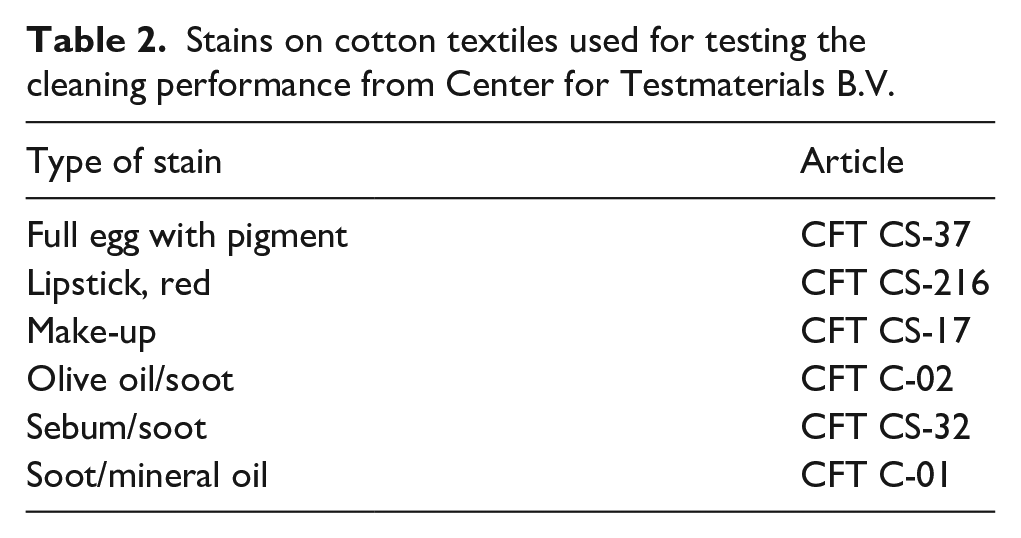
The selected stains contained oily soils and pigments and showed the highest effect of ultrasound in preliminary experiments. The effect of other typical stains for measuring washing performance would be smaller, but the effect of ultrasound was significant for most typical stains used for assessing the cleaning performance in household washing. 14 The choice of these stains was also in accordance with the consumer’s perspective for pretreatment, as these stains were very difficult to remove by a conventional washing process.
Some of the stains contained additional black pigments like soot to make it easier to measure stain removal. The cleaning effect was assessed by the CIELAB lightness L* in accordance with DIN EN ISO 11664-4. 16 L*was measured with the reflection spectrophotometer, CM-2600d, from Konica Minolta Inc. The reflectance was measured with light D65 without gloss at an observation angle of 10 and a measuring aperture with a diameter of 3 mm. The value L* = 0 corresponds to black and 100 to white. Higher values indicated a better cleaning effect as the dark or colored stains were removed from the white textile substrate. In the following text, L* is abbreviated to L.
Cleaning performance was evaluated only on durable cotton fabrics that could be washed in programs such as a high temperature cotton program. In this case, a high energy saving could be achieved by using a pretreatment with ultrasound and choosing a lower temperature program. If the ultrasonic pretreatment were to be used more frequently in the future, further research should be conducted regarding more delicate laundry and the effect on dyes and finishing chemicals.
Temperature measurement
The temperature was measured continuously by a contact-type K element, which was attached to the transducer at a distance of 5 mm. It was immersed in the detergent solution and followed the movement of the transducer.
The temperature (T) dependence of the L-values was described by the Pearson correlation coefficient r which was calculated according to equation (1).
17
In the formula, T is the temperature in °C and L is the L-value. Variables

To better estimate the temperature in the contact area between the transducer and the textile, additional temperature measurements were taken for the stain sebum/soot.
Flat maximum temperature indicator stripes VWR 620-9102 from VWR International were placed directly below the treated textiles at the bottom of the detergent basin. These show the highest temperature that was available at this spot. An infrared camera, Testo 880-3, from Testo SE & Co. KGaA was able to measure the surface temperature of the water basin near the transducer. The emission coefficient of the water surface was manually adjusted so that the measured temperature values of the camera and the contact-type K element matched at room temperature.
Another approach was to measure the temperature indirectly by measuring the discoloration of fruit stains on textiles. A chemical reaction between a bleaching agent like peracetic acid and a fruit stain showed a strong temperature dependency. A higher temperature would lead to a faster fading of the dye, which can be measured by the same spectroscopic system used for other stains in this study. The stains of red wine (CFT CS-103) and black currant (CFT CS-12) were used, which showed a low effect of friction and ultrasound compared to the other stains used in this study. The enhancement of the brightness L after the application of the ultrasonic device was compared to the brightness that was obtained in a temperature-controlled bath at different temperature levels without the ultrasonic device. Peracetic acid (15%) was supplied by AppliChem GmbH (order No. 143495.1211), the concentration used in experiments was 3.5%. This kind of temperature estimate yielded an effective temperature at the textile surface in contact with the ultrasonic transducer. The measurements with temperature indicator stripes and bleach were performed as separate experiments in which the cleaning performance was not assessed.
Differentiation between soaking, friction, and ultrasonic cleaning
In the experiments, the values for soaking were measured in the same experiment that was conducted for friction. In this way, the conditions were as similar as possible concerning the mix of fluid, temperature, and duration of detergent contact. The values for friction and ultrasound were measured in the area where the transducer had contact with the textiles. The values for soaking were measured on the same textile outside this region, where no friction occurred.
The contribution of each step as a difference (Δ) in brightness value L was calculated in accordance with equation (2). L0 denotes the brightness before cleaning, Lsoak, Lfriction, LUS denote the brightness after cleaning with soaking, friction, or ultrasound (US).

The steps are outlined in Figure 2.

Diagram showing the different contributions of soaking, friction, and ultrasound (US) to the overall cleaning effect.
Results
Part 1 – Soaking, friction, and ultrasound at room temperature
The experiments were conducted at room temperature to obtain an overview of the effects of soaking, friction, and ultrasound on six stain types. In this part, the temperature increase caused by the activation of the ultrasound device was not measured.
The stained textiles were cut into pieces of 3 cm in width and 10 cm in length and were allowed to rest in the detergent solution for 30 s before starting the movement of the transducer. In this mode, friction occurs between the transducer and the textiles. If the appliance is turned on, ultrasound also acts on the stain. The duration of the treatment with the transducer lasted 30 s, and the transducer moved approximately 20 times back and forth over a 3 cm range parallel to the longer side of the textile. After the experiments, the textiles were dipped five times into an 800 mL tap-water bath to remove detergent and adherent soil. Before and after the experiments, the reflectance of the dry textiles was measured at five locations, either in the field where the transducer had contact for measurement of friction and the ultrasonic effect, or in the case of the soaking effect, in the region that had no contact (Figure 3).

Diagram of exemplary positions (circles, diameter 3 mm) where the cleaning effect was measured on the stained textiles (100 × 30 mm2). In each region, five measurements were carried out, either in the small contact area (dashed rectangle) for friction with or without ultrasound, or for soaking at a position outside the contact area.
The experiments were repeated five times for each cleaning procedure, that is, five experiments with and five experiments without ultrasonic were conducted for one stain.
The spherical shape of the Electrolux ultrasonic unit resulted in a very small contact area. This resulted in a very narrow cleaned strip on the textile. Since the minimum area that could be measured by the spectrometer was 3 mm in diameter, it was not possible to measure the cleaning effect for all of the stains. With ultrasound on, the evenly cleaned area for stains like soot/mineral oil and make-up was wide enough to be measured. However, other stains, such as lipstick (Figure 4), showed a too narrow brightened line with the Electrolux device, which could not be measured well with the spectrometer.
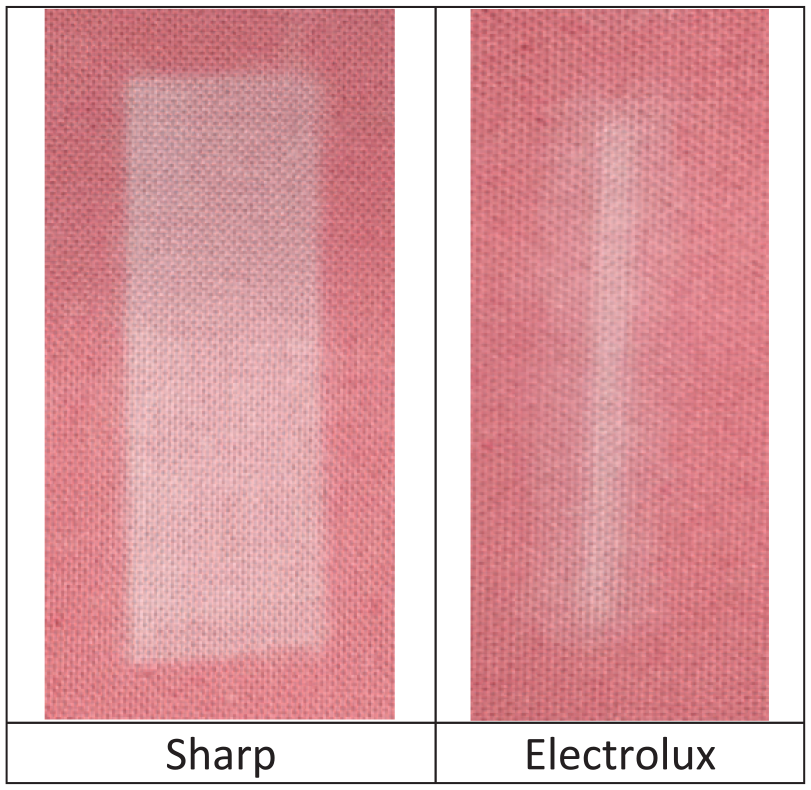
Exemplary comparison of the cleaned area with the Sharp device with a rectangular transducer and the Electrolux device with a spherical transducer for a lipstick-stained textile.
As an overview, the overall effect of ultrasound on the stains is shown in Figure 5. The value of the enhancement of brightness ΔL in this graph corresponds to the difference between the brightness after the application of ultrasound LUS and the value before L0. As the transducer moves over the textile in the detergent solution, this value also contains contributions from friction and soaking. The value ΔL equals ΔUS + Δsoak + Δfriction.

The overall effect of ultrasound on brightness for different stains. Only for the stains of soot/mineral oil and make-up was it possible to obtain a valid measurement for Electrolux. Bars are standard deviations.
The highest cleaning effect of ΔL between 12 and 17 units was seen on soot/mineral oil and egg/carbon black. The other stains also showed a high increase in brightness in the range of 7–12. To separate the contributions of soaking, friction, and ultrasound, additional experiments were carried out for soaking and friction.
For Electrolux, only two stains – make-up and soot/mineral oil – could be evaluated. The stain of make-up showed no statistically significant differences between the devices and the effect was the lowest compared to the other five stains. On the other hand, the stain soot/mineral oil showed the highest overall effect, but a significantly lower performance of the device from Electrolux compared to either Vitun or Sharp. In order to see which effect was responsible for the differences, the contributions for all three devices for the stain soot/mineral oil have been compared in Figure 6. There was no statistically significant difference between the devices from Sharp and Vitun.

Comparison of the effects of soaking, friction and ultrasonic (US) for three different devices on the removal of the stain soot/mineral oil.
Soaking has little effect on this type of stain compared to the effects of friction and ultrasound. The Electrolux device showed a slightly higher friction effect, but a much lower ultrasound effect.
For the devices from Sharp and Vitun, all six stains could be evaluated. As the effects for the devices from Sharp and Vitun were not statistically different, the mean values for both appliances are reported. The relative contributions to the overall effect are shown in Figure 7.

Relative contributions of soaking, friction, and ultrasound (US) to stain removal for different stains; mean values of the devices from Sharp and Vitun.
The contribution of ultrasound to stain removal was, for all stains, higher than 50%. The contribution of friction was between 25% and 40%. As the stains used in this study are difficult to remove and mainly react to mechanical action in the washing machine, such as friction and abrasion, the influence of soaking has the smallest value and, in all cases, is lower than 20%. During the experiments, a temperature increase on the transducer surface and the cleaning liquid could be observed but could not be measured with the initial experimental setup.
Part 2 – Effect of temperature
In order to evaluate all parameters of the Sinner’s circle, it is also necessary to assess the influence of temperature. The transducer itself is heated because of electricity losses in the device and by the dissipation of ultrasonic energy; it is cooled mainly by contact with water and energy radiation into the environment. As the transducer moves the whole time in water, this enhances cooling because of convection.
The temperature increase and its effect on cleaning performance were evaluated for a single stain and one device as an example. The sebum stain was chosen because it is a very relevant stain from the consumer’s point of view, since all fabrics in direct contact with the skin contain at least some sebum. 18 The analysis of the effects on the cleaning efficiency in Figure 7 shows that, for this stain, there is a strong effect of both ultrasound (51%) and soaking (19%). The Sharp ultrasonic device was used because it had the highest cleaning effect of the three devices.
A modified setup allowed the performance of experiments at higher temperature levels by heating the water basin in which the transducer was working. As water evaporated at higher temperatures and cooled the cleaning solution, the temperature range was limited to about a maximum of 56°C. The transducer tip and the detergent solution were preheated separately to the designated temperature ±1°C before starting the experiments.
The measurement of the temperature of the contact area between the transducer and textile could not be carried out directly. The main reason was that changes in this area would affect the cleaning effect and could change the ultrasonic field. Therefore, temperature was measured by a contact-type K element, fixed at a distance of 5 mm from the transducer. This is not the effective temperature at the contact area between the textile and transducer when the ultrasonic device is turned on; this value will be underestimated by this method. However, the value could be continuously recorded. In the case of the measurement of soaking and friction without ultrasound, the temperature readings reflect the correct value, as the temperature of the liquid and the contact area between the textile and transducer are more or less equal.
In addition, experiments for the measurement of the contributions of soaking, friction, and ultrasound analogous to Part 1 were conducted at different temperature levels. Soaking was determined in the same experiment as friction. Friction or the ultrasonic effect were measured at the surface area that was in contact with the transducer, with ultrasound turned off or on. Soaking was measured on the same stain but on a surface area that had no contact with the transducer. As the temperature increased during the operation and was not easy to measure, it was difficult to obtain a meaningful value of the increased temperature T1 (as shown in Figure 8) for each experiment. As the temperature effect on soaking was more or less linear, we chose the mean temperature during the treatments to calculate T1. A linear trend was calculated by a regression analysis, and the values were checked for outliers by an analysis of residues. Raw data and regression lines are shown in Figure 9.

Schematic representation of the cleaning effect of pretreatment with ultrasound. The temperature increase from T0 to T1 caused by the ultrasound mainly affects the soaking process.

Values of brightness L after application of ultrasound (US), friction, and soaking on a sebum stain. Dashed: regression line.
The linear regression shows the temperature influence on different cleaning modes; the data are shown in Table 3. The Pearson coefficient r was calculated according to equation (1). As individual data points for each measurement were used for the calculation, the correlation indicated by r appears to be low, with coefficients r lying between 0.62 and 0.84. Since the observed values seemed to be unusually low, we performed a re-evaluation of the correlation using a different method: If the data points for each temperature level were replaced by the mean temperature and the mean L value, then only five values per series of measurements, such as soaking, friction, etc., would be available to calculate the correlation. In this case, r would be between 0.90 and 0.96.
Regression analysis for different temperature dependent processes in Figure 9.

Linear temperature coefficient and constant of a least square fit are shown, and, additionally, the Pearson coefficient r.
As the slope of the regression lines for each mode of action like soaking, friction, and ultrasound show more or less the same value (0.047 ± 0.006) 1/°C, the explanation of the temperature effect can be simplified by attributing it only to the soaking process ΔLsoak(T). The contributions of ultrasound, ΔLUS, and friction ΔLfriction did not change much in the observed temperature range and can be regarded as a constant. Hence, the resultant brightness can be explained by ΔLsoak(T) +ΔLfriction +ΔLUS.
After starting the ultrasonic device at a temperature level To, temperature will increase to an effective temperature T1. The effect of turning on the ultrasound can be divided into different steps. First, soaking will be enhanced because of the increase in temperature. As the effects of friction and ultrasound can be regarded as constant, they can just be added to this effect to obtain the overall effect, as outlined in Figure 8.
The most relevant case is a pretreatment at room temperature. When the ultrasound was turned on, the temperature of the detergent solution increased from an ambient temperature of about T0 = 24.3°C to a mean temperature of about T1 = 27.7°C during the pretreatment. Using the regression data in Table 3, an increase of 3.4°C corresponds to an increase in brightness on account of the temperature-enhanced soaking of about 0.27 units.
This gives us an initial assumption about the temperature effect. However, temperature T1 measured at a distance of 0.5 mm from the transducer is not the temperature at the contact area between textile and transducer; the temperature will be higher in actuality. Therefore, the effect of T1 is only a lower estimate of the temperature effect.
Different strategies for estimating the temperature in the region between the textile and the transducer were tested, such as the chemical bleaching of stained textiles with dyes from fruits, the use of flat maximum temperature indicators, and infrared measurement of the transducer and the water surfaces. The setups are not shown, as they were only used for a rough estimation of the maximum temperature in the range of ±5°C.
The maximum temperature at the bottom was measured by flat temperature indicators as stripes. The surface temperature of the detergent solution near the transducer was measured by an infrared camera. The temperature of the contact area between the textile and the stain should be between the transducer surface temperature and the highest temperature visible by local hot currents on the surface of the detergent.
All measurements led to values of an effective temperature or a maximum of about (40 ± 5)°C when experiments started at the ambient temperature. This corresponds, according to the regression coefficients in Table 3, to an increase of about 1.07 units of brightness for temperature-enhanced soaking.
Both of these scenarios are summarized in Figure 10. The main change was caused by the temperature dependency of the soaking process. The contribution of friction and ultrasound were more or less constant.

Estimation of the minimum (+0.27) and maximum effects (+1.07) of temperature on the cleaning performance, starting at an ambient temperature 23.5°C. Hatched area above dashed line: enhanced soaking caused by temperature increase starting from the ambient temperature.
The influence of a temperature increase on soaking in comparison with the overall effect accounts for 2% for the lower temperature estimate and 9% for the maximum temperature estimate. This value is still much lower than the value of the contribution of ultrasound.
Discussion
No significant difference in cleaning efficiency was found between devices from Sharp and Vitun with rectangular transducers. The flat geometry of the transducers led to an even cleaning in the contact area. The device with a spherical transducer from Electrolux, however, behaved differently. The cleaning results of both types of transducers are difficult to compare because of the uneven cleaning performance of the spherical transducer compared to the rectangular transducers.
A comparison was still possible for two stains. The analysis of the frictional effect of the stain soot/mineral oil showed a slightly higher frictional effect of the device from Electrolux compared to the devices from Vitun and Sharp. This was surprising as the surface of the transducer from Electrolux was very smooth compared to the transducers of Vitun and Sharp and this type of stain is known to react mainly to abrasion. 15 On the other hand, the spherical shape of the transducer of Electrolux leads to a higher local pressure.
The reason for the good frictional effect of Electrolux seems to be a mixture of the deformation of the textile, the inter-yarn-friction and an enhanced mass transport due to a higher pressure. The disadvantage is that a smaller area is cleaned. As this stain contains particles which are removed well by ultrasound, this can explain the higher effect of the devices from Sharp and Vitun. 6 Measurement of the ultrasonic intensity showed a lower value for the device from Electrolux. 14 Therefore, it can be said that the reduced overall cleaning effect of the device from Electrolux on this stain can be explained mainly by the lower performance of the ultrasound.
The separation of parameters in accordance with Sinner’s circle was possible for all six stains with the devices from Sharp and Vitun. They showed no significant difference in cleaning performance. Fifty percent of the cleaning performance can be attributed to ultrasound, friction accounted for 25%–40%, and the influence of soaking was lower than 20%.
Both devices were of the same design, with the same type of ultrasonic generator. Since there was also no difference in the friction effect, the diagonal grooves of the Vitun device did not seem to have any influence. One reason may be that the grooves represented only a small percentage of the total area in contact with the textiles, and another is that the surface roughness was probably similar, since both devices showed wear due to cavitation.
In Gallego-Juarez et al., a similar, but much bigger, ultrasonic device was used to clean flat textiles in textile processing, but in this case neither friction nor temperature changes were measured and separated from the overall cleaning effect. 13
Since the use of ultrasound leads to a temperature increase in the transducer, the effect of temperature was investigated in more detail using the example of a single stain and the device from Sharp. The average temperature of the cleaning solution at 5 mm from the transducer was used to calculate the temperature effects. The temperature dependence of the cleaning of a sebum stain was measured at different temperature levels for soaking, friction, and ultrasound. In the temperature range of 20°C and 55°C, it was shown that the temperature mostly affected soaking. Therefore, the overall cleaning effect can be described as a temperature-dependent part of the soaking process with constant contributions from friction and ultrasound.
This seems to contradict the view in the literature that an increase in temperature increases ultrasonic efficiency. 5 The same literature points out, “It is often difficult to distinguish whether the benefit of increasing temperature is due to enhanced ultrasonic performance or increased chemical activity.” In this case, we were able to distinguish these effects. It is true, that the overall effect increases as the temperature increases, but in our case the enhanced “chemical” action is dominant and not an enhanced ultrasonic action. In this case, the “chemical action” refers to an improved effect of the detergent during soaking.
But, still, some uncertainties persisted, as this temperature was not identical with the temperature at the contact area between the transducer and the textile, therefore additional experiments were conducted. Starting at the ambient temperature, the maximum temperature at the contact area could be estimated by different methods to be within (40 ± 5)°C. This temperature range is only a rough estimate, as none of the methods could record the temperature in the textile in real time. A direct measurement was not carried out in order not to influence the ultrasonic field during application.
The corresponding effect of the maximum temperature on cleaning performance could be estimated to be about 9%. This shows that the ultrasonic effect during the contact between the transducer and the textile stain is not dominated by a local temperature increase, but a genuine effect of ultrasound in the proximity of the surface of the transducer.
Thus, it can be concluded that different strategies can be used to achieve a high overall effect for ultrasonic pretreatment devices. The effect of soaking can be improved by increasing the temperature. Another possibility would be to increase the soaking time, which was not varied in these experiments. However, the effect of temperature on cleaning performance was measured and was linear. The most important effects are friction and ultrasound. High friction values can be achieved either by using smooth surfaces at high pressure or by using rough surfaces at a lower pressure. This will result in different fiber damage that should be considered in future studies.
Footnotes
Declaration of conflicting interests
The author(s) declared no potential conflicts of interest with respect to the research, authorship, and/or publication of this article.
Funding
The author(s) disclosed receipt of the following financial support for the research, authorship, and/or publication of this article: We would like to thank Henkel AG & Co. KGaA for funding this work.
