



Abstract
In recent years, the exceptional performance of steel fiber-reinforced concrete in blast and impact resistance has garnered widespread recognition, sparking considerable interest in its practical application in small box girders. To this end, nine groups of Trinitrotoluene (TNT) explosion simulation experiments were designed with the equivalent magnitudes matching those of actual automobile explosions to evaluate the anti-explosion and anti-penetration capabilities of steel fiber-reinforced concrete and ordinary concrete using the Arbitrary Lagrangian-Eulerian (ALE) method and the Smoothed Particle Hydrodynamics-ALE method. The aim was to explore the application prospects of steel fiber-reinforced concrete in small box girders. The research results demonstrate that with increasing TNT equivalent, the leading cause of breach to concrete slabs changes from spalling to cratering. The penetration resistance of steel fiber-reinforced concrete slabs is superior to its blast resistance. However, when the explosive force is larger than the sedan, the anti-explosion effect of steel fiber-reinforced concrete slabs becomes negligible. Moreover, under typical automobile explosion loads, the addition of 2% steel fibers can reduce spalling by up to 23% and cratering by up to 13% and can decrease the area of penetration damage by up to 47%. In designing blast-resistant structures, steel fiber-reinforced concrete is not recommended to enhance the blast resistance of bridges when the TNT equivalent exceeds 500 kg.
Introduction
In 2022, terrorist attacks were projected to cause 7142 deaths across various countries, with this trend continuing to spread globally. 1 Terrorist organizations are increasingly targeting critical urban nodes such as bridges, railway stations, and subways, presenting a significant challenge to the ability of global building structures to withstand explosion accidents.2,3 Recent studies have demonstrated that adding fiber-reinforced polymers (FRP) can enhance the mechanical properties of concrete materials, with fiber-reinforced concrete demonstrating superior impact resistance. 4 Consequently, fiber-reinforced concrete is gradually employed in building structure components such as beams, slabs, columns, and walls to improve their anti-blast performance.5–7 However, while steel fiber-reinforced concrete is increasingly utilized in this field, its usage specifications for bridge blast-resistant design still need to be improved.
Many studies have been carried out on the mechanical properties of different types of fiber concrete. Bhogone and Subramaniam 8 and Mpalaskas et al. 9 pointed out through experiments that due to the anchoring mechanism of steel fiber, high tensile strength and high elastic modulus, the addition of steel fiber significantly improves the bearing capacity and bending resistance of concrete. Kytinou et al. 10 and Lantsoght 11 studied the mechanical properties of steel fiber reinforced concrete beams through experiments and numerical simulations, and pointed out that steel fibers have a favorable effect on the beam’s flexural performance, cracking performance and residual stress after cracking. In addition, researchers found that adding 1.25% steel fiber to steel fiber lightweight high-strength self-compacting concrete (SHLSCC) can increase concrete’s splitting tensile strength and flexural strength by 37% and 110%, respectively. The flexural strength of the beam strengthened by SHLSCC is significantly improved, and the peak load will be increased by 14% to 58%.12,13
Studies have confirmed that fiber-reinforced concrete significantly improves basic mechanical properties, such as strength, stiffness, and ductility, compared to traditional concrete. Additionally, some scholars have researched fiber-reinforced concrete’s anti-blast and impact resistance in-depth. Luccioni et al. 14 and Voutetaki et al. 15 obtained through experiments that the addition of steel fibers to High-Strength Concrete (HSC) can change the explosive phase response of concrete slabs, and pointed out that the effect of adding a small amount of long fibers on the bending response of concrete is more obvious than the explosion response. Algassem et al. 16 and Mpalaskas et al. 17 simulated blast loads using a shock-tube found that the incorporation of steel fibers in high-strength reinforced concrete beams can significantly improve their explosive performance. 1% fiber content can effectively improve the anti-explosion performance and reduce the maximum and residual displacement during equivalent explosion. Aliabdo et al., 18 through ASTM D1557 standard test research that using steel fiber as coarse aggregate can significantly improve the impact resistance of concrete, and the penetration depth of 2.0% of steel fiber parametric concrete can be reduced by 22%. Foglar and Kovar 19 conducted field explosion tests on prefabricated concrete slabs with different steel fiber parameters and found that adding steel fibers can effectively reduce the fracture area and concrete debris volume. Yang et al. 20 found through experiments that steel fibers significantly improve the spalling diameter and depth of concrete slabs. The improvement effect of end-hook steel fibers is the best. Foglar et al. 21 and Hájek et al. 22 conducted field explosion tests on composite fiber-reinforced concrete slabs and verified by numerical simulation that its failure under blast loads exhibits a layered nature, effectively absorbing the blast release energy, thereby improving the anti-blast performance of concrete. However, paying attention to the fiber ratio when selecting composite fibers is essential. Nam et al. 23 pointed out in the experimental research on the contact explosion of composite fiber concrete slabs that the mixing type and mixing ratio of fibers directly affect the anti-explosion performance of fiber concrete.
It is worth noting that adding steel-fiber does not necessarily improve the blast resistance of concrete structures. Waste plastic and scrap steel fibers have been used in fiber-reinforced concrete to improve its crack resistance, Foglar et al. 24 and Mwendwa Mwonga et al. 25 found in non-contact explosion tests that they had relatively little effect on the anti-blast performance of the concrete slab. Most studies on the anti-blast type of steel fiber-reinforced concrete slabs are mainly based on field experiments, which limit the use of explosives to a certain extent, making it impossible to study actual explosion conditions. Zhang et al. 26 and Peng et al. 27 pointed out that establishing a random steel fiber mesoscopic model can also effectively reflect the failure form under impact load. This method makes it possible to study sizeable equivalent blast loads. Therefore, the author put the midpoint in the real explosion situation using MATLAB software to make a random steel fiber model and uses LS_DYNA finite element software to simulate the explosion of the bridge deck.
The article examines the potential application of steel fiber-reinforced concrete in enhancing the blast resistance of small box girders. Nine control simulation experiments were conducted using TNT equivalent to actual automobile explosion loads as test conditions to investigate the damage of steel fiber reinforced concrete and ordinary concrete box girders under common vehicle explosions. The research analyzed the damage mechanism of the steel fiber reinforced concrete top plate of the box girder under blast loads and the penetration damage caused by explosion fragments of the top plate to the bottom plate of the reinforced concrete box girder after the explosion. The expected outcome is to enhance the anti-blast performance of steel fiber-reinforced concrete compared to ordinary concrete in actual explosion conditions.
Material properties and constitutive
The model comprises four components: the explosive, air, concrete, and steel parts. Among them, the explosive air and the concrete part all use the SOLID164 unit, which has eight nodes. Nodes have degrees of freedom for translation, velocity, and acceleration in the x, y, and z directions. The reinforcement part in the model adopts the Beam161 beam element. It uses three nodes to jointly define the cross-sectional direction and shape of the beam element. The MAT HIGH EXPLOSIVE BURN material model is employed for the explosive part. This model defines the detonation velocity and Chapman-Jouguet pressure to simulate the detonation of high-energy explosives and then matches the Jones-Wilkins-Lee Equation of State (EOS JWL). The specific expression of the state equation is provided. 28 Table 1 is the TNT material parameters.
Material parameters of TNT.


Where
P is the detonation pressure;
V is the relative volume;
E0 is the initial internal energy;
A, B, R1, R2 are the characteristic parameters of the explosive.
The air is modeled using the SOLID14 element and the MAT NULL material model. The EOS LINEAR POLYNOMIAL state equation is used to describe the air state, and its specific expression is provided. 28 Table 2 is the air material parameters

Material parameters of air.

When describing an ideal gas in explosion problems, the material equation of state assumes C0 = C1 = C2 = C3 = C6 = 0, C4 = C5 = γ − 1 Under these conditions, the linear polynomial state equation is simplified as:

where
C0 ~ C6 are material parameters;
ρ is the air density,
ρ0 is the initial air density;
E0 Internal energy per unit reference volume;
γ is the air specific heat capacity ratio.
The concrete part is modeled using SOLID164 element with the Riedel–Hiermaier–Thoma (RHT) concrete model. Based on the continuum damage mechanics theory, this model considers damage, strain rate, shear expansion, hydrostatic compaction, and pore pressure effects on concrete properties. The model uses three limit surfaces to describe the shear strength of concrete: the elastic yield surface, the failure surface, and the residual surface. The elastic yield surface defines the beginning of plastic deformation and damage, the failure surface defines the maximum strength of concrete before failure, and the residual surface defines the residual strength of concrete after failure. Additionally, the model uses a nonlinear equation of state to describe the volumetric behavior of concrete under high pressure, which considers the effects of porosity, compaction, and phase transformation. 29 Thus, the RHT concrete model can effectively simulate complex failure modes of concrete structures under various loading conditions, such as penetration, perforation, fragmentation, spalling, and cracking, under impact and blast loads. 30 Table 3 is the concrete material parameters
Material parameters of concrete.

The reinforcement is modeled using the BEAM161 element with the MAT PLASTIC KINEMATIC material type, which enables cost-effective and efficient simulation of isotropic materials and dynamic strengthening material models. The Cowper-Symonds model accounts for the relationship between material yield strength and strain rate effects. Table 4 is the material parameters of the steel bar. The yield stress of the steel bar can be expressed as follows 28 :

Where:
C is the Cowper-Symonds model strain rate parameter, taken as 40;
P is the Cowper-Symonds model strain rate parameter, taken as 5;
β is the reinforcement parameter;
Material parameters of the longitudinal bar.

Stirrups take 420, Steel-fiber take 800.
Explosion on box girder roof
Method
This paper adopts the Arbitrary Lagrangian-Eulerian (ALE) method to simulate the propagation of blast shock waves in the air. The steel elements are 150 mm in size, while the concrete, air, and explosive elements are 100 mm in size. To more accurately simulate the failure form of concrete during an explosion, the maximum failure principal strain is used as the failure criterion for concrete. To reduce the distortion effect caused by explosive size scaling and its impact on simulation accuracy, the model uses a 2.5:1 ratio to build a TNT explosive, which is similar to the aspect ratio of a car, instead of a regular hexahedron. Since the explosion time is very short, the damage to the concrete usually occurs within a few milliseconds. Therefore, a calculation end time of 3 ms is selected.
To compare the difference in damage between steel fiber reinforced concrete and ordinary concrete under automobile explosion loads, a reinforced concrete small box girder roof is selected as the research object. The box girder roof has a length of 4000 mm, a width of 2400 mm, and a plate thickness of 180 mm, as shown in Figure 1 The FE model includes a steel fiber reinforced concrete slab with a length of 2000 mm and an ordinary concrete slab with a length of 2000 mm.
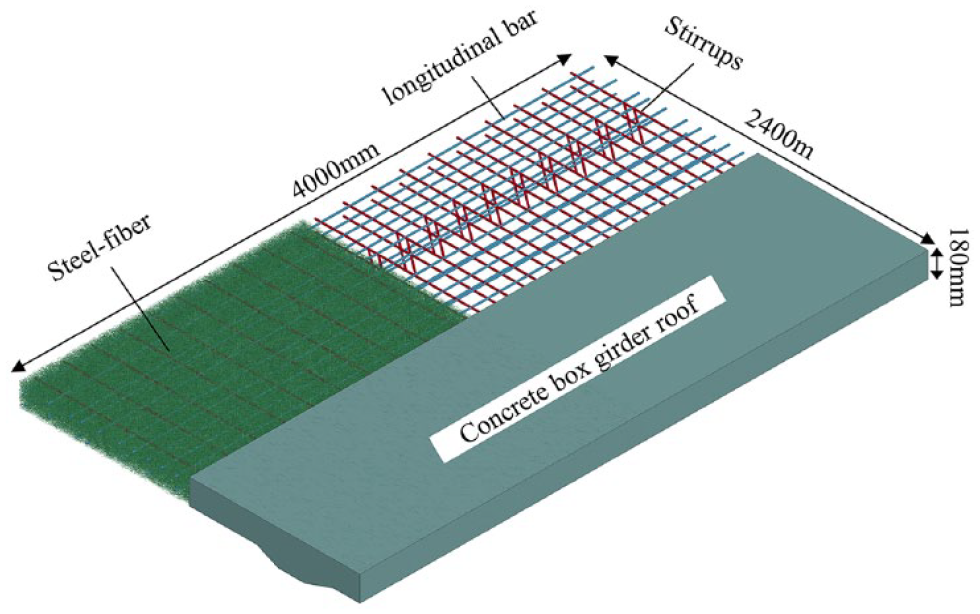
Finite element model of box girder roof.
In the concrete slab model, the longitudinal bars and stirrups are made of Ф13HRB400 steel bars with a stirrup spacing of 200 mm. The steel fibers are straight steel fibers with a diameter of 0.7 mm and a length of 40 to 50 mm, the aspect ratio is between 50 and 70 with a volume fraction of 2%. The randomly distributed steel fiber model is established based on the Cat Munro method and is coupled to the concrete slab using the keyword LAGRANGE IN SOLID, verified by Peng et al. 27 The concrete has a compressive strength of 48 MPa.
Based on Refs.,31–34 the article shows the TNT equivalent of explosions caused by standard vehicles in Table 5. From the statistics, five working conditions were designed, with the height of the explosion center set at 1 m based on the average height of the vehicle. The specific working conditions are presented in Table 6. Where the relative distance is defined by equation (5) and is dimensionless.

Where:
R is the distance from the explosion point to the target, unit: m;
W is the mass of explosives, unit: kg.
TNT equivalent scale of accidental explosion of common road transport vehicles.

Material parameters of reinforcement.

Result analysis
Damage to concrete slabs under blast loads mainly includes craters, spalling, and surface damage. Figure 2 presents the damaged image of the concrete slab at 1 ms under 100 kg TNT equivalent. Figure 2(a) shows the damage on the front of the concrete slab, mainly in craters. This damage is caused by the compressive failure of the concrete slab under blast loads. Figure 2(b) presents the damaged image on the back of the concrete slab, which is mainly in the form of spalling. The tensile failure of the concrete slab under the blast load usually causes this type of damage.

The damage diagram of concrete slab under 100 kg TNT equivalent at 1 ms: (a) top view and (b) bottom view.
According to the Figure 2, the degree of damage to the steel fiber concrete slab and ordinary concrete slab under blast load is significantly different. Specifically, at this stage, the ordinary concrete slab has already broken with a large amount of reinforcement exposed due to broken concrete, whereas the steel fiber concrete slab remains unbroken. The transverse failure boundary of the concrete slab is concentrated mainly at the junction of the top slab and the web of the box beam. In Figure 2(a), the axial stress diagram of the steel fiber in this location is magnified, indicating that the axial stress of the steel fiber is higher in the cracked area of the concrete slab. This phenomenon is known as the crack-bridging effect of steel fiber-reinforced concrete, 14 which can effectively span cracks and bridge them to prevent further crack propagation. The bridging effect of this steel fiber significantly strengthens the toughness and bearing capacity of concrete. By bridging the cracks, the steel fibers can bear the load partially, slowing the rate at which the cracks propagate and spreading the stress around the cracks. This effect helps to increase the tensile strength and ductility of concrete, thereby improving the overall performance of the structure. A similar phenomenon is observed in the spalling area on the back of the concrete slab in Figure 2(b), where the steel fibers absorb some of the tensile stress at the cracked back slab, improving the cracking resistance of the concrete and strongly compensating for its low tensile strength. Adding steel fibers improves the tensile damage of the concrete slab effectively, thereby enhancing its blast resistance.
Figure 3 presents the damage time history diagram of concrete slabs from 300 to 500 μs. The y-axis indicates the percentage of cratering, concrete spalling, and peeling in the thickness direction of the concrete slab, while the horizontal axis represents time. Concrete penetrations are also indicated in the diagram. After the explosion, the explosion shock wave first acts on the surface of the concrete slab, causing compression damage to form a crater. As the stress propagates inside the concrete slab, the back of the concrete is subjected to tensile damage and peeling off. It can be observed that both steel fiber reinforced concrete and ordinary concrete slabs have penetrated under 500 kg and 300 kg TNT equivalent at 500 μs. However, only ordinary concrete slabs have penetrated under 200 kg TNT equivalent. This phenomenon suggests that adding an appropriate amount of steel fibers can reduce the damage to concrete slabs. By observing the damage development trend of the concrete slab, it can be noted that it first exhibits craters, and then the concrete backing slab peels off under the blast load. The damage view diagrams of 23, 100, and 200 kg TNT equivalent indicate that the damage to the concrete slab mainly comprises spalling under these conditions, and the expansion of the crater along the thickness direction is insignificant. The spalling of steel fiber-reinforced concrete develops slower than that of ordinary concrete. With the increase in TNT equivalent, when the TNT equivalent exceeds 300 kg, the proportion of craters begins to increase, and craters gradually become the main component of concrete slab breach, replacing spalling.
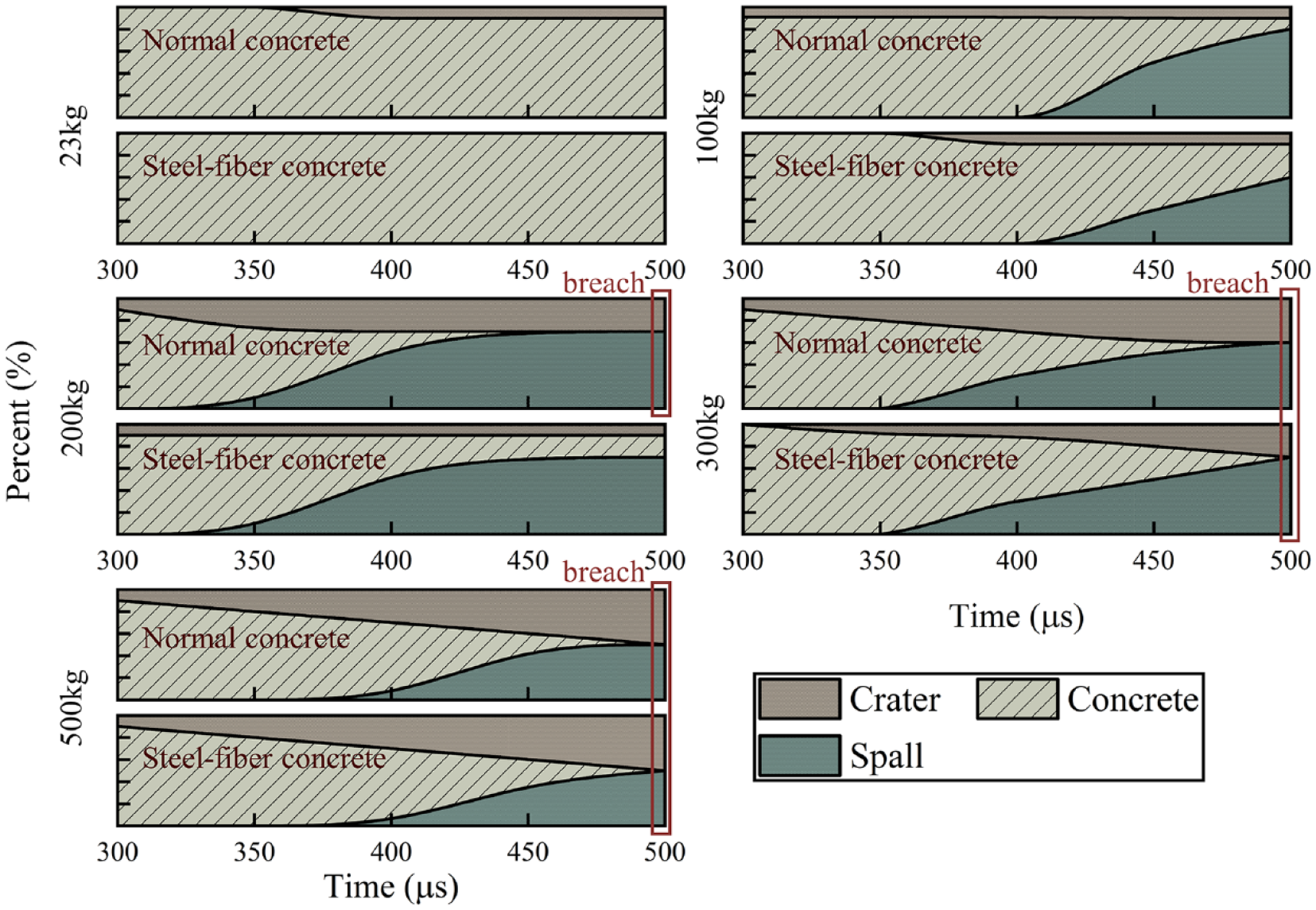
Concrete damage time history change diagram.
The study presents statistical data on the length of craters and spalling of concrete slabs under different explosion loads, as depicted in Figure 4. Notably, at 23 kg TNT equivalent, the steel fiber reinforced concrete slab only experiences cracking without craters or spalling. As the explosive amount increases between 100 and 200 kg, the lateral expansion of the crater becomes relatively slow. However, when the TNT equivalent exceeds 200 kg, the length of the concrete crater increases rapidly with the increase of the explosive, eventually becoming the primary type of breach of concrete slabs. In this study, a statistical analysis was conducted on the spalling damage length of the concrete slab and the damage length of the crater, followed by linear fitting. The results revealed that the R-Square (R2) for spalling damage of ordinary concrete slabs under blast load was 0.9, while for crater damage, it was 0.8. However, with the addition of steel fibers, the R2 values for spalling and crater damage increased to 0.94 and 0.82, respectively. This indicates that the length of spalling damage in the concrete slab exhibits a relatively stable increase with the ratio of an explosive amount to the crater of the concrete slab within the range of 100 to 500 kg TNT equivalent, and it can also be seen that the addition of steel fibers can make the damage of the concrete slab more moderate. At 500 kg TNT equivalent, the spalling and craters of the concrete slab spread to the edge of the concrete slab.

Damage statistics of concrete slab under explosion load: (a) crater length statistics and (b) spall length statistics.
By comparing data, Figure 5 illustrates the reduction in damage of steel fiber reinforced concrete slabs compared to ordinary concrete slabs under different blast strengths. Since steel fiber reinforced concrete did not show spalling and craters under 23 kg TNT equivalent, statistical analysis was only conducted within the range of 100 to 500 kg TNT equivalent. The results indicate that adding 2% fiber content to concrete slabs can effectively delay the break time of damage and can increase the maximum delay rate up to 171%. Moreover, steel fiber concrete can effectively reduce spalling length by up to 23%, crater length by up to 13%, and overall damage rate by up to 23%, compared to reducing the length of the crater. Generally, the effect of adding steel fibers to concrete gradually reduces as the TNT equivalent increases. The figure highlights the area where the damage weakening is less than 5%. When the lifting rate is below 5%, the effect of steel fiber addition on concrete lifting can be considered negligible. It can be observed that the improvement effect of steel fiber-reinforced concrete becomes less significant when the TNT equivalent is greater than 300 kg. When the TNT equivalent reaches 500 kg, the anti-blast performance of steel fiber-reinforced concrete is similar to that of ordinary concrete. It is worth mentioning that the best damage reduction effect of steel fiber reinforced concrete occurs when the TNT equivalent is 200 kg. This phenomenon is because spalling is the primary failure type of concrete slab at this point, which is caused by the tensile failure of the backing slab concrete. The addition of steel fibers effectively increases the tensile strength of the concrete, making the weakening effect most significant.
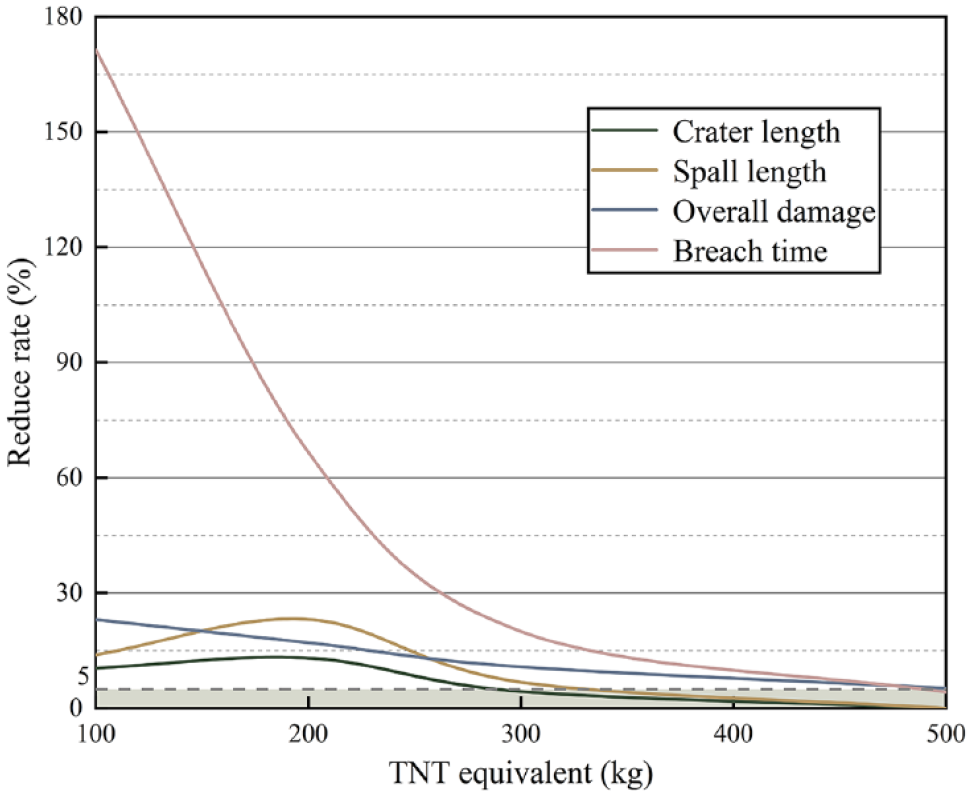
Damage reduction rate.
Figure 6 illustrates the acceleration time histories of steel fiber reinforced concrete slabs and ordinary concrete slabs under various blast loads to investigate the correlation between dynamic response and damage of concrete slabs. The findings indicate that the dynamic response of the concrete slab is amplified with the increase of TNT equivalent. The peak value of dynamic response for 500 kg TNT equivalent is 200 times greater than that of 23 kg TNT equivalent. Starting from 100 kg TNT equivalent, the dynamic response of the concrete slab does Non-convergence. With the increase of TNT equivalent, the time of this Non-convergence appears early, suggesting that the concrete fails earlier at the respective measuring point.
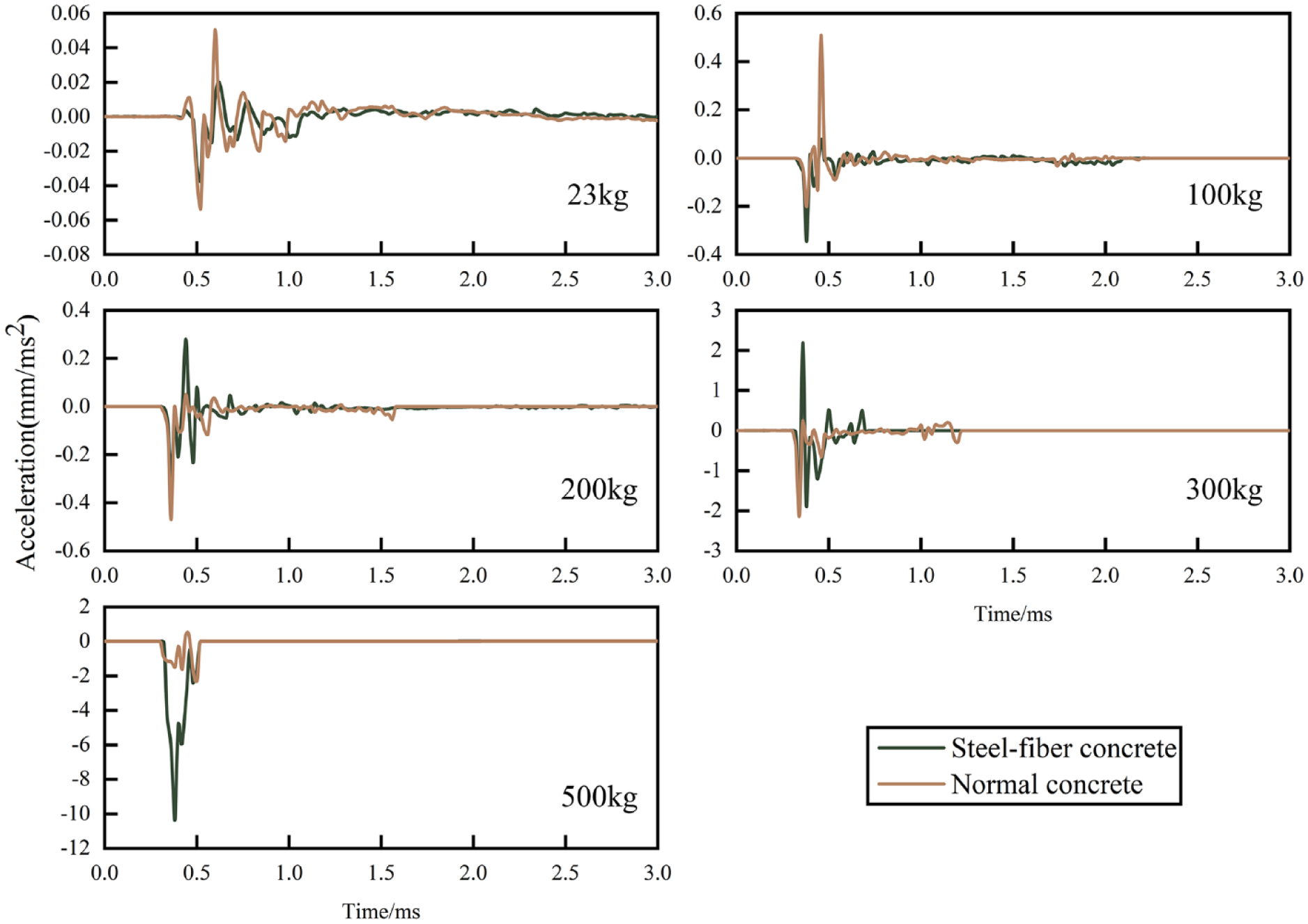
Concrete slab acceleration time history curve.
Below 200 kg TNT equivalent, the dynamic effect of ordinary concrete slabs is more potent than that of steel fiber-reinforced concrete slabs. During this period, the steel fiber reinforced concrete slab manifests superior toughness. Nevertheless, after TNT equivalent reaches 300 kg, the steel fiber-reinforced concrete slab starts to exhibit a dynamic response akin to that of ordinary concrete slabs. Additionally, combined with the outcomes presented in Figure 5, it demonstrates that the anti-blast performance of steel fiber reinforced concrete becomes insignificant beyond 300 kg TNT equivalent.
Penetration of box girder bottom plate
Method
To investigate the penetration of debris through the bottom plate of a concrete box girder due to a vehicle explosion above it, a finite element analysis model of the concrete box girder floor and roof is established, as shown in Figure 7. The model does not include the web of the box girder since it only considers the debris penetration into the floor.

Finite element model of box girder roof and floor.
This article aims to simulate the penetration of explosive fragments and attempts to use the Smoothed-particle hydrodynamics-Arbitrary Lagrangian-Eulerian (SPH-ALE) method. The keyword ADAPTIVE SOLID TO SPH is set to convert failed concrete solid units into SPH particles to simulate concrete debris behavior. The finite element model consists of a reinforced concrete slab with a length of 3000 mm, a width of 1000 mm, and a thickness of 180 mm for the top plate of the box girder and a concrete slab with the same thickness and a width of 900 mm for the bottom plate. The composition of the top plate is divided into 1500 mm steel fiber reinforced concrete and 1500 mm ordinary concrete. The distance between the upper surfaces of the top plate and the bottom plate is 1020 mm, and the calculation time is set to 15 ms. The remaining model parameters are the same as those of the box girder roof explosion.
According to the research results in the previous section, when the TNT equivalent is 23 kg, there is no breach in the roof of the box girder, so this working condition is excluded when studying the penetration effect.
Result analysis
Figure 8 presents the velocity diagram in the Y-direction of the concrete slab subjected to 100 kg TNT equivalent, the unit of speed in the figure is m/s. At 5 ms after the explosion, Figure 8(a) reveals that the box girder roof has undergone damage under the explosion load, resulting in a gap, and many steel bars have bent. Consequently, the concrete fulfilling the failure criterion has been transformed into SPH particles and moved down due to the initial velocity from the blast load. At 10 ms after the explosion, as illustrated in Figure 8(b), some concrete fragments penetrated the bottom plate of the box girder, leading to damage in a section of the box girder’s bottom plate.

Y direction velocity diagram of concrete slab: (a) 5 ms and (b) 10 ms.
Figure 9 illustrates the damaged areas of the front and back of the box girder bottom plate caused by the penetration of explosive fragments. The results indicate that the front and back sides of the box girder bottom plate exhibit similar damage patterns. Specifically, when the TNT equivalent is less than 200 kg, the damage on the front side of the concrete slab is more severe than that on the backside. This phenomenon is because the speed of some concrete debris is not high enough to penetrate the concrete slab, resulting in a larger damaged area on the front side of the concrete slab. As the TNT equivalent increases, the penetration of concrete debris gradually destroys the floor. The difference between the front and back damage of the box girder bottom plate decreases.

Damage statistics of small box girder floor under debris penetration: (a) front damage area and (b) back damage area.
This study selects a concrete fragment passing through a steel fiber-reinforced concrete slab and an ordinary concrete slab for analysis. Figure 10 illustrates the time history of the velocity of the fragment. The concrete debris attains high acceleration under the blast load, achieving its maximum velocity. Upon hitting the bottom plate of the box girder, it begins to decelerate due to penetration. The maximum velocity of concrete debris increases with the increase of TNT equivalent, reaching thrice that of 100 kg TNT equivalent at 500 kg TNT equivalent.

Concrete fragment velocity time history curve.
Furthermore, it is observed that the deceleration effect of fragments varies when passing through concrete slabs of different materials. Steel fiber-reinforced concrete slabs show a better deceleration effect than ordinary hardness slabs. However, as TNT equivalent increases, the deceleration effect weakens gradually.
Figure 11 presents statistics on various types of damage to the box girder floor, including the attenuation ratio of penetration damage of steel fiber reinforced concrete (SFRC) slabs compared to ordinary concrete slabs speed attenuation ratio of box girder roof fragments. The results indicate that SFRC slabs can reduce the velocity of concrete fragments on the box girder roof by up to 84%. The attenuation effect on front damage of the concrete slab can reach a maximum of 39%, and the attenuation effect on back damage of the concrete slab can reach a maximum of 47%. Overall, the weakening effects of damage decreased with an increase in TNT equivalent. However, even when the TNT equivalent reaches 500 kg, the damage reduction effect remains high at 10% or more. The complete research results demonstrate that SFRC is more effective in inhibiting back slab damage than frontal damage, similar to the reinforcement effect of SFRC under blast loads. SFRC slabs are also more effective in resisting debris invasion than the anti-explosion aspect, where TNT exhibits excellent performance. When the TNT equivalent is less than 400 kg, the damage reduction ratio is higher than 20%.

Damage reduction rate.
Discussion
Based on the test data analysis, it can be observed that steel fiber-reinforced concrete slabs exhibit enhanced performance under blast loads or debris penetration compared to ordinary concrete slabs, especially in terms of penetration resistance. The addition of steel fibers improves the anti-explosion properties of concrete slabs in two primary aspects: first, steel fiber-reinforced concrete slabs possess more excellent toughness than ordinary concrete and can effectively absorb the energy generated by explosions; second, fiber-reinforced concrete offers better tensile strength than ordinary concrete, thus effectively suppressing any damage caused by tensile failure that is common under blast loads.
Conversely, with the increase of TNT equivalent, the dominant factors of concrete slab failure will change. When tensile failure becomes the dominant mechanism, the addition of steel fibers is effective in resisting failure. However, when compression failure becomes the primary mechanism, the anti-knock effect of adding steel fibers is no longer significant for reinforced concrete. On the other hand, in steel fiber reinforced concrete, concrete is the primary material. With the increase of explosion load, the concrete matrix gradually fails. When the matrix around the fiber fails, the effectiveness of steel fiber will also lose. Therefore, replacing ordinary concrete with steel fiber-reinforced concrete is not a one-size-fits-all solution to improve blast resistance. Each steel fiber reinforced concrete type has its suitable range of applications. In future research and practice, the boundary effect of steel-fiber reinforced concrete under blast load is also worth studying. When designing and using steel fiber reinforced concrete structures, it is essential to carefully consider the possible explosion conditions the structure may encounter and select the most appropriate type of steel fiber reinforced concrete accordingly.
Conclusion
This paper presents a numerical study on the explosion resistance of steel fiber reinforced concrete and ordinary concrete small box girder roof and the penetration resistance of the box girder bottom plate after the explosion of standard vehicle models. The simulation results are analyzed to understand the failure modes of the concrete slab under the explosion load and under the penetration of concrete fragments. As well as, the lifting effect of steel fiber reinforced concrete relative to ordinary concrete under different blast loads was obtained. The main conclusions of this study are as follows:
Under blast loads from standard vehicles, the failure modes of concrete slabs include cratering, spalling, and surface failure. Typically, when the blast load is less than 200 kg, spalling is the primary failure mode of concrete slabs. However, when the blast load exceeds 300 kg, craters dominate the breach to the concrete slabs. This phenomenon notably impacts the blast resistance performance of steel fiber-reinforced concrete slabs.
The SPH-ALE method can simulate the penetration of concrete explosion debris. SPH particles can describe the movement shape and velocity change of debris under explosive load, but they cannot accurately describe the size of debris.
Steel fiber-reinforced concrete slabs’ blast and penetration resistance shows variation with the blast load. The steel fiber reinforced concrete slab with a volume fraction of 2% exhibits the best overall performance in the blast and penetration resistance under the sedan explosive load. However, the steel fiber-reinforced concrete slab does not show an apparent anti-blast effect when the vehicle size becomes larger. However, it can still show relatively good anti-penetration performance.
After the TNT equivalent exceeds 500 kg, steel fiber-reinforced concrete’s explosion, and penetration resistance is not significantly improved compared with ordinary concrete. Use steel fiber reinforced concrete to cope.
Footnotes
Declaration of conflicting interests
The author(s) declared no potential conflicts of interest with respect to the research, authorship, and/or publication of this article.
Funding
The author(s) disclosed receipt of the following financial support for the research, authorship, and/or publication of this article: This study is sponsored by the Key Laboratory Scientific Research Program Funded by Shaanxi Pro-vincial Education Department (No. 20JS091).
