



Abstract
Steel fiber reinforced concrete (SFRC) is one of the fastest growing and most widely used fiber concrete as engineering structural material. Considering the importance of steel fiber concrete in tunneling applications, this paper reviews and discusses the damage mechanism of concrete and the crack arresting effect of steel fiber, and further investigates the application of SFRC in tunneling based on the reinforcement theory of SFRC. It was obvious that (1) steel fiber can not only delay the cracking damage of concrete, but also improve the deformation capacity of concrete, SFRC has excellent impact resistance and high tensile strength; (2) all the reinforcement theories can be considered to be developed on the basis of composite mechanics theory and fiber spacing theory by comprehensive improvement, but still need to further explore the reinforcement theory reflecting; (3) the combination of steel reinforcement and steel fiber will reduce the use of tunnel reinforcement, which is proven to be a better choice, because the content of steel fibers in SFRC has a certain degree of unevenness, so steel fibers can not completely replace the application of steel; and (4) SFRC applied to the node part of the tunnel structure is more effective, but the relevant research is less, in addition, steel fiber concrete tunnel node seismic resistance will be an important direction for future research. The relevant research in this paper can provide reference for the practical application of SFRC in tunnel engineering and other research directions.
Highlights
1) SFRC has excellent impact resistance and high tensile strength.
2) All the reinforcement theories can be considered to be developed on the basis of composite mechanics theory and fiber spacing theory by comprehensive improvement.
3) Steel fibers cannot completely replace the application of steel.
4) Steel fiber concrete tunnel node seismic resistance will be an important direction for future research.
Introduction
Concrete is the most widely utilized construction material worldwide, owing to its benefits such as easy moldability, low energy consumption, good durability, and low cost. When combined with diverse steel materials, it exhibits a significantly increased structural load-bearing capacity.1–3 Concrete also features a simple construction, compact structure, and high early strength, rendering it ideal for tunnel engineering, particularly when confronting unfavorable geological conditions. It can withstand tunnel deformation and collapse effectively. Nonetheless, as tunnel engineering ventures into increasingly intricate geological conditions, tunnels are being built in areas with complex geological conditions, which heightens the likelihood of deformation, water leakage, and other issues. Additionally, the continuous degradation of concrete poses severe threats to the tunnel’s operation and diminishes its utilization function.4–7 Therefore, in order to meet the requisite safety and durability standards for tunnels in complex geological conditions, concrete must possess enhanced tensile strength, greater crack resistance, and impermeability characteristics.
Fiber reinforced concrete is a crucial approach to modifying concrete, as it significantly enhances its tensile strength, deformability, and durability. In the realm of fiber reinforced concrete structures, steel fiber reinforced concrete (SFRC) has undergone rapid development and is currently a widely employed engineering structural material. SFRC is characterized by its excellent qualities of ordinary concrete, and its crack resistance capabilities are further augmented by the presence of steel fibers. As a result, this inherently brittle material exhibits enhanced crack resistance, which effectively prolongs its service life. Steel fiber shotcrete has found extensive usage worldwide, with Sweden having conducted a large-scale experimental study in the late 1970s comparing the reinforcement of steel fiber shotcrete with that of steel mesh spray. In the early 1980s, Canada extensively researched and applied various SFRC technologies. SFRC is now widely used in mines, tunnels, water conservancy, and other construction projects requiring engineering support systems across Europe, Australia, the United States, Japan, and other nations. Spray-formed SFRC accounts for over half of the total steel fiber concrete utilized globally. Norway, in the late 1980s, formulated a set of design and construction methodologies based on a large number of tunnel engineering practices, called the Norway Tunnelling Method (NTM).8–10 This method is primarily suitable for rock masses featuring strong joints, which use anchor bolts and wet shotcrete as permanent structures for support. NTM is more appropriate for hard rock due to the uneven filling of joints, which can affect the stability of the surrounding rock. Consequently, shotcrete or shotcrete with steel fiber is necessary to reinforce the bolt system. This support system can serve as both temporary and permanent support for the tunnel. This paper studies the reinforcement mechanism of SFRC through the failure mechanism of concrete and the crack resistance mechanism of steel fiber, and explores the practical application of SFRC in tunnel reinforcement through practical cases, with the aim of further promoting the use of SFRC in tunnels.11,12
Concrete failure mechanism
Concrete materials can be considered as a composite consisting of three phases: a base phase, a dispersed phase, and a joint surface. During pouring, the bleeding of concrete and the shrinkage of cement slurry during drying are limited by the aggregate, which creates a hidden joint surface between the base and dispersed phases. The mechanical properties of concrete are influenced by the mechanical properties of these phases and their joints. These joints gradually form micro-cracks, which become weak faces. Concrete contains a large number of original cracks and defects, such as slag inclusions, bubbles, holes, and segregation. The stress concentration at the crack tip of the concrete matrix causes the cracking of the concrete.13–15 The failure of concrete starts with these internal micro-cracks, indicating that concrete is a non-uniform material that contains micro-cracks and even macroscopic defects. The strength, deformation, and failure properties of concrete are all related to the propagation of cracks. Submicroscopic analysis of concrete reveals that concrete has cracks before it is subjected to a load. These cracks can be divided into two types: randomly distributed micro-cracks, which control the tensile and compressive strength of concrete, and certain macroscopic cracks in a specific direction, which sometimes result in the anisotropic mechanical properties of concrete. The fracture process of concrete is governed by the original micro-cracks. 16 These micro-cracks affect the initiation process of macroscopic cracks and play a dual role in shielding and deteriorating the main cracks. The destruction of concrete is caused by various defects in the material. 17 The destruction process is a result of micro-crack initiation, expansion, and penetration, leading to the generation of macroscopic cracks, which cause the concrete to become unstable and more prone to destruction.
Concrete damage can be classified into three levels based on the system-level structure of the material and the extent of crack propagation. The initial stage of damage corresponds to the concrete’s failure, which is characterized by the emergence of severe cracks on the interface between the aggregate and mortar. This stage is typically marked by the initiation of multiple stable and slow-developing cracks.18–22 The second stage of failure involves the disintegration of the mortar, which is marked by the propagation of the crack into the mortar joint. During this stage, the sand and hardened cement slurry undergo initial disintegration, and the crack expansion is on the verge of penetrating the hardened cement slurry. The third and final stage corresponds to the disintegration of the hardened cement slurry. At this point, the cracks gradually coalesce and interconnect, leading to a sharp increase in the rate of crack propagation within the cement slurry. Even under constant loading, the concrete ultimately succumbs to failure.23–25 As shown in Figure 1.

Steel fiber to prevent crack propagation
The resistance of concrete to cracking represents a prominent area of research interest in the field. Current engineering practices focus primarily on improving construction and design in order to mitigate the occurrence of non-structural and structural cracking in concrete.26–30 However, the effectiveness of such measures is limited. In this context, research has demonstrated that the incorporation of fibers can yield a significant barrier effect against cracking.30–32
Upon being mixed with concrete, steel fibers exhibit remarkable crack resistance capabilities by virtue of their superior strength relative to that of the surrounding material. Specifically, steel fibers are able to inhibit and delay the formation and propagation of micro-cracks in concrete.33,34 This crack resistance mechanism hinges on the process of micro-crack generation and expansion within the material. Research has demonstrated that the inclusion of steel fibers in concrete results in a reduction in water loss area and impeded water migration, thus mitigating the capillary pore tension that arises from pore shrinkage. Alternatively, the high elastic modulus of steel fibers enhances interfacial adhesion and mechanical bonding with the cement matrix, thereby increasing the tensile strength of the material against cracking and reducing the occurrence of original micro-cracks.35–37 By penetrating and traversing the original micro-cracks within the concrete matrix, steel fibers rely on interfacial adhesion to apply a stress field opposing the direction of concentrated stress around the cracks. This, in turn, mitigates the effect of stress concentration at the tips of the micro-cracks and imparts significant inhibitory effects on their propagation and expansion within the concrete. 38 Further research has indicated that the effectiveness of steel fibers in concrete is contingent on their geometrical dimensions, reflecting a significant “size effect.” In particular, the 28-day compressive strength of the reference concrete was set to approximately 60 MPa, and two distinct diameter steel fibers were employed - one being the commonly used larger diameter steel fiber, while the other was a finer steel fiber with a diameter of 0.17 mm. 39 Both fibers were incorporated at a volume fraction of 0.5%. Details regarding the concrete mix ratio are presented in Table 1.
Mix proportion of concrete. 33 .

The findings revealed that carbon fiber exerts a substantially lower impact on the strength and toughness of concrete compared to steel fiber. Specifically, the number of fibers per unit volume of fine steel fiber was notably higher than that of larger diameter steel fiber, resulting in a more robust restraining effect on the propagation of cracks in concrete. Consequently, in steel fiber reinforced concrete (SFRC), the incorporation of steel fibers exhibits a pronounced “size effect.” The tests yielded a relationship between bending load and deflection, 33 as shown in Figure 2. As the size of steel fibers decreases, the influence of steel fiber reinforced concrete (SFRC) prior to the peak of the load-deflection curve is augmented, while the influence after the peak is diminished, thus demonstrating a noticeable “Size effect” on the fracture characteristics of the concrete. The primary function of steel fibers is to hinder the propagation of micro-cracks, even those that are not visible to the naked eye, but are generated within the concrete matrix. These micro-cracks are distributed throughout the interfacial region between coarse aggregate and sand, as well as the cementitious matrix. The needle-shaped steel fibers, embedded within the concrete, impede the expansion of micro-cracks as the cementitious matrix solidifies.40–43 When the length of the micro-crack exceeds the fiber spacing, as depicted in Figure 3, the fiber functions as a bridge, transmitting the load across the crack. This results in a more continuous and uniform stress field within the concrete, mitigating stress concentration at the micro-crack tip, and restricting further expansion. However, when the length of the micro-crack is shorter than the fiber spacing, as shown in Figure 3, the fiber becomes obstructed in front of the micro-crack extension, compelling it to alter its direction of expansion or to generate additional finer cracks through the fiber. 34 The aforementioned mechanism substantially elevates the energy consumption of micro-crack propagation, thereby deterring further propagation of micro-cracks. In light of the presence of pre-existing micro-cracks and micro-voids in concrete, stress concentration zones emerge in proximity to such defects following the application of load. If the level of stress concentration surpasses the load carrying capacity of the material, it triggers a rapid expansion of the crack. Sudden fracture transpires when the external load strength is lower than the material strength. 38 The integration of steel fibers into concrete results in a decrease in stress concentration at the tip of micro-cracks. 44 Hence, steel fibers exert a noteworthy preventive influence on the propagation of micro-cracks within concrete.

Curve of bending load and deflection. 33

The mechanism of SFRC to prevent crack propagation (a) contents, and (b) geometry. 34
Several researchers have investigated the correlation between varying steel fiber content and the shrinkage capacity of CF50 steel fiber concrete. The findings indicate that steel fibers can effectively impede the shrinkage of concrete, as illustrated by Figure 4.45–47 Specifically, concrete containing a volume fraction of 1.5% steel fiber displays a distinctive rate of shrinkage at different ages compared to conventional concrete, and its capacity to reduce shrinkage can be augmented by approximately 20%.48–51 These results suggest that the addition of steel fibers can significantly enhance the shrinkage resistance of concrete.

In actuality, steel fibers can not only impede the occurrence of cracking damage in concrete, but also augment its deformability. Figure 5 demonstrates that when SFRC is subjected to bending, numerous dispersing cracks appear in the matrix while the fiber continues to resist the tensile action of the external force, thereby reinforcing the material’s toughness to withstand greater external forces. 52 Under external forces, the fiber can absorb more damage energy, thereby enhancing the toughness and deformability of the concrete. The flexural strength of initial crack serves as an indicator of the load bearing capacity of concrete upon the occurrence of an initial crack. When the steel fiber content reaches 160 kg/m3, the initial cracking strength increases by approximately 100%, and continues to increase multiplicatively with increasing fiber content. These results suggest that incorporating steel fibers into concrete can substantially enhance its strength and deformability. 53

Several investigations have revealed that incorporating an excessive amount of fiber can impair its dispersibility, leading to an adverse impact on the shrinkage and crack resistance of concrete.54–56 While the effect of fiber cracking on concrete is indisputable and can effectively enhance its durability, quantitative evaluations of its use are challenging to perform, often resulting in the underestimation of its effectiveness. Therefore, further analysis is necessary to comprehensively examine this aspect of the study.
Strengthening theory of SFRC
Steel fibers are uniformly dispersed in the concrete matrix prior to cracking, and they are closely bonded to the cement stone matrix. Upon application of external forces that lead to cracking, the steel fiber can effectively impede the formation of micro-cracks, thereby enhancing the initial cracking strength of the matrix. 57 Once cracking occurs in the matrix, some steel fibers traverse the crack and endure the stress transmitted from the matrix, slowing down the crack propagation process.58,59 This greatly mitigates the stress concentration phenomenon and enhances the plastic deformation capacity of the matrix.
The fundamental principles underlying SFRC are derived from the theories of fiber reinforced plastics and fiber reinforced metals. There are two primary theoretical frameworks used to study the mechanism of SFRC: composite mechanics theory and fiber spacing theory. These theories provide distinct perspectives on the reinforcing effect of steel fiber on concrete, but ultimately arrive at consistent results. Other theories can be seen as extensions or elaborations of these two main theories. In contemporary research, there is a growing focus on the interface mesostructure and the corresponding interface effects, as well as the relationship between the microstructure of steel fiber concrete and its macroscopic behavior.
Composite mechanics theory
The fiber spacing theory considers the spacing between fibers as an important factor affecting the reinforcing effect of steel fibers. The spacing between fibers affects the stress transfer and energy absorption capacity of the fiber concrete, and thus affects the cracking behavior and ultimate strength of the material. The theory assumes that the concrete is isotropic and homogeneous, and the fiber is distributed evenly and randomly in the concrete.60–62 The fiber spacing theory proposes a theoretical model to predict the ultimate strength of fiber reinforced concrete based on the fiber spacing, fiber content and other parameters. The first to apply this theory to SFRC is Samy (UK), Mangat (UK), Hannant (UK), Naaman (USA) et al. 63
The basic assumptions of the theory of composite mechanics are: ① The fibers are continuously and evenly arranged in parallel and aligned with the direction of force. ② The fibers are bonded to the substrate intact, that is, the two produce the same strain

Scientific studies have demonstrated that within the elastic range, the fibers present in a composite material experience the same degree of deformation as the matrix. This implies that, irrespective of the constituent materials, if the direction of the force is aligned with the orientation of the fibers, then the stress or modulus of elasticity of the composite material can be determined by adding the product of the matrix, fiber stress (or matrix and fiber elastic modulus), and the matrix volume rate. In simpler terms, the stress or elastic modulus of the composite material is closely related to the stress or elastic modulus of each constituent material (or phase) and its corresponding volume ratio. The theory of composite mechanics posits that the modulus and strength of Steel Fiber Reinforced Concrete (SFRC) are proportionate to the fiber volume. 61 In the case of SFRC, since the elastic modulus and strength of the steel fibers are considerably higher than that of the concrete matrix, the reinforcing effect of SFRC is significantly pronounced.
Fiber spacing theory
The fiber spacing theory was originally proposed in 1963 by Romualdi, Batson, and Mandel (1963–1966).64–66 This theory elucidates the restraining effect of steel fibers on the formation and propagation of cracks based on the principle of linear elastic fracture mechanics. The theory postulates that in order to improve the tensile properties of concrete, which is inherently brittle, it is imperative to minimize the size and quantity of internal defects, which in turn reduces the stress field strength factor at the crack tip. Upon incorporating steel fibers into the brittle matrix, the structural configuration and failure process of the composite material are altered, leading to a more effective enhancement of the material’s ability to resist crack initiation and propagation before and after the application of force. Thus, the incorporation of fibers strengthens the concrete as intended. Romualdi employs the model depicted in Figure 7 to explicate the rationale behind the increased strength of concrete following the addition of fibers.61,67

Mechanical model of crack confinement in fiber matrix for brittle materials: (a) fiber constraint model and (b) A-A section. 61
Romualdi selected the continuous fiber reinforced concrete in the same direction, assuming that the fibers are uniformly distributed in the matrix in the checkerboard direction as shown in Figure 7. The fiber spacing is S, the crack radius is A, and the crack occurs at the center of the area enclosed by the fiber. Under tensile force, a bond stress τ distribution pattern as shown in the figure will be produced around the fibers adjacent to the crack. 60 The bond stress τ produces a reverse stress on the crack tip, which reduces the stress concentration at the crack tip, and the fiber constrains the crack propagation.
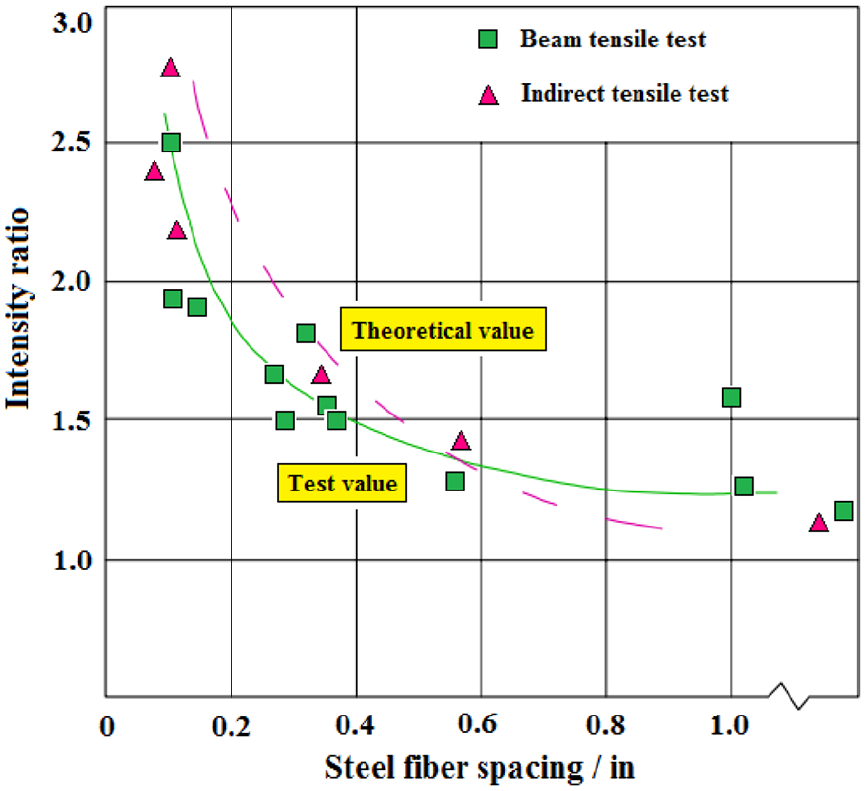
Romualdi conducted flexural and tensile tests on directional steel fiber specimens and suggested that the toughening ability of steel fiber reinforced concrete is regulated by the average spacing of fibers. Later, Romualdi and Mandel applied this concept to evenly distributed chaotic short fiber reinforced concrete and obtained experimental results that agreed with theoretical analysis, thus indicating the reliability of the fiber spacing theory. Romualdi also proposed that the tensile strength of steel fiber reinforced concrete is inversely proportional to the square root of the fiber spacing. The tests showed that the effective fiber spacing for improving the tensile strength of concrete cannot be greater than 0.5 inches (1.27 cm), and when the fiber spacing is less than 0.3 inches (0.76 cm), the tensile strength increases sharply, as depicted in Figure 8. However, Shah, Johnson, and others have disputed the fiber spacing theory.60–62 Their experimental results showed that the fiber spacing has little effect on the strength of the composite, and the relationship between the strength ratio and the fiber spacing is basically linear. Hannant also shares the same perspective. In fact, the controversy between these two viewpoints can be attributed to the differences in ideas and methods of analysis.68–71 Despite the controversy, the fiber spacing theory proposed by Romualdi is widely accepted by industry professionals and is constantly being improved and enriched through application and practice. For instance, Kazuyoshi’s research work further promoted the development of the fiber spacing theory by considering SFRC as a particle-type composite. 63 He proposed a formula for calculating the tensile strength of SFRC, which was complemented by corresponding experimental results. This further demonstrates the relationship between fiber spacing and tensile strength of composites, with the effect of intensity not being isolated.
The fiber spacing theory is an empirical theory used to reinforce steel fiber concrete. However, it has limitations as it overlooks the reinforcing effect of the fiber and the impact of fiber length on the reinforcement effect.72–74 As a result, it can only provide a qualitative explanation of the principle of fiber reinforcement.
Various fiber reinforcement theories and experimental data analyses indicate that the reinforcing effect of steel fiber depends on several factors, including matrix strength, the ratio of steel fiber length to diameter (l/d), the volume percentage of steel fiber in SFRC, adhesion strength between steel fiber and matrix, and the distribution and orientation of steel fiber in the matrix.75,76 In SFRC, the majority of fibers are pulled out rather than pulled off during fracture, highlighting the importance of improving adhesion strength between fibers and the matrix as a key factor for enhancing the fiber reinforcement effect.
Application of sprayed SFRC in the field of tunnel lining
Since the early 20th century, metal fiber reinforced concrete has been proposed for use in Europe. After several decades, composite materials consisting of steel fiber and concrete have been extensively researched and applied in tunnel construction across Europe. By the mid-20th century, developed countries like Sweden and Japan had conducted advanced research on the application of shotcrete in engineering, with the aim of enhancing its performance.60,61 The research found that the use of jet steel fiber concrete as a tunnel support structure can significantly expedite the construction schedule, improve tunnel excavation progress, and timely reinforce the surrounding rock surface with steel fiber concrete before the surrounding rock loosens.77–83 The application of steel fiber reinforced concrete (SFRC) in engineering can be divided into two aspects: ① In soft rock, particularly in tunnel engineering with substantial deformation of the surrounding rock, steel fiber shotcrete is utilized as an initial support to the weak deformation of the surrounding rock and to prevent its collapse; and ② Steel fiber shotcrete is employed as permanent support for the single-layer lining of tunnels in hard rock masses.
The New Austrian Tunneling Method and Norway Tunneling Method theories specify that tunnel support must be timely, close-fitting, flexible, and deformable. The properties of SFRC align with the support theory and have been extensively employed in several countries.84,85 Japan has used SFRC for the repair of poor underlying work, while the UK has opted to use SFRC in place of steel mesh for tunnel reinforcement. Furthermore, China has also started to promote its use in tunnels and mines.5,86 However, there is no definitive and consistent reference standard for the application of SFRC in tunnel design and theoretical analysis.
Johnson et al. 83 conducted a study on the application of SFRC in tunnel lining design. They performed a three-dimensional finite element numerical simulation on the axial direction of the Lee tunnel, as illustrated in Figure 9. The research paper analyzed the cracking resistance of SFRC applied to the Lee tunnel and confirmed its durability. In fact, the SFRC lining’s initial crack formation is very gradual, and when the width of the crack growth exceeds 0.5 mm, a strain softening phenomenon occurs. However, the strain softening is very slow and does not cause any loss in strength.

Three-dimensional FE model for Lee tunnel pump shaft. 83
What is particularly noteworthy about Johnson et al.’s research is that they replaced the reinforcement with high-performance SFRC, while also controlling the content of steel fiber within 30–45 kg/m3. The application of SFRC allowed for 1700 tons of steel bars to be saved in the Lee tunnel project, which effectively demonstrates the superiority and scalability of SFRC. In reality, the quantity of steel fiber plays a crucial role in the reinforcement of the tunnel’s overall structure. 83 As Carmona et al. stated in their article, 84 the distribution of SFRC in tunnel sections is often not uniform in practice. They highlighted that the steel fiber content at the end of the tunnel is usually higher than that at the middle of the tunnel.
Figure 10 illustrates that the experiment investigated the steel fiber content in precast tunnel sections by selecting drill cores of varying sizes at different locations. To ensure statistical robustness, at least 11 cores were selected, thus guaranteeing a high level of accuracy. The results indicated that a core diameter of 150 mm yielded a more convergent distribution of steel fiber content.83,84 Furthermore, the study suggested that the non-uniformity of steel fiber content in tunnel lining sections primarily relates to the transportation, pouring method, and compaction degree of SFRC. Notably, no explicit specifications exist in the literature for this aspect, and additional research is necessary to enhance the uniformity of SFRC in practical applications.

Sampling locations where cores were drilled in each of the three tunnel lining segments. 84
According to the relevant literature, steel fiber provides significant advantages such as strong tensile strength and toughness, resulting in concrete requiring 100 times more energy to break.5,85–87 During concrete structure construction, steel fiber effectively prevents crack occurrence and further development under stress, greatly enhancing the load-bearing capacity of concrete, thereby maintaining the overall stability and durability of the structure. Tiberti et al. conducted a study on the optimization of local stability and delamination resistance of tunnel lining by combining steel and steel fibers in concrete (20 kg/m3, class 2c, with cubic compressive strength fcm = 52.5 MPa). Under unfavorable load conditions, this combination demonstrated improved mechanical behavior, as shown in Figure 11. 87 The study found that steel fiber incorporation into concrete diffuses internal stresses, thereby reducing internal cracks in the structure. Additionally, the combination of steel and steel fibers reduces the amount of steel required, saving manufacturing and labor costs.
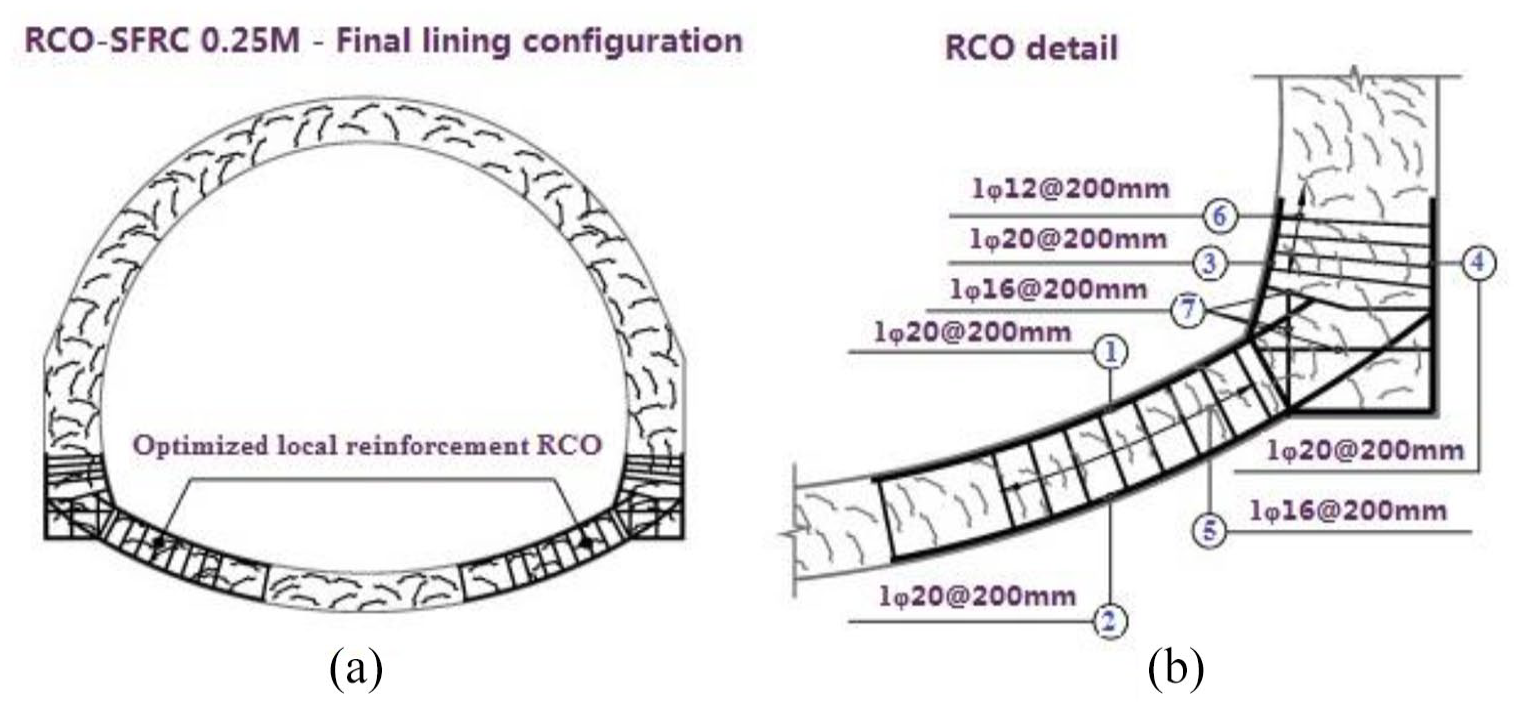
Optimized reinforcement proposed for the final tunnel lining based on rebars+steel fibers (a); detail of rebars placed in the critical region of the lining (b). 87
Numerous practical engineering cases have demonstrated the remarkable efficacy of employing steel fibers in the reinforcement of concrete tunnel linings. While steel fibers can partially replace steel bars, complete separation from steel bars during tunnel construction is not feasible. The combination of steel fibers and steel bars has been identified as the optimal reinforcement method.
Chiaia et al. conducted research that demonstrated the effectiveness of installing steel fibers to reduce crack expansion in reinforced concrete tunnel lining, even when steel bars are limited in quantity. The authors proposed the installation of a small amount of steel bars to ensure tunnel structure stability. Two-dimensional finite element simulation of the Italian Faver – S.S.612 tunnel lining structure was conducted using PHASE2 software, as shown in Figure 12(a). The use of steel fibers instead of steel bars resulted in the distribution of surrounding rock pressure on the tunnel lining section, especially the vault and arch foot, as depicted in Figure 12(b). The authors also proposed a model that provides As,min≈ 800 mm2 for both the curved and plane invert. The necessity of installing steel bars was highlighted in the study.5,85–87 The combination of steel fiber and steel bars effectively reinforced the tunnel lining without requiring additional materials. The study successfully applied SFRC to tunnel lining structures, as illustrated in Figure 12(c) to (e).5,85–87

The cross-section FS27 of the Faver – S.S. 612 tunnel lining in Italy 85 : (a) finite element model of the final stage, (b) principal stresses in the final lining, (c) geometrical properties of the lining, (d) steel bar arrangement in the cross-section, and (e) details of the arch frame reinforcement.
Similarly, Kooiman 88 also proposed that SFRC has good tensile stress bearing capacity. Adding the correct ratio of steel fiber to concrete can reduce both the ductile failure rate of cement-based and also the design area of ordinary steel bars. In fact, steel fiber can prevent or even limit the development of cracks in tunnel lining structures. Chiaia et al., 89 Pakravan et al., 90 Buratti et al. 91 define this phenomenon as a “bridge effect.” Many scholars92,93 believe that smaller sized fibers have the effect of agglomerating bond cracks, while larger sized fibers have hinder the development and extension of macroscopic cracks. With the development of hybrid fiber combination research on concrete reinforcement, some scholars have pointed out that mixed steel-steel fiber has better mechanical properties than other mixed fibers, mainly in the tensile strength and flexural strength of mixed steel-steel fiber. Kim et al. 94 used a combination of different macro-ST fibers and micro-ST fibers to study the bending properties of different hybrid steel fibers. As shown in Figure 13, the results show that the area below the hybrid fiber curve is proportional to the flexural capacity and energy absorption level of the fiber after the incorporation of the hybrid fiber. Moreover, the incorporation of a certain amount of hybrid fibers can improve the toughness and resistance to cracking of SFRC.

Effect of blending fiber (macro and micro ST) in HPFRC. 94
Numerous documents5,80–95 show that SFRC is widely used in the field of tunnel engineering, but it is worth noting that the treatment of weak parts of the tunnel structure should be an important part of structural safety considerations. Globally, there are few related experimental studies. The most valuable thing is that the Gong et al. 96 has studied the performance comparison of SFRC and reinforced concrete applied to the tunnel structure joints. The schematic diagram of the tunnel joints are shown in the Figure 14, which introduces the installation position of the tunnel structure joints, and the simplified model used in the actual experiment. The experiment studied the flexural performance and the ability to prevent cracks and cracks of SFRC and reinforced concrete through comprehensive tests. In order to distinguish the setting of SFRC and reinforced concrete at the tunnel segment joints, the experimental grouping research is shown in Table 2.

Schematic diagram of the tunnel joints and structure used in the experiment. 96
Experiment grouping situation. 96

The structural performance of steel fiber reinforced concrete (SFRC) at tunnel segment joints was investigated through three-dimensional hydraulic experiments by the Gong et al..95–99 The experimental setup included a data acquisition system, a load/displacement control system, a self-balancing frame, and a steel support structure. The ultimate bearing capacity and cracking characteristics of reinforced concrete (RC) and SFRC joints under different loading conditions were obtained. Results from the experiments are presented in Figures 15 and 16, which illustrate the load-deflection, joint extension width, and bending moment of RC and SFRC joints under positive and negative torque conditions.

Comparison of the load-deflection relationships of the RC and SFRC joints: (a) positive moment and (b) negative moment. 96

Comparison of the moment-joint opening relationships of the RC and SFRC joints 96 : (a) positive moment and (b) negative moment.
The experimental results presented in Figures 15 and 16 indicate that the peak load bearing capacity of SFRC joints was slightly higher than that of RC joints.95–112 Furthermore, under both positive and negative torque experimental conditions, SJ2 and SJ4 test groups exhibited smaller joint gap openings, demonstrating that the incorporation of steel fibers enhances the flexural performance of joint cracks.
In summary, compared to RC joints, SFRC joints demonstrate higher initial crack loads, adequate compression and flexural ductility, similar initial crack energy absorption capacity, and significantly reduced crack width. 113 The implications of this research are significant for the use of SFRC in critical structural components of tunnels. 114
Conclusions
Through a comprehensive review of relevant literature and engineering application cases, this paper provides a theoretical discussion of the reinforcement mechanism of SFRC and examines its potential advantages in tunnel construction, as well as the practical feasibility of strengthening critical structural components. Results from related experiments demonstrate the excellent impact resistance and high tensile strength of SFRC. Implementation of SFRC support structures during construction can greatly reduce damage rates, thus improving the waterproof performance of tunnel linings. Additionally, the inhibitory effect of steel fiber on concrete cracking results in reduced crack width and less damage to concrete caused by external substances (e.g. chloride ions in groundwater), thereby improving the durability of tunnel linings. In conclusion, this research highlights the potential benefits of SFRC in tunnel construction and underscores the importance of its continued exploration in this field. The main concluding remarks are summarized as follows:
(1) The addition of an appropriate amount of steel fibers to concrete can enhance its strength and toughness by inhibiting the formation and propagation of cracks. The presence of steel fibers restricts crack development, endowing concrete, which is inherently brittle, with high crack resistance and the ability to delay crack initiation. Consequently, concrete demonstrates better softening, crack resistance, and fatigue resistance. Steel fibers not only delay concrete cracking and failure, but also improve its deformability.
(2) The existing fundamental theory of steel fiber reinforced concrete (SFRC) is an extension and application of fiber-reinforced plastics and fiber-reinforced metals. The reinforcement mechanism of SFRC is primarily explained by two main theories: composite mechanics theory and fiber spacing theory. These theories explain the reinforcing effect of steel fibers on concrete from different perspectives, yet their conclusions are consistent. Other theories can be considered as developments based on these two theories. Despite the numerous studies on the reinforcement mechanism of SFRC, its complexity due to its multiphase, multicomponent, and heterogeneous nature makes it difficult to establish a comprehensive theory that considers the impact of different construction methods, steel fiber shapes, and coarse aggregates. Therefore, the reinforcement mechanism of SFRC is still under debate, development, and refinement.
(3) The properties of SFRC meet the requirements of the New Austrian Tunneling Method and have been widely used in many countries. SFRC can not only reinforce tunnel structures but also reduce the amount of steel used through the combination of steel and steel fiber, saving costs and labor expenses. It is worth noting that the amount and size of steel fibers can affect the reinforcement effect. Numerous factors affect the mechanical properties of SFRC, such as matrix strength, volume fraction, fiber shape, selection of external additives, and forming technology. The degree of influence of these factors varies, and their effects are intertwined. Therefore, it is challenging to establish a test that describes the mechanical properties of SFRC while accounting for all of the above factors, particularly in the context of tunnel and underground engineering. Due to the limitations of engineering conditions, testing equipment, and technology, research in this area is insufficient.
(4) Numerous experimental studies have demonstrated the exceptional flexural strength and crack arresting capability of steel fiber reinforced concrete (SFRC), rendering it suitable for use in certain experimental settings. Nevertheless, it is imperative to incorporate a small amount of steel into the tunnel lining section due to the uneven distribution of steel fibers in SFRC, leading to varying degrees of reinforcement in different sections of the lining. Unfortunately, there are no established standards to reference, thus necessitating a thorough investigation into the uniformity of the SFRC construction and pouring process.
(5) Furthermore, the incorporation of steel fibers into concrete has been proven by numerous experiments and documented sources to be effective in diffusing internal stress, consequently reducing the incidence of internal cracks in structures. Additionally, the combination of steel bars and fibers can reduce steel usage, making it a significant method for tunnel support with considerable promotional significance. When SFRC is applied in the tunnel field, the treatment of weak joints in tunnel structures should also be considered, an area that has been underexplored in the literature. Future research should focus on the seismic resistance of SFRC tunnel joints, with quasi-static cyclic tests utilized to examine hysteresis characteristics, skeleton behavior, energy dissipation, and stiffness degradation of nodes under varying seismic conditions.
Footnotes
Declaration of conflicting interests
The author(s) declared no potential conflicts of interest with respect to the research, authorship, and/or publication of this article.
Funding
The author(s) disclosed receipt of the following financial support for the research, authorship, and/or publication of this article: This research work was financially supported by Guangzhou Construction Group Co., LTD. Science and technology plan projects (2022-KJ019, 2022-KJ026). Their financial supports are gratefully acknowledged.
