



Abstract
This study focuses on the development and characterization of pigeon pea stalk/cotton fibers mixed with a blend ratio of 50/50, 70/30, 30/70, 60/40, 100/0 waste cotton and 0/100 waste pea stalk composites are equipped with a compression molding system. The entire composite samples are tested for acoustics, thermal and physical parameters as per the American Society for Testing and Materials standard (ASTM). The sound absorption coefficients (SAC) were measured according to ASTME1050 by an impedance tube method, and the SAC over six frequencies 125, 250, 500, 1000, 2000, and 4000 Hz were calculated. The result revealed that the composite samples that are prepared from cotton/pigeon pea waste have confirmed more than 80% of the SAC and the waste composites provided the best insulation, sound absorption, moisture absorption, and fiber properties. The effect exposed that composites materials arranged from cotton/pea stalk waste fiber have established further than 75% by the sound immersion measure and the waste 28% composites handed the fashionable Appropriation, sound immersion, humidity immersion, and fiber materials. The waste cotton/pigeon pea stalk composite samples have satisfactory moisture resistance at high humidity situations without disturbing the insulation properties.
Keywords
Introduction
The search for more environmentally-friendly porous sound absorbers than mineral and synthetic materials continues. From Life Cycle Assessment (LCA), natural materials have been shown to produce much less CO2 equivalent compared to commercial absorbing materials such as glass wools and minerals 1 the characteristics of natural fiber composites are durable, low-cost, low weight, high specific strength, non-Abrasive, equitably good mechanical properties, eco-friendly and biodegradable. 2 waste cotton natural fibers have proved to be an excellent reinforcement in polymers. The automotive and aerospace sectors represent the best opportunity for natural fibers due to their favorable characteristics such as lower weight, better crash absorbance, and sound insulation properties. The applications of natural fibers are often limited to interior structures due to their hydrophilic nature. These properties, however, can be improved through the use of chemical treatments. Natural fibers absorb moisture when they are exposed to different temperatures and humidity conditions; understanding the hygroscopic behavior of natural fibers is a key issue to use them in different environmental conditions. 3
The natural fibers from stalk fibers, numerous researches on natural fibers for acoustic materials have been published. Coir fibers, for example, are capable of absorbing sound with average absorption coefficients of 0.8 for frequencies greater than 1 kHz with 20 mm thickness. 4 Materials from renewable resources Natural fibers cotton/ pigeon peas are increasingly being used in the polymer industry in the development of biocomposites for a wide range of applications, including textiles and other sectors. This interest is mainly because of its renewability, low cost, and low abrasiveness of natural materials in the polymer industry. 5 Moreover, there is an increasing demand for high-performance applications and increased environmental issues on conventional materials that lead manufacturers to adopt the technology and meet consumer demands. Natural fiber-based composite materials play a major role in polymer composite sectors for transformation into greener-based materials. 6 Porous sound absorption material is most widely used as sound absorption functional material, which is made of fiber, wool fiber, pea stalk fiber, or polyester fiber and adhesive as board or soundproof felt. Some many macropores and micropores are interconnected and opened to the surface inside the material. It can be seen as a complicated channel system with many solid frames and capillaries.7,8 The pigeon pea (Cajanus Cajan) is a perennial legume that belongs to the family Fabaceae and is the sixth most important legume crop in the world. India is one of the major pigeon pea-producing countries in the world (90% of world production) where this plant is more popularly known. 9 The stalks are the waste after harvesting the food grains, and hence its value addition is vital for sustainability. The pigeon pea stalk (PS) has been studied in the preparation of cement-bonded composite boards. 10 The abundant availability of these stalks has led the authors to explore the prospective use of this fiber as a source of reinforcement in the polymer area. To the best of our knowledge, this agricultural waste usage in the preparation of the polymer composites has not been reported among the basket of natural fibers available. The novelty and research gap of this pigeon pea stalk (PS) is an agricultural by-product. In this article, have been studying its potential as natural fibers to be utilized in waste cotton composite preparation. The physical, thermal, Acoustic, and morphological properties of the Cotton/PP composites with and without compatibilizer have been investigated. The morphological study showed a better dispersion of stalk fibers in the matrix with the addition of a compatibilizer. An increase in the physical, Acoustics properties and thermal stability of the composites were observed with the addition of PS fiber to cotton waste for thermal and acoustic absorption in aerospace, sporting, and automotive interior applications.
Materials and methods
Materials
The raw materials used for this research were agricultural wastes from cotton/pigeon pea materials. The carding section cotton waste is collected in Tirupur spinning mills and pea stalk agricultural waste materials were gathered from Aruppukottai Tamilnadu, India for the preparation of composite materials. The first opening and cleaning of the agrarian waste were also arranged to reuse in the waste opening machine where the wastes are fed up in the opener machine to get fibers. The waste fibers are after that changed into a web structure with different layers by using a mechanical carding process in a carding machine. To form a web, and the binder used for this composite is epoxy resin with hardeners with a molecular mass of 97.08 g/mol and dissolve 15 g of hardeners with 90 ml of water to make the solution of 10 wt% hardeners. Waste composite materials could fulfill the demands of sustainability. They are preferred for the construction of many built environments, assisting in producing high energy-efficient, lightweight, and durable products without affecting their performance.11,12 (Figure 1).

(a and b) Cotton/Pigeon pea fibers.
Development of composite materials
A waste fiber preform or materials is placed in a heated mold with epoxy resin mixed and injected into the mold under pressure. A typical compression molding process is performed at a mold temperature of 350°F and mold pressure of 100 psi (180°C and 700 kPa) with a curing time of 3 min. After the material is cured, the mold is opened and the sample package is pushed out (Figure 2). The shaped compound cotton/ pea stalk samples similar to as100 % cotton, and 100% waste pea stalk fibers, and within different blended rates 50/50,70/30,60/40, and 30/70 on the standard weight of waste fibers using electronic balance were used. These chosen samples with proportions of 4–8 mm wide, and 180 mm long are developed to identify the sound insulation as per the ASTM Standard. The Experimental Testing was also been conducted on the physical properties of the developed composite samples.13,14

(a and b). Cotton/Pigeon pea composite materials.
Experimental testing methods
Measurement of sound absorption coefficient
The impedance tube method is mainly applied to measure the sound absorption coefficient (SAC) of composite materials. It can effectively evaluate the sound absorption performance of materials, so the impedance tube method has been widely used in the study of noise absorption evaluation. The typical circumstance of SAC (Sound Absorption Coefficient) was calculated in assurance with the (ASTM1050-10) standard test system can be gently handed to the Automotive Analyzing and Examining Center (ARTC, Taiwan). The techniques of the impedance tube were set up shown in Figure 3. When the sound flow is a circumstance on the material, it could be fascinated, reflected, and passed out by the item of marvels that are implicated upon types of the samples. The relevance range that can be owned for the development of the formation is from 50 to 4000 Hz. Occurrence order was divided into three separate ranges with low(50–1000 Hz), medium(1000–2000 Hz), and high(2000–4000 Hz) ranges. These analyses were taken from each sample for assessing the sound-absorbing materials. 15

Impedance Tube setup methods.
Measurement of thickness
The thickness tester is a specialized equipment to determine the thickness of composite materials. The mean value of all the readings of thickness was determined to the nearest 0.01 m calculated and the result is the average thickness of the sample under test. The fabric thickness was determined by ASTM D5729 standard method. 16
Measurement of density
ASTM D4052 materials mass density or materials bulk density (g/m3) depends on both materials weight and fabric thickness. The specimen with 50 cm2 has cut out randomly and weighed. The average of 20 observations taken for the sample density of the composites was calculated using the given formula: Density (g/m3) = Areal Density (g/m2)/Thickness (m) intended using the given formula. Density (g/m) = Area Density (g/m)/Thickness (m).17,18
Measurement of specific porosity
The porosity of previous data was defined by the rate of volume of voids with material to its volume stated. The equation is given, VA = Volume of air voids, Vm = Total sample volume of tested insulation material. Determine the porosity of six composite samples based on the ASTM standard of D 3776.12,19
Measurement of airflow resistance
Airflow resistivity, r (Pa.s/m2) is the specific airflow resistance per unit thickness and is only appropriate as a specification parameter for homogeneous materials. Where d (m) is the thickness of the layer of porous material in the direction of airflow, the air resistance of the given composites was tested by the standard of ASTM Test Method D 737. 20
Measurement of thermal conductivity
The thermal conduction of trials was deliberating the use of Lee’s fragment system Principle, the instance (mixes similar to cotton, pea stalk, and cotton/pea stalk fiber mix with 5 cm in 5 edges was placed between the discs (A) and (B). The temperature is handed between the discs. The roguishness of (A) and (B) discs was calculated using two thermocouples. The present rate of force energy was noticed. The complete high temperature (Q) can be gained in reservations of force energy (IV) since the whole heat supplied must be original to that given up by the variety of materials. The preliminary outcomes are fulfilled with the standards of ASTM D6343.20,21
Measurement of Scanning Electron Microscopy (SEM)
The morphological discussion was performed as per the standard of ASTM D 256 which also uses the following standards as JEOL 3 SEM outfit, cryogenically on the fractured surface of composite samples. The advanced waste fiber mixes the crushed surface after testing the tensile which has been tested using the scanning electron of a simple microscope (SEM) JEOLJSM – 6480LV (Figure 4). As shown in SEM Picture (a) and (b), the micrographs of SEM were introduced to the fractured surface of waste fiber mixes’ tensile test. 22
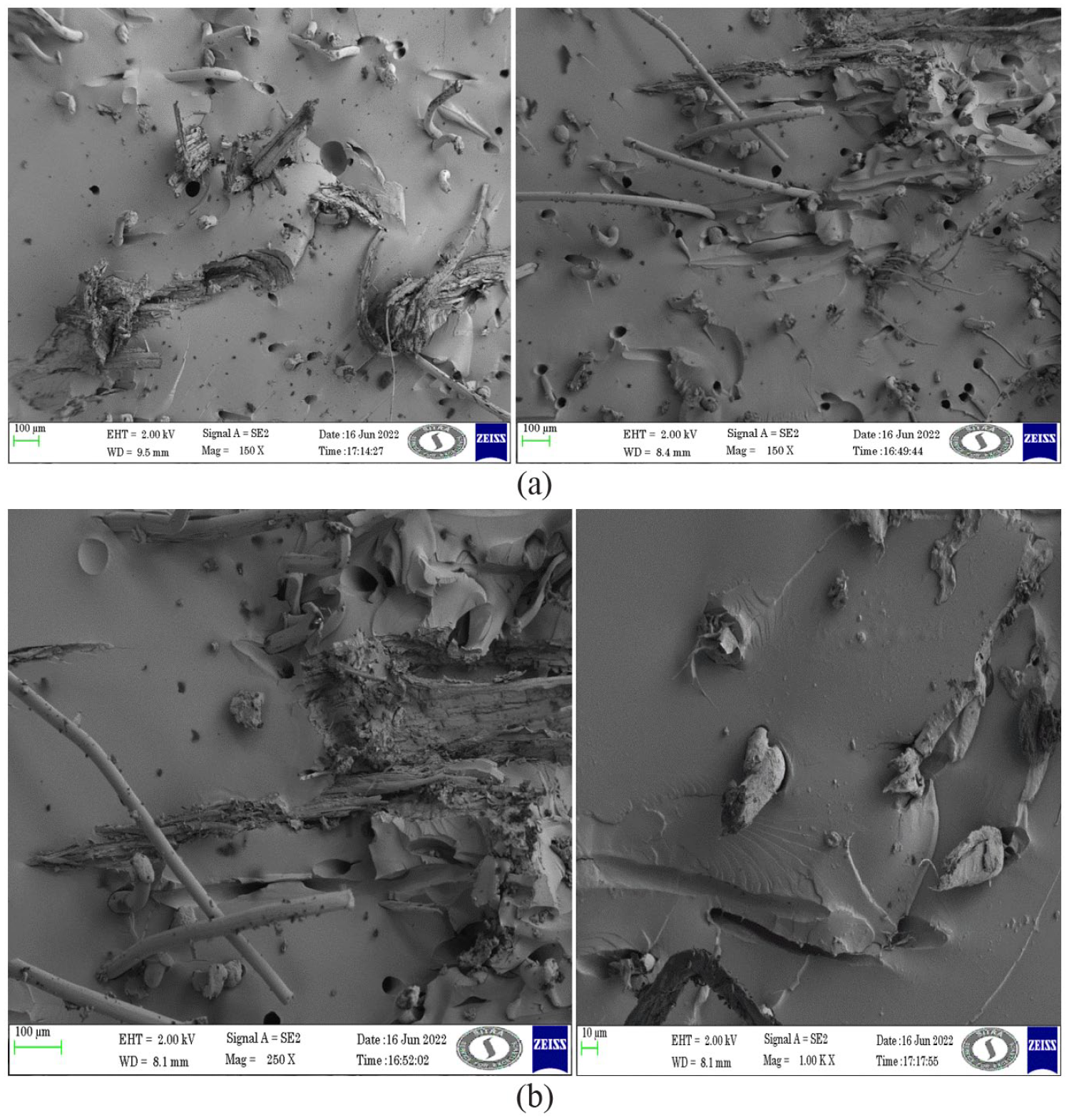
(a) SEM images/Cotton fibers composites and (b) SEM/Pigeon pea fibers composites.
Results and discussions
The physical properties of the waste recycled 100% cotton and pigeon pea stalk blend fibers are measured and average values of samples are given. In Table 1 the samples of cotton (S1C 100%), pigeon pea stalk (S2P 100%), cotton/pea stalk (S3C/P 50/50), cotton/pea stalk (S4C/P 70/30), cotton/pea stalk (S5C/P 60/40) and cotton/pea stalk (S6C/P30/70) are tested in the manner with ASTM standard.
Properties of composite materials.

Sound absorbing properties of developed composite materials
Sound absorption composite materials are widely used in many noise control applications. The acoustic behavior of these materials can be measured using the impedance tube with small size samples but in practice, materials used in noise control applications are not small and incident waves on them are not planar waves. In practice, materials of different sizes and shapes are used in noise control applications and the acoustic field is diffuse. All developed waste composite samples showed enhanced sound absorption samples in overall SAC (50–5000 Hz). The acoustic absorption values (SAC) of given tests with colorful varieties are shown in Figure 5. Waste cotton/pea stalk-blended samples can be existential in that while frequency increases the sound with the absorption (Sound Absorption Coefficient) of every sample S1C, S2P, S3C/P, S4C/P, S5C/P, and S6C/P also increases the sound with absorption measure which consistently increases the sound absorbing performance. The outside frequencies are 4000 Hz, and the samples of SAC values were S1C, S2P, S3C/P, S4C/P, S5C/P, and S6C/P which also increases the values of 0.15%, 0.31%, 0.18%, 0.33%, 0.232%, and 0.361%. The moderate values of designs were followed by S1C, S2P, S3C/P, S4C/P, S5C/P, and S6C which are 0.156%, 0.312%, 0.331%, 0.232%, and 0.36% also reveals the same. It is related to the frequency and incidence direction of the sound, therefore sound absorption coefficient refers to the mean absorption value to the sound of certain frequency from all directions. To the same porous material, its mass density increases, the absorption efficiency to low-frequency sound becomes better and the absorption efficiency to high-frequency sound decreases. With the outstanding performance of the high-frequency sounds well, particularly above 4000 Hz, A corresponding result was attained by Hongisto et al. 23 and Sakthivel et al. 24
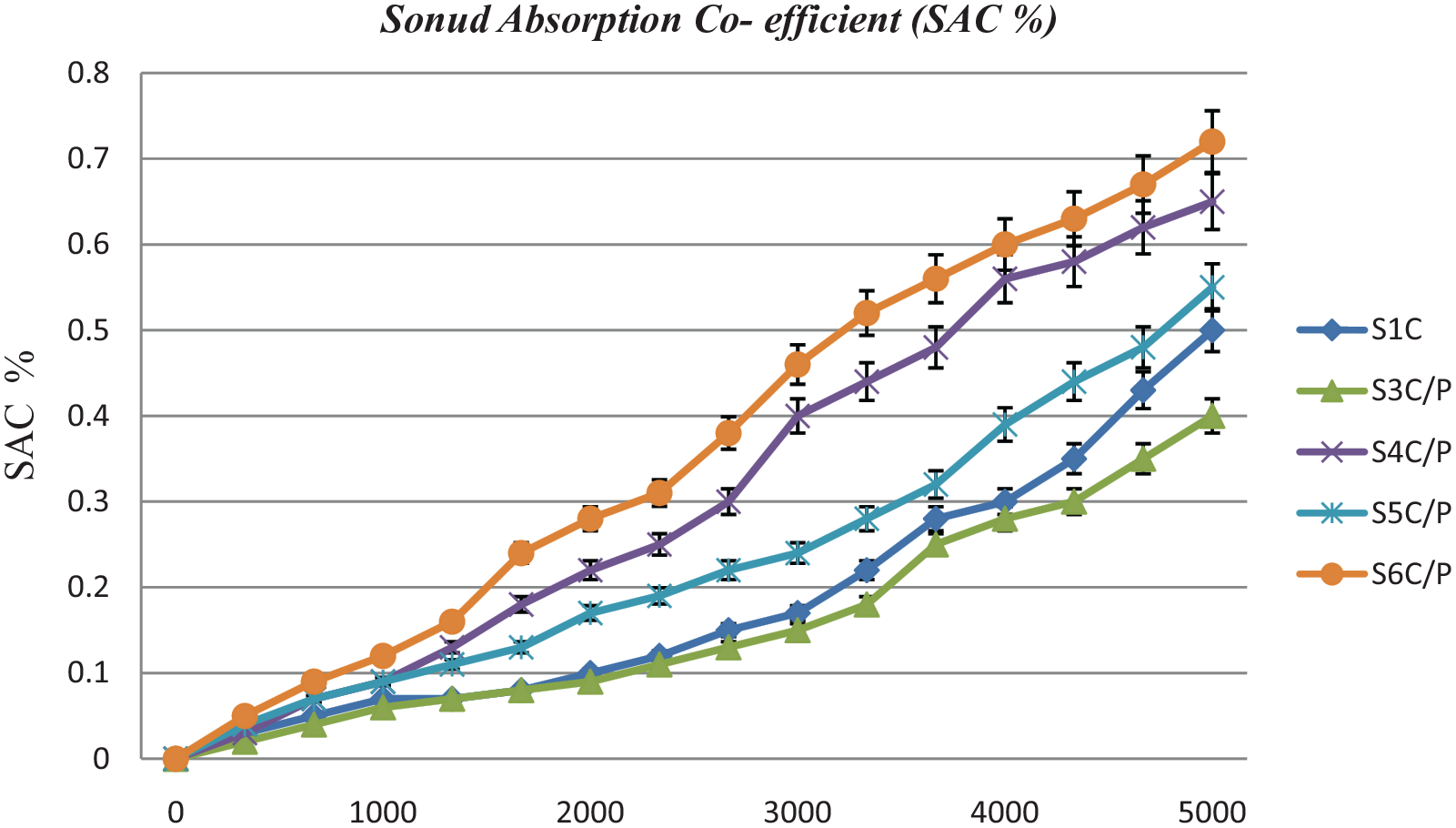
Sound absorption performances of S1C, S2P, S3C/P, S4C/P, and S5C/P & S6C/P.
Impact of thickness on sound absorption
Increasing the thickness can enhance the absorption of low-frequency sound, but it makes little difference to high-frequency sound. Material’s pore features. More pores in smaller sizes increase the sound absorption effect. In contrast, the material with bigger pores has a weak sound absorption effect. Figure 6 showed cotton/pea stalk fiber which mixes 50/50 merged Cotton/Pea stalk with a consistency thickness of 13.05 mm resulting in superior for S1C, S2P, S3C/P, S4C/P, S5C/P, and S6C/P composite samples. The consistency of the waste composite is 12.03, 12.85, 12.78, 13.04, and 13.02 mm lower than 3.5 mm little sound absorption is achieved, if the 27% evenness is further than 13.05 mm topmost sound absorption is achieved. Materials that have higher densities tend to reflect more sound than they absorb (such as concrete or solid plywood). Materials with lower densities tend to absorb more sound (such as melamine foam or cork). Also, thicker materials tend to absorb a wider range of sound frequencies than thinner materials. The identical finding was experimental by Archana. 25

Influence of thickness on sound absorption.
Impact of density on sound absorption
Sound absorption efficiency is related to the following factors: material’s mass density. To the same porous material, its mass density increases, the absorption efficiency to low-frequency sound becomes better and the absorption efficiency to high-frequency sound decreases. Figure 7 indicates the thickness which enlarges the absorption of sound which measures the sample increasing the sample. The study by Kathiresan et al. 26 exposed the enlargement of sound immersion helps in the center and the spread in frequency as the thickness of samples was increased. A lower quantum of thickness and the structure absorbs the sound less frequently (500) Hz. A thick structure performs better for frequencies above 4000 Hz. This reveals enlarges the thickness directly ascends the SAC. Cotton composites that have diversity in the density of 0.1539 g/cm3 with the C/P combined (50/50) mixed epics 24% increase in SAC. Cotton and pea Stalk (70/30) mixes have a variation in thickness of 0.1497 g/cm3 of with the Depicts also increasing in the mean of SAC. Cotton/pea stalk (60/40) mixes have the isolation of density 0.1244 g/cm3, 0.1323 g/cm3, 0.1366 g/cm3, 0.1212 g/cm3 and increases in the mean of SAC for 0.361%. The quantum of fiber was increased per unit thickness heavy. An equal finding was attained by Mamtaz et al. 27

Influence of density on sound absorption.
Impact of porosity on sound absorption
The porosity in this area is in the rising range of the porosity-sound absorption curve. In that range, the sound absorption performance increase with the increase of porosity. After the peak point, with the increase of porosity, the sound absorption performance shows a downward trend. Figure 8 indicates the pressure of porosity in the sound absorption of waste cotton/pea stalk-composite in the lead the cotton and pea stalk samples values are S1C 0.769%, S2P 0.919%, S3C/P 0.924%, S4C/P 0.891%, S5C/P 0.884%, and S6C/P 0.894%, and the results were exposed when comparing with porosity and micros pores. A lower quantum of absorption of lower air Permeability of the samples allowed the sound by frequency a lower quantum at a low-frequency position but at a progressive frequency. The experience of the sound enters of the fine pore was the difference between the fibers and cohesion, therefore performing with superior absorption with sound energy. A similar finding was attained by Nandanwar and Kiran 28 and Abedom et al. 5

Influence of porosity on sound absorption.
Impact of airflow resistance on sound absorption
The higher the airflow resistivity, the less air permeability there is. Sound waves cannot enter materials, so the sound absorption is reduced. However, with reduced airflow resistivity, the transformation efficiency from sound energy to thermal energy lessens. Figure 9 shows the relationship between specific airflow resistance and sound absorption coefficient. It can be inferred that higher airflows give better sound absorption values. The sound absorption property was influenced by a high increase in airflow. With a high increase in airflow resistance and an increase in the density of the fabric, the sound absorption property is also highly affected. The airflow resistances of the composites are 34.8–39. Cm3/S/cm2 with SAC of 0.15% to 0.31%, it is clear that where the fabric density increased, the airflow resistance decreased due to increased resistance to airflow caused by the consolidation of the samples, but also increases the short fiber content which has occupied the air voids. The waste cotton/ pigeon pea samples have the highest airflow resistance value with a SAC of 0.361 which is greater than that of S1C, S2P, S3C/P, S4C/P, S5C/P, and S6C/P the same result was obtained by Alyousef 29 and Chagas Rodrigues et al. 30

Influence of airflow resistance on sound absorption.
Impact of thermal conductivity on sound absorption
The thermal conduciveness of composite materials is shown in Figure 10 the conduciveness of thermal energy is better than the property of the composite. Fewer values of conduction of thermal energy indicate induction in advanced resistance to heat conduction with the sample. This enlarges the temperature and the conduciveness of thermal energy increases all the samples. Two-sub caste waste cotton fibers also with 50% waste pea stalk handed the stylish composite samples. These results show the possible produced items that were shown analogous to the conduciveness of thermal energy. The thermal conductivity for the waste pea stalk fiber composite material is about which has a sample value of 0.147 W/mK which is greater than that of values S1C, S3C/P, S4C/P, S5C/P, and S6C/P these items were acceptable for Ceiling application the similar finding was obtained by Rodríguez et al. 31 and Sakthivel et al. 11
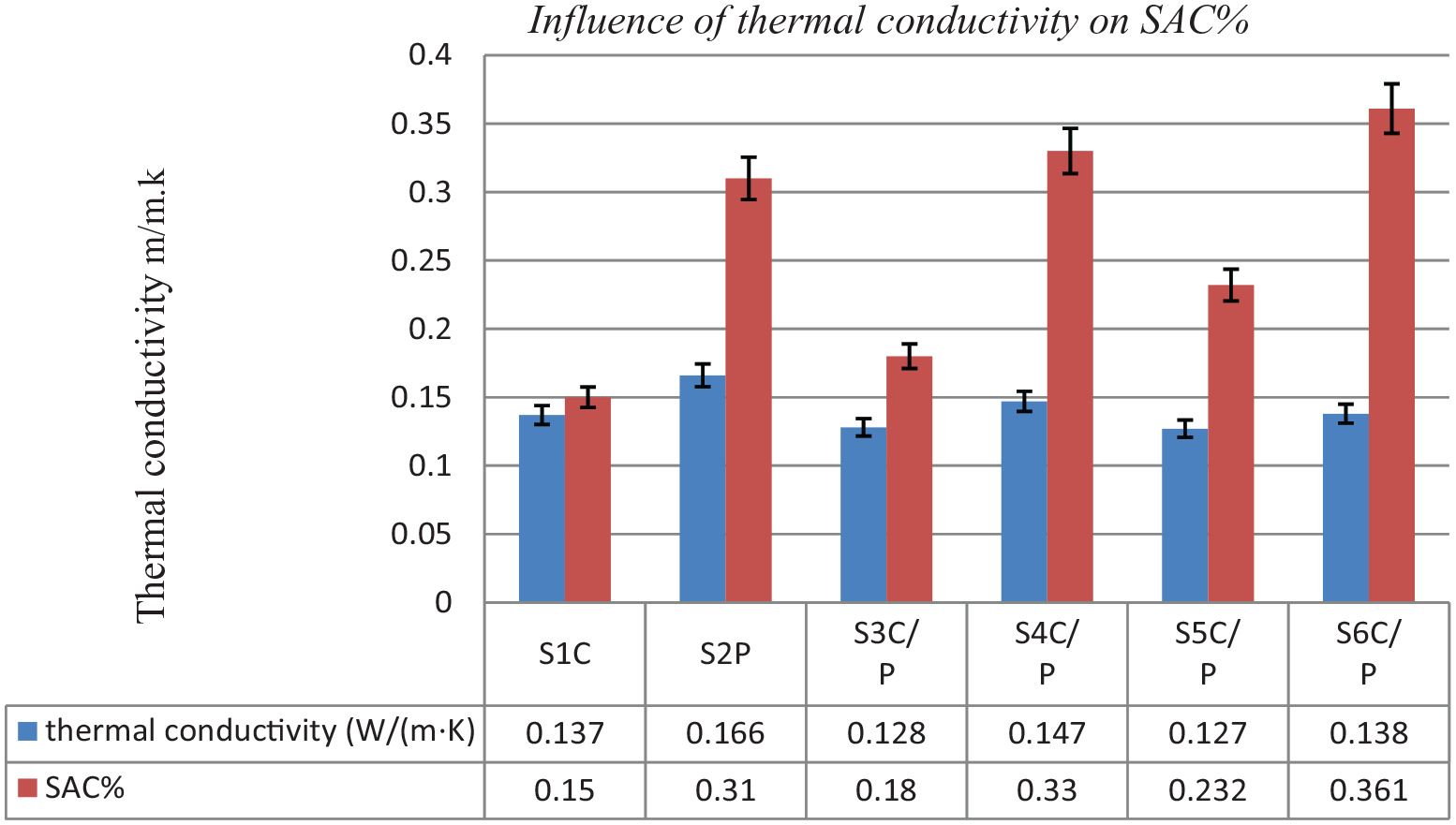
Influence of thermal conductivity on sound absorption.
Scanning Electron Microscopy Analysis
The rupture face study of waste composite samples after the tensile test is shown in numbers SEM Figure 4(a) and (b) The fibers are detached from the resin face due to top inter facilitating. Pulled-out fibers are noticeable for blends with 6%wt. the fiber content and 4 mm in length. Still, the composite with 20% wt, fiber, and 14 mm length shows the best quality matrix/fiber adhesion. Similar results were attained by Moges et al. 32 and Abedom et al. 5
Conclusion
The six diverse waste fiber cotton/pea stalk fiber composite materials (S1C, S2P, S3C/P, S4C/P, S5C/P, and S6 C/P) were fashioned and tested for acoustics and thermal absorption. Waste cotton/ pea stalk composite samples (S1C and S2P) showed stylish sound absorption and insulation. S3C/P, S4C/P, and composite samples were absorbed further than 75% of the incident noise (50–5000 Hz). There were no changes in the absorption and properties of the waste fiber composite samples when estimated under high moisture conditions. SEM numbers show some of the scales present in the waste cotton/pea stalk fibers fiber of S1C and S2P and S6 C/P composite samples are degraded, therefore anticipated no changes in the morphology of waste pea stalk fiber mixes were noticed. These indispensable composite materials would contribute to cost-benefit as well as green structure enterprise along with the development of materials from natural waste resources. Compared to other natural fiber-based composites, cotton/Pigeon pea stalk-reinforced epoxy composites and physical, acoustic, and thermal properties have demonstrated comparable advantages. Thus, this new class of composites could be employed as a viable alternative to some natural fiber-reinforced composites and could be used in lightweight structural applications such as automobile interior parts, furniture construction, indoor civil constructions, and packaging containers.
Footnotes
Declaration of conflicting interests
The author(s) declared no potential conflicts of interest with respect to the research, authorship, and/or publication of this article.
Funding
The author(s) received no financial support for the research, authorship, and/or publication of this article.
