



Abstract
This study aims at the proposition of a novel strategy to classify the upper body silhouette of the male population into different shapes. Instead of using an existing measuring scheme based on linear evaluation of the body, we devise the use of angle-based anthropometric data to capture the exhibited curvature of the upper body. The objectives are attained by quantifying and employing the chest-waist (CW) angle and hip-waist (HW) angle in the instigation of a more appropriate classification of the upper body. A sample of 241 males aged 17–29 years was scanned through a 3D body scanner to gather the anthropometric data including chest girth, waist girth, and hip girth and their respective heights. In the next phase, the extracted information was used to calculate the angles. Based on the empirical realizations of the resulting indices, criteria defining the classifications of the body shape were determined. The operational environment is further enriched by considering varying levels of angular differences capable of offering more notable stratification of the upper male body shapes. It is realized that the angular difference of 10° between the CW and HW angles results in the more prominent classification of the upper male body. The proposed body classification technique classifies the sample of 241 males into three body shapes that are, straight (61%), hourglass (36.51%), and torch shape (2.48%). The classification scheme proposed in this study is a step toward achieving a high degree of customer satisfaction regarding clothing fit. It is a reference for coming research in body shape classification to achieve clothing fit in customized clothing.
Introduction
Many researchers have lamented the in-efficacy of current ready-to-wear systems in fulfilling the clothing fit requirements of the consumers. 1 The roots of this in-efficiency of the existing and dominant systems are usually tracked into the dependency of ready-to-wear synergy on average body sizes and standard graded sizes. 2 The current sizing systems that are ISO and ASTM are based on the difference between hip and bust whereas the Chinese sizing systems are based on the difference between waist and bust. 3 However, in recent times the utility of taking into account the dimensional variations of the human body in defining the buying behaviors of customers is competently advocated.4,5 It will be of no surprise in the future if morphologic presence based on the classification of body shapes emerges as a fundamental component in acquiring a higher degree of clothing fit. A vigilant tour into the literature reveals that in 1940, 6 first introduced somatotypes, and classified the human body into three categories. A notable effort 7 observed that the same size garments were not suitable for the same somatotypes – the source of variation has nominated the difference in body shapes. The unprecedented technological advancements of the current era have resulted in the emergence of three-dimensional body scanners offering a clear and more elaborative understanding of the anthropometric features of human appearance. Over time, numerous parameters such as age, gender, ecological orientation, and ratios of prominent body features are being incorporated to enrich the analytic environment of the scan data.8–15 For example, 16 suggested three shapes of the lower body that is, straight, curvy, and tilt hip for US women while considering dimensions including waist girth, high hip girth, thigh girth, and hip girth. 15 Whereas, 17 argued the inclusion of hip angle and hip vector cross ratio when the focus remains on the classification of lower bodies. Further,18–22 instigated an improved sizing system while taking delicacies such as height, angle, shoulder, fitness, projection, and length of torso curve, weight, waist girth into consideration. Yet another study targeting children under 12 years concluded that there is little evidence in the support of certain body shape exhibitions based on in-obvious drop values. 23 Another focused research front in this regard stays the persuasion of different modeling schemes capable of encapsulating the interlinkages prevalent in the degree of appropriateness of sizing schemes and anthropometric measurements. For example, 24 devised a classification method for lower body shapes based on a fuzzy approach where correlation structure was explored by the launch of factor analysis. Similarly, 25 proposed a polyhedron model to classify the female body shapes while considering defect angles as a fundament of classification instead of body sizes. Fewer studies are found to focus on clothing fit based on body shape classification and anthropometric measurements. For example, 26 classified the male body shapes, based on data assembled from the USA, into four types that is, heavy shape, slim shape, slant inverted triangle shape, and short round top shape. Whereas 11 focused on the classification of the lower male torso using data collected on males of Chinese and Russian origin.
Based on the studies, it remains plausible to highlight two concerns; (i) – the notion of complex classification metric is not consistent with the conception of parsimony and (ii) – the clothing fit based on existing sizing systems is not suitable to capture the curvature of the upper male body silhouette. This collaborative effort contributes to the existing literature while continuing the exploration of the aforementioned research pathways.
The objectives are achieved by following the steps mentioned in Figure 1. Initially, the assembly of anthropometric data is gathered from a sample of South Asian (Pakistan) young males aged, 17–29 years attained through the launch of a three-dimensional body scanner. The extracted data are then used to instigate the classification of young males’ body shapes by the consideration of a novel scheme exploiting the symmetry of the human body. We instigate the idea of employing angular differences to encapsulate the prevailed curvature of the upper male body. Based on the classifications three-dimensional avatars are realized and relevant summary statistics are provided. This article is further divided into four sections. Section 2 is devoted to elaborating on the methodological advancements of the suggested approach. The main findings are discussed in section 3, whereas section 4 summarizes the outcomes of the research along with some plausible future venues.
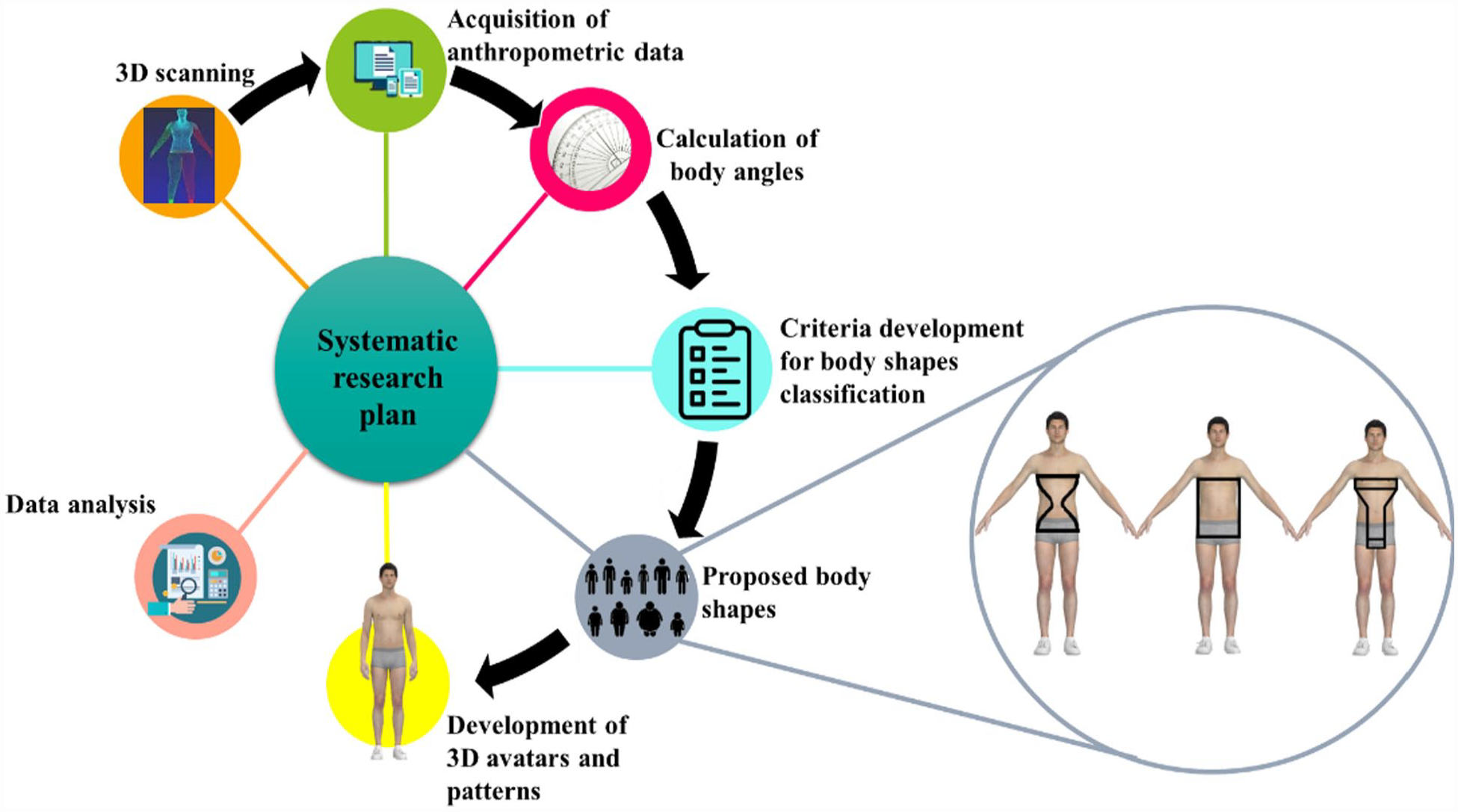
Flow diagram synchronizing the main phases of the research.
Methodology
The data
The data for this study are collected from a sample of 241 young males, aged 17–29 years from Pakistan. The proposed research is performed after approved from the “Research Ethics Committee” of National Textile University, Pakistan. The distribution of age and body mass index is reported in Figure 2.

Display of the age distribution and the distribution of body mass index of the sample: (a) Age distribution. (b)BMI distribution.
The selected sample from the male population was then scanned through a three-dimensional body scanner (TC2–19B 3D) and six anthropometric measurements were extracted including chest girth (cm), waist girth (cm), hip girth (cm), chest height (cm), waist height (cm), and hip height (cm) by following ASTM- D 5219.27,28 Table 1 reports the summary statistics of the assembled data regarding the anthropometric measurements. One may notice the closeness of the measures of central tendency of the extracted measurements indicating the symmetry of the data. Also, the controlled extent of dispersion highlights the plausible nature of the collected data for future analysis. Motivated by these realizations, the extracted variables were used to calculate four measures that are, differences between chest girth and waist girth, waist girth, and hip girth, chest height and waist height, waist height and hip height, playing a fundamental role in the accomplishment of research goals. The summary statistics of these differences are documented in Table 2. Yet again the summary of calculated differences along with the lower extent of the dispersion exhibited in the data is encouraging for the launch of the next phase of the model proposed.
Summary statistics of research variables for the young male population (n = 241).

Summary statistics of the calculated differences.

Proposed model
The body shape classifications proposed in the existing literature are based on various anthropometric measures.29–32 However, unfortunately, the working principle of existent schemes suffers on one fundamental front which is the consideration of linear measures to enumerate the body shape. This research fundaments the idea that the curvature exhibited in the upper human body is, in fact, the consequence of deviations from straightness. Therefore, to pursue the degree of curvature, this research novely proposes the use of angular measures capable of capturing the extent of deviation from straightness more competently. The conceptual depiction of the devised strategy, encapsulating the different possible formations of body shapes because of prevailed curvature, is presented in the schematic diagram of Figure 3.

Schematic diagram of the working principle of the proposed scheme.
The suggested model is bloomed over two upper body angles that are, chest-waist angle (CW) and hip-waist angle (HW). Moreover, because of the rarity of hemi-hyperplasia disorder (one person out of 86,000 people), it is reasonable to assume the symmetry of the silhouette exhibited on the left side and right side of the upper body. 33 As demonstrated in Figure 4, the deviation from straightness and resulting curvature in the upper half of the body is captured by using the chest-waist angle, whereas lower half curvature is evaluated through the consideration of the hip-waist angle. One may notice that the straight body will generate both angles with an associated magnitude of 90°.

Schematic diagram of body angle acquisition.
Relying on the aforementioned advocacy, the calculated angles are used as the foundational block of the classification index to identify the body shape. The required angles are quantified by the launch of the expressions given in equations (1) and (2) such as.


Table 3 offers summaries of the calculated angles for the selected sample.
Summary statistics of body angles.

Results and discussion
In this section, we proceed with our investigation under the object-oriented hypothesis covering two prime fronts of the upper body measurements to improve the body image and thus assist the clothing fit. We advocate that.
Hypothesis 1: The use of the newly propose angular measure capably handles the exhibited male upper body silhouette.
Hypothesis 2: The proposed measure profoundly serves as a legitimate index to classify the male upper body shapes.
The aforementioned hypotheses are tested by launching initial boundary conditions of straightness in the upper body silhouette such as.

Moreover, the curvature in the upper body outline is assessed by the quantification of the extent of deviation from straightness. The degree of curvature is enumerated through the employment of second boundary conditions such as.

The above-documented boundary conditions are now applied to the data set focusing on the upper body measurements of 241 males. The investigative environment is enriched by considering various values of angles highlighting the degree of deviations from the straightness propagated through the boundary condition given in expression (3). The degree of deviations from straightness is captured by considering four values of the absolute difference between the CW angle and HW angle. The calculations are facilitated by using the below-given criterion providing the empirical rule to establish the observability of curvature such as.

Here,

Body shapes for 5° angle difference criteria; (a) CW = HW, (b) CW > HW, and (c) CW < HW.
Next, we proceed with a 10° angular difference. The realizations of body shapes were more elaborative concerning the considered angular difference. Almost, 61% of males represent straight body shapes. However, deviation from straightness was seen in two forms. One group based on the first condition represents a purely curvy body shape which is named an hourglass. About 36.51% of young males represent the hourglass body shape. While the third group represents the combination of straightness and curviness named torch shape covering 2.48% of the population. The resultant avatars of body shapes are depicted in Figure 6.
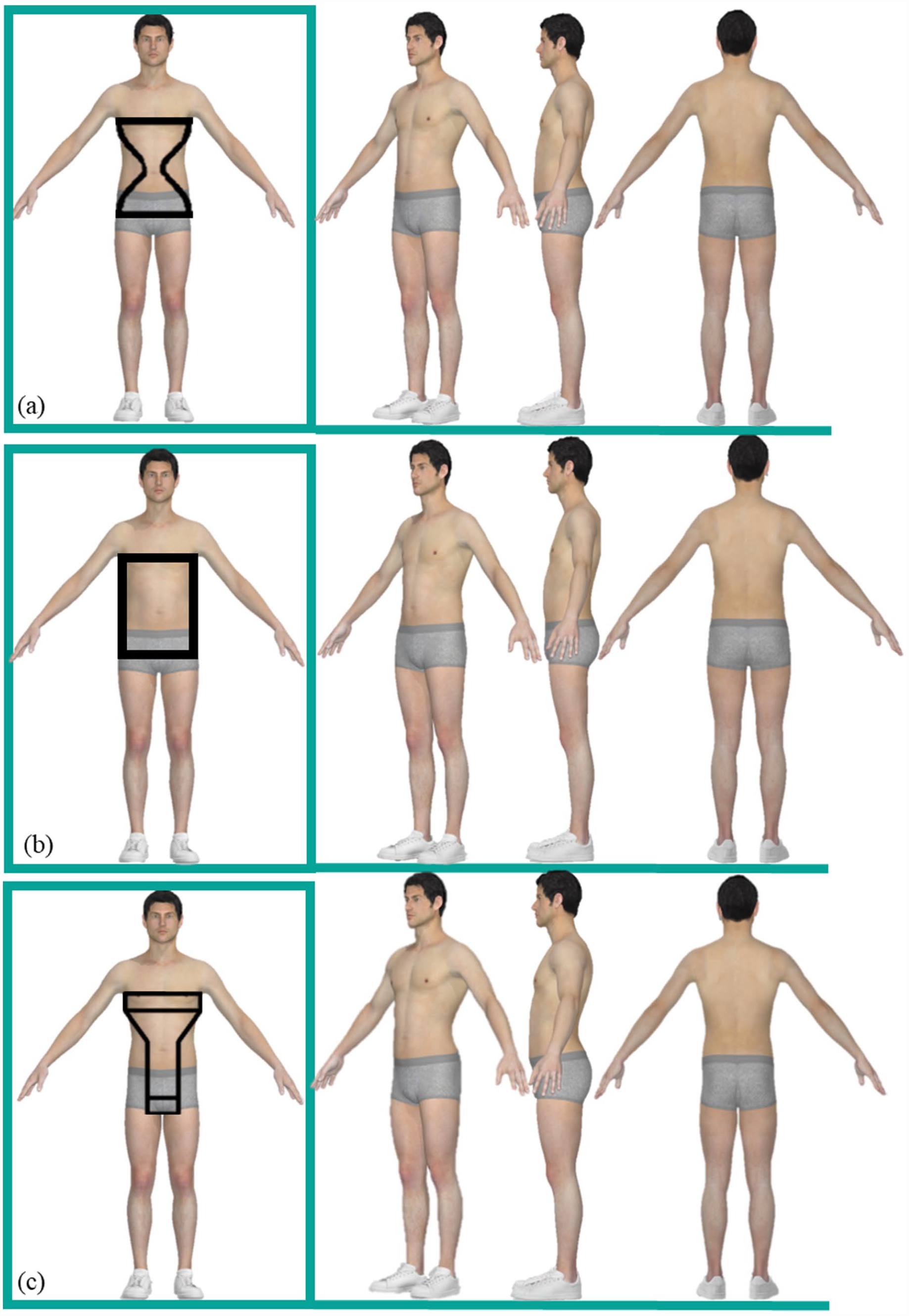
Body shapes for 10° angle difference criteria; (a) CW = HW, (b) CW > HW, and (c) CW < HW.
At 15° angular difference, the population of upper male body silhouette is divided into two classifications that are, straight and curvy (hourglass). About 53.52% of the population is categorized as a curvy shape, whereas 46.05% of the population is found to fall in a straight shape. Only one person remained tagged with a torch-like shape. The display of the shapes stayed consistent with Figure 6. Lastly, we read 20° angle difference subtilities. Concerning this setting, about 71.36% of the male population is estimated to be ranked as hourglass body shape. Further, about 28.21% population is found to be staying in the pear-like shape category. Again, one person is read as a carrier of a torch-like shape. Figure 7 displays the realized shapes.

Body shapes for 20° angle difference criteria; (a) CW = HW, (b) CW > HW, and (c) CW < HW.
One may notice that the more prominent classifications in the body shape occur at the angular difference of 10°. Where straight, curvy, and a combination of straight and curvy body shapes are achieved. The summary statistics of these body shapes are reported in Table 4.
Summary statistics of proposed body shape to varying degrees of angular difference.

Conclusion
The easy-to-calculate and more competent body classification indices remain highlights of the ready-wear clothing industry. However, the less appropriateness of the existing measuring systems is repeatedly lamented in various interdisciplinary research efforts. The contributing factor of this discrepancy is anticipated to be rooted in the in-efficacy of existing sizing indices using the anthropometric data linearly. This research proceeded with the understanding that the exhibited curvatures of the upper male body remain more calculable with the launch of angle-based measurements. Using this anticipation, the article novely proposes a new index to quantify the upper male body silhouette. The objectives are achieved by exploiting the symmetry of the human body and thus competently using the angular differences between chest-waist and hip-waist. Moreover, to meet the aim of generality, diverse parametric settings are incorporated. The empirical data of 241 males of Pakistani origin is explored concerning four levels of angular difference that is 5°, 10°, 15°, and 20°. The resultant stratifications of the upper male body types highlight the effectiveness of the difference of 10° by offering three main categories of body shapes such as straight (61%), hourglass (36.51%), and torch shape (2.48%). Based on the outcomes of the research, it can be concluded that the proposed scheme may be considered a step forward toward the attainment of a high degree of customer satisfaction regarding clothing fit. This contribution is anticipated to be of assisting the mass production of the customized clothing industry. Moreover, the findings can be considered as a reference for coming research in body shape classification to achieve clothing fit in ready-to-wear clothing.
Footnotes
Declaration of conflicting interests
The author(s) declared no potential conflicts of interest with respect to the research, authorship, and/or publication of this article.
Funding
The author(s) received no financial support for the research, authorship, and/or publication of this article.
