




Abstract
Among the fitness and body shaping exercises of Chinese women, swimming has become an increasingly popular sporting activity. Swimsuits are fundamental to participation in this sport and paramount to achieving the wearers’ aim of participation. A survey of 3348 Chinese women showed that body fit is central to the purchase of a swimsuit, whether one piece or two piece, with the two-piece swimsuit proving the most popular in terms of comfort. This survey revealed that the comfort of a swimsuit is relative to the design variables of the swimsuit style, the material/body cover factor and, informed by the female form, body size and body shape. This is particularly pertinent in both the right and left anterior mammary regions and also the left lateral mammary region for the female wearer to stay comfortable during swimming when she moves in the water. This study investigated the factors that affect the comfort of women wearing swimsuits when they swim. The two-piece swimsuit was considered the most comfortable. It was also found that swimsuits negatively affect women’s chest area. These results present important considerations for swimsuit manufacturers.
Since 2005, swimming has become popular among the female Chinese population for general fitness, relaxation and, in particular, as a low to high-impact sporting exercise.1–5 In China, 400 million women swim 20 to 40 times a year on average, with young women (18–38 years old) accounting for 85%.5,6 The ultimate goal of partaking in swimming as a sport is significant in terms of the female wearers’ requirements for swimsuits. Approximately 75% of female swimmers own two to five swimsuits. 6 Considering merely the aesthetic design of the surface material is insufficient when it comes to body fit and wear comfort. The swimsuit is, in essence, a secondary skin, a close-fitting item that should provide continuous comfort and support during the wearers’ physical activity associated with swimming.7,8 The production of the aesthetic design of a swimsuit is a secondary requirement. The primary requirement for the manufacturing of swimsuits is the performance of the material/materials relative to the female body type and physiology. Therefore, the design of a swimsuit affects the female wearers’ body comfort experience and mobility when swimming.9,10
Before swimming, and while dry, the interaction between the swimsuit and the human body remains in a static state for a short time, and there is normally no strong discomfort.11,12 Female swimmers usually wear their swimsuits for 1–3 h while swimming in the water, which makes it important to take comfort into account when selecting the appropriate material during production/manufacturing. This inherent comfort requires consideration of the impact of underwater pressure and the interaction between the wearer’s skin and the surface of the swimsuit.7,13 After entering the water, swimmers choose a swimming style that suits their sporting exercise regime and/or relaxation according to their physical coordination and preferences. 14 If the experience a swimsuit gives to a female swimmer is unsatisfactory during low to high-impact underwater sporting exercise, it will greatly affect their comfort during swimming. Some studies showed that when a swimsuit does not fit the body shape/form well, it increases swimming load on the chest, buttocks, and/or abdomen of the female swimmer as well as exercise resistance (e.g. Montagna et al., 2012). 6 The research of Catarino et al. (2011) 15 found that wearing a well-fitting and comfortable swimsuit for exercise can promote blood circulation in the human body and achieve the effect of regulating body temperature. However, there is a fine line between ill-fitting and well-fitting, considering the skin-to-swimsuit proximity, which can lead to the embarrassing tracing of the body contour of the female form. Overcoming this issue requires engineering elasticity (in the form of certain fibres/yarns) into the swimsuits’ proposed material during manufacture in order to enable stretching. This stretch-and-recover ability of the material/swimsuit optimizes the performance of the swimsuit as a secondary skin against the skin of the female body/form. 16 When a woman wearing a swimsuit enters the water, additional pressure is exerted: pressure from the swimsuit while wearing it in the dry state and when wet; pressure from the proximity of the swimsuit to the body relative to swimming motions, and the extent of an ill fit between the two. The latter is typically associated with poor resilience of the fabric material, resulting in insufficient flexibility. This poor pressure comfort of the swimsuit leads to water/air forming in small pockets of varying dimensions. The number of water/air pockets corresponds to the number of areas of ill fit between the swimsuit and the female body/form. The style structure and body shape of a swimsuit together with the ultimate fit are not enough, however, to eradicate these issues.17,18 Therefore, when designing swimsuits for the female body/form, numerous variables need to be considered, including, but not limited, to the cover factor (percentage of swimsuit material to the body), 19 visual comfort (aesthetic design of the surface material), 22 athletic function, 2 material/swimsuit performance, tactile comfort, 17 and fit to body shape. 18
The design of swimsuits for female swimmers is undergoing continuing research and development, and innovative improvements are being made in terms of swimsuit styles and swimsuit materials. However, these improvements to noncompetitive swimsuits are limited, and are usually carried out in the three areas of pressure comfort, thermal and moisture comfort, and tactile comfort. 2 The historical development of swimsuits in sports performance and research has been reviewed in the literature.19,20 A literature review performed by O’Connor and Vozenilek (2011) 20 emphasized that sports performance depends on swimsuit style and physical properties, and that measuring the body shape of different swimmers can help to improve the overall performance of swimsuits. An earlier study analyzed the body shape and swimsuit size measurements of 20 female American swimmers. 21 That study showed that the design of female swimsuits did not consider the overall body proportions and different body types, which led to excessive accumulation of water/air pockets in the chest and abdomen areas of the swimsuits. Kainuma et al. (2009) conducted a study of 139 female swimmers in the United States, in which ill-fitting swimsuits were believed to be the main cause of physical pressure. 22 The deformation of the body due to the pressure of the swimsuit may also affect the swimming speed, 23 and some people have pointed out that the relative proportions of the female body parts are extremely important. 24 By designing swimsuits that take into account the differences in female body types, a better fit to the surface of the human body can be achieved, and resistance can be reduced (especially in the back area or in the chest area). 25
Similarly, the effect of different female swimsuits on body coverage also raises the question of how this affects swimmers and the way they swim.9,26–28 At present, the styles of noncompetitive female swimsuits can be divided into one-piece swimsuits, two-piece swimsuits and bikini swimsuits. 28 Different types of swimsuits cover different areas of the body and exert different pressure on the body,29,30 confirming that different styles of swimsuits result in differences in sports performance and physical comfort.22,23 In addition, Berthelot et al. (2010) 25 pointed out that women tend to suffer more pressure on body parts because their curves are more concave and convex than those of men. Similarly, due to the lack of data, more research is needed to confirm whether the swimmer’s body characteristics and the suitability of a swimsuit are decisive for comfort.29,31
In terms of the fit between body type and swimsuit, the effect of different body shapes on swimsuit design has been extensively studied in the literature. Several surveys have found that female body types can usually be divided into five categories: ‘hourglass’, ‘pear’, ‘apple’, ‘strawberry’ and ‘flat’.5,32–-34 Different body types have different degrees of influence on the type, design, fit, colour and fabric of swimsuits. Swimwear generally has less fabric and tightly fits the human body, easily exposing the curves of the human body. 15 Consumers buy swimsuits that suit their body types, and swimsuits can play a role in shaping and beautifying the human body.17,35,36 Suitable swimsuits can help women of different body types to highlight the advantages of their figure, cover up their shortcomings and make their bodies more balanced.
Many studies have focused on professional swimmers’ swimsuits and equipment and their effects on exercise and discomfort. For example, 37 the influence of larger breasts (D cup and above) on exercise during swimming needs to consider both the degree of fit of swimsuits, the breast and the kinematic principle of swimming. 38 The accumulation of water in the chest area of the swimsuit is an important factor affecting the degree of comfort. The appropriate degree of fitting could reduce the discomfort caused by pressure and prevent water pockets, thereby helping the swimmer move their upper limbs comfortably in the water. Exercise and its effects on the female breast have been extensively researched in the literature. Several studies have investigated the effects of exercise on breast pain and how bra type, design and fit affect an individual’s perceived comfort.19,39 These studies suggest that the type of bra used affects the level of discomfort felt by the wearer. Other studies have focused on the effects of larger breasts during exercise. 37 Besides, the degree to which the hips and the abdomen fit in the swimsuit also has a great impact on swimming motions. If the swimsuit does not fit these two body areas well, it will either compress the female abdomen or, if the fit is too loose, it will lead to water pockets, thus affecting the stretching and movement of the waist and legs.39,40 All studies agree that the comfort of swimsuits affects the athletic ability of female athletes, such as bending and extending the torso. Therefore, swimsuits with insufficient fit will limit or reduce the ability to perform movements. If the swimsuit is poorly designed, or the style or size of the swimsuit worn by a woman is not right, it may increase the burden on the woman’s body while swimming. Therefore, this study focuses on the consideration of influencing factors that may affect the comfort of women wearing swimsuits.
The factors influencing the wearing comfort of swimsuits are quite complicated, and different factors have different effects. To achieve the best optimization, it is necessary to reach a state of balance regarding the various factors in the system. Therefore, the design of swimsuits must conform to the measurements and shape of the female body. The purpose of this research was to gain an in-depth understanding of the key factors that may affect the swimsuits of Chinese women by collecting and analyzing preliminary data. In particular, the following aspects were investigated:
the type of swimsuit commonly used by Chinese women; the size range of Chinese women’s swimsuits; the parts of a women’s body that are uncomfortable when swimming; factors that may affect the comfort of a swimsuit.
Methods
A survey was conducted to identify relevant information from Chinese female swimmers in order to determine what discomfort Chinese women have when swimming in swimsuits, and to find out Chinese women’s needs and preferences regarding swimsuits. Ethics clearance was obtained from the university research ethics board prior to all data collection. This survey was voluntary, no incentives were provided, and completion of the survey was considered to imply informed consent; all responses were anonymized. Participants were allowed to stop the survey at any time by exiting, with incomplete responses not included in the analysis.
Study population and inclusion criteria
The target population of this study was Chinese women aged 18–50 years. As the main purpose was to study the discomfort that Chinese women experience while swimming wearing swimsuits, the participants were asked about their experience swimming in two-piece, one-piece, bikini and competitive swimsuits. This option was at the top of the questionnaire and participants had to click on it in order to proceed with the survey. In addition, the electronic questionnaire was sent to 38 large swimming centers in four geographical regions of China. Every participant was screened and those taking part in the survey were required to have regular swimming experience, which could be noncompetitive but did not include simple recreational water play. Eligibility for participation in the survey was determined by recording the location of the swimming center and self-reporting. Participants who used the electronic questionnaire to answer the survey questions formally were verified on the homepage to ensure the reliability and accuracy of the response and to avoid duplication of participants. Participants who met the inclusion criteria were directed to the participant information and consent page, which provided detailed information about the research, and agreed to continue the online survey. The experimenters performed regular quality checks on the data, such as participation restrictions, screening questions, and capturing and deleting incomplete answers or failure to provide or collect verification information. Participants were not permitted to review their answers after submitting the questionnaire; therefore, they could not change their answers once they had been submitted.
Instruments
Before the study, physical feature data were collected from 120 female swimmers of five age groups (under 18, 18–28, 29–38, 39–50 and over 50 years) from four regions of China (northeast and northern China, central China, middle and lower reaches of the Yangtze River, and southern China) using the convention sampling method. The preliminary field survey revealed six major issues:
important points of concern when buying swimsuits; discomfort areas of the body when swimming in a swimsuit; comfort when wearing a swimsuit and performing defined actions; swimsuit styles considered to be very comfortable; problems that cannot be tolerated when swimming in a swimsuit;
definition of the type of swimsuits normally worn by the participants when swimming, such as one-piece swimsuits, two-piece swimsuits, bikini swimsuits and competitive swimsuits.
The six issues of the preliminary survey are all related to women’s swimwear design, ergonomics and user experience issues for female swimmers. We invited an expert team composed of two female swimsuit designers, two professional female Chinese swimmers (who have competed in five national swimming competitions), and three ergonomic experts to design an experimental questionnaire based on the review literature and their experience.9,41–44 All had more than 10 years of professional experience. Before designing the questionnaire, all experts were familiarized with the purpose and content of this research. The questionnaire was repeatedly revised based on the comments of the panel until a consensus was reached.
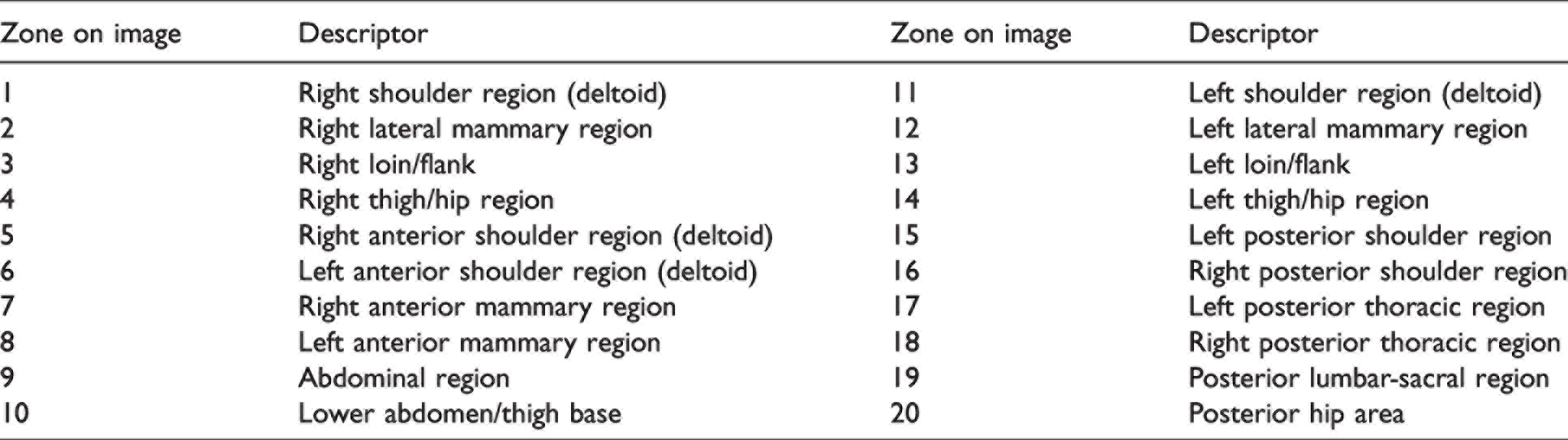
The swimsuit sizes were specified using the international clothing size standard.45–48 We adopted the body regions division from the study by Malbon et al. (2020) to identify the areas of discomfort when wearing a swimsuit. 49 Figure 1 and Table 1 illustrate the anterior, posterior and sides of a generic female torso.
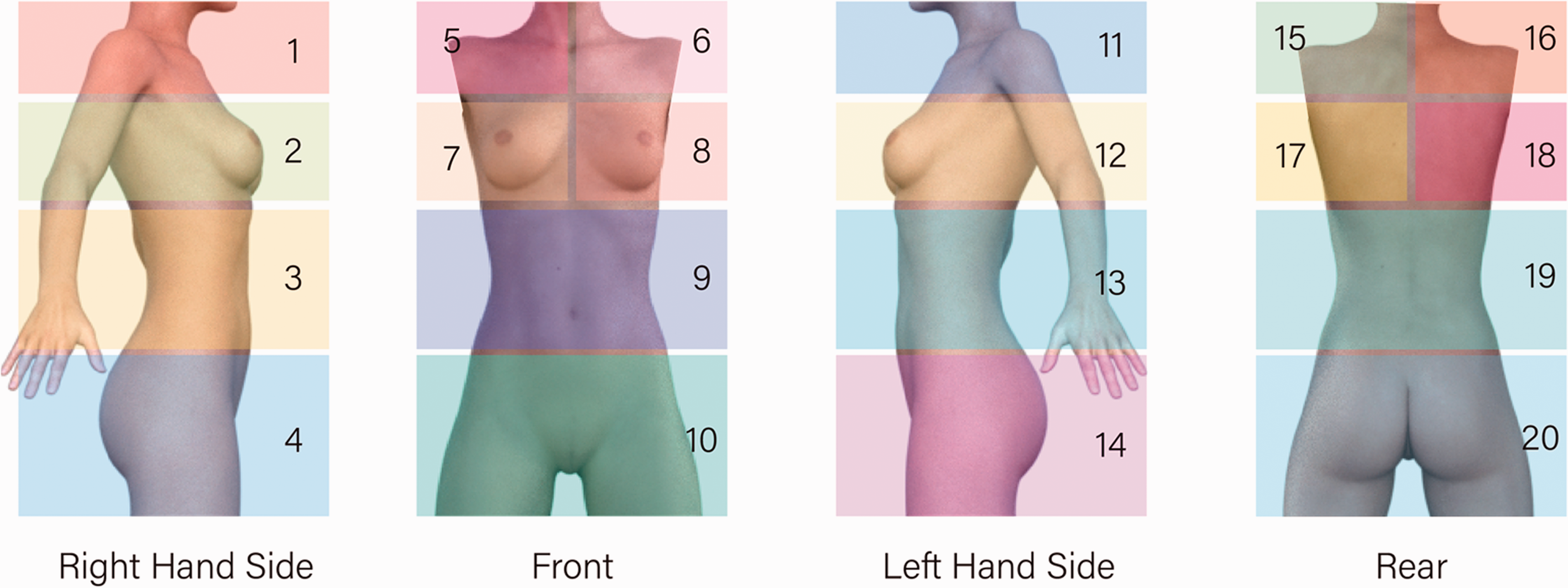
Torso image with zones and identifiers (reproduced from Malbon et al. (2020)). 49
Descriptive terminology for 20 body area zones (reproduced from Malbon et al. (2020) 49
The four types of swimsuits were discussed and agreed on by the panel of experts who designed the questionnaire. All four types of swimsuits were based on the most widely available types of swimwear on the Chinese market in 2021, each with a different design type and a basic configuration. The basic configuration of the competitive swimsuit covers the largest area of the body. The one-piece swimsuit comes second, while the two-piece swimsuit exposes the midriff area and the bikini swimsuit covers the smallest area of the body of the four types of swimsuits, as shown in Figure 2. As there were many participants, the swimsuits they wore would not exactly match these four basic configurations, so we informed the participants in the questionnaire to assess their swimsuit wearing experience based on these four basic shapes. If the swimsuit type worn by a participant matched one of these four basic shapes, the other elements of the swimsuit including brand, trim and lacing did not have to be identical.
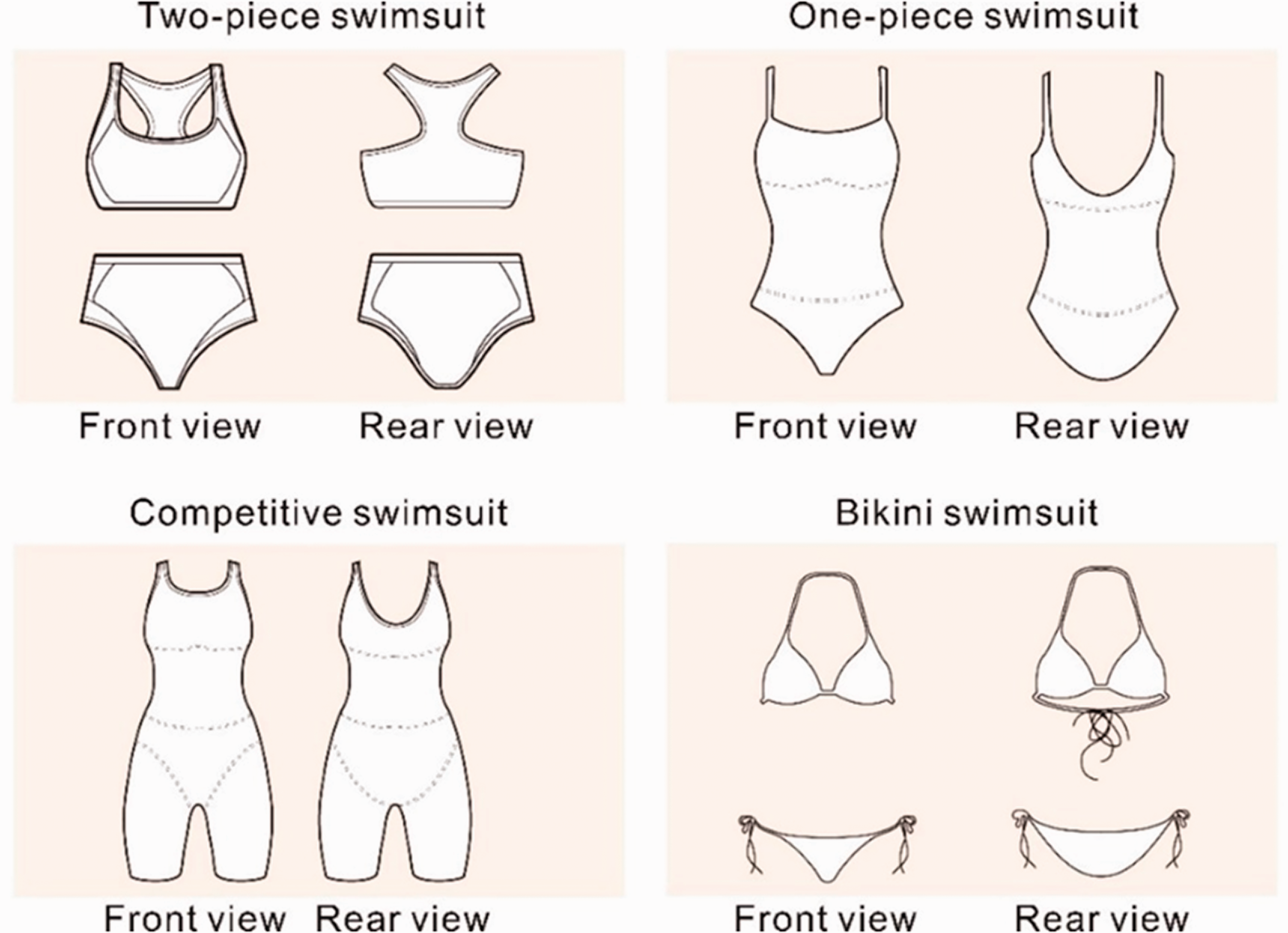
Diagram of the four basic swimsuit configurations.
The experimental questionnaire was pretested in five large swimming centers in Changsha City, Hunan Province, China. From 2 to 12 July 2020, a total of 140 eligible female swimmers completed the survey using the questionnaire. It took about 3–5 min to complete the questionnaire. The reliability of the initial part of the questionnaire, which dealt with the reasons for negative responses, was calculated using the Cronbach’s α value obtained from the pilot study (0.831), which shows that the questionnaire has a certain degree of reliability. The topics for discussing the reasons for the negative reaction were: (a) how much discomfort when wearing a swimsuit makes you unwilling to wear it? and (b) how much does the incompatibility of the swimsuit restrain you in your swimming? The responses to these items were also ranked on a five-point Likert-type scale. This method is widely used in cross-sectional surveys.50–54
Survey instrument and data analysis
An online ‘Tencent Questionnaire’ (wj.qq.com) was used to collect responses to 15 questions. Use of the ‘Tencent Questionnaire’ allowed us to collect a relatively large number of responses. The questionnaire was online throughout the summer in China from July 2021 to November 2021, at which time the response rate had dropped to zero for 2 weeks. Quantitative data were analyzed descriptively using SPSS 23.0. Total scores and frequencies were computed for all relevant outcomes.
Data collection
By the end of the survey, a total of 3426 responses had been collected. According to ISO 15535 (2003), 55 the age range of the current sample was divided into five age groups: under 18 (n = 182), 18–28 (n = 1641), 29–38 (n = 1169), 39–50 (n = 378) and over 50 years (n = 55), as shown in Figure 3. According to the geographical regions of China (1992) used by Zhou et al., 26.3% of the samples were from northeast and northern China, 24.6% from central China, 25.1% from the middle and lower reaches of the Yangtze River, and 24.1% from southern China, 56 as shown in Figure 4.
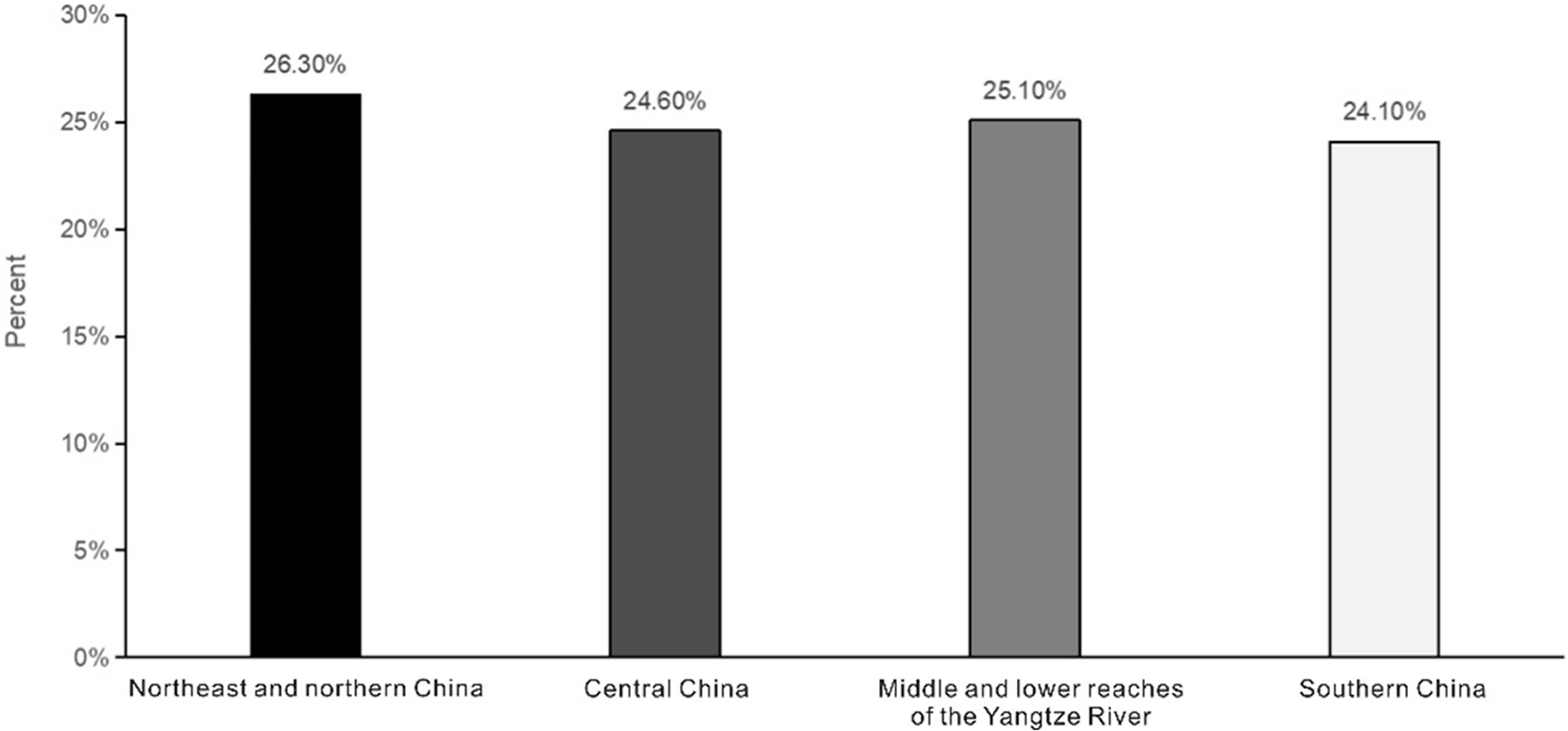
Geographical distribution of the participants.
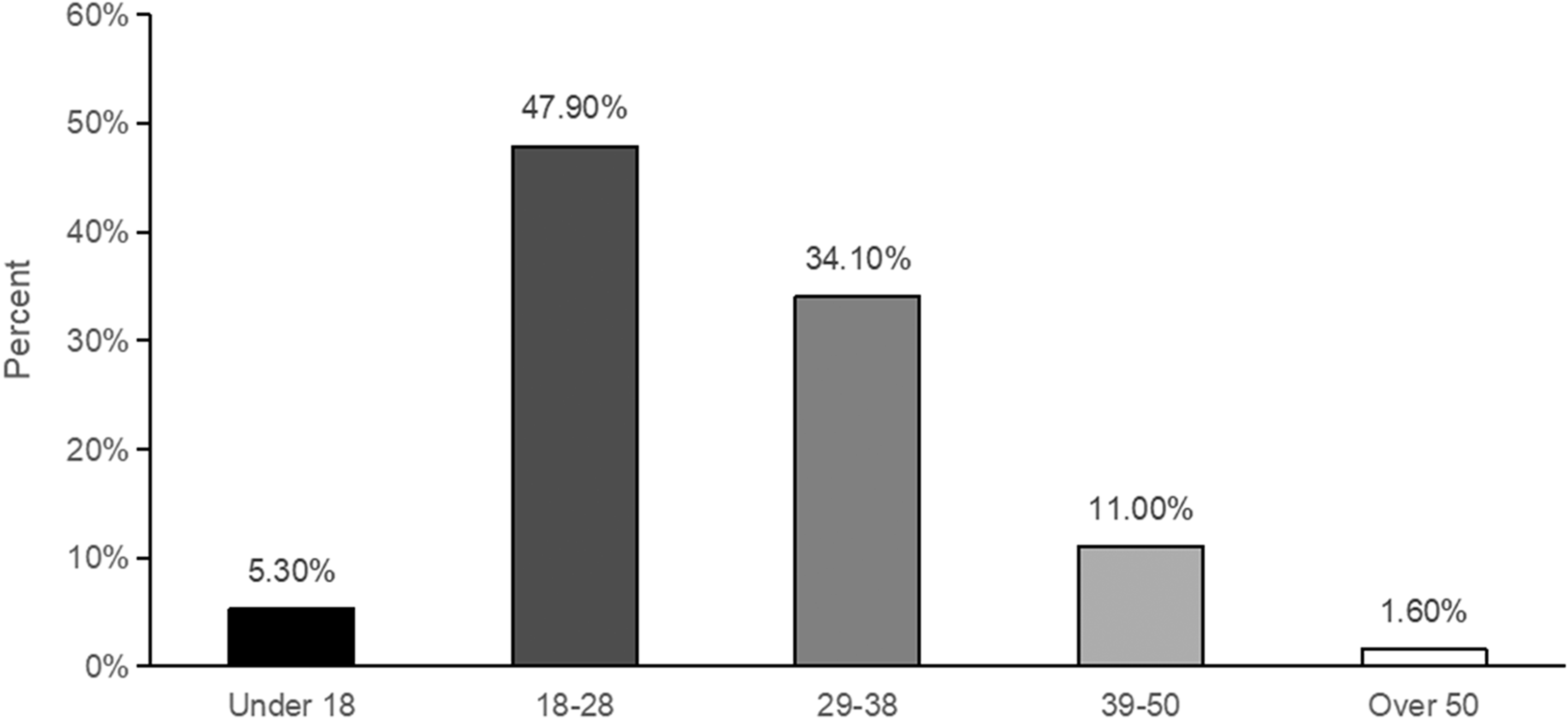
Age distribution of the participants.
Some of the data were eliminated for the following reasons:
incomplete survey: 0.9% (n = 30); indicated ‘no swimming experience’: 0.4% (n = 12).
As a result, a total of 3348 valid responses was used for data analysis.
If a participant selected ‘other’ for the type of swimsuit worn, this was reviewed to ensure that the swimsuit style was not a significant type. If the participant indicated ‘mainly one-piece swimsuits and occasionally bikini swimsuits’, this was reclassified as one-piece swimsuits in the answer.
Results
Participant characteristics
The height of the interviewees was mainly in the 160–165 cm range (44.4%), followed by 165–170 cm (25%) and 155–160 cm (21.5%). Only a few participants were in the range above 175 cm (0.9%). Overall, 72.6% of the respondents were taller than 160 cm, as shown in Figure 5.
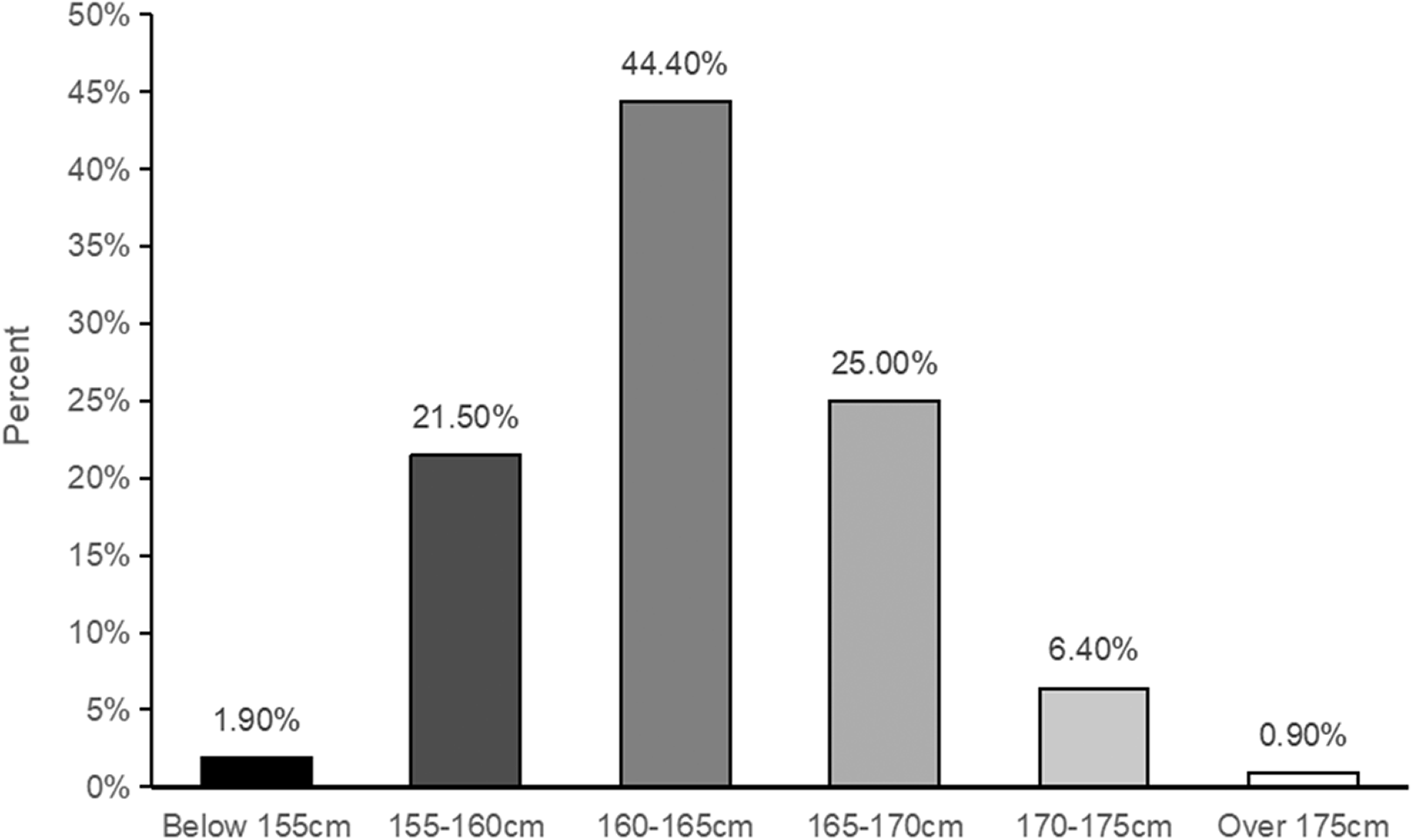
Height distribution of the participants.
The participants’ swimming experience in years is shown in Figure 6. The largest group of participants had been swimming for two to four years (42.5%). Overall, 79.3% of the participants had been swimming for more than two years. This shows that the largest percentage of participants had been swimming in swimsuits for more than two years. The number of years that Chinese women have been swimming is not necessarily related to their age.
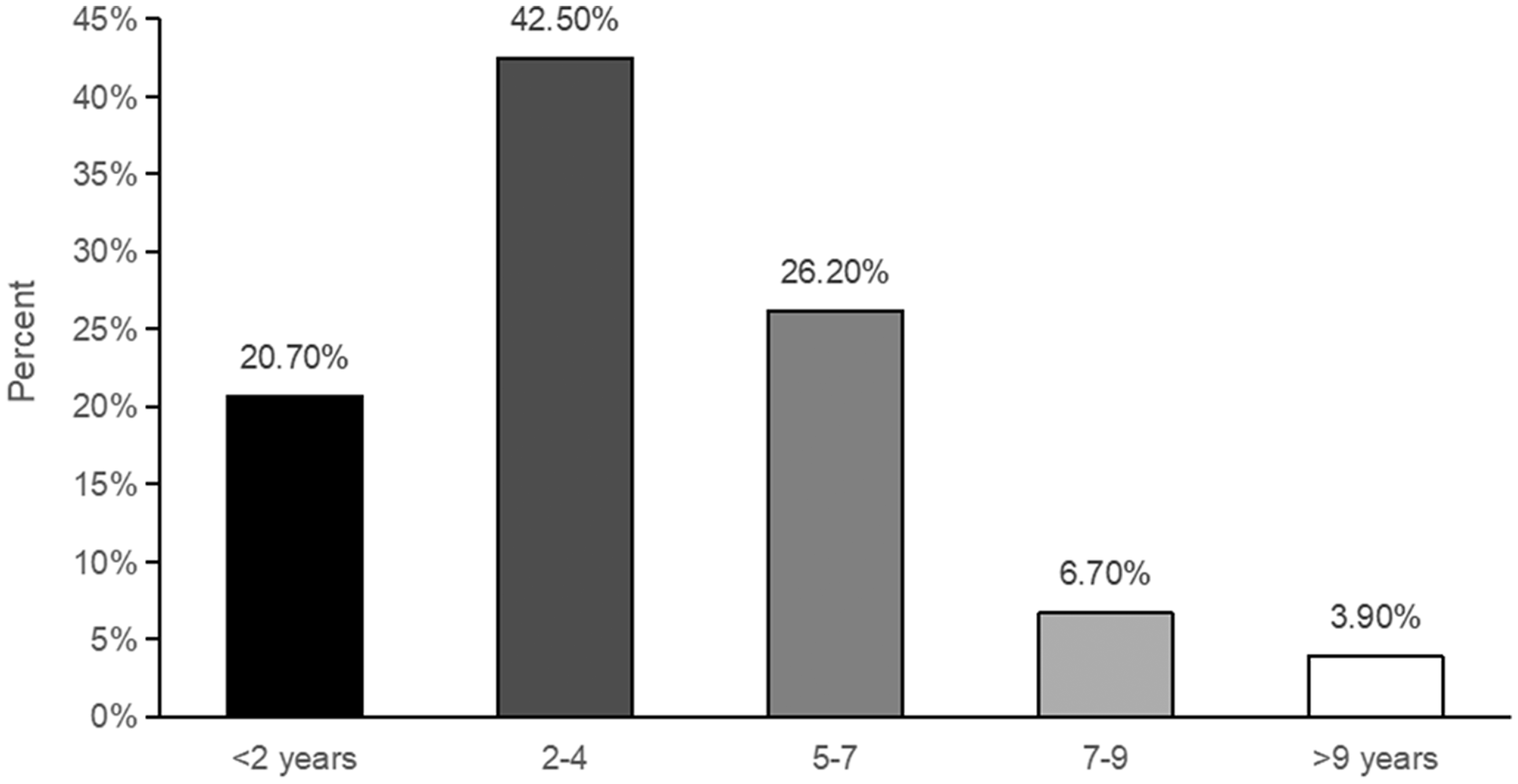
Length of time that Chinese women had been swimming wearing swimsuits.
Among the swimsuit sizes selected by the participants, the most frequently selected group was size M (39.9%), with XL being the second most frequently chosen swimsuit size by Chinese women (22.0%). Overall, 82.1% of the respondents wore swimsuit sizes above S. This shows that the largest proportion of Chinese women are of medium build (Figure 7).
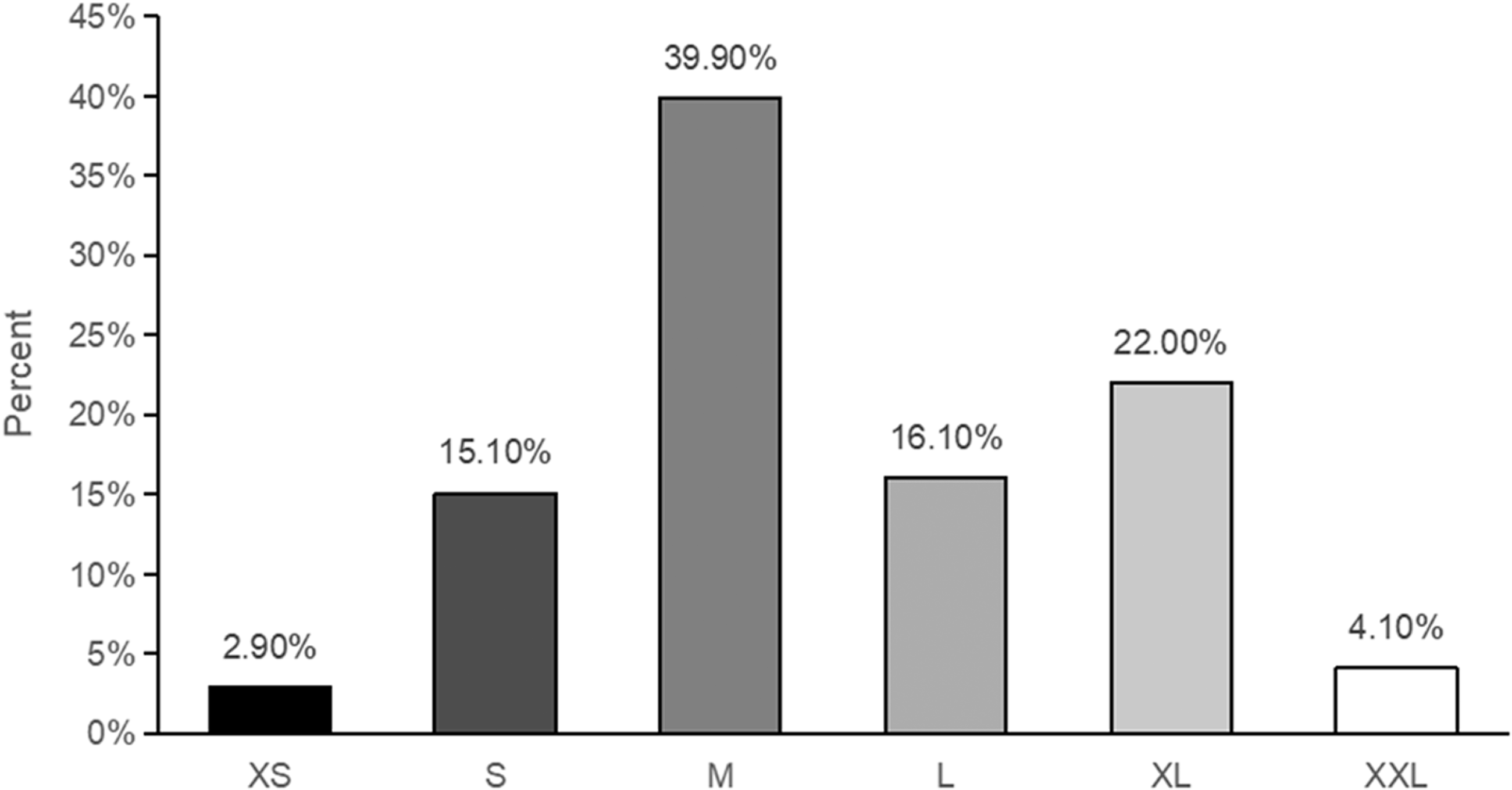
Swimsuit size distribution.
For Chinese women, the most comfortable type of swimsuit is the two-piece swimsuit (34.3%), followed closely by the one-piece swimsuit (30.2%). Competitive swimsuits (16.6%) and bikinis (18.8%) are relatively close, but competitive swimsuits were selected least often (Figure 8).
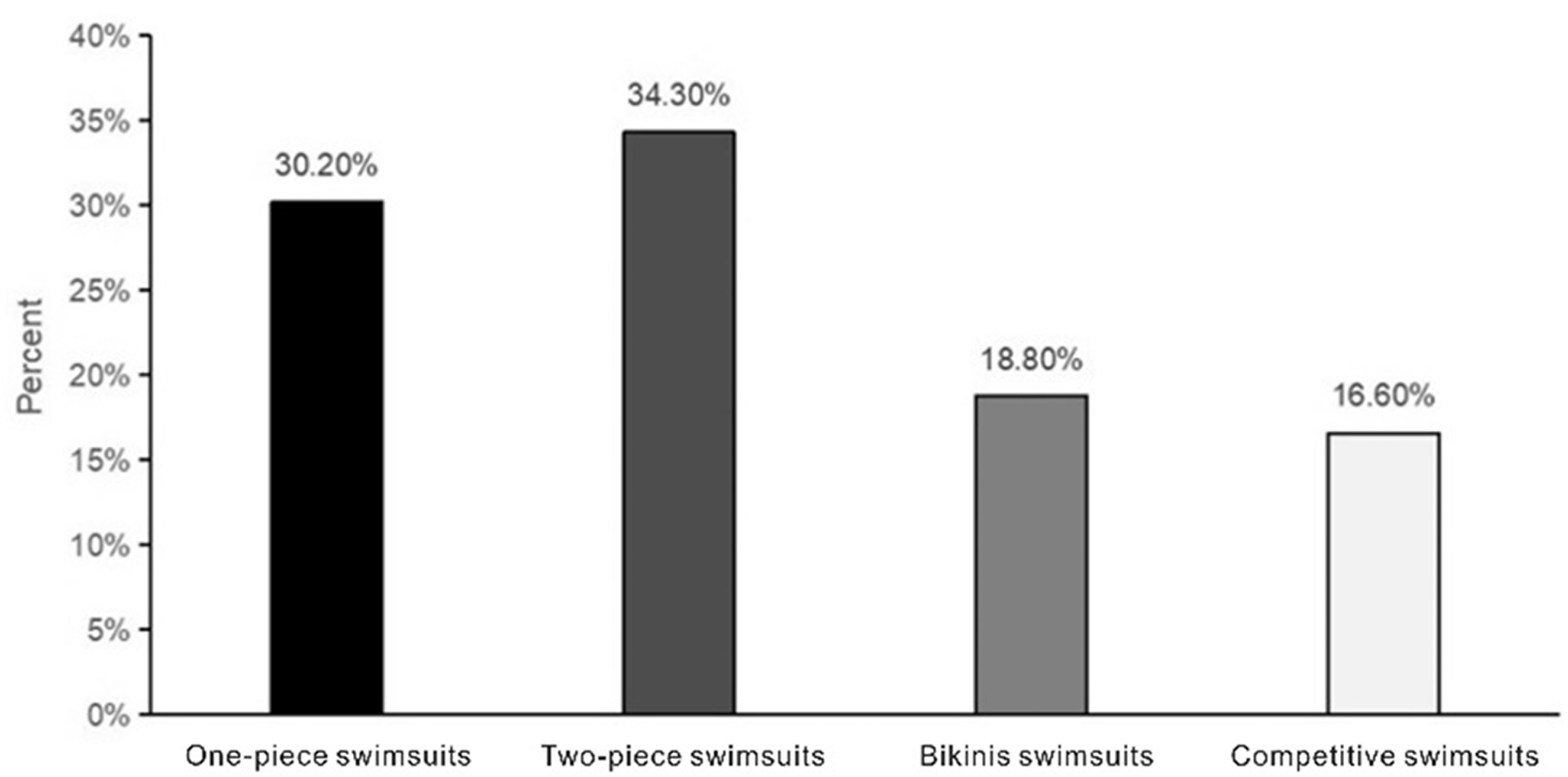
Choice of swimsuit type.
Needs when buying swimsuits
Figure 9 shows the factors that Chinese women are concerned about when buying swimsuits. The participants were most concerned about fit (whether the swimsuit fits their body) (18.9%) when purchasing swimsuits, followed by fabric (16.6%) and shaping ability (whether it highlights their body) (15.2%). Participants were least concerned with brand (8.30%) and type (8.50%), in addition to other (0.60%).
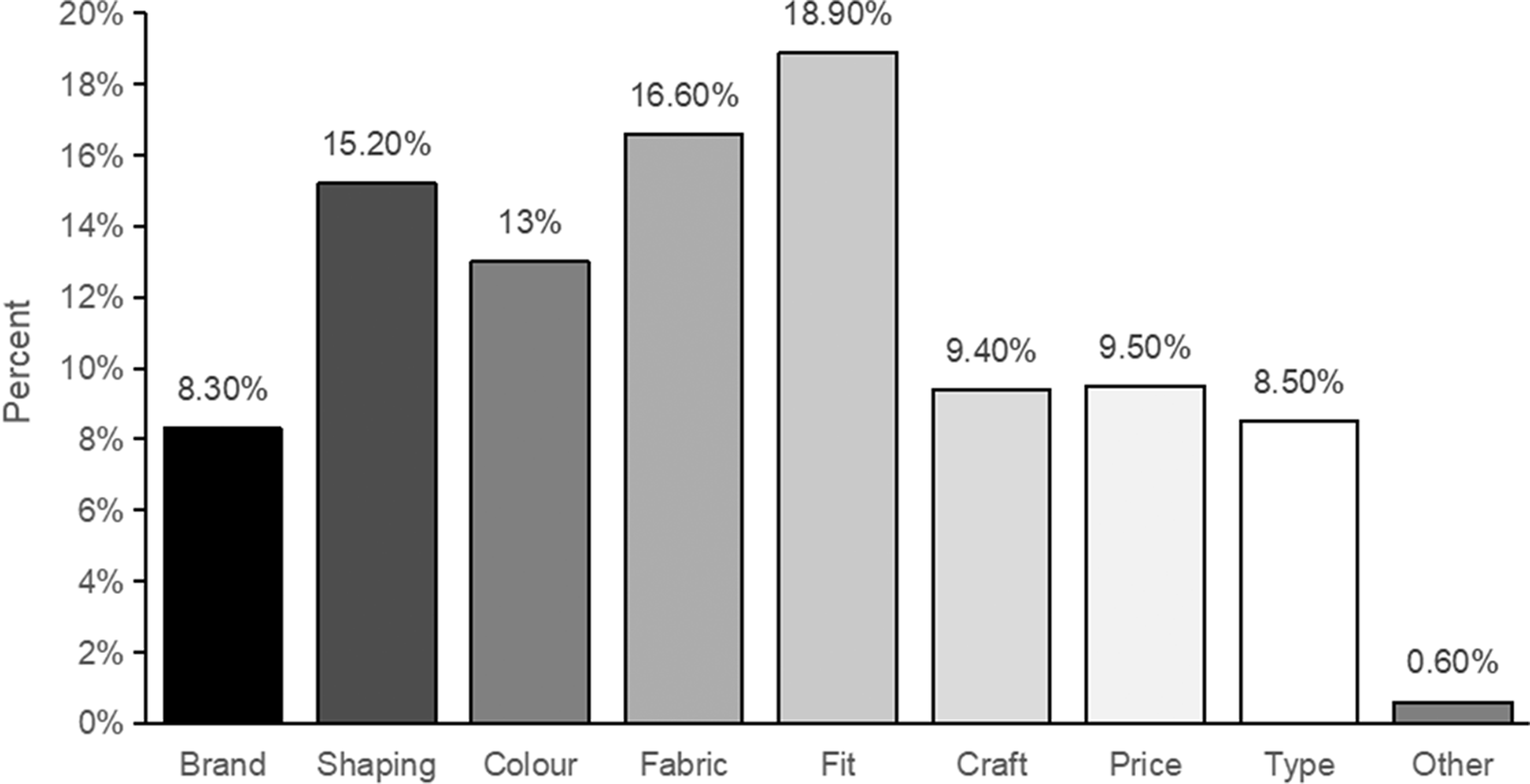
Factors of concern for Chinese women when buying swimsuits.
The participants reported mainly paying attention to the size of the swimsuit and any sizing information, such as the body measurements and weight for which that size is appropriate (34.9%), when purchasing a swimsuit to determine whether it will fit. If only one of these three types of information is provided, then the participants indicated that they give priority to the swimsuit measurements (bust, waist, hip) (30.3%), as shown in Figure 10.
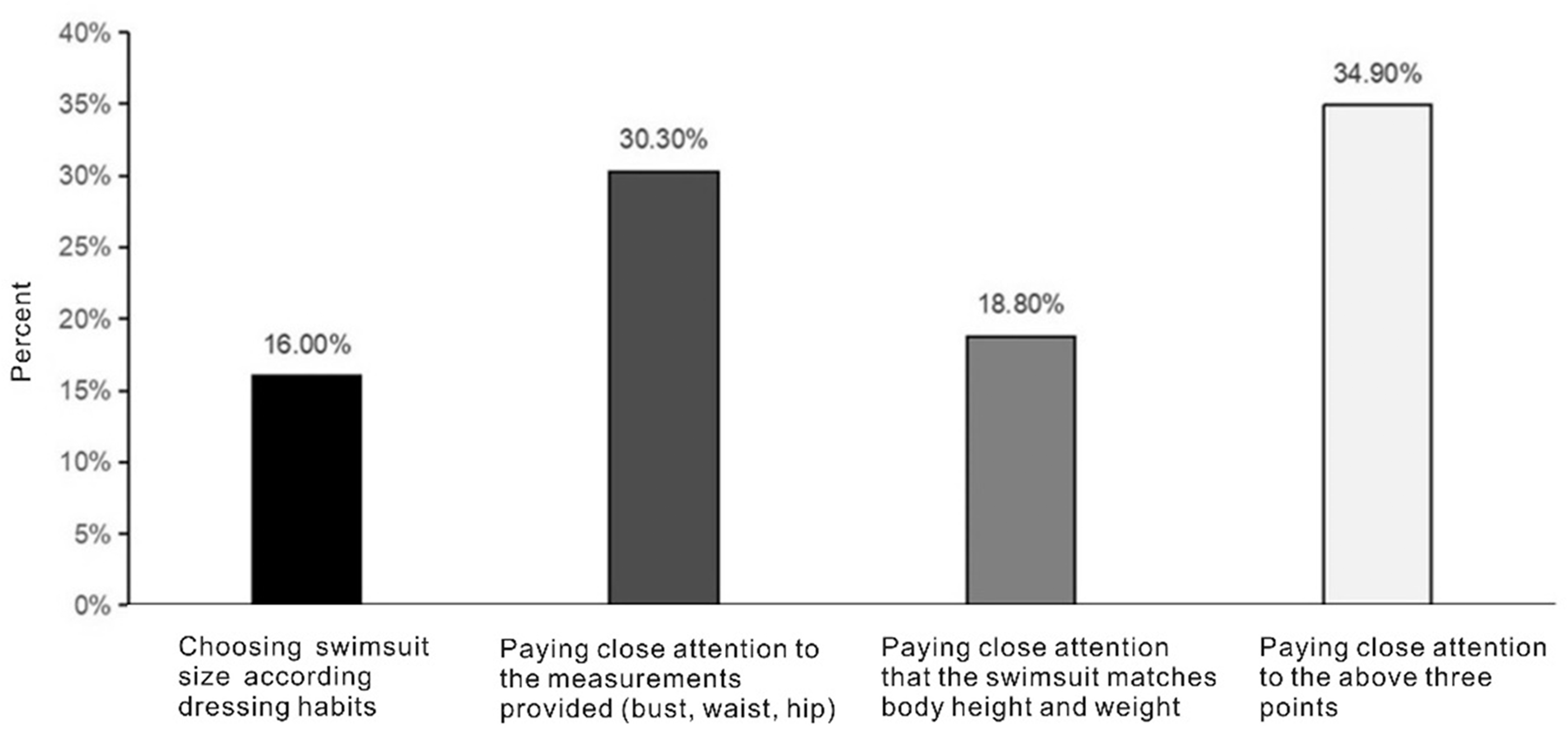
Information considered by Chinese women when buying swimsuits.
We found that the most unbearable problem for the participants was the complicated process of putting on or taking off the swimsuit (25.5%), followed by poor elasticity of the fabric, cracked elastic (23.2%) and tightness on the thigh or chest (19.9%), as shown in Figure 11.
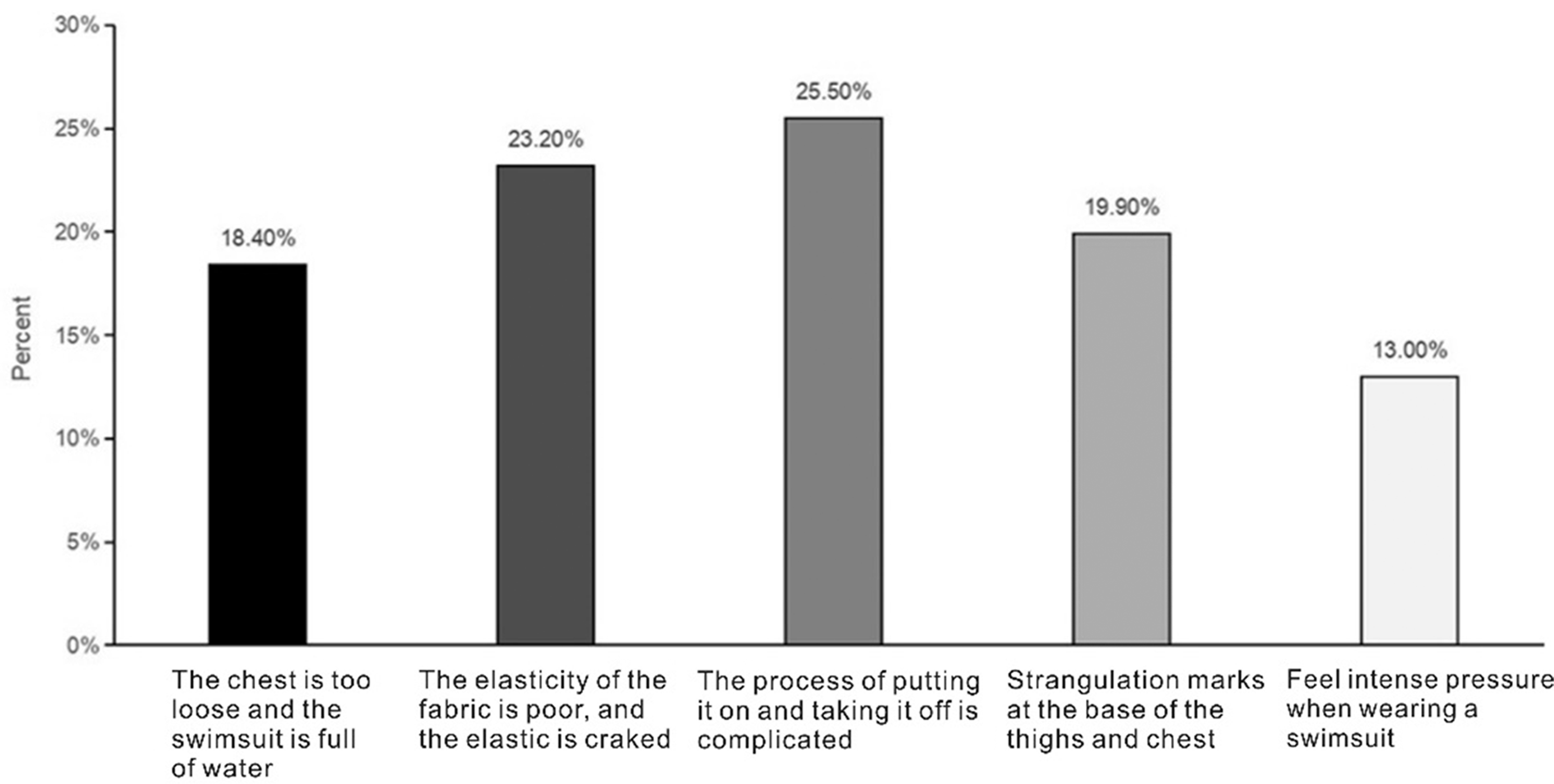
The most intolerable problems when wearing a swimsuit.
Relationship between body type and swimsuit type preference
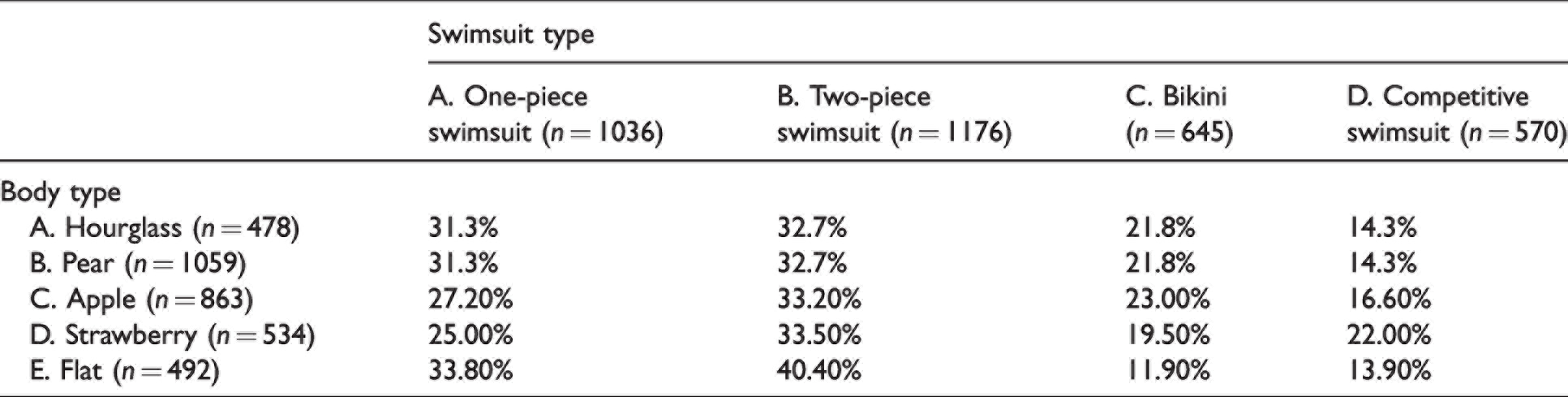
Table 2 shows the relationship between general body types and swimsuit types. The results show that among all body types, the most popular type of swimsuit is the two-piece swimsuit, while the second most popular one is the one-piece swimsuit.
Relationship between body type and swimsuit type preferences
Comfort level of swimsuit type
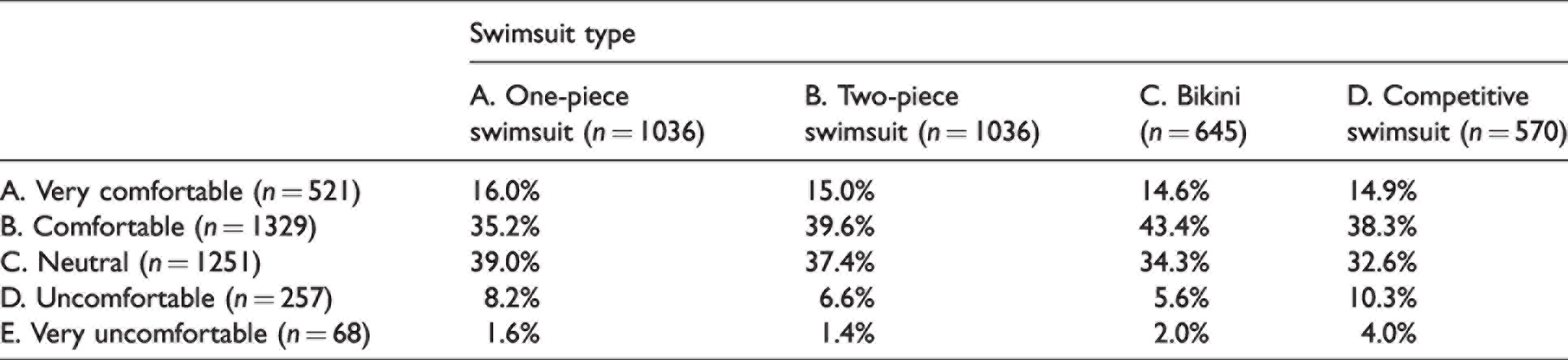
Table 3 shows the comfort that the participants felt when wearing different types of swimsuits. Overall, participants wearing bikinis (58%) and two-piece swimsuits (54.6%) had the highest level of comfort, while competitive swimsuits had the highest level of discomfort (4.0%).
Swimsuit type and level of comfort
Comfort of different body types wearing swimsuits
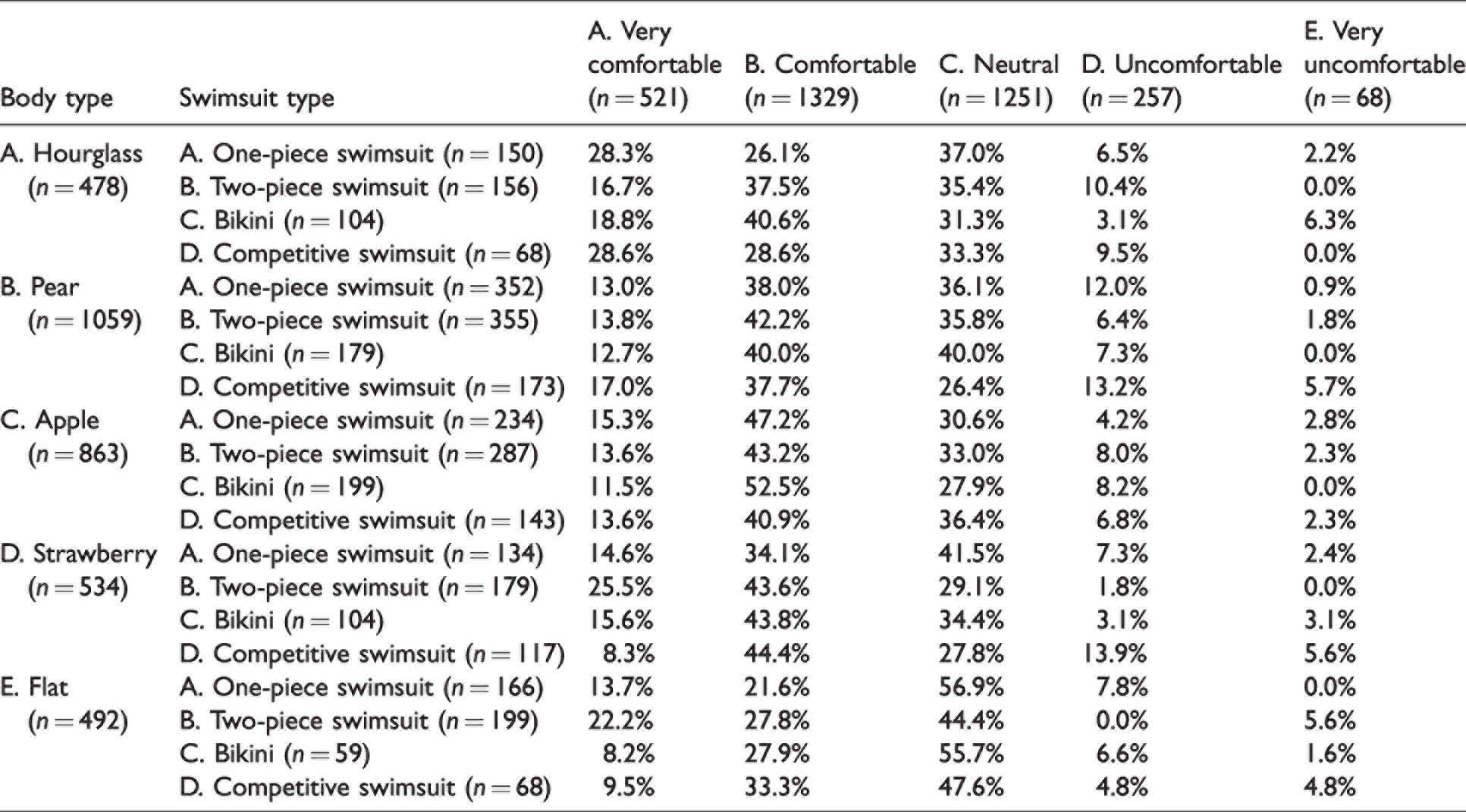
Table 4 shows the comfort that Chinese women of different body types feel when wearing different types of swimsuits. When the participants of the five body types wore different swimsuits, their comfort levels were primarily comfortable (n = 1329) and neutral (n = 1251). It was found that the highest percentage of women of all five body types rated the two-piece swimsuit as comfortable and very comfortable. Women with strawberry-shaped bodies rated the two-piece swimsuit the most comfortable (25.5%).
Comfort of different body types wearing swimsuits
Comfort level per swimming technique
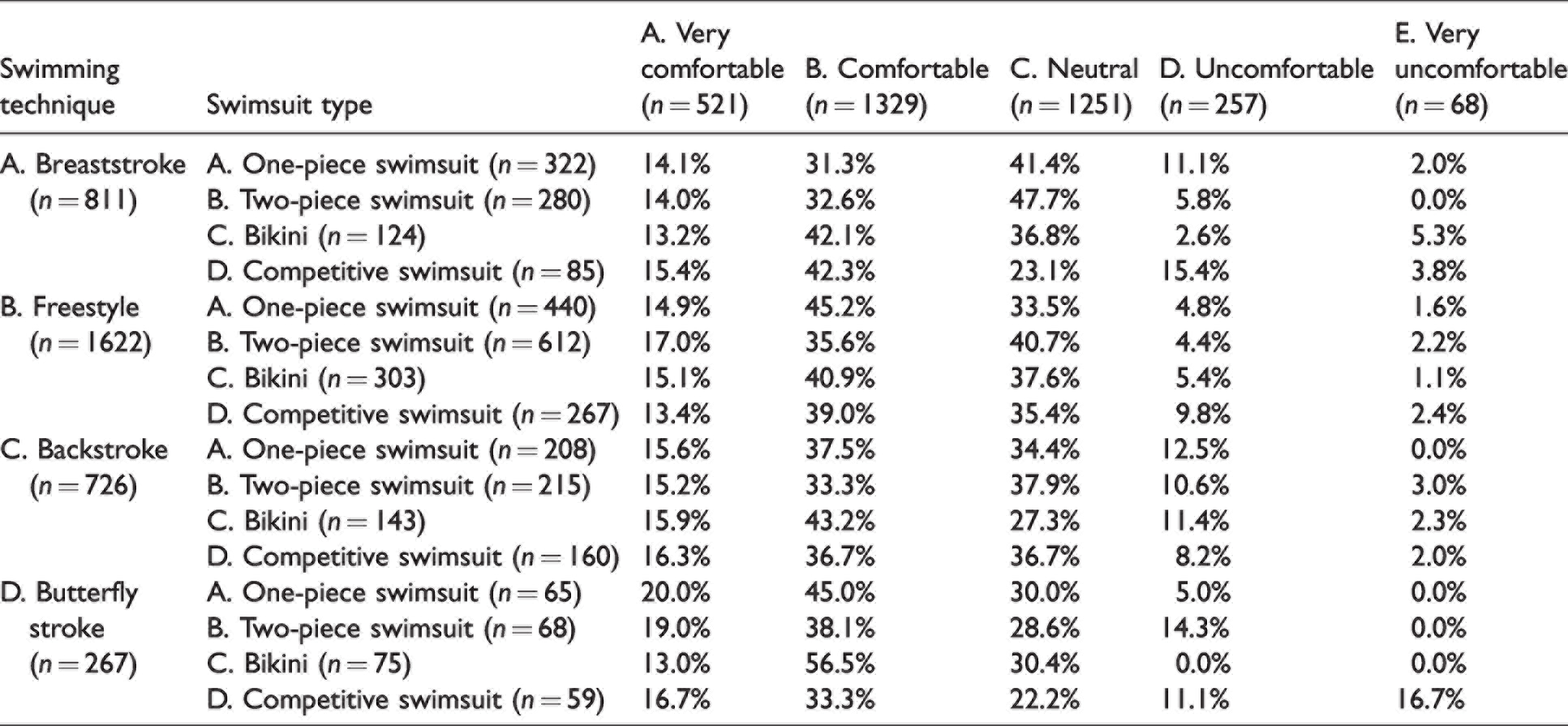
Table 5 considers a series of swimming techniques used by Chinese female swimmers and the comfort level of wearing different swimsuit types. Compared with freestyle, which had the highest response rate, the butterfly stroke was chosen by fewer people, but it is worth noting that only few responses for butterfly stroke indicated a very uncomfortable level. For the one-piece swimsuit, the two-piece swimsuit and the bikini, the response rate for very uncomfortable was even 0% in the case of butterfly stroke.
Comfort level of swimsuit types per swimming technique
Uncomfortable body parts when wearing different swimsuits
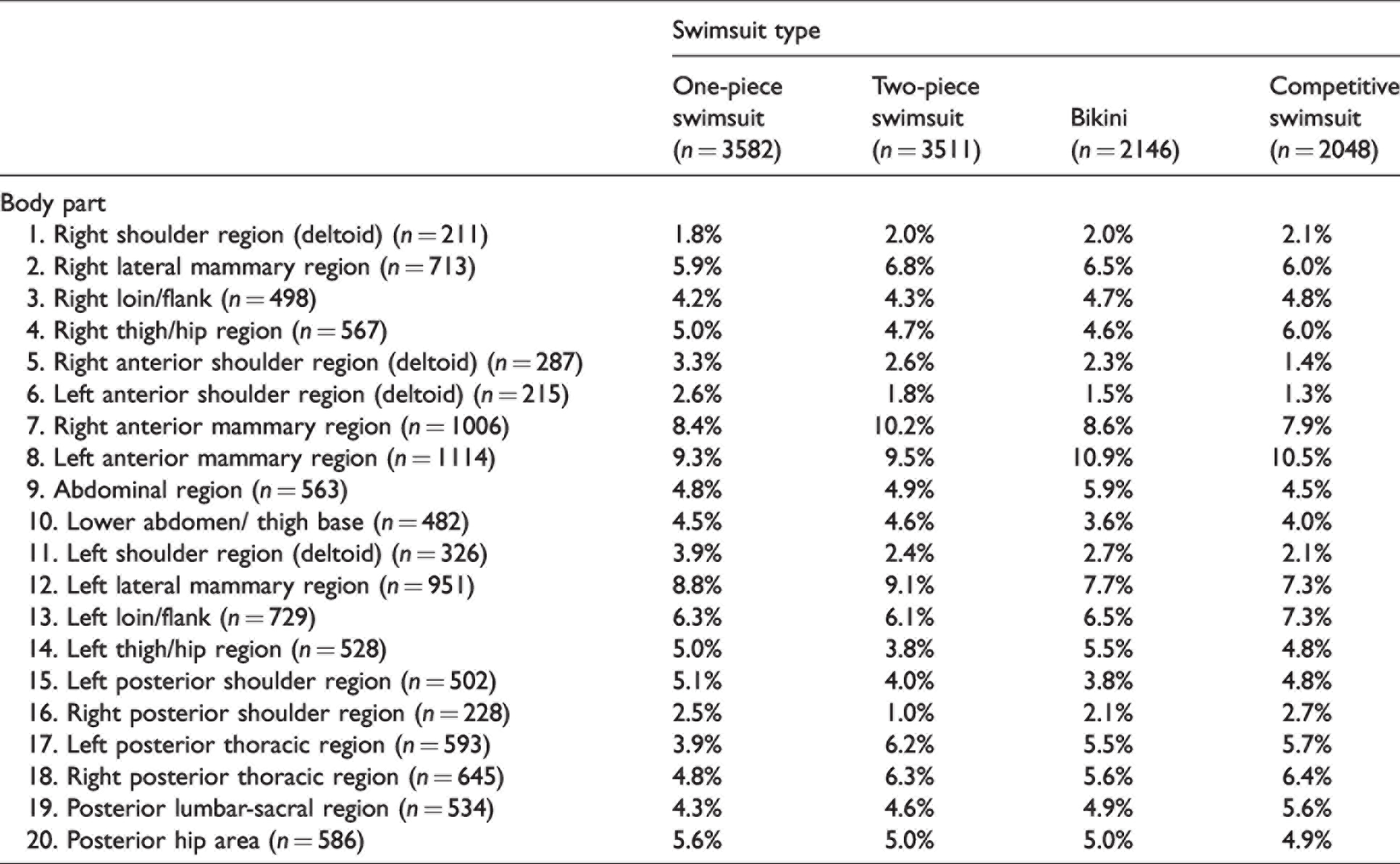
Table 6 shows the four most common types of swimsuits in relation to the participants’ uncomfortable body parts when wearing each type of swimsuit. It can be seen from the table that no matter what kind of swimsuit the participant is wearing, it is most uncomfortable for the right anterior mammary region, the left anterior mammary region and the left lateral mammary region.
Uncomfortable body part when wearing different types of swimsuits
Comparison of the six most common swimsuit sizes with uncomfortable body parts
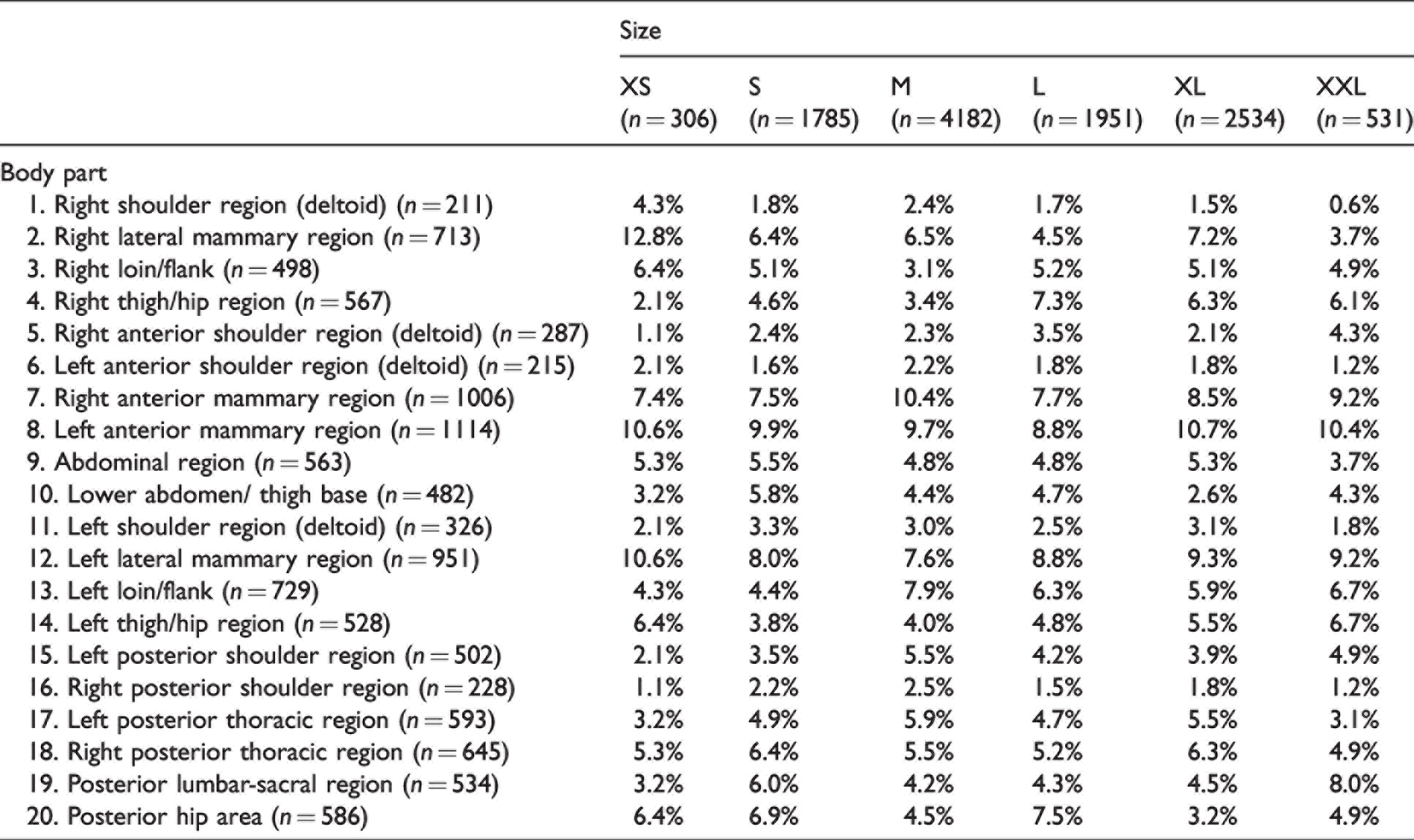
The parts identified by the participants as being uncomfortable were compared with the six most common swimsuit sizes, as shown in Table 7. In general, the main areas of discomfort are concentrated in the chest area, namely the right lateral mammary region, the right anterior mammary region, the left anterior mammary region and the left lateral mammary region.
Uncomfortable body parts as a percentage of the six most common swimsuit sizes
Discussion
The purpose of this study was to understand how the body/form (type), body size and swimsuit type of Chinese women could inform the optimization of swimsuits for superior fit and comfort. A predetermined set of parameters, including body type, body size and swimsuit type, were analyzed with regard to their effect on comfort when wearing a swimsuit. The concluding dataset, underpinned with additional data on comfort and physical activity while wearing a swimsuit, helps to develop an understanding of the issues women encounter while swimming. For this purpose, this study surveyed 3348 participants in order to identify the requirements of Chinese women for swimsuits to support the main findings of this study. Most of the participants were 18–28 years old, followed by those aged 29–38 years. The percentage of those under 18 and over 50 years was less than 10%, indicating that swimmers tend to be younger, with most being younger people aged 18–39 years. We also found that 36.9% of Chinese women had a cumulative swimming experience of more than four years, concentrated in two to four years, indicating that swimming has gradually become the main form of fitness and exercise, which is consistent with the findings of Zhang and Zhang (2010). 5 In the swimsuit size part of the survey, the largest proportion of the group reported wearing size M, and 82% of the participants wore swimsuit sizes larger than S, which indicates that most of the swimmers in the survey were of medium weight. This also confirmed what most participants indicated that the main purpose of swimming is for slimming and shaping. Understanding the size distribution of swimsuits helps to develop a range of swimsuit sizes suitable for Chinese women.
The preferred swimsuit type of Chinese women was found to be the two-piece swimsuit (34.3%) followed by a similar percentage with a preference for the one-piece swimsuit (30.2%), compared to bikinis and competitive swimsuits. It is worth noting that the styles of two-piece swimsuits and bikinis are similar, but there are also significant differences.59-62 Participants said that the choice between the two depends on how much of the body is exposed; there was broad consensus on this issue.63-65 Some studies have found that, although bikinis exert less pressure on the body than, for example, one-piece swimsuits, the fact that they expose a larger part of the body may be the reason why bikinis are less preferred by women.66,67 Another reason may be related to professional swimming or water sports, in which a bikini might not be the first choice for women engaged in professional swimming.68,69
The primary concern of the Chinese woman on purchasing a swimsuit is the fit – how it fits their body. The secondary concern is the fabric/material and the prominence of the figure. If a swimsuit is not chosen properly, the result may be an ill-fitting swimsuit that accumulates water/air pockets between the swimsuit and the body when worn during swimming. These water/air pockets increase the weight and exercise resistance causing discomfort. 6 Among all the participants, the complicated dressing and undressing process (25.5%) and the poor elasticity of the fabric, which causes the elastic to crack (23.2%), were considered the most intolerable effects of an ill-fitting swimsuit. Some studies have suggested that when the process of putting on and taking off a swimsuit is complicated and time consuming, the results are further negative emotions such as irritation and lower user experience at the start of the swim. 70 When the fabric of the user’s swimsuit has poor elasticity, causing the elastic to crack, the consequence could be greater resistance during swimming or, in more serious cases, strangulation of the skin leading to contusions, all of which negatively affect the swimming experience.71,72 Therefore, when women choose swimsuits, they are very concerned about the size and making certain their height and weight will fit in the dimensions of the swimsuit (34.9%).
We found that women with a pear body shape accounted for the largest proportion of swimmers (n = 1059), followed by those with an apple body shape (n = 865). For the different body types, the most popular type of swimsuit was the two-piece swimsuit; for this type, the flat body shape (40.4%) accounted for the highest proportion. The participants believed that the two-piece swimsuit could compensate for the shortcomings of their figure while simplifying the putting-on and taking-off process. One-piece swimsuits are generally more likely to cause water/air pockets in the abdominal area, and the process of putting them on and taking them off is complicated. Bikinis and competitive swimsuits had a lower preference, which was expected to be due to their degree of body coverage during swimming and their visual aesthetic effects. 27
The comfort of wearing different swimsuits is different for different body shapes. For those women with an hourglass and pear body shape, competitive swimsuits had the highest level of comfort (28.6%). Women with an apple body shape believed that one-piece swimsuits are the most comfortable (15.3%). Women with a strawberry or flat body shape believed that wearing a two-piece swimsuit is the most comfortable. It can be concluded that a woman’s body shape determines the comfort of a swimsuit, and that the fit of a swimsuit is critical to the comfort and compression of the body. 24
The body position and technique a woman prefers when swimming is personal for them, as is the swimsuit type, and our study revealed that the swimsuit type affects the body position and technique used. Women who prefer both breaststroke and backstroke techniques, found the highest level of comfort in a competitive swimsuit. Women who choose the freestyle and/or butterfly swimming technique experience greater comfort wearing a two-piece swimsuit. However, women who use the butterfly technique can experience a heightened degree of discomfort when wearing a competitive swimsuit compared to the other three types of swimsuits.
There is little difference between all types of swimsuits and the parts of the body where the participants experience discomfort. The area of discomfort is concentrated in the chest area: the right anterior mammary region, the left anterior mammary region and the left lateral mammary region. Competitive swimsuits may also cause discomfort to the left loin/flank. This shows that the fit between the chest and the swimsuit greatly affects the comfort during swimming.38,57 Loose swimsuits can cause water/air pockets to accumulate between the swimsuit and the chest area, while tight swimsuits could cause chest compression and cause breathing problems. 39 Wearing swimsuits of different sizes can also affect the comfort of different body areas. In general, the most uncomfortable area for the participants when wearing a swimsuit was the right anterior mammary region, the left anterior mammary region and the left lateral mammary region; these are the same areas as the uncomfortable areas of the swimsuit types. Of those female participants wearing a size M swimsuit, there was greater discomfort in the left loin/flank region, while participants wearing a size L swimsuit also experienced discomfort in the posterior hip area. This proves that the size of the swimsuit has little impact on the areas of the female body experiencing discomfort. However, for those participants who wore a size L swimsuit, it was found that, due to fuller buttocks, they may get ligature marks.
The factors affecting the swimming comfort of women may be caused by the pairing of swimsuit styles and body shapes, as seen in our investigation of the uncomfortable areas when wearing swimsuits. It was found that any style of swimsuit will cause discomfort in the chest area, so it is necessary to consider the style of swimsuit according to the body shape to relieve chest discomfort. Previous studies have suggested that as the chest area of women is not uniform across different body types,73,74 swimsuit manufacturers or designers may be able to explore design rules in the chest area according to different body types in order to provide a more comfortable fit, optimize curves through the swimsuit to improve aesthetics and reduce resistance in this area during swimming to relieve pressure, strangulation, etc.75,76 This survey has provided a dataset for future swimsuit designers. This dataset supports the assumption that the comfort of swimsuits is relative to the swimsuit type, the swimsuit/body size and the interaction between swimsuit type and female body shape.
Limitations
While this study provides important insights into the comfort and needs of Chinese women wearing swimsuits, there are some limitations. First, the design approach of a cross-sectional study is limited to exploring the comfort and needs of women wearing swimwear in previous periods, and their comfort and needs regarding swimwear may be related to their recent swimming experience, creating possible selection bias.51,58 Second, this article did not consider the influence of the design and material of swimsuits on comfort, nor the specific movements of women while swimming, because it is difficult for nonprofessional swimmers to define their movements during swimming. Therefore, we only used the general swimming body position and technique. 9 To develop a greater understanding, further research based on this survey is needed in the future, with each participant being provided with the same swimsuit and instructions on the correct way to wear it. Third, there were some interesting findings in the results of this study, with some results suggesting that participants did not experience consistent comfort in their left and right body parts while swimming in their swimsuits. While some studies suggest that the body is asymmetrical, some literature also reports that this may be related to participants’ preferred posture or habitual movements when performing physical activities, leading to some potential exercise discomfort or acute muscle stress.77,78 Therefore, further investigation into the differences involved is required. Finally, the swimsuit preferences of Chinese women may also be influenced by the most popular fashion trends at the time. This may be another large influencing factor, in addition to comfort, so future consideration should also be given to the influence of the fashion styles and swimsuit trends at the time of the study on user choice and preference.
Conclusions
This study developed a dataset of requirements for female Chinese swimmers to understand and aid their purchasing decisions for swimsuits that provide optimum fit, performance and comfort. The dataset permits varying combinations of the female body shape and the female body size with the material/body cover factor of different swimsuit styles. This dataset reaffirms that the swimsuit type and the inherent material-body cover factor, combined with the female body shape, must be in harmony in order to have a well-fitting swimsuit that provides comfort. The pear-shaped figure was the most common female body shape among the participants (n = 1059), with these participants preferring the two-piece swimsuit the most (34.3%). The data collected and the analysis of the survey revealed that the comfort of the chest area is the main issue of concern when purchasing a swimsuit. Therefore, by understanding the impact of different swimsuit characteristics and the human shape on the comfort of Chinese women during swimming motions, the future design of swimsuits can improve the process of women putting on, wearing and taking off a swimsuit. This is important because more and more Chinese women regard swimming as a new type of body-sculpting sport. Swimsuit manufacturers should pay attention not only to professional competitive swimmers, but also to the swimsuit requirements of noncompetitive female swimmers.
Footnotes
Acknowledgements
The authors would like to thank the National Swimming Management Centre of China and the China Swimming Association for their support. This work is supported by a research project of the National Social Science Fund of China (no. 20BG115), and a scholarship from the China Scholarship Council and the University of Leeds (no. 201908430166).
Declaration of conflicting interests
The author(s) declared no potential conflicts of interest with respect to the research, authorship, and/or publication of this article.
Funding
The author(s) received no financial support for the research, authorship, and/or publication of this article.
