



Abstract
In this study, the dynamic changes in human body shape according to movement have been analyzed using three-dimensional scanning system. For this, 12 male subjects were scanned in six postures and the amount of changes in 32 anthropometric measurement items were examined. As for the height items, all items changed in walking pose, and for the length items, the shoulder and chest lengths were affected by arm movement. For circumference items, considerable changes were observed in the chest and waist region according to the movement. A body cross section analysis software has been developed to analyze the change in body shape according to movement in various perspectives. As a result, the chest region was found to be affected by the movement of the arms, the waist region by the movement of the trunk, and hip region was by the movement of the leg.
Introduction
Human body movement causes changes in body dimensions and surface shape. Such changes affect the fit and comfortability of clothing. Clothing can cause uncomfortable feelings and behavioral restrictions to its wearer according to the body movement. In the case of military uniforms, working clothes, and PPE (Personal Protective Equipment), this can reduce their wearers’ efficiency and safety. The body dimensions are usually measured in anthropometric standing posture and therefore it is difficult to track the changes in human body size according to the movement. In order to design comfortable clothing, it is necessary to design clothing based on body dimensions measured in various postures.
The body surface shape changes according to the movements of joints and muscles. The skin’s extension and contraction also appear differently on each part of the body. In order to understand this phenomenon, the need for the analysis of dynamic changes in human body dimensions according to the movement has been noted. 1
Several studies have been conducted to measure the amount of changes in body size and surface shape between static and dynamic postures. However, both plaster bandage method or photogrammetry had limitations in that the scalability of the study was poor.2 –4 Three-dimensional scanning technology have enabled researchers to obtain individual human body dimensions and surface shapes easily. Many studies have been made using these three-dimensional scan data, but most of them were limited to the investigation of the amount of change in a few body dimensions and surface shape in a few postures.1,5 Other studies have been confined to the development of personalized clothing products using three-dimensional data.6 –8
This study aimed to analyze the body dimensions and cross-sectional shape in various postures. For this, one static and five dynamic postures were considered to analyze the tendency of changes in various body dimensions and cross-sections. This study is expected to serve as a basic study that can track the changes in human body shape according to its movement. Also, it is expected that the result of this study will be used as necessary data for the preparation of ergonomic product design guides.
Research methods
Three-dimensional human body measurement
In this study, a VITUS 3D body scanner (Vitronic, Germany) was used for three-dimensional human body scanning. To mark the landmarks on the human body, fluorescent yellow stickers with the diameter of 12 mm were used as shown in Figure 1. Direct measurements were also conducted under the same conditions. Twelve male subjects in their 20s (average age 25.5 years old, height 1755.08 mm, chest circumference 939.48 mm) were selected for measurement (IRB No. 2107/002-003). Three basic postures (basic standing pose, applied standing pose, and basic sitting pose) were selected from the sixth Korean human body measurement project, 9 SizeGERMANY 2009, 10 and previous studies. 1 In addition, three more postures (applied sitting pose, walking pose, and applied standing pose2) were selected that are expected to cause considerable changes in body proportions in work or sports situations (Figure 2).

Location of landmarks using stickers.

Three-dimensional scan postures.
Body data analysis
Body landmarks and measurement items were determined based on the sixth Korean human body measurement project, 9 SizeGERMANY 2009, 10 and ISO 8559. 11 Table 1 shows 22 landmarks and 32 measurement items (height 7, length 9, circumference 12, width 2, depth 2). Direct measurement of body dimensions was performed in the anthropometric standing posture using a Martin anthropometric instruments.
Anthropometric measurements.

Some scan data needed to be corrected. For example, chair was scanned in the case of seated posture and holes were formed at the regions that are invisible to the scanner as shown in Figure 3(a). 3D Sense (3D Systems, USA) and Blender (Blender Foundation, Netherlands) were used to remove those artifacts as shown in Figure 3(b). The body dimensions were measured using the SNU-BM, a body measurement software. 12 That is able to measure the human body in various postures.
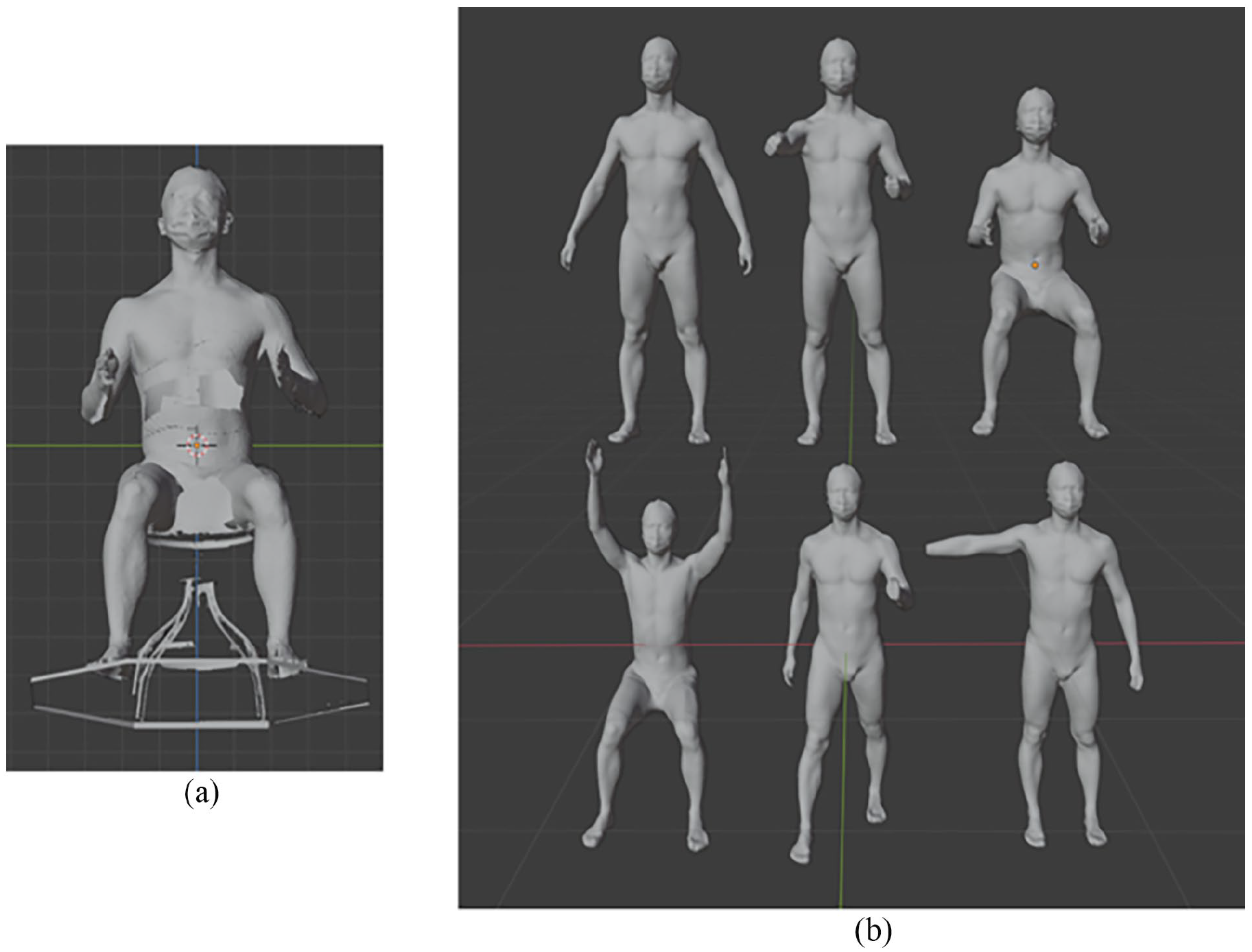
Three-dimensional body data: (a) raw scan data and (b) corrected scan data.
The human body dimensions extracted from the scan data and measured by the direct measurement data were compared. Paired-sample t-test was performed to confirm whether the human body dimensions measured from the scan data had a significant difference from those measured by direct measurement or not, which showed a good correspondence. A significant difference in dimensions between dynamic and static postures was observed, and a paired-sample t-test was conducted to find out whether the body dimensions change with movement or not.
Development of body cross section analysis software
To analyze the changes in the cross-sectional shape of the human body according to movements, a software capable of analyzing arbitrary cross sections of scan data has been developed. It can measure the convex circumference, area, and distance from the center point to the contour of the cross section as shown in Figure 4. In order to analyze the changes in the shape of the cross section more systematically, it was divided into quadrants. A paired-sample t-test was conducted to determine whether the cross-sectional area of each quadrant has significant difference between the dynamic and static postures or not. In addition, cross-section shape comparison of multiple three-dimensional data became easier by superimposing the cross-sections of multiple human bodies as shown in Figure 5. The basic configuration and UI of developed software are shown in Figure 5.

Measurement at body cross section.

Overview of body section analysis software.
Results and discussion
Comparison of direct and three-dimensional body measurement
Prior to the analysis, it was confirmed whether the human body dimensions obtained from the scan data were measured accurately enough to be used in this study. A paired-sample t-test was conducted using 32 body dimensions measured by direct (using Martin anthropometric instruments) and three-dimensional measurement methods. There was no statistically significant difference in 28 items with the significance level of 95%. The differences in the rest of the values were within 1.4%, which confirmed that there was little difference in measured values between two measurement methods.
The differences in some items, such as upper arm circumference (p ⩽ 0.009**), chest breadth (p ⩽ 0.014*), and waist depth (p ⩽ 0.001**), were due to the differences in measurement methods and they were selected as the analysis targets of this study. For example, in the case of waist depth, the result of the direct measurement method tended to be smaller than that of the three-dimensional measurement method by 8.919% because the subjects became nervous and pulled their stomach in during the direct. The armscye circumference (p ⩽ 0.000***) was excluded from the analysis because it was very difficult to measure it from scan data without significant human intervention.
Dimensional change between standing and dynamic postures
Height
The test results of the height item at the significance level of 95% are as shown in Table 2.
Dimensional change between standing and dynamic postures – height.

*p < 0.05. **p < 0.01. ***p < 0.001.
In the case of walking pose, all height items showed significant differences from those of the basic standing pose. Because the legs were spread in the walking pose, it was confirmed that the overall height dimensions decreased. Among them, waist height showed the largest difference (−2.756%) because the upper body tend to bend in the walking pose. Waist height (Omphalion) also showed large difference in the applied standing pose because the chest and abdomen tended to be pulled up when the right hand was stretched forward.
In the case of sitting postures, height items were compared between sitting postures. Sitting height increased by 0.494% because the upper body was naturally elongated by raising the arms above the head in the sitting position. Also, the waist height was increased by 3.186%, which showed a significant difference.
Length
The test results of the length items at the significance level of 95% are as shown in Table 3.
Dimensional change between standing and dynamic postures – length.

*p < 0.05. **p < 0.01. ***p < 0.001.
Shoulder length showed significant difference in applied standing pose (−2.708%), applied sitting pose (-34.642%), and applied standing pose2 (−10.049%), which were postures with a lot of arm movement. As the arm moved, the distance between the two shoulder points decreased and the shoulder length was shortened. Biacromial length was also changed by the arm motion. Biacromial length increased in the applied standing pose (2.264%), basic sitting pose (5.343%), and walking pose (7.316%), in which arms moved back and forth. However, it decreased in the applied sitting pose (−23.324%), in which the arms moved up and down.
Interscye breadth (front) decreased as the anterior axillary point moved to the inside of body when arms moved forward or upward. It decreased in the applied standing pose (−8.923%), the basic sitting pose (−3.239%), and the applied sitting pose (−18.159%). Interscye breadth (back) increased as the posterior axillary point moved away from each other when arms moved forward or upward. It increased in the applied standing pose (5.033%) and applied sitting pose (7.735%). On the other hand, Interscye breadth (back) decreased as the posterior axillary point moved inside when the arm was extended to the side or back. It decreased in the walking pose (−3.662%) and applied standing pose2 (−5.315%).
The waist front length and waist back length slightly decreased in the sitting poses but they were not significant. However, vertical trunk length significantly decreased in the basic sitting pose (−3.581%) and in the applied sitting pose (−3.529%).
A significant decrease (−5.112%) was observed in thigh vertical length as the leg was bent in the walking pose. Arm length significantly increased (basic sitting pose 4.843%, walking pose 2.684%) or decreased (applied sitting pose 5.061%, applied standing pose2 8.462%) in all postures except for the applied standing pose. Arm length was changed due to the change of the body surface shape in the arm movement.
Circumference
The test results of the circumference items at the significance level of 95% are as shown in Table 4.
Dimensional change between standing and dynamic postures – circumference.

*p < 0.05. **p < 0.01. ***p < 0.001.
It was confirmed that the movement of the arm affected the neck base circumference when the arm was raised above the shoulder. Neck base circumference decreased in applied standing pose (−0.768%), applied sitting pose (−1.21%), and applied standing pose2 (−1.151%).
In the case of chest circumference, significant changes were observed in the majority of motions. It was found that arm movement had an effect on the chest circumference. It increased by 0.917% in the applied standing pose and 1.83% in the basic sitting pose respectively. The chest circumference increased when the arm was bent and attached to the chest. It was confirmed that the muscles and fat in the chest area were stretched in the applied sitting pose, which resulted in the significant decrease in the chest circumference (−1.772%). The chest circumference increased (0.32%) in the walking pose due to arm movement. It is important to examine the changes in chest circumference in more detail because it serves as one of the most important size standards for men’s clothing products. Therefore, this study aims to analyze the cross section of the chest circumference in various perspectives.
The waist circumference (omphalion) also increased in the two sitting poses. However only the basic sitting pose (2.684%) showed a significant increase. In the applied standing pose, the waist circumference (omphalion) decreased significantly (−0.459%). The waist circumference increased in the basic sitting pose (4.84%) and the applied sitting pose (3.623%) in which abdominal tension is relieved. The increase was greater in the basic sitting pose in which the arm was bent and extended forward than in the applied sitting pose in which the arm was extended upward. Also, the waist circumference increased in the walking pose (0.713%). Waist circumference is also important in apparel product sizing system, therefore, a detailed cross-sectional analysis was performed on it.
Hip circumference increased (0.53%) significantly only in the walking pose that was expected to affect hip circumference due to the movement of the lower body. Since the hip circumference is also a necessary measurement item in designing protective clothing or special clothing, cross-sectional analysis was conducted. The knee circumference increased in the basic sitting pose (2.602%) and applied sitting pose (2.554%), and it was assumed that the knee came forward in the sitting posture and the circumference also increased. Midthigh circumference, decreased slightly in all poses except walking pose, but it did not appear significant. However, a significant increase (1.406%) was found in walking pose. This may be due to the movement of the thigh muscles and fat during the walking pose. Calf circumference increased because the calf muscle was expanded when bending the knee. Ankle circumference increased (0.499%) only in the walking pose.
Upper arm circumference increased as the biceps brachii muscle and triceps brachii muscle were expanded in the basic sitting pose and walking pose in which the elbow joint was bent. These changes were noticeable in bodies with more arm muscles. It increased by 4.037% in the basic sitting pose and 5.539% in the walking pose.
Breadth and depth
The test results of the breadth and depth items at the significance level of 95% are as shown in Table 5.
Dimensional change between standing and dynamic postures – breadth and depth.

*p < 0.05. **p < 0.01. ***p < 0.001.
Shoulder width decreased significantly in the applied sitting pose (−37.878%) and the applied standing pose2 (−7.226%), in which the shoulder point moved to the inside of the body according to the arm movement. Chest width was also greatly affected by the arm movement because the muscles and fat on the side of the chest moved along the arm. As a result of this effect, it was found that the chest width decreased by −5.64% in the applied standing pose, −4.466% in the applied sitting pose, −5.768% in the walking pose, and −3.715% in the applied standing pose2.
Waist depth increased significantly in the basic sitting pose (5.687%). It was due to the relief of tension on the lower back. The increase was smaller in applied sitting pose than the basic sitting pose (3.608%). The legs were spread back and forth in the walking pose, which made the hip landmarks move away from each other. Therefore, hip depth increased (2.429%) significantly in the walking pose.
Analysis of body cross-sections
Three cross sections including chest, waist, and hip were selected for further analysis because they serve as the important standards for garment sizing system. Cross sections of 12 subjects were used, and the representative shape of each cross section is shown in Figure 6. Two hundred sixteen cross-sections were obtained by extracting three cross-sections from each subject with six postures. The cross section was divided into four quadrants and each quadrant was named front left, front right, back left, and back right as shown on Figure 6. A paired-sample t-test was performed to compare the quadrant area of posture 1 and other postures. Since the areas of the front left, front right, back left, and back right were compared respectively, the effect of the motion on the cross section could be confirmed in more detail.

Cross sections of participant’s body circumference: (a) waist, (b) chest, and (c) hip.
Chest cross-sections
The test results of the chest cross sections at the significance level of 95% are as shown in Table 6. Some examples of the changes in quadrant area according to the movement are as shown in Figure 7.
Chest cross sections.

*p < 0.05. **p < 0.01. ***p < 0.001.

Comparison of chest cross-section area: (a) posture 1 and 2, (b) posture 1 and 3, (c) posture 1 and 4, (d) posture 1 and 5, and (e) posture 1 and 6.
Areal difference was found in front left, front right, and back left in the applied standing pose. When the right arm moved forward, the right chest moved toward inside the body, and the front right decreased (−5.436%). Also, when folding the left elbow and attaching it to the body, the front left (2.867%) and back left (5.929%) area increased (Figure 7(a)). Every area of the basic sitting pose increased, but it was not significant except for the back left (3.213%), (Figure 7(b)). As for the applied sitting pose, front left (−10.641%), front right (−10.074%) and back left (−4.443%) area decreased (Figure 7(c)). It was caused by the elongation of the bones, muscles, and fat in the chest area when raising the arm. The decrease was greater in the anterior area than in other areas where the volume of muscle and fat was larger. In the walking pose, when the torso turns to the right, the left arm moves forward and the right arm backward. Due to this, the back left decreased (7.249%) and the back right increased (12.314%), (Figure 7(d)). In the applied standing pose2, the front right decreased (−12.035%) and the front left and back right increased (4.588%, 5.466%) when extending the right arm toward the right (Figure 6(e)). The chest cross section was most affected by arm movement, and then torso movement.
Waist cross-sections
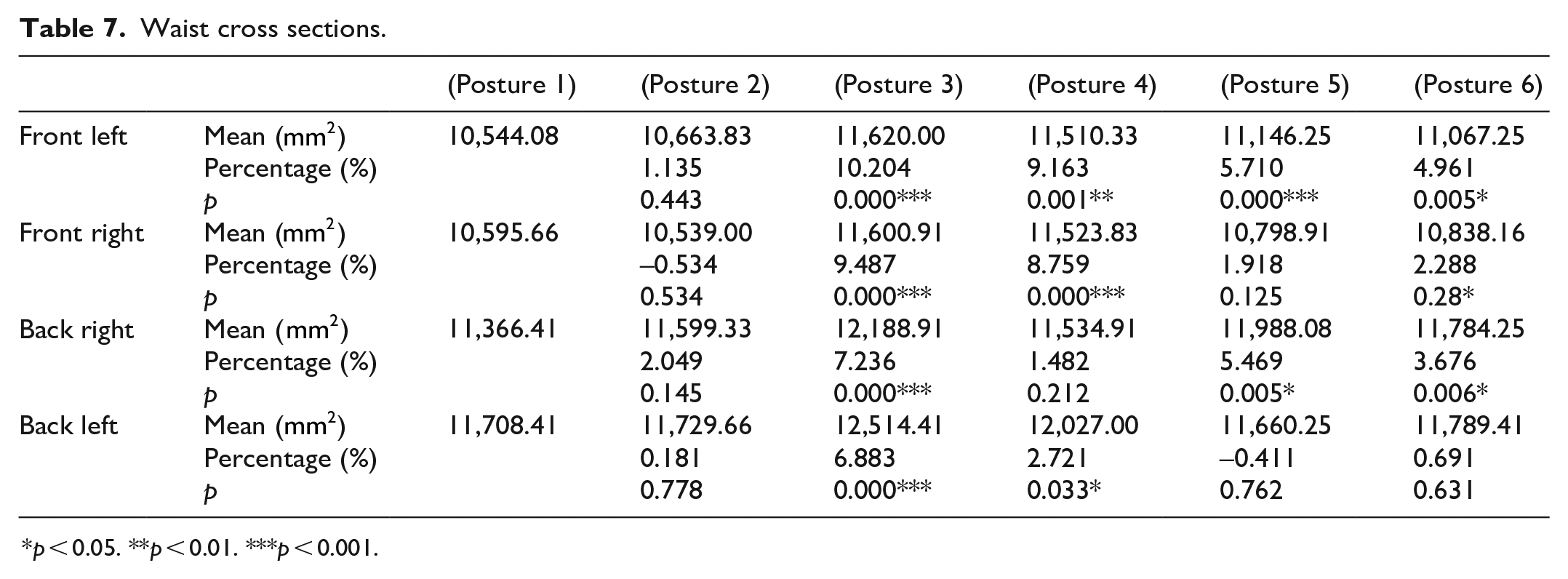
The test results of the waist cross sections at the significance level of 95% are as shown in Table 7. Change in each quadrant according to the movement is shown in Figure 8.
Waist cross sections.
*p < 0.05. **p < 0.01. ***p < 0.001.

Comparison of waist cross-section area: (a) posture 1 and 2, (b) posture 1 and 3, (c) posture 1 and 4, (d) posture 1 and 5, and (e) posture 1 and 6.
There was no difference between the applied standing pose and the basic standing pose (Figure 8(a)). Therefore, waist circumference can be considered to be less affected by arm movement than chest circumference. In the basic sitting pose, abdominal tension is relaxed and muscles are relaxed. At the same time, torso is lowered and torso length is reduced. Therefore, the abdominal fat is pressed from the top to bottom. As a result, the overall waist area increased. The area especially more in front left (10.204%) and front right (9.487%), where a lot of muscle and fat were distributed (Figure 8(b)). The subjects with more abdominal fat showed large increase. Applied sitting pose also showed an overall increase in waist cross section area for the same reason as basic sitting pose. However, the waist area increased less than the basic sitting pose because the trunk length was elongated due to the effect of upward arm movement (Figure 8(c)). In the walking pose, front left and back right area increased (5.710%, 5.469%) based on the trunk rotation and arm movements, same as the results of the chest cross section (Figure 8(d)). In the applied standing pose2, front left (4.961%), front right (2.288%), and back right (3.676%) area increased due to arm movements (Figure 8(e)). Waist cross section area was greatly affected by the rotation and length of the trunk, along with the movement of the arms.
Hip cross-sections
The test results of the waist cross sections at the significance level of 95% are as shown in Table 8. Change in each quadrant according to the movement is shown in Figure 9.
Hip cross sections.

*p < 0.05. **p < 0.01. ***p < 0.001.

Comparison of hip cross-section area: (a) posture 1 and 2, (b) posture 1 and 3, (c) posture 1 and 4, (d) posture 1 and 5, and (e) posture 1 and 6.
The hip cross section area decreased in the applied standing pose compared to that of the basic standing pose. This was due to the tension which were applied to hip muscles during extending the arms forward. Especially, the front right (−1.698%) and back left (−1.891%) decreased significantly (Figure 9(a)). The hip cross section greatly increased in basic and applied sitting pose because the fat and muscles were pressed down by upper body weight. Hip cross section increased significantly on the left and right rather than the front and back as shown in Figure 9(b). The applied sitting pose showed the same result, but the arm movement had no effect on the hip cross section. Accordingly, the front left (27.272%), front right (35.699%), back right (23.675%), and back left (21.160%) all increased (Figure 9(c)). In the walking pose, each hip cross section change was different according to the leg movement. As the right leg moved forward, the front right (13.527%) increased and the back right (−7.836%) decreased. As the left leg moved backward, the front left (−3.201%) decreased and the back left (9.272%) increased (Figure 9(d)). There was no difference between the applied standing pose2 and the basic standing pose (Figure 9(e)). Therefore, it can be concluded that the hip circumference is hardly affected by simple arm movements. Hip cross section area was greatly affected by the leg movement and changes in lower body position.
Conclusion
In this study, the changes in the dimensions and shapes of human body were analyzed using the three-dimensional scan data. Each subject was scanned in six different postures and 32 body dimensions were measured. In addition, the cross-sections of the chest, waist, and hip, which changed largely depending on the movement, were analyzed in more detail. As a result of the study, it was possible to see the change of the human body dimensions according to the movement. The shape of each quadrant of a cross-section of the human body changed differently depending on the type of movement. It was found that both standing posture and dynamic posture should be considered at the same time when developing clothing products for frequent movements. Using this study, it is able to produce a dynamic posture size chart that can be used for clothing patterns and ergonomic designs based on data measured in various postures. This study is expected to have significance as a basic study for designing protective garments that support specific movements. If the human body shape changes were considered, the pattern design process for protective garments would become more effective. Future research will focus on the implementation of this research into the parametric pattern development system to reflect changes in body dimensions according to body movement to the shape of garment patterns.
Footnotes
Acknowledgements
The authors thank Dr. Seowoo Kim and Professor Juyeon Park (WEAR Lab at Department of Textiles, Merchandising, and Fashion Design, Seoul National University) for help and advice in the process of using the 3D scanner.
Declaration of conflicting interests
The author(s) declared no potential conflicts of interest with respect to the research, authorship, and/or publication of this article.
Funding
The author(s) received no financial support for the research, authorship, and/or publication of this article.
