




Abstract
The developed technologies for creating the three-dimensional shape for the formation of feminine personal protective armor proved to be applicable in the case of high-performance protective triaxial fabric, made of polyester, Vectran, and Kevlar. The suggested method combines cyclic loading and deep forming under heat. Cup shape geometry was analyzed to get the relations between the cup volume and the cup diameter for different cup bra sizing systems. This work analyzed the factors of molding triaxial fabric in creating a three-dimensional shape to get a bra fitting essential for the comfort of the protective armor and to provide useful information about the treatment of different fabrics molding. A smoothly formed cup surface has a natural configuration of the breast shape and also provides unlimited designs. The suggested technology of fabric forming will architect fabric from 2D to construct the required 3D shapes. In this work, a setup was designed for heating the fabric accomplished with the application of variable cyclic loading. The procedure of forming bra cup shapes with the deep drawing that permits 3D fabric architects for the bra shapes of varied sizes was given.
Keywords
Introduction
The design of high-performance protective armor takes into consideration the following criteria for the wearer; secure protection against a threat, comfort, optimum heat retention factor, weight, and mobility. 1 Body armor is essential for safety in certain jobs such as police officers and soldiers. The discomfort and restriction of mobility after long wearing periods, especially the female officers were recorded. 2
Female wearers should seek protective armor with a female line that is both comfortable and high protection either for bulletproof vests or stab vests. Body armor issues expressed by some female officers include improper fit, riding up or shifting out of place, skin abrasions, bust cups too large, and bust cups too small.3,4 The armor should design to offer maximum comfort and freedom of movement which are essential for extended usage without fatigue through the suggestion of ergonomic solutions. Designing and building armor for female officers can present issues of particular concern. 5 Depending on design and materials, they may not be suitable for those with larger busts, as the busts push the front armor panel forward, enlarging the underarm gap and therefore lessening the area of coverage between the front and rear panels. 6 There are several methods to create cups, including cutting and stitching the material or drafting the material to form a cup. 7 These methods which consist of locating the seams material folding is the potential of local weakness under bullet impact or stabbing energy. Another solution is to mold the bust cup which again represents a hard place in soft armor and affects the wearer’s comfort and will be similar to an armor panel. Hard plates for the chest that are available are mostly flat, which is a design feature that caters to the male anatomy. A lack of plates designed to fit the female anatomy that concerns the effectiveness of flat plates. 2 According to the definition of the U.S. Department of Justice, the Bureau of justice assistance the “uniquely fitted vests” armor vests that conform to the individual wearer to provide the best possible fit and coverage, through a combination of: (1) correctly sized panels and carrier, determined through appropriate measurement and (2) properly adjusted straps, harnesses, fasteners, flaps, or other adjustable features. Accurate measurements do not necessarily result in well-fitting armor, so this practice goes a step further by describing well-fitting armor along with a personal armor fit assessment that the wearer can do for himself/herself. 8 In this case, the manufacturer should use the standard systems developed the bra dimensions available in the design of female protective armor. Standardization of the Bra cup can be based on one measurement, the breast Hemi circumference (HC). It is based on measuring the medial to lateral breast inflection points, which represent the take-off points where the breast attaches to the chest wall. 9 Many studies have been conducted aimed at establishing sizing standards for consumers’ body shapes. 10
The bra size depends on the burst size, several bra sizing systems in use around the world, the bra sizes usually consist of a number, indicating the size of the band around the woman’s torso, and one or more letters that indicate the breast cup size. The cup size is chosen so the breasts should fill them without spilling out. Getting a professional bra fitting is essential for the comfort of the protective armor. There is significant heterogeneity in breast shape, density, and volume. As such, current methods of bra fitting may be insufficient for this range of chest morphology. Since the protective armor may be put on for a long time, it is important to obtain a satisfactory fit, in the meantime, the designer and manufacturer of the armor should consider it. Moreover, the shape of the cup should take into consideration.11 –14 The contribution of breast volume and weight are related to body fat distribution in females, asymmetric breasts, and breast volume variation. It was revealed that an increase in average bra size with time was approved. 15
In results of measuring the HC in the USA, indicates that HC of 20.0 cm correlated to a reported bra cup size of a “B cup,” 21.5 cm HC on average was a “C cup,” 23.4 cm HC correlated to a “D cup,” and 25.0 cm correlated to a “DD cup.” In the single-surgeon cohort, the data were similar with patients reporting “B cup” having a 19.3 cm HC, “C cup” 21.3 cm, “D cup” 23.5 cm, and “DD cup” 25.3 cm. 9 The bra cup shape changed in both directions to raise its volume as the value of HC increased. However, the existing bra sizing systems lack a scientific basis. 16 To get a professional bra fitting is essential for the comfort of the protective armor. There is significant heterogeneity in breast shape, density, and volume. As such, current methods of bra fitting may be insufficient for this range of chest morphology. Since the protective armor may be put on for a long time, it is important to obtain a satisfactory fit, in the meantime, the designer and manufacturer of the armor should take it into consideration. Moreover, the shape of the cup should take into consideration.12,17 –20 Three-dimensional (3D) shape becomes a crucial issue in fashion design. 21 Generally, there are two types of methods for creating 3D shapes of apparel; the physical-based method and the thermal-based method. 22 The principle of the thermal-based method is to transform two-dimensional (2-D) fabric into a 3-D shape by stretching and compressing the fabric under heat.23,24 These methods are not suitable for stiff high modulus fabrics, made of high-performance fibers. The formation of the 3-D shapes from fabrics through deep drawing was high attention in the modern application of fabric. The manufacturing of female armor requires the transformation of 2-D fabrics into various structural 3-D shapes through performed processing.21,25 –28 It is proposed to approach forming of fabric through the dynamic bagging of the fabric by the application of cyclic loading on the fabric during the formation of 3-D reinforcement structure. 28 It can be used to obtain suitable fabric parameters to assure a stretch-forming operation without overstraining the fabric. The mean breast volume of the left and right breasts was 642 and 643 ml, ranging from125 (size 10A) to 1900 ml (size 24DD). The average professionally fitted bra band size was 12 (range size 10–24; Australian sizing) and cup size was DD (range A–G). A range of breast volumes was found to correspond to the same bra size and the volume of any one cup size was not homogenous amongst different band sizes. 29 The bra cup volume depends on the different Bra sizes. It was revealed that the relation between the bra size and bra cup volume follows a binomial function. 30 There was some variation in the volume capacity of the same cup size among the different Brands between 130 and 150 cc. 31 However, there are many challenges in developing a standardized bra cup system. Women’s breasts occur in a fluid range of shapes, sizes, and volumes. 9
In this work we introduce a method for forming the vest material to form the required size of the bust cup from the Kevlar fabrics providing safe and comfortable armors for the female wearer, hence striking the bust area. Design criteria for soft body armor for female body shape will be developed, and the existing relations between the bra volume and the bra size were considered to prove the concept of manufacturing women’s armor with a deep drawing method.
Material and methods
Material
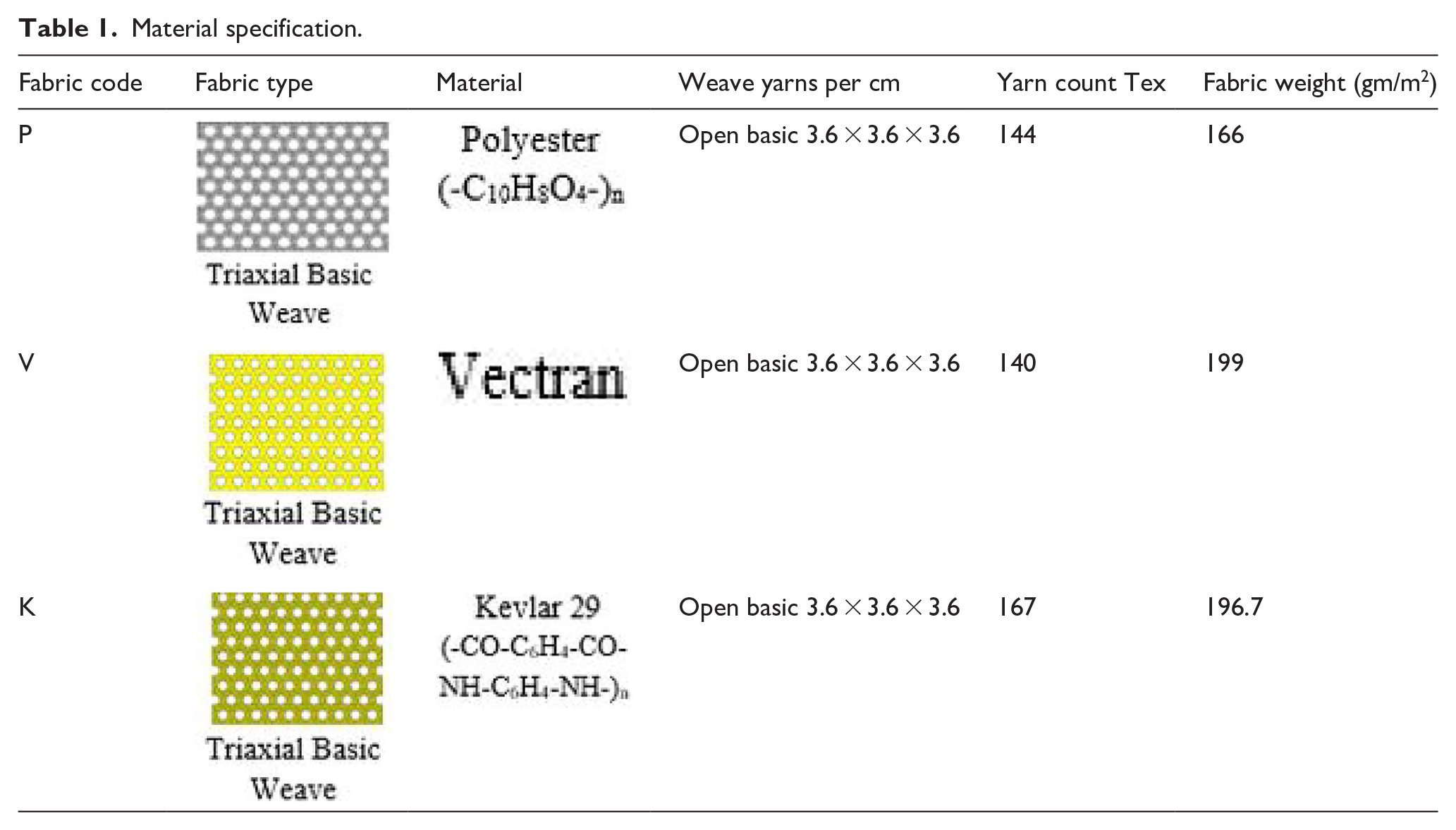
Table 1 gives the specifications of the samples used in the investigation. The samples are manufactured by Tri-axial Structures, Inc. USA.
Material specification.
Testing set up
Fixing a flat fabric between two clamps with a desired shape and by applying cyclic motion from the lower clamp an oscillation resulted give stress on the fabric. Increasing the distance raised more tension applied to the fabric to rearrange the yarns inside the fabric to form the Bra shape, with the aid of heat as shown in Figure 1.Cyclic loading with the different regimes and cycle times was applied under hot air at temperatures up to 500°C. 28 As illustrated in Figure 1, the tested fabric is placed between two plates of fabric holders. The upper half of the bra cup die is fixed to the upper plate fabric holder; besides, both are fixed to the heating section to form the upper part of the set-up. This part can travel down wards to move the upper part downwards in steps, according to the regime of forming. 26 The movement of the bra cup forming mandrel will apply the tension–tension cyclic stretch on the fabric specimen that stretches the yarn’s forming the fabric. The value of the stress σfabric(max) should be less than the bursting stress of the fabric in order to prevent fabric failure so the value of σfabric(max) should be ≪ Fabric bursting stress of the material. After making deformation for the fabric that ensures the required bra cup height h, it is compressed in a compressor to form a 3D shape without wrinkles formed in the fabric. The bra cup form mandrel was designed in order to fit the bra cup form. The shape of the bra cup mandrel should be taken from the dimensions and the shape of the bra that is, cup diameter, cup height, and cup volume.
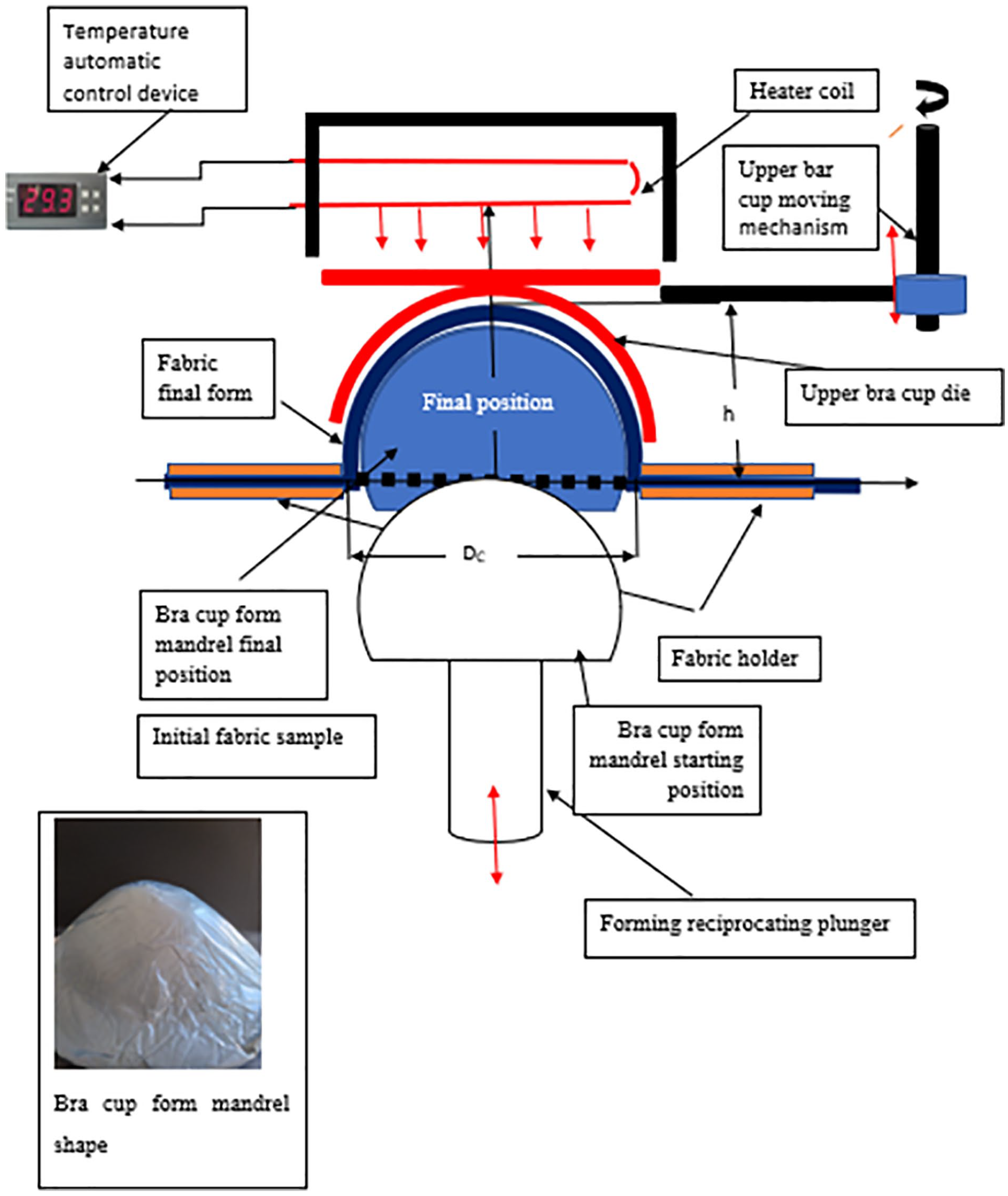
Sketch of the set-up unit.
Procedure of the cup formation
The fabric was firstly tested for the determination of its tensile properties.
Cut the fabric according to the size of front face of the soft armor.
Fix the fabric in the fabric holder of the set up so that the fixed diameter of the fabric is equal to (Dc).
Adjust the suitable temperature and rate of in plan deformation according to diagram.
The fabric was subjected to cyclic loading for time intervals of ΔT, then the upper die half was moved downwards for distance Δy. This cycle was repeated till the final height of the cup shape was reached.
Start both cyclic loading and down word movement of the holder till the middle yarn length stretched enough to form a cup of the required volume, according to the bra cup standards. The process was performed under constant pressure and temperature, depending on the type of material.
The die will be kept under constant temperature for a period of 30 min for annealing. The number of cycles during each step of formation, pressure rate, and clamping pressure, that is, the pressure required to hold the sample during forming at the end of the forming process hot press, were chosen depending on the physical and mechanical properties of the fabric, fabric design, and type of fibers. 25
Results and discussions
Geometrical analysis of bra’s cup
As a guide to choose the radius of the fabric sample to star with Dc the size of the underwire was chosen as a part of a circle that surrounds the cup bra size. The bra underwire guide chart can be applied for the under-wire size and cup diameter and volume.32,33
Bra cup volumes
The bra cup volume depends on the different bra sizes. It was revealed that the relation between the bra size and bra cup volume follows a binomial function. 30
There was some variation in the volume capacity of the same cup size among the different Brands between 130 and 150 cc. 31
However, there are many challenges in developing standardized bra cup system. Women’s breasts occur as a fluid range of shapes, sizes, and volumes. 9
In this work, the existing relations between the bra volume and the bra size were considered to prove the concept of manufacturing women’s amour with a deep drawing method. 28 The problem is determining the size of the fabric required to form the burst size after forming. Hence the fabric will be subjected to cycling loading and heating. The fabric will fix in a special holder with a diameter Dc, and subjected to cyclic loading which will extend the fabric with the aim to reach the final bra size. A range of breast volumes was found to correspond to the same bra size and the volume of any one cup size was not homogenous amongst different band sizes. 29 Therefore, manufacturers designing bras for volumes of this wide range must modify designs accordingly so that the bra design is appropriate for the corresponding breast volume, particularly for the large breast sizes, so that adequate breast support is achieved.
Bra cup sizes
To find cup size, subtract the measurement of the body band from that of the bust band and refer to the chart below in Table 2.
Calculation of bra cup size.

The bra sizing system is different from US, European, and UK. The values of the cup diameter (Dc), and cup volume (Vc) are according to the US system. Calculations assume the cup can be considered as half of the ellipsoid the cup height (h) can be calculated as well as the ratio of the Dc/h. 34 For US standards the average value of (Dc/h) was found to be 2.There are several other systems depending on the local analysis of the body Ergonomics. 35
Figure 2 shows the relation between the bra cup volume and cup diameter, which was found to be different according to, the bra size and the Brand.

Cup volume versus cup diameter for different bra Brands: (a) Brand I and (b) Brand II.
Also, the cup volume was found to vary depending on the Brand size as illustrated in Figure 3.
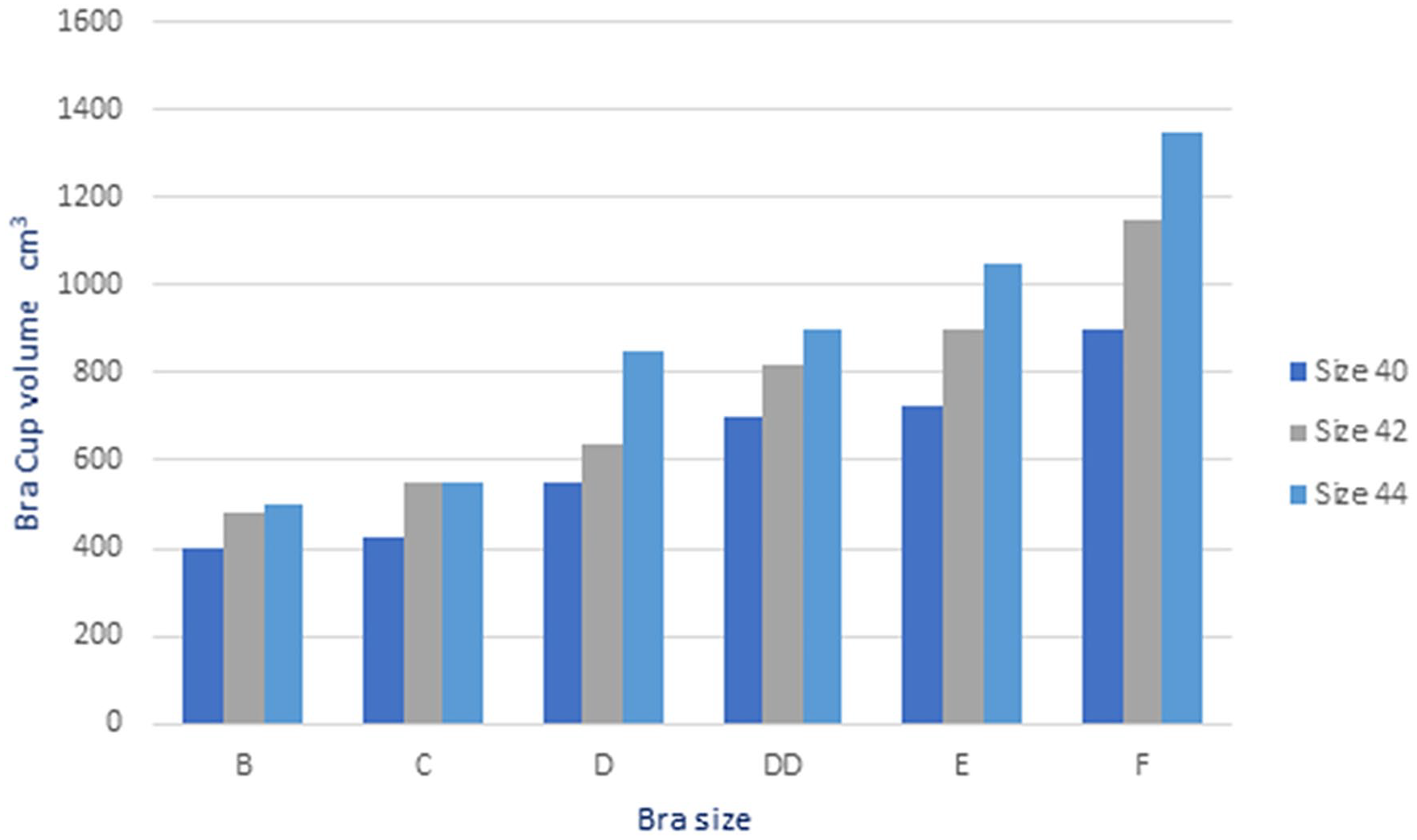
Bra cup volume versus bra size.
Knowing the bra cup volume and the bra diameter are essential data for the determination of the required fabric deformation, and deep drawing process. The relation between the cup height and cup diameter for different bra size systems was illustrated in Figure 4.
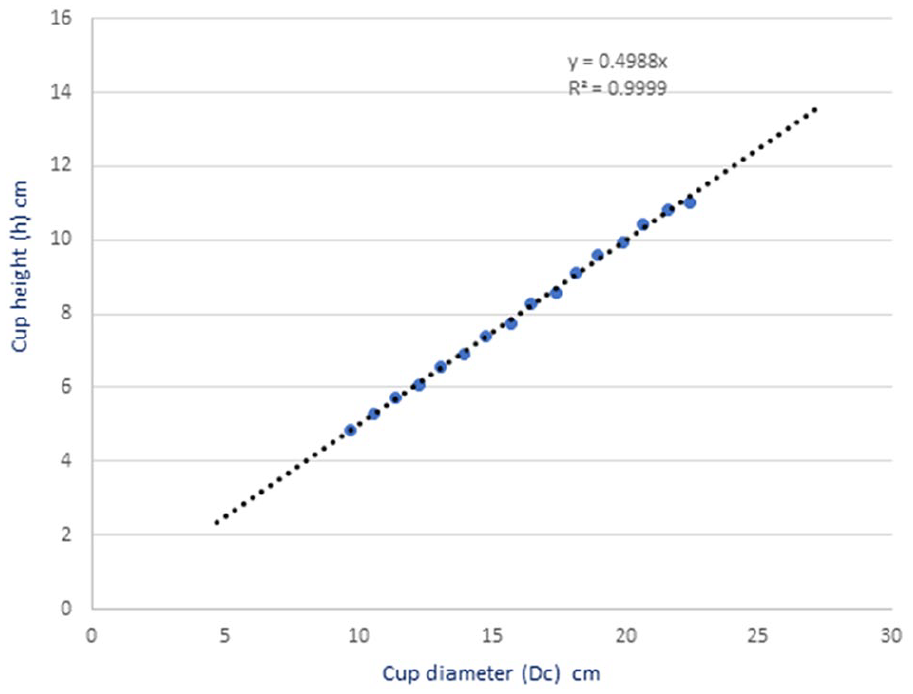
Cup height versus cup diameter for different bra size systems.
Generally, it was found that the cup height

Values of cup diameter, Cup Volume, and cup height can be obtained from Table 3. 34
Bra cup dimensions US standards.

Bra forming calculations
The main objective of the process of cyclic stretch forming and deep drawing is to have value of the relative final residual bagging volume is approximately equal to (Vc) using the following procedures
Cup diameter Dc and corresponding Vc are given from the standards.
The maximum height (h) can be obtained after deep drawing is equal to. In this case the ellipsoid cup,

3. Maximum yarn elongation due to stretching and deep forming of the fabric of diameter Dc to height (h)

4. The extension in the yarn at the center of the sample

5. The yarn will stretch to reach the cup standard height (hs).
6. The stretch of yarn after formations depends on the standards used to classify different bra size systems. The value of yarn strain is equal to Stotal
7. The dimension of the cup should satisfy the following conditions. • The cup volume of the deformed fabric is Vc • The bra cup after deformation is Dc • The strain of the yarns εtotal ⩽ εlimit
Where
εtotal – strain due to yarn de-crimping and yarn straining during stretching and deep forming.
εlimit – the maximum allowable yarn strain.
The complexity in breast shape and variations in size and shape among women, requires the existence of several systems for bra size standards, US, UK, EU, FRANCE, ITALY, JAPAN, AUSTRILA, INDIAN, CHAINA that target the Ergonomics of their female bust. 36
The theoretical analysis of the data for the cup diameter and the cup volume as discussed in equation (2), of the different cup heights is shown in Figure 5. The fitting of the data of the cup volume indicates that the bra cup geometry according to the US standards Table 3, it can be presuming the following equation.


Cup volume versus the cup diameter as a function of the cup height.
If the bra cup shape can be considered as of ellipsoid form and h = 0.5 Dc, then the cup volume (Vc) was found to be;

Both equations are approximately giving the same results as shown in Figure 5.
The suggested procedure for cup formation the central yarns in the cup will be stretched, without failure. The value of the yarn stretched length depends on the cup diameter, cup volume and cup shape. The analysis of the maximum stretched length of the yarn after the bra cup formation, yarn extended length for different bra sizes is shows Figure 6.
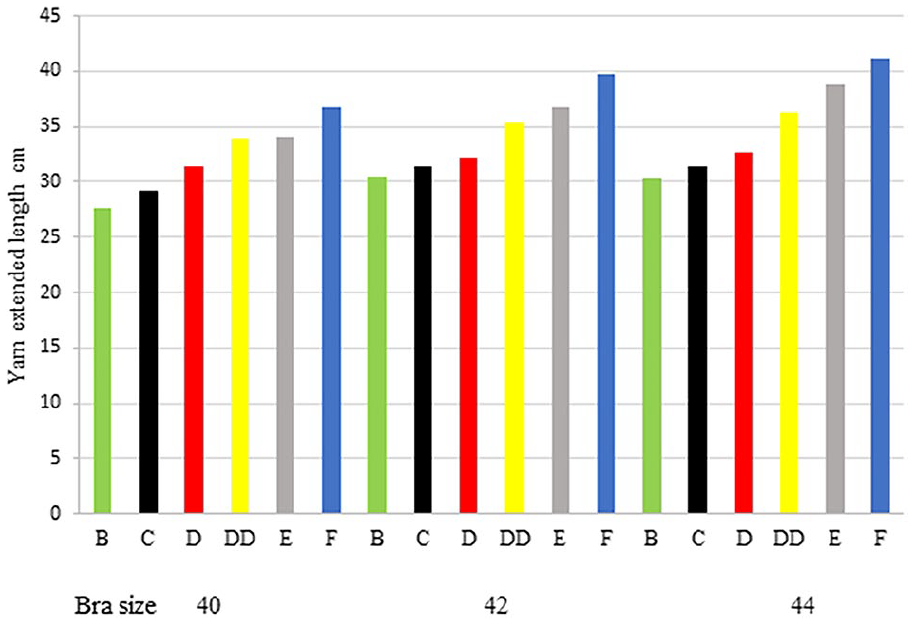
Maximum central yarn extension for versus bra size.
While Figure 7 shows the variation of the maximum yarn extension according to different bra standards which are found to be linearly proportional to cup diameters in all considered bra standards. Its value varied between 100% and 242.21% Dc according to bra cup standards.
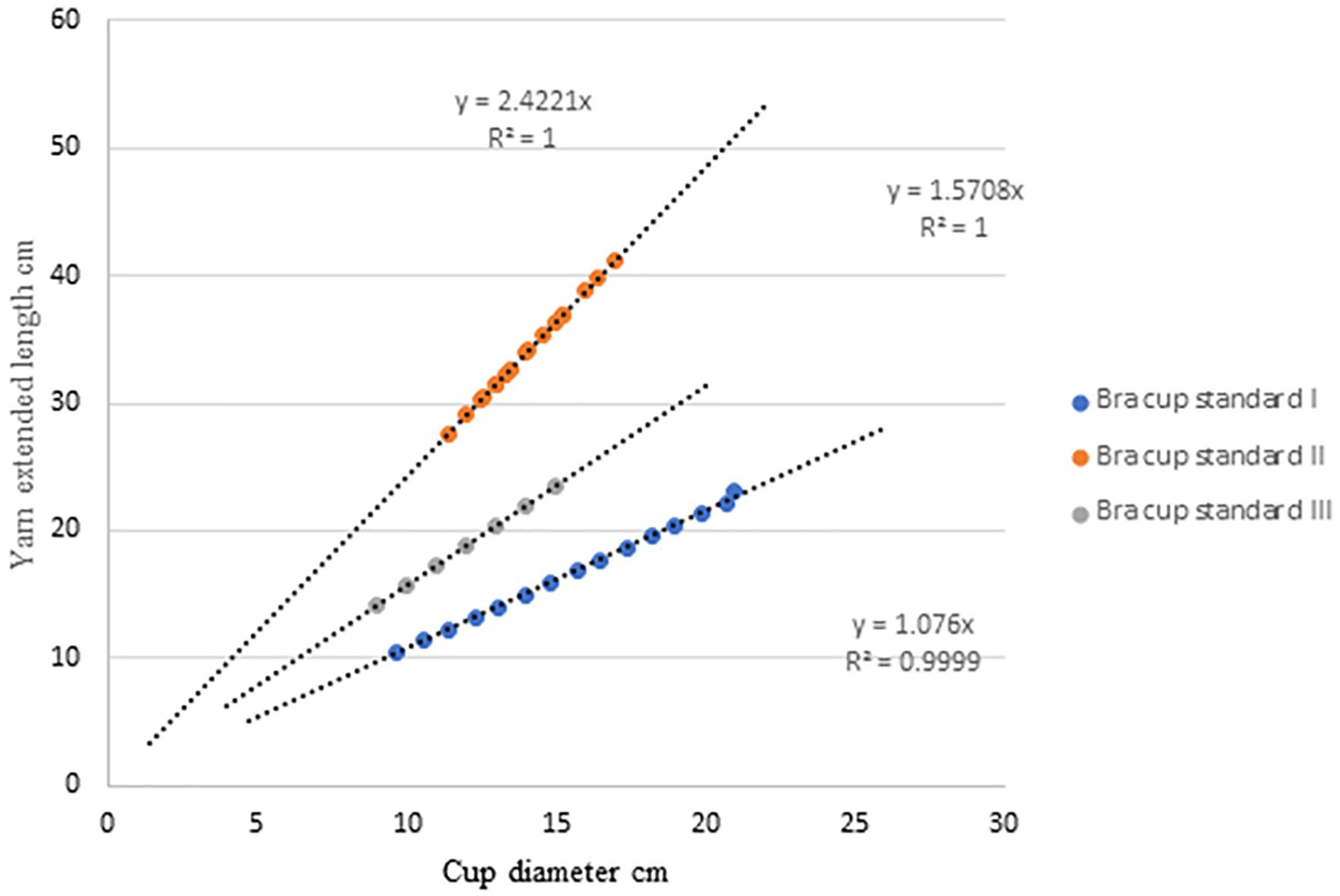
Maximum yarn extended length versus the cup diameter.
The maximum yarn elongation is greatly affected by the cup height. Figure 8 shows that, the maximum yarn elongation is a function of the cup height (h) for US standards the relation between maximum yarn elongation and the cup height (h) taken h = 0.5 Dc is


Maximum yarn extension length versus the bra cup height.
To reduce the required yarn, stretch due to cyclic stretching and deep forming, fabric with high crimp is suggested to be used.
The fabric areal density will decrease according to the percentage of yarn extension in each case.
The fabric after cup forming will have an areal density (GMS) of

Then areal density of the fabric after formation GMS(f), Taking h = Dc/2, then


Where, GMS (0) is initial fabric weight per square meter, Dc cup diameter, h cup heigh.
Consequently, it should take into considerations that the bra part will have less value of GMS than the original fabric depending on the how much the fabric was stretched during the combines of cyclic loading and deep forming under heat.
Bra cup forming by cyclic stretching and deep drawing
Cup shape using triaxial fabric
The triaxial fabric is no crimp fabric. Triaxial woven fabrics are composed of three yarn types, which intersect and interlace at 60-degree angles with one another providing for a more uniform distribution of load during fabric deformation. Also, during cup form mandrel causing deformation’ triaxial woven fabrics exhibit a much more uniform isometric strain. The triaxial fabric has no crimp like the woven fabric so the fabric can be easily deformed during the cup formation. Three types of fibers were chosen with specifications given in Table 1. The size of the mandrel used (dc) is given in Table 4.
Data of the manufactured bra cup.

polyester. **Vectran. ***Kevlar.
The value of deep drawing length should be resulting in the same cup volume required keeping the yarn strain at a predetermined value. Figure 9 shows the shape of different deep drowned cup forms from different materials.
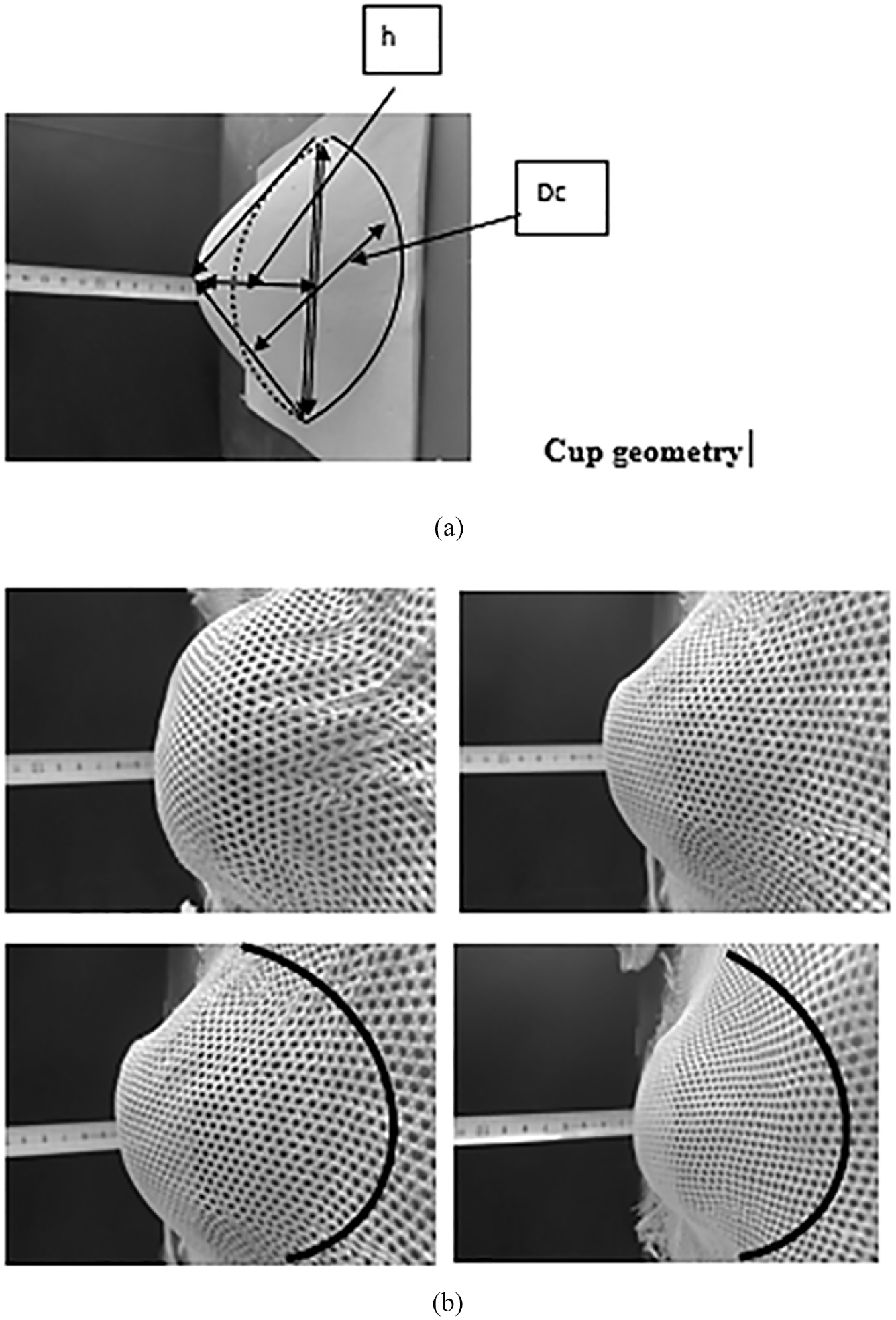
Manufactured bra cup of different shapes: a) cup geometry and b) cup height.
Effect of bra cup formation on the yarn tensile properties
The yarns during the bra cup will be subject to different values of stress depending on their location in the cup area with maximum value applied to the yarn at the center of the cup. 28 In order to evaluate the change of the yarn strength after bra cup formation, five samples of the yarns that were subjected to the maximum stress during the formation process were drowned and tested on tensile testing. The results indicated that no significant change in the yarn tenacity for all types of yarns after bra formation. this may be due to the low number of cycles needed and the process applied under thermal deformation. In the case of large bra cup sizes, the value of initial (Dc) can be taken larger than the required so that the final yarn extension will equal to that.
Total maximum yarn extension = (Ly) – Extension due to cyclic loading – extension due to de-crimping.
Then the formed bra cup will be pressed to the final cup dimensions.
Conclusion
The conducted tests showed that the structure of the Triaxial fabric has a considerable influence on the bra cup formation for all types of materials used. Based on these tests, it can be concluded that
In the experimental comparative analyses of bra sizes the relation between the basic dimensions of the bra cup depends on the standards considered.
For USA standards, the cup volume = 0.253Dc 3 , cup height h = 0.5Dc will lead to maximum yarn elongation = 0.57 Dc.
The choice of the material for the Bra cup should show allow reduction of the strength under the deep forming processes.
The distribution of the yarn extension for the Triaxial fabrics demonstrated a considerable influence of the fabric weave geometry on the way of its spread making it easy to deform according to the curvature of the Bra cup, thus, the Triaxial fabric is recommended.
Footnotes
Declaration of conflicting interests
The author(s) declared no potential conflicts of interest with respect to the research, authorship, and/or publication of this article.
Funding
The author(s) received no financial support for the research, authorship, and/or publication of this article.
