



Abstract
An apparel product has a unique feature other than other products in that apparel product design must consider three categories of design requirements, namely function (governed by natural sciences), comfort (governed by ergonomics), and pleasure (governed by aesthetics and psychology). This paper proposes a general design theory for apparel products. The theory is based on Axiomatic Design Theory (ADT), which is for the functional aspect of products, particularly by adapting ADT to apparel product design, to which all the aspects (function, comfort, pleasure) need to be considered. The proposed theory is thus called the Axiomatic Design Theory For Apparel (ADT-FA). The ADT-FA has two axioms. Axiom 1 (apparel) concerns coupling in the design requirement, and Axiom 2 (apparel) concerns redundancy in the design parameter. The proposed theory is preliminarily validated with the Zoot suit, which is well known in the community of apparel design. The work opens an avenue for more validations in future.
Introduction
Design is to discover the structure of a product under design from its requirement. 1 Design is inherently with the characteristics of iteration and open-endedness. 2 Iteration means that a design process is a back-and-forth process before it reaches a final design. Open-endedness means that there are multiple design candidates or alternatives during a design process; yet a final design is reached through comparison and deliberation.3,4 Deliberation always contains designers’ subjective or empirical knowledge, which thus involves vagueness, uncertainty, and incompleteness. 5 However, it is the subjective decision-making process,6,7 and because of that, design is a highly creative activity.
A design theory refers to the knowledge of explaining the quality of the structure of a product to meet the design requirement pertinent to it. A general design theory refers to the knowledge suitable to all types of products (e.g. apparel products, car products, etc.), while a specific design theory refers to the knowledge available to a specific type of products, for example, car product, apparel product. It is worth mentioning that the general and specific theories here follow the so-called information relativity principle 8 ; see also Figure 1, where an example is illustrated for the information relativity principle. Specifically, in Figure 1(c), the principle 2 gives an account for the phenomenon of the final state of the assembly of parts (A and B), but the principle 2 is a phenomenon (in itself), which is accounted for by the principle 1. As such, the principle 2 serves as a principle while at the same time it serves as a phenomenon. By the way, a design methodology refers to approaches to address problems in design processes.
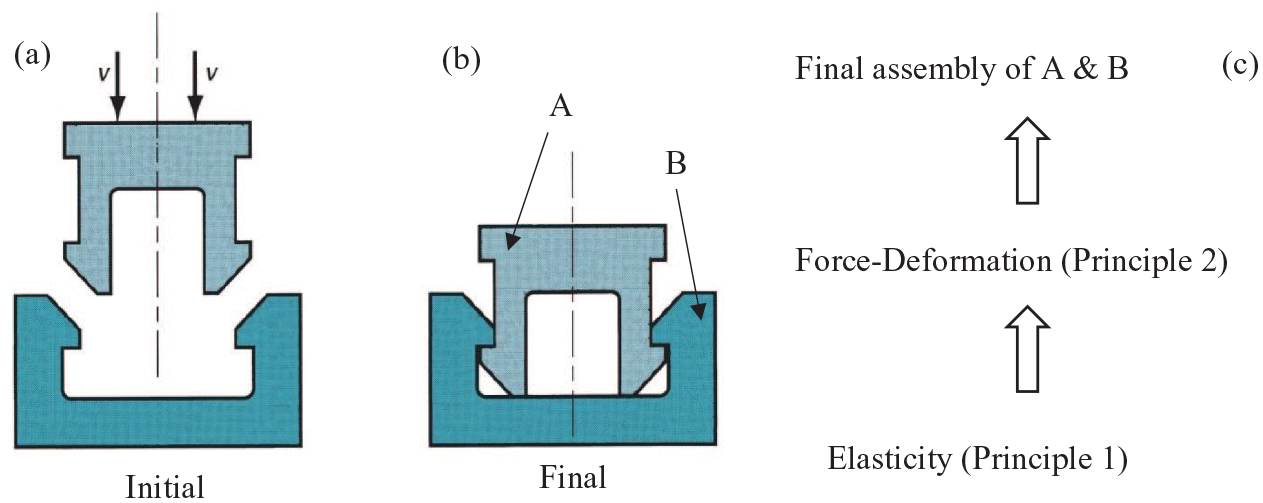
The concept of information relativity principle: (a and b) represent an assembly of two parts (A and B), where (a) is the initial assembly, and (b) is the result of the assembly and (c) illustrates the phenomenon and principle that explains why and how the phenomenon occurs.
This paper concerns the general design theory for apparel products. The general design theory discussed in this paper may not be valid to car products and so on. Nevertheless, the general design theory for apparel products is not meant about a piece of knowledge specifically for determining the structure of apparel products of a special type. 9 For example, a special piece of knowledge is: “cotton materials are with a high biocompatibility as opposed to synthetic polymer materials, so choose cotton materials for a consumer with a sensitive skin.” The general design theory does not contain the special piece of knowledge as exemplified above. It is noted that one of the motivations to develop a general design theory for a specific type of products (e.g. apparel products) is that such a theory is a basis for computer (automatic) design of that type of products (e.g. apparel products).10,11
Apparel design has undergone through a huge change, involving much more complex processes for not only the function but also the comfort (for body and organs) and pleasure (or human’s affect or emotion).12 –15 Design for function follows physics and chemistry, and design for comfort follows ergonomics, and design for pleasure (or affect or emotion) follows aesthetics. 12 A unique feature with apparel design is that all the three categories of design requirements need to be considered in design and further, such consideration must be taken in a simultaneous manner. 4 The structure of an apparel product, generated to meet the functional requirement, is expected to contribute to the requirement in comfort and pleasure (mind, emotion). 16 In functional product design, there are general design theories and methodologies available, for example, Axiomatic Design Theory (ADT).13,17 It is noted that ADT is only for the functional aspect of products, or functional products. A similar theory like ADT is not available to apparel product design, which makes sense to all the three aspects (function, comfort, pleasure).
Few studies in the field of apparel design are on a general design theory for apparel products. Lamb and Kallal 18 proposed a design framework along with a design requirement model called F-E-A (function, expressive, and aesthetic). The F-E-A model recognizes that apparel design involves the aesthetic requirement in addition to the functional and ergonomic requirements. Here, “F” represents the function along with the comfort, “E” represents the identity along with the status of the wearer, and “A” represents the beauty in. 18 They also outlined a design process model, which includes several design phases. Further, the application of the F-E-A model has been reported by Bye and Hakala 19 to the design of the sailing apparel for women. In our view, merging the function and the comfort into one category “F” in the F-E-A model is inappropriate, because design for function follows physics and chemistry while design for comfort follows ergonomics (see the previous discussion in the present paper). This situation violates Axiom I of ADT – each function in the functional decomposition lattice must keep its unique principle.3,13,17
Further in our view, the separation of Expressive (E) and Aesthetics (A) in the F-E-A model is inappropriate as well, because both are about the effects of one’s mind and emotion, and both follows aesthetics, see the previous discussion in the present paper. The F-E-A model recognizes that among “F,” “E,” and “A,” there may be conflicts, and design is to find a balance among conflicts and to minimize conflicts. It will be shown that this conflict theory agrees well with the general design theory for apparel products presented in the present paper, where the conflicts are classified and some of them may not have a negative effect on design for apparel products.
There are many studies on the design phase theory (i.e. design activities are divided into several phases) for apparel design, 20 for example, the three-phase model, 21 the six-phase model, 22 the eight phase-model, 23 and ten-phase model. 24 The design phase theory is to provide a guideline and method to decompose an entire design problem, from a consumer’s voice of needs to a final product, into a set of sub-problems or partial problems; after that, solving all partial problems leads to solving an entire problem. The motivation of the design phase theory comes from the axiom of divide-and-conquer for problem solving. 13 However, the design phase theory does not provide any explicit knowledge to determine the structure of an apparel product, though implicitly the theory contributes to generation of the structure of an apparel product. The design phase theory complements to the design theory proposed in this paper.
The study described in this paper was motivated by seeking for a theory, particularly an axiomatic type of theory like ADT for functional products in literature,13,17 to explicitly contribute to the determination of the structure of an apparel product. The study was based on the general requirement model for apparel products, namely the one that represents the function, comfort (in body), and pleasure (in mind and affect or emotion). For the convenience of later discussions, the theory developed in this study is called ADT-FA (Axiomatic Design Theory For Apparel), as the theory in this study is derived from ADT for general products. In the remaining part of the paper, Section 2 will present the ADT-FA. Section 3 will illustrate the usefulness of the ADT-FA with a known design sample, which has had consensus regarding the quality of this design in the field of apparel design. Section 4 is a conclusion.
A general design theory for apparel products
In the general design theory and methodology for functional products or technical systems, there is a theory called Axiomatic Design Theory (ADT).13,17,25 Two salient features with ADT are coupling and redundancy. Coupling in ADT says: if a design has several requirements, then (1) these requirements must be kept as independent to one another and (2) design parameters that satisfy these requirements must maintain this independency [3, 13, 17]. This coupling concept is expressed as Axiom 1 in ADT, 17 see below:
Axiom 1 (ADT): Functional requirements (FR) must be made to be independent to each other and design parameters (DP) to fulfill functional requirements must maintain the independency of functional requirements. 17 According to Fan et al., 13 and Suh 17 any design that violates Axiom 1 (ADT) is a poor design.
In the case of apparel products, a particular design parameter (e.g. color) may not only meet a functional requirement but also meet an emotional or affective requirement26 –28 or requirement for pleasure called in this paper. This means that the coupling across the three categories of requirements (functional, comfort, and pleasure) with respect to design parameters is inevitably presented and thus, conflicts among the design parameters with respect to the three categories of requirements may be presented. As such, Axiom I of ADT is not suitable to apparel product design.
Redundancy in ADT in Fan et al. 13 and Suh 17 refers to the situation where two or more design parameters are defined to satisfy the same (functional) requirement at the same time and same place. For a product that only the functional requirement is concerned, redundancy makes sense in many areas, such as improving the reliability and resilience of products (e.g. two engines in the aircraft),1,3,29,30 and the functionality of machines. 31 However, to apparel products, redundancy does not appear to make sense in the foregoing areas, because the reliability as well as resilience is the attribute with respect to the functionality. Even for a functional apparel product, the reliability of product is much about the material rather than anything to do with the structural redundancy. Further, redundancy does not contribute to the ergonomic and aesthetic properties of an apparel product. 12
Based on the above discussion, we adapt the notions of design coupling and design redundancy in ADT for general functional product design to apparel product design, specifically proposing the following axioms for apparel products.
Axiom 1a for apparel (ADT-FA) (RE: coupling): coupling of the requirements in the functional category or the ergonomic category is not allowed, which is the same as Axiom 1 in ADT.
Axiom 1b for apparel (ADT-FA) (RE: coupling): coupling of the requirements across the two or more requirement categories (functional, ergonomic, and aesthetic) is allowed.
Axiom 1c for apparel (ADT-FA) (RE: coupling): coupling of requirements in the aesthetic requirement category is allowed.
Remark 1: Axiom 1c is valid due to the nature of an affective or emotional response from humans. Suppose there are two requirements on affective responses to an apparel product under design, denoted as AR 1 and AR 2 (AR: aesthetic requirement). For instance, AR 1: elegant, AR 2: beautiful. First, an apparel to a wearer, which makes the wearer look elegant, may make the wearer look beautiful as well. Second, the DP 1 (to achieve AR 1) and DP 2 (to achieve AR 2) are inevitably coupling (Figure 2). This point has also been demonstrated by the computer aided system for aesthetic design for apparel products.26,27 Indeed, a design parameter for AR 1 can hardly be made with no influence on AR 2, and vice versa. Indeed, our experience is such that an emotional response is always emergent from various structural elements or DPs in the context of design.
Axiom 2 for apparel (ADT-FA) (RE: redundancy): there is no sense of redundancy to apparel product design or redundancy design for apparel is bad design.
Remark 2: The axioms are the necessary condition rather than the sufficient condition, which means that if a design violates the axioms, it deems to be a poor design otherwise a further evaluation of the design is needed.
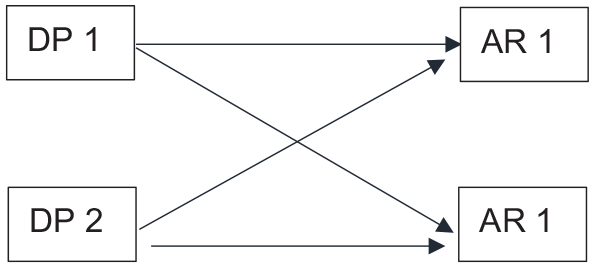
Full coupling between the design parameter and aesthetic requirement.
Preliminary validation
In this section, we present a preliminary validation to the proposed axioms (ADT-FA). The approach is as follows. We use an existing apparel product called zoot suit, 32 to which there has already been a consensus in the apparel design community about good or bad with it. We apply the proposed Axioms (ADT-AF) to the zoot suit design to see whether a similar evaluation of the design as one existed in the apparel design community can be re-produced by ADT-AF.
The known consensus on the zoot suit
The zoot suit is a fashion of design in the apparel history. 32 It has high-waist, wide-legged, tight-cuffed, pegged trousers, and a long and oversized jacket with giant collars and wide padded shoulders (Figure 3(a) and (b)).33,34 The following are some consensuses about the zoot design in the apparel design community.
○ Consensus 1 (critique): the zoot suit design wastes materials or uses materials in an excessive way.
○ Consensus 2 (critique): the zoot suit design is comical in appearance, and the suit appears to have overly large clearances for wrapping up the body. 32
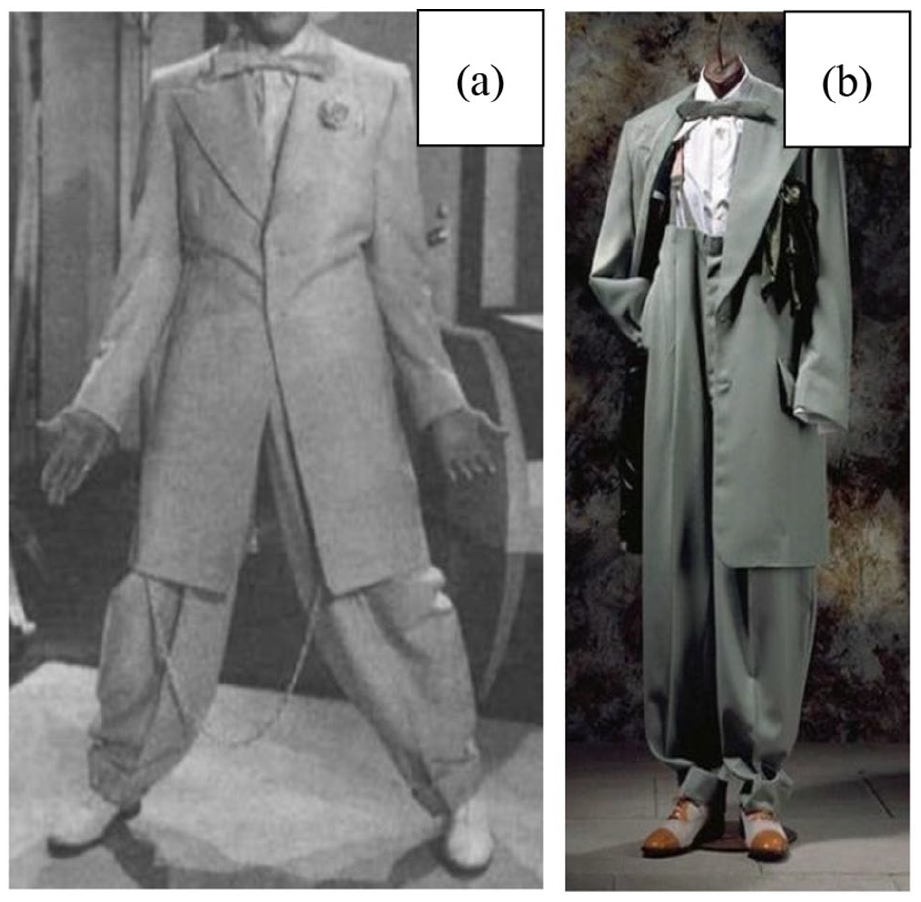
Zoot suit: (a) the whole suit (jacket and pant) 31 and (b) the pant of the zoot suit.
Therefore, the zoot suit design is not appropriate for use in the general population but rather may be limited to its use in comedies in that cultural and social context.
Analysis of the zoot suit design with the proposed axioms
The main requirements (R) of the zoot suit are coverage of the body (function), ease of wear (ergonomics), and affect (aesthetics), and they are put together named as FEA (F: function, E: ergonomics, A: aesthetics) (FEA may also be named as FCP, where F: function, C: comfort, P: Pleasure.). Specifically, the design requirements for the zoot suit can be described as follows:
(1) FEA-R1 (F): maintain warm by keeping the temperature in the range of 36.5°C to 37.5°C.
(2) FEA-R2 (E): facilitate the movement of limbs.
(3) FEA-R3 (A): be consistent with the mood of people at that time (During the 1930s, the economy was in recession, and the atmosphere was one of worry and anxiety 32 ).
(4) FEA-R4 (F): be cost effective (especially in the aspect of materials).
FEA-R1 (F) is further decomposed into:
• FEA-R1.1 (F): use of materials with the low thermal conductivity.
• FEA-R1.2 (F): coverage of parts of the body except limbs.
• FEA-R1.3 (F): coverage of body and arms.
• FEA-R1.4 (F): coverage of legs.
FEA-R2 (E) is further decomposed into:
FEA-R2.1 (E): movement of arms relative to the upper body.
FEA-R2.2 (E): movement of legs relative to the lower body.
By examining the design of the zoot suit, the apparel design parameters (ADPs) are identified and defined in the following:
○ ADP1.1: cashmere which has a low thermal conductivity.
○ ADP1.2: apparel for the body part except limbs.
○ ADP1.3: jacket (large and extra-large).
○ ADP1.4: trouser (large and extra-large).
Figure 4 shows the association (coupling and redundancy) between the apparel design parameter (ADP) and the functional, ergonomic, and aesthetic requirements (FEA-R). From Figure 3, the following observations can be made. Observation (1): ADP1.3 and ADP1.4 couple FEA-R1.3 and FEA-R1.4 in that ADP1.3 (ADP1.4) fully achieves FEA-R1.3 (FEA-R1.4) while partially achieving FEA-R1.4 (FEA-R1.3). Observation (2): There is a redundancy design, that is, ADP1.3 fulfills FEA-R1.3 in full while partially fulfills FEA-R1.4, and ADP1.4 fulfills FEA-R1.4 in full while partially fulfils FEA-R1; in other words, to fulfill FEA-R1.3 (FER-R1.4), ADP1.4 (ADP1.3) makes redundancy with ADP1.3 (ADP1.4) in part.
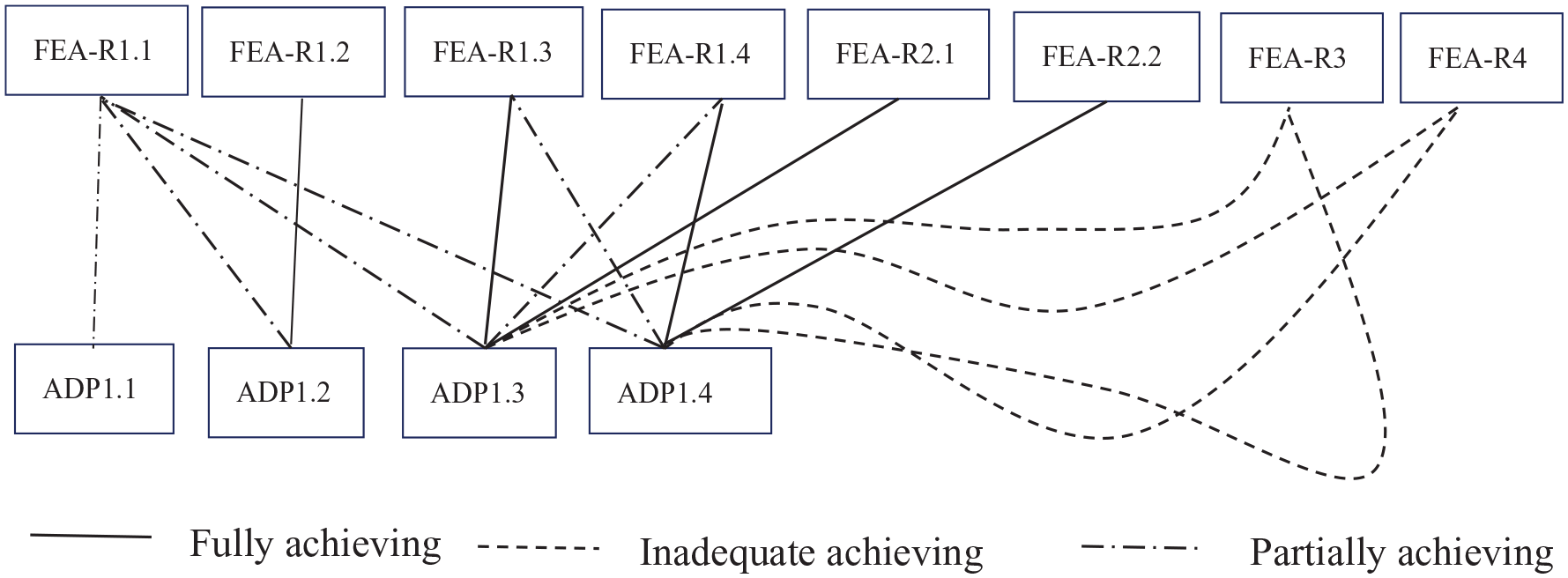
The association between the apparel design parameter (ADP) and the function, ergonomics, and aesthetics (FEA) for the zoot suit design.
Analysis of the above design based on the two proposed axioms is conducted and the result of it is summarized with several remarks in the following.
Remark 3: The above design has a design flaw (Flaw 1) – that is from the point of view of the coverage function (FEA-R1.3 (F) and FEA-R1.4 (F), respectively); the jacket and pant have a coupling to the functional requirement category, that is, violating Axiom 1a (ADT-FA). This error agrees with Consensus 1 (critique).
Remark 4: ADP1.3 (ADP1.4) gives a partial redundancy design in achieving FEA-R1.4 (FEA-R1.3), which results in another design flaw (Flaw 2), that is, violating Axiom 2 (ADT-FA), a large allowance or ease to the body with the jacket (pant or trouser) in this case.
Remark 5: The joint effect of the two flaws is responsible for the comical effect – see Consensus 2 (critique). Particularly, both the jacket and pant designs have poorly met the ergonomic requirement (i.e. too spare rooms or ease between the apparel and body). Interestingly, the situation here seems to say that a poor design from a functional or ergonomic point of view may also negatively create a poor affective response; in this case, the redundancy design, that is, violating Axiom 2 (ADT-FA) along with the design violating Axiom 1a (ADT-FA), creates a comical affective response.
Remark 6: It can also be found from Figure 4 that there are several design couplings across the functional, ergonomic, and aesthetic requirement categories or domains, for example, ADP1.3 contributing to both FEA-R1.3 (F) and FEA-R2.1 (E) – creating a coupling between the functional requirement domain and ergonomic requirement domain (see Figure 5). In Figure 5, the design of the overall jacket contributes to the function of FEA-R1.3 (F) (covering the arm), while it also meets the need of the movement of the arm, that is, FEA-R2.1 (E), which is governed by the ergonomic principle. Nevertheless, this coupling does not violate the axioms (ADT-AF) at all, because FEA-R1.3 is about the requirement in function, while FEA-R2.1 is about the requirement in comfort. It is worth mentioning that not violating the axiom (ADT-FA) here does not imply that the design, ADP1.3 in this case, is a good design (see also Remark 2 in the previous discussion). In fact, according to Remark 4, ADP1.3 is a redundancy design with ADP1.4, suggesting a design flaw. Further, a comical response may also be created in ergonomic design alone, which is out of the scope of the present paper.
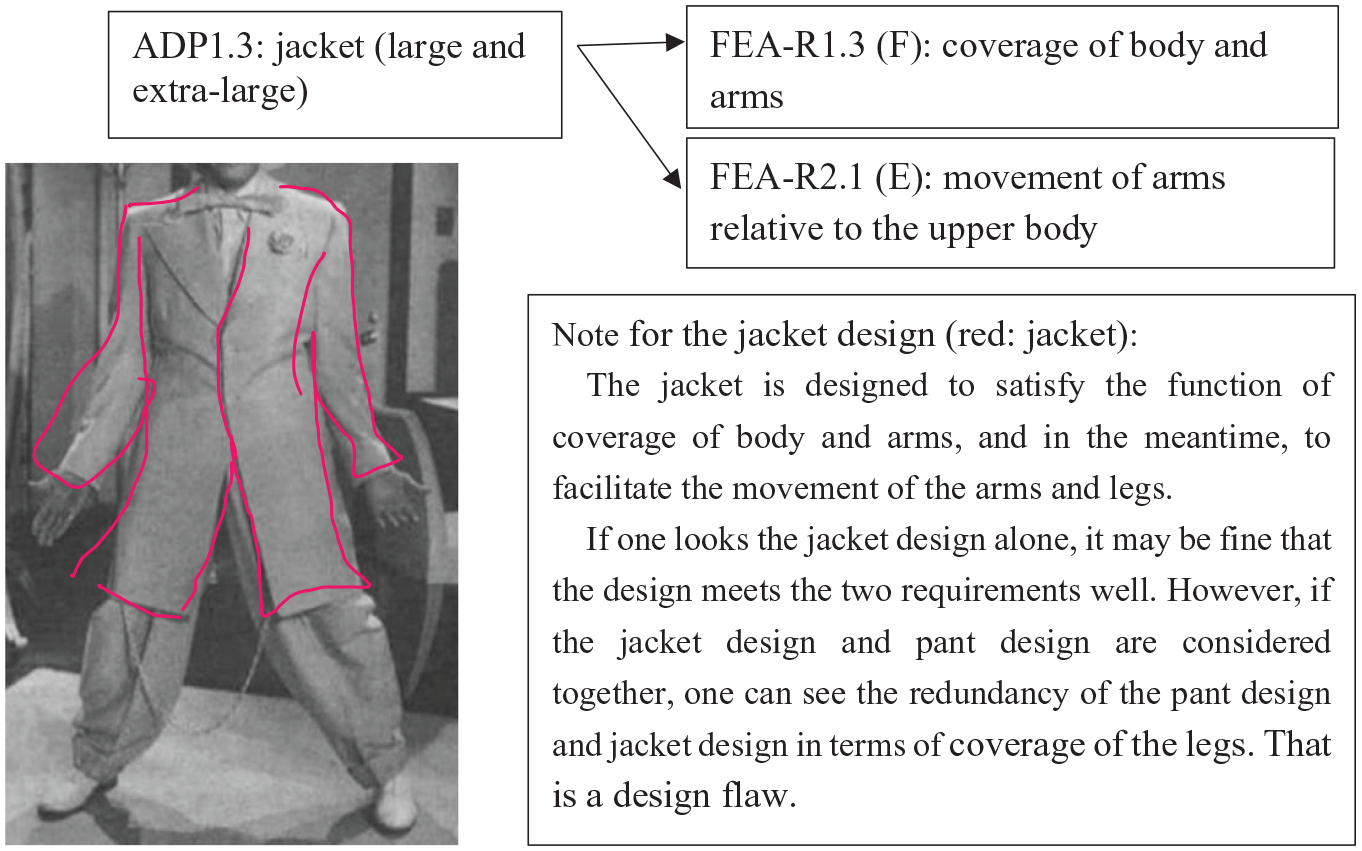
Narrative analysis of the jacket design. It couples the function and comfort domain, which has not violated the ADT-FA because of different requirement domains.
Conclusion and future work
In this paper, a new general design theory for apparel products was presented, which is called ADT-FA (axiomatic design theory for apparel). The ADT-FA helps to determine the structure (i.e. design) of an apparel product to meet all three categories of design requirements, namely function, comfort, and pleasure. The ADT-FA is inspired from the axiomatic design theory (ADT) 17 for general functional products and thus has a solid foundation. Just as ADT is a general design theory for functional products, ADT-FA is a general design theory for apparel products to meet the design requirements in terms of not only the function but also comfort and pleasure. In fact, the ADT-FA is applicable to any type of product, to which all the three aspects (function, comfort, pleasure) make sense.
ADT-FA only gives a necessary condition for a good design but not any sufficient condition. The sufficient condition shall be given by the principles in ergonomics and aesthetics (see Remark 6 above). It is worth mentioning that in ADT for functional products, there is the other axiom called “Information content axiom,” which gives a sufficient condition for the best design. Unfortunately, in ADT-FA, there is no such an axiom available, worthy of future research effort.
The main limitation with this paper is that only one validation was conducted. There are two reasons for this limitation, though a future effort is certainly warranted. First, the axioms proposed in this paper for apparel product design are the necessary condition only, which implies that they can only be used to delineate a bad design (e.g. the zoot suit). Finding a bad design with a high degree of consensus in the apparel design community is difficult. Second, an axiom inherently comes from empirical knowledge, meaning a need of many practices. This suggests that validation be more achievable by many researchers and design practicians in the apparel design community, which we vision more researchers may join us if our paper can be in a public domain.
Footnotes
Declaration of conflicting interests
The author(s) declared no potential conflicts of interest with respect to the research, authorship, and/or publication of this article.
Funding
The author(s) disclosed receipt of the following financial support for the research, authorship, and/or publication of this article: The study was financially supported by Chongqing Social Science Funds (Grant No. 2022NDYB172), Humanities and Social Science Funds of Ministry of Education [Grant No. 21YJCZH239], the Fundamental Research Funds for the Central Universities [Grant No. SWU2109241], Innovation Research 2035 Pilot Plan of Southwest University [Grant No. SWUPilotPlan027], and the Open Project of China’s Borderland Literature and History Research Center of Regular University’s Humanities and Social Science Key Research Base of Xinjiang [Grant No. BJWSZ202201].
