




Abstract
Sports bras have been reported to be a hindrance to the effective workout of females. This study elucidates the pressure distribution in eight different sport bra types of different sizes during shoulder workout activities to address this hindrance. The upper body moves in horizontal, vertical, and circular directions. An observational survey was carried out at the Zhejiang Sci-Tech University gyms, and among 300 females, the majority focused on shoulder workouts. The experiment used pressure sensors to analyze the most significant sports bra for females with a bra size of 34C, 36C, and 38C during three body movements. We conclude the in-depth width of the neckline has an impact on strap comfortability as well as the back design and structure also influence the performance of the back band. Additionally, racerback bras produce less pressure for bra size 34C. In addition, crossing back with thicker and broader straps produces less pressure for females with a bra size of 36C. For bra 38C, a racerback with thicker straps generated less pressure.
Introduction
Comfort comes first when sports bras are mentioned, with most females identifying the straps as the comfort area. 1 A sports bra becomes one of the critical components to consider in doing exercises to reduce, if not eliminate, discomfort. Emma mentioned support as the second factor of thoughts on a bra. However, Risius 2 and Risius et al. 3 reported support as the third factor after esthetics. Meanwhile, previous breast biomechanics research showed that increased breast support could minimize breast discomfort. 4 The significance of pressure on the comfort of a bra on the body is of concern in the apparel industry due to its direct contact with the human body and its sensitivity. 5 Breast elevation and compression have been linked to increasing the comfort of the breast, with McGhee et al. 6 proposing that the inclusion of thick foam pads inside bras could be much more supportive to breast discomfort. The tightness of the under-bust band was identified to be an interference with ladies’ comfort. 7
One other factor associated with bra and comfort is the bra size. Concerning a sports bra, wearing the wrong size, too small or big, can result in breast pain. Already some sports bras lead to breast displacements such that very loose bras result in support issues during workouts. In the case of a very tight sports bra, there is the generation of high pressure which subsequently leads to discomfort. 8 Research has shown that about 46% of women suffer from unfitted sports bras 9 while a higher percentage of women complained that some parts of sports bras are too tight (shoulder straps, underbust, and armhole). 7 Although shoulder straps are designed to support breast mass, they are considered uncomfortable in some cases to wearers owing to the excessive pressure it exerts on the shoulder. 10 Therefore, crisscrossing the straps at the back helps to reduce the straps’ discomfort. 11
The pressure from the bra is among the most critical factors that affect the wearer’s health and comfort. The pressure of a sports bra on the wearer can irritate the skin and decrease blood flow when the pressure value of the bra is greater than the human’s tolerance limit.12,13 For this reason, the device used to measure the pressure of the bra on the human body should be very accurate and human-friendly.
To date, no clear conclusion has been drawn on the pressure from bra straps on humans. For instance, 14 argued that there is no significant difference in bra straps where they reported that wider straps produce less pressure on the shoulder. They further compared vertical and cross back bras and revealed that vertical bra strap orientation is more suitable for women with larger breasts than cross back strap orientation. On the contrary, 15 reported higher pressure from cross-back strap orientation compared to vertical strap orientation. Here, the mean peak pressure varied and was low for the two types of orientations studied. It was concluded that the vertical strap orientation gives lower discomfort as compared to cross-back orientation. Xiaomeng 16 studied the effect of pressure on both smaller and larger breast sizes. He concluded that the back area of a sports bra is more sensitive to pressure than other areas for women with larger breasts than those with smaller breasts. To this end, the reviewed literature indicates the lack of coherency in research findings on the comfort associated with a sports bra. Therefore, the present study aims to compare and evaluate the pressure levels of eight different back structures for both smaller and bigger breasts during three selected physical activities that result in the upper body’s horizontal, vertical, and circular movement. It is expected that the findings in this work elucidate the pressures associated with a sports bra and recommend bra types for specific physical activities that lead to more comfort.
Method
Participant
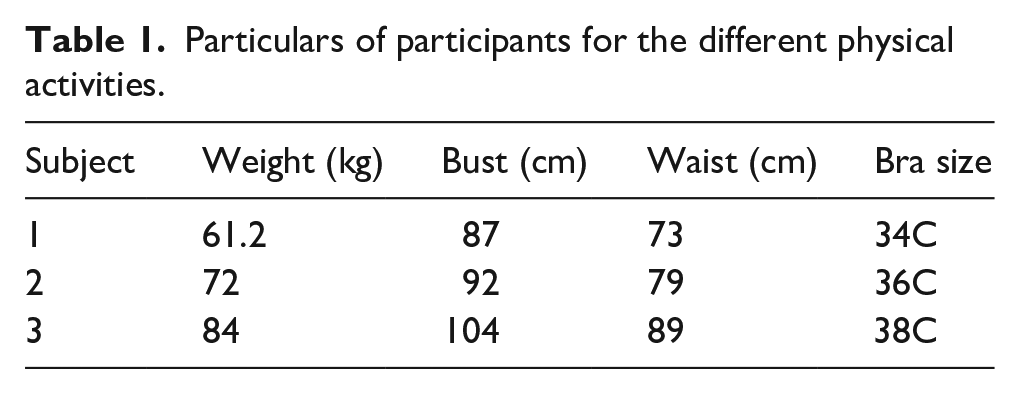
Three young females who had not breastfed before were recruited for the current work. All subjects take part in sports activities, mostly shoulder and back workouts which made it easier because they already had a fair idea about the chosen activities. This is justified because each participant had to undergo three different activities using different sports bras sizes and types. Hereafter, participants are referred to as subjects. Table 1 shows the details of the subjects used in the work.
Particulars of participants for the different physical activities.
Bra samples
The material used to design sports bra, the structure of the neckline, and the width and thickness of shoulder straps and under bust band were found to be influencing factors to consider about, control, and support. 17 In total, eight different structures of sports bras were used. The main similarity between these sports bras was the fabric; sports bras A, B, D, E, and F had a fabric composed of 75% nylon and 25% spandex, whilst sports bras C, G, and H had 70% nylon, 20% spandex, and 10% polyester fibers. Figure 1 gives a summary of the details of the sports bras used.

The structure and design characteristics of the various sports bras used in the present study.
Experimental procedure
In identifying the appropriate sports bra that produces less pressure when females undertake different shoulder activities, a dynamic pressure experiment was conducted. The pressure sensors were positioned on the left side of the subjects. Sensor 1 “S” named shoulder strap, and sensor 2 named back band is shown in Figure 2. A repeated test was done for all the subjects during all activities which lasted for 10–20 s. Each activity lasted about 97 s with 5 min rest intervals before the next activity took place.

Detected positions used in pressure the test.
During activity 1 (seated dumbbell press), a 2.5 kg dumbbell was placed in the left palm while the subject sat upright in a comfortable position with their hands slightly wider than a shoulder-width distance apart. Their core was kept straight and tight, and then the dumbbells were moved from the left side to the center without dropping the elbow. It was repeated until it was rest time. Secondly, for activity 3 (dumbbell front raise), the exercise was started by standing with a shoulder-width stance and holding a pair of 2.5 kg dumbbells in front of their thighs so that their palm faced their thigh (overhand grip). They then raised the weights in the front and continued moving them upward until they reached shoulder level. Their elbow was slightly bent whilst the palms faced down. After the second push, they lowered the dumbbells to their initial position. Lastly, a flat plate was placed in the palms of the subjects where their hands were stretched to shoulder level, and the plate was rolled in a circular motion for activity 3 (front roll). Figure 3 shows the different activities described.
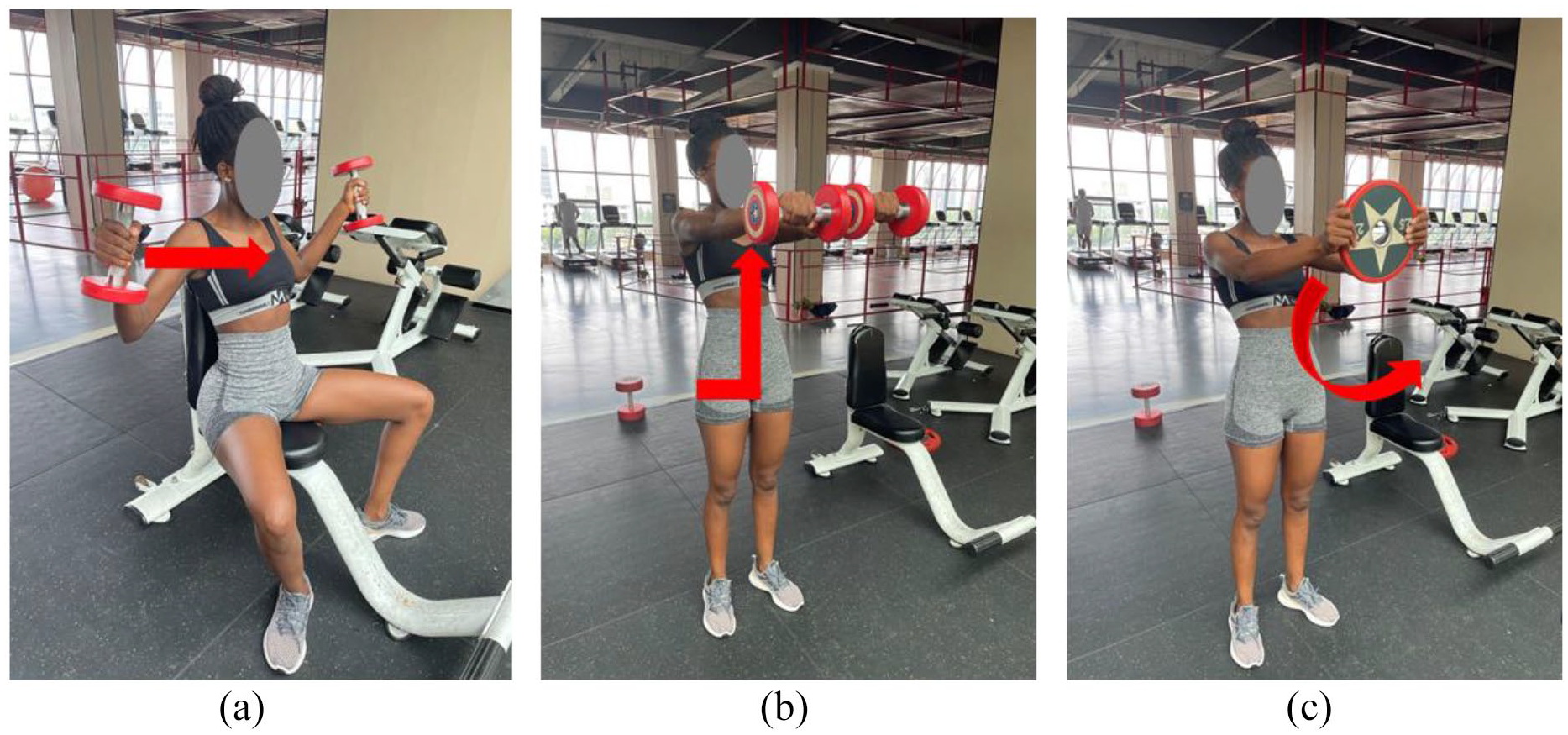
Activities: (a) seated dumbbell press (vertical movement), (b) dumbbell front raise (horizontal movement), and (c) front roll (circular movement).
Materials
Coltman et al. 14 suggested that measuring the pressure value of the bra required a device with high sensitivity and stability. Sensors used in measuring pressure value should be human friendly, measure any part of the body, especially curvy parts, and possess the ability to function under different conditions (static or dynamic). Air-pack pressure and electrical pressure sensors are the most dominant measuring devices used to measure pressure values. FlexiForce is one of the commercially available electrical pressure sensing systems commonly used. Another standard pressure measurement system is the Novel Pliance system, composed of a multi-channel analyzer, calibration device, and computer software. This type of device can measure different parts of the human body due to the different sizes of sensors. Also, the elasticity of the sensor can ensure consistency around contoured areas of the body without wrinkling. 18 Based on the above, this study used the Novel Pliance system to accurately measure both static and dynamic motions (see Figure 4).
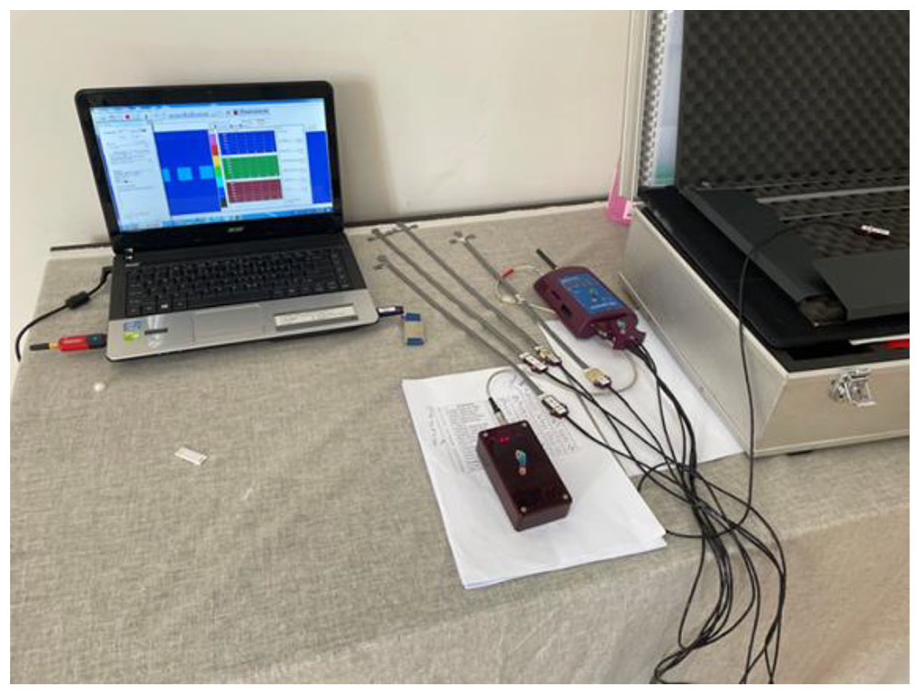
Novel Pliance-X pressure sensors show the different components of the sensor system.
Results and analysis
The main aim of this study was to identify a comfortable sports bra for each subject during different movements (horizontal, vertical, and circular) of the upper body. Figure 5(a) shows the strap pressure distribution results of all eight sports bras. Table 2 shows the mean ± SD pressure distribution of subject 1 (34C) shoulder strap (S) for activities 1, 2, and 3. Sports bras F, A, and H generated less pressure at the shoulder level during activity 1, which moves the upper body vertically. They came with 1.61, 1.92, and 2.07 kPa, respectively, whilst sports bras G, D, and B produced more pressure with an average mean of 3.68, 2.67, and 2.41 kPa. With activity 2, sports bras F, E, and A produced less pressure with 1.76, 1.97, and 2.27 kPa, respectively, whilst sports bras H, G, and D generated more pressure with a mean pressure of 6.30, 3.54, and 3.15 kPa respectively. Sports bras F, E, and G were identified as the less pressured straps during activity 3 with 1.57, 1.96, and 2.67 kPa, respectively. During the same activity, sports bras H, D, and A generated more pressure with 5.22, 4.52, and 3.49 kPa, respectively. Considering the total of all eight sports bras during the three movements, activity 1 represented a total mean of 18.60 kPa and 1.62 SD. Also, activity 2 showed a total mean of 24.44 kPa with 4.79 SD whilst activity generated 3, 25.13 kPa with 4.26 SD. From the total mean, it can be said that a relationship exists between horizontal and circular but not with vertical movement of the upper body for bra size 34C because of the interval between activity 2 and 3 <1 kPa whilst the interval between these two activities and activity 1 >5 kPa.
Comparison of the shoulder strap for subject 1 during all activities.


(a) Bra size 34C average strap pressure for all activities and bra types, (b) comfortable strap for bra size 34C. Strap34CF1 – bra size (34C), bra type (F), and activity 1. Strap34CF2 – bra size (34C), bra type (F), and activity 2. Strap34CF3 – bra size (34C), bra type (F), and activity 3.
Figure 5(b) shows the best pressure distribution of subject 1 (34C) shoulder strap (S) for activities 1, 2, and 3. Surprisingly, sports bra F was identified as the comfortable strap during the three movements of the upper body. Therefore cross back sports bras with hallow neckline, thin straps, and compression design is recommended to females with bra size 34C whilst sports bras with shallow neckline and thicker straps aren’t recommended to subject 1 when the shoulder strap is the key factor.
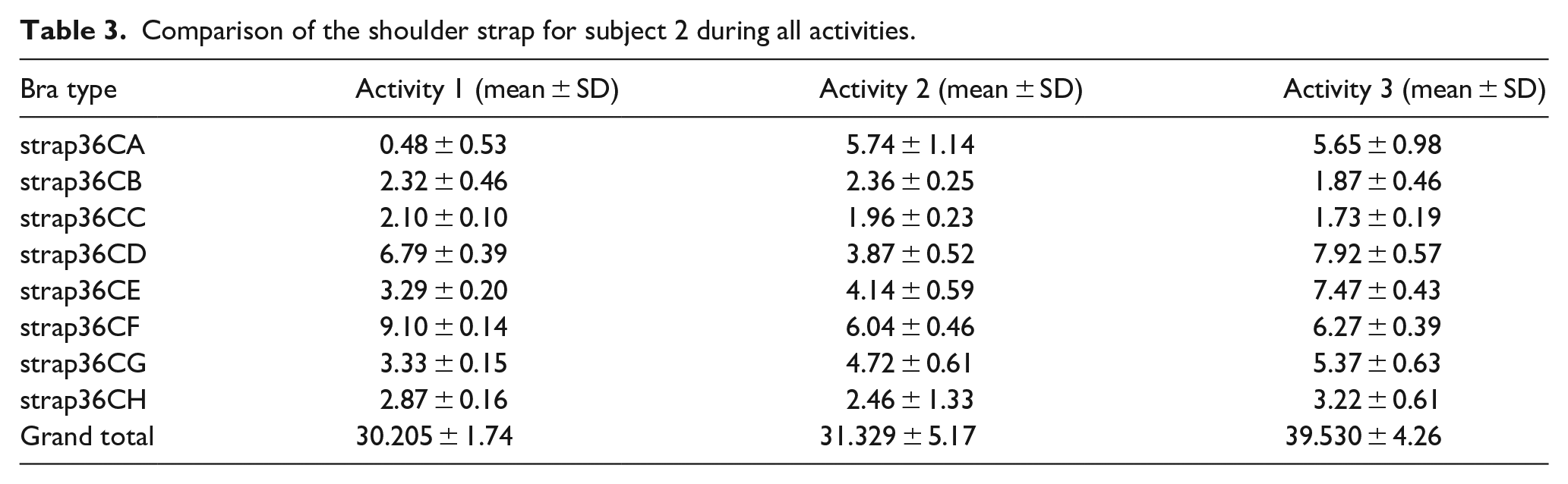
Table 3 shows the mean ± SD of the shoulder straps during activities 1, 2, and 3 of subject 2. In assessing the shoulder strap, sports bras A, C, and B were identified as the most comfortable bra during activity 1 with 0.48, 2.10, and 2.32 kPa respectively, whilst sports bras F, D, and G produced more pressure with 9.10, 6.79, and 3.33 kPa respectively. Also, during activity two sports bras, C, B, and H generated less pressure with an average mean of 1.96, 2.36, and 2.46 kPa respectively but sports bras F, A, and G produced more pressure with 6.04, 5.74, and 4.72 kPa respectively. Furthermore, sports bras C and B were still identified as the comfortable strap during activity 3, they came up with a mean pressure of 1.73 and 1.73 kPa respectively, only two sports bras were chosen to be comfortable at this stage because the mean interval between the third bra and the first two comfortable bras chosen was >5 kPa but three sports bras generated more pressure at the shoulder strap because their mean interval was >1 kPa, sports bra D, E, and F fell under the mean of 7.92, 7.47, and 6.27 kPa respectively. Again, Table 3 shows the total mean±SD of all activities, activity 1 generated 30.205 kPa with ±1.74 SD, activity 2 produced 31.329 kPa with 5.17 SD, and activity 3 summed up to 39.530 kPa with 4.26 SD. Based on the total mean, there’s a relationship between the vertical and horizontal movement of the upper body but no relationship between all three movements, because the mean interval between activity 1 and was 2 >1 kPa whilst the interval mean between these two activities and activity 3 was >9 kPa. Figure 6(a) shows a clear graph of all eight bras and activities.
Comparison of the shoulder strap for subject 2 during all activities.

(a) Bra size 36C average strap pressure for all activities and bra types, (b) comfortable strap for bra size 36C. Strap36CA1 – bra size (36C), bra type (A), and activity 1. Strap36CC2 – bra size (36C), bra type (C), and activity 2. Strap36CC3 – bra size (36C), bra type (C), and activity 3.
Figure 6(b) shows the best pressure distribution of subject 1 (36C) shoulder strap (S) for activities 1, 2, and 3. Sports bra A was identified as the best bra that produces less pressure when females move the upper body vertically. Also, sports bra C produced less pressure when females with bra size 36C moved the upper body horizontally and circularly. Based on the sum of both movements, there is a positive influence of cross-back sports bras with shallow necklines and thicker shoulders. Encapsulation design is on females with bra size 36C, whilst cross back sports bras with hallow neckline and thinner shoulder straps are not suitable for them when the shoulder strap is the critical factor for analysis.
Considering all eight sports bras, Table 4 shows the mean ± SD pressure of subject 3 during three different activities. Sports H, B, and C generated less pressure during activity 1. They came up with an average mean of 1.91, 2.55, and 2.87 kPa, respectively, whilst sports bras F, G, and A were identified as the discomforting strap with an average mean of 7.82, 6.31, and 5.63 kPa respectively. Also, during activity 2, sports bras D, C, and H were identified as the comfortable strap with a mean of 2.86, 3.32, and 3.53 kPa, respectively but sports bras G, A, and F performed poorly with a mean location of 6.31, 5.52, and 5.40 kPa respectively. Lastly, sports bras G, B, and D generated less pressure during activity 3 with a mean pressure of 2.51, 2.95, and 3.15 kPa, respectively, whilst sports bras A, F, and E produced more pressure with a mean of 5.65, 5.50, and 4.13 kPa respectively. From the total activity, 1 generated 35.306 kPa with 1.81 SD, activity 2 34.715 kPa with 5.74 SD, and activity 3 came up with 31.909 kPa with 5.57 SD. Due to these total, there is a relationship between these three activities because their mean interval is >3 kPa. However, activities 1 and 2 have a close relationship because their mean interval is <1 kPa. A graph is presented in Figure 7(a) to show a more precise comparison of all sports bras and activities for subject 3.
Comparison of the shoulder strap for subject 3 during all activities.


(a) Bra size 38C average strap pressure for all activities and bra types, (b) comfortable strap for bra size 38C. Strap38CH1 – bra size (38C), bra type (H), and activity 1. Strap38CD2 – bra size (38C), bra type (D), and activity 2. Strap38CG3 – bra size (38C), bra type (G), and activity 3.
Figure 7(b) shows a line graph of the best sports bra for subject 3 during all activities. During activity 1, it is recommended that females with bra size 38C use a compression sports bra with a racerback design, hallow neckline with thicker shoulder straps. Encapsulation racerback with a hallow neckline and the thinner strap is not recommended when focusing on activities that move the upper body vertically. Also, compression sports bras with a cross-back design, shallow neckline, and thinner shoulder strap are recommended when they take part in activities that move the upper body horizontally, such as running, skipping, and jogging. In contrast, encapsulation cross-back bras with shallow necklines and thicker shoulder straps are not recommended. Lastly, a compression racerback sports bra with a hallow neckline and thicker strap is recommended, whilst encapsulation cross back with shallow neckline and thicker shoulder strap is not recommended to females with bra size 38C when circular movement is considered.
Table 5 shows the total mean of all eight back band analyses for subject 1 during all activities. It is shown that sports bras G, H, and B generated less pressure during activity 1 with an average mean of 1.09, 1.17, and 1.32 kPa, respectively, whilst sports bras A, C, and D produced more pressure with 3.45, 2.98, and 2.85 kPa respectively. Secondly, during activity 2, the mean intervals between all sports bras were <3 kPa, so it is said that all sports bras performed well at the back band for subject 2. However, sports bras B, F, and H were identified as the best bras with an average mean of 1.27, 1.55, and 1.59 kPa, respectively, whilst sports bras D and E showed less comfort at the back band with a mean of 3.10 and 2.59 kPa respectively. Lastly, sports bras B, F, and G generated less pressure when activity 3 was considered. They came up with a mean of 0.36, 0.61, and 1.44 kPa, respectively, whilst sports bras A, D, and C produced more pressure with a mean of 3.35, 3.15, and 2.99 kPa, respectively. The interval between the total of all activities shows that all activities were <1 kPa due to this. It is concluded that there is a relationship between the vertical, horizontal, and circular movement of the upper body for females with bra size 34C when the back band is the critical factor for analysis. A clear graph of the mean distribution is shown in Figure 8(a).
Comparison of the back band for subject 1 during all activities.

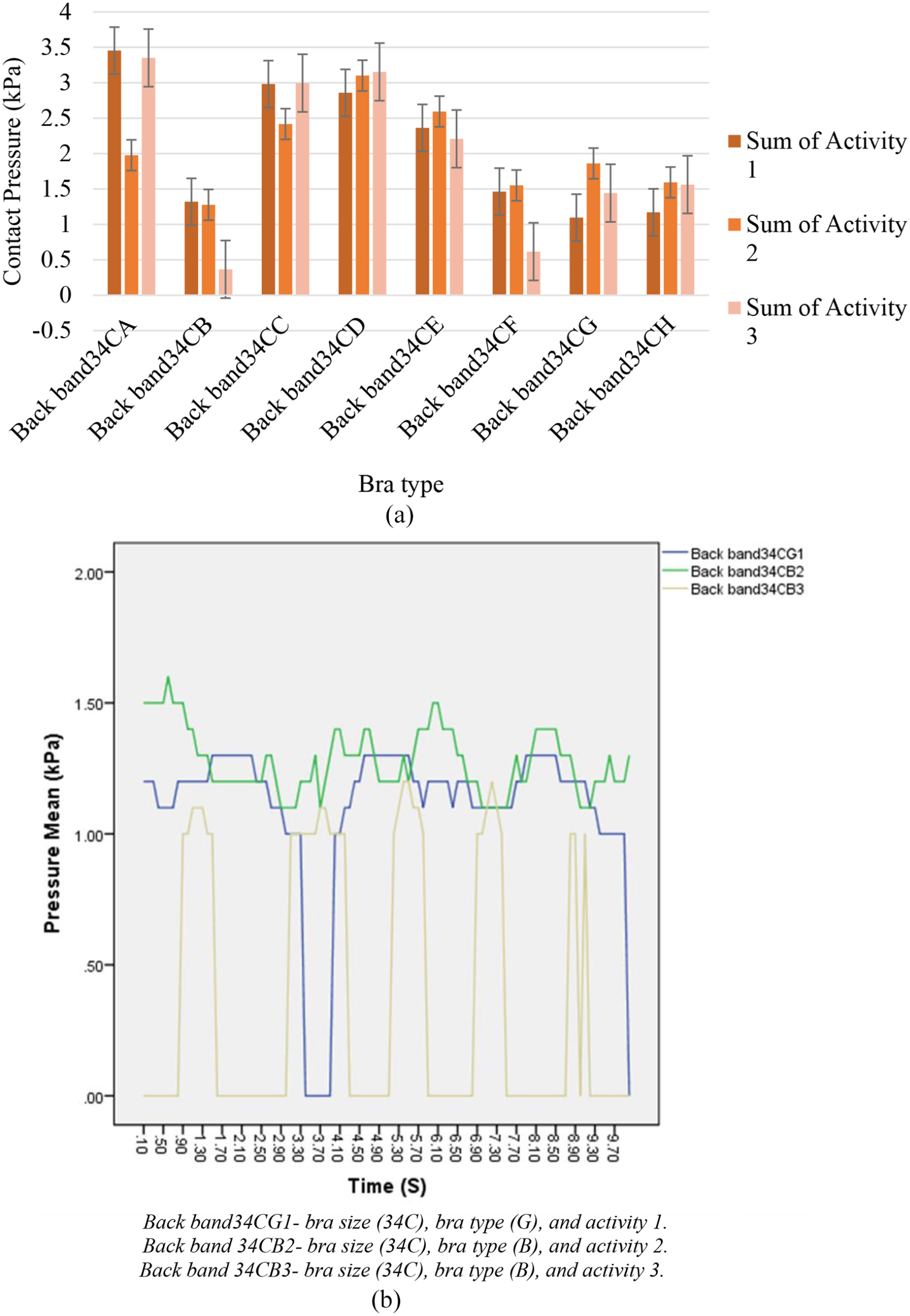
(a) Bra size 34C average back band pressure for all activities and bra types, (b) comfortable back band for bra size 34C. Back band34CG1 – bra size (34C), bra type (G), and activity 1. Back band 34CB2 – bra size (34C), bra type (B), and activity 2. Back band 34CB3 – bra size (34C), bra type (B), and activity 3.
Figure 8(b) shows the best sports bras identified for females with bra size 34C during these activities. In activity 1, a compression sports bra with a racerback and a thinner waistband is recommended when the upper body moves vertically. However, an encapsulation with a cross-back and a thicker waistband is not recommended. Also, when it comes to the horizontal movement of the upper body, compression sports bras with a Y back and a thicker waistband influences the pressure of the waistband while encapsulating a racerback sports bra with a thinner waistband is not recommended to subject 1. Surprisingly, considering the circular movement, compression sports bras with a Y back and a thicker waistband were still identified as the best sports bra that produces less pressure at the back band. Again, encapsulation cross-back sports bra with a thicker waistband is not recommended for circular movement of the upper body when the waistband is factored for females with bra size 34C.
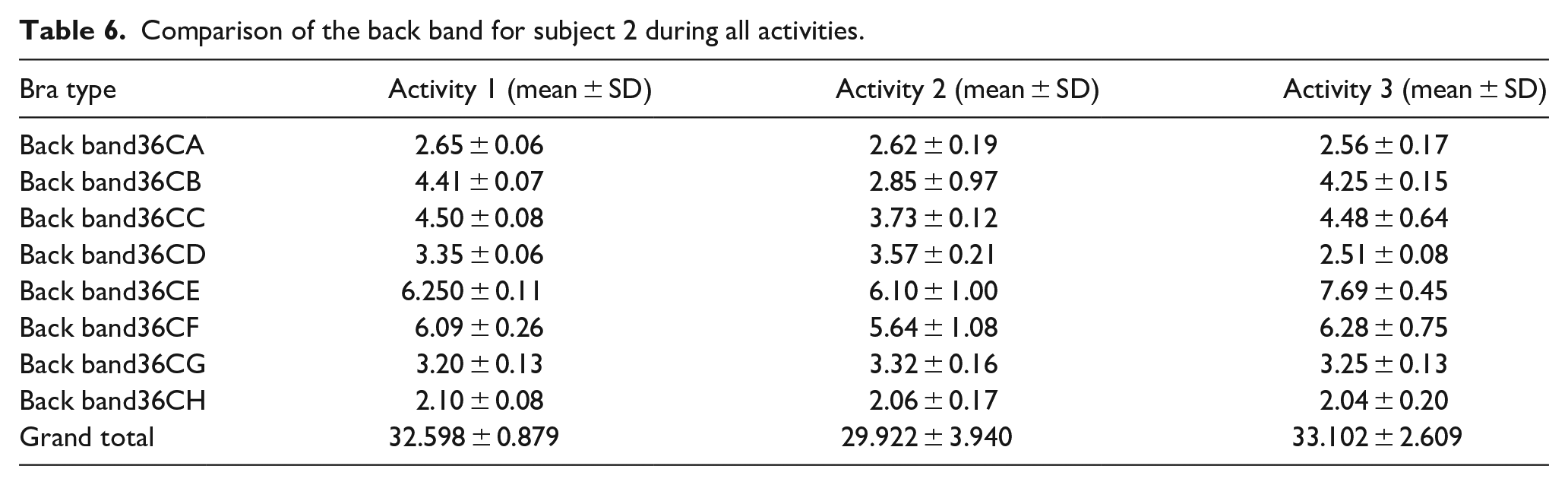
Table 6 shows the mean±SD distribution for the back band during activities 1, 2, and 3 of subject 2. Sports bras H, A, and G generated less pressure during activity 1. They were recorded at a mean of 2.10, 2.65, and 3.20 kPa. Sports bras E, F, and C produced more pressure at the back band with an average mean of 6.25, 6.09, and 4.50 kPa, respectively. Again, sports bras H, A, and B were identified as comfortable bras when the back band was considered during activity 2. They came up with 2.06, 2.62, and 2.85 kPa, respectively, but sports bras E and F again produced more pressure with 6.10 and 5.64 kPa, respectively. Only two bras were identified because the mean interval between the third bra and the first two selected bras is too broad between comfort and discomfort. Surprisingly, during activity 3, sports bras H, A, and D were still identified as a comfortable back band with a mean of 2.04, 2.56, and 2.51 kPa, respectively. Also, sports bras E and F generated more pressure with an average mean of 7.69 and 6.28 kPa. Figure 9(a) shows the mean graph of all 8 of subject 3 during all three activities.
Comparison of the back band for subject 2 during all activities.
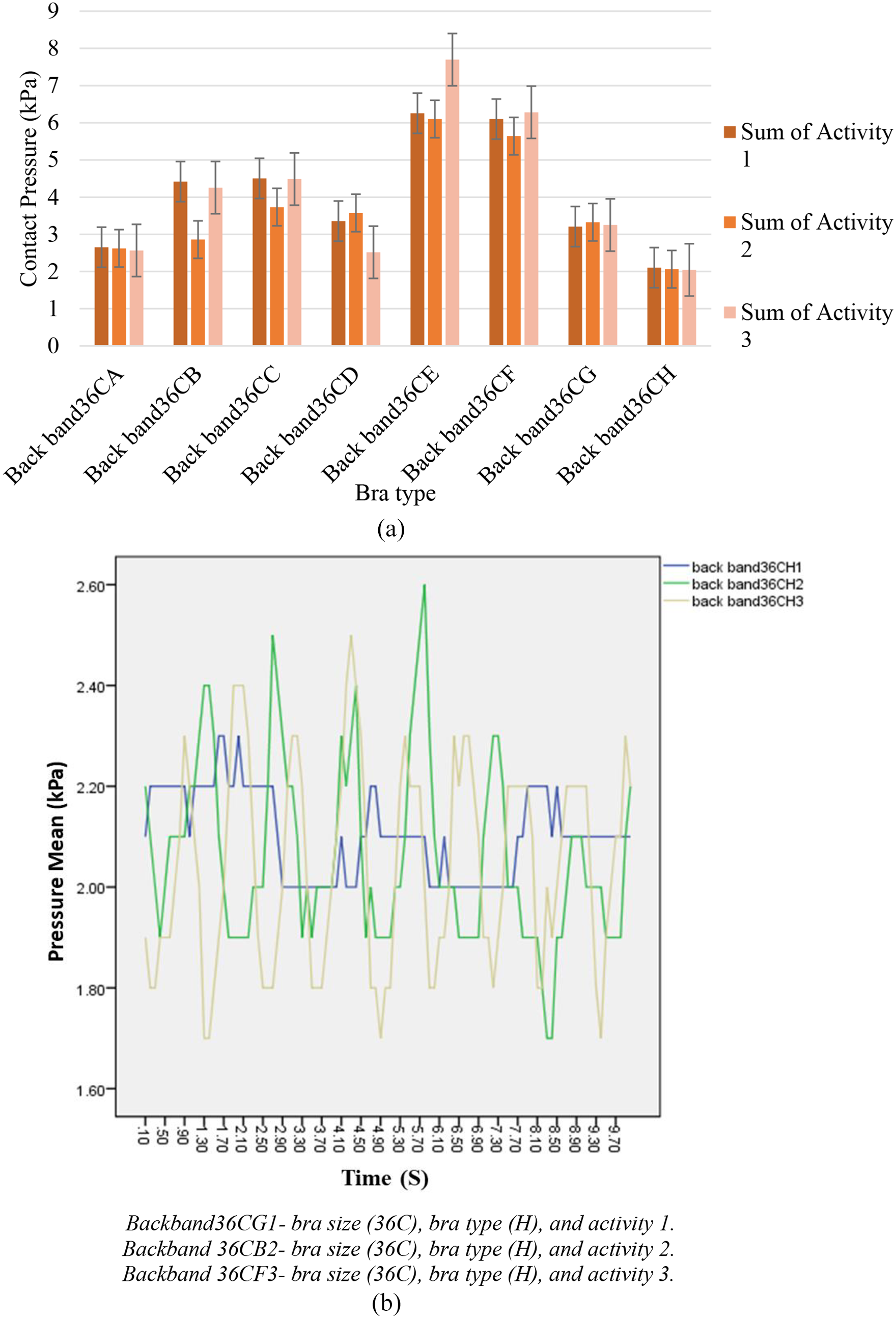
(a) Bra size 36C average back band pressure for all activities and bra types, (b) comfortable back band for bra size 36C. Backband36CG1 – bra size (36C), bra type (H), and activity 1. Backband 36CB2 – bra size (36C), bra type (H), and activity 2. Backband 36CF3 – bra size (36C), bra type (H), and activity 3.
The best sports bras for all activities when subject 2 back bands are considered in Figure 9(b). Regarding subject 3, the back band results differed from the other two subjects because the same set of sports bras was identified as comfortable, and the same set was selected as discomforting bras. In assessing all three activities, a compression sports bra with racerback and thinner (3.9 cm) waistband is recommended for females with bra size 36C when taking part in activities that move the upper body vertically, horizontally, and circularly. When considering pressure, encapsulation sports bras with racer back and medium (4.2 cm) waistband negatively influence the back band.
In assessing all eight back bands of subject 3 during activities 1, 2, and 3, in Table 7. Sports bras H, F, and E produced less pressure at a mean l of 1.43, 1.92, and 2.11 kPa, respectively, during activity 1. In assessing the less performed bras, only sports bra B was identified at 3.78 kPa because the mean intervals between the first selected sports bra and the less performed bra were <1 kPa. It cannot be categorized as an uncomfortable bra, but it can be placed as a medium comfort sports bra. Also, during activity 2, sports bras, H, B, and C produced less pressure with an average mean of 1.45, 2.04, and 2.21 kPa, respectively. Again, the mean interval for activity 2 only sports A was identified as a less performed bra with 7.25 kPa because its interval between others was >4 kPa, so other bras cannot be compared with it. Lastly, sports bras H, F, and C were less pressured back bands during activity 3 with 1.20, 2.09, and 2.07 kPa, respectively. However, sports bra A was identified as a discomfort back band with a mean of 13.15 kPa, and it is the mean interval with other bras was >9 kPa due to this, other sports bras were placed as medium comfort bras. A relationship exists between activity 1 and 2 and not activity 3 because the interval between their total mean was <4 kPa whilst their interval and activity 3 intervals was >5 kPa. A clear graph of all sports bras and activities is shown in Figure 10(a).
Comparison of the back band for subject 3 during all activities.


(a) Bra size 38C average back band pressure for all activities and bra types and (b) comfortable back band for bra size 38C.
The best sports bras for subject 3 during all three activities are shown in Figure 10(b). Surprisingly, compression racerback sports bras with medium-length (4.9) waistband are highly recommended to females with bra size 38C during activities that move the upper body vertically, horizontally, and circularly. However, compression Y back with medium length (4 cm) is not recommended when participating in activities that vertically move the upper body. Also, considering activities 2 and 3, encapsulation cross back sports bras with medium-length (4.8 cm) waistband negatively influences females with bra size 38C when pressure analysis is done at the back band.
Discussion
This study focused on three subjects with bra sizes 34C, 36C, and 38C. All the subjects participated in three different shoulder activities involving horizontal, vertical, and circular motions of the upper body. Surprisingly, each activity identified a comfortable strap and back band during the pressure analysis. A total sum was made from all the selected bras to identify which sports bra suited the breast well. There is a relationship between the horizontal and circular movement since subject 1 identified the same sports bra comforting at the strap and back band but a different sports bra for the vertical movement. Sports bra F produced less pressure at the shoulder strap and back band during all three activities, so it can be concluded that sports bra F gives less pressure to breast size 34C during shoulder workout. On the other hand, sports bra D and H performed poorly at the strap and the back band area. Therefore, females with bra size 34C should not use sports bras D and H for activities that move the upper body vertically, horizontally, and circularly because of the excessive pressure produced.
Also, there is a relationship between the horizontal and circular movement for subject 2 since sports bras C and B were identified as the less pressured strap during activities 2 and 3, whilst sports bras A and C gave less pressure for activity 1. For the back band, sports bras H and A produced less pressure during the three activities, and at the same time, sports bras E and F performed poorly throughout the three activities. Regarding pressure analysis, we can say that sports bras A and E suit female breast size 34C very well during shoulder workouts, whilst sports bras F and E are not suitable for ladies with bra size 34C because they performed poorly both at the strap and back band.
Regarding subject 3, there was no relationship between the three movements when the strap was considered due to the large breast size. However, there was a relationship between the three activities for the back band because sports bra H produced less pressure during the three activities. Sports bras A and E produced more pressure during activities 2 and 3. It is concluded that there is a relationship between the three movements when the back band area of subject 3 is considered. Sports bras H and B were identified as comfortable bras, while sports bras A and G were the most petite comforting bra for females with bra size 38C.
Conclusion
Younger women are more interested in doing physical activities such as running, skipping, abs, triceps extension, pushups, bridge, and many more. Among the activities mentioned, most investigations have been on running and skipping when females put on different sports bras while ignoring other activities. For this reason, this study chose to focus on only shoulder workouts. This study has shown that not all sport bra suit all breast sizes during different activities since each breast size has a specific bra that produces less pressure at the shoulder strap and back band. Furthermore, the same bra can be used for activities that move the upper body horizontally and circularly because a particular bra was identified to be more comfortable.
This study focused on four hallows and four shallow necklines. It was revealed that sports bra with a shallow neckline produces more pressure at the shoulder strap for females with bra sizes 36C and 34C than sports bras with a hallow neckline. For the back band, we identified that the size and thickness of the band do not influence the wearer but how expansive or tiny the person’s waist is. This study concludes that racerback bras produce less pressure whilst crisscrossing more pressure for females with bra size 34C when the body moves horizontally, vertically, and circularly. Also, cross back produce less pressure whilst cross back gives more pressure to females with breast 36C. For bra 38C, racerback produces less pressure whilst cross back produces more pressure when the three movements are taken into consideration. In regards to females with bra size 34C, thinner shoulder straps with 8.6 cm neckline elongation are recommended while sports bras with broader with thicker straps aren’t recommended for them. Also, thinner straps are recommended for females with breast size 36C with a neckline elongation of 10 cm while semi-thinner with thicker straps produces more pressure. Lastly, broader with thicker shoulder straps with an 8.7 cm neckline elongation works best for females with breast size 38C.
In future studies, further investigation needs to be done on breast displacement to check if any relationship exists between the identified sports bras when females move the upper body in a horizontal, vertical, or circular motion.
Footnotes
Author contributions
FMO contributed to the conception and design of the study and also drafted the manuscript. LZ supervised and helped in drafting the manuscript and, XJ supervised the experiments. All authors read and approved the final manuscript.
Declaration of conflicting interests
The author(s) declared no potential conflicts of interest with respect to the research, authorship, and/or publication of this article.
Funding
The author(s) disclosed receipt of the following financial support for the research, authorship, and/or publication of this article: 2020 National Social Science Foundation of Art Project: “History of Chinese women’s underwear” (Grant/Award Number: 20BG134).

Availability of data and materials
Will be sent to editors on reasonable request.