



Abstract
The conventional single-stage pre-treatment technique requires more electricity, is more expensive, polluting, harmful, and unhealthy because it uses artificial chemical compounds and auxiliaries. This research focuses on environmentally friendly and cost-effective textiles scouring-bleaching of cotton fabric with saponin and wild yam (Dioscorea villosa L.) root powder. The root of the wild yam contains alkaloids, amylose starch, and saponin. The investigations discovered important findings in cotton wet processing by developing a safe, water- and electricity-saving scouring method. Cotton fabric, along with the utilization of wild yam roots resulted in a significant cost effective method. As a result, it was used as a natural surfactant, foam stabilizer, and emulsifier in this scouring. The single stage Bot scouring was optimized with 40 g of untamed yam and a weight to volume (MLR in W/V) (weight of fabric to water) ratio of 1:10 at 80°C for 60 min on a pH of 5–7. The treatment’s effectiveness was measured using a weight reduction percentage and an absorbency test (a drop of water, capillary upward thrust, sinking time). In terms of weight reduction, water absorbency, capillary boost, as well as amazing friendliness, scouring cotton fabric with wild yam powder at optimized scouring conditions is comparable to scouring cotton fabric with 30% (at the weight of cloth) caustic soda. To verify the fabric samples’ resistance to microbiological development and strength maintenance, wild yam and Caustic soda scoured cotton fabrics were subjected to a soil burial test. The fabric sample scoured with wild yam has a much lesser standard deviations of toughness and elongation at break than the caustic soda scoured and untreated control samples. The Single stage scouring of cotton fabric with wild yam powder met the requirements for green scouring while also providing antibacterial qualities.
Introduction
The loom state cotton fabric contains about 8%–12% natural impurities of the total weight of the fiber. 1 The impurities are waxes, proteins, pectic substances, and mineral matters. Also, the mechanically held impurities termed as “motes” containing seed-coat fragments, aborted seeds and leave, etc are impurities that cling to the fiber are considered as added impurities.2–4 Contaminants with adventitious oils such as machine oils, tars, greases, etc which are added to fabric during production time are another type of added impurities. 5 The externally added and non-cellulosic natural impurities create a physical hydrophobic barrier due to their lubrication behavior during textile processing and affect the enhancement of the fabric’s wettability and absorbency. Such lubrication behavior negatively affects the processing stages of bleaching, dyeing, and printing. 6 If these impurities are not properly removed, they can show up, after processing by way of inadequate hydrophilicity, insufficient bleach effects, fabric damage in the course of bleach, precipitation in the treatment liquors, roll deposition, brown specks due to the seed coating, unlevel dyeing/printing, and poor colorfastness. The gray preparation removes all the impurities as completely as possible and in particular as uniformly as possible without causing excessive damage to cotton. Therefore, the removal of the impurities as completely as possible is mandatory for the wet-processing of textiles which is mainly based on water absorption of the substrates.7–9
Scouring is the removal of oily substances from textiles. Scouring reduces the impurities completely or sufficiently to obtain uniform and reproducible results in dyeing and finishing operations.2–4,10,11 Conventional scoring uses alkalis, such as sodium hydroxide, and is a multi-step process. The use of the alkalis and the multi-stage processing of the fabric attack the cellulose and solubilizes it which results in a reduction in strength and loss of fabric weight. Furthermore, their salting wastewater has a high COD (Chemical Oxygen Demand), BOD (Biological Oxygen Demand), and salt content. It also consumes more energy and water.2,4,12 Ahmed et al. 13 studied Combined Desizing, Scouring, and reported it as an energy-saving and cost-efficient method. They also reported its advantages in price negation. Other Researchers studied the combined desizing–bleaching–reactive dyeing process of cotton and reported the method can save water up to 400% and thermal energy up to 50% than the traditional single-stage pre-retreatment. 14
Optimum conditions for combined desizing and scouring using potassium persulfate along with sodium hydroxide for the J-box system works for cambric and poplin fabrics. A combined desizing-scouring process based on a stabilized hydrogen peroxide solution in J-box operation is claimed to be stable at pH 12. A scouring bath comprises of caustic soda (3.8%), surfactant (0.2%–0.4%), and chelating agent (0.1%–0.2%). 15 Yam is the most important food crop since the time of immorality in the tropics and subtropics. Yams are house-trained and cultivated in over 60 million people in tropical and sub-tropical regions. 16 Worldwide in 2007, 52 million tons of yams were produced and 94% of this was in Africa. 17 Wild yam contains glycoside saponins, steroidal saponins, diosgenin, alkaloids, tannins, phytosterols, and starch. 18 At a concentration of 1%–2% plant material, Wild Yam Root Extract contained 0.4% steroidal saponins. 19
Dioscorea (Wild Yam) have polyphenolic compounds 20 and are antimicrobial against gram-positive and gram-negative bacteria.21–23
Green chemistry is the creation, design, and use of chemical products and methods either to intentionally minimize or to avoid the formation and usage of toxic materials. It has been also defined as environmentally benign chemical synthesis. The major goals of green chemistry are to minimize the toxic effect on humans and the environment through remodeling, man-made or synthetic methods, harmful molecules, and manufacturing processes.24,25 This study introduces a green method of scouring to avoid chemicals to reduce the chemical load and processing cycles without compromising scouring efficiency. It is about combined scouring-bleaching of cotton using wild yam powder and saponin in an eco-friendly technology to improve the hydrophilic property without degrading the fiber.
Materials
Wild yam roots (Figure 1) were collected through an assisted visit in South wollo of Ethiopia from Tanta city.

Wild Yam plant and the root.
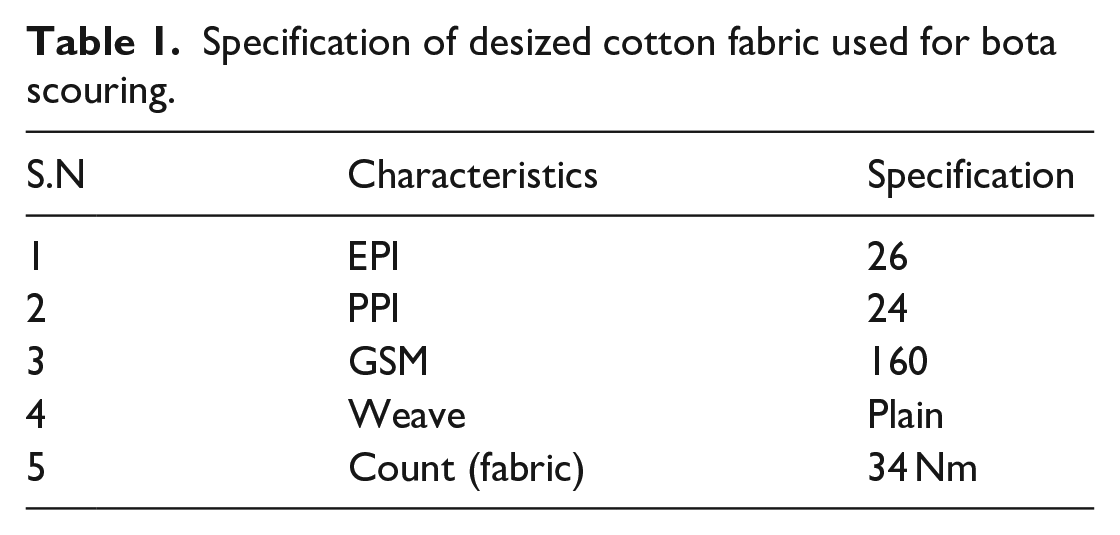
Plain woven fabric with the following details was used for Bota/combined Scouring- bleaching.
The chemicals and reagents used for this research work were analytical grade and certified by the research laboratory with the proper specification. For the scouring of the cotton fabric with wild yam powder and saponin; the following chemicals and reagents were used.
✓ Non-ionic Wetting agent
✓ Sequestering agent for neutralizing metal ions,
✓ Methanol (for extraction of saponin from powder).
Equipment (Apparatus) and Machinery used to collect raw material are a digger, knife, heat, plastic, and coffee crush machine and for extraction and bota scouring (Figure 2) weight balance, beakers, stove, pipet, soxhlet apparatus, lien test machine, and launder meter. The Mesdanl Lab Strength Tester was used to determine the threads strength maintenance from wild yam and caustic soda scoured as well as from the untreated control fabric.

Equipment used for yam powder preparation.
Method
Preparation of wild yam powder
The root of Wild yam (Figure 3) washed-off dirt and sands was chopped into pieces, dried under direct sun-light and grounded to powder with help of a grinder.

Preparation of wild yam root powder for scouring.
Optimization of wild yam powder scouring/bleaching
Optimization of wild yam powder scouring-bleaching was studied on 10 g fabric samples (Table 1) using fabric weight to volume (W/V) MLR of 1:10, different weight of wild yam powder for the 10 g fabric samples (1–10 g), different temperature (30°C–90°C), different times of scouring (15–90 min) respectively as variables. The Experimental design used to optimize the scouring process was OFAT (one factor at a time) technique by varying a single variable at a time while keeping the others variables constant.
Specification of desized cotton fabric used for bota scouring.
Determination of efficiency
The efficiency of the combined scouring/bleaching was determined qualitatively characterizing the water absorbency, Capillary rise, and weight loss against the standard.
Antimicrobial performance
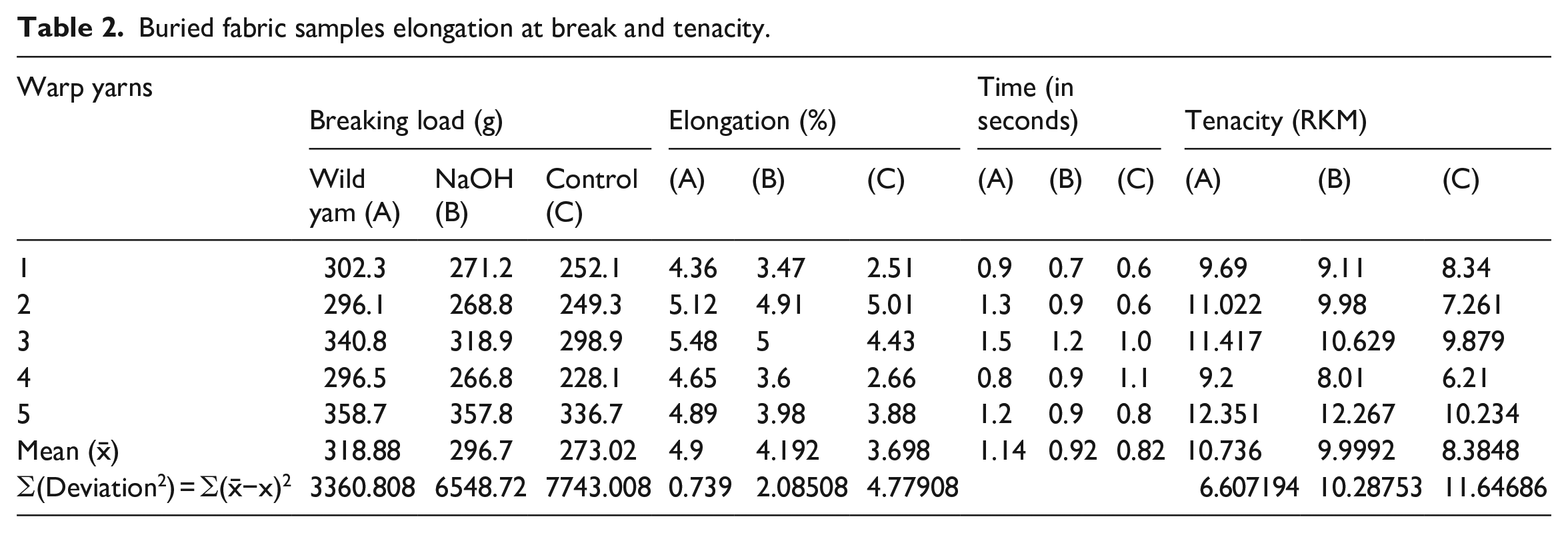
Three Fabric samples with Wild Yam Powder and Caustic scoured and UN scoured cotton fabric samples were buried in standard atmospheric soil for 28–30 days and the strength loss was analyzed by results collected from Mesdanl Lab Strength Tester. Each five (5) warp yarns were analyzed from fabric samples of wild yam and Caustic soda Scoured and untreated control fabrics. The Table 2 below summarizes the test results:
Thread Type: Warp Yarn
Yarn Count: 34 Nm,
Sample number: 5
Sample length: 500 mm
Clamp speed: 1000 mm/min
Buried fabric samples elongation at break and tenacity.
Result and discussion
Optimization of wild yam powder scouring
Effect of amount of wild yam powder
The scouring/bleaching effectiveness of wild yam powder was determined as per AATCC Test Method No. 79 to measure the scoured fabric wetting. A drop of water is placed on the fabric, and the time it takes for the drop to penetrate the fabric is recorded, as shown in Figure 4. The fabric’s capillary rise and sinking properties are summarized as depicted in Figure 4.
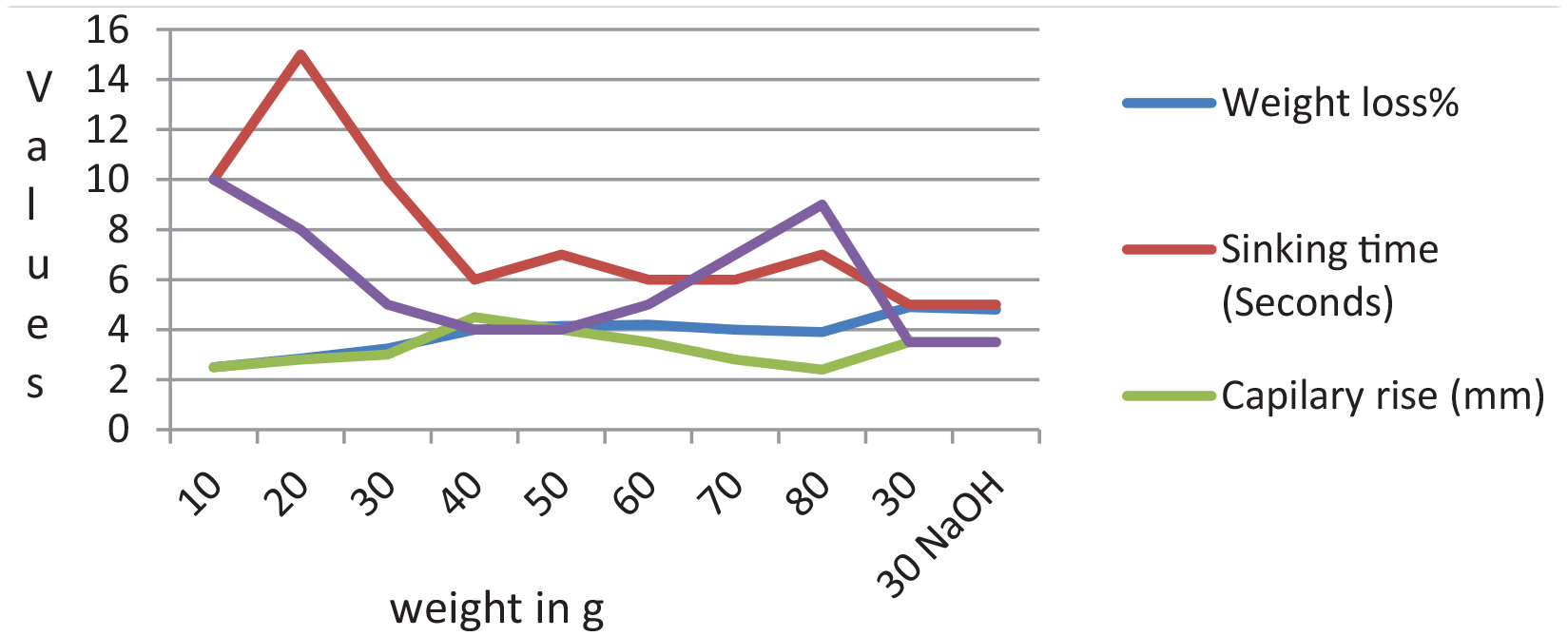
Scouring 10-g fabric with different yam powder amount with MLR of 1:10, at pH of 5–7 for yam powder and 11–12 for NaOH at 90°C for 1 h.
Scouring/bleaching efficiently results in 3%–5% weight loss, quick water sinking into the fabric, short water drop absorption time, longer capillary rise in 5 min of capillary test time, and shorter water drop absorption time. The weight loss was approximately 4% when 40 g of yam powder was employed, which is in the ideal range, with the quickest period of water drop absorption (4 s) and the lowest sinking time (6 s). Using more than 40 g of wild yam powder increases the amount of starch in the bath and diminishes scouring effectiveness by coating the fabric’s surface with the starch. Combined Scouring-bleaching with 40 g yam powder was found to be comparable to scouring with 30% NaOH in this study. Traditional textile preparatory undergoes a number of chemical treatments before becoming a finished fabric. Single stages include things like desizing, scouring, bleaching. Water, chemicals, and auxiliaries, as well as extra energy, are required in all steps of the traditional preparatory process. The chemicals and auxiliaries used in the single stage preparatory process are extremely dangerous to human health, the environment, and the economy.
Effect of scouring temperature
Increased scouring temperature decreases the time necessary for sinking water drop absorption linearly while gradually increasing weight loss and capillary rise. The weight loss reported for the fabric sample scoured at 80°C (optimal scouring temperature) was 4%, (Figure 5) which is within the optimum range, with a minimum time of water drop absorption of 3.5 s, the highest capillary rise of 4.5 cm, and a minimum sinking time of 6 s. The following truths can be linked to an increase in scouring at higher temperatures. Water’s increased thermal energy can hydrolyze esters (fats and waxes) by uncatalyzed processes at high temperatures. The hydrogen bonding of water and its ion concentration drastically changes at higher temperatures due to the breakdown of the hydrogen bonding network. Water substrate protonation is accelerated due to changes in hydrogen bonding and ion concentration. Hydrolysis of organic fats and waxes is aided by faster water substrate protonation. At high temperatures, water with a low dielectric constant also aids the solubility of organic fats and waxes.

Scouring 10-g fabric with 40 g yam powder with MLR of 1:10, at pH of 5–7 for yam powder at different temperatures for 1 h.
Effect of scouring time
Figure 6 shows that scouring for 60–90 min is effective, but scouring/bleaching for a long time at a high temperature causes problems with the process. When the wild yam is left to boil in the bath for an extended amount of time, the naturally occurring starches in the wild yam dissolve in the bath and coat the fabric’s surface, making fabric wash-off difficult. Cooking over a longer duration at a higher temperature, on the other hand, uses more energy. Given these considerations, 60 min was chosen as the optimal scouring-bleaching time for wild yam powder.

Scouring 10-g fabric for different times using 40 g yam powder, MLR of 1:10, pH of 5–7 at 80°C for 1 h.
Antimicrobial activity
As depicted in Table 2, Standard deviation of tenacity was calculated using the following formula for the soil burial test of the three (3) fabric samples, that is, the fabric samples scored-bleached with wild yam (A), caustic soda (B), and the untreated control fabric (C).

Fabric samples A, B, and C, that is, wild yam scoured-bleached fabrics, Caustic Soda scoured fabrics, and untreated control fabrics, have a standard deviation of breaking load, tenacity, and elongation. Breaking load, elongation at break, and tenacity standard deviations were calculated and determined to be 840.202, 1637.18, and 1935.752 for breaking load, 0.18475, 0.52127, and 1.19477 for elongation at break, and 1.6517985, 2.5718817, and 2.9117157 for tenacity, respectively. Among the values, fabric sample A has the smallest standard-deviation in breaking load, elongation at break, and tenacity, while fabric sample C has the largest. The wild yam powder-treated fabric sample had the most constant properties; however the microbially influenced warp yarns evaluated from untreated control fabric attributes varied the most. For each of the five tests, the smallest value of standard deviation reflects the constancy of the warp yarn strength. In this study, the wild yam scoured-bleached cotton fabric had the best strength maintenance (reduced bacterial assault) when compared to the caustic-treated and untreated control samples, as well as the best strength and elongation at break consistency. This is due to the antibacterial and antifungal activities of wild yam against both gram-positive and gram-negative bacteria,26,27 which prevented microbial development on the fabric using phenolic compounds in the extract.26,27 As a result, cotton fabric scoured with wild yam powder reduced microbiological growth while maintaining strength and elongation at break.
Conclusion
Wild yam powder has a combination scouring and bleaching effect and is an environmentally friendly textile processing solution. The gray fabric must go through a series of chemical treatments in traditional textile wet processing, including desizing, scouring, mercerizing, bleaching, and washing. All of the chemicals employed in these steps are harmful and have health, environmental, and financial consequences. The wild yam root powder is effective for bota/combined scouring and bleaching of cotton fabrics under ideal scouring-bleaching conditions.
At 80°C for 60–90 min at a pH of 5–7, a combined scouring-bleaching of 10 g cotton fabric was carried out using MLR of 1:10 (W/V), 40 g of yam powder, and a pH of 5–7. Because scouring-bleaching the fabric for 60 and 90 min yields nearly identical scoring efficiency, scouring for 60 min was chosen as the optimal scouring-bleaching time to minimize fabric damage and energy consumption.
Wild yam powder scoured-bleached cotton fabric has typical weight loss, water sinking to the fabric, capillary rise, and water drop absorption with no fabric damage and efficient scoured fabric features. The qualitative parameters of the scoured-bleached cotton fabric with wild yam powder are identical to those of a fabric sample scoured with 30% (by weight) caustic soda.
Antimicrobial properties of wild yam scoured cotton fabric when buried in soil resist microbial development and degradation because to the presence of phenolic chemicals, allowing them to preserve their elongation and toughness. In burial tests, wild yam scoured-bleached cotton fabric showed more consistent elongation and strength maintenance than caustic soda scoured fabric.
This research has to be looked into further. The interaction between the independent variables and the validation of experimental measurements were left untested. Future research could look into how various independent variables influence the behavior of other variables.
Footnotes
Declaration of conflicting interests
The author declared no potential conflicts of interest with respect to the research, authorship, and/or publication of this article.
Funding
The author received no financial support for the research, authorship, and/or publication of this article.
