



Abstract
Based on the Friedel-Crafts alkylation reaction, epichlorohydrin is applied to decorate the meta aramid to enhance the comfort of the fabrics. It is obviously more perfect that the samples are treated with the hydrophilic soft finishing agent. In this paper, the effects of modification and finishing time on the structure and properties of meta aramid are studied. The results indicate that the surface roughness, polarity, active point, and wetting property of the modified fabrics are increased, and the loading rate and fastness of the finishing agent on the meta aramid are enhanced. After finishing, the wetting time and the time of water transfer from the surface to the bottom become shorter in the fabrics, and the water absorption rate becomes faster, the core absorption height rises by 60%, the bending stiffness lowers by 39%, the moisture permeability increases by 5.9%, the permeability decreases by 3.6%, and the friction electric voltage reduces by 78%, The longitudinal and weft secondary combustion time increase by 0.3 s and 0.2 s, the smoldering time increase by 0.3 s, and the improving rate of damage length are 5.4% and 7.6%, respectively.
Meta aramid has excellent properties such as high mechanical properties, fatigue resistance, chemical resistance, high heat resistance, low expansion, non-combustion, and non-melting.1–3 And it has become an ideal material for protective clothing in the field of military fire protection and petrochemical industry.4,5 Nonetheless, the poor hydrophilic softness of meta aramid affects its wearing comfort in practical use. 6 Through finishing method can improve the hydrophilic softness, but due to the steric hindrance effect of benzene ring of meta aramid and the molecular chain of high crystallinity, make its surface very smooth and chemical inertness is strong.7,8 Amide groups on its surface are hard to work with other groups to finishing agent on the fibers of low load and combination between the fiber and finishing agent poor fastness, seriously affect the finishing effect, reduce the service life.9,10 Relevant experts and scholars use activation treatment to finish the meta aramid and activate the surface of fibers.11–13 By reducing the orientation of the fiber surface or adding some active groups, the compatibility between the fiber and finishing agent can be improved, so as to improve the comfort of meta aramid.14,15
In this paper, based on the Friedel-Crafts alkylation reaction in the organic synthesis, we treated the meta aramid with epichlorohydrin activation to induce electrophilic substitution on the benzene ring on the surface of it. The hydrogen atoms of it are replaced by highly active epoxy group and alkyl short branched chain, and the increase of surface activity points leads to the improvement of surface polarity and wettability.
Epoxy chloropropane (ECH) is a kind of important organic chemical raw materials and fine chemical intermediates, mainly for the production of epoxy resins, reinforced resins, water treatment resin, etc. 16 Its molecular structure contains two active atoms, which can react with a variety of material and produce a wide variety of derivatives. SOFTEX S-4356 which is the amino polysiloxane polyether modified hydrophilic softener, belongs to the fourth generation of softening agent, and its main chain consists of Si-O-Si keys, side chain containing amino and polyether. Amino belonging to the polarity functional group can be adsorbed on the surface of modified aramidum fiber, resulting in cross-linking, forming a network structure with high degree of polymerization, which can improve the fastness of binding between the fibers and the finishing agent and the load of the finishing agent on the fiber.
Experiment
Experimental materials
Meta aramid fabric (160 g/m2) made by Yixing Dongfeng Textile Co., Ltd were used for researching; Dichloromethane (CH2Cl2), epichlorohydrin (C3H5ClO), anhydrous aluminum trichloride (AlCl3), sodium dodecylbenzene sulfonate (LAS), and sodium hydroxide (NaOH) were made by Tianjin Damao Chemical Reagent Factory; Anhydrous ethanol was made by Tianjin Fuyu Fine Chemical Co., Ltd. Acetone was made by Dongguan Guomao Petrochemical Co., Ltd. Hydrophilic softener SOFTEX S-4355 (hydrophilic softener M), and hydrophilic softener SOFTEX S-4356 (hydrophilic softener N), Foshan Dye and Online Information Technology Co., Ltd. Deionized water was prepared in the laboratory. The reagents used were all analytical pure.
Meta aramid fabric Friedel-Crafts alkylation modification
The meta aramid fabric samples were preliminarily treated by LAS to remove impurities from the fabric, then washed with the deionized water and anhydrous ethanol and dried under the room temperature. 17 After drying, the samples and methylene chloride which were placed in a conical flask with a mass ratio of 4:250 dissolved in a supersonic cleaner for 30 min. Then, epichlorohydrin and anhydrous AlCl3 (The mass ratio of epichlorohydrin to anhydrous AlCl3 was 40:25) were joined and treated for 2 h in 40°C. The sample was washed repeatedly with deionized water and acetone until the pH value of the lotion was 7.0. The reaction mechanism was shown in Figure 1. The sample which was treated was placed into the sodium hydroxide solution for 2 h in 80°C, then washed and dried at 80°C. 18

Reaction mechanism of epichlorohydrin grafted interposition aramid.
Interposition aramid soft hydrophilic finish
According to the ratio of compound dosage to 2:8, hydrophilic softener M and N were prepared the finishing liquid whose mass-to-volume concentration was 100 g/L in the same bath. The modified aramid sample was impregnated in the finishing solution for 20 min at 45°C. A dip and a roll and the rolling rate is 70%. Finally, the setting machine was used to set and bake at 100°C for 2.5 min. The experimental process is shown in Figure 2.

Hydrophilic soft finishing of modified interposition aramid fiber.
Testing and characterization
Load rate test
Electronic analytical balance (JT5003A, YuYao Jinnuo Balance Instrument Co., Ltd.) was used to weigh the weight of samples before and after the finishing and calculate the load rate.

Where M was the weight of the finished sample; M0 was the weight of the sample before finishing.
Core suction height test
According to FZ/T 01071-2008 «test method for capillary effect of textiles», the height of core absorption was tested by capillary effect tester (YG (B) 871, WenZhou Darong Textile Instrument Co., Ltd.).
Flexural stiffness test
Electronic stiffness tester (LLY-01, LaiZhou Electronic Instrument Co., Ltd.) was used to test the bending length of samples according to GB/T 18318.1-2009 «determination of bending properties of textiles – part 1: inclined surface method». The calculation formula of bending stiffness was as follows:

Where G was the bending stiffness of unit width (mN·cm); M was the unit area weight of the sample (g/m2); C was the average bending length of the sample (cm).
Water resistance test
Samples was washed in accordance with the washing method of JIS l-0217-103 «Washing methods for household appliances», and then the core absorption height and bending stiffness were measured.
Wetting time and water absorption rate test
MMT liquid water management tester (SDLAtlas Ltd.) was used to test wetting time and water absorption rate of samples.
Moisture permeability test
According to GB/T 12704.2-2009 «Methods of test for moisture permeability of textile fabrics –part 2: evaporation method», the moisture permeability of the fabric was measured by automatic moisture permeability tester (FX3150, TEXTEST Instruments, Switzerland).
Permeability test
According to GB/T5453-1997 «Determination of air permeability of textile fabrics», A digital air permeability meter (YG461E, NingBo Textile Instrument Factory) was used to measure air permeability.
Frictional live voltage test
According to GB/T 12703.5-2010 «Textiles-assessment of electrostatic properties-part 5: frictional electrified voltage», the highest voltage was measured by fabric friction electrostatic tester (LFY-402, ShanDong Textile Research Institute).
Flame retardancy test
According to GB/T5455-2014 «Determination of length of smoldering and duration of afterburning in the vertical direction of textile combustion performance», the flame retardancy of textiles was tested by vertical combustion tester (Auto-SP01, ShenZhen Odyssey Precision Instrument Co., Ltd.).
Infrared spectroscopic (FT-IR) analysis
The surface groups of meta aramid fiber before and after modification were tested by fourier transform infrared spectrometer (Spotlight 400, PerkinElmer, USA). ATR mode was used for 32 scans with a resolution of 4 cm−1 and a spectrum acquisition range of 4000–400 cm−1.
X-ray photoelectron spectroscopy (XPS) analysis
The chemical elements on the surface of meta aramid fiber before and after modification were analyzed by X-ray photoelectron spectroscopy (AXIS ULTRA type, KRATOS UK). The excitation source was monochromatic Al Kα, calibrated using C 1 s peak (284.8 eV).
SEM analysis
The surface morphology and structure of meta aramind fiber before and after modification were analyzed by field emission scanning electron microscope. The surface of meta aramid fiber was scanned at 5 kv low voltage, up to 10,000 times.
Results and discussion
Infrared spectrum analysis of fiber surface
After the surface of the meta aramid fiber was modified by Friedel-Crafts alkylation, chemical reactions occurred on the surface of the meta aramid fiber, and other groups were grafted to it. The infrared spectrum of the surface of the untreated meta aramid fiber and the modified meta aramid fiber was shown in Figure 3.
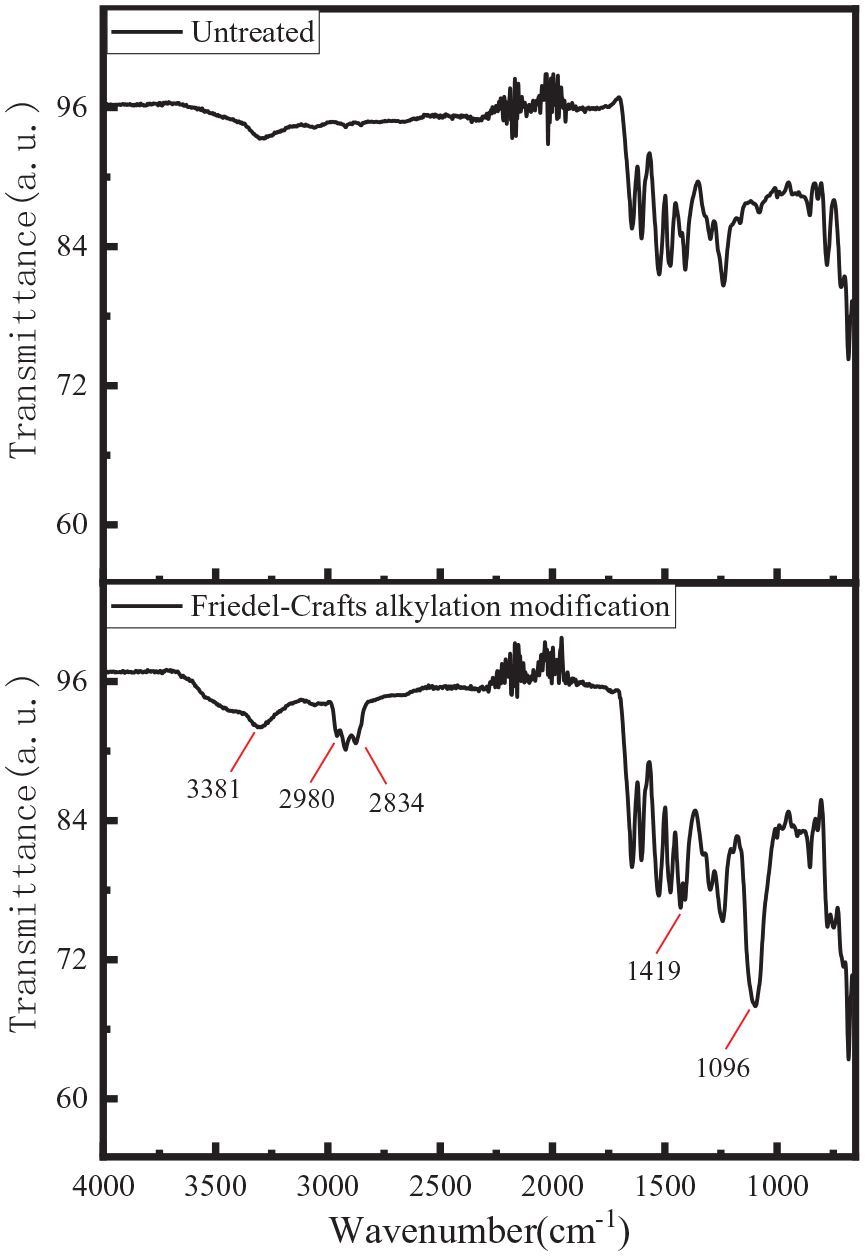
Surface of meta aramid fiber before and after modification.
Figure 3 showed that after Fourier alkylation modification, a new absorption peak appeared at 1096 cm−1 of meta aramid fiber. It could be seen from the analysis that this was the characteristic absorption peak of the formed epoxy functional group. The results showed that new oxygen functional groups appeared on the surface of meta aramid fiber modified by Friedel-Crafts alkylation, which provided a reactive point for the subsequent hydrophilic soft finishing. The characteristic absorption peak of −CH3 appeared at 1419 cm−1; between 2980 and 2834 cm−1, three smaller C-H stretching vibration peaks appeared; at 3381 cm−1, a smaller absorption peak appeared, which was formed by the superposition of N-H and O-H absorption peaks. The above indicateed that the epoxy group and its by-products had been grafted onto the surface of the fiber successfully. The disadvantage of the Friedel-Crafts alkylation reaction was that the electrophilic substitution would occur at multiple positions of the benzene ring, so it was difficult to obtain the pure product, but it could make the fiber obtain more active groups.
Fiber surface XPS analysis
After fourier alkylation, the content of chemical elements on the surface would also change due to the appearance of new functional groups. XPS analysis was performed on the surface of the fibers, and the results were shown in Figure 4 and Table 1. As it could be seen, the content of C after modification was obviously reduced, while the contents of O was obviously increased. O/C increased from 20.6% to 36.48%. After finishing, the change of O element was the most obvious, and the change of CV of O content was 64.31%. This was consistent with the results of infrared spectroscopy analysis. The content of oxychlorinated element on the fiber surface increased, the active points augment, and the infiltration was improved.

XRD spectra of meta aramid fiber before and after modification.
Content of chemical elements on the surface of aramid fiber before and after modification.

Fiber surface morphology analysis
Figure 5 were the sem images of the surface morphology of the meta aramid fiber before and after modification. As could be seen from Figure 5(a), the surface of unprocessed meta aramid fiber was smooth, but after being modified by fourier alkylation, as shown in Figure 5(b), the surface of the fiber become rough and there were abundant small protruding particles attached to it. Combined with FT-IR and XPS analysis, it could be concluded that these small particles should be the epoxy groups and by-products grafted onto the surface of the fiber to increase the surface roughness of the fiber, which helped to improve the fastness of the fiber to the finishing agent and the loading capacity of the finishing agent on the fiber.

Scanning electron microscopy (sem) of the surface morphology of meta aramid fiber before and after modification (×10,000): (a) untreated and (b) Foucault alkylation modification.
Effect of foucault alkylation modification on the loading rate of the finishing agent on interposition aramid fiber
Table 2 showed the load rate of the unmodified but finishing meta aramid fiber and the modified and finishing meta aramid fiber. As could be seen from Table 2, the load rate of unmodified but finishing was much lower than that of modified and finishing.
Finishing agents in the interposition of meta aramid fiber.

In the rigid molecular chain of aramid fiber, the benzene ring had a shielding effect on the hydrogen on the amide functional group. It made the hydrogen atom inactive and difficult to be replaced by other groups. And meta aramid fiber had a strong chemical inertness, high surface crystallinity, smooth surface and poor wetness, resulting in the inability of the finishing agent to be effectively loaded on the surface of it. The surface of aramid fiber modified by foucault alkylation become rough, its activity was increased, and its wetting was promoted. These provided conditions for increasing the load rate.
Effect of foucault alkylation modification on fastness of finishing agent to meta aramind
The test results of washing resistance of meta aramid after finishing were shown in Table 3. It could be found from Table 3 that, compared with the unmodified direct finishing, the modified re-finishing of the sample had higher wicking height and lower flexural rigidity. It indicated that the modified re-finishing method could make the sample obtain better hydrophilic softness. With the increase of washing times, the wicking height decreased and the flexural rigidity promoted. But the variation amplitude of the modified and finished samples was smaller than that of the unmodified and finished samples. After 40 times of washing, the retention rate of the wicking height and flexural rigidity of the modified and finished samples were 92% and 91%, respectively. However, the retention rate of the wicking height and flexural rigidity of the unmodified but finished samples were only 72% and 88%.
Washing resistance of interposition aramid fiber after finishing.
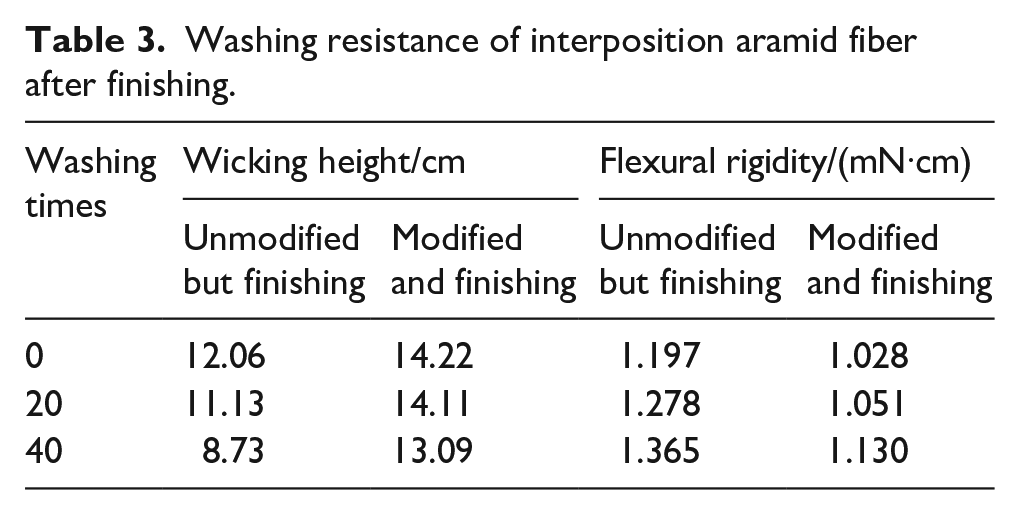
Because modified fiber surface roughness increases and benzene ring externally branches with epoxy and flexible chain segment, and amino which was contained in hydrophilic softener SOFTEX S-4356 side chain could occur with the modified fiber directional adsorption, crosslink, form a network structure of high degree of polymerization on the fiber surface. It made the combination between the fiber and finishing agent fastness to strengthen, improved the water resistance.
Comfort analysis
After finishing, the test results of meta aramid fabric comfort were shown in Table 4. By Table 4 showed: The wetting time of the surface and bottom layer after modification and finishing was lower than that of untreated samples. The water absorption rate of the surface and bottom layer after modification and finishing was higher than that of untreated samples. The wetting time difference value between surface layer and bottom layer was small. Namely, after modification and finishing, the wetting time of meta aramid fabric become shorter and the absorption rate of meta aramid fabric become faster. The time of water transferred from the surface to the bottom was shorter, and the core suction height was increased by 60%, which indicated that hydrophilicity was greatly improved. The bending stiffness decreased by 39%, indicating that the softness was improved.
Comfort of interposition aramid fiber after finishing.

After modification and finishing, moisture permeability increased by 5.9%, but air permeability decreased by 3.6%, indicating improved moisture permeability and worse air permeability. The static electricity of the untreated meta aramid fabric was very serious. After modification and finishing, the frictional electrified voltage was significantly reduced, and the reduction rate was up to 78%. The antistatic effect was good, which improved the contact comfort of the meta aramid fabric.
Flame retardancy analysis
The flame retardancy test results of meta aramid fabric after finishing were shown in Table 5. On the grounds of GB/T 17591-2006 «Flame retardant fabric», the flame retardancy of the textiles was rated. When the damage length was ⩽150 mm, the continuous combustion time was ⩽5 s, and the smoldering time was ⩽5 s, it could be judged as class B1. As could be seen from Table 5, after modification and finishing, the afterburning time, smoldering time and damage length all increased. Where: the time of continuous combustion in the direction of warp and weft increased by 0.3 s and 0.2 s respectively; the smoldering time in both warp and weft direction increased by 0.3 s; the increase rate of warp and weft damage length was 5.4% and 7.6%, respectively. It could be seen that after modification and finishing, the flame-retardant property decreased, but it still reached the flame-retardant fabric B1 level, which had a good flame-retardant effect.
Flame retardancy of interposition aramid fiber after finishing.

Conclusion
To sum up, the modified and hydrophilic soft finishing of meta aramid showed excellent comfort and flame retardancy, which were obtained through two steps. That was, epoxy chloropropane was used for fabric surface modification and hydrophilic soft finishing of modified fabric. Using Fourier transform infrared spectroscopy (FTIR) analysis, it could be concluded that a large number of epoxy functional groups and their by-products had been grafted onto the finished meta aramid fabric; the O content and Cl content of the modified meta aramid fabric were obviously increased by energy spectrum analysis; the surface of the fabric fiber could be found to be rough and protruding by scanning electron microscope observation; and the modified finishing was beneficial to the extraction high fabric loading rate to hydrophilic softener. Compared with the original meta aramid fabric, the modified and hydrophilic soft finishing fabric had better washing resistance and hydrophilic softness, and its comfort was obviously improved. This study provided an efficient and feasible method to improve the comfort performance of meta aramid fabric, which was helpful to expand the range of use of meta aramid fabric.
Footnotes
Declaration of conflicting interests
The author(s) declared no potential conflicts of interest with respect to the research, authorship, and/or publication of this article.
Funding
The author(s) disclosed receipt of the following financial support for the research, authorship, and/or publication of this article: This work was kindly supported by Science and Technology guidance project of China Textile Industry Federation (2019003) and Key R&D Program of Shaanxi Province (2019GY-177).
