




Abstract
Owing to the good mechanical properties of braided structures, regular braided ropes are increasingly being used in various fields, including marine exploration, aloft work, recreation activities, and oil prospecting. However, under certain severe conditions, they could break, a situation that is absolutely undesired. Thus, predicting their stress distribution and strain-force characteristics when they are subjected to different tensile loads is a pre-requisite for their application. Therefore, in this study, a mathematical model for ropes with regular braided structures is developed, and based on the model, this study reveals that uneven stress distributions in the different strands of regular braided ropes generate different stress distributions and strain-force characteristics in each of the strands. Additionally, the uneven stress distributions in the different strands also induce mechanical failure more readily. Finally, to ensure the reliability of braided ropes in different applications, different strand parameters are compared.
Introduction
Rope braiding possibly dates as far back as 28,000 years ago. During the braiding processes, two sets of braiding strands are each moved in the clockwise and counter-clockwise directions such that they interlace with each other. 1 Three types of braided structures exist, these are: diamond, regular, and Hercules braided structures. Most common are regular braided structures, which can be produced with circular braiding machines. 2 Even though they are simple, the tensile properties and internal stress characteristics of their constituent strands are not. The degree of complexity exhibited depends on the specific architecture of the braiding strands as well as many other braiding parameters.
Most previous studies published as far back as the 1950s focused on the geometrical modeling of braids, on the basis of which subsequent finite element analysis (FEA) as well as the analysis of the tensile properties of braids could be performed. 3 Brunnschweiler4,5 proposes an idealized geometry for diamond braided structures, which assume the concept of constituent strands. Later, Goff 6 and Douglass 7 and investigate braided structures with respect to different braid parameters, and recently, Rawal et al.8–10 focused on the yarn path of braided structures, and they propose a series of CAD models. Kyosev 11 proposes a generalized geometrical approach for the modeling of braided structures, and based on the assumption that braiding strands follow a helical path, Hristov et al. 12 studies the braided structure and mechanical behavior of circular hybrid braids. Additionally, based on the results of studies conducted by Goff 6 and Wu et al., 13 Alpyildiz 14 proposes a modified geometrical model for the strand path of biaxial braided structures. For braided ropes consisting of low twisted multi-filaments, Phoenix 15 proposes a diamond tubular braid model, which takes into consideration constituent sinusoidal strands, and based on this model, the actual strand length, effective cross-sectional area of the strand that is normally directed along the braid axis, crimp angle, and other braid assembly mechanical parameters could be analyzed.
These proposed models that are primarily designed for diamond braided structures are unsuitable for regular braided structures, which are different. However, a few studies on regular braided structures are conducted for example, for regular braided structures, Lomov et al. 16 propose a geometrical model that takes into account structure skewness.
By establishing a geometric model, and thereafter solving it using a FEA software, more accurate rope mechanical parameters could be obtained. Therefore, a professional software, such as Texmind Braider, which can be applied in braided structure modeling, is required17,18; otherwise, the task would be very cumbersome. In this light, the purpose of this study is to establish a simplified model, and from it, directly obtain approximate mechanical properties that can be useful in preliminary design processes.
Thus, a simplified regular braided rope model that can be used to compute the uneven stress distribution in different braided rope strands is proposed. Thereafter, to better illustrate the impact of the uneven stress distribution in different regular braided rope applications, different braided rope parameters are compared.
Mathematical modeling
Regular braided ropes have a loop structure along their length. Figure 1 shows an example of such a regular braided rope consisting of 12 strands.

A regular braided rope with 12 strands.
In Figure 2, the strands of a one loop structure are shown, and it gives a perspective view along the strand direction. It shows that the yarns in the rope are under a tensile force
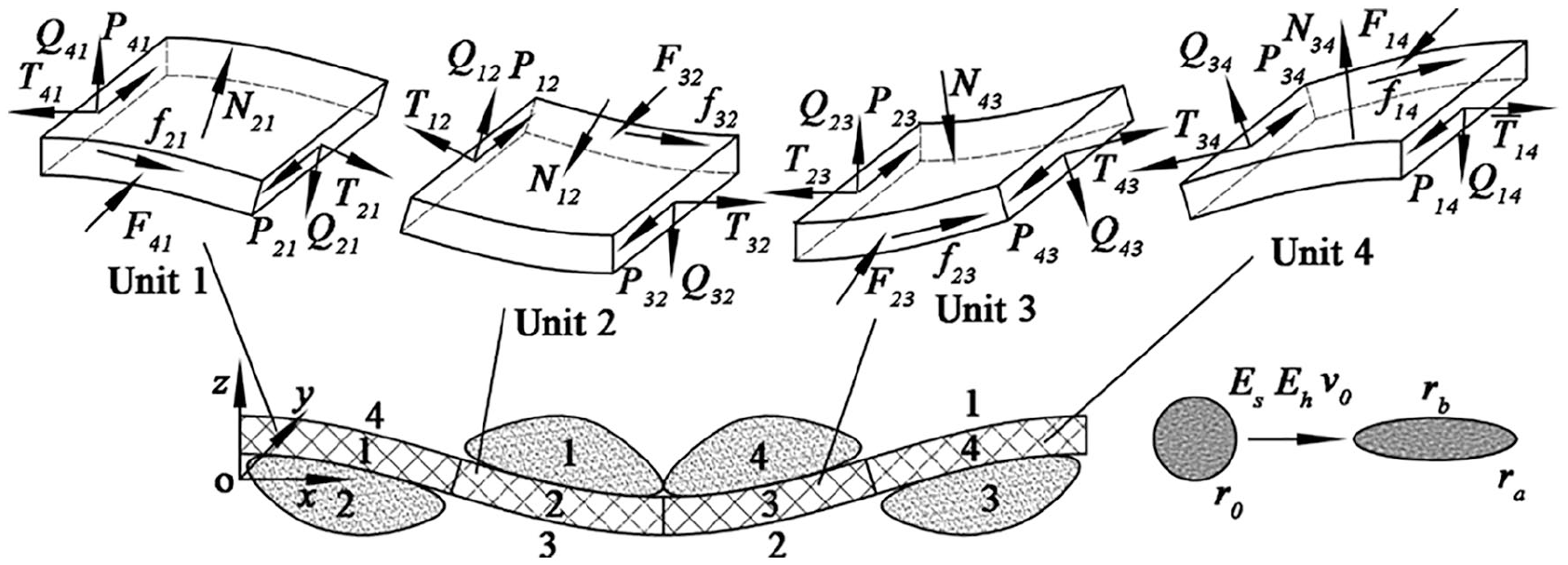
Perspective view of regular braided structures along the strand direction.
The basic structure of regular braided ropes can be studied using Figure 2, and for convenience and numerical analysis, and based on practical engineering, the following assumptions regarding the model are made.
(1) Assume all strand cross-sections are circular (radius =
(2) Although there are shear forces during the process of braiding and forming, they quickly change into shear thermal form and are released owing to that yarn and fluid have similar mechanical properties to a degree. After forming the braided structure completely, yarns are in a soft state. Therefore, the internal forces f, F, P, and Q are ignored.
(3) As a consequence of the cylindrical symmetry, the stresses of each strand are periodically and symmetrically distributed.
(4) Given that strands are braided together closely, the multifilament effect inside each strand is ignored.
Force equilibrium equations for regular braided structures
Outer radius,

As expected, the strands adjacent to the centerline are staggered by a one unit position. The cross-section consists of N strands at each point, representing N internal forces, among which there are N/4 sets of four different internal force values. For instance, while N = 12, one loop of each strand consists of 12 units, and each unit has an equivalent internal force. However, most of the equivalent internal force values are the same. Due to symmetry, the internal force of the 12 strands could be divided into three same groups by a step of one-unit-position length, and each group has four different internal force values.
The total internal force at any cross-section is equal to
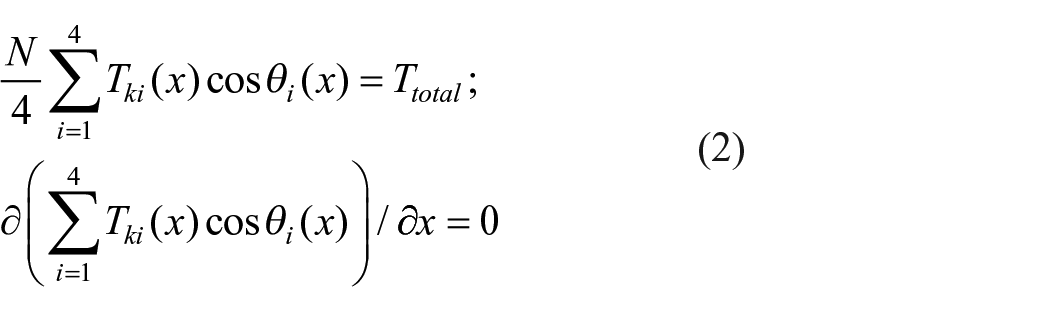
where
Additionally, the internal force equilibrium equations for each unit are given by:


where
The center-of-mass coordinate of the curve
The
Physical properties of regular braided structures
Based on elastic mechanics and the Hertz contact theory, 2 the equations for physical properties of the regular braided structure could be derived such that



where
Deformation compatibility relationship in regular braided structures
Figure 3 shows a sectional view of the cross section along the centerline strand. Based on the symmetry of the braided structures, the deformation compatibility relationship requires that at point C in the cross-section,

Sectional view along the strand centerline.
The angle between the cross section
The space volume equation of the strand is expressed as:
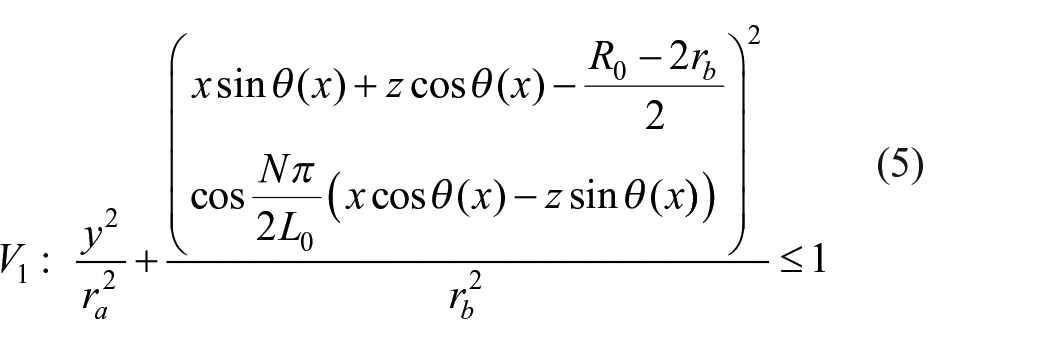
where
The plane

The projective area Ω1, of the strand onto the

Based on the deformation compatibility relationship, the cross-sectional shape of Ω1 is found to be the same as that of

By intersecting the new cross section Ω1' and the

where
The length of

Results and discussion
Combining equations (2) to (4) and (10), the stress distribution in regular braided rope strands could be determined using Matlab.
However, even though each basic structure consists of four basic units, only two different types of stress distributions are identified in counter-clockwise and clockwise strands. Based on the different parameters of regular braided ropes, the stress distributions in the strands are analyzed. Using aramid fibers, the braiding parameters are determined as:

Some strand geometrical parameters with varying tensile force: (a) clockwise strands and (b) counter-clockwise strands.

Stress distributions of strands with varying tensile force: (a) clockwise strands and (b) counter-clockwise strands.
As expected, as the tensile force increases, the geometrical parameters of the strands also increase; likewise, their stress distribution fluctuating amplitude also increases (Figure 5). However, the fluctuation ratio decreases from 18.8% to 16.4%, indicating that the rope could become tighter under a larger tension.
Additionally, given that the strand strain and the stress at point A, are important references in the failure criteria, they are studied under different

Stresses under different elastic modulus conditions: (a) stress at point A and (b) average stress of

Strain-force characteristics under different elastic modulus conditions.
Stresses at point A did not significantly change under different elastic modulus (
For different braiding applications, strand numbers could be varied (e.g. 8, 12, 16, 20). In Figures 8 and 9 the strand strains as well as the stress at point A for different strand numbers are shown. Here,
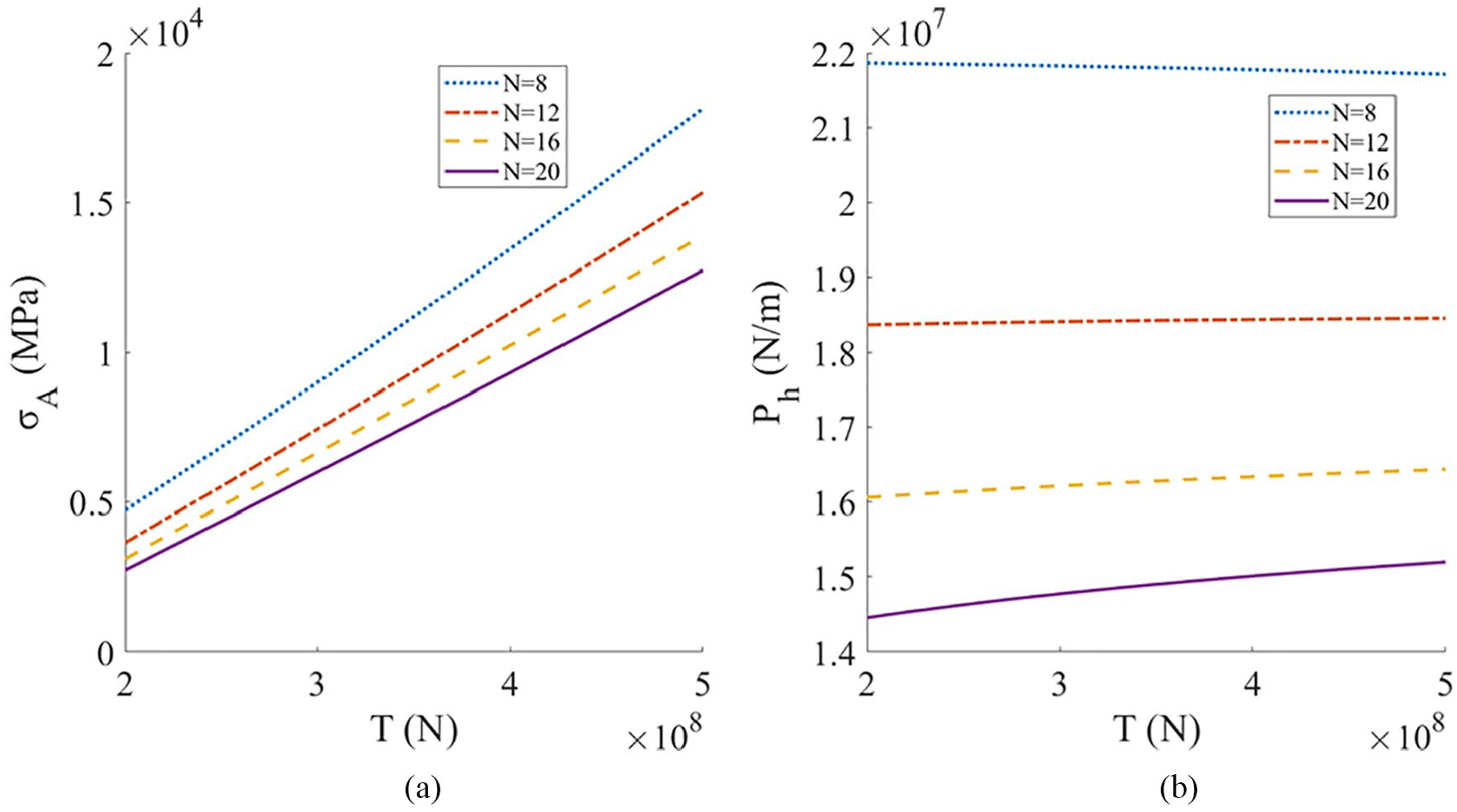
Stresses for different strand numbers: (a) stress at point A and (b) average
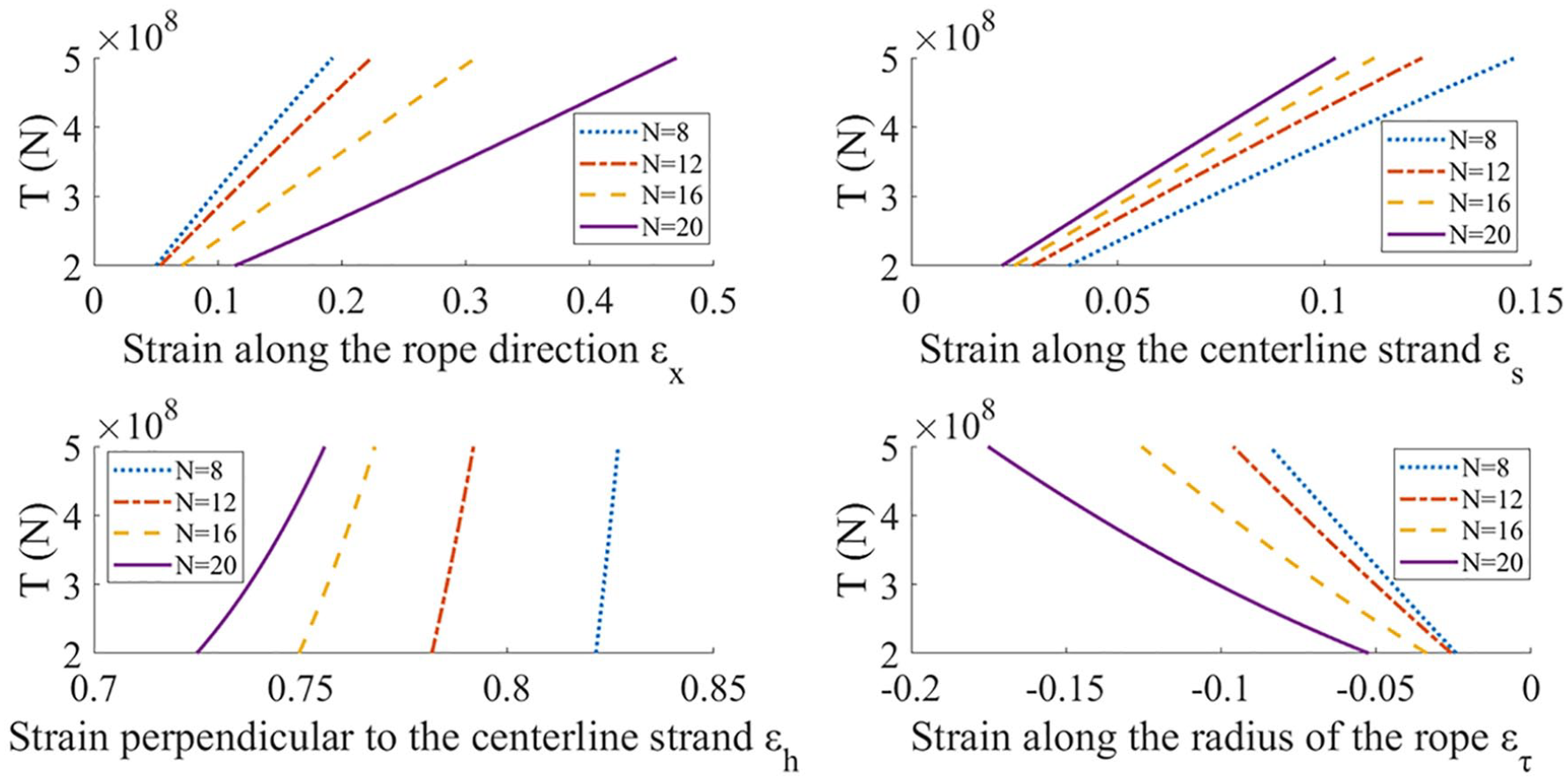
Strain-force characteristics for different strand numbers.
Both, the stress in each strand as well as that in all the strands decreases as the number of strands increases (Figure 8). Additionally, the strain in both directions of the cross section decreases, while the strain of the rope increases as the number of strands increases (Figure 9).
Moreover, in Figures 7 and 9, it can be observed that curves do not start at zero. The cause of this phenomenon probably is that a certain amount of yarn tension is required when braiding. If there is not enough yarn tension, they cannot form a tight braid. Therefore, after braiding the rope, an initial pulling force exists to maintain the fixed braided structure, otherwise the rope state is uncertain and parameters could change, which could induce the simulation calculation could not analyze.
Conclusions
In this study, by dividing ropes into basic loops consisting of four different units, a regular-braided rope mathematical model that can be applied to mono-filaments is proposed. Using this model, the different tensile properties of regular braided ropes are investigated, and for numerical analysis, the rope strands are classified as clockwise or counter-clockwise, and their stress distribution, strain, as well as their other geometrical parameters are investigated.
The results show that an increase in the tensile force on the strands results in an increase in the fluctuating amplitude of the stress distributions in the strands. However, the fluctuation ratio decreases from 18.8 to 16.4% resulting in a tighter rope. Additionally, a comparison of Figures 4 and 5 shows that the points where the stress is maximum are the outermost points. This observation suggests that for regular braided ropes, an extra safety margin of approximately 20% should be allowed, owing to the uneven distribution of stresses in strands during their application.
Additionally, this proposed mathematical model could also be used to calculate the strain under different braiding parameters. This property is vital when dealing with some fragile strand materials for example, depending on the application, if a higher durability is required, the number of strands could be increased, and if a limited strain coefficient is required, the number of strands could be reduced.
Footnotes
Declaration of conflicting interests
The author(s) declared no potential conflicts of interest with respect to the research, authorship, and/or publication of this article.
Funding
The author(s) disclosed receipt of the following financial support for the research, authorship, and/or publication of this article: This project is supported by National Natural Science Foundation of China (Grant No. 51905088); Special Fund of Scientific and Technological Achievements Transformation in Jiangsu Province (Grant No. BA2018061); Fundamental Research Funds for the Central Universities (Grant No. 2232019D3-31).
