




Abstract
The prime intention of this study is to develop and validate the efficiency of a fuzzy logic model to predict the tensile strength of bleach washed denim garments. Denim washing is nowadays a widely used technology to give a worn-out appearance to denim garments and thus add esthetic to that garments’ appearance and outlook. In the case of regular overall fading of denim, bleach washing is very popular. At the same time, it is also a matter of concern that the process optimization of bleach washing is critical as bleaching agents have an adverse effect on the fabrics. Among others, bleach concentration, time, and temperature are the primary process parameters in bleach washing, which directly impact the final strength of the treated denim garments. Though their relationship is nonlinear, a fuzzy expert-based system has been constructed to model and illustrate the complex relationship among bleach concentration, time, and temperature in the input side, whereas tensile strength is the output. Strength is the most critical parameter of the final denim product, as it dominates the serviceability of that garments. Therefore, predicting the tensile strength without the trial-and-error method, which is being practiced now, can be a blessing for industrial practitioners. With the help of a laboratory trial, the developed model has been evaluated, and it has been found that the mean relative error was 2.82 and 3.92 for warp and weft direction tensile strength, respectively. On the other hand, the comparison exhibited a coefficient of determination (R2) of 0.99 for both warp and weft direction tensile strengths. The authors found that the performance of the developed model is satisfactory enough to predict the tensile strength of the bleach washed denim garments.
Introduction
Denim is a stiff and sturdy fabric that has been used for a very long time as a successful fashion item.1–3 Denim is trendy among people of all age groups. Denim is a woven twill (3/1 warp faced) fabric constructed using indigo dyed yarns as warp, while white yarns are as weft in its most common form. For this color variation, one side of the fabric provides an appearance of blue while the other side looks white.1,3 Denim is typically processed before wearing as garments.4–6 Dry processes and/or wet washes do this processing. Bleach washing is one of the prominent denim wet washes,7–9 where the colors from the fabric are uniformly removed, and a worn-out appearance is created.8–11 In the washing of denim, hypochlorite bleaches are generally used, which are applied in aqueous form by preparing from the bleaching powder. In the first stage, during the discoloration, the chemical bonds that make up the chromophore are broken by the bleaching agent. Eventually this process transforms the molecule into a new material, that either lacks a chromophore or has a chromophore that doesn’t absorb visible light. 12 Bleaches then target the fabric’s exterior layer and decompose the color before progressively penetrating the fabric’s structure. The projecting fibers are degraded first, and then the fabric’s constituent yarns are attacked. The chemical linkages of the primary wall (outer layer) are disrupted as the aqueous solution of hypochlorite bleach decomposes. The secondary wall is attacked in the next step. 8 Thus the bleaching agent reacts with the fabric and eventually degrades the fabric if a higher concentration of bleach is used, and/or the temperature of the wash bath is high, and/or the processing time is high.5,10 Therefore, uncontrolled process parameters can decrease the tensile strength of the treated garments significantly. At the same time, the required tensile strength should be maintained in the final product as strength has a very significant effect on the serviceable life of the garment.8,10,13 In this situation, to maintain the proper tensile strength of bleach washed denim, the process parameters such as bleach concentration, bleaching time, and bleaching temperature are needed to be controlled precisely.
After a rigorous literature review it has been found that approaches have been made to determine the properties of denim fabric and garments after denim washing.5,9–11,14 Most efforts have been made to determine the physical, mechanical, and color properties of the bleach-treated denim. Among these properties tensile strength, elongation at break, stiffness, dimensional stability, weight loss, color fading, moisture regain, and water absorption are studied in various studies.10,15–17 In a comprehensive study, the authors have evaluated the effect of bleach washing parameters on the mechanical properties of denim garments. The authors concluded that hypochlorite bleach washing treatment decreases the stiffness (26.3% in face and 37.9% in back), tensile strength (3.9% in warp direction and 5.8% in weft direction), fabric weight per unit area GSM (grams per square meter) (3.7%), seam strength (23.91%), and surface roughness. 8 Construction of denim fabric plays a major role in the reaction of the fabric toward bleach washing conditions. To address the issue, in a research, three different constructed denim fabrics were used: (i) 98% cotton and 2% spandex, (ii) 99% cotton and 1% spandex, and (iii) 100% cotton. After analyzing the efficacy of KCI bleach, the authors suggested that 100% cotton fabric sample has not shown any positive change considering other two samples. 7 Along with other parameters, bleach concentration is also an important factor in determining the physical and comfort properties. The authors used three different conditions (3, 5, and 10 g/L bleach concentration). They concluded that with the increasing of bleach concentration GSM, EPI (ends per inch), and PPI (picks per inch) increase but tear strength, tensile strength, and stiffness gradually decrease. 5 In a separate rigorous study, bleach wash was completed varying three parameters: bleach concentration, time, and temperature. The authors investigated different physical and mechanical properties and claimed that the increment of these parameters caused a higher reduction in tensile strength, GSM, and stiffness. 10 On the other hand, the comfort and performance properties of the denim garments during usage are also very important. Other than mechanical properties, bleaching and softening has a huge effect on the color properties of the denim.5,8 In a study, the authors investigated the effect of industrial bleach washing and softening on denim’s physical and comfort properties and found that bleach washing affects the properties of denim garments. Stiffness and drape, which are considered sensorial non-thermal comfort parameters of a garment are also significantly influenced by the bleach washing process. 5 In another conclusive study, it is found that bleaching and softening treatments have a notable and positive influence on the thermal comfort properties of denim garments, namely thermal conductivity, thermal diffusion values, and thermal absorptivity. 18 While conducting this research, stiffness and tearing values were evaluated using one-way ANOVA, whereas, Kawabata Evaluation System (KES-FB) was employed to measure tensile, shear, bending, compression, and surface properties. 18 In a study, the desized indigo kapok/cotton denim fabrics and cotton fabrics were bleached with cellulose enzyme, potassium permanganate, sodium hypochlorite, laser, and hydrogen peroxide. After bleach wash, air permeability, tensile strength, the K/S values, thickness, crease recovery, and colorfastness to rubbing angle of denim fabrics were evaluated. 19 The influence of pumice stone-bleach washing on the physico-mechanical properties (elongation at break, tensile strength, color change, fabric weight, water absorption, and stiffness) has been studied, and the author stated that stone-bleach washing without soda ash has a negative effect on color loss.11,20 However, washing with soda ash caused more stiffness loss, more water absorption, and less strength loss. 21 Another work compared and evaluated the impact of bio-polished denim garments after bleaching with hydrogen peroxide and bleaching powder and found a significant difference. 22 It is evident from the literature review that the process parameters, mainly bleach concentration, bleaching time, and temperature affect the major properties of the treated denim significantly.
In a separate note, in the field of textiles, a lot of modeling approaches have been performed to predict the properties and optimizing the process parameters. For example, artificial neural network (ANN),23–25 Adaptive Neuro Fuzzy Inference System (ANFIS),26,27 Genetic Algorithm (GA),28,29 etc., based modeling has been adopted to model and predict different properties of textiles. These methods also aided in the appropriate process parameter selection with significant accuracy.30–36 However, all these models have some significant limitations. For example, the most used methods in textiles like ANN and ANFIS generally require a larger amount of data to operate accurately. Acquiring so much data in the industrial situation is always not easy and practical. On the other hand, fuzzy logic-based models are relatively simple, require less data, and are highly customizable.4,37,38 Moreover, the fuzzy logic-based model performs remarkably in property prediction, especially with smaller datasets, which is convenient for industries. 38 Therefore, to assist the process optimization of the bleach washing of denim garments, fuzzy logic based models can be an excellent choice for their advantages over the other common modeling methods.
Modeling based on fuzzy expert systems has been used in the field of dyeing, weaving, knitting, seam strength prediction, laser engraving, etc.4,35,38–44 Nevertheless, no significant work has been reported to demonstrate fuzzy-based modeling in the field of industrial garment washing, especially in the case of bleach washing. Since washing is crucial in today’s apparel world and bleach wash is the most challenging type of wash whose process parameters are hard to control, they demand extra precautions to maintain the quality of the final product. 8 As a result, fuzzy-based modeling could help in predicting the required property of the bleach washed garment. Moreover, based on the predictions, the process can be designed with significant accuracy, causing less man hour and material loss. This aspect is vital in terms of productivity, environmental footprint, and profitability of the washing industries.
Therefore, we have investigated the possibility of developing a fuzzy expert-based model that is a potential candidate to predict the tensile strength of bleach washed denim. This model is expected to be super convenient, customizable, and user friendly to predict the tensile strength of the bleach washed denim garments
Methodology
Configuration of the fuzzy logic model
To illustrate the intricate correlation among the input and output parameters, a model based on fuzzy logic has been constructed. Bleach concentration (g/L), bleaching time (min), and bleaching temperature (°C) have been used as the input variables, while tensile strength (lb.) is the only output variable. To examine whether the model is capable of predicting the said properties of bleach denim, a trial experiment has been conducted in the laboratory. Finally, the data predicted by the model and actual experimental data have been analyzed to validate the credibility of the developed model. The theory of the fuzzy expert system is described as follows:
The expert system based on fuzzy logic has been extensively used in various scientific fields since Zadeh developed it at the University of California in 1965. 45 The basic architechture of the fuzzy expert system comprises of four basic modules such as fuzzification interface, rule base, decision making unit, and defuzzification unit.
Figure 1 represents the four major modules of the fuzzy expert system.38,42,46 They are discussed as follows-
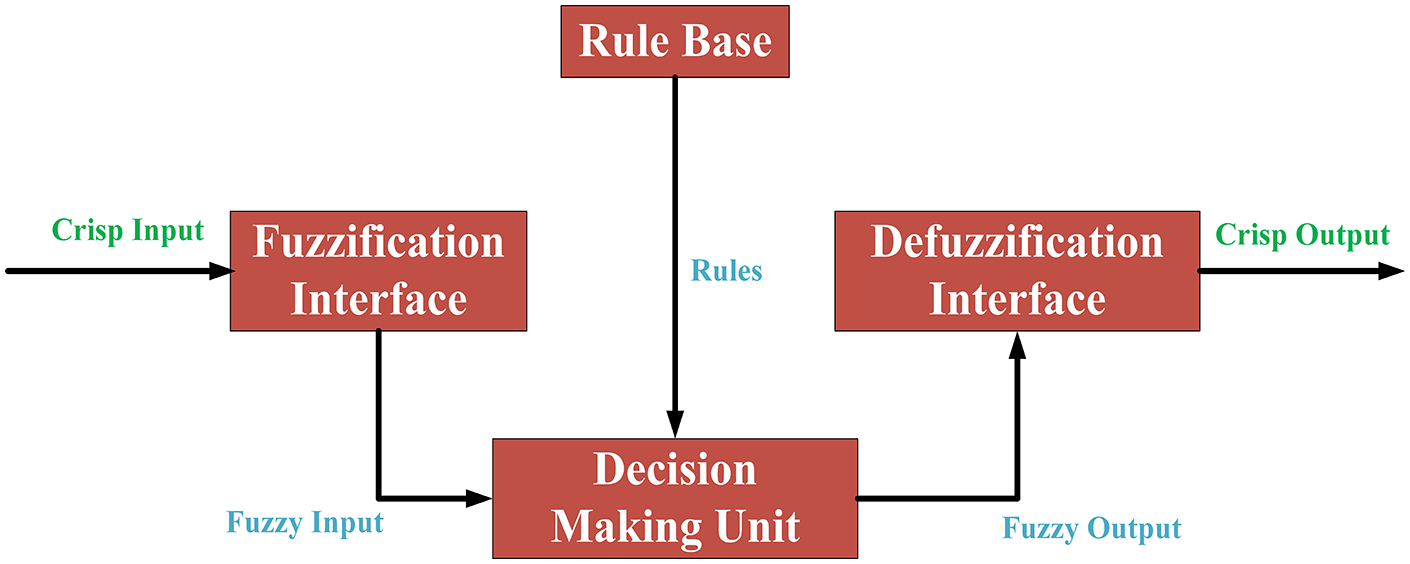
Basic configuration of the fuzzy logic system.
The fuzzification interface is the first component of the fuzzy logic system, and it is used to select the input and output side variables. For both input and output functions, membership functions must be developed. In linguistic terms, the numeric variables are designated as low, medium, high, etc. The simplest membership function is the triangle membership function, and it is most extensively utilized among several other membership functions.4,46–48
Fuzzy rules may be considered as important as the heart of a fuzzy system. 38 These rules use an if-then statement to connect the input and output variables [24], [26], [28]. For example, for the inputs X and Y, and output Z those have the linguistic variables, namely low and medium for X and Y respectively, and medium for Z then the fuzzy expert rules39,47 can be constructed as the following expression:
If X is low, and Y is medium, then Z is medium.
Between the two types of fuzzy rule base named Mamdani and Sugeno,39,48,49 Mamdani rules have been used in this particular study.
In the fuzzy logic system, the role of decision-making logic is significant since it allows for human-like decision-making. The Mamdani max-min fuzzy inference was used in this research because it ensures an interpolation of outputs between rules that is linear.37,38,50 The decision making unit works according to the information obtained from the fuzzification interface. Then by applying the knowledge of the rule base decides the best way to control the process. To build a relationship between input and output linguistic variables, these rules are expressed in IF-THEN expressions. The fuzzy decision maker that will regulate the process’s central role is to select the best control signal. In a Cartesian product space in which the input variables take in their respective universes of discourses, the connective “AND” is implemented as fuzzy conjunction. Figure 2 depicts the fuzzy logic mechanism in the case of three inputs and a single output (warp and weft direction).

Fuzzy inference mechanism for: (a) tensile strength in warp direction and (b) tensile strength in weft direction.
The defuzzification interface is the last module of a fuzzy logic architecture.38,51 The defuzzification interface combines the decisions produced by the decision-making logic to turn the noisy output into crisp and clear numerical values.39,52 The defuzzification method based on the center of gravity (centroid) is the most preferred, as it ensures a linear interpolation of the output between the rules.38,42 Equation (1) defines the conversion of fuzzy output into a crisp value Z4,51:
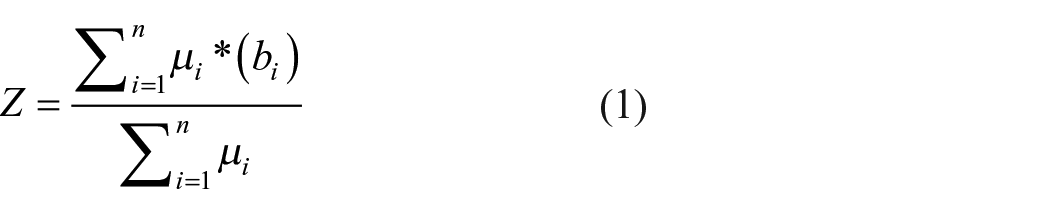
Where n represents the number of elements in the sample,
Development of the model based on fuzzy expert
Three process variables such as bleach concentration (g/L), bleaching time (min), and bleaching temperature (°C) as input variables, whereas, tensile strength (lb.) as the output variable have been used to develop fuzzy logic based model. The fuzzy model was created using the MATLAB (Version 9.6) fuzzy logic toolbox. For input variables, three linguistic fuzzy sets were chosen: Low (L), Medium (M), and High (H), and they were distributed in a regular manner to cover up the full input range. Very Low (VL), Low (L), Medium (M), High (H), and Very High (VH) were selected and also evenly distributed as the fuzzy output sets that were employed for the tensile strength (lb). Fuzzy sets with their linguistic variables and value ranges are tabulated in Table 1.
Linguistic variables and value ranges of the fuzzy variables.

In this study, triangular-shaped membership functions have been employed for both input and output variables. The centroid defuzzification approach and the Mamdani max-min inference mechanism39,48,49 have been utilized for better convenience.
The following functions assist in the fuzzification of the used factors:



Where
Prototype triangular-shaped fuzzy sets for the input and output variables, namely bleach concentration (g/L), bleaching time (min), bleaching temperature (°C), tensile strength- Warp, and tensile strength-Weft was constructed with the help of the fuzzy toolbox. Figures 3 and 4 represent the membership values for inputs and output. For input parameters as depicted in Figure 3, it can be seen that the (a) the range of bleach concentration (5–15) is expressed in the linguistic terms as low (L), medium (M), and high (H). The total range is evenly distributed by using triangular-shaped membership functions. The same principle is applied for the other two input parameters: (b) bleaching time and (c) bleaching temperature. In both cases, the total value range of the parameters (20–40 min for bleaching time and 40°C–60°C for bleaching temperature) have been evenly distributed by using the triangular-shaped membership functions. Figure 4 shows the membership functions of the output parameters. For the output parameters, the tensile strength in both warp and weft direction is expressed as 05 linguistic terms, namely very low (VL), low (L), medium (M), high (H), and very high (VH). Similar to input parameters, the triangular-shaped membership functions have been employed for the output parameters. The total value range (160–380 lb. for warp direction and 120–300 lb. for weft direction) is evenly distributed. Expert opinion was used to formulate 27 fuzzy rules. Four rules as samples are depicted in Table 2.
Fuzzy rules.


Membership functions of: (a) bleach concentration (g/L), (b) bleaching time (min), and (c) bleaching temperature (°C).

Membership functions of: (a) tensile strength in warp direction and (b) tensile strength in weft direction.
Experimental procedure to validate the model
100% cotton denim fabrics were collected from the factory, and leg panels were manufactured. The used denim has a construction of 74 × 42/9 × 7, 55″. The weight per unit area, GSM (Grams per Square Meter) of the raw denim was 381 and woven in a 3/1 warp face twill arrangement. The prepared leg panels were then bleach washed and softened using a standard process recipe according to the intended process parameters.
As the first step of the washing process, the desizing was carried out in a material to liquor ratio 1:10. The main chemical was a desizing agent (Luzyme FRHP) at a rate of 0.6 g/L and detergent (Hostapur WCTH) at 1 g/L. The entire process of desizing was carried out in a lab-scale horizontal garment washing machine (Sutlick, Singapore). The temperature was kept at 60°C for 20 min, and the pH of the bath was maintained at 7. After the intended time, the liquors were dropped, and then the garments were rinsed hot (60°C) and cold (room temperature) for 2 min, respectively. The desized panels were then bleach washed in the same machine maintaining the same liquor ratio as desizing for 20–40 min in 40°C–60°C using a hypochlorite bleaching agent (KCI bleach) at a concentration of 5–15 g/L. The pH of the washing bath was maintained at 10. After the desired time, the panels were rinsed in normal water for 2 min at room temperature. The bleached panels were then neutralized in the same machine, maintaining the same 1:10 material liquor ratio using sodium hyposulphite at a rate of 2 g/L at room temperature for 7 min. The neutralized garments are then rinsed twice at room temperature. Afterward, the bleached and neutralized denim has undergone a softening process using a softener (Resil AOEC) at a rate of 2 g/L, maintaining a liquor ratio 1:8. Acetic acid (40 g.) was used in the bath to achieve and retain a pH of 5.5. The softening process was continued for 7 min at room temperature. The liquors were then dropped. Hydro extracting of the bleach washed and softened denim leg panels was performed at 200 rpm for 5–7 min to achieve a minimum of 70% wet pick-up. The hydro extraction was carried out by using a laboratory-scale hydro-extractor machine (Zanussi, Roaches International Limited, England). The hydro extracted leg panels were then dried at 60°C–65°C for 20 min in a gas dryer (Fabcare, India).
Conditioning of the samples and experiment
Before being tested by following the standard atmospheric conditions of relative humidity, RH% (65 ± 2)% and temperature (20 ± 2)°C,13,38 the samples have undergone a conditioning process for at least 24 h on to a flat surface. The tensile strength (breaking force) of the bleach-treated specimens was assessed by following the test standard ASTM D5034-21 53 with the help of the Testometric Universal Strength Tester (M350-5 CT). The strength has been measured in both the warp and weft direction of the samples. The tensile strength for each combination of bleach concentration, bleaching time, and bleaching temperature was calculated using an average of 05 specimens.
Results and discussion
Operation of the fuzzy logic model and analysis of the experimental results
The rule viewer for the fuzzy logic model is depicted in Figure 5. Rule viewer is the interface that displays the change in output variables due to changes in input variables. By this interface, the decision-makers can take the final decision to select optimum input parameters based on their requirement. For instance, in this interface, if bleach concentration is 10 g/L, bleaching time is 30 min, and bleaching temperature is 50°C, then the tensile strength is 270 and 210 lb. for warp and weft direction, respectively. Figures 6 and 7 demonstrate the surface view of the fuzzy model which explains the relationship among the parameters of input and output side.
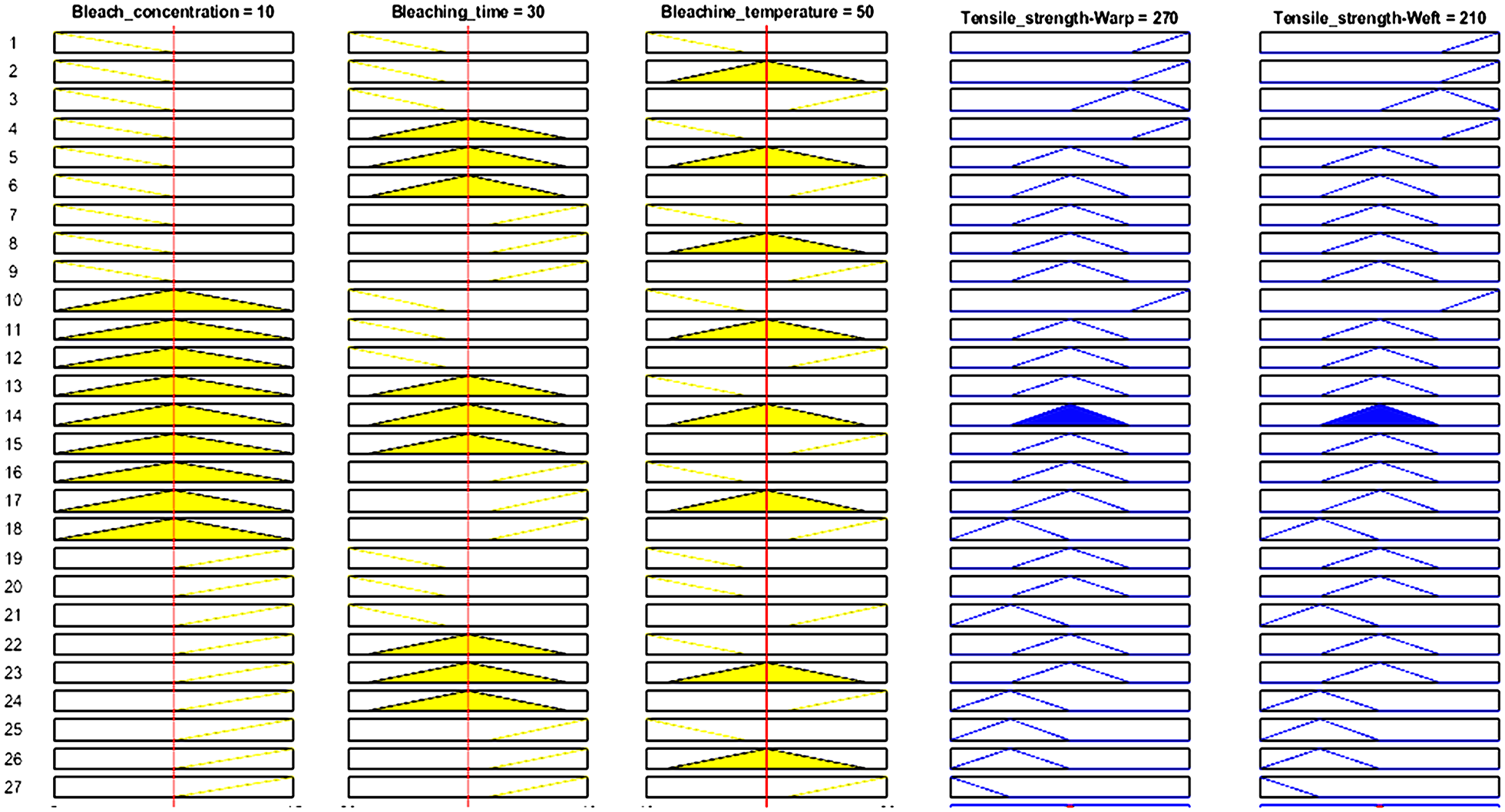
Rule viewer of the fuzzy logic model.
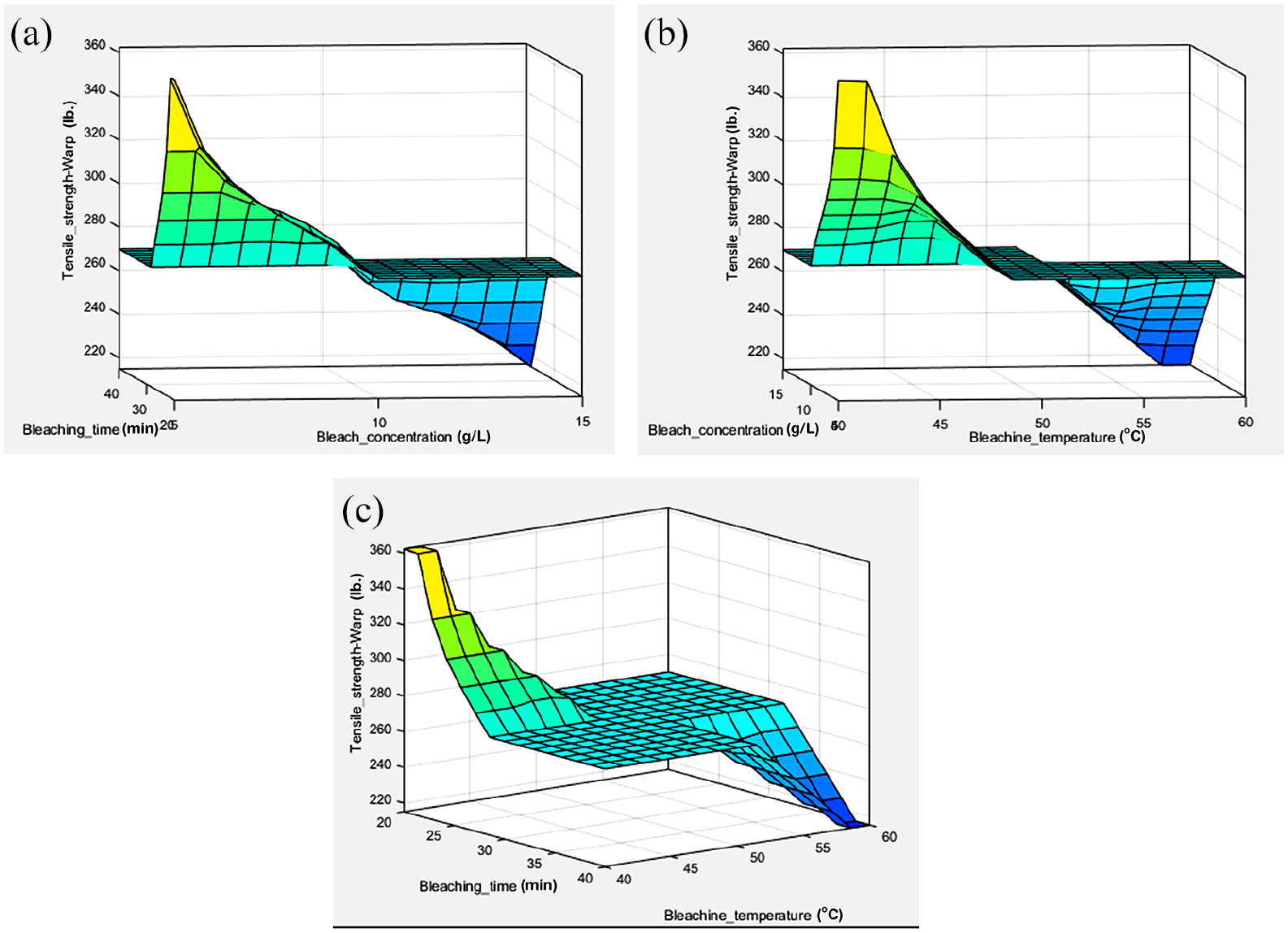
Surface view of the effects of: (a) bleaching time (min) and bleach concentration (g/L), (b) bleaching temperature (°C) and bleach concentration (g/L), and (c) bleaching time (min) and bleaching temperature (°C) on the tensile strength in warp direction.
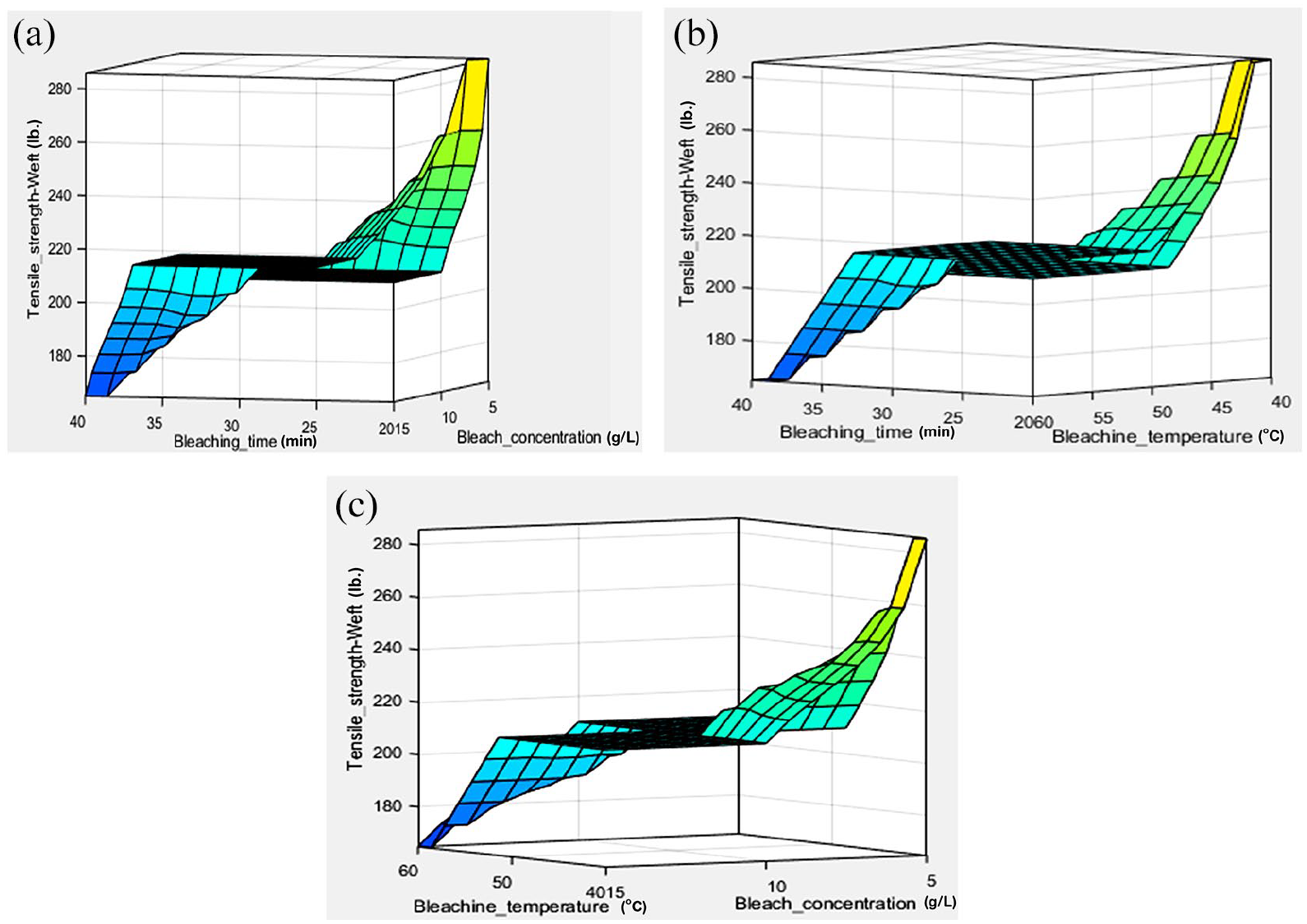
Surface view of the effects of: (a) bleaching time (min) and bleach concentration (g/L), (b) bleaching time (min) and bleaching temperature (°C), and (c) bleaching temperature (°C) and bleach concentration (g/L) on the tensile strength in weft direction.
Figures 6 and 7 show that bleaching concentration, bleaching time, and bleaching temperature have an inverse effect on the tensile strength in both directions. When each input parameter increases, the tensile strength for both warp and weft direction decreases and vice versa. It has also been found that the input parameters have a considerable impact on the output parameters. As bleaches work by destroying the constituent of the fabric surface, it certainly affects the tensile strength of the treated fabric.5,8,10,11 At the same time, exposing the fabric for more time in the bleach or even a higher process temperature affects the fabric’s tensile strength. The increment of all of the input parameters gradually decreases the strength of the treated garments.5,8,10 Therefore, choosing the optimum process parameters in bleaching is vital for maintaining the required tensile strength after industrial bleach washing. This proposed model can help in this regard to select proper bleach concentration, bleaching time, and bleaching temperature to get the required tensile strength and, at the same time, can suggest optimum input parameters to get a particular output result. For example, from the rule viewer of the fuzzy model as depicted in Figure 5, every input and output side parameter can be selected and changed individually to predict the parameters effectively. If any or all input parameters, namely the bleach concertation, bleaching time, and bleaching temperature, are changed, the resultant tensile strength will be displayed automatically. In contrast, if any particular tensile strength is required, upon selecting that particular value in the output side, the model can suggest the optimum bleach concentration, bleaching time, and bleaching temperature to achieve that tensile strength. Thus, this model can predict and recommend the optimum process parameters for maintaining the required properties of the final denim garment.
Validation of the model
The model predicted data and experimental data had been compared to validate the model. A total of 10 random data have been used for the validation purpose. Mean absolute error (%), the correlation coefficient (R), and coefficient of determination (R2) have been evaluated for all of the output variables. The coefficient of determination (R2) has been plotted and calculated with the help of GraphPad Prism software (Version 8). Table 3 shows the overall summary and assessment of the experimental and model-predicted values.
Comparison of actual and predicted values of tensile strength.

Figure 8 represents the linear fit diagram between the predicted and experimental values of the output variable concerning the input variables. From the analysis, it has been found that the coefficient of determination (R2) has been found 0.99 for both warp and weft direction tensile strength. Therefore, it is reasonable to believe that the proposed model is well competent to explain up to 99% of the total change in the tensile strength of the treated denim. The mean relative error has been found 2.82%, 3.92% for warp and weft direction tensile strength, respectively, which fits outstandingly within the acceptable limit of 5%. The results suggest the satisfactory accuracy of the proposed model in predicting the output variables.

Correlation between actual and predicted values by the fuzzy logic model: (a) for tensile strength in warp direction and (b) for tensile strength in weft direction.
Conclusion
The main objective of this study was to design and assess a fuzzy expert-based model with the capability to predict the tensile strength of bleach washed denim garments. Based on the experimental findings and comparison with the model predicted values, the conclusion may be drawn as follows:
The mean relative error of tensile strength between the predicted and experimental values were observed to be 2.82 and 3.92 for the warp and weft directions, respectively, within the acceptable range of 5%.
By analyzing and calculating, the correlation coefficient (R) was found to be 0.99 between the predicted and experimental tensile strength values.
The Coefficient of determination (R2) is 0.99 for both warp and weft direction tensile strength, which demonstrated that the model data and experimental data were well aligned, implying that the model is compatible enough.
The developed model is less time-consuming and highly customizable. Moreover, the model is material and process efficient, thus positively affects the environmental footprint. As a result, to model other washing parameters than bleach washing is also conceivable with the help of this model. By analyzing the model predicted data and after a laboratory-scale validation process, it is evident that all of the bleach concentrations (g/L), bleaching time (min), and bleaching temperature (°C) affect the tensile strength of the treated denim garments. On the other hand, this model can explain the changes in tensile strength of the bleach-washed denim in respect of the input parameters with significant accuracy, which may help the industry practitioners set the optimum processing parameters during the denim processing.
To develop and assess the efficiency of the fuzzy logic modeling in the future (i) other fabric types than denim, (ii) other physical, mechanical, and/ or color properties, and (iii) more comprehensive range of process values can be considered.
Footnotes
Declaration of conflicting interests
The author(s) declared no potential conflicts of interest with respect to the research, authorship, and/or publication of this article.
Funding
The author(s) received no financial support for the research, authorship, and/or publication of this article.
