



Abstract
Moso bamboo has strong mechanical property and high economic efficiency. However, its anisotropy and inhomogeneity will increase the time and cost of mechanical properties testing. Aiming to solve this problem, in this paper, a series of tests were systematically carried out to test the parallel-to-grain compressive resistance, bending resistance, tensile resistance, shear resistance and perpendicular-to-grain compressive resistance, tensile resistance. Then, the characteristic values of mechanical properties of bamboo were analyzed for establishing the relationship between mechanical properties and density of bamboo and finding a kind of conversion method among mechanical properties. The results show that the parallel-to-grain properties of bamboo are better than that perpendicular to the grain. There is a high correlation between Mechanical properties and density of bamboo and can be well fitted by Linear functions. This research provides mechanical properties conversion parameters that can be used to evaluate and predict the properties of the moso bamboo.
Introduction
Many countries have published a series of policies to promote environment-friendly construction to solve the increasingly severe environmental problem, such as the “Zero Energy and High-Performance Green Building Executive Order” of the United States and the “Green New Deal” of European Union and “Green Building Creation Action Plan” of China. As one of the main building structures, the bamboo structure can realize the harmonious coexistence with the ecological system, which is one of the major trends in the future development of the building. At present, the typical applications of bamboo structure include Green School in Bali Island, 1 Nomadic Museum in Mexico, 2 Suntory Museum of Art in Japan. 3 In China, its main application can be observed in village characteristic buildings, tourism buildings, 4 the roof of large characteristic stadiums. 5 Moso bamboo is the most commonly used species6,7 because of its excellent mechanical properties and low economic cost.8–10
At present, the research on bamboo mainly concentrates on the basic mechanical properties11–15 and the properties of components and joints.16–20 However, systematic research on the prediction of its mechanical properties was rarely carried out. Sá Ribeiro et al. 21 carried out bending tests of bamboo stalks and respectively fitted the relationship between bending strength, elastic modulus and density. Dixon and Gibson 22 investigated the relationship between the parallel-to-grain compressive strength and density of bamboo and found they had a high correlationship. Javadian et al. 23 correlated bamboo’s parallel-to-grain tensile and bending properties to the wall thickness, perimeter and density, and proposed the relevant calculation formulas. In order to determine the appropriate influencing factor of the mechanical properties of bamboo, scholars studied and found that the density had a strong correlation with the mechanical properties of bamboo. Bahtiar et al. 24 measured the compressive strength and bearing capacity of bamboo stalks, and the results showed that there was a good linear relationship between density and compressive strength. Lo et al. 25 studied the effect of bamboo diameter and bamboo age on compressive strength, and the results showed that the fiber density of bamboo internal sacrosanct tissue was a good indicator of bamboo strength ability. A large number of literature studies showed that density was a physical parameter with a high correlation with bamboo mechanical properties.
Bamboo is a kind of two-phase porous and compressible anisotropic material. A fully understanding of the mechanical properties of bamboo is the basis for the application of bamboo structure. At present, the research about the prediction of mechanical properties of bamboo did not comprehensively study bamboo properties and the number of samples and the sampling sites is limited, and the transformation relationships between mechanical properties have not been established, which can save a lot of time and cost of testing materials for the engineering application. 26 In order to systematically study the mechanical properties of Moso bamboo and establish the corresponding prediction model, the following research contents were finished in this paper: (1) The specimen used for testing various mechanical properties (including compressive resistance, bending resistance, tensile resistance, parallel-to-grain shear resistance, perpendicular-to-grain compressive resistance and tensile resistance) were made and tested under the consideration of bamboo nodes influence. And the density of specimens were measured after the test. (2) The characteristic values of mechanical properties of bamboo were analyzed statistically. (3) The relationships between the mechanical properties and density were established. (4) The conversion methods of mechanical properties of Moso bamboo were proposed.
Material and method
Preparation of specimens
In this paper, bamboos were harvested from Chenzhou City, Hunan Province, China; their DBH (diameter at breast height) were about 100 mm. About 160 vertical bamboo stalks without mildew, insect pests, rot were randomly selected in the bamboo forest, and the Cutting position was 0.1 m away from the ground. Each bamboo stalk sample was 6 m long and marked with labels before transporting to the laboratory and stacking in the ventilated and waterproof place with air-drying treatment, as shown in the Figure 1(a).
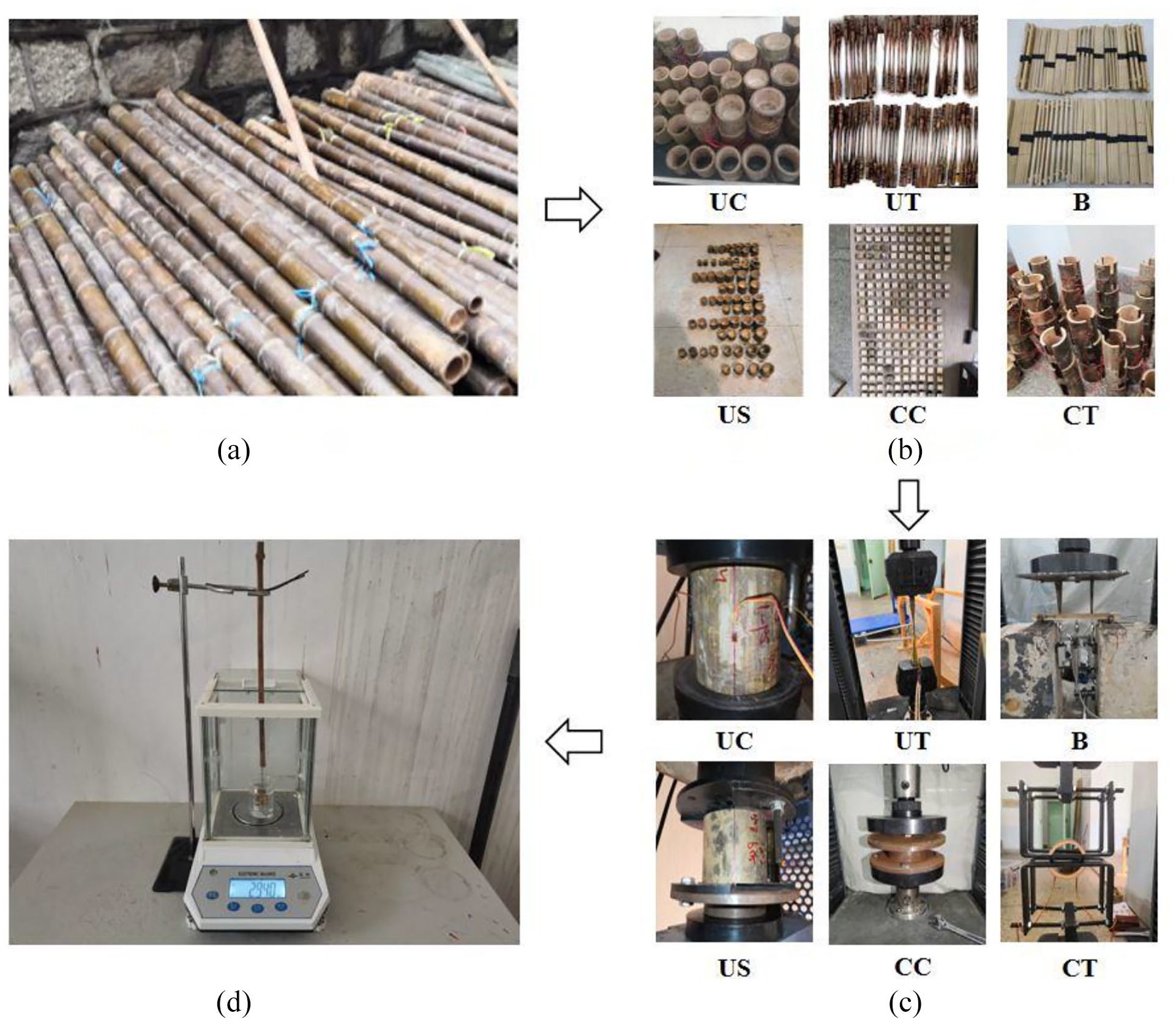
The processing and testing of Moso bamboo: (a) raw Moso bamboo, (b) internode and node specimens, (c) density determination, and (d) experiments.
The mechanical properties tests in this paper include compressive resistance (UC), bending resistance (B), tensile resistance (UT), parallel-to-grain shear resistance (US), perpendicular-to-grain compressive resistance (CC), and tensile resistance (CT). Twenty-five bamboo stalk samples were randomly selected to make the specimen as shown in the Figure 1(b). All kinds of node and internode specimens were selected alternately along with bamboo stalk height and made under the consideration of node influence. The ratio of height to the outer diameter of the specimen (UC and US) was set as 1. The size of the B specimen was 220 mm × 15 mm × t mm, the size of the UT specimen was 330 mm × 15 mm × t mm, the size of the CC specimen was 15 mm × 15 mm × t mm, and the size of the CT specimen was 100 mm × D mm × t mm.27,28 The detailed size and labeling of various specimens are shown in Figure 2 and Table 1.

The size of internode and node specimens.
Dimensions of specimens.

H refers to the height of the specimens; D refers to the diameter of the specimens; t refers to the thickness of the specimens.
Mechanical property test
The universal testing machine was used to apply load to UC, US, and UT specimens with the rate of 0.01 mm/s. The loading rate of B specimen was 150 N/mm2 per minute, the loading rate of CC specimen was 20 N/mm2 per minute, and the loading rate of CT test was 0.005 mm/s. The process of experiments are shown in Figure 1(c). Then, the parallel-to-grain compressive strength (UCS), parallel-to-grain elastic compressive modulus (UCE), bending strength (MOR), elastic bending modulus (MOE), parallel-to-grain tensile strength (UTS), parallel-to-grain elastic tensile modulus (UTE), parallel-to-grain shear strength (USS), perpendicular-to-grain compression strength (CCS), and perpendicular-to-grain tensile strength (CTS) were obtained from those experiments. The calculation formulas of the mechanical property indexes are as follows 27 :




where, SW represents UCS, UTS, USS, CCS, and CTS (MPa) when the moisture content is W; EW represents UCE and UTE (MPa) of when the moisture content is W; MORW and MOEW are bending strength (MPa) and elastic bending modulus (MPa) when the water content is W, respectively. Pmax and A are the failure load (N) and the stressed area (mm2) of the specimen, respectively. ∆P and ∆l are the difference in load limitation (N) and the deformation (mm) between the top and bottom in the elastic section, respectively. t and b are the thickness (mm) and height (mm) of the specimen, respectively. δm is the deflection of Pure bending section of the specimen under the impact of ∆P (mm).
Measurement of density and moisture content
After the specimen was damaged, a small test piece with a size of about 20 mm × 20 mm near the failure zone was selected to measure its density and moisture content. The mass was measured by electronic scale, and the volume was measured by Archimedes drainage method, as shown in Figure 1(d). The calculation formulas are as follows 28 :


where, ρW (g/cm3) is the density when the moisture content is W; m1 is the air-dry mass (g); V is the air-dry volume (cm3); m0 is the absolute dry mass (g).
Adjustment of the index value of property
Before analyzing bamboo properties, the value of the index of property should be converted to the value under the condition of the standard water content (12%) as follows 27 :


where, ρ12 (g/cm3) is the density for standard water content; K is the volume shrinkage coefficient; M12 is the mechanical property for the standard water content; MW is the mechanical properties when the water content is W; KW is the correction coefficient of water content.
Outliers handling
The physical and mechanical properties of bamboo were discrete to some degree, and there were inevitably abnormal values of mechanical property index obtained in the test. In this paper, the performance index values were analyzed after eliminating those discrete data according to the IQR criterion. The IQR criterion aims to obtain the lower quartile value Q1 from 1/4 and the upper quartile value Q2 from 3/4 in the data sorted from the smallest to the largest on the premise that the data meets the standard normal distribution. The interquartile range of IQR is calculated by the following formula 29 :

The detection interval of outliers is calculated by the following formula 29 :

All the data analyzed in this paper were obtained after excluding outliers.
Results and discussion
Eigenvalue statistics
Figures 3 and 4 and Table 2 were obtained from the statistics of mechanical property indexes of moso bamboo. As shown in Figure 3 and Table 2, The parallel-to-grain mechanical properties were significantly better than those perpendicular to the grain direction. Among all the strengths, the parallel-to-grain tensile strength was the highest, with an average value of 139.542 MPa. The average parallel-to-grain internode tensile strength was 147.723 MPa. The parallel-to-grain compressive strength was also high, while the bending strength was lower than the parallel-to-grain tensile strength. The bending elastic modulus was slightly higher than that of parallel-to-grain compression and tensile resistance. It can be seen from Table 2 that the average density of node bamboo was 0.936 g/cm3, and the average density of internode bamboo was 0.898 g/cm3. The bamboo culms were divided into six segments with the length of 1 m and labeled ρ-1 to ρ-6 from the bottom to the top of the bamboo stem. The average density of each segment is shown in Figure 4, and it can be seen that the density of bamboo gradually increased, and there existed a difference in density between node bamboo and that of internode bamboo. Compared with other major building materials, the strength of bamboo is higher than that of wood, and the parallel-to-grain tensile strength is about twice that of wood. The strength-to-weight ratio of bamboo is better than that of steel. 30 In conclusion, Moso bamboo is an ideal renewable material for green building with the advantages of high strength, high stiffness, and high ratio of strength to weight.

Histogram of mechanical properties: (a) strength and (b) modulus of elasticity.

Density histogram.
Statistical results of characteristic values of mechanical properties.

The relationship between mechanical properties and density
By applying the Linear function, Exponential function, and Power function to fit the relationship between mechanical properties and density of Moso bamboo, fitted curves and relationship expressions are obtained and shown in Figure 5 and Table 3. Relationship expressions in Figure 5 are the optimal fitted relationship expressions. Determination coefficient R2, a parameter in the range of [0, 1], used for measuring the fitting degree. It can be seen from Figure 5 that the parallel-to-grain compressive strength, bending strength, parallel-to-grain tensile strength, parallel-to-grain shear resistance, and perpendicular-to-grain compressive strength of internode of bamboo all showed a positive correlation with density while perpendicular-to-grain tensile strength and perpendicular-to-grain compressive strength of node of bamboo had a negative correlation with density. It can be seen from Table 3 that, generally, there is a good correlation between the mechanical properties of bamboo. The mean of each determination coefficient R2 of optimal relationship expression is 0.658.

Fitting curve of mechanical properties and density: (a) UCS, (b) UCE, (c) MOR, (d) MOE, (e) UTS, (f) UTE, (g) USS, (h) CCS, and (i) CTS.
Fitting relation between mechanical properties and density.

Ruiz-Aquino et al. 31 had established a model to predict the log value of mechanical properties based on physical properties. The range of the optimal univariate fitting determination coefficient R2 in the model was [0.104, 0.494]. The range of determination coefficient R2 of the multiple regression model was [0.190–0.646]. Although the fitting result of mechanical properties of wood and bamboo was discrete to a certain extent. On the whole, the fitting of mechanical properties of Moso bamboo in this paper has a good result. Among fitted relationship expressions for 18 mechanical properties, 12 Linear functions have optimal fitting results, 4 Exponential functions have optimal fitting results, and 2 Power functions have optimal fitting results, and each mean of determination coefficient R2 value of fitted relationship was 0.533, 0.529, and 0.526, respectively. Therefore, it is suitable to use Linear functions for predicting the mechanical properties of bamboo because of its good prediction result and strong practicability.
The basic density of moso bamboo is related to its section surface system, vascular bundle system and ground tissue system, 32 and the distribution density and basic tissue content of vascular bundle are also in significant relationship with the basic density of moso bamboo. The larger the distribution density of the vascular bundle, the larger the basic density of the moso bamboo. 33 Bamboo can be treated as a two phase composite made of vascular bundle and ground tissue, in which the fibrous sheath in the vascular bundle is the enhancement phase 34 with a large aspect ratio and thick cell wall, and it almost decides all the mechanical properties of bamboo.
When the moso bamboo is under loads such as parallel-to-grain compression, tension and perpendicular-to-grain compression, the vascular bundle and ground tissue can bear loads at the same time. When local tissue in the section is destroyed, the rest tissues can continue to bear loads. While the vascular bundle is the main part for bearing loads, 35 and the basic density of the moso bamboo increases with the increase of the distribution density of the vascular bundle. Therefore, the larger the section density of the bamboo, the higher the section strength. Thus, parallel-to-grain compressive strength, tensile strength, shear strength, bending strength and perpendicular-to-grain compressive strength of internode of bamboo are all in positive relationship with density.
When the moso bamboo is under perpendicular-to-grain tension, the perpendicular-to-grain mechanical performance of vascular bundle is poor, so the basic system bears the main load. Although the basic density of the moso bamboo increases with the distribution density of the vascular bundle, once there is a slight separation between basic system fibers, the broken section will spread quickly along the longitudinal direction until the whole section peels or slides. Therefore, the tensile mechanical properties of node transverse grain is in negative relationship with density.
As for the perpendicular-to-grain compressive strength of node, the fiber texture at the node of specimen is more fluffy and disordered compared with other places. When the bamboo is under perpendicular-to-grain compression, the bamboo node of specimen is mostly crushed first. Thus, the bamboo node has a reduction effect on the perpendicular-to-grain compressive property. Specimen density will increase with the elevation of sampling height, but the proportion of the bamboo node in the whole specimen increases as well. Thus, perpendicular-to-grain compressive strength of node of bamboo is in negative relationship with density.
Relationship between mechanical properties
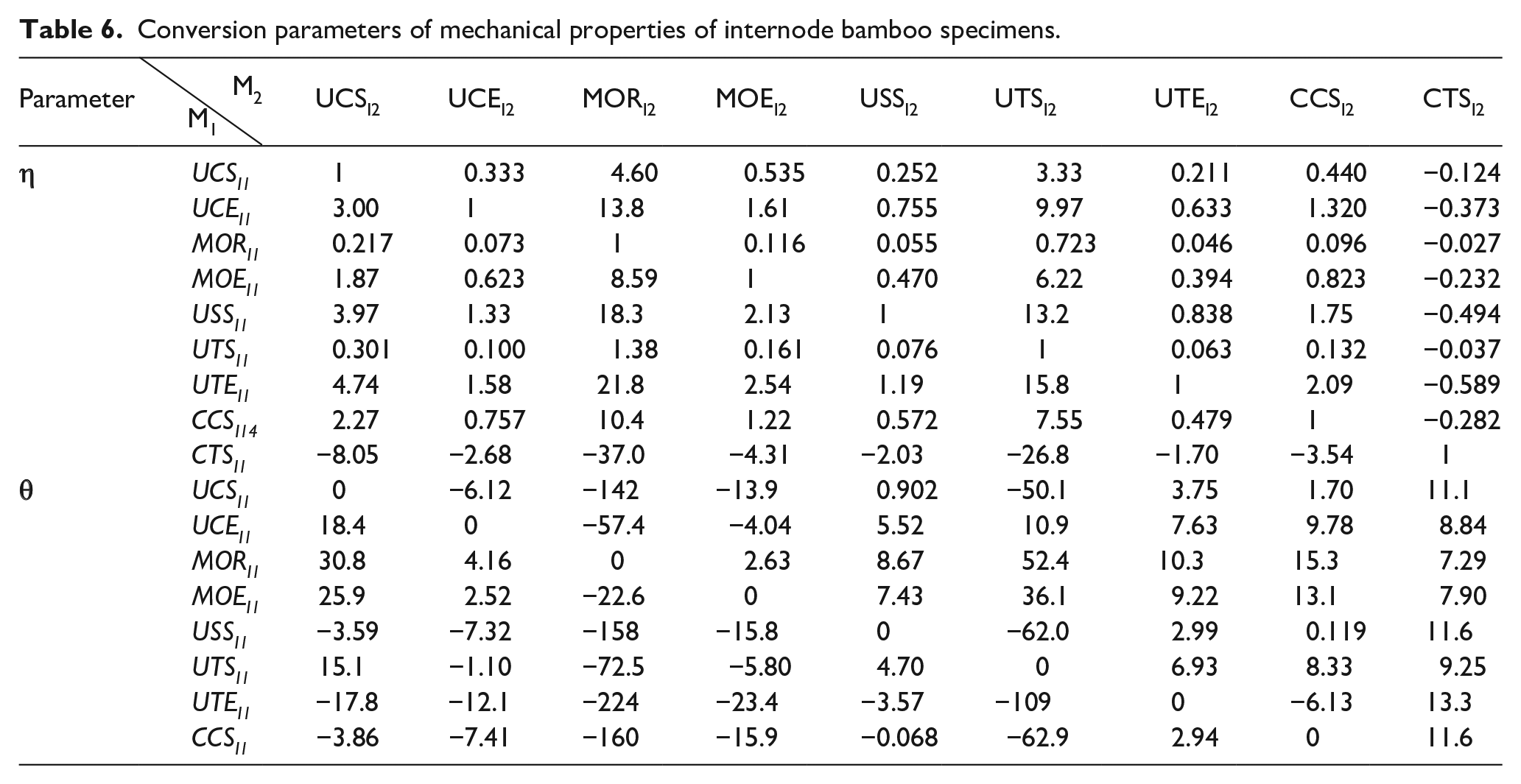
Based on the above analysis, the linear relationship between the mechanical properties and density can be used to derive the relationship among the mechanical properties. Table 4 shows the conversion relationship between mechanical properties of specimens of node and specimens of internode. Table 4 also reflects the quantitative impact of bamboo nodes on mechanical properties of bamboo. Because multiple mechanical properties can not be obtained simultaneously from one mechanical property specimen, so in this paper, the conversion relationships of multiple mechanical properties were derived from the linear fitting relationships between the mechanical property and the density. The conversion formula between mechanical properties is as follows:

where M1 and M2 are the mechanical property indexes; η and θ are the conversion parameters, whose details are shown in Tables 5 and 6.
Relationship of mechanical properties between node and internodes of Moso bamboo.

Mechanical property conversion parameters of node bamboo specimens.

Conversion parameters of mechanical properties of internode bamboo specimens.
Discussion
Moso bamboo has been widely used in bamboo structures because of its highest yield and economic value. A large amount of bamboo and bamboo text is needed in bamboo structural engineering due to the discreteness of mechanical properties of bamboo. It will take a lot of time and cost to make specimens with high precision and do multiple experiments. So the engineering practicability will be restricted by factors above.
The bamboo density test is suitable for engineering applications because it does not need a highly precise measurement of specimen size while predicting the mechanical properties, and the test method is simple and high-efficient. A lot of time and cost of material testing can be saved in actual engineering. In reference, 22 the predicted values of UTSI and UCEI were 130.6 MPa and 10.6 GPa by substituting the measured ρ into the prediction formula in this paper, and the measured UTSI and UCEI values were 130 MPa and 10.56 GPa. As shown in Table 7, the absolute error between the predicted value and measured value of UTSI was 0.6, and the relative error was 0.46%. The absolute error between the predicted value and measured value of UCEI was 0.6, and the relative error was 0.46%, indicating that the prediction model proposed in this paper behaves well in predicting the mechanical properties of Moso bamboo.
The difference between the experimental value and calculated value.

Conclusions
This paper systematically carried out tests for mechanical properties of bamboo materials and analyzed the relationship between the mechanical properties and density, and put forward the prediction formula and conversion method of mechanical properties of bamboo. The main conclusions are as follows:
The mechanical properties of Moso bamboo have a significant anisotropic characteristic, especially for the parallel-to-grain tensile properties, bending properties. Performances of parallel-to-grain compressive strength, tensile strength and bending strength are significantly better than Performances of perpendicular-to-grain mechanical properties. Moso bamboo is an ideal renewable green building material with the advantages of high strength, high stiffness and high ratio of strength to weight.
The density of Moso bamboo gradually increases along the height of the bamboo stem. The parallel-to-grain compressive resistance, parallel-to-grain tensile resistance, parallel-to-grain shear resistance, parallel-to-grain bending resistance, and perpendicular-to-grain compressive resistances of internode are positively correlated with the density. In contrast, the perpendicular-to-grain compressive resistance of node and perpendicular-to-grain tensile resistance are negatively correlated with the density. There is a strong correlation between mechanical properties and the density of Moso bamboo, which can be fitted and used to predict the mechanical properties of Moso bamboo.
The conversion parameters of the mechanical properties are derived from the relationship between mechanical properties and density of moso bamboo. Those parameters can provide references for the performance evaluation of bamboo materials and the prediction of mechanical properties of bamboo in actual engineering.
Footnotes
Acknowledgements
The authors thank the editor and anonymous reviewers for their helpful comments and valuable suggestions.
Declaration of conflicting interests
The author(s) declared no potential conflicts of interest with respect to the research, authorship, and/or publication of this article.
Funding
The author(s) disclosed receipt of the following financial support for the research, authorship, and/or publication of this article: This work was supported in part by the National Key R&D Program of China (Grant No. 2017YFC0703500).
