



Abstract
The objective of this study was to develop a new method of designing ergonomically shaped men’s jackets that perfectly adapt to the customer’s body shape and style (i.e. custom made jackets). The study included 10 adult subjects who prefer to wear formal jackets to work. These subjects underwent 3D scans, and the images were used to execute the study objective. The constructive balance values of men’s jacket patterns were determined by considering the characteristics of the subject’s torso and preferred style. The longitudinal contours of the torso were described by parabolic equations, which were solved with the Gauss method. The obtained value of the constructive balance (1.5 ÷ 3 cm) was used to design jackets using a particular module of Gemini CADs, which allows the mathematical relations between the positions of specific points on the contour of a men’s jacket to be expressed. The pieces are designed in Gemini’s geometric layer. The designer can establish the mathematical relations based on his/her pattern-making competencies and human body and garment evaluation results. In a 3D virtual environment (Lectra-Modaris 3D), the customer’s avatars were dressed with the same jacket model but with different bust lines and various widths on the lateral side. The bust line level was established by using the backside length (measured from the seven-vertebra until the armpit level) and an allowance value, which was established after the human body backside curvature, garment silhouette, number of layers, etc. were analysed. Two variants of the jacket model were designed: a regular- and a medium-fit at the bust level (the value of the constructive bust allowance was 7 ÷ 10 cm). The garment position on the body was evaluated by studying its relative displacement when the avatar performed regular movements (moving his upper limbs). Thirteen cases were considered significant and used to analyse the jacket hemline relative displacement (relative to its horizontal position). These cases were analysed with factorial programming and a rotatable compound central programme with two independent variables. The best shape, size and position of the jacket on the virtual body were determined for the following situation: the value of the backside allowance (longitudinal direction) was between 1.6 and 4 cm, and the width of the jacket on the lateral side was calculated with the percentage of the constructive bust allowance ranging from 49% to 51%. With these parameters, the garment appears to fit the body well.
Introduction
Garments are tridimensional structures that can be created by successively integrating the textile’s bidimensional components in a specific way. These products are made to meet the customer’s preferences in terms of parameters such as quality, price fit and fashion style.
Currently, the clothing industry manufactures customised products specifically designed for an individual customer (‘made only for you’). Producers thus find and apply virtual solutions to develop high-quality personal goods with intricate designs but at lower manufacturing costs.
The objective of this study was to develop a new method of designing ergonomically shaped men’s jackets that perfectly adapt to the customer’s body shape and style (i.e. fitted jackets).
The existing literature presents ways to classify body shapes by using 3D body scans. It has been observed that the body shape categories exhibit dissimilar anthropometric size measures.
This study was necessary to determine the best shape, size and position of the jacket on the virtual body for the following situation: the value of the backside allowance (longitudinal direction) was between 1.6 and 4 cm, and the width of the jacket on the lateral side was calculated with the percentage of the constructive bust allowance ranging from 49% to 51%. With these parameters, the garment appears to fit the body well.
Literature review
Mass customisation
We are living in an era in which a significant percentage of our lives is spent in a virtual environment: we pay bills, purchase goods and have meetings online. The young generation (which is also known as the ‘Z Generation’) is familiar with different digital apps, and many of the members of this population participate socially on digital networks, such as Instagram, Twitter and Facebook.
Furthermore, during the COVID-19 pandemic, clothing must be sold and purchased online. Designers have to be creative and develop new products quickly by analysing and interpreting customers’ demands from virtual platforms, digitally assessed body features and fashion preferences. 1
Designers are considering customers’ demands and preferences as they create 3D models of their bodies and integrate these data in the design process. 3D models can be created using a mobile app that scans the customer’s body shape or by using a traditional scanner. Regardless of which method is used, the purpose of this procedure is to obtain images of the customer’s body, taken from different angles, and reconstruct the images in 3D to determine anthropometric parameters.
Anthropometric surveys
Scanning technologies are versatile and are designed to boost productivity, eliminate unnecessary costs, and create new products and services. They enable the user to obtain highly accurate data (massive volume of data) in a matter of seconds. These technologies involve software that automatically takes measurements during the scanning process and eliminates transcription and measurement errors. 2
Clothing designers study the 3D digital models of customers’ bodies to determine whether the scanning process has been carried out with a high degree of accuracy (following the scanning protocol). If the results are relevant, the images are used for designing different products: medical, 3 sports-related, protective or fashion items. If any issues are detected (holes, strange shapes or contours), the designers decide whether they need to rescan the customer’s body or correct the scanned images using specialised software.
The garments produced within the industrial manufacturing system are made for standardised bodies (with normal postures, conformations and proportions). The standard sizes (included in the ‘body type system’) are established on the basis of different anthropometric studies carried out in representative samples of the population, which take a variety of different criteria into account: gender, age, occupation, geographic area, social and economic conditions, education, etc.4 –6
Only a small volume of initial data is used during the design process by the industrial manufacturing system: anthropometrical parameters (values of heights and perimeters), the length and width of the garment, and details of the model (silhouette, cut lines, volumes, etc.).
The appearance of a garment on the customer is evaluated by producing a physical prototype and by analysing it.
Anthropometric studies carried out both in Romania7 –10 and other countries11,12 have demonstrated that a significant fraction of customers has postures, proportions or conformations that do not fall into any standard category. Therefore, customers who buy garments produced within the industrial system (standard sizes) might not be satisfied with the items they have purchased because the garments might not fit them well.13,14 To obtain a garment with the desired features and quality, it is essential to modify the garment patterns by integrating anthropometric parameters of the customer’s body in the design process.
Torso evaluation
Anthropometric studies carried out in the clothing design field have shown that the adult male and female population is diverse (in terms of shape, size, proportions, postures, conformation), especially in terms of the torso. 15 The particularities of the torso must be taken into consideration when producing fitted garments, as well as the way in which the garment is meant to fit the shoulders to ensure comfort and customer satisfaction. The way in which multilayer fitted garments are designed and sized in the support area has a significant impact on its balance and appearance. 16
Methods
The authors of this paper propose a method of assessing constructive balance, with consideration of anthropometric measurements of men’s torsos and transversal dimensions of the garment model. Constructive balance is calculated with a mathematical model to design men’s jacket models (‘made-for-you’). The shape and the size of the chosen model are checked in a virtual environment to determine whether the garment fits the clients’ avatar well. In this paper, the authors explain how customer satisfaction is evaluated with the selected model and how to obtain all information that is needed and can help create garments with appropriate shapes and sizes.
The quality of the garment is determined by several factors, which can be divided into two groups: the first group includes features of the human body, and the second group includes characteristics of the garment. The first group consists of data concerning the proportions, conformations and postures (in either static or dynamic situations) of the human body, the degree of development of muscle tissue, the degree of development and the distribution of adipose tissue, gender, age, etc.17,18
The second group comprises data concerning the details of the model, the characteristics of the raw materials and accessories used during the manufacturing process (the physical properties, colours and structure of the design), silhouette, sewing accuracy lines, etc.
If a model has a large silhouette, minor problems caused by an imbalance or inconsistency with the customer’s body might not inconvenience the client or be noticeable. If the model is fitted, any minor issues regarding its size/dimensions, shape and aspect are bound to inconvenience the customer, which means that they require immediate attention.
The way in which a garment fits on a person’s body offers preliminary information about the wearer’s comfort, balance and the fit of the garment.
The concept-development stage of a model plays an essential role in its success on the market.
The method applied in this paper consists of the following steps:
(a) Identifying the anthropometric parameters that need to be used to design custom-fit patterns for men’s garments (jackets);
(b) Determining the constructive garment balance;
(c) Determining the constructive parameters of the garment, following its outline and the shape of the customer’s body;
(d) Drafting fitted multilayer garment patterns by using a particular CAD system module (made-to-measure);
(e) Obtaining the 3D virtual model prototype used to evaluate the extent to which the model fits the virtual mannequin and determining the client’s opinion regarding the shape and size of the garment.
Designing 2D patterns for a men’s fitted jacket
Identifying the anthropometric parameters that need to be used to design custom-fit patterns for men’s garments (jackets)
The parameters that characterise the torso need to be assessed to design garments that are supported by the shoulders. These measurements are used in some mathematical relations to find the values of the parameters describing the constructive segments and to determine the balance of the garment. For this purpose, different anthropometric measurements were assessed (Figure 1). 19

Human body anthropometric measurements: 1 – width of the backside (ℓs), measured between the armpits points; 2 – distance from the seventh vertebra point to the armpit, measured along the spine (L 7v-ax); 3 – length of the backside, measured from the seventh vertebra point to the waistline (along the spine) (LT); 4 – height of the neck base point (Ipbg); 5 – height of the shoulder point (Ipu); 6 – height of the rear axilla point (Ipaxp); 7 – front width measured between the posterior axillar points (ℓf); 8 – waist perimeter (Pt); 9 – anteroposterior diameter of the arm (Da-pbr); 10 – perimeter of the bust (the third one, measured over the nipple points, along the horizontal plane) (Pb); 11 – perimeter of the arm (Pbr); 12 – perimeter of the neck base (Pbg); 13 – shoulder length (ℓu).
The aforementioned anthropometric parameters are scanned using a smartphone or tablet app or a standard 3D scanner (i.e. Vitus Smart XXL – Human Solutions).
Determining the constructive garment balance
The constructive balance (
The authors propose a method of determining the constructive balance that uses anthropometric measurements that characterise the torso.
The shape of the section of the scapular region (Figure 2) along the sagittal plane is characterised by its width (ℓza) and depth (aza).


Sagittal view of the male torso.
The results obtained from previous research20,21 show that the width and depth do not differ significantly, which means that the section of the scapular region along the sagittal plane can be assumed to be a disc:

For a fitted jacket, the values of the constructive segments corresponding to the bust line are determined by using the following relations:



where ℓs – width of the backside, measured between the armpits and ℓf – front width measured between the posterior axillar points are anthropometric body measurements (Figure 3) and Ab is the value of the bust constructive allowance that is used for designing jacket patterns.

Sagittal view of the torso.
The constructive balance of the fitted jacket is determined by using an analytical description of the torso: the backside is considered to have a unique curve characterised by the distance between the seventh vertebra point and the armpit, and the frontside is considered to have a unique curve that is characterised by the distance between the neck base and the nipple.
The shoulder height is given by the following formula:

where Dvr = the vertical diameter of the armhole, Pc = the position of the body (the projection of the seventh vertebra point to a plane tangent on the backside, at the scapula level), Da-pbII = the anteroposterior diameter of the bust (at the level where the second bust perimeter is measured), dbg-Pc = the projection distance between the base neck point and the seventh vertebra point, Ipbg = height of the neck base point, and Ipu = height of the shoulder point.
We define the following quantities:
AB = the length of the projection of the curve characterised by the distance between the seventh vertebra point and the horizontal level of the bust (through the nipple points),
A′B′ = the length of the projection of the curve characterised by the distance between the neck base point and the lowest point on the armhole contour.
Figure 3 shows that:


where:


We have defined these variables as follows:
Iis is the projection of the curve characterised by the distance between the seventh vertebra point and the prominence of the scapular point (the line that is tangent on the blade);
Iif is the projection of the curve characterised by the distance between the neck base point and the closest point located at the nipple level (the line that is tangent to the nipple point).
Experiments on pattern cutting4,20,21 have shown that the length of the projection of the curve characterised by the distance between the neck base point and the closest point located at the nipple level is 0.8*Dvr, and the projection of the curve characterised by the distance between the seventh vertebra point and the prominence of the scapular point has a length of 0.7*Dvr.
The mathematical model of the torso length with the Iis and Iif projections is determined by considering a rectangular system with the origin either in the blade point (scapula point) and the other in the nipple point.
The longitudinal contours of the torso have parabolic shapes, described by equations of the form:

where a, b and c are regression parameters that are determined by the square method.
For this purpose, we define the variables
We then need to solve the following linear system:

This can be done by using the Gauss method. The expressions for the parameters ‘a, b and c’ are as follows:


In general, the length of a curve given by an equation of the form

Thus, the relations for

where:

We introduce

The general expression of the mathematical model becomes:

where hi is as follows:


In this case, we have to compute two definite integrals. We start by making the following substitution

Then,

where ‘i’ is either ‘s’ or ‘f’.
After successive computations, it turns out that the following formula gives L1:

where z1 = b

Therefore, the back and front lengths of the torso (measured to the bust line) are functions dependent on (Pb/2) and on the vertical armpit diameter (Dvr), given by (as follows:

We can infer that the constructive balance of the garment (the anteroposterior balance) can be computed by using the following relation (Figure 4):


The constructive balance of garment support on the shoulders (men’s jacket).
Here, Lf and Ls are determined using the previous relations (28) and
For example, the values for
Determining the constructive parameters of the garment, considering its outline and the shape of the customer’s body
The patterns of garments that are meant to be supported by the shoulders (multilayer garments) are drafted as 2D shapes by applying geometrical principles. The values of the constructive segments of the patterns are determined by using mathematical relations, each of which consists of two or three distinctive parts:
I. The first part includes the anthropometric parameters of the human body.
There are two categories of anthropometric parameters: those that directly pertain to the constructive segment that is to be assessed or the primary body parameters involved in the mathematical formula. In the second situation, the mathematical relation represents the correlation between the secondary body dimension (which corresponds to the constructive segment that we want to assess) and the secondary body parameters. 4
II. The second part concerns the features of the garment. This part involves allowances distributed as percentages (corresponding to longitudinal/transversal directions). The level of the allowances is determined by the silhouette of the model and its cut lines, along with the structure of the garment (number of layers, thickness, contraction, etc.).
III. The third part concerns the characteristics of the materials: elasticity, contraction, density, etc. The physical properties of the material can significantly affect the sizes of the pieces of the garment. In general, the second and third parts of the mathematical relations are not separately mentioned.
Usually, the initial data that are necessary for drawing the patterns (for a men’s jacket) are as follows4,5,22:
– values of the body parameters: the height of the body (Ic), the perimeter of the bust (Pb), the perimeter of the waist (Pt) and the perimeter of the hip (Ps). The designer can select and use as many body measurements as is deemed necessary.
– values of the parameters of the jacket: the length of the jacket (Lpr), the length of the sleeve (Lm), the width of the sleeve along the hemline (ℓmt), and the width of the lapel. To design jacket patterns, the designer decides the width of the collar, the overlapping distance of the front jacket pieces between consecutive buttons, the dimensions of the pockets, the dimensions of the flap, etc.
– the values of the pattern constructive allowances: bust (Ab), waist (At) and hip (As).
The main stages in drafting pattern contours for garments supported by the shoulders via the geometrical method (Table 1 and Figure 5) have been reported in the literature.4,22
The process starts by drawing a rectangle from point (1) (see Figure 5).


Basic patterns of a men’s jacket: front, side panel (a), back and sleeve (b).
Drafting fitted multilayer garment patterns by using a particular CAD system module (made-to-measure)
The model that was chosen to simulate the design scenario developed by the authors is presented in Figure 6. The details of the model are as follows: The fitted men’s jacket is equipped with a lapel and a collar (with an average position), three buttons, a welt pocket on the left side and piped pockets on the front side. The sleeves are made of two pieces: front and back pieces. Each sleeve comes equipped with a vent with three buttons.

A model of the jacket.
The patterns in Figure 5 were made by using specific tools found in the Made-to-Measure module in the Pattern Design Program that was developed by Gemini CAD Systems. The main steps are as follows 23 :
– The initial data is input into the software. The information needed is normally entered in the beginning stage. However, the designer can add/change or remove some of the data at any time (Figure 7).
– The position of the first point (automatically named P1) is chosen. Then, mathematical relations that are necessary for finding the key points of the basic blocks or of the contour lines of the patterns are introduced. The positions of the points are selected by using specific functions of the MTM module (geometric functions). In this way, the designers are able to create a specific geometric layer (Figure 8).
– Connecting the points by using specific lines (straight or curved). The contour of the piece is linked with the geometric layer. Afterwards, the contour lines are adjusted to obtain the required shape of the piece (Figure 9).

Initial data input.
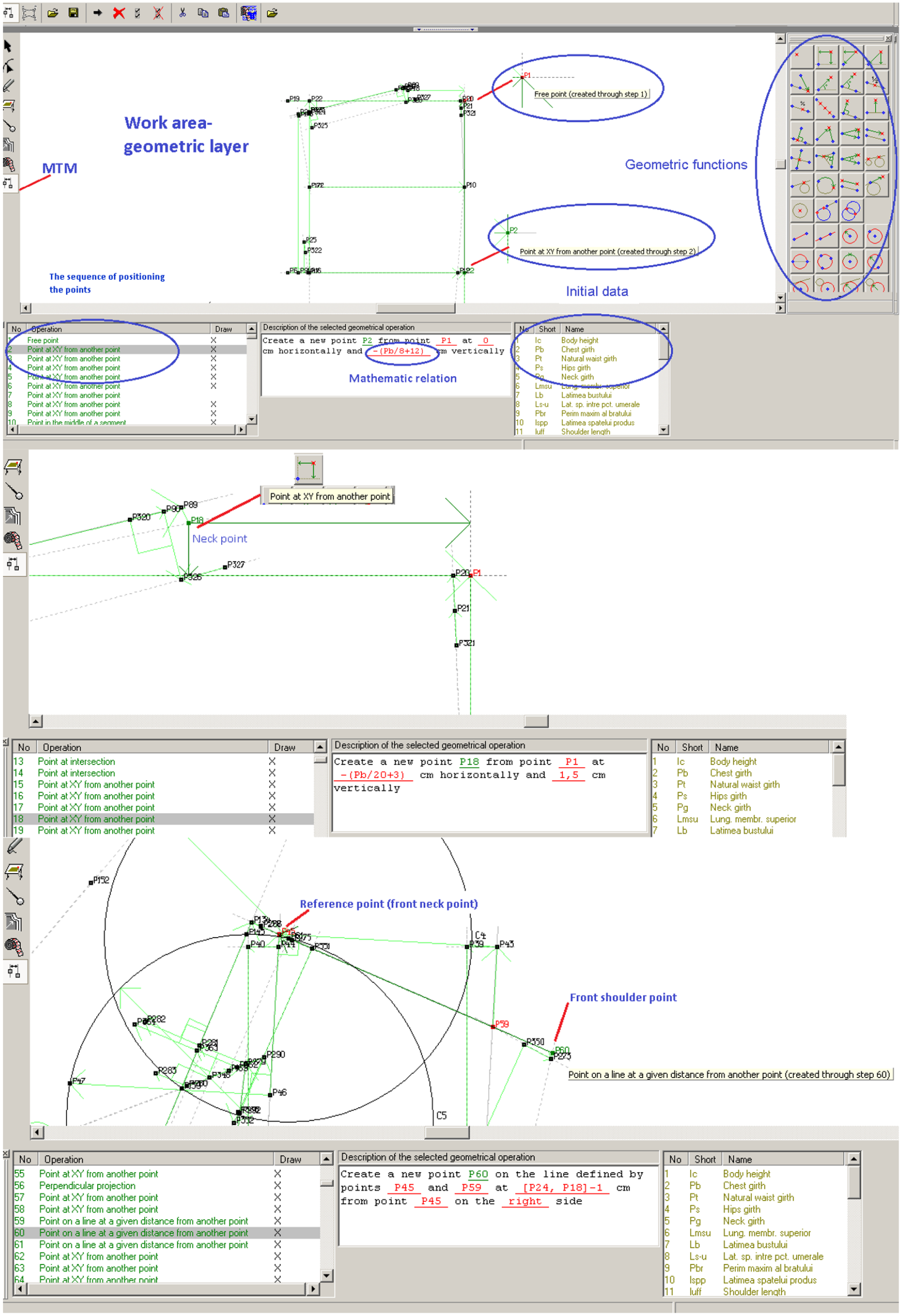
Creation of a specific geometric layer.

Obtaining the appropriate contour of the piece.
Any pattern designed in a CAD environment can be used to develop different models. The designer needs to know which parameters to modify to adjust the size and shape of the main patterns and modify components of the selected model appropriately.
For this purpose, the following changes need to be made in the patterns corresponding to the main garment elements (Figure 6):
− The overlapping distance of the components located between consecutive buttons on the front side (Ds = 1.3 cm) need to be increased.
− The lower point of the lapel (1 ÷ 3) cm needs to be positioned beneath the bust line. Afterwards, the width of the lapel and the shape of the outer contour line need to be decided.
− The buttons/buttonholes need to be positioned.
− The weld and piped pockets need to be positioned. Then, the size of the pocket flaps needs to be determined by the designer.
− The shape of the edge needs to be selected. The chosen model has the same length as that provided in the initial data;
− The pattern for the base of the collar needs to be designed. This process consists of selecting the length and shape of the collar corner and the angle between the lapel and the collar, as well as defining the shape of the collar’s outside contour lines.
− The sleeve vent needs to be designed. This process consists of choosing the first buttonhole position and defining the shape of the sleeve components.
Figure 10 presents the design patterns for the components of the model (lapel, collar, vent) and the selections for the overlapping distance, the position of the welt pocket, etc. Additionally, it presents the points connected by specific lines (straight or curved) that are linked with the geometric layer, as well as their modified shape.

Patterns for the components of the model.
All transformations listed were made by using geometric functions (Figure 11).

Geometric transformations.
Figure 12 presents the process of designing the lapel, drafting the contour line, and editing its shape (as necessary).

Designing the lapel and drafting the contour line.
Figure 13 presents the positioning of the buttons and the welt pocket.

Positioning the buttons.
Customising the design process for a men’s fitted jacket
To customise the design stages, the specialist must be knowledgeable and skilled in pattern-making. The technician or designer should meet the following criteria:
He or she must be able to find, combine and adapt different pattern-making solutions from the literature or his or her own experience to design the necessary components;
He or she should be able to ‘read, understand and interpret’ the characteristics of the model (the proportions, volume, size and shape of all of its components) by thoroughly analysing a sketch;
He or she must understand the physical characteristics of the materials that are used to manufacture the selected model while keeping in mind that the properties of the materials (thickness, contraction), density, colours or other chromatic motifs, elasticity, etc.) heavily influence the design and manufacturing process;
He or she should analyse the shape of the human body (its posture, proportions, and conformation), know how to adjust the positions at which the anthropometric measurements are measured if necessary, and be able to decide which dimensions need to be selected and used to determine the extra information (anthropometric indicators) that is needed for the design process;
He or she must be able to understand the structure of the mathematical relations that are used for determining the positions of the key points on the pattern and should be able to modify the aforementioned relations if necessary.
To customise the design process for a fitted jacket for men, one has to follow the following steps 24 :
I. Identify the customer’s measurements that need to be taken/select. The programme will automatically import the values of the selected type of body measurements (taken from the scanned model of the customer) that are going to be inserted into the mathematical relations (Figure 14).
II. Edit the details of the model as requested by the customer, including the dimensions of the lapel and collar, position of the pockets and vents, the overlapping distance, etc. The designer makes all the needed changes (according to the customer’s preferences and model features) (Figure 15).
III. Change the content of some mathematical relations.

Import of the selected type of body measurements (new client).

Adjusting the model according to the customer’s requests.
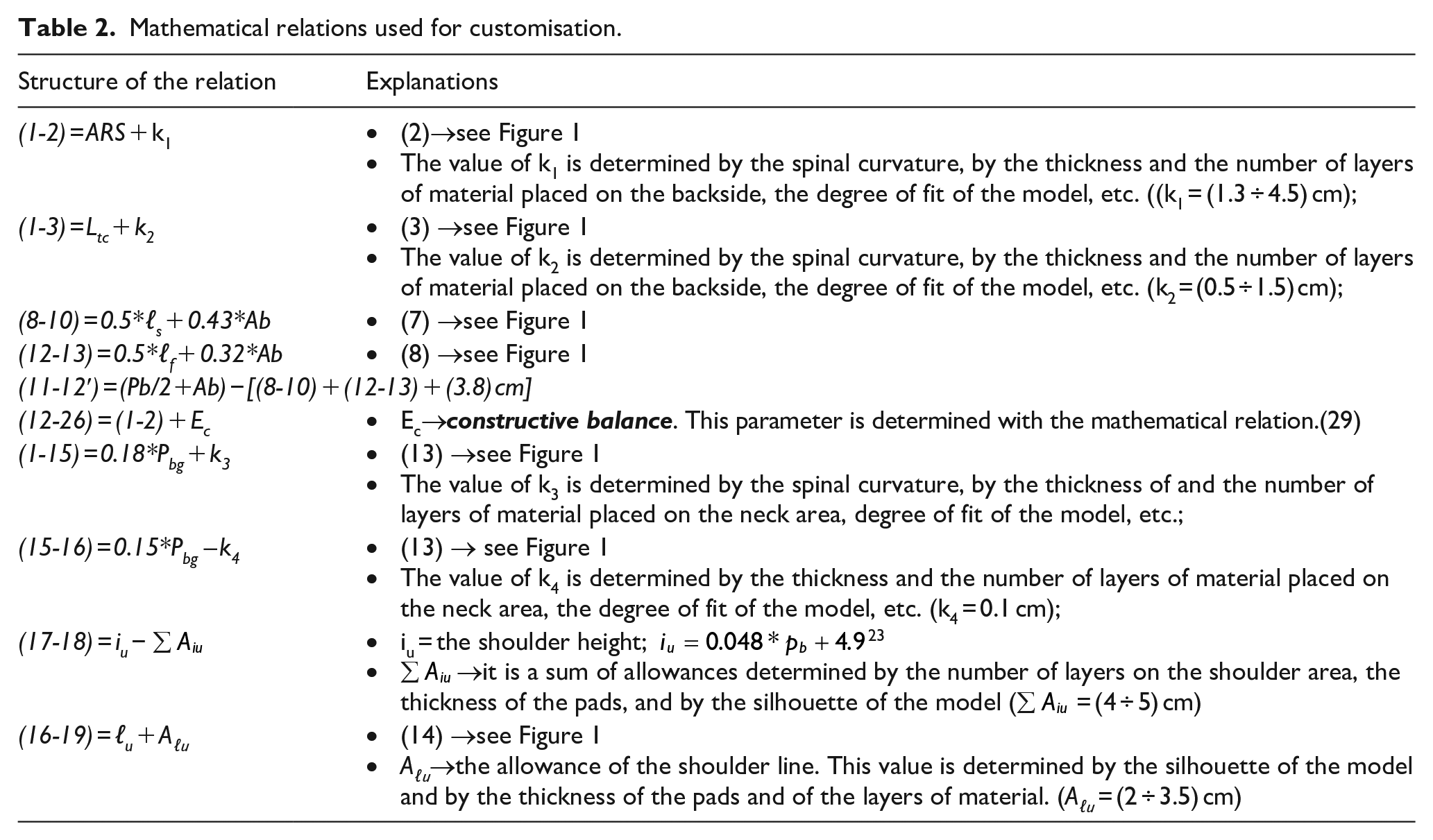
The designer needs to replace some parts of the mathematical relations with the automatically selected body measurements (their values are the ones that have been scanned). If necessary, they can also change the constructive allowances’ values (bust, waist and hip) (Table 2).
Mathematical relations used for customisation.
The shapes of all of the patterns of the components of the model are automatically updated. The patterns overlap; their shape and size are individually generated according to the initial values. The backside patterns are made so that they overlap, as shown in Figure 16, with shows standard size 52 and an individual client (khaki colour). The differences between these pieces in the bust perimeter and bust allowance are seen on the lateral contour.

Backside patterns.
Obtaining the 3D virtual model prototype used to evaluate the extent to which the model fits the virtual mannequin
The model panels are imported into a 3D CAD environment to visualise how the model was designed and decide whether it fits nicely on the virtual avatar. In our example, the model pieces have been imported into a Lectra-3DModaris environment. 24 The 3D virtual simulation is carried out by taking into account the characteristics of the material that have been chosen for the model in question (Figure 17). If the model fits nicely on the virtual avatar, its patterns are then turned into production patterns. However, if the designer identifies any issues, they will address them by making all the necessary modifications.

3D simulation of the customised men’s jacket patterns.
The garment balance and appearance are analysed in the sagittal view. For example, if there is a horizontal fold (Figure 18(a)) on the backside or the jacket slides towards the back (Figure 18(b)), the designer has to make the following adjustments.

Defects in the backside of the jacket: (a) change the backside pattern (decrease in the backside length and change in the position of the base neck point); (b) Ec’s calculation was reviewed (decrease the back length and increase the front length)
Figure 18(a) presents a decrease in the backside length and change in the position of the base neck point. The designer has to use geometric functions to change the shape of the upper part of the back panel. The new contour line (the blue line) results from the re-magnetisation process of the points that define the new neck contour line.
Figure 18(b) presents the solutions to the problem: the mathematical relations that establish the front and back lengths of the patterns (decrease the back length and increase the front length) were changed, and Ec’s calculation was reviewed.
After the necessary adjustments were made, the patterns were updated automatically.
Results and discussion
The garment-body interaction may be analysed by studying the position of the garment in relation to the body when it is worn. The most frequent movements that customers perform are lifting the upper limbs’ (by an average magnitude). When a person lifts the upper limbs, the garments move relative to the body. The relative garment displacement may or may not affect the wearer; he/she may or may not notice any changes regarding comfort or appearance.
The most visible change in a garment’s position when the customer wears it and when he/she moves the upper limbs is the displacement of its hemline (this displacement is related to its normal position in the static state). These displacement values are influenced by the level of the garment bust line and the garment’s width on the lateral side. The garment’s width on its lateral side determines the sleeve’s width; by its width and shape, the sleeve has to ensure total freedom of movement for the upper limbs.
In the following figure, the influence of two constructive garment characteristics on the relative displacement of the garment hemline is shown (Figure 19). Thirteen significant situations of dressed avatars were selected to determine the conditions in which the values of this displacement were the smallest.

The variation of the garment hemline displacement related to the pattern’s constructive parameters.
For this purpose, the authors of this paper selected the following variables:
X1 → the back allowance of the backside length, which establishes the level of the bust line (k1 parameter, see Table 2);
X2 → the percentage of the bust constructive allowance distributed for the lateral part of the garment;
Y → the hemline’s position related to its normal (the correct position).
Analysing the shape of the dressed jacket on the avatar, the suitable values for X1 (k1 parameter, see Table 2) are between 1.6 and 4 cm.
The analysis is performed using factorial programming, the rotatable compound central programme with two independent variables. 25
Table 3 presents the codes of the selected parameters used in the experimental planning, and Table 4 presents the experimental matrix.
Coded and real values (cm) of independent variables.

Experimental matrix.

Conclusions
The conclusions of this study are as follows:
The mathematical model’s general structure, which expresses the connection between the selected variables, is a polynomial structure, y = a + b*x1 + c*x2 + d*x12 + e*x22 + f*x1*x2.
The mathematical model is adequate because it respects the condition Fvalue > Fstd.error (for 99% confidence limits), and the coefficients are statistically significant (according to the t-test).
The X2 variable has a significantly larger influence on Y than does X1.
Y has the smallest value when X2 has a coded value (1 ÷ 1.5) (real value 49 ÷ 51%) and a larger value when X2 has a coded value (−1 ÷ −1.5) (real value 43% ÷ 41%).
The best value for the Y variable is shown when X1 has a coded value (1 ÷ 1.5), (real 3.4 ÷ 4 cm).
If X2 has a coded value of (−1 ÷ −1.5) (real value between 41% ÷ 43%) regardless of the value of variable X1, Y will register the most significant value.
The best value for Y is obtained with the following combinations: X1 either a coded value of (1 ÷ 1.5) (real value between 3 ÷ 4 cm) or (−1 ÷ −1.5) (real value between 1.6 ÷ 2.2 cm) and X2 with a coded value of (1 ÷ 1.5) (real value between 49% ÷ 51%).
If the jacket model requires the minimum bust allowance value, the customer will feel comfortable when the percentage of the bust allowance distributed across the garment’s lateral section is significantly larger (it is necessary to ensure the upper limbs are free to move).
It can be assumed that the basic patterns’ constructive parameters can be optimised to ensure the customer is comfortable and the model meets his or her aesthetic and ergonomic requirements.
With both advanced CAD tools and in-depth knowledge on garment pattern-making, designers can explore various methods of developing new and fashionable garments.
Customers are using increasingly more online platforms to purchase the items they are looking for, which means that they will in turn become increasingly familiar with sophisticated mobile apps. They will also become familiar with scanning procedures and online platforms that will enable them to choose the characteristics of the desired product (in this way, customers take part in the design process).
These changes will also strengthen the relationship between the customer and the producer/designer.
By using specialised CAD modules, designers can create blocks for different garments and then personalise them, however necessary. This process is done by taking into account the desired type of garment, the shape of the human body (proportions, posture and conformation) and the material properties (contractions).
Integrating 3D scanning technology into the design process for apparel goods will ensure collaboration between customers and designers at all touch points and enable the customers to take part in the product’s development process. The customer will also be able to simulate wearing the desired item in a virtual space.
By implementing these changes, producers will be able to update their production process, which will allow them to design and manufacture new products more efficiently, with a higher degree of accuracy and with less waste. Of course, to be successful, they must be able to efficiently transition from a primarily direct labour-oriented workforce to one specialised in indirect labour.
Footnotes
Author contributions
All authors were involved in the design of experiments and discussion of the results. All authors read and approved the final manuscript.
Declaration of conflicting interests
The author(s) declared no potential conflicts of interest with respect to the research, authorship, and/or publication of this article.
Funding
The author(s) received financial support for publication of this article from “Gheorghe Asachi” Technical University of Iasi-Romania (TUIASI) Grant number GI-P16/2021. The authors acknowledge Gemini CAD Systems and Lectra Systèmes SA for technical support and collaboration with the Faculty of Industrial Design and Business Management from Iasi, Romania.
Availability of data and material
The datasets used and/or analysed during the current study are available from the corresponding author upon reasonable request.
