



Abstract
Global heat, carcinogenic, and viral diseases created due to industrial pollutants has led people to shift toward natural products particularly natural dyes in all walks of life. In this study, U.S. rays up-to 60 min, were used to extract the color in aqueous medium and employed onto silk fabric at selected conditions. It has been observed that good color strength has been found when 30 mL of acidic extract (pH = 4.0) obtained from 6.0 g of Harmal powder containing 3.0 g/100 mL of salt as an exhausting agent was employed onto the US treated silk at 65ºC for 55 min. The utilization of the extract obtained from 7% of pomegranate as post-bio-mordant, 3% of acacia extract as meta-bio-mordant, and 7% of henna extract as meta-bio-mordants has given excellent color strength. In comparison, 5% of Al salt as meta mordant, 5% of Fe salt as pre mordant, and 7% of tannic acid as meta-mordant has given better results. ISO standard methods for fastness employed onto optimum mordanted dyed fabrics have given well to excellent fastness ratings. Hence, natural colorant extracted from Harmal seeds has excellent coloring efficacy to dye silk fabric under sustainable conditions, whereas the addition of eco-friendly mordants for shade development process has made the coloration of silk more sustainable with improved colorfastness properties.
Graphical abstract

Introduction
Sustainability in the modern world is now one of the most wanted terms in every walk of life. 1 Day by day rising pollution, due to the effluent load shed by industries is now disturbing ecosystem balance either by destroying the fertilized land or by contaminating the water bodies. 2 This disturbance in the ecosystem is rising global heat which is causing deforestation, consumption of fuels, and weather changes. 3 The textile industry is one of the major causes of pollution because in the processing a lot of chemicals are shed away which are carcinogenic, mutagenic, and non-biodegradable.4,5 These are not only causing hazardous diseases but also destroying global beauty, rivers, canals, agri lands, etc. 6
Nowadays there is a ray everywhere for rushing toward the use of natural products such as natural dyes. 7 Natural dyes are isolated without any chemical processes and being harmonized with nature, these colorants have no disposal issues. 8 Their shades are attractive, soothing, and cover a wide range of the spectrum. 9 Their wastes can also be reused and even upon mixing with agri-land can act as fertilizers. 10 These are green, sustainable, and biodegradable and can be obtained from every part of flora and fauna such as bark, leaves, flower, seeds, and stems. So, these benefits have urged the traders to introduce such sustainable products in food, textile, cosmetics, pharmaceuticals, electronics, flavors, etc.11,12 The world environmental agencies have spread awareness to use sustainable, green, and herbal based plant materials which have potential bio-molecules (natural colorant) with excellent biological characteristics.13,14 Due to the spread awareness for using such herbal-based bio-products (bio-colorants) by these associations, now people particularly the health-conscious community have started pressurizing the industrialist, traders, stake holders to introduce them in all fields.
However, these colorants have some limitations such as poor color yield and low rating of color fastness. 15 Old isolation methods such as stirring, soaking, heating, soxhlet, etc. have been used, 16 whereas, for fabric surface modification, cat-ionization mercerization, bio polishing, etc. are also used to increase its uptake ability. 17 But these are less effective and sometimes these methods can destroy the nature of potent molecules (colorant) by consuming a lot of heat and energy, solvent, time, economy, and labor,18,19 For improving fastness rating, chemicals such as electrolytes of Al3+, Cu2+, Cr3+, Co2+, Ni2+, Fe2+, etc. are used,20,21 but the utilization of electrolysis of Cr3+, Cu2+, Ni2+, Co2+, etc. in dyeing is under strict environmental regulation. In place of such chemicals, now plant-based mordants are used which not only can give the variety of shades but also have ability to valorize the dyeing process by giving good to excellent fastness ratings.22,23 For getting effective isolation of functional and potent bio-molecules (natural colorant), new modern methods such as microwave,24,25 ultrasonic,26,27 gamma rays, 28 Ultraviolet, 29 plasma, 30 supercritical fluid, 31 etc., are now taking considerable attention due to their cost, time, and energy effective nature.
Ultrasonic rays (U.S. rays) are considered as uniform and leveled heating sources with excellent energy transfer mechanism into the isolation system. 32 It enables the transfer of energy from solvent to rupture cell wall of plant for getting effective solid-liquid encounter to extract potent bio-molecule (dye) by consuming less energy, time, and solvent.33,34 These rays also tune the surface of fabric fibers by physical modification without altering their chemical nature. Similarly, without causing any change in the physiological nature of bio colorant, these rays can enhance the yield into a solvent which upon utilization during dyeing gives high color strength onto physically modified fabrics.34,35
This study has been conducted to explore herbal-based plant sources such as harmal seeds as a potential source of natural colorant for silk coloration under impact of U.S. rays. Harmal (Peganum harmala L.) being a member of the Nitrariaceae family is all over the world particularly in Asian region. Commonly known as Esfand, it is the symbol of surviving bad spirits. 36 Its seeds extract contain potent alkaloids (Harmal Harmaline, Harmalol harmane), which jointly impart color on the fabrics. 37 Its extract also has excellent anti-neoplasm, anti-microbial, anti-inflammation, anti-pyretic characters due to which, this plant has the exclusive place in the Greek, Chinese and Indian (Ayurvedic) system of medicine.38,39 Its extract used to dye wool, silk, and cotton, making tattoos, food, etc. 40 It is also considered as an alternative to Turkey’s red color (TR) due to the production of excellent red color onto fabric. Silk is one of the natural fabric which is proteinous in nature. 41 where its amido linkage (-NH2, -C=O) is used to interact with functional site of colorant (-OH, -C=O) and the fixing agent such as mordant by special bonding. 42
The current study aims to
(a) isolate colorant from harmal seeds under US irradiation in selected solvent.
(b) get good color characteristics of silk fabric using sustainable mordants before and after dyeing.
Material and methods
Collection of materials
Dried harmal seeds purchased from Big Herbal Store, Faisalabad were ground finely to get crude powder. The uniform particle size powder obtained after sieving was employed for extraction and dyeing experiments. Ready to dye silk fabric was procured from Rao Silk Fabrics, Faisalabad Pakistan. Chemicals used in this study for extraction, coloration, and shade development and assessment process were of laboratory grade (commercial = Pakistan Made).
Ultrasonic assisted extraction process (UAE)
For the extraction of natural colorant from Harmal seeds, 4.0 g powder was boiled with 100 mL of distilled water for 1 h by considering powder to aqueous medium ratio (P:A) of 1:25. 43 Extract obtained after filtration, and silk fabrics were separately given ultrasonic treatment upto 60 min with an interval of 15 min, using Rohs Ultrasonic. For obtaining the optimum extraction and irradiation condition, Irradiated (RE) and un-irradiated extracts (NRE) were applied to dye irradiated (RS) and un-irradiated silk fabrics (NRS) at 65°C for 55 min. 44 In separate experiment, for comparative studies, un-treated extract (NRE) was used to dye un-irradiated fabric (NRSF) called control at 65°C for 55 min.
Selection of coloring and mordanting conditions
Different dyeing parameters such as powder amount for extraction (g/100 mL), dyeing time (min), dyeing temperature (°C ), pH of the dye bath, the volume of the extract (mL), and salt concentration (g/100 mL) were optimized. To find suitable amount of powder to get maximum colorant yield, 2.0–10.0 g/100 mL of powder was also used for isolation of colorant. In another experimental series, 10–70 mL of aqueous extract of about 1.0–7.0 pH was used for dyeing of fabric. The optimization of dyeing temperature and time as contact levels was carried out at 35°C–85°C for 35–85 min. For getting maximum uptake ability of dye bath 1.0, 3.0, 5.0, 7.0, 9.0, and 10.0 g/100 mL of Table salt as the exhausting agent was employed. To develop new shades with enhanced coloring properties, the electrolytes of Al+3, Fe+2, and tannic acid (T.A.) as chemical mordant were employed at 65°C for 55 min. In comparison extracts obtained from 1.0, 3.0, 5.0, 7.0, 9.0 g/100 mL of pomegranate peels (Punica granatum), henna leaves (Lawsonia inermis), and Acacia bark (Acacia nilotica) were also employed at given condition. The extract of bio-mordants was prepared by boiling given amount with 100 mL of water for 45 min, filtered and used at selected conditions before after and during bio-dyeing by following the already documented methods of Adeel et al.37,43
Valuation of dyed fabrics
Color strength (K/S) of all dyed fabrics and shade quality parameters (L*, a*, b*) were determined using Kubelka Munk equation (K/S = (1−R) 2 /2R) which has been calculated in Spectra flash SF 600 (Data Color, USA). The rating for colorfastness properties of the optimum dyed fabric before and after chemical and bio-mordanting at optimal conditions were evaluated through ISO standard methods. For rating at a gray scale, the colorfastness to light (ISO 105-B02), colorfastness to rubbing (ISO 105-X12), colorfastness to washing (ISO 105-C03), colorfastness to dry cleaning (ISO 105-D01), and colorfastness to perspiration (ISO 105-E04) were employed onto optimal dyed chemical and bio-mordanted fabrics at quality control laboratory for Noor Fatima Fabrics (Pvt) Faisalabad, Pakistan.
Results and Discussion
Acoustic cavitation is the unique mode of action of ultrasonic rays (U.S.), through which, it transfers the energy from solvent to collapse with plant via rupturing its cell wall to evolve out the functional molecules by mass transfer kinetics into the solvent.45,46 The results given in Figure 1 show that the extract was obtained in an aqueous medium (UAE) under US treatment for 45 min has given better color strength (K/S) onto irradiated silk fabric (RSF). The significant extraction of functional bio-molecule acting as colorant through improved cavitation has been achieved, where the solvent has also contributed toward the extraction of the colorant through solid-liquid interaction. 47 From previous studies, it has been also found that U.S., treatment does not cause any chemical change in the functional nature of silk fiber, which has been verified via FTIR analysis but the changes observed in form of scales at the silk fibers as shown in SEM images prove that physically its nature has been modified to sorb dye too much extent. 44 Hence it is recommended that for effective results, the isolation of the colorant from harmal seeds should be done under ultrasonic radiations (UAE) for 45 min and the extracted colorant should be used to dye irradiated silk fabric (RSF) for getting better results.

Application of heat solubilized (aqueous) extract from Harmal seeds and its dyeing on silk fabric.
Dyeing variables are always important in the natural dyeing process because after the application of a sustainable isolation tool (U.S.), the level of variables can be reduced. The results show that utilization of 30 mL of extract obtained from 6.0 g powder has given good results isolation of colorant (Figure 2(a) and (b)). Figure 3(a) and (b) display that 30 mL of aqueous extract of 4.0 pH obtained from 6.0 g powder under U.S. treatment (UAE) containing 3.0 g/100 mL of Table Salt) as exhausting agent has given high tint strength (K/S) also. Similarly the dyeing of irradiated silk fabric with aqueous extract (pH = 4.0) for 55 min, at 65°C has furnished high color strength (Figure 4). Salts of sodium (T.S = NaCl) and Glauber’s salt (G.S = Na2SO4) being leveling or exhausting agents impart their roles during dyeing of fabric with natural dyes by adding value in the coloration process through short attractive forces. The low amount of salt cannot achieve leveled dyeing process which results in low fixation; where over exhaustion due to utilization of high salt may cause accumulation of dye molecules which results in improper fixation onto surface modified fabric. 48 In both processes, during finishing after the dyeing process, most of the unfixed colorant is detached and the low tint strength (K/S) is found.
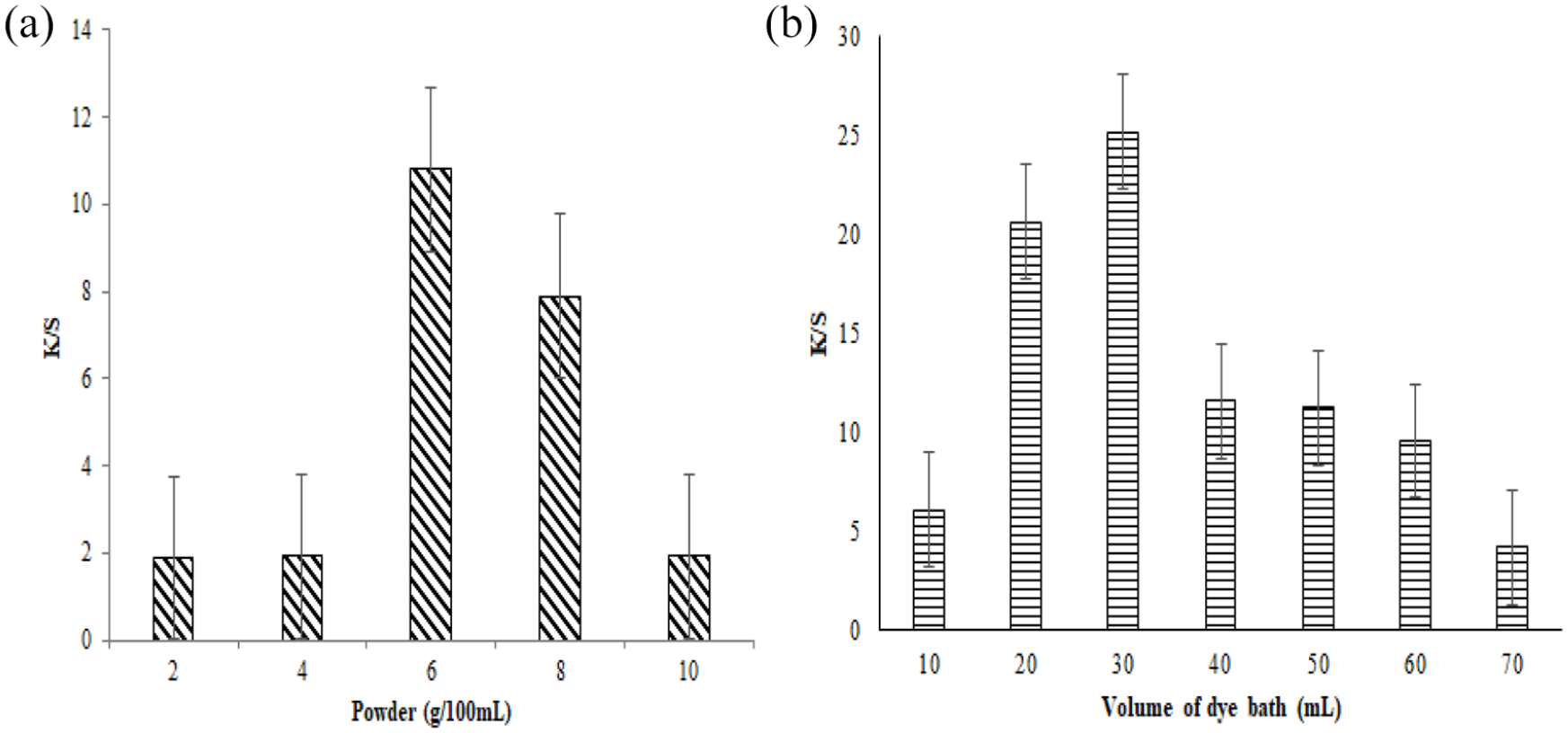
Effect of powder (a) amount in extraction of colorant from harmal seeds and application of volume of dye bath (b) for dyeing of silk.

Dyeing of silk with extracts of different pH (a) containing different concentrations of Table salt (b) for maximum exhaustion.

Effect of heating variables on dyeing of irradiated silk fabric using aqueous solubilized harmal seeds extract.
Contact variables such as dyeing time (min) and the temperature (°C) have the key role in the fixation of colorant onto surface modified fabric, because with the gradual rise of heating levels, the rate of dyeing increases, and at a certain level, the equilibrium point is attained, where above that point, no more bleeding of colorant has occurred and the leveled dyeing is observed. 49 The pH of the dye bath owing to the nature of silk fabric also plays its role. The nature of the colorant shows its actual coloring behavior at its specific pH, where moving toward a higher pH level (pH > 4.0), the ability of the colorant as well as the fabric functional site might be lost, which upon dyeing process gives low tint strength.50–52 It can also be seen that these radiations (U.S. rays) have not only reduced the amount of powder used for the isolation of the colorant but also limited the use of extract volume as well as contact levels to give effective results, which shows the cost-effective nature of irradiation treatment as modern tools.
Using ultrasonic treatment (U.S.), the results given in Table 1 reveal that the application of 5% of Al, and Fe salt, and 9% of T.A. as pre-chemical, whereas 5% of pomegranate and henna and 7% of acacia extract has given excellent results when employed before the dyeing of US treated silk fabric (RSF) using US irradiated aqueous extract of harmal seeds at optimal conditions. Similarly, 5% of Al, and Fe salt, and 3% of T.A. as post chemical mordants, whereas 7% of pomegranate and henna and 3% of acacia extract have given good color characteristics when employed after dyeing (post) of fabric with harmal extract at selected conditions. The application of 5% of Al, and 3% Fe and 7% of T.A. as chemical, whereas 7% of pomegranate and henna and 3% of acacia extract during dyeing has given good results onto fabric. Depending upon the mode of isolation, the dyeing conditions and the optimum amount of metal salt used (%) has given the variety of shades with yellowish red tones through metal–dye complex formation onto fabric, where the reduction and polarizing powder of metal is the key factor.21,53 The color coordinates given in Table 1 reveal that mostly the chemical mordants have produced brighter shades with reddish-yellow hue but the application of 7% of tannic acid (T.A.) during dyeing (meta) of US treated silk fabric (RSF) with the U.S. treated aqueous extract of harmal seeds at optimal conditions has given darker shade (L* = 50.32) with reddish-yellow tone (a* = 9.07; b* = 21.85). Similarly, results are given in Table 1 among bio-mordants used, the application of 7% of pomegranate extract after dyeing (post) of ultrasonic treated silk fabric (RSF) using the US treated aqueous extract of harmal seeds at optimal conditions has given a much brighter shade (L* = 73.02) with reddish-yellow tone (a* = 5.37; b* = 32.04).
Color characteristic of chemical and bio-mordanted silk fabrics dyed before, after, and during dyeing with ultrasonic treated Harmal seeds extract.
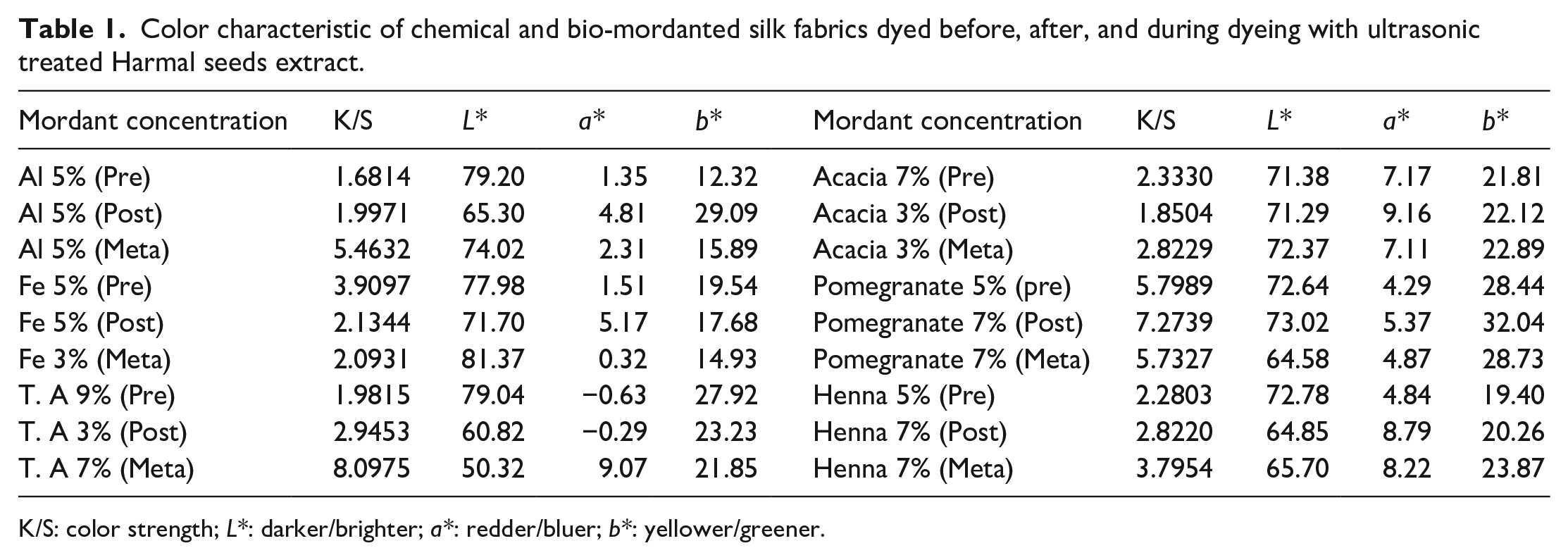
K/S: color strength; L*: darker/brighter; a*: redder/bluer; b*: yellower/greener.
Fastness properties given in Table 2 for fabric dyed with Harmal extract before, after, and during mordanting at given conditions show that in comparison to un-mordanted dyed fabric the value of the ratings has been enhanced. This good value is due to the formation of stable metal dye complex formation onto the fabric where the reducing power of metal fabric and colorant nature play their role. 32 During bio-mordants, the biological potent isolates via extra H-bonding conjugation and benzene ring play their role during firm and stable shade fastness properties.54,55 Upon exposure to heat moderate to good light fastness, upon exposure to detergent, good to excellent and upon crocking, dry cleaning and perspiration good to excellent ratings have been observed. 43 Hence U.S. treatment after surface modification of fabric not only reduced the mordant amount to get high color strength but also utilization of bio-mordants make fabric more-greener sustainable and ecofriendly.
Colorfastness rating of mordanted and dyed silk fabric using Harmal seeds extract after ultrasonic treatment at optimum levels.

LF: light fastness; WF: wash fastness; c.s: color stain; c.c: color change; RF: rub fastness; DRF: dry rub fastness; WRF: wet rub.
Conclusion
The attentive behavior of the global community due to the carcinogenic effects of synthetic dyes has spread awareness about the possible use of environmental friendly natural dyes which have not only antibacterial, antiviral, and antifungal activities but also have excellent disease curing characteristics. Harmal seeds containing alkaloids are one of the excellent natural sources for the coloration of fabrics particularly silk. It is concluded that ultrasonic rays as one of the cheaper isolation methods have not only the potential to explore the coloring wealth of plants but the addition of plant-based bio-mordants can enhance their color characteristics. At commercial scale, the utilization of this clean and green (ultrasonic treatment) for sustainable extraction of colorants from new plants should be used to enhance the coloration yield, whereas the application of herbal-based bio mordants has valorized the dyeing of silk fabric.
Footnotes
Declaration of conflicting interests
The author(s) declared no potential conflicts of interest with respect to the research, authorship, and/or publication of this article.
Funding
The author(s) received no financial support for the research, authorship, and/or publication of this article.
