



Abstract
The higher paste volume in Self Compacting Concrete (SCC) makes it susceptible to have a higher creep coefficient and cracking and has brittle nature. This brittle nature of concrete is unacceptable for any construction industry. The addition of fibers is one of the most prevalent methods to enhance the ductile and tensile behavior of concrete. Fibers reduce the cracking phenomena and improve the energy absorption capacity of the structure. Conversely, the addition of fibers has a negative impact on the workability of fresh concrete. In this research work, a detailed investigation of the influence of Nylon fibers (NFs) on fresh properties, durability, and mechanical properties of SCC was carried out. NFs were added into concrete mixes in a proportion of 0.5%, 1%, 1.5%, and 2% by weight of cement to achieve the research objectives. Durability assessment of modified SCC having Nylon fibers was performed using water absorption, permeability, carbonation resistance, and acid attack resistant. Mechanical tests (compressive and tensile) were conducted for modified as well as control mix. Test results indicate that the passing and filling ability decreased while segregation and bleeding resistance increased with NFs. Furthermore, test results showed a significant increase in strength up to 1.5% addition of nylon fibers and then strength decreases gradually. Durability parameters were significantly improved with the incorporation of NFs relative to the control mix. Overall, this study demonstrated the potential of using nylon fibers in self-compacting concrete with improved durability and mechanical properties.
Keywords
Introduction
Fiber-reinforced concrete (FRC) is not a new concept. Since biblical times fibers were used in cementing construction materials in the form of straw and horsehair. Today, there are a large variety of fiber options for reinforcing concrete, available in the marketplace. These include micro and macro synthetic fibers, steel, and 1 blended fibers, which are defined below. With so many options it can be difficult to determine exactly what fiber is required for a given application. Examples of existing applications utilizing FRC include ground-supported slabs, composite metal decks, pile-supported slabs, mat slabs, pavements, bridge decks, tunnel panel segments, and various precast applications. The selection of the various type of fibers depends on what you want to achieve. There are two types of fibers primarily. Micro and macro fibers. The main standard for fiber-reinforced concrete is ASTM C 1116. Microfibers have a diameter that is less than 0.3 mm in diameter. Microfibers are either monofilament or fibrillated. Microfibers should be used for plastic shrinkage control (cracking that can occur in the first 24 h of concrete cure), impact protection, and fire anti–spalling. 2 Micro Fibers 3 are not structural reinforcing fibers and cannot be used to replace any structural steel elements. Structural macro fibers have a diameter greater than 0.3 mm. Macro fibers can be used as a replacement for crack control mesh or as structural reinforcement in concrete or shotcrete. Macro fibers are used where an increase in residual (post-cracking) flexural strength is required (ASTM C1609). There are also blends of micro and macro synthetic fibers.4,5 The blends utilize the crack control of both the micro and macro synthetic fibers. So, control of cracking that can occur in the first 24 h of concrete cure (microfiber) and long-term crack control due to loads (macro fibers).
Self-Consolidating Concrete (SCC) is a special concrete that highly flows able, non-segregating and by its weight spread into place, fill the formwork even in the presence of dense reinforcement. 6 The self-compacting concrete (SCC) concept was proposed in 1986 by Okamura. 7 However, the prototype was first developed in Japan in 1988 by Ozawa. 8 Through extensive research, it has been concluded that the structural properties of concrete such as compressive, tensile, flexure, impact strength as well as ductility, and toughness were considerably improved due to the addition of fibers to concrete.9–15 It is also reported that improving the production technique of SCC is increasing day by day in concrete production. 16 ACI 544.5R-10 reported that thick fibers are less effective in reducing the plastic shrinkage cracks width than that of thin fibers. 17 Most thin diameter microfibers are particularly effective in reducing plastic shrinkage cracking of concrete due to high specific fiber surface area. 18 Moreover, the use of fibers helps in reducing the permeability and bleeding of concrete.19–22
Different types of fibers are used to reinforce cement-based matrices. The choice of fibers varies from synthetic organic materials such as nylon, synthetic inorganics such as steel or glass, and natural organic materials such as cellulose or sisal to natural inorganic asbestos. 23 The selection of the type of fibers is guided by the properties of the fibers such as diameter, specific volume, Young’s modulus, tensile strength, etc., and the extent to these fibers affect the properties of the cement matrix. 24 Mainly the fibers are divided into two types, that is, metallic and nonmetallic. Steel and carbon fibers are termed as metallic fibers and fibers like polymeric, carbon, glass, and naturally occurring fibers are clubbed under the umbrella of nonmetallic fibers. 25
Some studies showed that self-compacted reinforced composites under impact were capable of dissipating much higher energy compared with conventional fiber reinforced concrete with polymeric or steel fiber. 26 The research was carried out on mechanical properties of the macro polypropylene (PP) fiber-reinforced concrete, including the flexural and tensile strengths, fracture toughness, and fracture energy. 27 Studies were performed using waste carpet fibers in concrete as an environmentally friendly use of recycled carpet waste. 28
Majority studies of fiber reinforced concrete were conducted on steel fibers.29–36 Very few studies were conducted on nylon fibers.24,37,38 According to the author’s knowledge, very limited experimental work has been conducted to evaluate the performance of SSC with nylon fibers. Nylon fibers are expected to impart beneficial properties to SSC. Nylon fibers are used in the manufacturing of various products like carpet, rope, clothes, tires, and other durable materials. Nylon is a synthetic polymer. Nylon is thermoplastic silky materials that can be melted and processed into fibers, films, or shapes. 39 The reason for using nylon fiber is that it has good hardness, resilience, and durability properties; is readily available in different colors, can be dyed, resistant to soil and dirt, good abrasion and wearing characteristic and also availability in different cross-sections. 40 The Nylon fibers affect the environment and the disposal of these fibers pose a more severe threat. 41 Nylon is heat stable, hydrophilic, relatively inert, and resistant to a wide variety of materials. Nylon is particularly effective in imparting impact resistance and flexural toughness and sustaining and increasing the load-carrying capacity of concrete following first crack. 42 The use of nylon fiber as an ingredient in cement concrete is promising as it provided an alternative method of disposal and fibers, owing to this also improve strength and durability of concrete. 38 The addition of nylon fiber has also been reported to improve the durability of concrete. Fibers protect the concrete cover from spalling due to good bonding character. 43
Regardless of the benefits of using fibers in concrete, the inclusion of fibers adversely affects workability.44,45 Fibers have a relatively large surface area which increased the water demand. At the same time, more potential energy is needed for fresh concrete to flow by its weight due to increase friction between aggregate and fibers in the mixes. 46
Most of the studies present in literature focused only on hardened properties of steel fibers reinforced concrete.31–33,35,47–49 Furthermore, it has been reported that steel fibers are too costly as well as easily corroded. 50 Also, further research was recommended to use nylon fibers instead of steel fibers. Nylon fiber is economical and cannot be corroded as compared to steel fibers. Also, SCC concrete with nylon fibers is still scarce. The purpose of this study was to investigate experimentally the effect of the nylon fibers on self-compacting concrete to find the mix of self-compacting with the minimum nylon fiber requirement fibers that are economical yet provides enhanced properties of concrete.
The major difference between conventional concrete and SSC is fresh characteristics. The fresh characteristics were evaluated based on its passing ability, flowability, bleeding and segregation resistance using, Slump flow, Slump T50 Spread time, L-Box, V-funnel which are still rare. Besides, very few studies are available on the durability of nylon fibers reinforced self-compacting concrete. This experimental study investigates the mechanical properties and durability of SSC with the incorporation of NFs. Four different mixes of self-fibers compacting concrete with a varying dosage of NFs were examined on fresh, mechanical, and durability properties of SSC, focusing on slump flow, v-funnel and L-box tests, compressive and split tensile strength, water absorption, permeability, carbonation resistance, and acid attack resistant of the self-fibers compacting concrete. The optimum percentage of NFs was determined using statistical analysis that can be incorporated in SSC to enhance its properties.
Materials and experimental program
Materials
Cement
Ordinary Portland cement (OPC) type-1 in accordance with ASTM C150 51 was used in this study. Its chemical and physical properties are displayed in Table 1.
Physical and chemical property of ordinary Portland cement.

Nylon fibers (NFs)
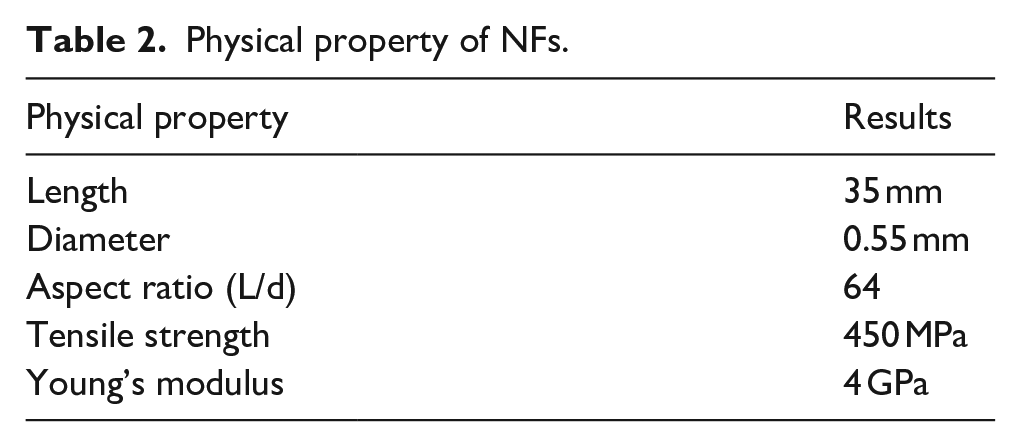
Nylon fibers used in this study was procured from Sika Company Islamabad Pakistan, having 35 mm long with 0.55 mm diameter as shown in Figure 1. The physical properties of nylon fibers are given in Table 2.
Physical property of NFs.

Nylon fibers.
Aggregates
Natural sand was used as a FA (fine aggregate) in all the mixes in SSD (saturated surface dry) condition which was obtained from local market Wah Cantt Punjab Pakistan. Its properties are given in Table 3. Normal weight coarse aggregate (crushed stone) in saturated dry condition (SSD) was obtained aggregate was 12.5 mm. Different tests were performed on coarse aggregate to evaluate its physical property as shown in Table 3.
Physical property of fine and coarse aggregate.

Superplasticizer
Chemrite-530 was used as a superplasticizer because it is a high range water-reducing admixture, on-toxic, and non-hazardous under relevant health and safety issues. The superplasticizer meets the requirements of EN 934-2 T 3.1/3 52 and ASTM C-494 Type F . Typical properties of the superplasticizer are given in Table 4.
Physical property of superplasticizer.

Experimental program
A two-stage experimental program was designed to achieve the goals of the research program. In the first stage, trial mixes were prepared to achieve the requirement of technical specifications for SCC. 6 In the second stage, five mixes were prepared with varying percentages of nylon fibers (NFs) to determine the effects of NFs on fresh and durability of self-compacting concrete (SCC), which are based on the finding of the first stage. Typical acceptance criteria for Self-compacting concrete define by the technical specification for self-compacting concrete with maximum aggregate size up to 20 mm are shown in Table 5.
Typical acceptance criteria for self-compacting concrete.

Specimen preparation procedure
ASTM C 31 method was followed for the preparation of the specimens and compaction was done manually by Roding in three layers having 25 blows per layer. Five mixes were prepared with the varying dosage of NFs. Details of the mixes are provided in Table 6. Before mixing, the required quantity of material was weighed by the method of weighing. Speed of mixer was kept at 35 rev/min for mixing of materials. Initially, coarse aggregates were added to the mixer followed by fine aggregates. The aggregates were then dry mixed following necessary quantification of cement and water which were added with time and mixing was done in approximately 8 min for all mixes.
Trials mixes for self-compacting concrete (SCC).

Specimen configuration and testing
Fresh properties tests of SCC (slump flow, slump T50 Spread time, L-Box, V-funnel) were performed according to technical specifications for SCC. 6 Standard-sized cylinders (6 × 12″) were used to measure the compressive strength as per ASTM C39/C39M. 53 Similarly, cylinders of standard size (6 × 12″) were cast and tested to determine the tensile strength as per ASTM C496-71. 54 Three specimens were tested for each test at 7, 14, and 28 days and the mean value of the specimens was considered for strength. For durability assessment, as per ASTM C642, 55 50 mm thick and 100 mm diameter disks were cast for water absorption test. A circular truncated cone of size Φ175 × Φ150 × Φ185 mm was used to determine the permeability resistance of SCC as per E30-2005 JTJ. 56 For acid resistance, a 100 mm cubical specimen of varying NFs mix was cured in 4% acid (H2SO4) solution for 7, 14, and 28 days. The acidic solution was changed every week to maintain 4% concertation. The acid attacks were measured in terms of mass loss (%) due to sulfuric acid (H2SO4) attacks.
Test results
First stage results
In the first stage, eight mixes as shown in Table 6 were prepared to achieve the best possible mix which would fulfill the requirement of Technical Specification for (SCC). Based on the research work results, fresh properties of SCC for each trial mix with different test methods (Slump flow, Slump T50 Spread time, L-Box, and V-funnel). It is clear from Table 7 that, Mix 6 will satisfy the range of different tests (Slump flow, Slump T50 Spread time, L-Box, and V-funnel) given by specified by the technical specification for self-compacting concrete. While other mixes do not satisfy the range of such tests. Therefore Mix 6 is considered the best mix of SSC and can be used as a reference concrete (control) with varying percentages of nylon fiber (NFs).
Results of trial mixes for self-compacting concrete (SCC).

Second stage (mix proportion of SCC)
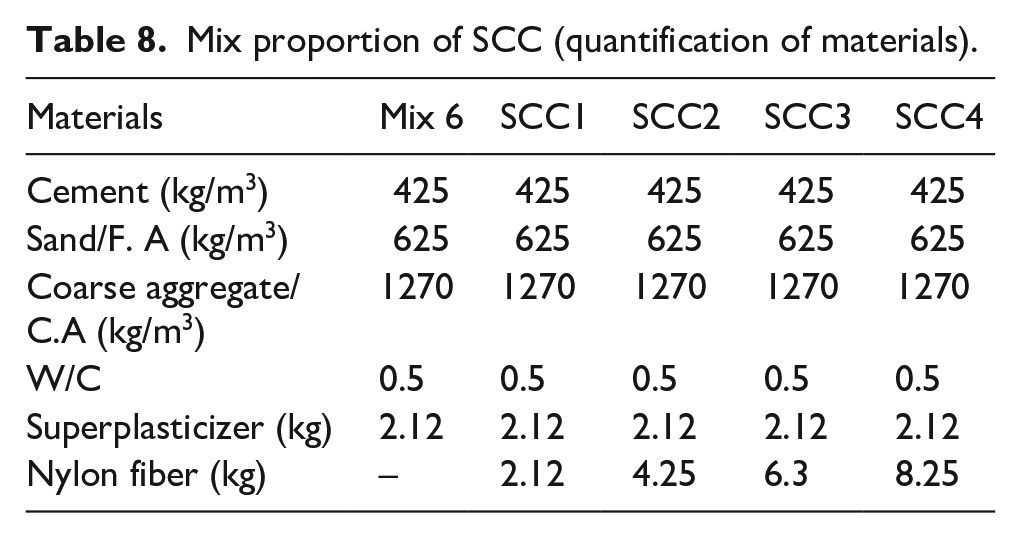
Based on the work results of the first stage, mix 6 (SCC) was selected for further experimental work. Therefore, the second stage of the experimental work was conducted on Mix 6 (SCC) which is reinforced with NFs. Four mixes were prepared at the second stage, after achieving the requirement of technical specification for SCC (Mix 6) which was given in the first stage as shown in Table 7. Different percentages of nylon fibers were added to the fresh self-compacting concrete (SCC). The percentages of nylon fibers (NFs) used were 0.5%, 1%, 1.5%, and 2% by weight of cement. Table 8 shows the concrete mix proportions of SCC (Mix 6) with varying percentages of NFs.
Mix proportion of SCC (quantification of materials).
Fresh properties of NFs SCC
Workability
The summary of the fresh properties of self-compacting concrete is shown in Table 9. Generally, the workability of SCC decreased as the percentages of NFs increased. This may be attributed to the fact that the NFs have a relatively large surface area which required more paste to coat them. At the same time, NFs SCC required more potential energy to flow by its weight due to increased friction between aggregate and fibers in the mixes. 46 From Table 9, it is noticed that all the nylon fibers concrete mixes do not satisfy the requirement given by technical specification for SCC. SSC up to 1.5% substitution NFs satisfied the requirements given by technical specification for SCC. However, beyond 1.5% substitution of NFs does not follow the specification of SSC.
Fresh properties of Self Compacting Concrete (SCC).

Slump and Slump T50 test for SCC is carried out according to EN 12350-8 (2010). 57 Results of Slump and Slump T50 are shown in Table 9. The test results indicate that mixes (SCC1, SCC2, SCC3) have a slump flow value between 600 and 800 mm, while slump T50 spread time was in the range between 3 and 5 s. which means, these mixes (SCC1, SCC2, SCC3) satisfied the requirement given by technical specification for SCC and have a good filling ability. Oztekin et al. 58 also reported these kinds of results in their research work. However, at a higher dosage of NFs SCC4 mix have a slump value of 592 mm which is out of range given by technical specification for SCC as shown in Table 9. Therefore, a high dosage of superplasticizer is needed.
Mixes (SCC1, SCC2, SCC3) have an L-Box test ratio (H2/H1) value between 0.80 and 1 except SCC4. This shows that these mixes (SCC1, SCC2, SCC3) satisfied the requirement given by technical specification for SCC having a good filling and passing ability. While mix SCC4 has an L-Box test ratio (H2/H1) of 0.73, which is out of range given by technical specification for SCC. However, it should be noted that Hamzah et al. 59 in their work determined that 0.60 blocking ratios have been accepted for SCC to achieve good filling ability.
The flow time of V-Funnel tests are used to find the filling ability of SCC. It measures the ease of flow of concrete. A shorter flow time indicates greater flowability. Test results indicate flow time between 6 and 12 s for mix (SCC1, SCC2, SCC3) and are in the acceptable range given by technical specification for SCC. However, at a higher dosage of NFS (SCC4), the flow time was 13 s which is out of range given by technical specification for SCC.
It is worth mentioning that the addition of nylon fibers in SSC considerably reduced the bleeding of fresh SCC. Besides, the homogeneity of mixes improved due to a reduction in bleeding. This is due to fact that NFs have a relatively large surface area which required more cement paste to coat them, 46 and as a result, there is no free water that comes out on the surface of SCC.
It is clear that SCC mix having up to 1.5% nylon fibers by weight of cement gives best mixes (SCC1, SCC2, SCC3) which cover all the requirements given by technical specification for SCC, but it is worthy to say that, 2% NFs mix (SCC4) do not cover all the requirements given by technical specification for SCC as shown in Table 9. Therefore, it is recommended to use NFs up to 1.5% by weight of cement for having good fresh properties of SCC.
Sieve segregation test
Sieve segregation test as per EN 12350-11 (2007) 57 referred to the measurement of segregation resistance of fresh concrete. The test consists pouring of fresh concrete on to 5 mm sieve and the weight of that paste that passes through the sieve. The segregation resistance of the tested mixture is classified as satisfactory, only if the result of laitance will fall within the range of 5%–15%. Figure 2 shows the segregation ratio of different fiber mixes of SCC.

Segregation ratio of different mixes.
From Figure 2, it is clear that the segregation ratio decreased with the addition of nylon fibers. The highest segregation ratio was obtained at 0.5% of nylon fibers whereas the lowest ratio was obtained at 2% of NFs (out of range i.e. 5%–15%). It means that the settlement of aggregate decreased with higher fiber content. It is due to the larger surface area of NFs, which required more water to coat them and hence increased viscosity of fresh SCC. The increased viscosity decreases the rate of settlement of aggregate and thus improved the segregation resistance of fresh SCC.
Mechanical properties of fibers SCC
Compressive strength
Compressive strength is an important property of a material that enables it to resist compressive stresses. The compressive strength test was done with compliance to the standard procedure of ASTM C39/C39M 53 for cylindrical specimens having standard dimensions as 6″ diameter and 12″ length. In this test concrete specimens (cylinders) were exposed to compressive axial force at a rate within recommended limit till the concrete failure. Compressive strength was then determined from the greatest failure load divided by the X-sectional area of the specimen.
Figure 3 shows the compressive strength of different fibers mixes of SCC. The general trend showed that compressive strength increased as the percentage of NFs increased up to 1.5% substitution and then gradually decreased as shown in Figure 3. All mixes of fibers SCC show greater strength than the reference mix. The maximum strength was obtained at 1.5% of nylon fibers whereas the lowest strength was obtained at 2% of NFs. After 28 days of curing, compressive strength is about 24% higher than the reference mix (Mix 6) at 1.5% of NFs by weight of cement. Tadepalli et al. 60 reported that adding up to 1.5% of fibers by volume raises the compressive strength from 0% to 15%. The positive effect on compressive strength is due to the confinement effect of the fiber reinforcement on the specimen. Compression produces lateral expansion, and with it, tension and shear. The tension and shear are resisted by the fibers. Therefore, the compressive strength of the fiber-reinforced SCC is increased. When the percentage of fibers is high then this confinement can reduce the transversal deformation of the specimen and increase its compressive strength. When increasing the fiber percent especially of higher dosage the process of compaction was difficult and due to that the compressive strength reduced at 2% of nylon fibers. Therefore, it is recommended that, to use NFs up to 1.5% by weight of cement.

Compressive strength of different samples at 7, 14, and 28 days.
A relative analysis of compressive strength is also illustrated in Figure 4. Compressive strength of the control mix (Mix 6) at 28 days was taken as the reference. It can be observed from Figure 4, that overall, compressive strength increment with different dosages of NFs is almost similar at different days of curing (7, 14, and 28 days). At 28 days of curing, the compressive strength of concrete with 0.5%–1.0% NFs almost overlaps with the compressive strength of the reference mix, and a significant increase is noted for 1.5%–2.0% NFs. At 14 days of curing, compressive strength was almost 15%–20% lower than the reference mixes up to 1% NFs. Whereas for 1.5% of NFs, compressive strength was 10% higher than the reference mix and coincide with the reference mix at 2% of NFs by weight of cement. Whereas at a similar dosage of NFs (1.5% by weight of cement), at 7 days compressive strength almost touches the reference mix. At other dosages of NFs (0.5%, 1.0%, and 2.0% by weight of cement), at 7 days compressive strength is almost 25%–30% lower than the reference mix. It can be concluded that nylon fibers have a strong potential to enhance the compressive strength of SCC.

Compressive strength of each mix relative to 28 days strength of reference mix (Mix 6).
Split tensile strength
Tensile strength tests were performed according to ASTM C496-71. 54 Figure 5 shows the split tensile strength of different fibers mixes of SCC. Similar to compressive strength, split tensile strength is also increased as the percentage of NFs increased up to 1.5% substitution and then gradually decrease. It is also noted that all mixes of fibers SCC have shown greater split tensile strength than the reference mix. The maximum split tensile strength was obtained at 1.5% of nylon fibers whereas the lowest strength was obtained at 2% of NFs. After 28 days of curing, split tensile strength is about 47% higher than the reference mix (Mix 6) at 1.5% of NFs by weight of cement. Williamson 48 in his research work concluded that adding 1.5% by volume of fiber can enhance the tensile strength of concrete to almost 40%. It has been reported that split tensile strength has a more positive effect than compressive strength with the incorporation of NFs. They can also report similar behavior split tensile strength with the varying dosage of NFs. 61 Positive effects on split tensile strength are attributed to the fact that when nylon fibers are mixed in concrete to increase the flexibility of concrete by halting the onset of tension cracks or preventing the generation of cracks in such a manner that the tensile strength of NFs reinforced concrete displays better than reference concrete. Lim and Ozbakkaloglu 62 reported that fibers behave as crack stoppers and not as cracks prevention. Fibers are known to enhance the tensile capacity of post-cracking behavior.

Splitting tensile strength of the samples at 7, 14, and 28 days.
A relative analysis of split tensile strength is illustrated in Figure 6(a). Split tensile strength of the control mix (Mix 6) at 28 days was taken as the reference. It can be noticed, that overall, split tensile strength increased increments with different dosages of NFs is similar at different days of curing (7, 14, and 28 days). At 28 days curing, split tensile strength of concrete with 0.5% NFs almost equal strength to the strength of the reference mix, and a significant increase is noted for 1.0%–2.0% NFs. At 1.5% substitution of NFs, spilt tensile strength is about 40% higher than reference mix at 28 days curing. At 14 days curing, split tensile strength was almost 20% lower than the reference mix at 0.5% of NFs and strength at 1% of NFs mix almost equal to the reference mix. Whereas at 1.5% of NFs split tensile strength is 10% higher than reference mix and tensile strength coincide with the reference mix at 2% substitution of NFs. At 7 days of curing, split tensile strength is almost equal to the reference mix.

(a) Split tensile strength of each mix relative to 28 days strength of reference mix (Mix 6) and (b) co-relation between compressive strength and split tensile strength.
As previously stated, split tensile strength exhibits the same pattern as compressive strength. according to past research, the split tensile strength of concrete is about 10%–15% of compressive strength. Therefore, a strong co-relation exists between compressive and split tensile strength. Figure 6(b) shows the co-relation between split tensile strength and compressive. A regression line is appeared to be straight, having R2 of more than 90%.
Durability
Water absorption
Water absorption is an indirect measurement of concrete durability. Mostly harmful chemicals are present in water. These chemicals react with concrete constituents, which changes the properties of concrete. Additional water present in the pores of concrete causes the freeze and thaw effect due to temperature change. Cracks occur due to expansion and contraction (freeze and thaw) results in decreased durability of concrete. Therefore, a water absorption test was conducted on 7, 14, and 28 days with varying proportions of NFs. Water absorption test results are shown in Figure 7. A general trend indicates that the water absorption capacity of fibers mix concrete decreased as the percentage of NFs increased up to 1.5% substitution of NFs. The elastic modulus of normal concrete is lower than fibers reinforced concrete. So, the addition of NFs would lead to increased tensile properties of concrete and as a result it would restrict the formation and development of initials cracks. 63 In other words, the density of concrete is increased using NFs which would lead to a decrease in the water absorption of concrete and hence increase the durability of the SCC mixes having nylon fibers. However, at a higher dosage of NFs (2.0%), excessive fibers cluster in the concrete composite which would result in numerous micro-cracks in concrete 64 which leads to increased water absorption of SSC.
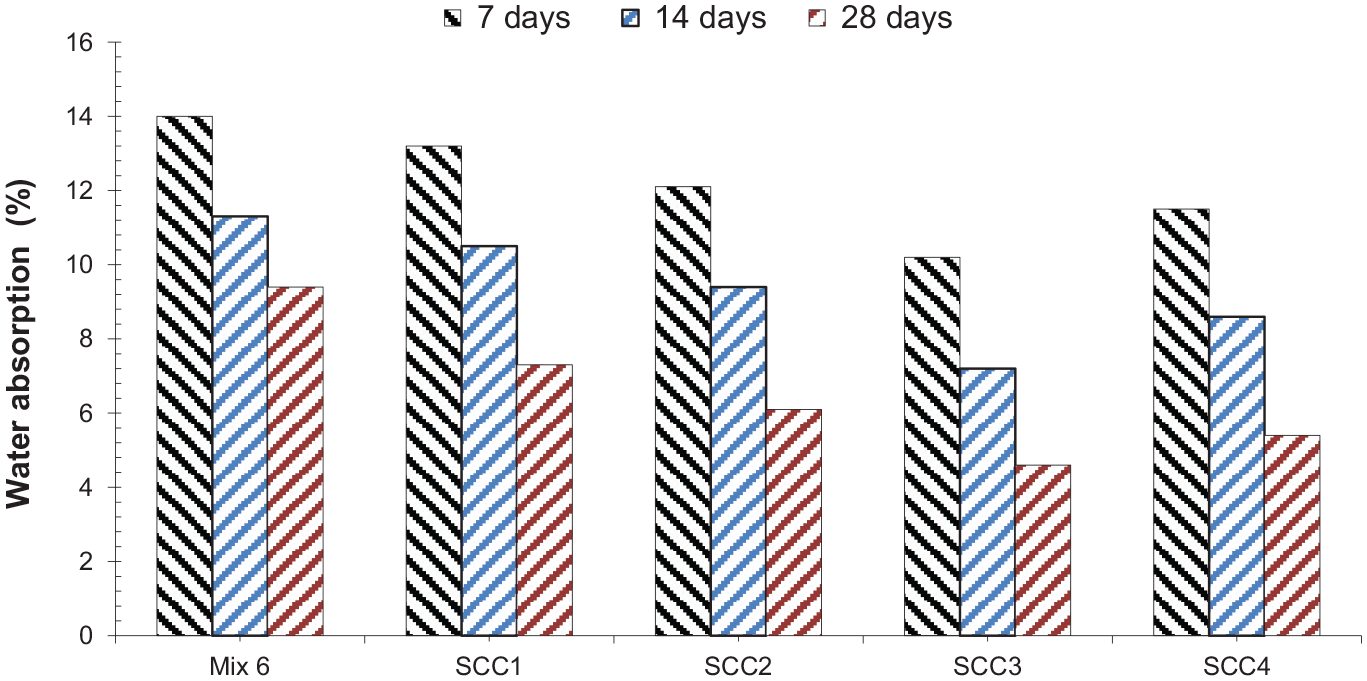
Water absorption of different samples at 7, 14, and 28 days.
Acid resistance
Although there are various aggressive acids, such as hydrochloric acids, nitric acids, sulfuric acids (H2SO4), and acetic acids. In this study, H2SO4 was taken as an acid for acidic attacks on the concrete sample with various proportions of NFs. The test results of acid resistance in Figure 8 are shown in terms of mass loss due to sulfuric acid attack of the specimens after 7, 14, and 28 days for each mix. It can be noticed from the results that weight loss due to sulfuric acid is considerably reduced with the addition of NFs up to 1.5% substitution. It is due to the fact that the addition of NFs effectively restricts the development and formation of initial cracks, and decreased the porosity of the concrete 63 which ultimately prevents the fast penetration of sulfuric acid. Erosion of concrete is the dissolution of calcium aluminate and calcium hydroxide due to sulfuric acid.65–67 Erosion speed will largely depend on sulfuric acid penetration rate into the concrete body and to reach calcium hydroxide and calcium aluminate. So, improvement in the porosity of concrete results in an increase in the density of concrete due to the addition of fibers. The increase in density would lead to reduce penetration rate of sulfuric acid in concrete and enhance its durability-related properties. However, at a higher dosage of NFs (2.0%) density of SSC decreased due to lack of workability, resulting in weight loss due to sulfuric acid considerably increased.

Percentage loss in concrete mass due to acid attack.
Permeability
Permeability of concrete is the ability to allow water/chemicals to pass through it. As it is a well-known fact that concrete is a porous material.68,69 To characterize concrete durability, permeability is considered as a fundamental material property as it determines the penetration rate of aggressive materials that are responsible for the degradation of concrete. 68 The result of the permeability test is shown in Figure 9. A general trend indicates that permeation depth decreased as the percentage of NFs increased up to 1.5%. Minimum permeation depth was obtained at 1.5% substitution of NFs while maximum permeation depth was obtained at 0% of NFs/control mix. It is due to fact that the elastic modulus of fibers reinforced concrete is much greater than that of normal concrete. Therefore, the tensile capacity of concrete increased as the percentage of NFs increased. This would effectively restrict initial cracks development and formation, and the porosity of the concrete could be reduced, which would be beneficial to improving the permeability resistance of concrete. 63 However, at a higher dosage of NFs (2.0%), the compaction process become more difficult by decreasing workability, leading to porous concrete which results in to increase in the permeation depth.
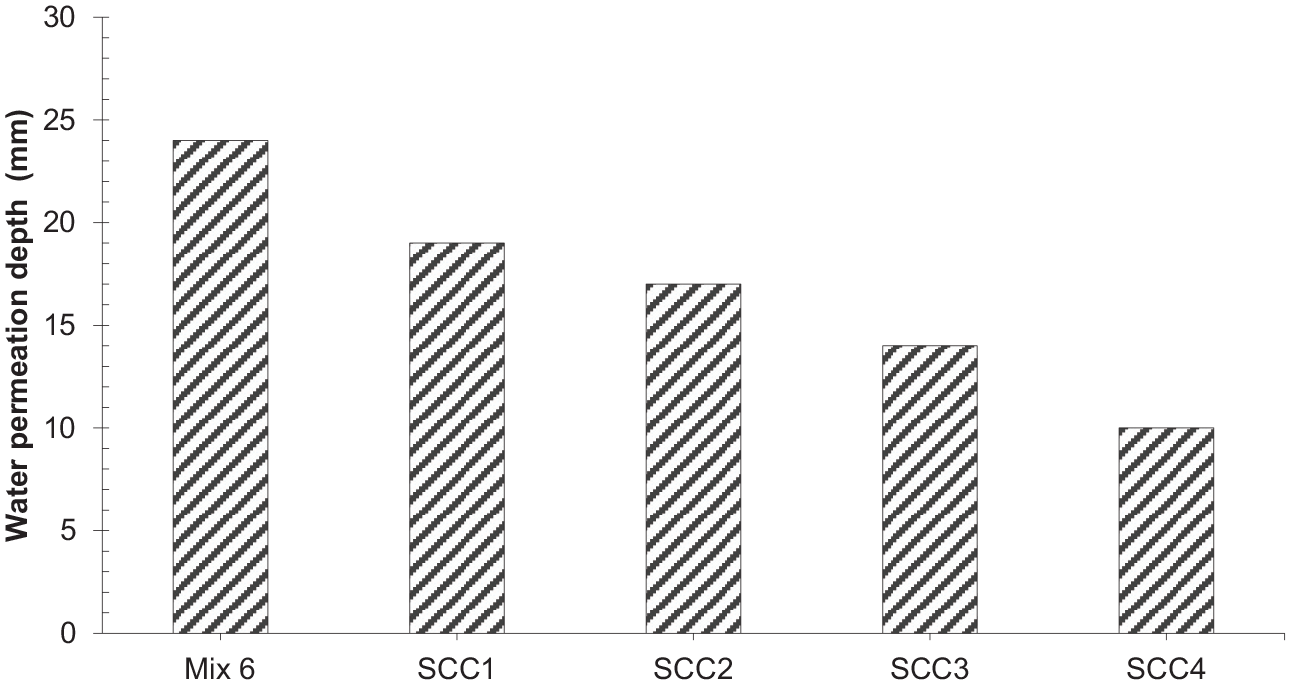
Permeability of the self-compacting concrete containing nylon fibers.
Carbonation resistance
Figure 10 shows the relationship between the carbonation depth of the specimens and the NFs dosage. It can be noticed that the carbonation depth of concrete decreases as the percentage of NFs increase from 0% to 1.5% and decreased steadily as the percentage of NFs increase up to 2.0%. All NFs reinforced mix shows lower carbonation as compared to the control mix without fiber. The minimum carbonation depth was observed at 1.5% of NFs which is almost 35% (at 28 days) lower as compared to the control mix. Many holes are formed in concrete which facilitates the diffusion of CO2 in concrete due to evaporation of free water and shrinkage. The addition of NFs blocks the diffusion channel of CO2 and results in to increase in the resistance for CO2 diffusion. This results in a decrease in carbonation speed. 70 Although nylon fibers act as reinforcement in the microstructure for concrete materials. The decreased carbonation speed can be ascribed due to the improvement of microstructure. However, at a higher dosage of NFs (2.0%), the fiber prevents the cement paste to fill the voids in microstructure which increased internal porosity and can provide a new channel for CO2 to penetrate in a concrete structure results in increased speed of carbonation. 71
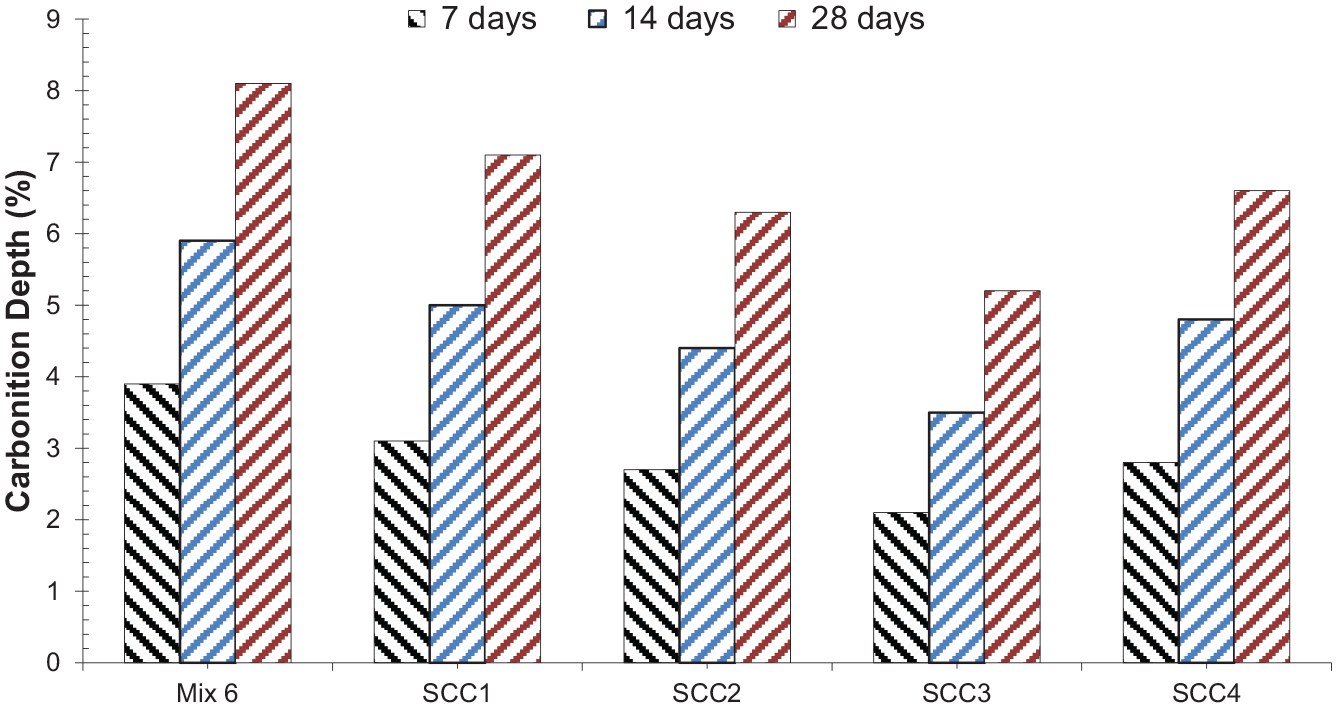
Carbonation resistance of the different samples.
Conclusions
The experimental study investigated the use of nylon fibers in self-compacting concrete. Based on the experiment work, the following conclusions were drawn.
The filling and passing ability of SCC is considerably reduced with the incorporation of NFs. This is due to the increased surface area of nylon fibers. In addition to the coarse aggregate, more mortar is required to coat the fibers. Also, more cement paste is required to reduce the friction force between fibers and aggregate. Therefore, filling and passing ability is decreased with the incorporation of NFs.
Bleeding and segregation resistance considerably improved with the addition of NFs. The presence of fibers decreases the rate of settlement of aggregate due to increased viscosity of paste and friction between aggregate and fibers, thus improving the bleeding and segregation resistance of fresh SCC.
The use of NFs up to 1.5% provides SCC mixture with acceptable fresh properties according to the technical specification for SCC. Therefore, it is recommended to use NFs up to 1.5% (by weight of cement).
All the NFs reinforced concrete show greater strength than the reference mix, having maximum strength at 1.5% of NFs (by weight of cement).
Durability aspects such as water absorption, acid-resistant, carbonation depth, and permeability considerably improved with NFs.
Nylon fibers positively influenced the overall mechanical performance of self-compacting concrete. Nylon fibers were more beneficial to splitting tensile than the compressive strength of concrete. Nylon fibers also upgraded the acid attack resistance.
The present study concludes that nylon fiber is a good local eco-material, available in abundance, and has a low cost that can be used for the SCC production, in a perspective between economic and environmental constraints.
Footnotes
Acknowledgements
The authors extend their appreciation to the Deanship of Scientific Research at King Khalid University for funding this work through group research program under grant number RGP. 1/100/42 and Taif University Researchers Supporting Project (number TURSP-2020/276), Taif University, Taif, Saudi Arabia.
Declaration of conflicting interests
The author(s) declared no potential conflicts of interest with respect to the research, authorship, and/or publication of this article.
Funding
The author(s) disclosed receipt of the following financial support for the research, authorship, and/or publication of this article: The authors extend their appreciation to the Deanship of Scientific Research at King Khalid University for funding this work through group research program under grant number RGP. 1/100/42 and Taif University Researchers Supporting Project (number TURSP-2020/276), Taif University, Taif, Saudi Arabia.
