



Abstract
The effect of recycled coarse aggregate (RCA) on the fresh and hardened properties of C40 self-compacting concrete (SCC) was investigated in this paper. The slump, T 500 (the time needed for SCC to spread into a round configuration with a nominal diameter of 500 mm), the slump flow and the flow time of fresh C40 SCC as well as the compressive strength and modulus of elasticity of hardened C40 SCC were studied. The modulus of elasticity of C40 SCC was calculated by theoretical formula, and the calculated values were compared with the experimental values. Mechanisms that effect on the C40 SCC properties at fresh and hardened states were also explored. The experimental results showed that the slump values of the C40 SCC are beyond 250 mm. The C40 SCC with RCA replacement content of 50% showed the highest slump value of 275 mm. All T 500 values of the C40 SCC are within 5 s. The slump flow of the C40 SCC slightly increases with the increase of replacement content of the RCA. In contrast, the compressive strength and modulus of elasticity of the C40 SCC slightly decrease with the increase of replacement content. The experimental values of modulus of elasticity are lower than that of the calculated values. Submerged in water before mixing of RCA leading to the slump flow of the C40 SCC increases with the increasing replacement content of the RCA. The old cement mortar attached to the RCA surface is the main reason that weakens the mechanical properties. The lower amount of coarse aggregate and the higher amount of cement paste attribute to the lower values of modulus of elasticity. This study implied that RCA can be effectively used in the production of C40 SCC without any significant sacrifice on workability and mechanical properties.
Keywords
Introduction
Self-compacting concrete (SCC) has been developed in Japan in 1988. 1 SCC is a new category of high-performance concrete. It can spread into mould under its own weight and without any vibration, and it can realize self-compacting without any segregation. Compared with the traditional vibrated concrete, SCC possesses many advantages for the reason that the SCC needs no vibration, lower energy costs and reduced noise. 2 –4
Recycled coarse aggregates (RCAs) are made from the demolished structures of concrete. Replacing natural coarse aggregates (NCAs) with RCA in concrete design can reduce the excessive use of NCA, which is a non-renewable resource, and can remove the large quantities of concrete waste generated by demolition. Besides the aspects on sociological and economic, sustainable development contains energy saving, environment protection and non-renewable natural resources conservation, notably in the context of RCA. There are many different physical properties between RCA and NCA: for example, remnant cement mortar from original concrete attached to the surface of the RCA, leading to less density and higher water absorption in RCA compared with NCA. 3,5
There is a question that whether the fresh and hardened properties of SCC can be compromised if RCA was used as a part of aggregate? SCC produced with RCA has not been extensively studied until now. But many researchers show a great interest toward this topic. Kou and Poon investigated the fresh and hardened properties of SCC using 100% RCA as aggregate. The initial slump flows of the SCC including RCA were at least 760 mm and the blocking ratios varied from 0.85 to 0.94. At the curing age of 28 days, the compressive strength of the SCC with water to binder ratio of 0.44 and 0.53 is 53.2 MPa and 38.7 MPa, respectively. 6 Grdic et al. researched the properties of SCC with the RCA replacement contents of 50% and 100%. They concluded that the replacement content of 50% and 100% of the RCA decreased the compressive strength of the SCC for 3.88% and 8.55%, respectively. 6 Safiuddin et al. reported that RCA could be used in SCC with replacement content of NCA for about 50% by weight without sacrificing the properties in fresh state such as filling ability, passing ability and segregation resistance of concrete. 7 Güneyisi et al. studied the replacement content of 100% of NCA with the surface-treated RCA in SCC. The improvements of compressive strength were approximately in the range of 2%–13% for SCC with treated RCA. 8 Kebaïli et al. investigated the effect of RCA replacement content on self-compacting ability. Three replacement contents of 40%, 60% and 100% were conducted. They found that the static yield torque T SC increased by increasing the replacement content of NCA with RCA. T SC was significantly increased with RCA contents of 60% and 100%. 3 González-Taboada et al. studied the fresh state behaviour of SCC with NCA replaced by RCA using replacement contents of 20%, 50% and 100% by volume. They concluded that increasing the RCA content results in an increase in both static yield stress and plastic viscosity. 9 Singh and Singh investigated the carbonation and electrical resistance of SCC. NCA was replaced by RCA with contents of 0%, 25%, 50%, 75% and 100%. They obtained that the carbonation resistance of SCC decreased with the increase of RCA content. Electrical resistivity of SCC made with 100% RCA decreased nearly by 48%. 10 Gesoglu et al. studied the effect of NCA replaced by RCA on compressive strength, splitting tensile strength and modulus of elasticity. They found that as the NCA was replaced by RCA with content of 100%, SCC showed a reduction of compressive strength, splitting tensile strength and modulus of elasticity up to 11.9%, 17.6% and 4.1%, respectively. 11
There are no data on the properties of C40 SCC at fresh and hardened states using RCA as coarse aggregate. This paper aims to investigate the effect of the replacement content of RCA on the fresh and hardened properties of C40 SCC and to explore the feasibility of RCA using in SCC. Two replacement contents of 50 wt.% and 100 wt.% were adopted. RCA was immersed in water for 24 h before mixing in order to overcome the shortcoming of higher water absorption. The properties as slump, T 500, slump flow and flow time of fresh C40 SCC as well as compressive strength and modulus of elasticity of hardened C40 SCC were measured. The modulus of elasticity of C40 SCC was calculated by theoretical formula, and the calculated values were compared with the experimental values. Mechanisms that effect on the properties of C40 SCC at fresh and hardened states were also explored.
Experimental studies
Materials
The ASTM Type I ordinary Portland cement 42.5 was produced by Dalian Xiaoyetian Cement Co. Ltd (Dalian, China) with a density of 3.1 g·cm−3. Typical physical properties and chemical compositions of cement are tabulated in Tables 1 and 2, respectively. Fly ash was bought from Dalian Huayuan Fly Ash Co., Ltd (Dalian, China). Typical physical properties and chemical compositions of fly ash are tabulated in Tables 3 and 4, respectively. River sand with particle size of 0–5 mm is used as fine aggregate. Its apparent density, stacking density, porosity and fineness modulus are 2.7 g·cm−3, 1.6 g·cm−3, 41.8% and 2.46, respectively. Superplasticizer with a density of 1.1 g·cm−3 was obtained from Mu Hu admixture Co., Ltd (Beijing, China). Crushed limestone with continuous grading and maximum size of 20 mm is used as NCA. Its apparent density and stacking density are 2.7 and 1.5 g·cm−3, respectively. RCA got from the demolition of structural concrete. Large pieces of concrete were crushed in a jaw crusher. Firstly, we got the demolished concrete members from our laboratory. And then, the demolished concrete members were crushed in a jaw crusher. Coarse aggregates with different sizes were obtained. After that, the coarse aggregates with different sizes were mixed evenly to realize continuous grading. At last, the aggregates were cleaned. RCA also possess continuous grading and maximum size of 20 mm; its apparent density and stacking density are 2.6 and 1.4 g·cm−3, respectively.
Physical properties of cement.

Chemical composition of cement.

SiO2: silicon dioxide; Al2O3: aluminium oxide; Fe2O3: iron(III) oxide; CaO: calcium oxide; MgO: magnesium oxide; Na2O: sodium oxide; SO3: sulphur trioxide.
Physical properties of fly ash.

Chemical composition of fly ash.

SiO2: silicon dioxide; Al2O3: aluminium oxide; Fe2O3: iron(III) oxide; CaO: calcium oxide; K2O: potassium oxide; TiO2: titanium dioxide; MgO: magnesium oxide; Na2O: sodium oxide; SO3: sulphur trioxide.
In order to overcome higher water absorption, RCA was submerged in water for 24 h, and then dried in air conditions for 1 h before preparation of SCC.
Mix proportions
Mix proportions of C40 SCC were calculated according to improved full calculation method and guide to design and construction of SCC 12,13 ; 30 vol% of cement was replaced by fly ash in the mixtures. A control mix (N) and two mixes incorporating RCA with replacement contents of 50 wt% and 100 wt% denoted R1 and R2, respectively, were produced. Details of the mix proportions are presented in Table 5. During the process of preparing for the mixtures, the cement, coarse aggregate and fly ash were mixed first, and then, the sand was added. After that, the superplasticizer was put into water. And then, the superplasticizer and water were added to the mixture together. Another 3 min mixing were lasted after the adding of the superplasticizer and water. Finally, the mixing process was completed by additional 2 min of mixing the mixtures.
Mix proportions of the C40 SCC.

SCC: self-compacting concrete; NCA: natural coarse aggregate; RCA: recycled coarse aggregate.
Testing on fresh concrete
Properties (slump, T 500, slump flow and flow time) of the C40 SCC at fresh state were determined according to guide to design and construction of SCC. 12 T 500 is the time for SCC to spread into a round configuration with 500 mm nominal diameter. It is a method to measure the flow speed. It is also an indication on the relative viscosity and resistance to segregation of the SCC. The slump flow shows the flowability of concrete under the conditions of unconfined. Information on the segregation resistance and uniformity of each spread could be observed during the testing process. The values of slump flow were calculated by the average values of two perpendicular diameters. The photograph of testing on slump flow of the C40 SCC with 100% RCA is shown in Figure 1. The flow time indicates the time needs for SCC from starting flow to stop. The slump and flow time also describe the flowability of SCC at fresh state. In order to reduce the variability of workability loss, the fresh state properties of mixtures were determined 30 min after mixing. The remaining of fresh concrete was used to prepare specimens to determine the mechanical properties. Three cubic specimens of 150 × 150 × 150 mm3 and six prism specimens of 150 × 150 × 300 mm3 of each group were prepared. The specimens were demoulded 24 h after casting and then curing in a room for 28 days under the condition with a temperature of 20 ± 1°C and relative humidity > 95%.
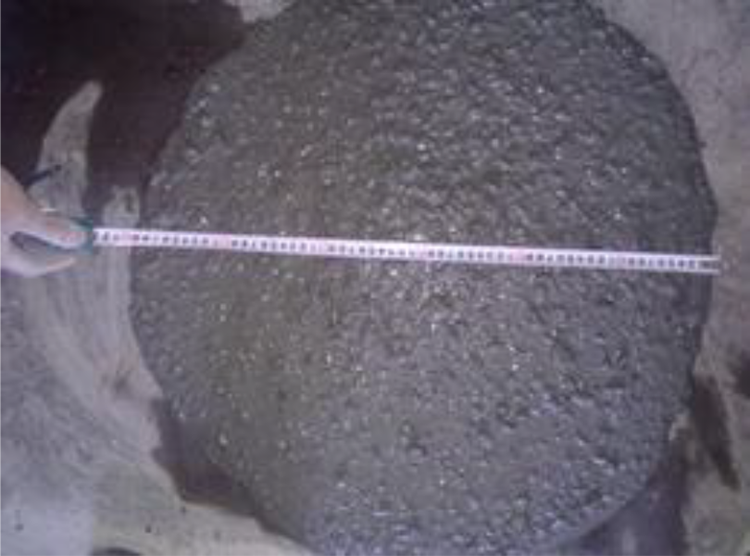
Photograph of slump flow testing on C40 SCC with 100% RCA. SCC: self-compacting concrete; RCA: recycled coarse aggregate.
Testing on hardened concrete
The compressive strength was measured by the cubic and prism specimens in accordance with standard for testing method of mechanical properties on ordinary concrete. 14 The compressive strength was calculated by averaging the values of three specimens in one group. Modulus of elasticity was determined by the prism specimens in accordance with standard for testing method of mechanical properties on ordinary concrete. 14 The experimental setup of compressive strength and modulus of elasticity is shown in Figure 2.
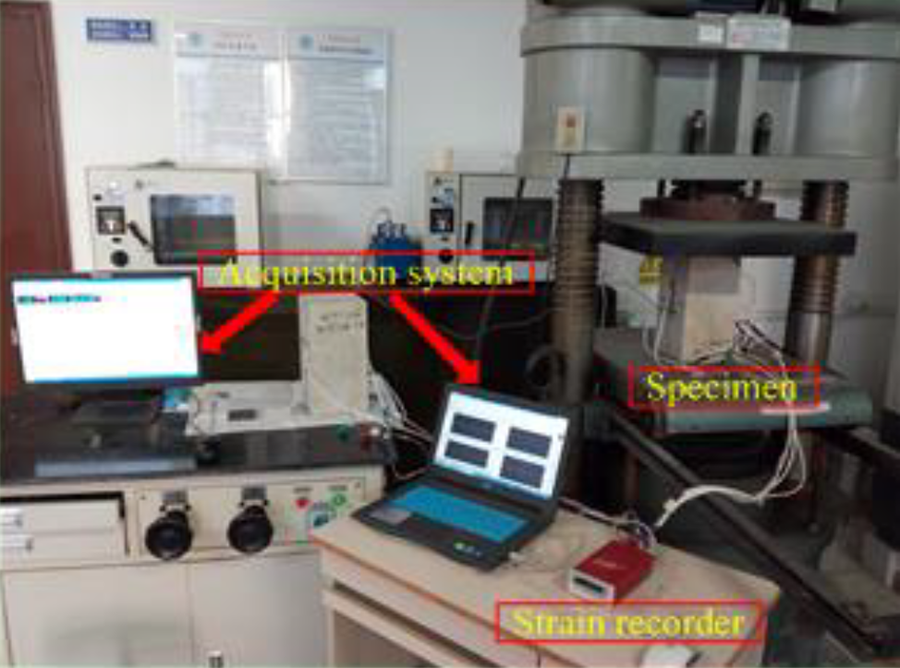
Photograph of mechanical property test setup.
Results and discussion
Properties of C40 SCC at fresh state
Properties of C40 SCC at fresh state are tabulated in Table 6. It can be seen from Table 6 that the slump values of three groups are beyond 250 mm. All the slump values are beyond the flowability lower limit of SCC. 12,15 R1 showed the highest slump value of 275 mm. All the T 500 values of the mixtures are within 5 s, which are in accordance with the SCC specifications. 12 The slump flow increases with the increasing replacement content of the RCA, and R2 reached the biggest slump flow value of 630 mm. In practice, 550 mm is the minimum slump flow for SCC to ensure adequate self-compacting capacity. 3,11 R1 and R2 showed the longest and the shortest flow time of 23s and 19 s, respectively. The reason of the slump flow increases with increasing replacement content of the RCA can be ascribed to the RCA was submerged in water before mixing. After 24 h of submerging in water, certain amount of water was contained in the RCA and the RCA was at saturated surface-dried conditions. NCA could not hold this amount of water initially, thus the slump flow increases with the increasing replacement content of the RCA. 15,16
Properties of the C40 SCC at fresh state.

SCC: self-compacting concrete.
Properties of C40 SCC at hardened state
Compressive strength and modulus of elasticity were tested after 28 days curing, and the results are presented in Table 7. In Table 7, both the compressive strength of cubic and prism of group N with the highest values of 57.8 MPa and 48 MPa, respectively, are observed. The compressive strength decreases with the increasing replacement content of the RCA. It shows that the cubic compressive strength decreases from 14.2% to 19.9% when the RCA replacement content increase from 50% to 100%. The prism compressive strength decreases from 23.3% to 25.4%, and the experimental value of modulus of elasticity decreases from 12.8% to 20.9%. Typical failure modes of C40 SCC are shown in Figure 3.
Compressive strength and modulus of elasticity of the C40 SCC.

SCC: self-compacting concrete.
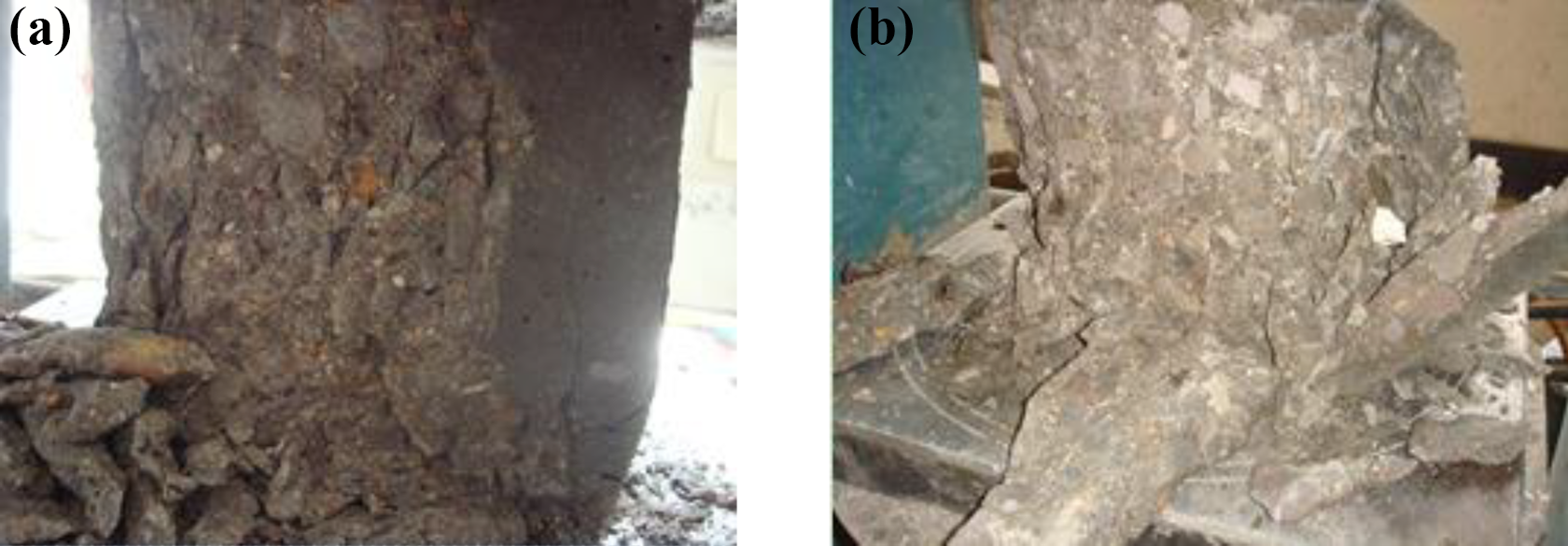
Typical failure modes of C40 SCC. (a) SCC with 100% RCA and (b) SCC with 0% RCA. SCC: self-compacting concrete; RCA: recycled coarse aggregate.
Many factors can weaken the mechanical properties of the C40 SCC. However, the old mortar on the surface of the RCA is the main reason. RCA is obtained by crushing the demolished concrete structure into smaller granulations. For the reason that the old cement mortar attached to the surface of the RCA, the properties of the RCA may have many differences compared with the original part. Porous and numerous microcracks were contained in old cement mortar. Thus, the physical properties would be affected by the old cement mortar attached on the RCA surface. At the same time, compared with the NCA, the density of the RCA is lower, the water absorption of RCA is higher, and the mechanical strength of the RCA is lower. Therefore, when the RCA is used in concrete, these characteristics of the RCA may weaken the interfacial bond between RCA and new cement mortar. Thus, this may lead to the decrease of mechanical properties of concrete made with RCA. 8,17 –26
The interfacial transition zone (ITZ) between RCA and new cement mortar is the connection between these two main components of new concrete. The ITZ is important for the reason that it almost governs the mechanical properties of concrete. There are two ITZs existing in SCC produced with RCA. The first ITZ is the new ITZ which is between new cement mortar and the RCA. The other ITZ is the old ITZ which is between old adherent cement mortar and the RCA. Many microcracks and voids are contained in ITZ from the old cement mortar. The strength of the SCC with RCA will be influenced by the microstructure. 8,20,27 –29
The experimental and calculated values of modulus of elasticity of three groups are presented in Table 7. The theoretical formula adopted for calculating modulus of elasticity is consistent with the code for design of concrete structures. 30 The experimental values of modulus of elasticity are lower than that of the calculated values, indicating that modulus of elasticity of SCC is lower than that of normal concrete. At the same time, experimental value of modulus of elasticity decreases with increase of the replacement content of the RCA. The proportions of experimental value of modulus of elasticity to the calculated value of modulus of elasticity in groups N, R1 and R2 are 0.72, 0.63 and 0.57, respectively.
The conclusion that the modulus of elasticity of SCC is lower than that of the normal concrete is confirmed by many researchers. Dehn et al. compared the modulus of elasticity of SCC and normal concrete by experimental study. They concluded that the modulus of elasticity of SCC is lower than that of the normal concrete. 31 Jacobs and Hunkeler found that the modulus of elasticity of SCC is lower than that of the normal concrete at a given strength. 32 The lower amount of coarse aggregate and the higher amount of cement paste of the SCC lead to these general conclusions. Moreover, RCA is characterized as porous and presents numerous microcracks, leading to the lower density and mechanical strength of the SCC. 18 –20,22 Therefore, the modulus of elasticity of SCC decreases with increasing replacement content of the RCA.
Conclusions
This paper presented an investigation on the effect of RCA on the properties of C40 SCC. The properties of C40 SCC incorporating NCA only and the C40 SCC with NCA replaced by RCA with two contents of 50 wt% and 100 wt% were studied. The RCA was immersed in water 24 h before mixing. The slump, T
500 (the time needed for SCC to spread into a round configuration with a nominal diameter of 500 mm), the slump flow and the flow time of fresh C40 SCC as well as the compressive strength and modulus of elasticity of hardened C40 SCC were studied. The modulus of elasticity of C40 SCC was calculated by theoretical formula, and the calculated values were compared with the experimental values. Mechanisms that effect on the properties of C40 SCC at fresh and hardened states were also explored. The conclusions can be drawn as follows. The slump values of the C40 SCC with the RCA replacement contents from 0% to 100% are beyond 250 mm. The C40 SCC with RCA replacement content of 50% showed the highest slump value of 275 mm. All the T
500 values of the C40 SCC with RCA replacement contents from 0% to 100% are within 5 s. The slump flow of the C40 SCC slightly increases with the increase of replacement content of the RCA. In contrast, the compressive strength and modulus of elasticity of the C40 SCC slightly decrease with the increase of replacement content of the RCA. The experimental values of modulus of elasticity are lower than that of the calculated values. Submersion in water before mixing of RCA leads to the slump flow of the C40 SCC increase with the increasing replacement content of the RCA. For the reason that the old cement mortar attached on the surface of the RCA, the mechanical properties of the C40 SCC were weakened. The lower amount of coarse aggregate and higher amount of cement paste of the SCC resulted in the lower values of modulus of elasticity. The workability and compressive strength of C40 SCC incorporating RCA satisfy the characteristics of C40 concrete. This study indicates that RCA can be effectively used in the production of C40 SCC without any significant sacrifice on workability and mechanical properties.
Finding a proper way to design and prepare SCC with good properties using RCA is still on the way. Accordingly, the RCA needs to be treated effectively to improve the properties of SCC, which is the work will be carried out in the future.
Footnotes
Acknowledgement
The authors are grateful for the funding support from the Hunan University of Arts and Science and Education Department of Hunan province. The authors also would like to thank Professor Baoguo Han for his help in writing the manuscript and the Liaoning University of Technology for their assistance in experiments.
Declaration of conflicting interests
The author(s) declared no potential conflicts of interest with respect to the research, authorship, and/or publication of this article.
Funding
The author(s) disclosed receipt of the following financial support for the research, authorship, and/or publication of this article: This work was supported by the PhD research start-up foundation of the Hunan University of Arts and Science (grant no. 18BSQD28), general scientific research project of Education Department of Hunan province (grant no. 18C0755), research-based learning and innovative experimental program for the university students of Hunan province (grant no. Xiang teaching [2018] 255) and general teaching reform project of Hunan University of Arts and Science (grant no. JGYB1953).
