



Abstract
In order to develop negative ion functional cotton knitting products with good performance, tourmaline powder was selected as the anion additive, and the anion functional finishing of cotton knitting products was carried out by the two-dip and two-rolling process. The microstructures of tourmaline powder and anion functional cotton fabric were observed, their anion emissions were measured, and the influences of particle size and amount of anion additive on the finishing effect were discussed. The results showed that, after grinding, the particle size of tourmaline powder decreased to different degrees and its distribution was more uniform. The negative ion emission of tourmaline powder was enhanced compared with that before grinding. The properties of cotton knitted fabric treated with ground negative ion additive were better than those treated with non-ground one. The contents of negative ion additive and modification temperature both have great influence on the amount of anion emission of finished cotton fabric. The anion functional cotton fabric had certain washing durability and needs to be improve.
Introduction
Air negative ions have a special positive effect on the human body and are known as “vitamins and auxins” in the air.1–3 Relative studies have shown that Air negative ions can purify the air and reduce the harm of air pollution to human body, 4 can enhance the vitality of human body, calm the nervous, significantly reduce the heart rate and temperature during exercise in a hot environment, 5 can inhibit the growth of bacteria and fungi and reduce the number of bacteria, 6 can promote blood microcirculation, enhance metabolism, and have a certain inhibitory effect on mammary gland hyperplasia, 7 etc. However, the problem of atmospheric pollution has been becoming more serious in recent years,8–10 and the concentration of negative ions in the air is getting lower, 11 which has endangered human health. Therefore, the development of a kind of functional fabric releasing air anions, especially the wearable fabric, has become an important subject of concern in the textile industry, and has a broad application prospect and value.12–14
Cotton fabrics is an important fabric used in people’s daily lives, such as bedding and clothing. Therefore, the development of anion functional cotton fabric is of great significance. Tourmaline is one of the most available resources for negative-ion-generating materials in nature. Because of its unique physical properties (piezoelectric and electric-releasing effects), it can ionize the air and generate the air negative ion beneficial to human body,5,6 which is a good negative ion functional finishing agent. But because of the large particle size of tourmaline powder, it is not suitable for fabric finishing before treatment. Most of the researches used nanometer material as anion additive to finish the fabric due to the excellent surface properties of nanomaterials. Our preliminary study of the research group showed that nanometer anion additives suitable for fabric finishing could be prepared through appropriate grinding process, which greatly expands the application space of tourmaline powder as negative ion additive. Meanwhile, because cotton fiber is natural fiber, surface modification can only be used to finish its products functionally. Three commonly used methods are coating method, dipping method, and hydrothermal synthesis method.15–17 The basic principle of finishing is that through physical van der Waals force or coating agent, the functional additive is cross-linked with the fabric to form a film on the surface of the fiber, thus adding a special function of durability to the cotton fabric. Colleoni et al. 18 introduced a multi-step method of producing functional fabric surface treatment by continuously deposing sol layer on cotton fabric by sol-gel method. Karimi et al. 19 used the coating method to finish the cotton fabric in accordance with the function, and the prepared nanocomposite finished cotton fabric had good antibacterial properties and anti-ultraviolet activity. Palaskar et al. 20 used atmospheric plasma and nanometer finishing technology to develop multi-functional cotton fabrics with better flame retardancy, antibacterial activity, and thermal stability. Liu et al. 21 analyzed the effects of negative ion finishing agent volume fraction, baking time, baking temperature and soaking time on the negative ion release amount, gas permeability and hand feeling of cotton fabric finishing, and evaluated the finishing effect by the method of variance analysis. Zhu et al. 22 pretreated the cotton fabric with 2.5 g/L silane coupling agent, and then consolidated the nano-functional powder onto the cotton fabric by high-pressure gas steaming combined with rolling and baking. After 20 times washing, the performance was almost unchanged. Dong et al. 23 used the silica sol-gel method to finish the two-dip and two-rolling of cotton socks and proved that the products prepared by this method have better antibacterial and deodorizing effects. These research results provide useful references for negative ion functional finishing of fabrics.
In this paper, tourmaline power was selected as negative ion additive, and the negative ionic functional finishing of cotton knitted fabric was carried out by dip the second dip and second rolling process. The effects of influencing factors including particle size and addition concentration of tourmaline powder on finishing effect of functional fabric were discussed to provide theoretical and experimental basis for the finishing of negative ion functional cotton fabric.
Experimental
The main materials used in this study include cotton knitted fabric (flat needle tissue 32S, weight 150 g/m2, Jiangsu Jinchen Knitting Co., Ltd.), tourmaline powder (Rt-p30000,4000 mesh, Shanghai Huzheng Nano Co., LTD), sodium hydroxide, polydimethyl acrylamide ammonia, nonionic detergent (provided by Fubin Group).
Tourmaline powder was ground for 5, 10, 15, and 20 h with wet grinding, respectively, by using an all-round planetary grinder. The mass ratio of grinding media to material is 1:3. The filling rate of agate ball is 80%. The wet grinding auxiliary is ethanol. Then the ground tourmaline powder was mixed with deionized water at room temperature, ultrasonically dispersed at 50 Hz for 5 min, and heated to 50℃. After added the functional agent (Polydimethyl acrylamide ammonia, 0.3 g/L) magnetically stirred for 30 min to get an even mixture. In order to get more even mixture, then ultrasonically dispersed again at 50 Hz for 1 h, and stirred at high speed for 15 min.
At the same time, it is necessary to pretreat cotton fabric before finishing using 2% sodium hydroxide under above 95℃ for 2 h and the bath ratio is 1:20. The bleached cotton fabric was washed with 1 g/L nonionic detergent at 90℃ for 15 min to remove impurities. Then a two-dip and two-rolling process was employed. The pretreated cotton fabric was immersed in the above anion finishing liquid, turning around in dyeing machine at 20℃–80℃ for 30 min, and the bath ratio is 1:20. And then the mixture was cured at 150℃ for 3 min and baked at 130℃ for 5 min to fix the prepared negative ion powder to the surface of the cotton fabric, and finally dried at 60℃.
The surface morphology of the sample was characterized by a field emission scanning electron microscope (ZEISS Sigma 500) at an accelerating voltage of 3 kV. Zeta potential and laser particle size analyzer (Brookhaven, 90Plus Zeta) were used to evaluate particle size, and particle size of the powder obtained under different grinding duration was tested. Referring to the standard GB/T 30128-2013, the negative ion emission of the sample was detected using smart ion monitor tester (ITC-201A, Japan) with environment temperature at 25℃ and relative humidity at 50%. The test sample is 1 cm below the air inlet, and the test data of each test sample is collected after standing for 10 s. Each sample was tested five times and the average value was taken. When the negative ion emission of fabric is measured, hand rubbing method is used to assist. According to AATCC Test Method 135-2000, the durability of the surface attachment to the washing was analyzed. About 5 g-finished anion fabric was selected for washing in an automatic washing machine (whirlpool, USA, 3NWTW4800AQ).
Results and discussion
Figure 1 shows the microscopic morphology of tourmaline powder before and after grinding. Figure 2 shows the particle size distribution of tourmaline powder before and after grinding for different time. As can be seen from Figures 1(a) and 2, the tourmaline powder has a particle size of around 1.2 μm before grinding, the particle size varies, and the proportion of powder with big size is relatively high. If it is directly finished on the surface of the fabric, there will be a noticeable foreign body sensation. In addition, due to the large particle size of the powder, the functional powder attached after washing is easily detached, 24 resulting in the fabric directly decreasing the function of emitting negative ions. In order to obtain anion functional fabric with good performance, tourmaline powder must be ground. As is shown in Figures 1(b) to (d) and 2, after grinding, the particle size of powder decreases obviously, and with the increase of grinding time, the particle size of powder decreases significantly, and the particle size is the minimum at 15 h. The particle size distribution of the powder at 15 h is relatively concentrated and distributed around 0.4 μm. However, after 15 h, the particle size showed an increasing trend and the distribution range of particle size became wider. This may be caused by the agglomeration phenomenon of tourmaline powder due to its too small particle size. During the initial grinding, tourmaline powder structure has defects and is easy to be crushed and destroyed. With the lengthening of grinding time, the structural defects become less, and with the reduction of particle size, the specific surface area increases, the formation of more and more powder with smaller particle size interaction, and adsorption on the surface of large particles, resulting in intensified agglomeration between the powder, particle size increases instead. Relative research showed that the external force generated by grinding can complicate the structure of inorganic powder or make its surface amorphous, thus improving its surface activity, enhancing its reaction characteristics with organic polymer, and achieving the purpose of surface modification. 25 And more importantly, the reaction characteristics of inorganic powders with the organic polymer can be enhanced to achieve the purpose of surface modification. So, the ground tourmaline powder should be more helpful for functional finishing.

SEM of tourmaline powder: (a) before grinding, (b) after grinding for 5 h, (c) after grinding for 15 h, and (d) after grinding for 20 h.
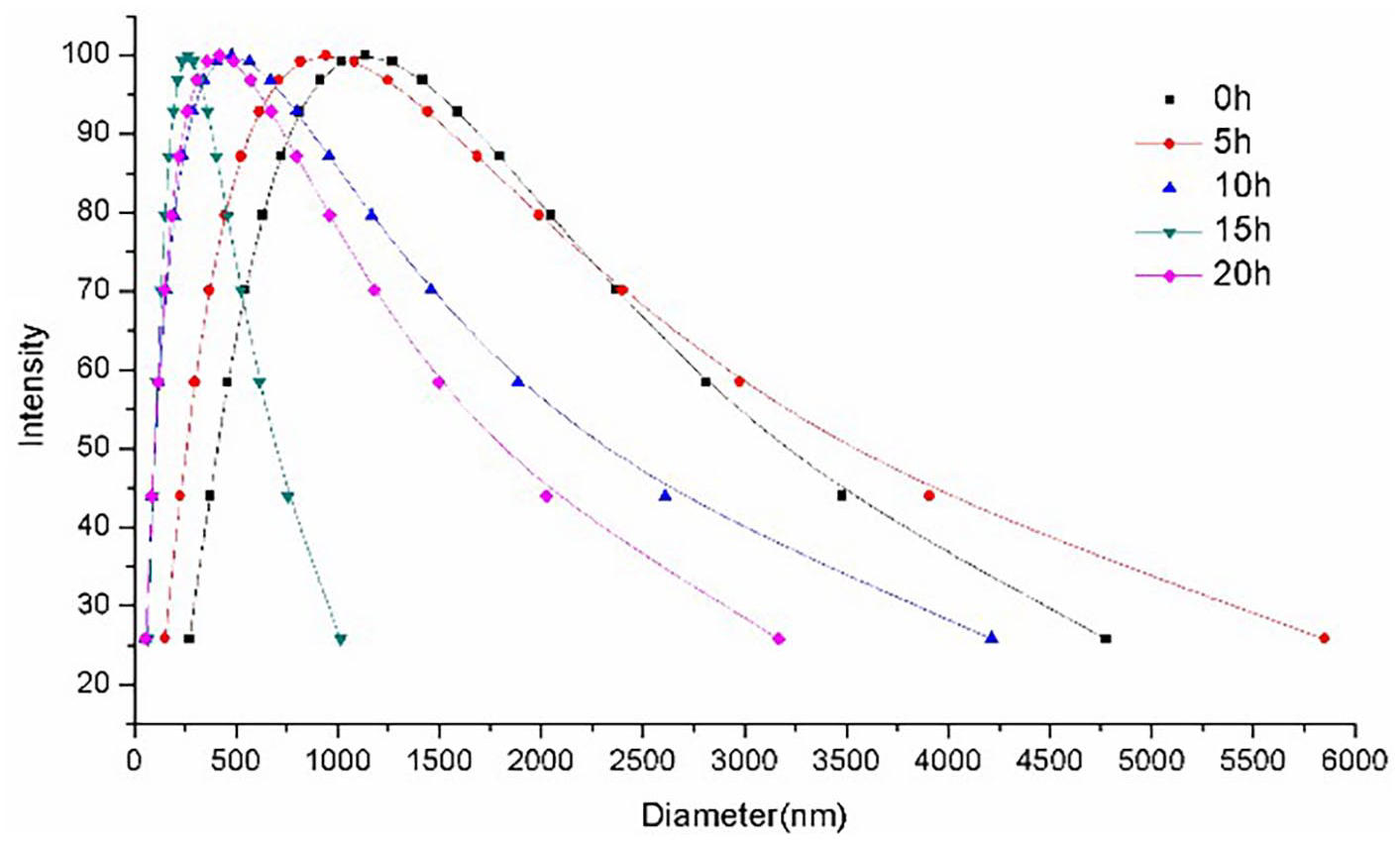
Particle size distribution of tourmaline powder unground and ground for different time.
Figure 3 shows the microscopic morphology of cotton fabric before and after finishing. As shown in Figure 3(a), before finishing, the surface of the pretreated cotton fabric is smooth, and no granular debris can be seen. It can be seen from Figure 3(b) that, after finishing, many granules are deposited on the surface of the immersed cotton knitted fabric, and some granules are also present in the gap of the fabric. During the finishing process, in addition to tourmaline anion additives, no other granular substances were added. Therefore, it can be considered that the anion additive was successfully modified on the cotton knitted fabric.

SEM of cotton fabric samples: (a) before finishing and (b) after finishing.
Table 1 shows negative ion emission of tourmaline powder and cotton knitting samples. It can be seen from Table 1 that, before grinding, the negative ion emission amount of tourmaline powder is 12,390/cm3 and increases to 15,420/cm3 after grinding. The negative ion emission amount is remarkably improved. That is relate to the particle size of tourmaline powder. Previous studies have shown that the negative ion generation of tourmaline powder was not only related to tourmaline type, but also related to its particle size. 26 For tourmaline of the same kind, as the particle size of tourmaline powder decreases, the electric polarization intensity increases, and the piezoelectric effect becomes more significant, that is, the stronger the ability to produce negative ions.
Negative ion emission of tourmaline powder before and after grinding and cotton knitting finishing (/cm3).

It can also be seen from Table 1 that the anion emission capacity of cotton knitted materials was significantly improved after finishing. Relevant studies have shown that air quality can be considered as good at 1500/cm3. By comparison, it can be considered that the anion functional cotton fabric achieves the above indexes. However, compared with pure tourmaline powder, the anion emission of cotton fabric with anion function is significantly lower. This is related to the adhesion amount of negative ion additive on cotton fabric. Theoretically, the higher the adhesion of the anion additive to the fabric, the stronger the anion emission should be. In order to further investigate this problem, we prepared different anion functional cotton fabrics by changing the amount of tourmaline powder in the anion finishing agent.
Figure 4 shows negative ion emission of cotton fabric with addition amount of tourmaline. It can be seen from Figure 4 that, as the tourmaline content increases, the negative ion emission amount of the finished fabrics tends to increase firstly, then gradually decreases, and becomes stable. When the tourmaline mass fraction exceeds 4%, the anion emission of fabric is the highest, then the anion presents a downward trend. After reaching 8%, the negative ion emission decreased gradually. We believe that it is because at the beginning of the negative ion additives gradually deposited on the cotton fabric. With the increase of deposition, the negative ion emission will increase gradually. When the deposit of tourmaline powder exceeds a certain level, it will lead to the accumulation and covering of the surface powder, which will affect the anion release effect of the cotton fabric. 27 Therefore, in order to obtain anion functional cotton fabric with excellent performance, it is very important that the concentration of anion finishing solution should be appropriately adjusted when finishing the cotton fabric with anion functional performance.
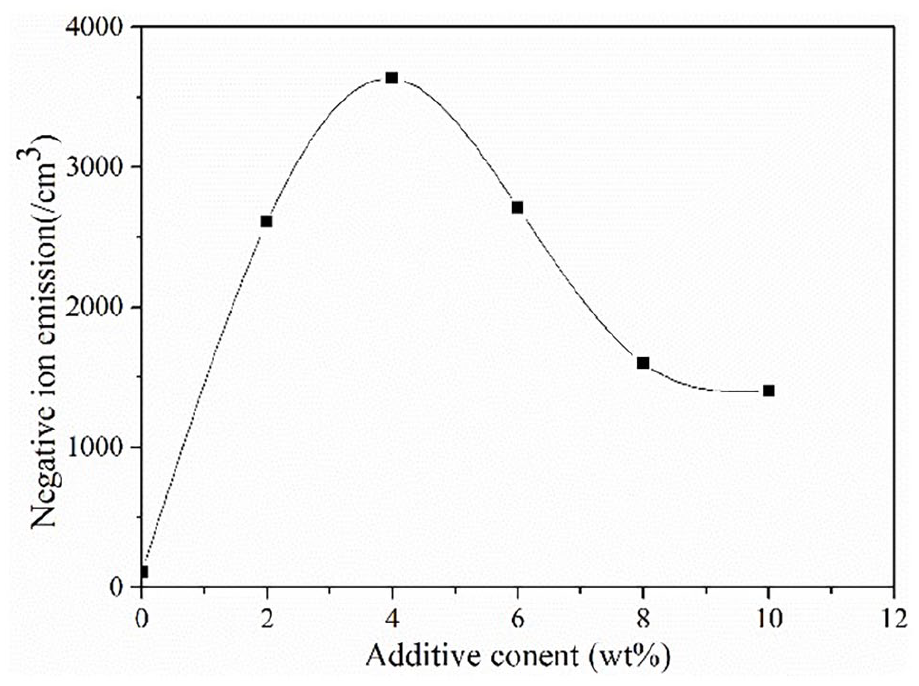
Negative ion emission of cotton fabric with addition amount of tourmaline.
Figure 5 shows the anion emission of anion functional fabrics prepared at different impregnation temperatures. As can be seen from Figure 5, the emission of anion of fabric increases linearly and then decreases with the increase of modification temperature. When the temperature is low, the increase of temperature makes the contact probability of coupling agent and tourmaline powder greatly enhanced, and the modification effect is significant. Under this condition, tourmaline can be better grafted onto cotton fiber, and the ability of cotton fiber to emit negative ions is enhanced. However, when the temperature is too high, the thermal motion between particles is intensified, the particles collide and agglomerate, and the modification effect becomes worse. 28 Therefore, the best effect is achieved when the temperature is around 50℃.
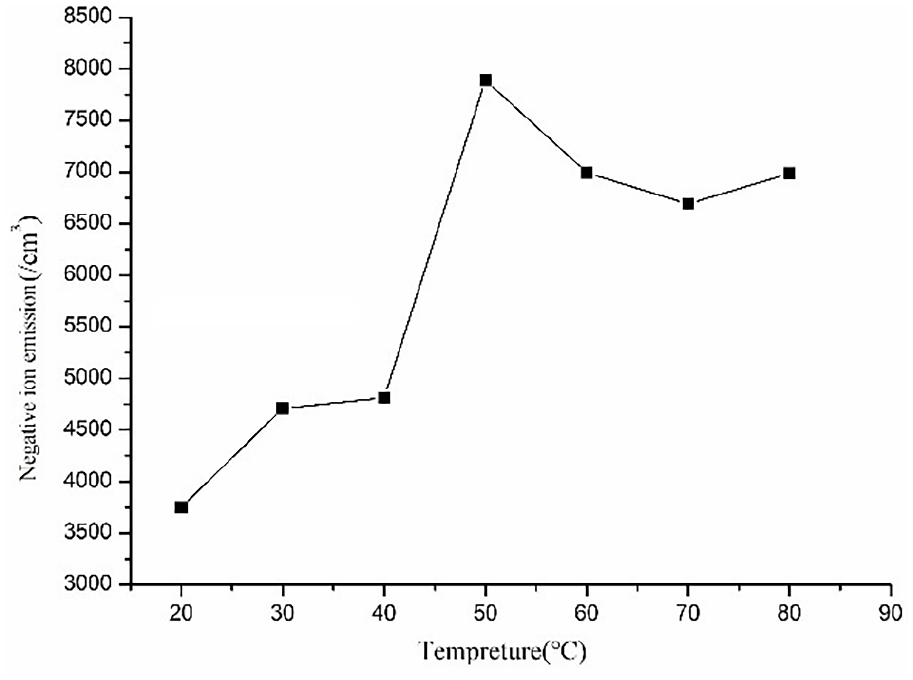
Negative ion emission curves of functional cotton fabrics prepared at different impregnation temperature.
Figure 6 shows SEM of negative ion functional cotton fabrics undertaking different times washing. It can be seen from Figure 6 that after multiple washings, the amount of negative ion additive adhered to the fabric is reduced obviously, but a certain amount of powders is still deposited on the surface after five times washing. It indicates that a strong chemical bond could have been formed with the surface of the fabric, so that the fabric can be washed several times and still have tourmaline powder attached to the surface of the fabric. In order to further observe the change of negative ion emission of fabric after washing for different times, negative ion emission of the fabric was tested.

SEM images of negative ion function cotton fabrics (4%): (a) unwashed, (b) one time washed, and (c) five times washed.
Figure 7 shows negative ion emission of the fabric after washing for different times. As can be seen from Figure 7, with the increase of washing times, the negative ion emission of cotton fabric presents a general trend of decreasing sharply at first and then stabilizing later. During the first washing, the tourmaline powder on the surface of the fabric with poor bond falls off into the washing liquid. With the increase of washing times, the combination of loose powder is less and less, the fall of powder is less and less. Only the powder with stronger binding force is left at last. Therefore, the emission of anion function cotton fabric after many times washing tends to be stable. As can be seen from Figure 7 that after five times washed, the negative ion emission of the fabric is only 30% of that of the fabric washed for one time. It also reflects that the stability of the negative ion functional cotton fabric is insufficient, and the impregnation process formula and process parameters need to be further optimized.

Negative ion emission of the fabric after washing for different times.
Conclusions
Negative ion cotton fabrics were prepared by selecting tourmaline powder as negative ion additive by dip two-rolling impregnation process. The effecting factors on the negative ion emission and durability of fabrics were analyzed, and the following conclusions were obtained: (1) Grinding can significantly improve the performance of the negative ion powder. The particle size of the powder after grinding is significantly reduced, and the amount of negative ion emission is increased. The amount of negative ion emission is nearly doubled after the powder is finished onto the fabric; (2) The addition amount of negative ion additive and modification temperature both have great influence on the negative ion emission of finished fabric. The sample has relatively better negative ion emission performance with 4% mass fraction of tourmaline solution at 50℃; (3) Negative ion cotton fabrics have certain washing durability, but it is not enough for everyday wear and need to further improve the impregnation process and strive for better durability indicators.
Footnotes
Declaration of conflicting interests
The author(s) declared no potential conflicts of interest with respect to the research, authorship, and/or publication of this article.
Funding
The author(s) disclosed receipt of the following financial support for the research, authorship, and/or publication of this article: The authors gratefully acknowledge the financial support for this work from the Characteristic Discipline Construction Project of Changshu Institute of Technology.
