



Abstract
There are different kinds of geometrical models and physical models used to simulate weft knitted fabrics nowadays, such as loop models based on Pierce, piecewise function, spline curve, mass-spring model, and finite element analyses (FEA). Weft knitting simulation technology, including modeling and yarn reality, has been widely adopted in fabric structure designing for the manufacturer. The technology has great potentials in both industries and dynamic virtual display. The present article is aimed to review the current development of 3-D simulation technique for weft knitted fabrics.
Introduction
As an important branch in knitted domain, weft-knitted fabrics are widely applied in our daily life. 3-D simulation of weft-knitted fabrics has a great research significance for 2-D reversible changed, production, virtual fitting and animation simulation, etc. How to simulate the knitted fabrics in real-time and vividly is one of the most concerned focus in the current research. There are some similarities between warp-knitted fabrics and weft-knitted fabrics in structure. Some warp knitting simulation methods can be used for weft knitting simulation. But there are also some differences between them. In the simulation of warp-knitted fabrics, the commonly used stitch are the loop stitch and inlay stitch with different gauge transverse movement, and the loop models are the connection of the underlaps and loop legs. The warp-knitted fabrics are composed of two or more groups of warp yarns, so it is necessary to judge the relationship between each group of warp yarns. The warp-knitted yarns are mainly made of multifilament composite filament yarns which means the spatial configuration between single filament should be considered in simulation. Different from warp-knitted fabrics simulation, weft-knitted fabrics simulation mainly involves the simulation of plain stitch, tuck, float and loop transfer. Weft-knitted fabrics simulation needs to establish the connection between the legs and sinker loop of loops. The collision and string between loops are formed by the same yarn continuously. Most weft-knitted yarns are short fiber yarns, so the twist and hairiness of yarn should be considered in simulation.1–5 Up to now, many weft knitted fabric models have been established since the 2-D loop models to the current 3-D geometrical loop models and mechanical models are proposed by researchers.6–8 Those models provide theoretical foundation for researching the properties of the fabrics, simulating geometrical structure and mechanical, production and design. It can largely improve productivity when product design and testing apply the weft knitted fabric simulation. The development of the 3-D simulation technique of weft knitted fabrics in loop modeling, yarn realistic simulation and physical modeling are reviewed in this paper.
3-D simulation of geometrical modeling
Researchers have established series of geometrical models to simulate the structure of weft knitted fabrics. The modeling methods of weft knitted fabric mainly include the following three models: the models based on Pierce loop model, the models based on piecewise function and the models based on spline curves.
Loop model based on Pierce
Pierce loop model 9 is a typical model for loop simulation. It assumes that needle arcs and sinker arcs of the fabrics are represented by semicircles when the fabrics are completely relaxed. The section of the yarn is circular and remains constant radius in the model. There is a proportion between total length in the model, course spacing, wale spacing, length of the loop pillar and diameter of the yarn. Although it has the disadvantage of being too idealistic in structure, it lays the foundation for the study of the subsequent loop model. Based on the Pierce loop model, the Leaf-Glaskin model and the Munden model are further improved. The Leaf-Glaskin model is composed of four symmetric space arcs. The thickness of the loop can be shown from the side. The relationship between density and length of loop can be obtained. The density of the actual weft knitted fabric can be reflected by Leaf-Glaskin model, but it is still based on 2-D models. 10 The bending resistance and internal stress of the yarn are not considered in Munden model. The unambiguous mathematical relationship between the length of the loop and the size of the knitted fabric is calculated. To achieve the bending effect of the loop, B-spline curve and ellipse were used based on Pierce loop model. The loop was divided into two parts through the center line. Ellipses were used to replace the needle loop and sinker loop, and the loop pillar was described by B-spline curve, as shown in Figure 1. 11 Modeling based on Pierce loop model allows the loops to have sufficient bending amount, so that the 3-D effect of the weft knitted fabric is improved.

Geometrical loop model based on Pierce loop model. 11
Loop modeling based on piecewise function
In order to enhance the 3-D construction of the loop, the loop model based on a piecewise function was applied to the weft knitted fabric simulation. The loop was divided into 8 sections according to different locations in Kurbak model.12,13 In the model, each section was corresponded to function which described the orientation of the yarn. Based on Kurbak model, different stitches are established, such as tuck, purl stitch and rib stitch.4,5,14 Figure 2 is the simulation of purl and its geometrical model based on Kurbak model. Vassiliadis et al. 15 established loop model based on piecewise functions by measuring and analyzing the length and the structure of the loops. The result is closer to the loops of the real fabrics, but the calculation is complicated. According to the geometric properties of weft knitted fabrics, Liu and Long 16 established a three-dimensional geometry loop model, which is consisted of several segments of space arcs and curves. The arcs and curves are represented by parametric equations of sinusoidal functions. The thickness and undulation effect of weft knitted fabric is simulated. Wadekar et al. 17 proposed the application that a geometric approach to simulating a physical manufacturing process is offered by modeling with helicoids, and this way ought to generate geometric models which apply for downstream mechanical and validity analyses. Specify the centerline of a yarn in a knitted fabric as a geodesic path, and the boundary conditions are constrained to extend at a fixed distance along the helicoid. With an optimization process over a polyline, the shape of the centerline of a yarn is produced. The distances among the vertices of the polyline will be shortened, and the repulsive potential will keep the vertices at a certain distance from the helicoid. Express these actions and constraints as a single “energy” function, and then minimize it and generate the yarn geometry as a tube around the centerline. These models are based on the premise that the loops are not deformed under ideal conditions. Although these improved methods greatly improve the three-dimensional effect of the loops, the flexibility is general.

Scaled drawing of the purl stitch: (a) geometrical model and (b) simulation of purl stitch. 4
Loop modeling based on spline curve
With the rapid development of computer graphics technology, researchers pay more attention to study the three-dimensional structure of the knitted loops. Spline curves are introduced to simulate the loops, which enhance the flexibility and authenticity of the simulation. These studies have greatly promoted the development of three-dimensional simulation of weft knitted fabrics.
Bezier 18 was applied into industrial design with a lot of advantages, such as intuition and convex hull. However, when a bonding point is changed, the entire curve will transform. In the case of fitting multiple curve segments, the Bezier cubic curve cannot be used to represent n points. The B-spline curve can effectively control these two issues, which is a complete piecewise polynomial and composed of any number of curve segments. Therefore, changing one control point does not affect the shape of other curve segments. Non-Uniform Rational B-Spline (NURBS) is a typical B-spline curve which uses homogeneous coordinates to specify the curve. It unified Bezier, rational Bezier, uniform rational B spline, and non-uniform rational B spline. On the basis of obtaining all the advantages of the B-spline curve, NURBS introduces weight factors to adjust the shape of the loop. NURBS quantifies the effect of the variation of a single weight factor on the shape of the curve. In this way, the NURBS has more flexible and stable characteristics which is specially suit for weft knitted fabric simulations.
The most representative research result of the three-dimensional knitted loop simulation is the introduction of weight factors by Piegl,19,20 which established a 3-D loop model by the NURBS curve. The model proposes a curve shape adjustment method based on the weight factors, and quantifies the influence of the variation of a single weight factors on the shape of the curve. In order to solve this problem, Li et al. 21 calculated the position of the control points by reversing the control points. The approach addressed the problem that the NURBS curve cannot completely pass through the bonding points of the loops. Figure 3 gives the weft knitted fabric simulation based on NURBS curve. Cong et al. 3 simulated the central axis of the warp knitted fabric by using the NURBS spline curve and surface methods, which introduced interpolation method to solve the problem that the NURBS needs to reverse the control points. Zhang et al. 22 proposed a 3-D loop modeling method based on Cardinal spline and recursive rotation frame method. To connect all the control points via a curved line to form a knitted loop shape, the Cardinal spline method is adopted due to its simplicity of calculation and adjustable in radians. The Cardinal spline can go through all of the control points, in which only the four adjacent segmental lines deform when the control point moves. Sha et al. 23 used the interpolation algorithm which can generate new auxiliary points to solve the problem of the NURBS curves which cannot pass through all control points. To simulate the twist of folded yarns, the NURBS curves are regarded as the geometric center which is rotated around with the cylinders whose three relative Euler angles are calculated by the spatial coordination of adjacent points.

3-D simulation for weft knitted fabric based on NURBS. 19
3-D simulation of yarn reality
Yarn is the basic unit of the fabric, so the shape of the yarn directly affects the appearance of the loop and the fabric. The modeling process of yarn realism can mainly be classified into two categories: one is yarn simulation based on image processing technology; the other is the use of various mathematical methods to establish a three-dimensional model of yarn.
Yarn simulation based on image processing
To establish yarn model, the images of weft knitted fabrics are analyzed and processed based on image processing technology. Adanur et al. 24 used the obtained yarn parameters as the model of the yarn by comparing a large number of collected yarn images to achieve three-dimensional simulation of the yarn. Özdemir and Başer 25 simplified the cross-section of the collected yarn into an elliptical shape, simulating the bending shape of the yarns according to the actual direction of the yarn in the fabric. This method can reflect the bending effect of the loops in the real state. Kaldor 26 extracted the eigenvalues of the weft knitted fabric, judged the loop type and preprocessed the image by extracting the characteristic parameters of the loops. The properties of the yarn models are obtained by filtering de-noizing, graying, image enhancement and edge extraction to realize the realistic simulation of weft knitted fabrics. These methods have to comparatively analyze a large number of yarn characteristics due to the large amount of information that needs to be collected. Therefore, the processing methods are complicated and the application is not extensive.
Yarn simulation based on mathematical method
The yarn simulation based on the mathematical methods transform the geometries according to the given yarn count, twist coefficient, etc., which realize the three-dimensional simulation of the yarns. Mathematical, physical and computer language are used to build a 3-D model of yarn. Such methods, based on observation and experience, assume the shape of the yarn which is used to simulate the cross section of the yarns. Chen et al.27,28 presented an efficient procedure for realistic synthesis based on the observation that a single cross section of yarn can serve as the basic primitive for modeling entire articles of knitwear. The slice is used to describe radiance from a yarn cross section that accounts for fine-level interactions among yarn fibers. By representing yarn as a sequence of identical but rotated cross sections, the slice can effectively propagate local microstructure over arbitrary stitch patterns and the shapes of the weft knitted fabrics, as shown in Figure 4. Durupinar and Güdükbay 29 improved the model into a voxel model, which avoids the distortion and misalignment in the simulation. A Catmull-Rom spline on the bonding points is used to determine the path of each loop of the knitwear, which provides a smoother path for the quads and consequently results in much better visual quality. The tangents of the Catmull-Rom spline at specific points are employed to compute the normal of the corresponding quads. In this improved approach, instead of rendering a different yarn segment corresponding to each line segment, the whole yarn loop is rendered at once by placing the quads at regular intervals on the spline, 30 as shown in Figure 5.


(a) The problem with one-dimensional array of two-dimensional quads is shown, (b) the problem is solved by using a 3-D grid of voxels as explained in the text, (c) the effect of discontinuities in the overlaps at the segment joints, and (d) the effect is alleviated by fitting a Catmull-Rom spline on the bonding points. 30
Physical model of weft knitted fabrics
With the continuous improvement of computer technology and the reality of three-dimensional simulation of weft knitting, the physical simulation of weft knitted fabrics have gradually become the focus of research by scholars. Among them, the mass-spring model and the finite element model are most widely used.
Physical model based on mass-spring model
To simulate three-dimensional knitted fabric, the physical properties of knitted fabrics are analyzed. Provot31,32 proposed a physical based model to animate cloth objects derived from elastically deformable models in order to take in account the non-elastic properties of woven fabrics. Due to the similarity of physical properties between weft knitted fabrics and woven fabrics, the spring-particle model is widely applied in the three-dimensional simulation of knitwear.33,34
The loop models are built on spring-mass model, which can simulate the shape of the loops when different tissues are mixed together, and can also simulate the deformation state of the fabric after being subjected to external force. In the traditional spring-mass model, the springs are divided into three types: structural springs, shearing springs, and bending springs. The structural springs are used to maintain the distance between the warp and weft directions of the fabrics. The shearing springs are employed to maintain the distance between the fabrics in the oblique direction. The shearing springs are adopted to simulate the bending resistance of the fabrics.31,32
Figure 6 shows the geometric model of weft knitted loop based on particle system. As depicted in Figure 6, the gray and black points are bonding points and mass points, respectively, and the black lines represent springs. The interpolation equations for the positions of stitch bonding points and particles are provided, which means when the particles are displaced by internal force or external force, the bonding points also moves, and the shape of the loops changes. 35 To simulate the correct physical behavior of weft knitted fabrics, Meissner et al. 36 adopted a particle system to calculate the dynamics of stretching, repelling and bonding of the yarn in weft knitted pattern. The actual length of the loops and the position of the bonding points on points mesh are stored. Spring forces pull or repel the neighboring particles toward each other are assumed and coupled particle system are built, as shown in Figure 7.

Loop geometry model based on particle system. 35

(a) Repel and stretch of bonding points and (b) bending of yarn loops. 36
Yukesl et al. 37 proposed a modeling technique that builds stitch mesh models of complex knitted stitches. To augment the stitch mesh, low-level knitting operations preface are stored. A polygonal model is used to represent the large-scale surface of knitted fabric. A variety of complicated knitting patterns can be simulated by manipulating this mesh and assigning stitch types to its faces. The curve model representing the yarn is generated from the stitch mesh, then the final shape is computed by a yarn-level physical simulation that locally relaxes the yarn into realistic shape while preserving global shape of the garment, thereby producing valid yarn geometry suitable for dynamic simulation. It can efficiently create yarn-level models of knitted clothing with deformation behaviors of weft knitted stitches by using their methods. Based on their knittability-preserving editing operations, a wide range of fancy stitches can be created and knitted. For example, to simulate the deformation of cable stitch, they replaced a group of selected course edges with a cable face. The cable face is placed in between two consecutive rows and has no wale edges. The yarn model that corresponds to the cable face determines the order in which the loops are pulled through the ones on the previous row.38,39 Figure 8 gives an example of cable stitches simulation.

Mozafary and Payvandy 40 presented a new mesh based on loop shape for simulating 1 × 1 rib fabric which is called Loop mesh. In order to construct the Loop mesh, yarn loop is defined by eight points as key points. These points are considered as mass points in the mass spring model. In order to investigate validity and accuracy of the Loop mesh, drape behavior of knitted fabrics with different properties falling over table are simulated using the loop and common meshes. Sha et al.23,41,42 provided a cuboid particle system to obtain deformation behavior and volumetric characteristic of fancy weft knitted fabric. Velocity-Verlet, a numerical integration, is introduced to simulate fancy weft knitted stitch and the stable results are obtained. The results showed that these models and algorithm display the accurate deformation behavior of fancy weft knitted stitch, as demonstrated by qualitative comparisons to measure the deformations of actual samples, and the simulator can scale up to animations with complex dynamic motion. By analyzing the relationship between the deformation of loop and the displacement of the particles, the deformation behavior of fancy weft knitted stitch is simulated, as shown in Figure 9. Based on these research, Peng et al. 43 deformed the mesh of the particle system according to the type and combination of fancy stitches, and then traced the path of the loops by a quadratic Bezier curve to achieve the real force deformation effect of the pattern organization of the fabric loop.
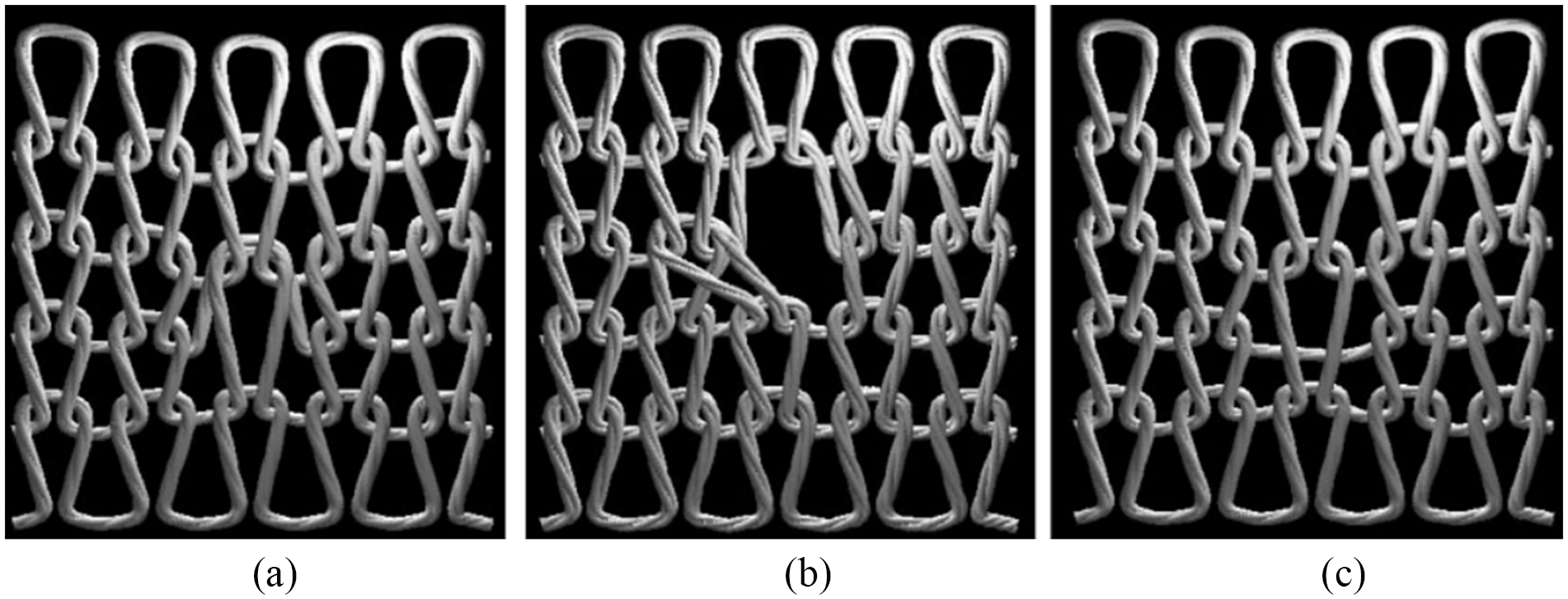
The weft knitted fabric simulation of fancy structures: (a) tuck, (b) loop transfer, and (c) float. 23
Physical model based on finite element analyses (FEA)
The FEA is a numerical method to solve the problems of engineering and mathematical physics, which is used to solve the typical problems in the field of mathematics and related engineering. Because the FEA can easily simulate the structure of irregular objects,44,45 it is applied to the fabric simulation. Araujo et al. 46 built a 3-D loop model based on FEA. The average values of the mechanical properties are obtained with FEA and compared with the experimental ones. The 3-D FEA model has shown great value for the prediction of properties in the wale-wise direction, but requires a provision for introducing frictional forces into the model in order to be able to improve predictions, especially in the course-wise direction. To solve this problem, the symmetry structural unit cell is proposed based on the mechanical analysis of one-half of a loop. The use of the minimum possible structural unit refers to the fastest computation of the mechanical parameters, without any distortion of the final results and without limiting the generalization of them. The precise and successful modeling of even one-unit cell requires a relatively big number of finite elements. Both wale-wise and course-wise directions of extension were considered. The stress-strain curves parallel to the wale-wise and course-wise directions for a given knitted fabric were simulated by FEA method and compared with the experimental results. The results showed that the stress-strain curve obtained from simulating method is very close to the experimental one, as depicted in Figure 10. 47 Based on their methods, Vassiliadis et al. 48 introduced FEA for reflecting the anisotropic properties of the yarns in mechanical modeling of fabrics. The modeling of the yarns as homogenous cylinders simplifies the representation of the yarn structure. However, it produces realistic results only when the material of the cylinders is considered as transverse isotropic. The different elastic properties along the yarn axis direction and the radius direction can describe the non-homogenous behaviors of the yarn. Wang and Hu 49 simulate the tensile deformation behavior of an auxetic warp-knitted spacer fabric structure by using the finite element method. The geometrical models were meshed using the PLANE 183 element to build finite element models. In order to explore the unique mechanical properties of knitted textiles, Wadekar et al. 50 have developed a yarn-level model for weft-knitted fabrics which can be used in FEA simulations. The model is optimized to avoid inter-penetrations while minimizing curvature and maintaining the length of the yarns. In the calculating context, define a single “cost” function that captures the various required features of the final geometric model. In this way, the minimum function evaluation that produces the required geometric model is specified, which means the cost of consumption is reduced. The FEA showed that the simulated fabric deformations behaviors at different tensile strains were very close to the real fabric deformations.
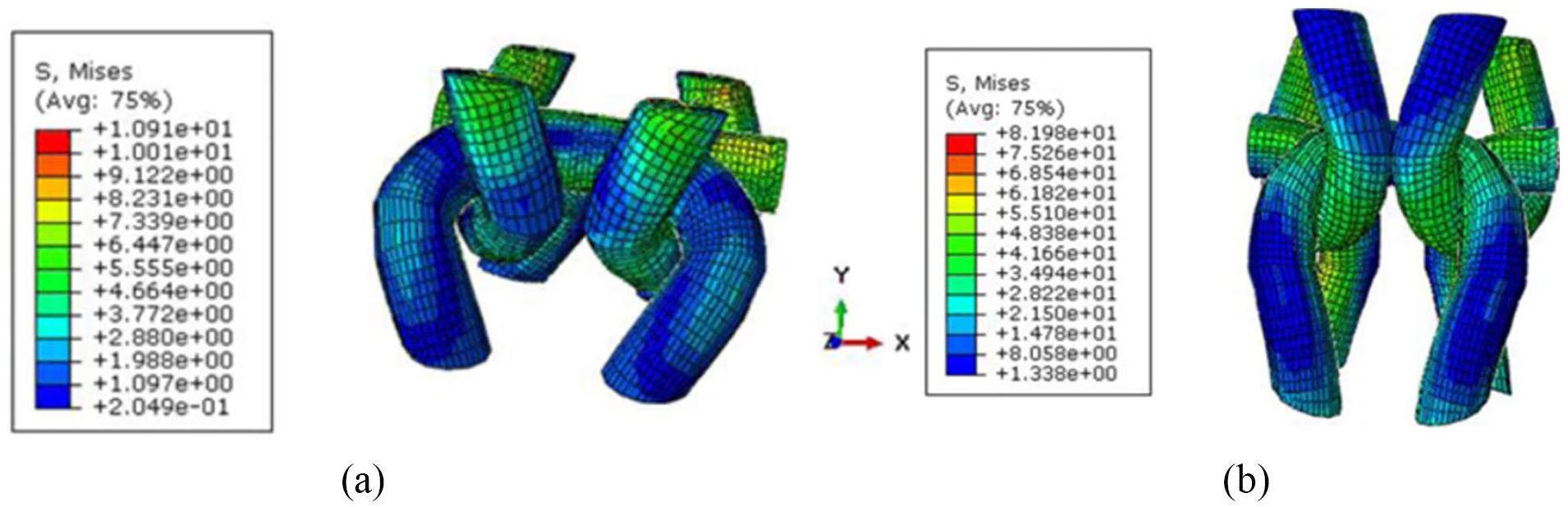
Typical stress distribution in a meshed fabric unit-cell under (a) wale-wise loading of model in low strain and (b) wale-wise loading of model in high strain. 47
Conclusion
With the development of the textile industry and the computer field, weft knitted products have been widely applied in different fields, which promotes the development of functional materials three-dimensional simulation technology of weft knitted fabrics. Further research on the three-dimensional simulation technology of weft knitted fabrics is an inevitable trend in the development of the textile industry and the computer field. There are three main aspects in the development trend of 3-D simulation of knitted fabrics:
Simulation methods physicalize
The three-dimensional simulation of static weft knitted fabrics has been developed to a certain extent, and both producers and consumers hope to help completing the production and purchase by obtaining the dynamic simulation effect of weft knitted fabrics. Moreover, the rapid development of computer technology has made the 3-D simulation of weft-knitted fabrics less limited by the time required for simulation, which means that researchers can achieve 3-D simulation of weft-knitted fabrics with more precise and complicated methods. 3-D physical simulation, which provides a good environment for dynamic 3-D simulation of weft knitted fabrics, will be more widely applied in industry. Using the dynamic simulation method, the simulated weft knitted fabric not only has a static 3-D effect, but also has the dynamic effect of changing the shape of the loops after the loops are forced, and exhibits the physical properties of the fabric.
Diversified loop structure types
Loops in weft-knitted fabrics have a variety of structures, in which different combinations of stitches generate multiple effects. Due to the flexible and variable of stitches combination, they can form a variety of complex structures. However, most of the research on stitch simulation still stays in the basic phases. Fancy stitches are ubiquitous in actual production and application. Fabric designers need to have a real simulation view as a reference when designing the fabric structure, which not only improves production efficiency but also saves design cost. Therefore, 3-D simulation of fancy stitches in weft knitted fabric are also requires further research.
Diversification of applications
At present, the research on the 3-D simulation of weft knitted fabrics mainly focuses on the establishment of loop models. The 3-D structure of the weft knitted fabric is realized by mathematical methods and computer technology. However, with the continuous improvement of the technical of weft-knitted fabrics and its wide application, the simple 3-D simulation of fabric cannot satisfy the needs of the entire industry. Due to the structural advantages and aesthetics, weft-knitted fabrics are widely used in industrial, home textile, industrial, aerospace and garment et al. The 3-D simulation of weft-knitted fabrics can provide a beneficial auxiliary effect. With the 3-D simulation of weft knitted fabrics, it is possible to effectively reduce the sample of the product and display the simulated fabrics and garments. Therefore, the three-dimensional simulation of weft knitted fabrics needs to be widely used in the field of knitting products.
Footnotes
Declaration of conflicting interests
The author(s) declared no potential conflicts of interest with respect to the research, authorship, and/or publication of this article.
Funding
The author(s) disclosed receipt of the following financial support for the research, authorship, and/or publication of this article: This work was supported by the National Natural Science Foundation of China (No. 61802285), the Scientific Research Project of Hubei Provincial Department of Education (No. D20201704), Hubei Province Technical Innovation Special Project (2019AAA005), the Chutian Scholar Program of Hubei Province, the Open Project Program of Key Laboratory of Eco-textiles, Ministry of Education, Jiangnan University (No. KLET1702 and KLET1704), the Open Project Program of Costume Art and Culture Research Center of Hubei Province (No. 2018HFG003), the Open Project Program of Fujian Key Laboratory of Novel Functional Textile Fibers and Materials, Minjiang University (No. FKLTFM1813), the Open Project Program of Engineering Research Center of Textile and Clothing (Minjiang University), Fujian Province University (No. MJFZ18103) and the Open Project Program of Engineering Research Center of Hubei Province for Clothing Information (No. 184084006).
