



Abstract
The present work aims at investigating the effect of applying different dyeing sequences on the imparted functional properties to partially hydrolysed and bleached PET and PET/CO fabrics loaded with TiO2, ZnO and SnO2 nanoparticles (NPs). The so obtained dyed fabrics have been characterized using SEM, EDX and FT-IR analytical techniques. The obtained results revealed that, an interaction has taken place between COOH groups created on dyed polyester fabrics and each of the applied NPs. Moreover, the effect of loading and sequence of dyeing wet operation on the functional performances of polyester fabrics was evaluated by estimating its antimicrobial efficacy and ultraviolet protection properties. The antimicrobial activity was tested against B. mycoides, E. coli and C. albicans. It has been found that, loading polyester fabrics with TiO2 and ZnO during dyeing process using exhaustion or after dyeing using pad-dry-cure methods paves the way for imparting outstanding antimicrobial activity even after five washing cycles. Moreover, the obtained results have also reviled that, the UPF values are dependent on the sequences of the loading of abovementioed NPs during or after dyeing wet operation.
Keywords
Introduction
In spite of the considerable properties of polyester fibres, which are superior in many ways to natural fibres, they also have some disadvantages (low hydrophilicity, not easily dyeable poor antistatic properties).
Recently, the nano-metal oxides TiO2, ZnO and SnO2 are one of the most important materials widely used in the functional finishing of PET fabrics for imparting new desirable properties.1–15 Antimicrobial,1–4 UV protection,5–12 self-cleaning13,14 and antistatic finish 15 finishing are among these imparted properties.
Most of these finishing methods depend on the activation of the surface of PET fabrics by creation of functional groups able to react with NPs. PET and PET/CO blended fabrics have been treated by Shalaby et al.3,11 with TiO2 and ZnO nanoparticles after surface activation of the fabrics by chemical and physical methods. It was found that, such activation facilitated imparting high antimicrobial and UV protection properties to the abovementioned fabrics.
It is important to emphasize that, the abovementioned properties were imparted to PET activated fabrics on libratory scale. At the same time technological and economic factors necessities carrying out such modifications on the wet processing operations line for fabrics. This can be achieved only after studying the effect of wet processing operations on the functional properties to PET and PET/CO blend fabrics loaded with different metal oxides nanoparticles.
Recently, Shalaby et al. 16 have investigate the effect of finishing on the properties imparted to bleached PET fabrics loaded with TiO2, ZnO and SnO2 NPs. This study is a part of an going research project aimed at investigating the effect of wet processing operations on functional properties imparted to PET fabrics loaded with different metal oxides nanoparticles. It has been found that, loading fabrics with NPs during or after carrying out final finishing process leads to imparting outstanding antimicrobial activity. Moreover, the obtained results revealed that, the sequence of loading the applied NPs before or during or after carrying finishing wet operation highly affect the UPF values.
Based on the abovementioed the present article is the second part of the abovementioned research aims at investigating the affect of the different sequences of dyeing wet process on the functional properties imparted to PET and PET/Co blended fabrics loaded with TiO2, ZnO and SnO2 nanoparticles.
Experimental
Materials
PET (100%) and PET/CO blended (50/50) partially hydrolysed and bleached woven fabrics (PET→H→B and PET/CO→H→B) were used throughout this study. PET and PET/CO fabrics were kindly supplied by local Egyptian textile companies. These fabrics were partially hydrolysed using the method described by Shalaby et al. 17 Its carboxylic content (10.9 and 22.4 meq/100 g fabrics) respectively were determined according to the method listed in Daul et al. 18
Chemicals
TiO2, ZnO nano – emulsions and SnO2 nano – powder (<100 nm) were purchased from Sigma-Aldrich.
Sodium hydroxide, Sedco finish SMA and nonionic detergent (dispersant agent) were purchased from Fluka and have been used as received.
Microorganisms Bacillus mycoides (Gram – positive bacterium), Escherichia coli (Gram – negative bacterium) and Candida albicans (nonfilamentous fungus) were used for estimation of antimicrobial potency of parent and treated samples. Microorganisms were obtained from the culture collection of the Department of Microbial Chemistry, Division of Genetic Engineering and Biotechnology, National Research Centre of Egypt.
Modified nutrient agar medium was used and is composed of the following ingredients (g/l): peptone (10.0), beef extract (5.0), NaCl (5.0) and agar (20.0). The pH was adjusted to 6.8. This medium was sterilized for 20 min at 121°C under pressure.
Disperse dye (Dianix Red CC Disperse), and reduction clearing agent (Sodium Hydrosulfite 1.0 g/l and Sodium Hydroxide 3.0 g/l), were kindly supplied by Misr Elbida company. Dispersing agent was purchased from Fluka and has been used as received.
Reactive dye (Dianix Yellow E-3GL) and soaping agent (Sera Fast), were kindly supplied by Dye Star company. Acetic acid, Dispersing agent, Sodium acetate, Sodium carbonate, non anionic agent, Sodium sulphate and sodium sulfite were purchased from Fluka and have been used as received.
Methods
Preparation of metal oxides NPs
0.5 g of metal oxides (TiO2, ZnO, SnO2) NPs (<100 nm) were added in 1.0 l of distilled water and subjected to sonication for 30 min at room temperature. Nonionic detergent was used as emulsifying agent to enhance the stability of the emulsion.
Loading PET bleached fabrics with metal oxides NPs
PET→H→B and PET/CO→H→B fabrics have been immersed in metal oxides NPs colloidal solution prepared according to the abovementioned method (method 1). PET and PET/C fabrics samples were squeezed to pick-up 75% increase, dried at 100°C for 60 min and then cured at 150°C for 10 min in case of loading with TiO2 and ZnO and at 130°C for 5 min in case of loading with SnO2. The loaded samples were then washed with distilled water to remove NPs that did not attach to the fabrics surfaces. In order to evaluate NPs adhesion to PET textiles, the loaded fabrics were repeatedly washed five washing cycles according to the standard AATCC test method (61-1989).

Dyeing of PET fabrics
Dyeing of PET fabrics was carried out using a high temperature high pressure laboratory dyeing machine (scheme 1). The required shade of disperse dye (2.0%) was placed in stainless-steel bowls and the pH of the dye aqueous solution was adjusted to 5.0–5.5. PET samples were immersed in the solutions, and the sealed bowls were rotated in a closed bath containing ethylene glycol at 130°C. The material to liquor ratio was 20:1. The bath temperature increased at rate of 2°C/min. After the predetermined duration (60 min), the samples were removed from the bath, then thoroughly rinsed and washed in a washing bath containing 1.0 g/l sodium sulfite and 3.0 g/l sodium hydroxide (reduction clearing) for 20 min at 70°C and finally rinsed in hot and cold water and dried in air (JIS-1998 Dyeing).


Dyeing Method of PET Component.
Dyeing of fabrics treated with metal oxides NPs
The dyeing of PET→H→B→ (TiO2 or ZnO or SnO2) NPs fabrics with disperse dye was carried out using the abovementioned method (No. 3).

Dyeing of PET fabrics at the same time of treatment with metal oxides NPs
The treatment of PET fabrics with metal oxides NPs was carried out using the abovementioned method (No. 2). The required amount of NPs were added in stainless – Steel bowls during dyeing PET with disperse dye.

Dyeing of PET fabrics followed by treatment with metal oxides NPs
PET→H→B→D fabrics have been immersed in metal oxide NPs colloidal solution prepared as mentioned before. PET fabric samples were treated according to the method (No. 2).

Dyeing of PET/CO blended fabrics
PET/CO Blended fabrics were dyed in two steps. First step: Dyeing PET component was carried out using the same method mentioned before (No. 3). Second: Dyeing of cotton component was carried out using method described in scheme 2.


Dyeing Method of Cotton Component.
Dyeing of PET/CO fabrics treated with metal oxides before dyeing
The dyeing of PET/CO→H→B→ (TiO2 or ZnO or SnO2) NPs fabrics with disperse and reactive dyes was carried out using the method No. 3 and scheme 2.

Dyeing of PET/CO fabrics at the same time of treatment with metal oxides NPs
The treatment of PET/CO→H→B fabric with metal oxides NPS was carried out using method described in scheme 2. The required amount of NP were added in stainless – Steel bowls as follows: (a) During dyeing PET/CO fabrics with reactive dye and (b) During dyeing with both disperse and reactive dyes
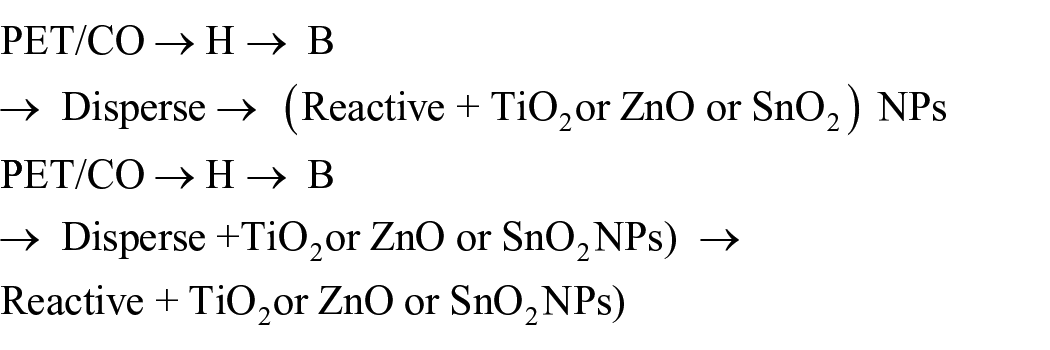
Dyeing of PET/CO fabrics followed by treatment with metal oxides NPs
PET/CO→H→B→Disperse→Reactive fabrics have been immersed in metal oxide NPs colloidal solution prepared as mentioned before (method No. 1). Then the samples were treated according to the method No. 2.

Analysis
Carboxylic content
Carboxylic content was determined according to the method described by Daul et al. 18
Antimicrobial activity
Antimicrobial activity of PET→H→B and PET/CO→H→B fabrics loaded with metal oxides NPs was quantified using shake flask method. In this method the antimicrobial activity of immobilized antimicrobial agents is determined under dynamic contact conditions according to ASTM standard test method 2143 (2001).
Scan electron microscope (SEM)
Fabrics morphology was characterized by scanning electron microscope (SEM) (JEOL Model TSM T20).
Energy dispersive X-ray (EDX)
Energy Dispersive X-Ray (EDX) mode was applied for the elemental composition analysis. Gold layer was deposited on the samples before analysis.
Fourier transformation infrared (FT-IR)
The chemical structure was determined using the Fourier transformation infrared (FT-IR) spectrometer, model NEXUS 670, NICOLET USA. The measurements were carried in the spectral range from 4000 to 500 cm−1. Reflection percentage measurement technique was applied (R%). All investigated samples have the same area and weight.
Ultraviolet protection factor (UPF)
Ultraviolet Protection Factor (UPF) was determined using UV- Shimadzy 3101 P C spectrophotometer. It is a double beam direct ratio measuring system. It consists of the photometer unit and a PC computer. UPF factor was determined according to the method described in Australian/New Zealand standard AS/NZS 4399: 1996. UPF values were calculated automatically and classified according to Table 1.
Protection and classification according to AS/NZS 4399:1966.

Results and discussion
As we have mentioned before, the present study aims at clarification of the effect of wet processing operations on the valuable functional properties of PET fabrics gained after loading it with metal oxide nanoparticles. These studies will pave the way for the proper design of the technological process on the wet process line and therefore decrease the cost of modification.
The effect of the sequences of loading with various types of NPs with dyeing wet process operation on the properties of bleached, partially hydrolysed and dyed polyester fabrics have been carried out as follows:
1. PET→H→B and PET/CO→H→B were separately immersed in TiO2, ZnO and SnO2 NPs emulsion squeezed at 75% pick up increase, dried at 100°C for 60 min and cured at 150°C for 10 min. The loaded samples were then washed with distilled water to remove NPs that did not attach to the fabrics surfaces. The samples were dyed and evaluated (loading before dyeing).

2. Each of PET→H→B and PET/CO→H→B fabrics were treated in a bath containing at the same time the dye and each of TiO2, ZnO and SnO2 NPs emulsions. The fabrics were then treated according to the same sequence and conditions used in experimental part (loading during dyeing).

3. PET→H →B→D and PET/CO→H→B→D were separately immersed in TiO2, ZnO and SnO2 NPs emulsions, squeezed to 75% pick up increase, dried at dried at 100°C for 60 min and cured at 150°C for 10 min. The loaded fabrics were then washed with distilled water to remove NPs that did not attach to the fabrics surfaces. The samples were then dried and finally evaluated (loading after dyeing).

In order to evaluate NPs adhesion to PET textiles, the loaded fabrics were repeatedly washed five washing cycles according to the standard AATCC test method (61-1989).
Characterization of fabrics loaded with TiO2 or ZnO or SnO2 NPs and dyed at different conditions
Characterization of PET→B→H→D and PET/CO→B→H→D Fabrics Loaded with TiO2, ZnO and SnO2 NPs at different conditions. We have mentioned before that, the present work aims to clarify the effect of dyeing wet operation on the functional properties imparted to partially hydrolysed, bleached, dyed and loaded with different NPs polyester fabrics. Therefore, to confirm that the reaction has actually taken place between carboxylic groups formed on polyester fabrics and each of the used NPs, characterization of the so dyed fabrics seems to be of great importance. This was carried out through Energy Dispersive X-Ray (EDX), Scanning Electron Microscope (SEM) and FT-IR measurements.
Energy dispersive X-ray (EDX) and SEM
EDX and SEM analysis performed in EDX mode was used to confirm the presence of the applied TiO2, ZnO and SnO2 NPs on the polyester fabrics, following the washing step, are shown in Figures 1 and 2. The obtained results confirm the existence of metallic Ti, Zn and Sn, irrespective of the mode and sequences of carrying out loading and dyeing operations.

SEM and EDX micrographs of bleached, partially hydrolysed and dyed PET fabrics loaded with TiO2, ZnO and SnO2 NPs* (X 2000): (a) PET→H→B→D (blank), (b) PET→H→B→Dis→TiO2 (pad−dry−cure), (c) PET→H→B→[Dis.+ TiO2] (exhaustion), (d) PET→H→B→Dis→ZnO (pad−dry−cure), (e) PET→H→B→D [Dis.+ ZnO] (exhaustion), (f) PET→H→B→Dis→SnO2 (pad−dry−cure) and (g) PET→H→B→D [Dis.+ SnO2] (exhaustion).

SEM and EDX micrographs of bleached, partially hydrolysed and dyed and PET/C blended.
It was found that the fabrics still contain Ti, Zn and Sn even after five standard washing cycles (Tables 2 and 3). Data listed in Tables 2 and 3 also reveal higher Zn and Sn contents on PET→H→B→D and PET/CO→H→B→D fabrics. Based on the abovementioned, one can conclude that the dyeing wet operation has no effect on the interaction between the COOH groups and the metal oxides NPs.
Ti, Zn and Sn content on the surface of partially hydrolysed, bleached and dyed PET blended fabrics loaded with TiO2, ZnO and SnO2 NPs.

H: hydrolysed; B: bleached; D: dyed; Dis.: disperse dye.
Treatment conditions:
Pad−dry–cure method.
[TiO2] and [ZnO], 0.5%; Curing temperature, 150°C; Curing time, 10 min.
[SnO2], 0.5%; Curing temperature, 130°C; Curing time, 5 min.
Disperse dyeing conditions:
Dianix green CC; [Shade], 2.0%; pH = 5.5; Temperature, 130°C; Duration, 60 min, M:L, 1:20.
After one and five washing cycles; AATCC test method (61-1989).
Ti, Zn and Sn content on the surfaces of partially hydrolysed, bleached and dyed PET/C blended fabrics loaded with TiO2, ZnO and SnO2 NPs.

H: hydrolysed; B: bleached; D: dyed; Dis.: disperse dye; Reac.: reactive dye
Treatment conditions:
Pad−dry–cure method.
[TiO2] and [ZnO], 0.5%; Curing temperature, 150°C; Curing time, 10 min.
[SnO2], 0.5%; Curing temperature, 130°C; Curing Time, 5 min.
Disperse dyeing conditions:
Dianix royel blue CC; [shade], 2.0%; pH = 5.5; Temperature, 130°C; Duration, 60 min, M:L, 1:20.
Reactive dyeing conditions:
Prosion red HE 7B; [Shade], 2.0%; pH = 5.5; Temperature, 70°C; Duration, 60 min; Sodium carbonate, 15.0 g/l, Sodium chloride, 80.0 g/l; M:L, 1:20.
After one and five washing cycles; AATCC test method (61-1989).
Scan Electron Microscope (SEM) The surface topography of PET→H→B→D and PET/CO→H→B→D fabrics loaded with metal oxides NPs and dyed was investigated using SEM technique. The obtained results (Figures 1 and 2) reveal the following:
PET→H→B→D and PET/CO→H→B→D fabrics are characterized by rough surfaces with pits (Figures 1 and 2(a)).
Treatment of PET→H→B→D and PET/CO→H→B→D fabrics with TiO2, ZnO, SnO2 NPs emulsions using pad-dry-cure method after dyeing wet operation leads to the formation of some precipitation on the surfaces (Figures 1 and 2(b–d)).
Carrying out the loading and dyeing operations at the same time leads to an increase of the thin layer formed on the surface. In addition to this, such treatment paves the way for filling the pits formed after partial hydrolysis with alkali (Figures 1 and 2(e–g)).
It is worth mentioning that, carrying out loading with metal oxide NPs during dyeing with exhaustion or after dyeing wet operation with pad-dry-cure method leads to get fabrics with more homogeneous and smooth fabric surfaces. The abovementioned changes which took place on the surface topography of PET→H→B→D and PET/CO→H→B→D fabrics loaded with TiO2, ZnO and SnO2 NPs are a direct indication that these NPs are attached to the fabric surfaces.
Fourier transformation infrared (FT-IR)
Data in Tables 4 and 5 show the effect of dyeing wet operation on FT-IR absorption bands of functional groups in bleached, partially hydrolysed and dyed polyester fabrics loaded with different metal oxides NPs. Based on these data one can conclude the following:
The loading of dyed fabrics PET→H→B→D and PET/CO→H→B→D with NPs is affected on the absorption bands positions and the intensities of the carbonyl and hydroxyl groups, irrespective of the loading position with the above mentioned NPs during or after the dyeing wet operation (Tables 4 and 5).
Data listed in Tables 4 and 5, also indicate that, loading PET→H→B→D and PET/CO→H→B→D with TiO2 NPs, during or after carrying out the dyeing operation leads to a decrease in the intensities of these groups. The FT-IR spectra of all fabrics dyed and loaded with NPs show the appearance of new absorption bands in the range of 700–764 cm−1 which characterizes the formation of bonding (Ti-O-C) irrespective of the loading position of NPs (Tables 4 and 5) and type of loaded fabrics.
In the Case of Loading with ZnO NPs Results shown in Tables 4 and 5 reveal that, the absorption bands of carbonyl groups in all fabrics loaded with ZnO NPs changed its position from 1714.7 to 1737.7 cm−1 within PET fabric and from 1715.6 to 1736.6 cm−1. Contrary to this, the intensities of such groups have decreased specially in the case of fabrics loaded with ZnO NPs during or after dyeing operation (Tables 4 and 5). The same holds true in case of the positions and the intensities of the OH-groups. The FT-IR spectra of all fabrics loaded with ZnO NPs and dyed show the appearance of new absorption bands in the range of 629.6 cm−1 651.8 cm−1 which characterizes the formation of new bonding (Zn-O-C) irrespective of the position of loading NPs (Tables 4 and 5).
In the Case of Loading with SnO2 NPs It was found (Tables 4 and 5) that, the wave length of carbonyl groups in all fabrics loaded with SnO2 NPs did not change its position. On the contrary, this was accompanied with a decrease in the intensities of these groups reaching its maximum in the case of loading the PET fabrics after or during carrying out the dyeing operation. The same holds true in case of the position and the intensity of the OH¯ groups. Moreover, it was found that the maximum decrease in OH¯ group intensities takes place in case of loading fabrics with SnO2 during carrying out the dyeing operation. The FT-IR spectra of all fabrics loaded with SnO2 NPs and dyed confirm the appearance of new absorption bands in the range of 428.1 to 436.8 cm−1 which characterizes the formation of bonding (Sn-O-C) irrespective of the loading position of and type of treated fabrics SnO2 NPs. 16
Stemming from the abovementioned one can conclude that, the C=O and OH¯ groups are affected as a result of loading PET→H→B→D and PET/CO→H→B→D fabrics with metal oxides (TiO2, ZnO and SnO2 NPs). This happens irrespective of the nature of loaded NPs and the sequences of the loading process: during or after carrying out dyeing operation. In addition to this, the COO¯ groups, created on the fabrics surface after alkali treatment reacted with NPs forming a new chemical bond with such NPs. Similar findings have been reported.19,20
FT-IR absorption bands of partially hydrolysed, bleached and dyed PET fabrics loaded with TiO2, ZnO and SnO2 NPS*.

H: hydrolysed; B: bleached; D: dyed; Dis.: disperse dye
Treatment conditions:
Pad−dry–cure method.
[TiO2] and [ZnO], 0.5%; Curing temperature, 150°C; Curing time, 10 min.
[SnO2], 0.5%; CUring temperature, 130°C; Curing time, 5 min.
Disperse dyeing conditions:
Dianix green CC; [Shade], 2.0%; pH = 5.5 Temperature, 130°C; Duration, 60 min, M:L, 1:20.
After one washing cycle; AATCC test method (61-1989).
FT-IR absorption bands of partially hydrolysed, bleached and dyed PET/C blended fabrics loaded with TiO2, ZnO and SnO2 NPS*.

H: hydrolysed; B: bleached; D: dyed; dis.: disperse dye; Reac.: reactive dye.
Treatment conditions:
Pad−dry–cure method.
[TiO2] and [ZnO], 0.5%; Curing temperature, 150°C; Curing time, 10 min.
[SnO2], 0.5%; Curing temperature, 130°C; Curing Time, 5 min.
Disperse dyeing conditions:
Dianix royel blue CC; [Shade], 2.0%; pH = 5.5 Temperature, 130°C; Duration, 60 min, M:L, 1:20.
Reactive dyeing conditions:
Prosion red HE 7B; [Shade], 2.0%; pH = 5.5 Temperature, 70°C; Duration, 60 min; Sodium carbonate, 15.0 g/l, Sodium chloride, 80.0 g/l; M:L, 1:20.
After one washing cycle; AATCC test method (61-1989).
The functional performances of polyester fabrics
Antimicrobial activity
Antimicrobial activity of bleached, partially hydrolysed and dyed (PET→H→B→D and PET/CO→H→B→D) fabrics loaded with TiO2, ZnO and SnO2 NPs was evaluated by determining the reduction percentage of Gram-positive (Bacillus mycoides) – Gram-negative (Escherichia Coli), and nonfilamentous fungs (Candida albicans) bacteria using the shake flask method.
Data given in Tables 6 and 7 illustrate the effect of finishing, the sequences used for loading the fabrics with NPs and the repeating washing on the percentages of colony forming units (% CFU) reduction on the above mentioned fabrics. Based on the data given in Tables 6 and 7, one can conclude the following:
In general, the loading of TiO2, ZnO and SnO2 NPs on (PET→H→B→D and PET/CO→H→B→D) fabrics, led to the reduction of microbes on the surface of fabrics. This reduction depends on the nature of NPs, the sequences of loading and the resistance towards repeated washings.
It was found that the sequence of loading with the above mentioned NPs during dyeing wet processing operations for polyester fabrics plays a very important role. This conclusion is based on the following:
(a) The loading of TiO2 and ZnO NPs on PET fabrics before carrying out the dyeing operation also leads to imparting antimicrobial properties to a lesser extent compared with those obtained after loading during or after dyeing operation (Tables 6 and 7). (b) The loading of TiO2 and ZnO NPs using pad-dry-cure method after dyeing operation, led to obtaining polyester fabrics with 100% CFU reduction after one standard washing cycle with respect to the above mentioned three types of bacteria. It is worth mentioning that, the repeated washings of such fabrics did not cause a noticeable decrease in its ability for reduction of microbes. The data listed in Tables 6 and 7 illustrate that after five washing cycles, the fabrics still acquire excellent CFU reduction towards B.m and E.C. On the contrary, the application of SnO2 NPs did not cause any noticeable improvement in the antimicrobial activity of such fabrics in comparison with those obtained after loading with such NPs directly after alkali treatment.
Antimicrobial activity of partially hydrolysed, bleached and dyed PET fabrics loaded with TiO2, ZnO and SnO2NPs, determined by shake flask method.

H: hydrolysed; B: bleached; D: dyed; Dis: disperse dye.
Treatment conditions:
Pad−dry–cure method.
[TiO2] and [ZnO], 0.5%; Curing temperature, 150°C; Curing time, 10 min.
[SnO2], 0.5%; Curing temperature, 130°C; Curing time, 5 min.
Disperse dyeing conditions:
Dianix royel blue CC; [Shade], 2.0%; pH = 5.5 Temperature, 130°C; Duration, 60 min, M:L, 1:20.
After one and five washing cycles; AATCC test method (61-1989).
Antimicrobial activity of partially hydrolysed, bleached and dyed PET/C fabrics loaded with TiO2, ZnO and SnO2NPs, determined by shake flask method.

H: hydrolysed; B: bleached; D: dyed; Dis.: disperse dye; Reac.: reactive dye.
Treatment conditions:
Pad−dry–cure method.
[TiO2], [ZnO], 0.5%; Curing temperature, 150°C; Curing time, 10 min.
[SnO2], 0.5%; Curing Temperature, 130°C; Curing Time, 5 min.
Disperse dyeing conditions:
Dianix royel blue CC; [Shade], 2.0%; pH = 5.5 Temperature, 130°C; Duration, 60 min, M:L, 1:20.
Reactive dyeing conditions:
Prosion red HE 7B; [Shade], 2.0%; pH = 5.5 Temperature, 70°C; Duration, 60 min; Sodium carbonate, 15.0 g/l, Sodium chloride, 80.0 g/l; M:L, 1:20.
After one and five washing cycles; AATCC test method (61-1989).
Based on the above mentioned, we can conclude that, the best method for loading partially hydrolysed, bleached and dyed polyester fabrics with TiO2 and ZnO NPs for imparting high antimicrobial activity even after repeated washings should follow the sequence:
1- Bleaching; 2- Partial hydrolysis of fabrics using NaOH aqueous solutions; 3- dyeing polyester fabrics; 4- Loading partially hydrolysed, bleached and dyed polyester fabrics with TiO2 and ZnO during dyeing using exhaustion operation or after carrying dyeing process using pad-dry- cure method.
Ultraviolet protection
The effect of the sequences of finishing with TiO2, ZnO and SnO2 NPs on UV protection properties of bleached, partially hydrolysed and dyed polyester fabrics loaded was investigated. The obtained data listed in Tables 7 and 8 indicate the following:
In general TiO2 and ZnO NPs are able to impart bleached, partially hydrolysed and dyed polyester fabrics UV protection properties compared to unloaded ones. On the contrary, the loading with SnO2 NPs did not cause any noticeable improvement in such properties.
It was found that, the dyeing of (PET→H→B→D and PET/CO→H→B→D) fabrics was not accompanied with changing UPF rating after five washing cycles in comparison to the undyed fabrics.
The data in Tables 8 and 9 indicate that, the sequence of loading the applied NPs after, during or before carrying out the dyeing wet operation highly affect the UPF values of such fabrics as follows:
(a) Loading the fabrics with TiO2 NPs before, during or after dyeing wet operation leads to imparting PET fabrics good UV protection properties even after five standard washing cycles. The best result (UPF = very good) was obtained after loading TiO2 simultaneously during the dyeing wet operation. (b) Loading PET→H→B→D and PET/CO→H→B→D fabrics with ZnO and SnO2 NPs after, or during dyeing operation causes a substantial increase in UPF (UPF = Excellent) even after five washing cycles. (c) Based on the listed data in Tables 8 and 9, one can conclude that loading ZnO and SnO2 NPs during or after carrying the dyeing seems to be the ideal method for obtaining polyester fabrics with excellent UPF, even after five standard washing cycles.
Ultraviolet protection factor (UPF) of partially hydrolysed, bleached and dyed PET fabrics loaded with TiO2, ZnO and SnO2NPs.

H: hydrolysed; B: bleached; D: dyed; Dis: disperse dye.
Treatment conditions:
Pad−dry–cure method.
[TiO2] and [ZnO], 0.5%; Curing temperature, 150°C; Curing time, 10 min.
[SnO2], 0.5%; Curing temperature, 130°C; Curing Time, 5 min.
Disperse dyeing conditions:
Dianix royel blue CC; [Shade], 2.0%; pH = 5.5 Temperature, 130°C; Duration, 60 min, M:L, 1:20.
After one and five washing cycles; AATCC test method (61-1989).
Ultraviolet protection factor (UPF) of partially hydrolysed, bleached and dyed PET/C fabrics loaded with TiO2, ZnO and SnO2NPs.

H: hydrolysed; B: bleached; D: dyeing; Dis.: disperse dye; Reac.: reactive dye.
Treatment conditions:
Pad−dry–cure method.
[TiO2] and [ZnO], 0.5%; Curing temperature, 150°C; Curing time, 10 min.
[SnO2], 0.5%; Curing temperature, 130°C; Curing time, 5 min.
Disperse dyeing conditions:
Dianix royel blue CC; [Shade], 2.0%; pH = 5.5 temperature, 130°C; Duration, 60 min, M:L, 1:20.
Reactive dyeing conditions:
Prosion red HE 7B; [Shade], 2.0%; pH = 5.5 Temperature, 70°C; Duration, 60 min; Sodium carbonate, 15.0 g/l, Sodium chloride, 80.0 g/l; M:L, 1:20.
After five washing cycles; AATCC test method (61-1989).
Conclusion
The current study presents the effect of dyeing wet processing operation on the functional properties imparted to polyester fabrics loaded with different metal oxides nanoparticles. Characterization of PET and PET/CO dyed fabrics and loaded with TiO2, ZnO and SnO2 NPs was carried out through SEM, EDX and FT-IR. The obtained results reveal that, NPs are chemically bonded to polyester fabrics, and that, the dyeing wet operation has no effect on this interaction. The antimicrobial activity of loaded and dyed polyester fabrics was tested. It has been found that, loading fabrics with TiO2 and ZnO during or after carrying dyeing process paves the way for imparting outstanding antimicrobial activity even after five washing cycles, indicating their excellent laundering durability. It was also found that, the sequence of loading NPs after or during dyeing wet operation have a noticeable enhancement on the UPF values. According to the results discussed and presented above, one can conclude the feasibility of carrying out such modification on the wet processing line of polyester fabrics.
Footnotes
Declaration of conflicting interests
The author(s) declared no potential conflicts of interest with respect to the research, authorship, and/or publication of this article.
Funding
The author(s) received no financial support for the research, authorship, and/or publication of this article.
