




Abstract
Wheat gluten proteins are good raw materials for preparing fibers due to their excellent viscoelasticity. However, protein fibers made directly from wheat gluten have poor mechanical properties. In this paper, transglutaminase was used to induce the glycosylation reaction between wheat gluten proteins and carboxymethyl chitosan. The glycated proteins were then made into fibers by wet spinning. After glycosylation modification, the breaking strength and breaking elongation of the wheat gluten protein fibers (WGPF) improved by 43% and 127%, respectively. Fourier transform infrared spectroscopy and sodium dodecyl sulfate-polyacrylamide gel electrophoresis analyses revealed that the glycosylation-modified WGPF molecules contained saccharide portions, which confirms the covalent attachment of carboxymethyl chitosan to the wheat gluten protein. Scanning electron microscopy showed that the number of pores in the cross-section of the modified WGPF was lower than that in the unmodified WGPF. The thermal stability and dyeability of the modified WGPF were also improved.
Introduction
Synthetic fibers made from petrochemical materials are widely used in the textile industry due to their high breaking strength. However, these synthetic fibers also show some disadvantages, such as poor wearing comfort, biodegradation difficulty, and most importantly, limited petroleum resources. The application of alternative fibers made from more abundantly available, low-priced, and sustainable agricultural byproducts has therefore attracted substantial attention. Wheat gluten is a byproduct of the starch production process and has good properties for producing protein fibers, such as excellent elasticity, 1 water insolubility, thermoplasticity, biodegradability, 2 and low cost, which makes it competitive with materials derived from petroleum sources. However, the poor mechanical properties of protein fibers are the most common weakness restricting their application. Wheat proteins must therefore be modified using physical, chemical, or enzymatic methods to improve the fiber strength.
The glycosylation modification of proteins can improve their mechanical properties,3,4 thermal stability, 5 and even endow them with novel functionality. 6 Glycosylation includes the Maillard-type glycosylation and transglutaminase (TGase) glycosylation. Maillard-type glycosylation is actually a complex form of non-enzymatic browning, and shows some disadvantages, such as the formation of melanoidins 7 and harmful compounds, 8 as well as long reaction times. 9 TGase can induce the acyl transfer reaction in which the carboxyamide groups of peptide-bound glutamine residues act as acyl donors and the primary amines act as acyl acceptor. 10 In the presence of saccharides containing primary amines, TGase can induce protein glycosylation (i.e. conjugate the saccharide aminos to the protein glutamine residues). TGase-induced glycosylation is extensively used owing to its specificity, 11 safety, and high efficiency.
In addition to fiber mechanical properties, close attention is also paid to their dyeing properties. Fibers with inferior dyeing properties require longer dyeing times, higher dyeing temperatures, and most importantly, cause more dye residue in the wastewater. Several successful methods have been proposed to improve fiber dyeability, such as bio-protease treatment technology, low-temperature plasma technology, resin finishing, ultrasound, etc. 12 Kiumarsi and Parvinzadeh 13 confirmed that lipase treatment enhances the absorption of the acid and disperse dyes into the nylon 6 fibers. Mirjalili and Karimi 14 reported that the cold plasma treatment of polyester under nitrogen gas for 2 min increases the depletion of acid and disperse dyes in solution. Chirila et al. 15 studied the effect of gamma irradiation on the dyeing properties of fabrics and found that the dyeing properties of cotton fabrics are significantly improved by irradiation treatment at a dose of 40 kGy. However, some of these methods may induce negative changes to the physical, chemical, and mechanical properties of fibers.
The grafting of cationic groups (e.g. amino or ammonium groups) onto fibers can increase their interactions with anionic dyes and thus improve the fiber dyeing properties.16,17 Carboxymethyl chitosan is a water-soluble derivative of chitosan, which exhibits excellent water solubility, 18 biocompatibility, 19 antibacterial activity, 20 and adsorption capacity. 21 Because of carboxymethyl chitosan contains active amino, hydroxyl, and carboxyl groups in the molecule, it can provide enough adsorption groups for increasing the adsorption capacity toward dyes. 22 Hence, it is expected that the use of carboxymethyl chitosan as an acyl acceptor to incorporate wheat gluten proteins using TGase, so as to improve the dyeing properties of gluten protein fibers. However, this approach has not yet been reported and the properties of modified WGPF remain unknown.
In this paper, TGase and carboxymethyl chitosan were used to glycate wheat gluten protein, and the glycated proteins were then used to prepare fibers using wet spinning. Furthermore, The modified WGPF was structurally characterized by Fourier transform infrared spectroscopy (FT-IR), sodium dodecyl sulfate–polyacrylamide gel electrophoresis (SDS-PAGE), and scanning electron microscopy (SEM), and its mechanical properties, thermal properties, and dyeability were also investigated.
Materials and methods
Materials
Wheat flour was purchased from Yihai Kerry (Kunshan) Food Industry Co., Ltd. Carboxymethyl chitosan was purchased from Chengdu Ornris Chemical Reagent Co., Ltd. Transglutaminase was purchased from Jiangsu Yiming Biological Co., Ltd. with a measured activity of 100 units (U) per gram. C.I. Reactive Red 195 was purchased from Inspire Trading Company. The remaining reagents in this study were of analytical grade.
Experimental methods
Gluten modification
Wheat flour was mixed with distilled water in a mass ratio of 1.8:1 to form a smooth dough. After 20 min, the dough was washed with running water to remove starch and soluble material. Iodine solution was used to test whether or not the starch was completely removed from the gluten. The washing process was continued until the blue color disappeared. Five grams of wheat gluten were added to 45 mL of distilled water and the solution pH was adjusted to 12, then stirred for 3 h to achieve wheat gluten complete dissolution. The wheat gluten solution was mixed with 0.2 g of carboxymethyl chitosan and the pH of this mixture solution was then adjusted using 1 mol/L HCl to pH = 9. The reaction was started by adding 10 mg of TGase to the solution and carried out at 40°C for 40 min with continuous agitation. The reaction was then stopped by heating at 85°C for 5 min. The excess carboxymethyl chitosan was removed by dialysis. The pH of the solution was then adjusted to 7 and the solution was centrifuged at 3000 rpm for 20 min. The deposits were glycosylation-modified wheat gluten protein, which were washed three times with distilled water.
Fiber preparation
Protein fibers were prepared according to the method of Reddy and Yang 23 with some modifications. The unmodified gluten and glycosylation-modified gluten were dissolved with cysteine and 8 mol/L urea to prepare a spinning solution with a gluten concentration of 52% (w/w). The spinning solutions were then centrifuged (3000 rpm, 10 min) and allowed to stand for a moment. The fibers were extruded from the spinning solution into a coagulation bath consisting of 10% (w/w) ammonium sulfate and 10% (w/w) sulfuric acid using a disposable syringe and needle. The formed fibers were kept in the coagulation bath for 20 min and then rinsed in water and air-dried. The fibers were then dipped in warm water at 55°C and drawn by hand to approximately 1–2 times their original length. The fibers were dried in an oven at 85°C for 1 h and subsequently annealed at 125°C for 1 h.
FT-IR analysis
The WGPF (1.0 mg) samples were sheared and finely ground, mixed with KBr powder (100.0 mg), and then compressed into a pellet using a pelletizer. An IS10 Fourier transform infrared spectrometer (Nicolet, U.S.A.) was used to record the infrared absorption data in the range of 4000–400 cm−1 with a resolution of 4 cm−1 and accumulation of 32 scans.
SDS-PAGE
SDS-PAGE was performed according to the method of Laemmli, 24 with some modifications, using a 5% stacking gel (pH 6.8) and 12% separating gel (pH 8.8). The fiber samples were sheared and ground to powder. Approximately 3 mg of protein fiber powder was dissolved in 1 mL of 2X loading buffer. The mixtures were subsequently boiled for 5 min in water and centrifuged at 10,000 rpm for 5 min before loading. The electrophoresis voltage of the stacking gel and separating gel was set to 80 and 120 V, respectively. Standard protein markers with molecular weights ranging from 14.4 to 97.4 kDa were purchased from Beijing Solarbio Science & Technology Co., Ltd. After electrophoresis, the gels were rinsed with distilled water and stained with Coomassie Brilliant Blue R-250 and periodic acid-Schiff (PAS) reagent, respectively. The gels were then photographed using a Bio-rad Gel Doz EZ imager.
SEM
A FEI Quanta 200 model SEM was used to observe the microscopic morphological characteristics of the fibers. The unmodified and glycosylation-modified fibers were mounted on conductive adhesive tape, sputter coated with gold–palladium, and observed on the SEM using a secondary electron detector and an accelerating voltage of 10.0 kV.
Thermogravimetric analysis (TGA)
A TGA2 instrument (Mettler Toledo) was used for thermogravimetric analysis. All of the fiber samples were ground to powder in an agate mortar and 2–3 mg of the protein fiber powders were placed in a crucible. Nitrogen was introduced at a flow rate of 50 mL/min and the temperature was gradually increased from room temperature to 550°C at a rate of 10°C/min.
Dyeing properties
For dyeing of the unmodified and glycosylation-modified WGPF, 2.5% (on weight of fabric) C.I. Reactive Red 195 was used at room temperature with a liquor ratio of 1:500. After dyeing, the dye exhaustion percentage (E%) of all samples was calculated by equation (1).

where A and B are the absorbance of the dye solutions before and after the dyeing process, respectively.
Mechanical properties
Before measurement, all of the fiber samples were equilibrated overnight in an environmental chamber with 65 ± 3% relative humidity at 20 ± 2°C. The mechanical properties (breaking strength and elongation at break) of the fibers were measured using a TA-XT Plus type texture analyzer. Breaking strength is corresponding to a maximum breaking load of fiber that can bear (expressed in units of cN/dtex), and elongation at break refers to the corresponding elongation of the fiber at the maximum breaking load. 25 An A/TG tensile probe was chosen with an initial clamping distance of 40 mm and tensile speed of 20 mm/min. Approximately 15 fibers were tested for each condition to obtain the average and standard error for the means.
Standard moisture regain
The standard moisture regain of the fibers were measured according to the American Society for Testing and Materials (ASTM) D 2654. 26 All of the fiber samples were first dried at 105°C for 4 h in an oven and subsequently weighed and recorded as G0. All of the fiber samples were then placed in a standard atmosphere of 21°C and 65% relative humidity for 24 h. The fibers were reweighed and recorded as G. The standard moisture regain (MR) was calculated using the following equation:

where G0 is the weight of dried fibers and G is the weight of fibers under standard atmospheric conditions. Each sample was tested three times and the results are reported as an average.
Results and discussion
FT-IR
FT-IR spectroscopy is a useful technique to study the relationship between molecular structure and infrared absorption, which can be effective in the analysis of structure characteristics. The FT-IR spectra of unmodified WGPF and glycosylation-modified WGPF are shown in Figure 1. It can be seen from the picture that the infrared spectroscopy of modified WGPF and unmodified WGPF are roughly analogous in pattern, but the absorption peak intensities differ. The absorption peak around 3600–3300 cm−1 is caused by N-H stretching and O-H deformation vibration, and the peak around 1150–1050 cm−1 is related to C-O stretching and -OH deformation vibrations. 27 Compared with the unmodified WGPF, the modified WGPF shows remarkably broader and stronger absorption in the region around 3600–3300 cm−1 and stronger absorption in the region around 1150–1050 cm−1, indicating higher -OH and -NH2 group content. This might be considered as evidence that the carboxymethyl chitosan was covalently linked to the wheat gluten protein during the modification, which would be confirmed by the SDS-PAGE analysis. These results are similar to those of Liu et al. 28 who reported that when silk peptide and carboxymethyl chitosan covalently bond, the absorption peak around 3432 cm−1 widens.
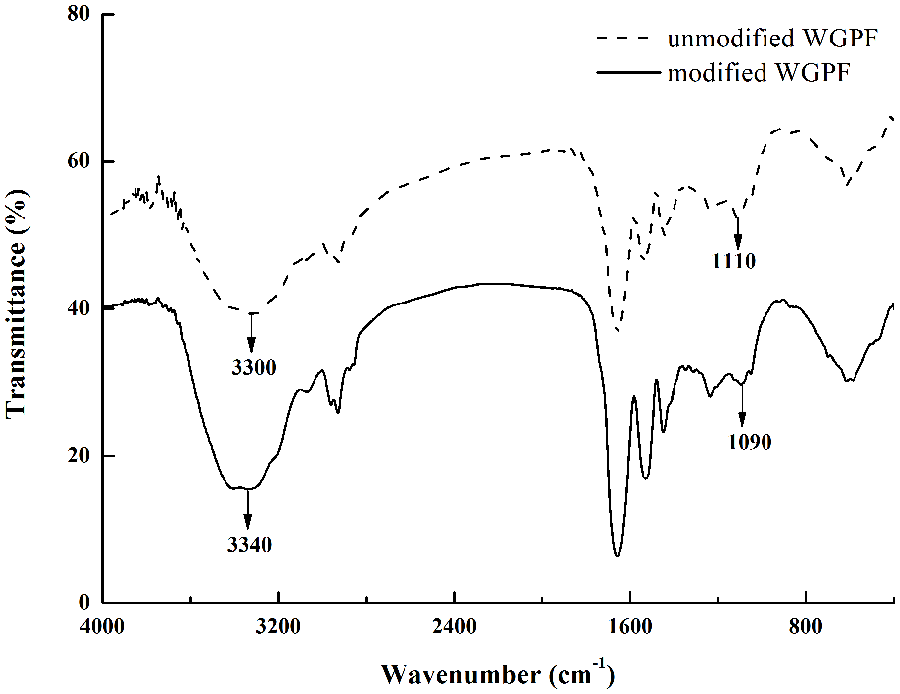
FT-IR spectra of unmodified WGPF and modified WGPF.
SDS-PAGE
SDS-PAGE analysis was performed to further confirm whether the modified WGPF contained carboxymethyl chitosan. The gels were stained with Coomassie Brilliant Blue (Figure 2(a)) and PAS (Figure 2(b)). Lanes M, 1, 2, and 3 represent the standard protein markers, unmodified WGPF, modified WGPF, and horseradish peroxidase, respectively. In Figure 2(a), the unmodified and modified WGPF have the same bands, but the band color on the top of the separating gel in the latter is darker. The low molecular weight (14.4 kDa) band color in the modified WGPF is also weaker, which means that compounds of higher molecular weight formed during the glycosylation modification. In Figure 2(b), horseradish peroxidase is a glycoprotein serving as a positive control. When the gels are stained by PAS reagent, the periodic acid oxidizes the carbohydrates to aldehydes, reacts with Schiff’s reagent, releases a pararosaniline adduct, and stains the glycol-containing proteins pink. 29 The results shown in Figure 2(b) reveal that the modified WGPF contains glycoprotein fractions because lane 2 shows a specific band at the top of the separating gel after PAS staining whereas lane 1 does not. These phenomena demonstrate that TGase induced the conjugation of carboxymethyl chitosan with wheat gluten proteins. Similar results were also reported by Akhtar and Dickinson 30 who showed that the whey protein isolate–dextran complexes generated by the Maillard reaction were too large to enter the gel and the pink band appeared on the top of the separating gel.

SDS-PAGE of the standard protein markers (M), unmodified WGPF (1), modified WGPF (2), and horseradish peroxidase (3): (a) Coomassie Brilliant Blue stain and (b) periodic acid-Schiff stain.
Surface and cross-section morphology of the fibers
SEM micrographs of the longitudinal appearance and cross-section of the unmodified and modified WGPF are shown in Figures 3 and 4. A prominent change in the microstructure of the modified WGPF is observed compared with the unmodified WGPF. The surface of the unmodified WGPF is rough with numerous grooves, whereas the modified WGPF shows fewer grooves on the surface. A comparison of the 3000× enlarged images (Figure 3(c) and (d)) shows that the modified WGPF has granular materials on the surface. As can be seen from the comparison of Figure 4(c) and (d), the cross-section of the unmodified WGPF shows many pores, whereas the modified WGPF shows few pores. Additionally, the pores in the cross-section of the unmodified WGPF are larger than that of the modified WGPF.
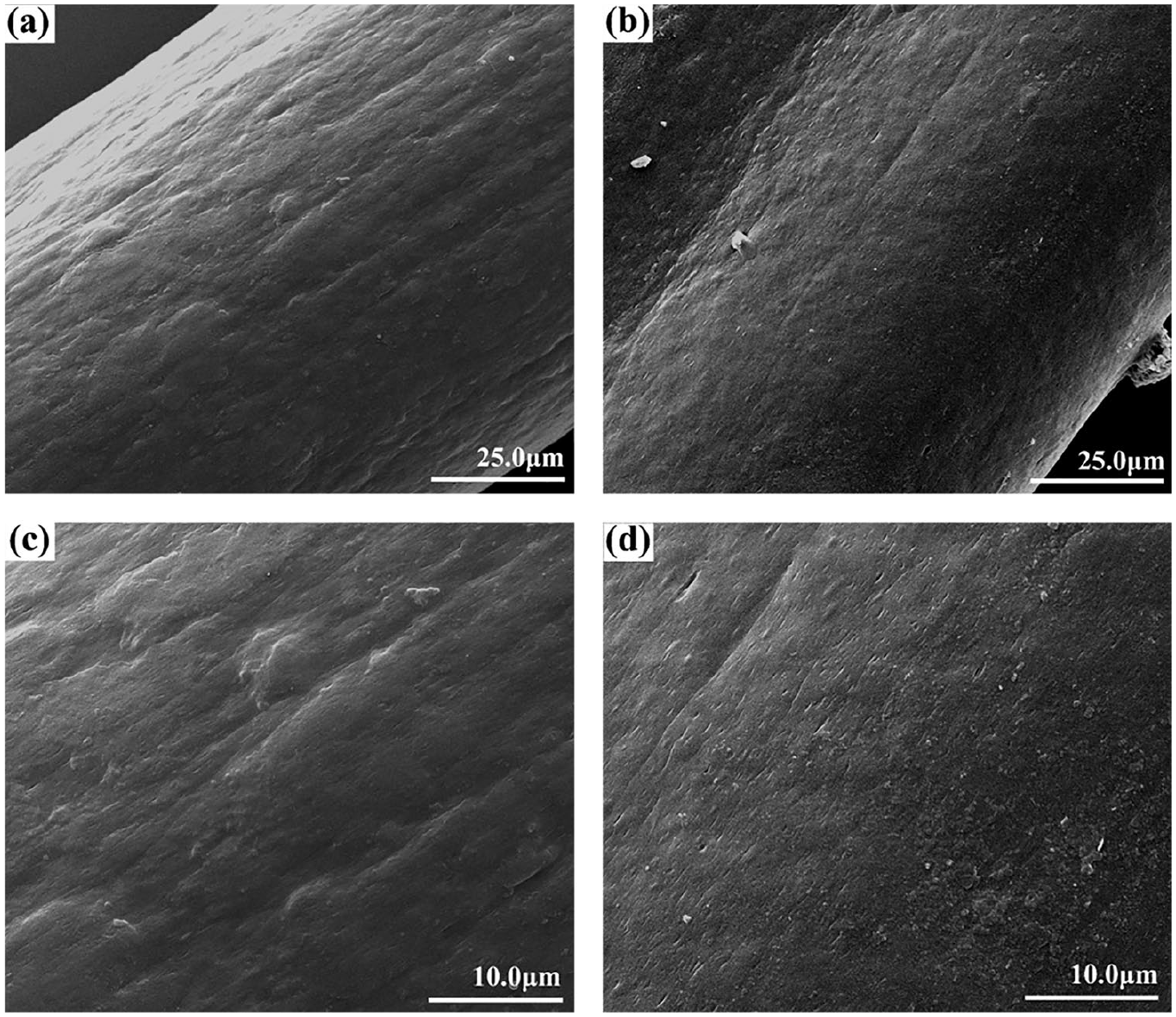
SEM images of the surface of different fibers: (a, c) are images of unmodified WGPF enlarged 1200 and 3000 times and (b, d) are images of modified WGPF enlarged 1200 and 3000 times (working distance = 12.6 mm).

SEM images of the cross-section of different fibers: (a, c) are images of unmodified WGPF enlarged 1200 and 3000 times and (b, d) are images of modified WGPF enlarged 1200 and 3000 times (working distance = 16.9 mm).
TGA
Thermogravimetric analysis curves for the unmodified and modified WGPF were plotted to analyze the fiber thermal stability (Figure 5(a)). The first weight loss reflected the removal of water between 30°C and 160°C. Above 250°C, the weight loss is mainly attributed to the thermal decomposition of the protein fraction. The DTG curves (Figure 5(b)) indicate maximum weight loss temperatures of 318.7°C and 324.3°C for the unmodified and modified WGPF, respectively. The residual amounts at 550°C for the unmodified and modified WGPF were 17.18% and 24.57%, respectively, which clearly indicates that the thermal stability of the modified WGPF is higher than the unmodified WGPF. These results are similar to those of Tang et al. 31 who found that the peak transition temperature and the initial denaturation temperature of the phaseolin were considerably increased by glycosylation modification.

(a) TGA and (b) derivative thermogravimetry (DTG) curves of the unmodified and modified WGPF.
Dyeing properties
To study the effect of glycosylation modification on the dyeing properties of protein fibers, the unmodified and modified WGPF were dyed with C.I. Reactive Red 195 at 25°C using different dyeing bath pH values. The dyeability of silk was also measured for comparison. Figures 6 and 7 show that the dye exhaustion percentage of the three fibers all increased with increasing time from 0 to 60 min. At pH = 4.5 (Figure 6), the dye exhaustion percentages of the unmodified and modified WGPF were 39.9% and 52.4% after dyeing for 60 min, respectively, whereas the silk showed a low dye exhaustion of 0.69%. When the pH of the dyeing bath was increased to 6.5 (Figure 7), the dye exhaustion percentages of the unmodified WGPF, modified WGPF, and silk were 23.9%, 36.6%, and 1.64%, respectively. Both WGPF samples exhibited higher dye absorption than silk at room temperature, while the modified WGPF clearly showed a greater dye uptake than the unmodified WGPF. This can be attributed to the increased number of free amine groups on the fiber surfaces after glycosylation modification, which enhances the interaction with anionic dyes. The WGPF samples showed lower dye exhaustion percentages at pH = 6.5 than pH = 4.5, mainly because of ion exchange reactions between the amino groups of the WGPF and carboxy group of the dye. The isoelectric point of the wheat gluten protein is approximately 5–7. At pH = 6.5, the gluten protein is relatively stable and the number of amino groups exposed to the positive charge is reduced, thus, the number of ionic bonds between the amino groups and dye molecules accordingly decreases. However, at pH = 4.5, more amino groups are exposed, thus, the dye exhaustion percentage of the WGPF increases. Figure 7 also shows that the modified WGPF dyed for 24 min exhibited nearly the same dye exhaustion percentage as the unmodified WGPF dyed for 60 min. When dyeing at pH = 4.5, the modified WGPF dyed for 17 min exhibited nearly the same dye exhaustion percentage as the unmodified WGPF dyed for 60 min. The modified WGPF therefore requires a shorter time to achieve the same dye exhaustion percentage as the unmodified WGPF, and the appreciable reduction in dyeing time could improve production efficiency.
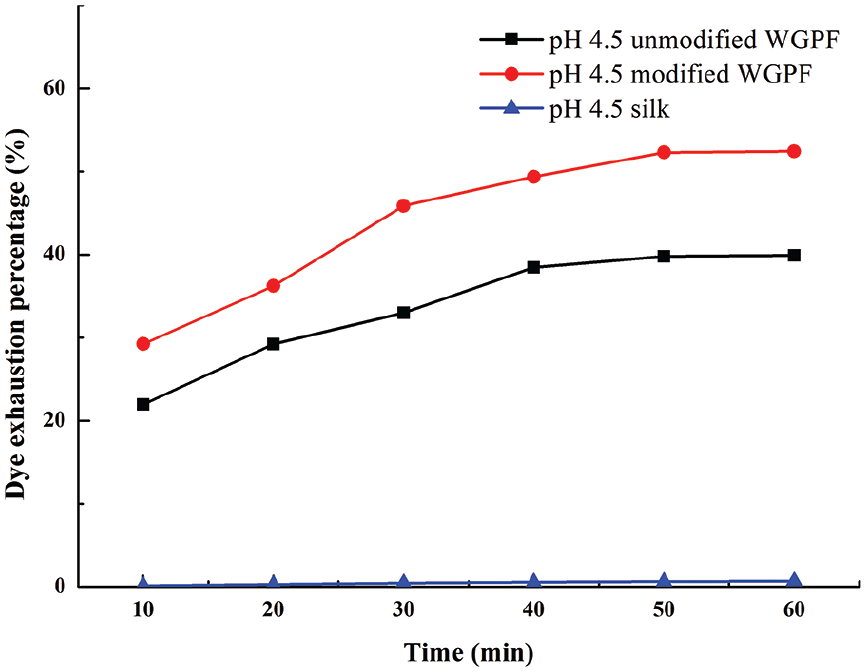
Rate of dye exhaustion of different fibers at pH 4.5.

Rate of dye exhaustion of different fibers at pH 6.5.
Mechanical properties and standard moisture regain
The breaking strength, breaking elongation, and standard moisture regain of the unmodified and modified WGPF are listed in Table 1. After glycosylation modification, the breaking strength of the WGPF significantly increased from 0.49 ± 0.02 cN/dtex to 0.70 ± 0.04 cN/dtex, and the elongation from 4.86 ± 0.38% to 11.01 ± 0.93%. The standard moisture regain of the unmodified and modified WGPF was 10.2 ± 0.5% and 11.06 ± 0.3%, respectively. This implies that the modified WGPF has better hygroscopicity, which is close to that of silk.
Mechanical properties and standard moisture regain of the different fibers.

Conclusion
This study shows that transglutaminase-induced carboxymethyl chitosan glycosylation is a promising method to improve the properties of protein fibers. Without using external crosslinking agents, the breaking strength and breaking elongation of the modified WGPF can reach 0.70 ± 0.04 cN/dtex and 11.01 ± 0.93%, respectively; an increase of 43% and 127% compared with unmodified fibers. The FT-IR and SDS-PAGE results demonstrate that TGase induces carboxymethyl chitosan incorporation into wheat gluten protein during the reaction. The TGA curves show that the modified WGPF has a higher thermal degradation temperature than the unmodified WGPF. Furthermore, amino and hydroxyl groups are introduced into the WGPF after glycosylation modification, which increases the adsorption capacity of the fibers to the dyes. The dyeing properties of the modified WGPF are therefore also improved compared with the unmodified WGPF.
Footnotes
Declaration of conflicting interests
The author(s) declared no potential conflicts of interest with respect to the research, authorship, and/or publication of this article.
Funding
The author(s) received no financial support for the research, authorship, and/or publication of this article.
