




Abstract
Eri silkworm is easy to be raised and has high cocoon yield, the cocoon fails to be continuously reeled due to a loose structure, a large part of cocoon coat and an eclosion hole. In this work, a fifth instar larvae of eri silkworm was provided with only a flat cocooning place to spin to produce a flat cocoon, it was fed with the castor leaves sprayed with nano-TiO2 and graphene oxide (GO), Compared with the flat cocoon obtained without nanomaterials, the silk was not found to change in morphology and structure significantly. Nanomaterials promoted the transformation of the random coil/α-helix conformation of the silk to the β-sheet conformation to a certain extent, which formed a stable crystallization. Thus its strength value could increase by 15%–17%, the ultraviolet protection factor (UPF) value of the flat cocoon with nanomaterials increased significantly, and the silk obtained made up for the lack of the strength in natural eri silkworm silk and poor resistance to sunlight. The flat cocoon features a stable structure, good formation, uniform thickness, and manual control. It can be directly used as raw material for processing flat textile products, which provides a feasible idea for the high-value utilization of the eri silkworm cocoon.
Keywords
Introduction
The eri silkworm is the third largest in the world, behind the mulberry silkworm and the tussah. It mainly feeds on castor leaves, cassava leaves, ailanthus altissima leaves, etc. Its cocooning cycle is generally 15–18 days, only about half of the cocooning cycle of the silkworm, but the volume and mass of the eri silkworm cocoon are 1.8 times and 1.3 times those of the mulberry silkworm cocoon, respectively.1–3 As shown in Figure 1, the eri silkworm cocoon is tapered at both ends, shaped like a jujube kernel and swollen in the middle with unequal sizes on both sides of the waist. Some eri silkworm cocoons are irregularly triangular, each with a closed tail and a small decocooning hole (eclosion hole) in the head. 4 The cocoon coat of the eri silkworm cocoon is thick and massive, accounting for about 1/3 of the weight of the cocoon shell. The cocoon layer is thin and soft, lacks elasticity, and is obviously delaminated.2,5 There is no obvious boundary between the cocoon layer and the cocoon coat, and the inner layer of the silkworm cocoon is tight.6,7 Due to its own structure, the eri silkworm cocoon is not suitable for continuous reeling, but is only used for silk spinning or used as filling material in a few areas, 8 the economic benefits are lower.
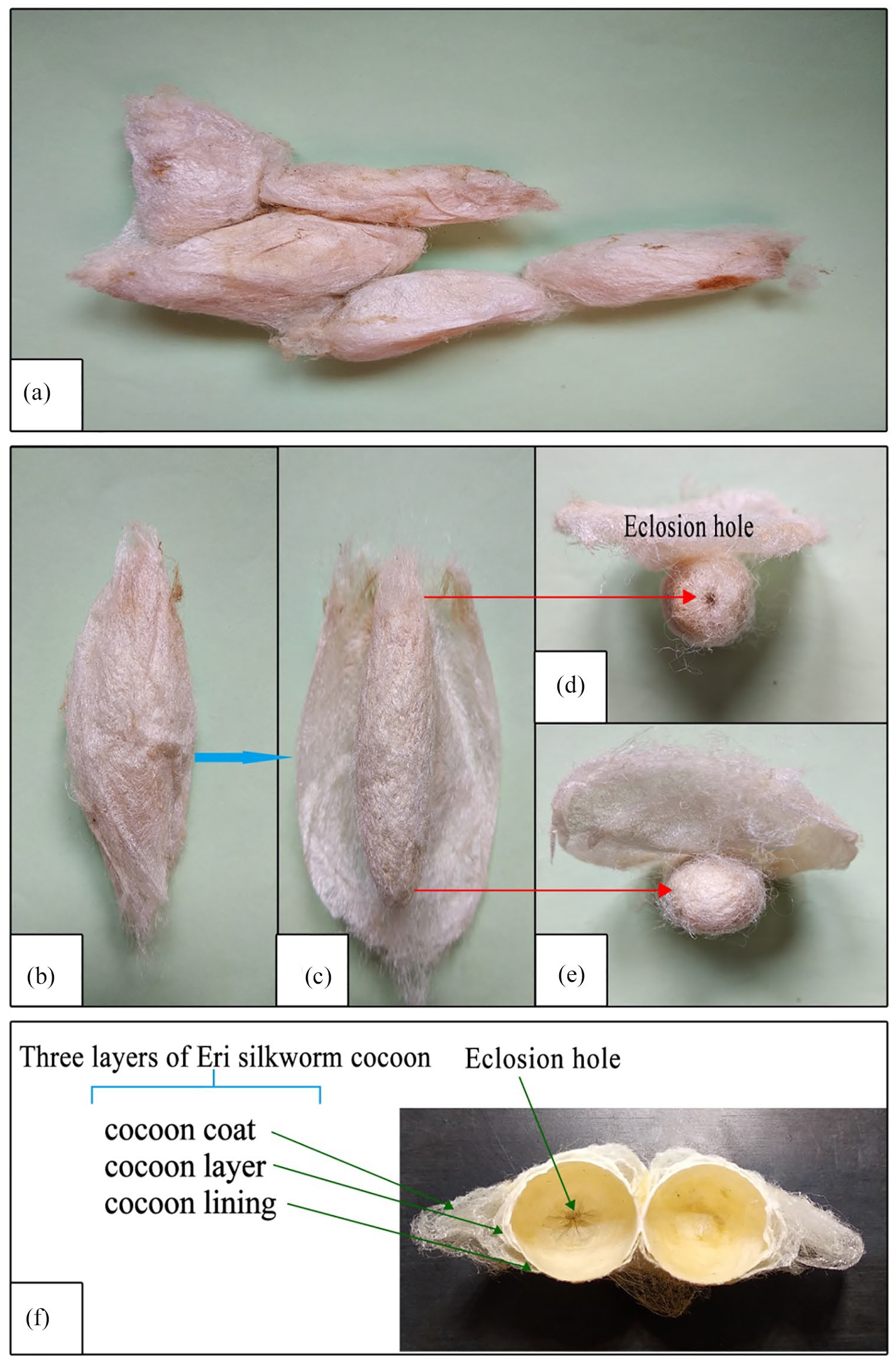
Digital images of eri silkworm cocoon: (a) morphology diversity of eri silkworm cocoon, (b) an intact eri silkworm cocoon, (c–e) cocoon after the outer most layer has been cut open, and (f) the three layers (cocoon coat, cocoon layer, and cocoon lining) and eclosion hole of the cocoon.
Eri silkworm silk is slightly lower than mulberry silk in strength, and the former is similar to the latter in terms of breaking elongation and acid resistance. 9 Wild silk itself is superior to cultivated silk in UV and antibacterial properties, with less significant effect, which limits its application field and large-scale promotion. Many scholars are devoted to the research of modified silk which is oriented to the domestic silkworm. Due to their unique properties, nanoparticles have been widely used in the modification of materials to improve the mechanical properties of the materials and increase their functionality.10–12 Among them, nano-titanium dioxide (TiO2) and graphene oxide (GO) have been widely researched and applied in terms of their advantages of easy availability of raw materials and unique properties. 13 At present, researchers usually blend nano materials with silk fibroin solution for regenerated spinning or film-forming,14,15 or use nano materials to carry out surface grafting modification of silk fabrics to improve the mechanical, antiUV and antibacterial properties of silk products.16,17 Pan et al. 18 mixed nano-TiO2 into the regenerated fibroin solution and obtained the regenerated silk with better toughness by dry spinning. Many researchers have also focused on the effect of nano-TiO2 on the UV resistance and anti-yellowing of silk fabrics.19–21 The nano-TiO2 with good dispersion was used to impregnate the silk fabric with sodium polyacrylate as the dispersant. The UV resistance and anti-yellowing of silk fabrics were enhanced, but the breaking strength and breaking elongation of the finished silk sample decreased.19,22–24 Li et al. 25 used surface modification technology to incorporate nano-TiO2 onto the surface of silk fabrics. The nanoparticles and silk substrate were connected by covalent bonds to form a stable composite system, which provided silk with significant anti-ultraviolet and antibacterial capabilities.25–27 GO not only shows excellent mechanical properties in composite materials, but also has relatively good biocompatibility. Its nano composites have become one of the hot spots of scholars from various countries.28–31 Some scholars studied the composite material formed by GO and silk fibroin and used silk fibroin and GO hydrogel to prepare a composite membrane material with a layered structure and excellent mechanical properties. 32 Most of these methods have the disadvantages of complex process, harsh conditions and easy to produce pollution. Rearing silkworms by adding functional materials is also a hotspot of silk modification research. At present, most of the materials are dyes. Thus it is easy to observe the results, and there are some related reports on adding other materials. Tansil et al.33,34 used mulberry leaves as feed and added a series of fluorescent dyes to produce colored and luminous filaments. Zhou et al. 35 fed silkworms with a red dye called “NO2 Red X,” which produced red silkworm cocoons, and the results showed that the dye had no effect on the quality of the cocoon, and the red color did not fade away easily. The method for rearing silkworms by adding materials to their food is simple and environmentally friendly, and has a broad industrialization prospect.36–39
This paper will take the eri silkworm as the research object. Nano TiO2 and GO are mixed into the castor leaves separately or together, which are absorbed and transformed by the eri silkworm itself to produce modified natural silk with a stable combination, excellent mechanical properties and anti-ultraviolet functionality and at the same time eri silkworm was provided with only a flat cocooning place to spin, which changes the spinning path of the eri silkworm to produce the flat cocoon material that can be directly used as a raw material for processing flat textile products to make up for the structural limitations of the cocoon itself to its industrial development. It provides a new idea for the direct high-value application of eri silkworm cocoon material, and speeds up the process of its industrial utilization.
Experimental
Materials
The experimental eri silkworms were supplied by Sericultural Research Institute, Chinese academy of agricultural sciences (Zhenjiang, China), Graphene Oxide (GO) aqueous solution, the solvent is deionized water, with a concentration of 2 mg/mL, 1–2 layers and average size of 300–500 nm, Suzhou Hengqiu Technology Co., Ltd. (Suzhou, China). TiO2, with the particle size range of 50–100 nm, Jiangsu Tansail New Material Co., Ltd. (Huaian, China). Other chemicals used for the study were purchased from Shanghai chemistry reagent Co., Ltd. (Shanghai, China). Castor leaves were picked in June from castor plants (The Oil Crop Research Institute, Chinese Academy of Agricultural Sciences) that were artificially planted in Baoshan district, Yunnan Province.
Preparation
Artificial diet
In order to conduct qualitative research, the TiO2 aqueous solution with a concentration of 2 wt% is prepared, the solvent is deionized water, and the GO aqueous solution is diluted with the volume ratio of 1:3, which finally produces the solution with a concentration of 0.5 mg/mL. The two solutions are mixed with the volume ratio of 1:1 and subject to ultrasonic treatment for 20–30 min, so that the nanoparticles in the mixed solution are evenly dispersed. The mixed solution is put in small sprinkling cans and is sprayed evenly on the castor leaves laid flat. After spraying, the mixture will not flow over the leaves. They are collected for use after standing still for drying.
Feeding experiments
The eri silkworms are fed with common castor leaves in the environment of temperature (20 ± 2)°C and relative humidity (65 ± 10)% from the first to the fourth instar. On the first day of the fifth instar, they are divided into four groups. There are 30 eri silkworms in each group. The normal group continues to be fed with common castor leaves, which is labeled as NFC, and the experimental groups are fed with the castor leaves sprayed with TiO2 solution, GO solution and their combination separately, which are labeled as TFC, GFC, and MFC, respectively. The fifth-instar period is the stage where the silkworms eat a lot, their silk glands develop rapidly, and the silkworms grow relatively mature and are not easy to die. At this time, it is the best time to feed the eri silkworms with the castor leaves sprayed with the experimental materials.
Flat cocoon formation
At the end of the fifth instar period, the eri silkworms are ready for cocooning, and the four groups of eri silkworms are placed on a 30 × 30 (cm × cm) flat spinning plate to generate flat cocoons. When the eri silkworms mature, the flat spinning place will change their spinning habits, and a flat piece of silk, that is, a flat cocoon, will be woven. Through the reasonable adjustment of brightness and the slope of the spinning plate, a flat cocoon with uniform structure and thickness can be obtained.
Silk degumming
Flat Cocoon materials were degummed by treating them in 0.5% Na2CO3 solution for 40–50 min at 80–90°C with a solution to cocoon materials ratio of 20:1. All cocoon materials were washed carefully with deionized water and then dried at 60°C.
Characterization
Morphology
Digital imaging equipment was used to obtain images of feeding and cocooning of eri silkworms. Conductive tapes were connected to the surface of silk sample and the sample carrier, gold was sprayed, and SEM (Su8010) was used to characterize and analyze the microstructure of the silk surface with the acceleration voltage of 5 KV or 10 KV.
FT-IR spectroscopy
Infrared spectra were recorded with a Nicolet 6700 (Thermo Fisher, USA) with a resolution of 0.09 cm−1 at 25°C and 50% relative humidity. A diamond attenuated total reflectance (ATR) accessory was employed for the infrared spectra measurement. 40 PeakFit (V4.12) software was used to perform the peak-differentiating and imitating of the amide I band of the infrared spectrum, and the contents of random coil/α-helix, β-sheet, and β-turn of the degummed silk were calculated.
X-ray diffraction
Bruker D8 advance X-ray diffractometer was used to determine the X-ray patterns of four kinds of silkworm cocoon degummed silks under the test conditions of: Ni filtering, Cu target Kα ray, tube voltage of 4.0 kV, tube current of 35 mA, scanning speed of 5(°)/min, and 2θ in the range of 10° to 80°.
Measurements of properties
Mechanical properties
YG004 fiber tensile tester was used to determine the mechanical properties of four kinds of degummed silks. The test conditions were: tensile speed of 200 mm/min; gauge length of 20 mm; pre-tension of 0.05 cN/dtex; and 20 tests per sample.
Anti-UV performance test
Four groups of flat cocoons with uniform structure and the same average thickness were taken for anti-UV performance testing. Ultraviolet protection factor (UPF) of the cocoons was measured on YG902C Anti-UV and sunscreen protection tester (DARONG, Wenzhou, China) based on GB/T 18830 (China). According to the transmission of cocoons from sunlight ultraviolet radiation, the UVA transmittance T(UVA) in the wavelength range of 315 nm to 400 nm, the UVB transmittance T(UVB) in the wavelength range of 290 nm to 315 nm and the UPF are calculated according to the formula.


where Ti(λ) is the spectral transmittance of the specimen i at a wavelength of λ; m and k are the respective number of measurements between 315 nm to 400 nm and 290 nm to 315 nm. E(λ) is solar spectral irradiance, W·m−2·nm−1, ε(λ) is the relative erythema effect, ∆λ is the wavelength interval, nm.
Silks were placed in an YG811 sunlight fastness meter (HONGDA, Nantong, China) to receive ultraviolet radiation, and the anti-UV performance was measured by comparing the loss of mechanical properties of silks. The ultraviolet wavelength was 300 to 380 nm, the ultraviolet intensity was 1245 μW/cm2, and the exposure time was 3 h.
Results and discussion
Effect of feeding nanomaterials on surface morphological structure of silk
Figure 2 shows the pictures of various groups of fifth instar larvae of eri silkworms and flat cocoons, as well as the SEM images of the corresponding degummed silks. All the eri silkworms grew healthily during the feeding, and the size and color of the mature silkworms were not visually discernible. No addition of nanomaterials was found to affect the eating speed of the silkworms, or cause the growth retardation and death of silkworms, indicating that the feeding of TiO2 and GO would not affect the normal growth of eri silkworms. The colors, sizes, and shapes of flat cocoons were basically the same among the groups. The surfaces of the four groups of degummed silks are relatively smooth, especially the TFC group. No other obvious particles are found on the cross sections and surfaces of the silks, indicating that the nanomaterials entering the silk gland did not have obvious agglomeration in the silk gland.

Feeding and spinning flat cocoons and SEM images of fifth instar larvae of eri silkworms: (a) normal feeding (NFC), (b) feeding TiO2 (TFC), (c) feeding GO (GFC), and (d) feeding TiO2 and GO (MFC).
Effect of feeding nanomaterials on secondary structure of silk
Figure 3 shows the infrared spectra of five groups of degummed silks and the results of quantitative analysis after the peak-differentiating and imitating of the amide I band. Infrared spectroscopy is often used to analyze the secondary structure of silk. The peaks with the wave numbers of 1620 to 1640 cm−1 and 1690 to 1700 cm−1 are the characteristic peaks of silk fibroin β-sheet and β-turn conformation respectively, and the peaks with the wave numbers between 1655 and 1660 cm−1 belong to the characteristic peaks of silk fibroin random coil/α-helix conformation. 40 It can be seen from Figure 3(a) that the infrared spectrum of silk of flat cocoons fed with nanomaterials has basically the same waveform as the silk of flat cocoons fed normally, and there are no other characteristic peaks, nor displacements of the characteristic peaks, indicating that the feeding of nanomaterials did not change the basic structure of the silk. As can be seen from Figure 3(b), the content of random coil and α-helix conformation of GFC, TFC, and MFC is lower than that of NFC, the content of β-sheet conformation is higher than that of NFC, and the content of β-turn conformation is not significantly changed. Thus it can be seen that the entry of nanoparticles is conducive to the transformation of silk fibroin from random coil/α-helix conformation to β-sheet conformation. The β-sheet conformation of the degummed silks obtained by MFC is higher than that of the other two groups. The reason may be that a large number of polar groups on the GO surface, such as carboxyl groups and hydroxyl groups, form hydrogen bonds with silk fibroin, and there are some titanium atoms and oxygen atoms with dangling bonds on the TiO2 surface, in which titanium atoms can form Ti-O chelate bonds with oxygen atoms in silk fibroin molecules, and oxygen atoms can also form hydrogen bonds with hydrogen atoms in silk fibroin.41–43 Hydrogen bonds are directional, and the intermolecular hydrogen bonds (gravitational action) are conducive to the orientation (orderly) arrangement of molecules, thereby promoting the movement and rearrangement of molecular chains, promoting the transformation from random coil and α-helix conformation to β-sheet conformation, forming a stable crystallization effect, and resulting in an increase in the content of β-sheet in silk.

(a) FTIR spectra of degummed silks, and (b) deconvolution result of FTIR spectra in amide I band.
Effect of feeding nanomaterials on crystalline structure of silk
The Jade software is used for whole pattern fitting of XRD diffraction peaks in the test range, and pseudo-Voigt function is used to describe the diffraction peaks; and a straight line background is used for peak searching and fitting. Finally, the integral area values of crystalline peaks and amorphous peaks are obtained for the calculation of the crystallinity.44,45 The calculation of the relative crystallinity is as follows:

where Ic is the integral strength of crystalline peaks, and Ia is the integral strength of amorphous peaks; in the calculation, the diffraction peak with half width (FWHM) greater than 3° is labeled as the amorphous peak.
Figure 4 shows the X-ray diffraction curves and peak-differentiating and imitating results of four materials. It can be seen that the shapes of X-ray diffraction curves of the four kinds of silk fibers are basically the same, and there is no obvious difference in positions of diffraction peaks, indicating that the main structures of the four kinds of fibers are basically the same, the addition of nanomaterials did not change the basic structure, but the diffraction intensities of the diffraction peaks are different. NFC has the lowest intensity of the diffraction peak. There are two very strong diffraction peaks at the diffraction angles 2θ of 16.65° and 20.12°, a strong diffraction peak at the diffraction angle 2θ of 23.84°, and a weak diffraction peak at diffraction angle 2θ of 33.85°. Through conversion by the formula of d = λ/2sinθ (λ = 1.54 Å), the interplanar spacings of these four diffraction peaks are 5.34 Å, 4.41 Å, 3.72 Å, and 2.63 Å, respectively. The literature data show that the interplanar spacings of characteristic diffraction peaks in the X-ray diffraction pattern with the β-sheet structure are 5.30 Å and 4.30 Å; the interplanar spacings of characteristic diffraction peaks in the X-ray diffraction pattern with the α-helix structure are 7.40 Å and 3.70 Å,46–48 which are similar to the interplanar spacings of several kinds of eri silkworm flat cocoon silks, so it can be considered that there are β-sheet and α-helix structures in the eri silkworm flat cocoon silk. From the peak-differentiating and imitating curves (Figure 4(c)–(f)), it can be clearly seen that the crystallinity of flat cocoon silk fed with nanomaterials is higher than that of flat cocoon silk without nanomaterials. As can be seen from the calculation results in Figure 4(b), the crystallinity of MFC is the highest (26.61), which is 36.4% higher than that of NFC. The crystallinity of GFC and TFC is relatively close, which is consistent with the results of the secondary structure analysis of infrared photograph.

A comparison of the X-ray diffraction patterns and peak-differentiating and imitating patterns of NFC, TFC, GFC, and MFC: (a) X-ray diffraction pattern, (b) crystallinity, and (c–f) peak-differentiating and imitating spectrograms.
Effects of feeding nanomaterials on mechanical properties of silk
Figure 5(a) shows the stress-strain curve of the flat cocoon silk from the eri silkworms fed with different nanoparticles. It is found that the addition of nanomaterials has a good promotion effect on the improvement of the mechanical properties of silk. Under the same experimental conditions, the breaking strength of the flat cocoon silk from the eri silkworms fed with nanomaterials is higher than that of NFC silk, the breaking strength of NFC silk is (4.3 ± 1.1) cN/den, and the breaking elongation is (28.6 ± 1.5)%. The breaking strength of GFC silk, which is significantly higher than that of NFC silk, is (5.1 ± 1.2) cN/den, but its breaking elongation is slightly reduced (22.7 ± 2.1)%. The breaking strength of TFC silk is (4.7 ± 0.8) cN/den, but its breaking elongation is as high as (37.2 ± 3.3)%. As mentioned above, the formation of the hydrogen bond by interaction of abundant polar groups such as hydroxyl and carboxyl groups on the GO surface with amino and carboxyl groups on silk protein molecules, as well as the rigidity of GO itself, enhances the mechanical properties of fibers, and the increase of intermediate phase content also plays a certain role in enhancing the mechanical properties. The absorbed TiO2 does not exist in a new form, because TiO2 cannot react with the silk protein molecules to form a new compound, and the infrared spectra does not show the formation of new titanium-containing compounds. Therefore, the most possible form of nano TiO2 in silk fibroin is still the state of nanoparticles. Nano TiO2 particles act as cross-linking nodes in the silk fibroin fiber and are connected with grains to form a network effect, which greatly increases the toughness of the regenerated silk fibroin fiber. This mechanism may also be used to explain the increase of β-sheet conformation content and crystallinity in GFC, TFC and MFC silk in this study resulting in the increase of fiber strength. The network formed by the cross-linking of nanomaterials in the amorphous region is the main reason for the increase of breaking elongation of silk.

Stress–strain curves of flat cocoon silk: (a) degummed silk, and (b) degummed silk exposed to ultraviolet for 3 h.
Effects of feeding nanomaterials on anti-UV performance of silk
Ultraviolet protection factor (UPF) is defined as the ratio of the average effect of ultraviolet radiation calculated when the skin is unprotected and the average effect of ultraviolet radiation calculated when the skin is protected, The higher the UPF value, the better the UV protection function. According to formulas (1)–(3), the UPF of GFC, TFC, and MFC are 28.2, 24.1, and 19.4 respectively, which are all higher than NFC (11.3). As shown in Figure 6, NFC has the highest UVA and UVB transmittances (T (UVA) and T (UVB)) of 10.96% and 5.92%, respectively, GFC and MFC have the second highest T (UVA) and T (UVB) of (8.16%, 3.04%) and (6.3%, 2.5%) respectively, and TFC has the lowest T (UVA) and T (UVB) of 5.79% and 2.1%, respectively. Feeding nanomaterials can obviously improve the anti-UV performance of silk. Due to the absorption peak of TiO2 at the wavelength of 410 nm, TiO2 has an absorption effect on the UV in the range from 100 nm to 400 nm and a good shielding effect on UVA and UVB. The reduced product of graphene oxide (GO) can absorb high-energy short-wave ultraviolet, convert it to fluorescence, phosphorescence or heat energy, and reflect UVA. The reduced product is non-toxic.

The anti-ultraviolet performance of NFC, TFC, GFC, and MFC.
Figure 5(b) shows the stress-strain curves of four groups of degummed silk exposed to ultraviolet (280–400 nm) for 3 h. After UV irradiation, the breaking strength and the breaking elongation of the four groups of degummed silk all decrease, because UV irradiation can break the protein molecular chain and reduce the mechanical properties of silk, among which the mechanical properties of NFC silk decrease most obviously, while TFC silk experiences minimal property degradation. The breaking strength of NFC, GFC, TFC, and MFC degummed silk respectively decrease by 38.8%, 32.7%, 25.5%, and 30.9% (the ratio of the reduction in average breaking strength to the original average breaking strength) after UV irradiation. Therefore, it can be inferred that the addition of TiO2 improve the anti-UV performance of silk. The mechanical property of silk from the eri silkworms fed with GO decreases more significantly than that of silk from the eri silkworms fed with TiO2, because the former has more amorphous regions than the latter. Under UV irradiation, the amorphous regions are more vulnerable to damage than dense crystalline regions.
Conclusion
In this work, a flat cocoon containing functional nanomaterials is obtained by feeding eri-silkworms at the fifth instar with castor leaves supplemented with functional nanomaterials (TiO2, GO) and providing a flat spinning plate as the spinning place of eri silkworms. The experiment shows that the flat cocoon obtained has uniform structure, the addition of nanomaterials affects its secondary structure, the anti-UV performance and mechanical properties of the flat cocoon containing nanomaterials are enhanced and its strength loss is small under UV irradiation, which makes up for the defects in the structure and function of eri silkworms. The addition of nanomaterials has no adverse effect on the growth of eri silkworms and no obvious effect on the morphology of silk.
By changing the spinning path of eri silkworms with reasonable nanomaterials and mixing ratio, the natural silk materials with significantly improved properties can be directly obtained. Moreover, this silkworm cocoon can be directly used as biological composite materials without damaging the structure of the cocoon, such as mask substrate, protective mask, insulation and protective materials. These high-performance functional silk products are expected to be used to prepare high value-added textile and tissue engineering materials. Application of some wild silkworm cocoons which cannot be used in silk reeling processing due to structure “defect” and whose silk performance is excellent can be expanded to increase their industrialization prospect. In the later stage, we will optimize the feeding ratio of nanomaterials to obtain the products with the best application performance, and try to develop multi-functional silk by feeding other functional nano materials to increase the diversity of products. This study provides a reasonable and effective method for the direct application of silkworm cocoon as a natural biological polymer material, which has a potential application prospect in green and high-performance engineering materials.
Footnotes
Declaration of conflicting interests
The author(s) declared no potential conflicts of interest with respect to the research, authorship, and/or publication of this article.
Funding
The author(s) disclosed receipt of the following financial support for the research, authorship, and/or publication of this article: This research was supported by the Qinglan Project of Educational Department of Jiangsu Province, China (grant numbers: Education Department of Jiangsu Province (2017)15 & (2019)3); Construction Project of Integrated Platform for Integration of Industry and Education in Higher Vocational Education in Jiangsu Province (grant number: Education Department of Jiangsu Province (2019)26); General Program of Natural Science Foundation of Jiangsu Province (grant number: BK20201216).
