




Abstract
Facial masks are beauty products which composed of a facial mask paper and beauty solution. Silk contains the amino acid structure closest to the human skin, and has the skin-friendly, cosmetic and antibacterial functions, but the common method for making nonwoven facial mask paper is not suitable for silk. In this paper, the silkworm’s spinning path is intervened manually to obtain a smart silk facial mask paper (SMC) of controllable thickness, so that the sericin on the silk fiber is well preserved. In the experiment where the SMC is compared with the nonwoven 384-cuprammonium rayon facial mask paper (CRMC) which is the most widely used in the market, it is found that the ways of forming the two facial mask paper are completely different, and therefore the morphologies under SEM are obviously different. The thickness of the SMC is 0.183 mm and the areal weight of it is 38.0 g/m2. It is very close to the CRMC (0.187 mm, 38.4 g/m2). The porosity of the SMC is 84.0%, which is slightly lower than that of the CRMC (86.3%), but its pores are well distributed. Compared with the CRMC, the smart SMC has higher dry and wet strength, lower elongation, slightly lower air permeability and liquid entrainment rate, and better antibacterial performance.
Introduction
Facial masks are beauty products and they are very widely used. They are usually composed of a facial mask paper and beauty solution. Beauty essence solution is applied to the face by using the facial mask paper. Here, the facial mask paper not only acts like a carrier, but also imparts its own characteristics to the skin by means of close contact with the skin. Therefore, the facial mask paper plays a very important role.
The existing facial mask paper mainly made of cellulosic fibers or chemical fibers as raw materials into nonwoven webs in one or more nonwoven web forming methods, are reinforced by spunlace1–5 and others, which is a long production process as shown in Figure 1. The facial mask paper made of these fibers are poor in skin affinity, which just function as essence carrier without bionic intelligence. 6

The flow chart of spunlaced process of facial mask paper.
As is known, silk is a natural protein filament fiber with the amino acid structure that is the most similar to human skin, because silk fibers are formed by many nanofibers, which perform very well in both permeability and adsorption. Sericin is high in active protein, and in the presence of hydrophilic side groups on the sericin chain, silk has a natural moisturizing effect. The research by Kato et al., 7 Zhou et al., 8 and Dong et al. 9 has proven that sericin can inhibit the activity of tyrosinase and polyphenol oxidase and prevent the formation of melanin in the skin, thus whitening the skin. Antibacterial proteins in silk can inhibit the growth of skin fungi. 10 Sugar, fat and other carrier proteins can provide a variety of nutrients for the skin. Sericin contains amino acids with benzene rings, such as tyrosine, tryptophan, and phenylalanine, which can absorb ultraviolet rays from the sun and reduce the damage caused by ultraviolet rays to the skin.11,12
Silk has a natural skin care effect, 13 and therefore the attempt has been made to use it to make facial mask materials. Yang et al. 14 used traditional spunlace, papermaking and manual methods to make silk facial mask paper respectively, and used the urea method to extract sericin protein from the unprocessed silk fiber raw materials and processed facial mask paper. By LC-MS/MS experiments, they found that the protein was not detected in the spunbonded facial mask paper, which indicated that the spunlaced process could not guarantee the content of sericin in silk facial mask paper. Only 12 kinds of protein were extracted from the facial mask paper with the paper-making process. A total of 151 kinds of protein were extracted from the silk cocoon before hand-made process, and 122 kinds of protein were extracted after facial mask paper were made.
In the process of making silk facial mask paper by traditional spunlaced process, due to the poor electrical conductivity of silk fibers, static electricity tends to occur and tangle around the rollers in the process of carding. The facial mask paper forming process of the other two methods is also complex, which will cause different degrees of damage to the silk fiber in the production process, and the thickness uniformity of the finished facial mask paper cannot be well controlled.
Another way to make a silk facial mask is to obtain a sericin cocoon by modifying the gene.15–21 The sericin resembles a regular silk cocoon, while it melts quickly in hot water. The resultant can be applied to the face as a high-quality moisturizing facial mask. 3
In this paper, as a breakthrough in the conventional method for making the facial mask paper, the silkworm’s habit of spinning is used and changed to obtain a naturally facial mask paper of controllable thickness. The matured silkworm will spin on the cocooning tool with a three-dimensional structure and form an oval-shaped cocoon. If the spinning place is limited to the two-dimensional structure, it is difficult for the matured silkworm to find the best cocooning place, so that it will spin a flat piece of silk on the plane, which is called flatways-spun cocoon (FSC). If the area of the flat place is limited and the automatic dimming system is used simultaneously, the silkworm will spin evenly on the area, so that the thickness of the FSC is controlled. The weight and area of a FSC is measured, and the number of silkworms needed to spin together to form the cocoon is then calculated according to the weight and area of the facial mask material, to obtain the smart facial mask paper of the required shape, size and thickness. The properties of the SMC obtained are compared with those of the 384-silk imitation (cuprammonium rayon) facial mask paper popular in the market.
Experiment
Materials
One hundred and ten matured silkworms, 66 cm × 220 cm smooth square flat plate and CRMC with the area density of 38.4 g/m2 (i.e. 384 CRMC).
Preparation of smart SMC
Twenty matured silkworms are placed on 20 small smooth flat plates to spin to prepare the FSC. After the silkworms finish spinning, the FSC are weighed to obtain an average weight of 0.62 g. In order to prepare the paper with the same area density (38.4 g/m2) as the comparison facial mask paper, 90 matured silkworms are evenly placed on a 66 cm × 220 cm square flat plate to prepare flat plate silk with suitable surface density. In the production process, in order to better control the matured silkworms to spin more even flat plate silk, a set of automatic dimming system is used to automatically turn on some lights while turning off others at certain intervals to guide the silkworms to spread evenly. After the silkworms finish spinning, the facial mask paper with suitable size is obtained by cutting, as shown in Figure 2.
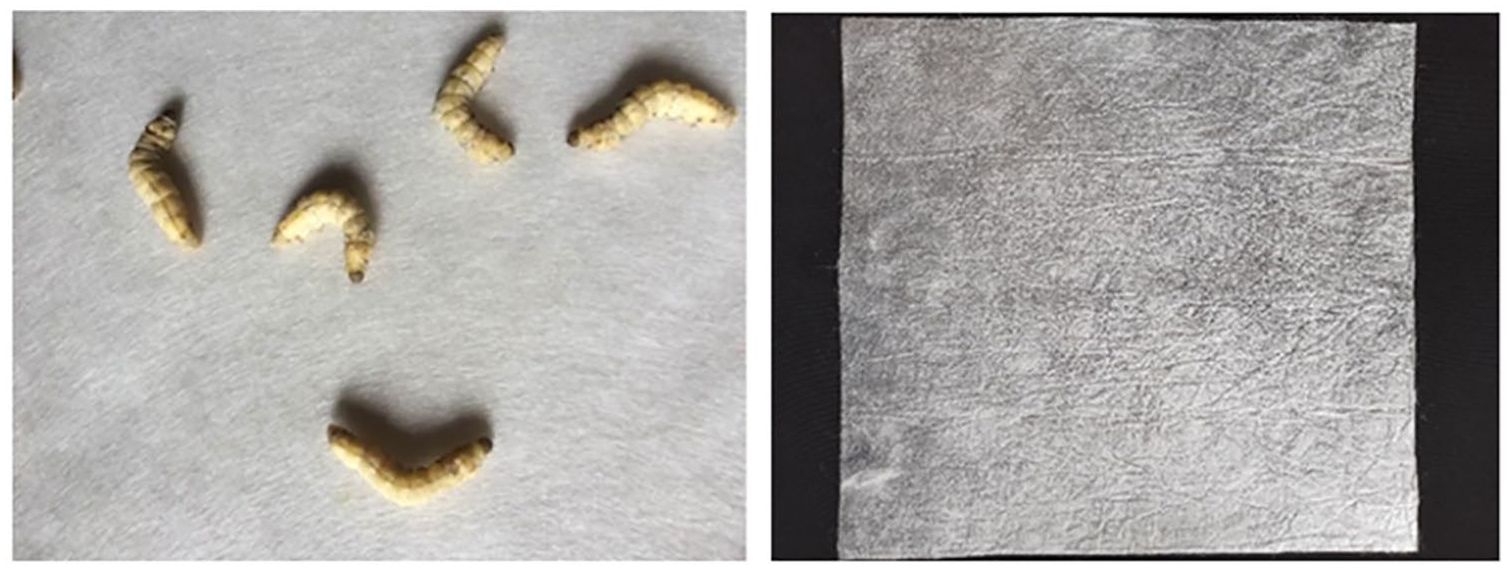
Smart SMC.
Performance test
Morphology
Appearance construction images of facial mask paper were obtained using a digital imaging equipment. The microstructure was analyzed under SU8010 SEM (Hitachi, Tokyo, Japan) at a voltage of 1 kV or 5 kV after gold-sputter coating.
Thickness test
An electronic vernier caliper is used to test the thicknesses of two facial mask paper, the thickness value of each sample is taken as the average of 10 measurements.
Porosity
The density (ρs) of the silk fibers was set at 1300 kg/m3 according to previous studies.22,23 The density (ρc) of the cuprammonium rayon was set at 1500 kg/m3. 24 The square areal weight (mc) of the CRMC is 38.4 g/m2. The square areal weight (ms) of the facial mask paper made of silk fiber is 38 g/m2. Thickness (σ) derived from the above test results. The porosity (n) of two facial mask paper were calculated by the formula

Mechanical properties
Paper were cut into strips with the width of 10 mm and the length of 100 mm to prepare the tensile test samples. Tensile testing instrument (YG065, Yantai, China) was used for tensile testing and all tests were carried out at room temperature with gauge length of 50 mm and at a speed of 200 mm/min. The corresponding stress–strain curve was obtained by dividing the load and displacement by the cross-sectional areas and the gauge length of the specimens, respectively.


Air permeability
Air permeability of facial mask paper was tested on YG (B)461D fabric air permeability tester (HONGDA, Nantong, China), according to ISO 9237, with a test area of 5 cm2 and a pressure difference of 100 Pa.
Liquid entrainment rate test
Samples are taken by cutting, each with the size of (100 ± 1) mm × (100 ± 1) mm. The mass of a single sample is <1 g, and therefore four samples are stacked on top of each other to form a combined sample with the mass >1 g. Five sets of such samples are prepared. The humidity of the samples is conditioned with the third-grade water as the test solution, which should be balanced in the standard atmosphere for a long enough time. After being fully soaked, the samples are hung for a certain period and then weighed. The formula LAC = (mn − mk)/mk is used to calculate the liquid entrainment rate of the combined samples. mk is the mass of the samples after humidity conditioning, and mn is the mass of the sample after liquid absorption.
Antibacterial activity test
Escherichia coli and Bacillus subtilis, the representative of Gram-negative and Gram-positive bacillus, are selected to study the antimicrobial activity of facial mask paper. They are inoculated separately in 10 mL Luria–Bertani (LB) medium and cultured with constant shaking (200 rpm) at 37°C overnight (15 h). After being exposed to CRMC and SMC (10 mg) at 37°C for 8 h, bacteria suspensions are diluted 10 times continuously (1:106, 1:107, and 1:108 are used in this test). Twenty microliters of the cell suspension is spread onto Luria–Bertani (LB) agar plates. The number of the colonies is counted after agar plates are incubated at 37°C in the dark overnight (18 h). The survival percentage is used to evaluate the antimicrobial effects of the facial mask paper. Survival percentage is calculated with the following equation 25 :

Results and discussion
Comparison between the two facial mask paper in terms of structure
The CRMC presented herein is made by spunlaced method. In the spunlaced process, Ω-shaped cross-links are formed between the fibers under the action of the high-pressure water needle, and the pores on the surface of the facial mask are of unequal size. The filaments on the SMC are stacked in the form of regular “∞,” firmly shaped by means of sericin, which are arranged in a manner similar to the cocoon filaments on the ordinary cocoon. Because silkworms spin silk covering large areas, the facial mask paper is looser and softer than the ordinary cocoon and with the pores of equal size.
Thickness
The different thicknesses of the facial mask paper result in the different speeds of moisture absorption, moisture permeation and ventilation, which produces different comfortable feelings on the face. An electronic vernier caliper is used to test the thicknesses of two facial mask paper, the thickness value of each sample is taken as the average of 10 measurements. The results of the measured thickness values are shown in Table 1.
The thickness and porosity etc. of facial mask paper by different process.

Both silk and cuprammonium rayon are relatively thin, and the thicknesses of the facial mask paper of the above two materials similar in areal weight are pretty much the same. 384 CRMC is industrially produced, uniform in thickness. For the SMC, the silkworm’s habit of spinning is used with the smart light system to control it, but the silkworms themselves are free. Although the silk is well-distributed on the paper, where the thicknesses are different in various areas.
Porosity
The porosity of the facial mask paper reflects their air permeability. Generally, the greater the porosity is, that is, the greater the volumes of pores contained are, the better the permeability of the material is. Through calculation, the porosity of the two facial mask paper is obtained, as shown in Table 1. The porosity of the SMC is slightly lower than that of the CRMC. As can be seen from the scanning electron microscope pictures, the pore size and distribution of the two facial mask paper also show different states. The pores of the SMC are uniform and well-distributed, which results from the fact that when the silkworms spin the flat plate silk, under the intervention of the light system, the spinning track is reasonably controlled to form the facial mask paper of even thickness, and the movement of the silkworm’s head during the spinning process is basically the same. The filaments of the CRMC are gathered in bundles. When the water needle is applied to the nonwoven fiber web, some filaments wrap up the fiber bundle in the shape of Ω, as shown in Figure 3(b), which will form relatively large pores on the surface of the facial mask paper.

Microstructures of the two facial mask paper: (a) smart SMC and (b) 384 CRMC.
Mechanical properties
The silk fibers are bonded together by sericin to form a sheet-like flat plate silk, where there are many well-distributed bonding points, and therefore the strength of the SMC in the dry state is higher than that of the CRMC, with lower breaking elongation, harder hand feeling and less deformation as shown in Figure 4(a). When the SMC are fully soaked at normal temperature, the acting force between sericin is destroyed, relative displacement tends to occur between silk fibers, the hand feeling of the SMC becomes softer, the strength becomes lower, and the elongation becomes higher. In the wet state, the strength of the CRMC becomes lower, and its elongation becomes higher as shown in Figure 4(b). In the wet state, the breaking strength of the SMC is still higher than that of the CRMC. It indicates that the bonding force between sericin decreases in the wet state at normal temperature, while it is still higher than the cohesive force between the fibers in the spunlaced process.

Stress-strain curves of the two facial mask paper in dry and wet states: (a) stress-strain curves in dry state and (b) stress-strain curves in wet state.
Air permeability
The air permeability of two kinds of facial mask paper is shown in Figure 5. The density of silk fibers is lower than that of cuprammonium rayon, and the fibers form a facial mask paper in a flat manner. Therefore, the shape structure is relatively dense, the pores are small and uniform, and the bonding force between sericin stabilizes the relative positions between the fibers. The CRMC relies on the Ω-shaped cross-links produced in the spunlaced process to stabilize the aggregation of fiber bundles, there is no connection between the filaments, and at the same time a number of uniform and large air holes are formed on the surface of the facial mask paper. Therefore, in terms of air permeability, it is superior to the silk fiber facial mask paper. SMC is formed by manual intervention. Its thickness can be controlled, while it may be different in the same relative position on the different flat plate silk, which makes the air permeability fluctuate in some way.

Comparison between the two facial mask paper in terms of air permeability.
Liquid entrainment rate
The thicknesses and pore sizes of the facial mask paper directly affect liquid entrainment. The liquid entrainment of the facial mask paper is divided into adsorption of water on the fiber surface and adsorption of water on the capillaries between the fibers, that is, the pores of the facial mask paper can also store liquid. With the same surface density, the fluffier the facial mask paper are, the more pores they have, the more liquid they store and the more liquid they entrain. Copper ammonia and silk belong to different types of materials, their processing techniques are different, and their thicknesses and pore sizes are not proportional. Therefore, the porosity is considered as the dependent variable affecting their liquid entrainment rate. The higher the porosity is, the stronger the ability to entrain liquid is and the higher the liquid entrainment rate is. Liquid entrainment rate of the two facial mask paper is shown in Figure 6.
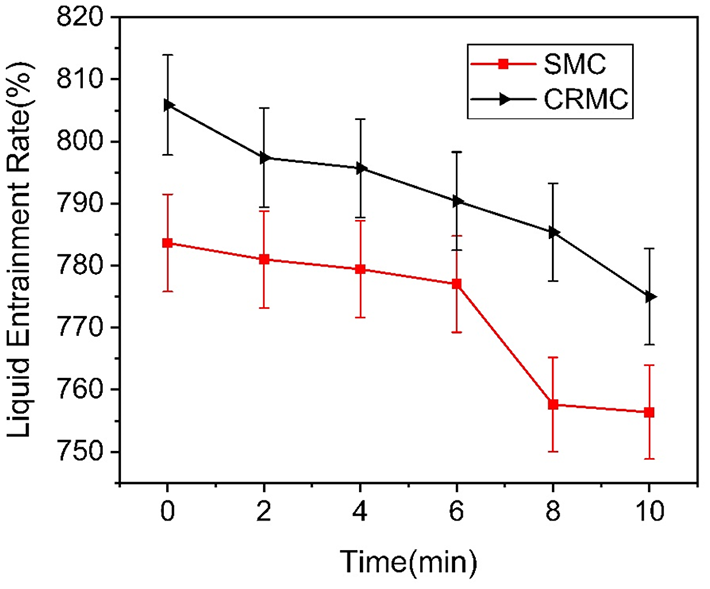
Liquid entrainment rate of the two facial mask paper.
Antibacterial properties
After the experiment of liquid entrainment rate, the samples after humidity conditioning are stacked together and placed in a dry container for 48 h, the two kinds of facial mask paper had become dry. The second to fifth group of CRMC had many mildew spots on it, but the SMC had no plaque, as shown in Figure 7.

Antimildew effects of the two facial mask paper: (a) CRMC in wet state, (b) CRMC after drying, (c) SMC in wet state, and (d) SMC after drying.
Escherichia coli is used in the colony-forming capability test (Figure 8). The results show that both CRMC and SMC are antibacterial to some extent, with three different dilution ratios. CRMC is not as good as SMC in terms of resistance to Escherichia coli. Especially with the dilution ratio of 1:106 and 1:108, the survival rate of Escherichia coli treated with SMC as compared with CRMC is significantly lower, and it is significantly different from the blank sample. Ag nanoparticles have been widely utilized to functionalize silk for antibacterial applications.26–28 Most of the works reported an antibacterial rate higher than 90%. Therefore, SMC has higher potential in antibacterial performance.
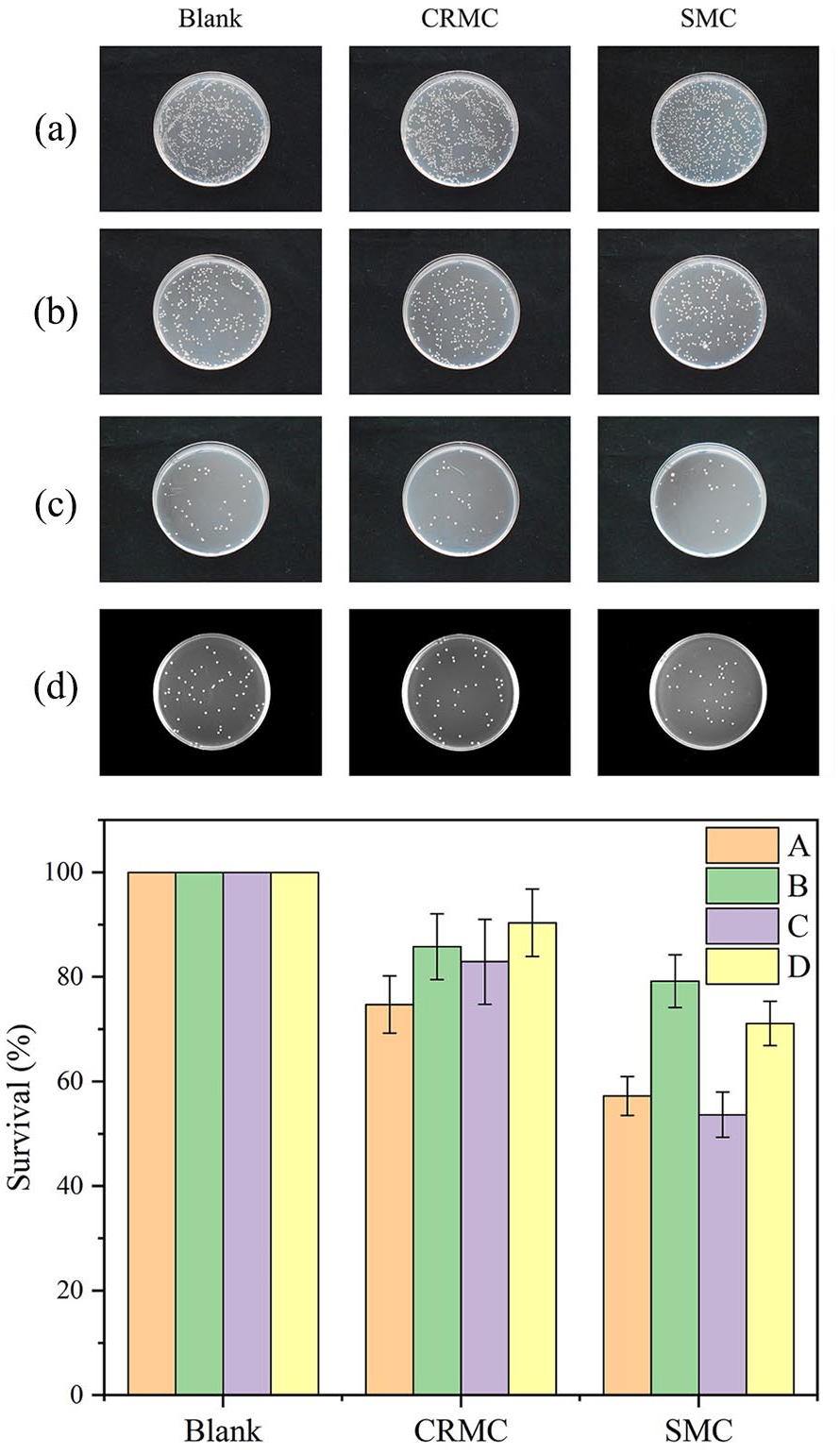
Antibacterial effects of the two facial mask paper: (a) Escherichia coli: the dilution ratio of 1:106, (b) Escherichia coli: the dilution ratio of 1:107, (c) Escherichia coli: the dilution ratio of 1:108 and (d) Bacillus subtilis.
Figure 8 also shows the antibacterial effects of the two facial mask paper to Bacillus subtilis. The survival rate of Bacillus subtilis treated with SMC is 71.15%, and the survival rate of Bacillus subtilis treated with CRMC is 90.38%. It is proved that the antibacterial property of SMC to Gram positive bacillus is still better than that of CRMC.
Conclusion
The production process of the smart SMC designed and made in this paper is very simple, which retains all the sericin on the silk fiber, so that any chemical reagent is not needed in the forming process. Through the comparison experiment, it is found that the thickness, areal weight and porosity of the smart SMC is very close to those of the 384 CRMC which has the best application performance at present. The elongation, air permeability and liquid entrainment rate are slightly lower than those of the CRMC. The antibacterial property, dry and wet strength are superior to those of the CRMC. The unique skin-friendly, skin-care and antibacterial properties of the smart SMC give itself broad application prospects. It can even be modified and applied to other fields.
Footnotes
Declaration of conflicting interests
The author(s) declared no potential conflicts of interest with respect to the research, authorship, and/or publication of this article.
Funding
The author(s) received no financial support for the research, authorship, and/or publication of this article.
