



Abstract
In this study, the mechanical properties and preferences of natural and artificial leathers were analyzed. The leathers were classified based on mechanical properties affecting their preferences. The mechanical properties of the leathers were measured via the KES-FB system, and an expert survey was conducted to evaluate leather preference. Leathers possess different mechanical properties depending on the manufacturing process and structural characteristics. Furthermore, differences were observed in the mechanical properties of natural and artificial leather. The mechanical properties of the leathers were related to the preferences for hand and bags. Accordingly, the leather was classified into three clusters. The leathers that were preferred for hand were not preferred for bags, and those preferred for bags were not preferred for hand. Therefore, different development strategies are needed, depending on the type of leather. Natural leather for bags should be light and have good compression elasticity along with its existing mechanical properties, whereas artificial leather should be light and have improved tensile resilience.
Introduction
Currently, advances have been made to artificial leather to make it significantly more similar to natural leather than ever before in terms of both physical properties and functionality. 1 The mixed use of natural leather and artificial leather is increasing given the advantages and disadvantages of natural leather and artificial leather in terms of price and durability. In the case of sofas and car seats, the areas that touch and don’t touch the skin are composed of natural and artificial leathers, respectively. In the case of bags, trimming and straps are made of leather although artificial leather is used in the body.
In a broad sense, the term “hand” refers to the sensory performance of a fabric sensed by touch and visual sense, and in a narrow sense, it refers to a feeling that is felt when a fabric is touched with a hand. Kawabata developed the objective Kawabata Evaluation System (KES) by assuming that the hand of the fabric is comprehensively determined by six mechanical properties, namely tensile, bending, shear, compression, surface properties, thickness, and weight. 2 In order to improve tactile comfort, mechanical properties and hand evaluation of various fiber textiles and finishes were examined.3–6 The hand of a fashion product, such as a bag, or item of clothing, is considered important to consumers. Leather hand is an indispensable attribute in the selection of leather and product development and is a purchasing consideration for manufacturers and consumers. Su et al. 7 and Huang et al. 8 used artificial neural networks to connect the objective and subjective measurement of leather hand. Roh and Oh evaluated the subjective hand and preference of artificial leather for use. Sudha et al. compared comfort, chemical, mechanical, and structural properties of natural and artificial leathers used in apparel.9,10
The frequency of use in the same product is increasing however, few studies compared and analyzed the relationship between mechanical properties and preferences of natural and artificial leathers via the same evaluation method. In order to thoroughly analyze the needs of increasingly demanding consumers and to offer differentiated products, it is necessary to evaluate natural and artificial leathers in the same manner and to comprehensively analyze the preference based on the mechanical properties of leather. Leather products required by consumers can be efficiently developed by classifying leather into similar types based on mechanical properties that affect preferences and by analyzing the properties of each cluster.
Therefore, the present study compared the mechanical properties of natural and artificial leathers, investigated the relationship with preferences and analyzed the characteristics of clusters by classifying leathers with similar mechanical properties.
Methods
Commercial natural leathers (cowhide, C) and artificial leathers (polyurethane-coated leather, P) of similar thickness were used (Table 1). As artificial leather may have different mechanical properties due to its differing constituents, it was selected mainly from artificial leather composed of similar ingredients.
Characteristics of natural and artificial leathers.

PU: polyurethane; B.F.: Base fabric; PET: polyester; S: surface; B: back.
In the subjective evaluation, the leathers were unified in black to minimize the effect of color.
The area of natural leather used in the experiment was limited to the butt. The natural leather corresponded to grain leather.
Thick artificial leather available in the market is typically brushed back. The embossing size measurement is as follows (Figure 1). The leather was laid on a flat platform without wrinkles or tensions. The length and width of the longest part of the embossing were measured, and the average of the length and width is used as the embossing size. Five samples were measured and averaged.
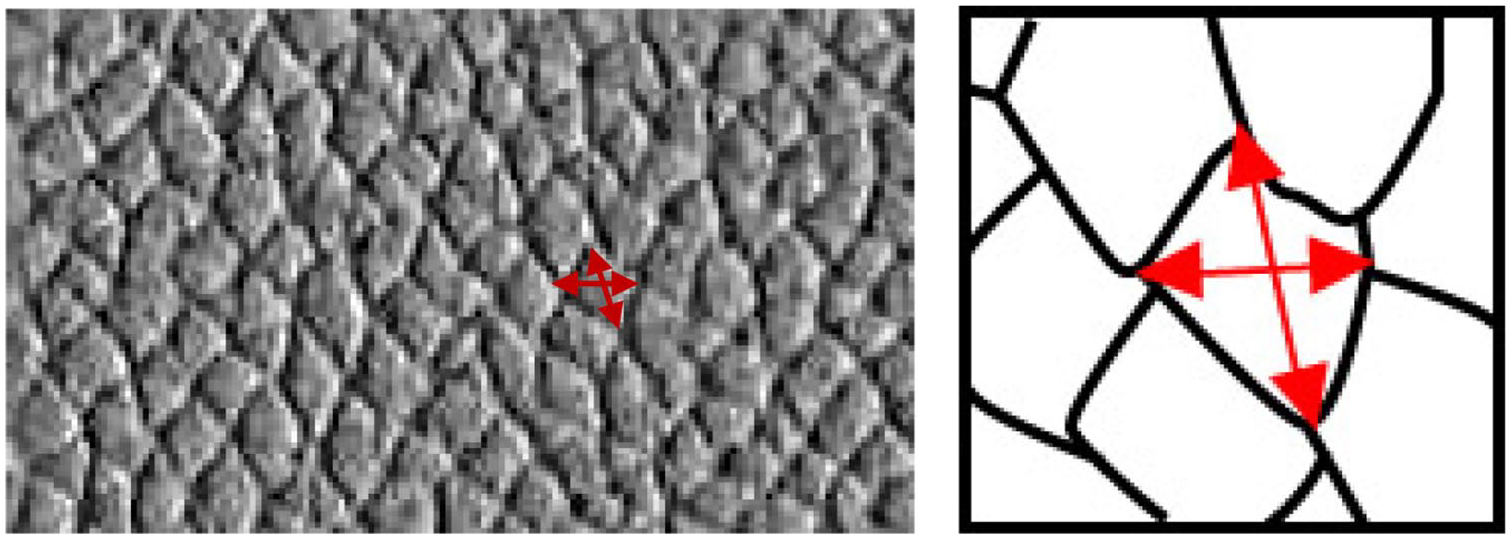
Measurement for embossing size.
The mechanical properties of the leather samples were measured using the Kawabata Evaluation System for Fabric (KES-FB, Kato Tech. Co. Ltd., Japan) in a standard laboratory (23.0°C, R.H 50.0%). 11 The properties considered in the study are summarized in Table 2.
Kawabata’s parameters, properties and apparatus. 2

The sample size corresponded to 20 × 20 cm2 excluding bending property. Three samples were measured, and the average value was obtained. Hand value and T.H.V (total hand value) used in clothing hand measurements were excluded due to their limited application in non-clothing samples. The leathers were thicker than that of a sample of clothing, and thus the bending properties were measured at 2 × 2 cm2.
Hand and bag preference items were used to evaluate the preference of leather. The items used the semantic differential method with a 7-point Likert scale ranging from 7 points for “agree strongly” to 1 point for “disagree strongly.” Based on the study by Cai, the scale can significantly affect the subjective measurement or assessment, and the 7-point scale is optimal among the three scales (i.e. 5, 7, 9 point). 12 Forty experts in clothing-related fields in their 20s and 30s evaluated their preferences from July 24, 2016 to July 22, 2016 including graduate students in clothing, instructors, clothing company designers, merchandisers, material designers, and textile researchers evaluated the preferences during 2016. 7.4~7.22. The leathers were evaluated for their preference after rubbing, pressing, bending, grabbing, hanging, pulling, etc.
Data were analyzed via frequency analysis, Mann–Whitney U test, Kruskal–Wallis test and Tukey HSD, correlation analysis, and cluster analysis using SPSS 18.0. Owing to the low number of samples, particularly twill leather, used in this study, nonparametric statistical methods were employed.
Results
Mechanical properties
Tensile energy (WT) is the work required for extending leather, and an increase in the WT value increases the tensile strength of leather. A significant difference exists between natural and artificial leathers with respect to tensile properties (Table 3 and Figure 2).
Difference in mechanical properties and preferences between natural and artificial leathers.

p < 0.01; **p < 0.05; ***p < 0.001.

Tensile properties of leathers. (a) Tensile energy. (b) Tensile resilience. (c) Extension at maximum load.
Specifically, higher WT was observed in artificial leathers that used tricot base fabric (P1–P5) and were light. The base fabric of artificial leathers is generally composed of woven, nonwoven, or knitted fabrics. Among these, knitted fabrics in general, are more elastic and can stretch up to 500%. The use of knitted fabrics of artificial leather facilitates the movement of fibers, yarns, and coating during tensile, thereby resulting in increased tensile energy. The results indicate that elongation of the base fabric and weight affect the elongation of artificial leather. 13
Conversely, WT was lower in natural leathers (C1~C9) and artificial leathers that were heavy and used a twill base fabric (P6, P7). This property is attributed to the fact that natural leather is subjected to leather processing and hence possesses strength suitable for a bag. The leather processing influences the arrangement of the basic unit, structure, viscoelastic nature, and mechanical properties of the leather. The tanned collagen fibers have, in principle, additional linkages introduced during the tanning process, also known as crosslinking. 14 As this process adjusts these additional linkages, natural leathers are presumed to possess a low WT. In addition, the leathers that were heavy and used a twill base fabric exhibited a lower WT than tricot base leather because the warp and weft intersected, resulting in less freedom in the yarns that make up the artificial leather.
Tensile resilience (RT) indicates the ability of leather to recover from stretching when the applied force is removed. Higher values indicate higher recovery from stretching. A statistical difference existed in the extent of reduction in tensile resilience between natural and artificial leathers. The RT of natural leathers exceeded those of artificial leathers. This implies that the shape stability of natural leathers is superior to that of artificial leathers. The bundles of collagen fibers, present in the leather matrix, are discontinuous and randomly arranged. Additionally, the branching of the collagen structure provides characteristic mechanical properties and viscoelasticity, 14 allowing the leather to exhibit improved recovery and tensile resilience.
The RT was lower in artificial leathers with the twill base fabric (P6, P7) when compared to that in leathers with tricot base fabric. The tensile resilience of the leather is due to the lower resilience of the twill compared to that of the tricot.
Extensibility or stretch (EM) corresponds to the percentage of strain at the maximum applied force. An increase in the value increases the stretchability of material. The EM results were similar to those of WT.
The bending properties of the leathers are shown in Table 3 and Figure 3. Bending rigidity (B) reflects the flexibility of the leather and a higher B value indicates greater resistance to bending. Bending hysteresis (2HB) indicates the ability of leather to recover after bending wherein decreases in the value of 2HB improve the bending recovery of the leather.
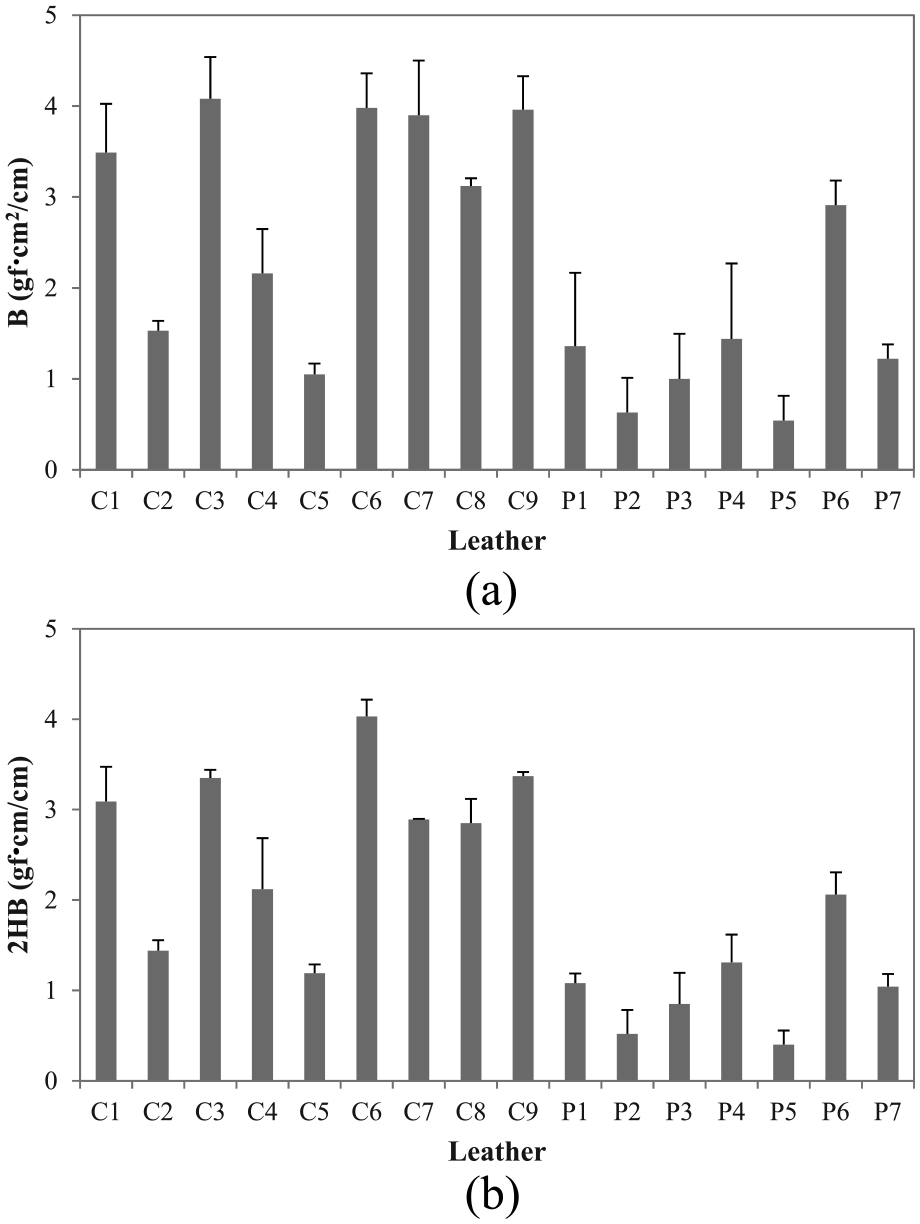
Bending properties of leathers. (a) Bending rigidity. (b) Hysteresis of bending moment.
The H and 2HB values were significantly different between natural and artificial leathers. Natural leathers also have varied bending properties, and those employed in this study have varied flexibility as the softness of each leather is different, owing to the structure and viscoelasticity of the collagen fibers, controlled by different processes. 14
Artificial leathers with the exception of P6 were more flexible relative to natural leathers. The use of flexible base fabrics (such as knit) results in the softness and suppleness of artificial leather.
Furthermore, P6 and P7 used the same twill base fabric albeit different bending properties, which seems to be due to the difference in the NCO/OH ratio and manufacturing process15–21 along with composition characteristics in the PU grain layer: P6 is the heaviest among artificial leathers; therefore, it is believed to have low flexibility.
In contrast to artificial leather, natural leather exhibited a difference in the values of B and 2HB. Moreover, C2, C4, and C5 were lower in B and 2HB. This is viewed as the difference caused by milling, vibration, and staking processes that endow the leather with flexibility. 22
Shearing stiffness is the ease with which the fibers slide against each other, resulting in a pliable or stiff structure. Lower values indicate less resistance to shearing corresponding to a softer material with a better drape. The shear properties of leathers exhibited similar bending properties tendency (Table 3 and Figure 4).

Shear properties of leather. (a) Shear stiffness. (b) Hysteresis at φ = 0.5 degree.
The compressional properties of natural and artificial leathers are shown in Table 3 and Figure 5 and include compressional energy (WC) and compressional resilience (RC). Specifically, WC corresponds to the work performed during the compression of leather. A higher WC value corresponds to the higher compressibility of leather. The RC indicates the extent of recovery or thickness regained after the compression force is removed. A higher value indicates better recovery ability from compression.
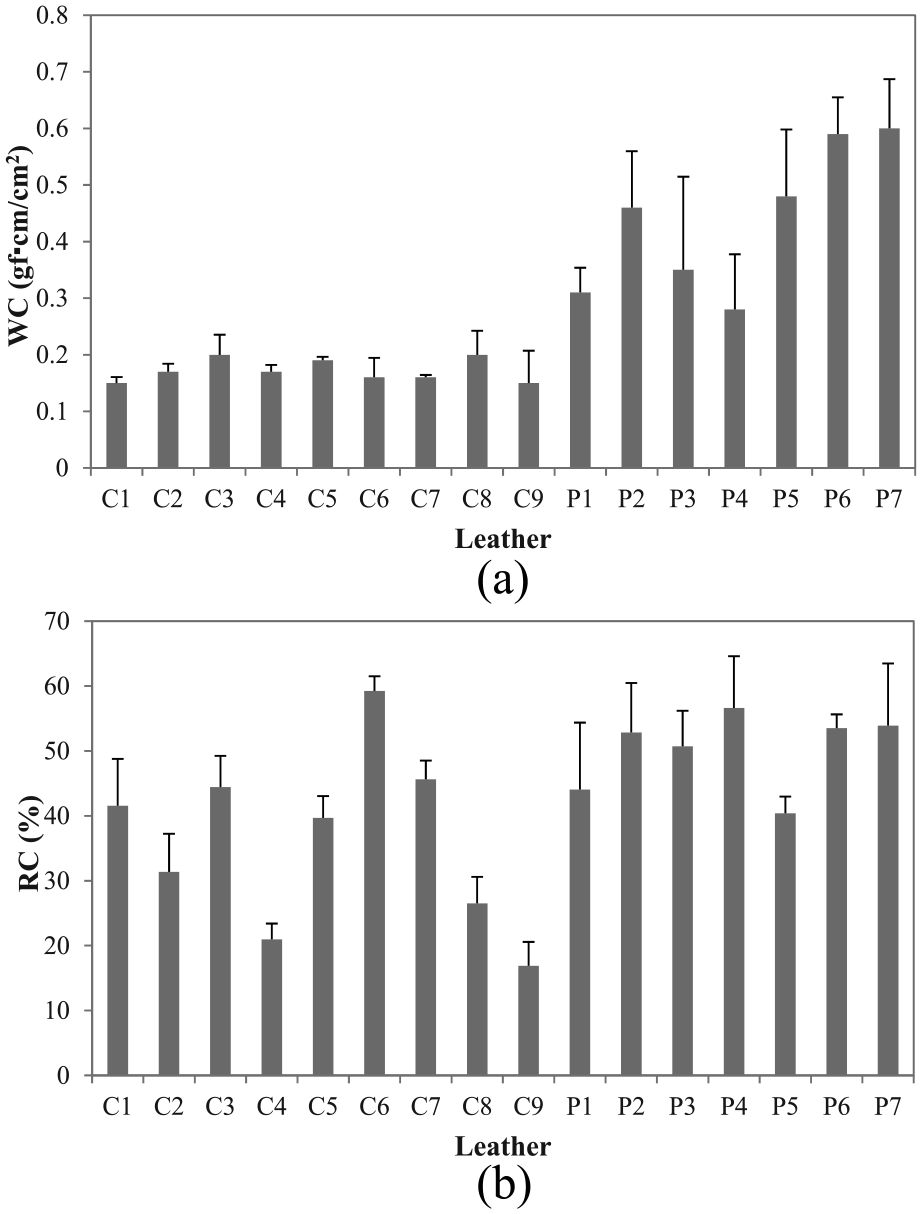
Compression properties of leathers. (a) Compression energy. (b) Compressional resilience.
The WC and RC of artificial leather exceeded those of natural leather. The differences in compression properties are due to differences in apparent density per unit area and structural differences in leather. Given similar thicknesses, natural leather was significantly heavier and exhibits a higher apparent density than artificial leather, thereby indicating less air content. Natural leather exhibits fiber bundles composition that is loosely and randomly interwoven with each other throughout the leather matrix. Conversely, PU leather seems to have three layers, namely the PU grain layer, polyester fabric intermediate layer, and a polyester fluffy layer. 10
The WC of natural leathers exhibit similar tendencies but differing RC values. This is because various processes can be used to manipulate the structure and viscosity of collagen fibers. The compression properties of artificial leathers of twill-based fabric were similar to those of other artificial leathers. This is believed to be as a result of the effects of other compositional properties and manufacturing processes on the compressive properties of artificial leather, apart from base fabrics.
Surface properties of the natural leather and artificial leather are shown in Table 3 and Figure 6 and include the coefficient of friction (MMD) and geometrical roughness of the leather surface (SMD). Specifically, MMD (μ) is determined by the ease with which two surfaces slide against each other. It corresponds to the ratio of the force required to slide the surfaces to the force perpendicular to the surfaces. A higher value of μ corresponds to increased friction or resistance and drag. A significant difference was absent in the surface properties of natural leather relative to those of artificial leather.
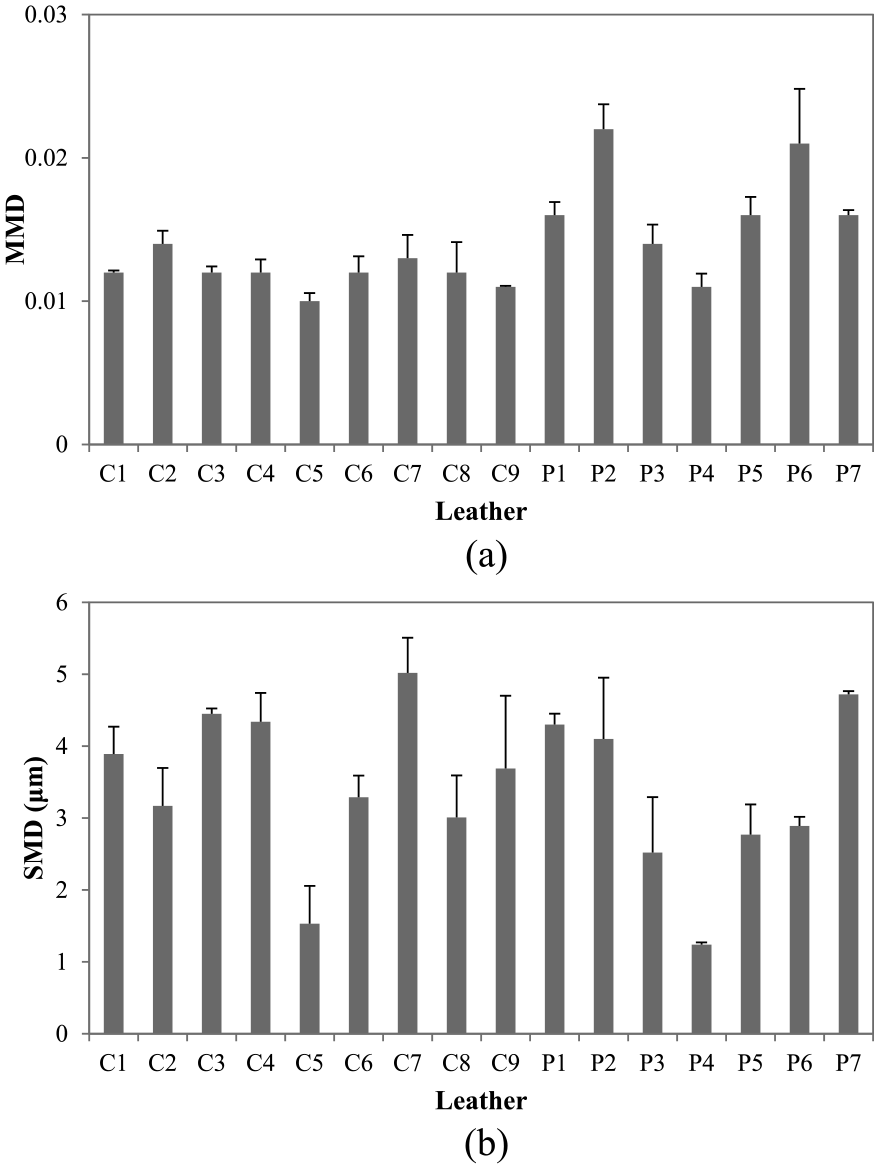
Surface properties of leathers. (a) Mean deviation of MIU. (b) Geometrical roughness.
Natural leathers were heavier relative to artificial leathers (Table 3). The thickness and weight of P1 and P2 in artificial leather were extremely close (Table 1), although there were differences in mechanical properties including tensile, bending, and shear properties. The results are potentially attributed to their effects on the mechanical properties of artificial leathers including the characteristics of the base fabric, impact, coating conditions, and solidification conditions of artificial leather. 13
The hand of natural leather was preferred to artificial leather although artificial leather was preferred to natural leather for bags (Table 3 and Figure 7). The hand of C4 was the most preferred. Conversely, P7 did not correspond to the most preferred. The two pieces leather significantly differed in terms of composition, weight, and compression properties. Specifically, C4 was hard and heavy while P7 was excellent in terms of compression elasticity and its lightweight.
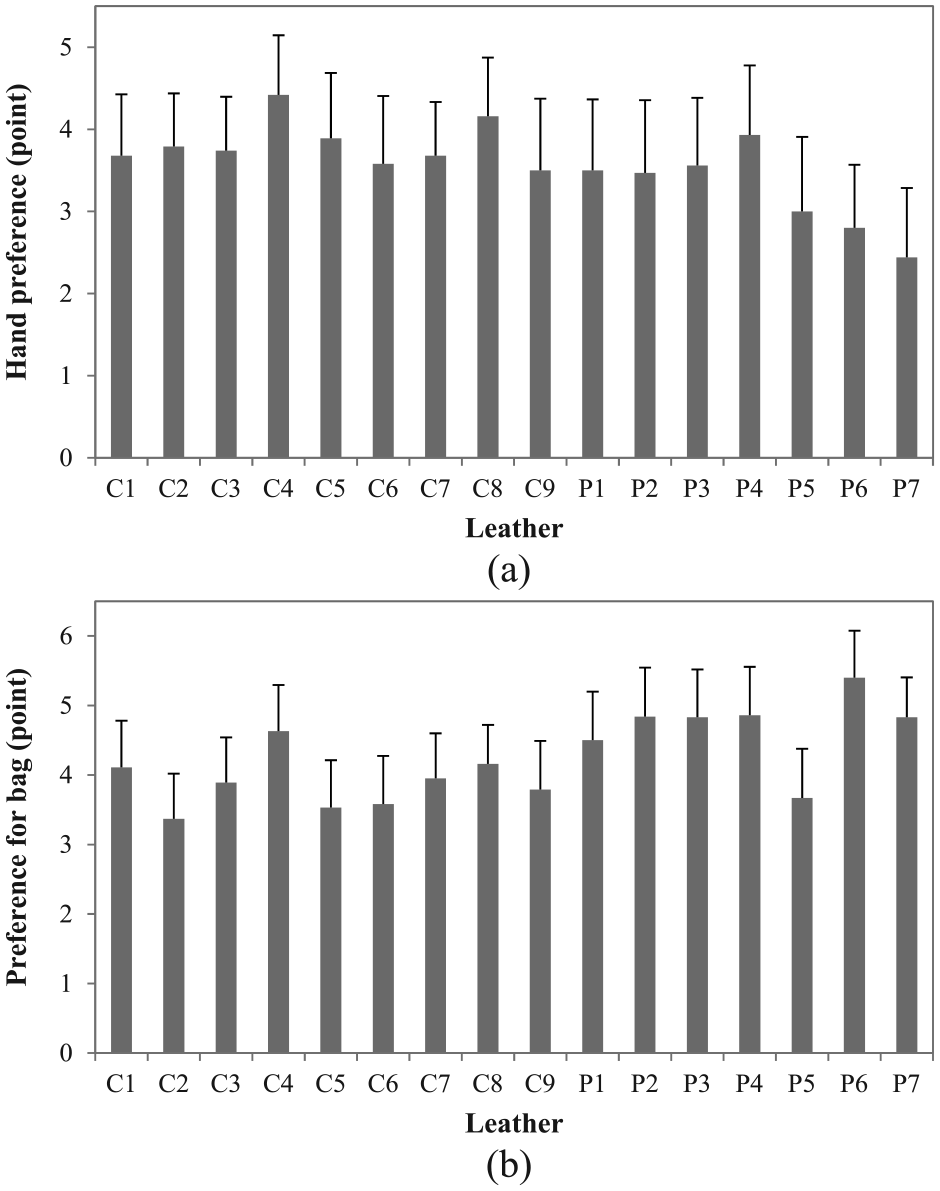
Preferences for leathers. (a) Hand preference. (b) Preference for bag.
Additionally, P6 corresponded to the most preferred leather for bags and C2 corresponded to the least preferred. Furthermore, P6 exhibited similarities in terms of the tensile, bending, and shear properties of natural leather using twill as a base fabric. Its compressive elasticity was excellent and lighter than that of natural leather although it was the heaviest among artificial leathers.
Correlation between mechanical properties and preferences
The preferences for the leathers were significantly related to several mechanical properties (Table 4). Hand preference was positively correlated with RT and negatively correlated with WC and MMD. Preference for bag leathers exhibited a positive correlation with WC and MMD and a negative correlation with RT and weight.
The correlation between the mechanical properties and hand preference differed from the correlation between the mechanical properties and preference for bag. However, as illustrated in Figure 7(b), artificial leather (P6), which was lighter than natural leather, but had mechanical properties similar to natural leather, was preferred for bags. The bag is believed to prefer light and resilient leather because the weight of the object that it carries can be modified by a tensile force and compression. 23 Owing to the mechanical properties of light artificial leather, it seems that the low tensile resilience and leather preferences for bags are related.
Correlation between mechanical properties and preference for leathers.

p < 0.01; **p < 0.05; ***p < 0.001.
Classification
Hierarchical cluster analysis (Ward’s method) was performed to classify leathers based on mechanical properties (RT, WC, MMD, and weight) that affect preference, and three clusters were derived (Figure 8). Kruskal–Wallis test and Tukey HSD were conducted to analyze differences in mechanical properties based on the clusters (Table 5). Significant differences were observed in all mechanical properties with the exception of SMD.

Classification of leathers based on mechanical properties that affect preferences.
Differences in mechanical properties and preferences among clusters.
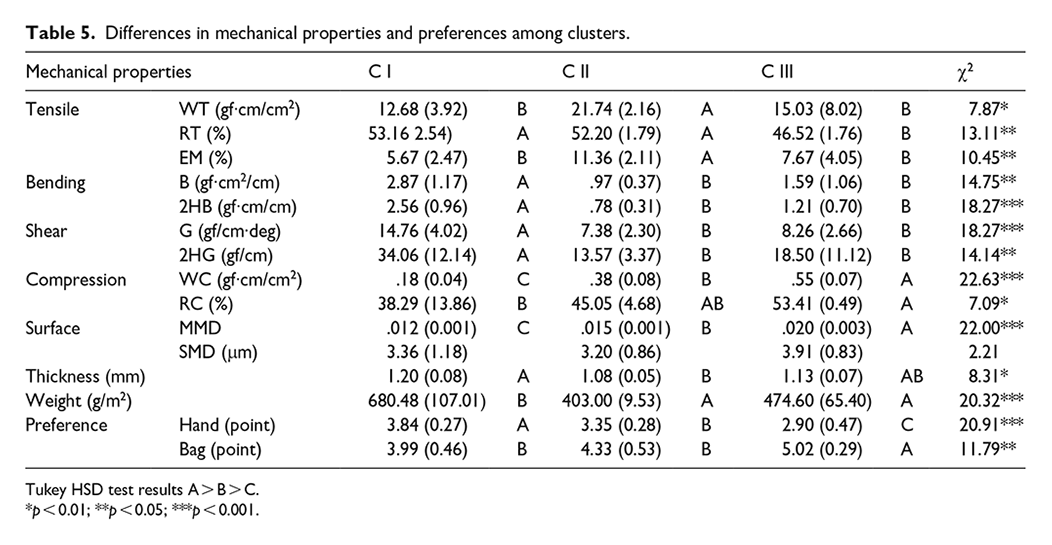
Tukey HSD test results A > B > C.
p < 0.01; **p < 0.05; ***p < 0.001.
The C I consisted of natural leathers and artificial leather, P4. The leathers did not stretch well and were stiff, hard, smooth, thick, and heavy. The leathers exhibited the most favored hand although they were less preferred for bags. Specifically, C II consisted of three types of artificial leathers that stretched well, exhibited high flexibility, good compression properties, and were thin and light. The hand of the aforementioned leathers was preferred although it was less preferred for bags. The C Ⅲ was not well stretched. However, it was flexible, exhibited the best compression properties, was not smooth, and consisted of the lighter leathers. The leathers exhibited the least hand preference although they corresponded to the most preferred for bags. The tensile, bending, and shear properties of P6 and that of P7 using twill as a base fabric were similar to those of natural leather, although they were not included in C I that consisted of natural leather. Conversely, P4 was included in C I. As shown in the results of correlation analyses, this was because the leathers were classified into three clusters based on the mechanical properties that affected preference.
Conclusion
This study analyzed the relationship between mechanical properties and preferences of natural and artificial leathers and classified leathers based on how their mechanical properties affected preferences. The leathers had different mechanical properties, and there were differences in bending, shearing, RC, and SMD between natural leathers. On the other hand, artificial leathers were different in the mechanical properties. Natural leather and artificial leather possessed different mechanical properties, but artificial leather exhibited the tensile, bending, and shear properties similar to natural leather due to the base fabric and weight control of artificial leather. In addition, some of the mechanical properties of leather exhibited a significant correlation between preferences, and RT, WC, MMD and weight showed a significant effect on preferences.
The leathers were classified into three clusters based on the mechanical properties that affect the preferences. A difference was found to exist between the preferred mechanical properties of leather and those of the bags. The hand of the C I’s leathers, which were hard, smooth and heavy, were preferred for the hand, but not preferred for the bag. C Ⅲ’s hand was not preferred, as they were flexible and had excellent compression properties, despite not being excessively light, but the leathers was preferred for bags.
Based on the use, these results show that the mechanical properties of the leather affect the preference, and different development strategies are needed depending on the type of leather. Natural leather for bags requires existing mechanical properties and should be light and have compressive elasticity. Meanwhile, artificial leather should be developed to improve tensile resilience and simultaneously be light.
However, given the use of leather in the market, there were difficulties in analyzing the effects of the manufacturing process on mechanical properties. In particular, there are few samples of leather using twill as the base fabric; thus, there is a limit to the explanation of the study results.
Therefore, a detailed study is required to examine the composition characteristics of artificial leathers and changes in the mechanical properties of natural and artificial leathers in the manufacturing process.
Footnotes
Declaration of conflicting interests
The author declared no potential conflicts of interest with respect to the research, authorship, and/or publication of this article.
Funding
The author received no financial support for the research, authorship, and/or publication of this article.
