




Abstract
3D printing is a well-known technology for creating 3D objects by laying down successive layers of various materials. Among the wide range of applications, fashion industry has adapted these technologies to revolutionize their brands. But due to the unique characteristics of textiles like comfort, flexibility, and so on, attempts have been made to create similar structures as textiles. The work presented here is part of a project to create garments using fused deposition modeling as 3D printing technology. Structures with various geometries are designed and tested with different materials starting from rigid to flexible. As a result, a fully 3D printed dress is created. Selecting this dress as a model, consumer acceptance for 3D printed garments is evaluated realizing an online survey containing 100 respondents. The data gathered show that respondents have knowledge of 3D printing, its advantages and the majority of them would accept wearing a 3D printed dress.
Introduction
3D printing, also known as additive manufacturing, is the general term for those technologies that, based on a geometrical representation, create physical objects by successive addition of material according the ISO/ASTM 52900:2015. The history of 3D printing begins in 1981 with Dr Hideo Kodama’s patent application for a rapid prototyping device. In this system, a vat of photopolymer material is exposed to a UV light that hardens the part and builds up the model in layers. Other attempts have been made by other engineers but the first patent was taken by Charles Hull for the technology stereolithography (SLA).1,2 3D printing is the opposite of traditional manufacturing technology. Here, the object is created by placing successive layer of material with a given thickness, generated by the slicing software.
3D printing, sometimes also named rapid prototyping, at first was used for prototypes. Recently, 3D printing technologies have gained great interest in different areas of production, even for mass customization and in some application for mass production as the case of footwear. The wide spread in different areas shows its importance for prototyping or production of different objects. 3D printing shows advantages to produce complex geometries which can be difficult to create with common industrial production or to produce objects in aeronautics or other situations where no other production machines are available.
Also, the fashion industry has adapted these technologies to revolutionize their brands. Applications in textile industry are presented in fashion shows by well-known fashion designer. Apart from them, even in the academic area, case studies of 3D printed fabrics are developed and presented by different authors. Even though a lot of work is done to develop materials similar to textile fabric, due to the unique characteristic of textiles as comfort, flexibility, and so on, there is still work to be done regarding 3D printing materials for textile production. In the case of rubber filament, attempts have been made to create similar structures as textiles. Recycled materials such as nylon, TPU (thermoplastic polyurethane), or PLA (polylactic acid) for 3D printers have attracted attention of fashion designers to develop 3D printed textiles, 3 in this case assisting waste reduction by material recycling. 3D printed fashion shows are not new for a number of fashion designers who see this technology as the future.4,5 One of the challenges to overcome is the comfort and the flexibility of these 3D printed textile fabrics. Researchers have shown great interest in designing and 3D printing various structures. Starting from traditional textile structures translated to digital code, different structures are tested to produce 3D printed textile fabrics6,7 similar to knitted or woven structures,8,9 where knitted structures are more flexible. 10 Moreover, by changing the geometry and size of the print, bending and deformation properties of 3D printed structures can be manipulated. 11 As the nozzle of 3D printers behaves like the spinneret of a melt spinning machine, by controlling the movement of a fused deposition modeling (FDM) printer head, soft and flexible textile structures can be produced. 12 Printing with fibers 13 to create textile structures is proposed for further studies. 14 Modeclix, a system of additively manufactured links, allows garment production by simply adding or removing links to adjust the size and shape of a garment. 15 Using the FDM technology, a new method for 3D printing textile-like surfaces shows the reduction of different steps for garment production. 16 Nevertheless, there are limitations compared to other types of 3D printing technology such as SLS (selective laser sintering) or SLA which uses powder or liquid types of materials an FDM-type 3D printer can only use solid materials such as acrylonitrile butadiene styrene (ABS), PLA, and TPU. 17
Apart from fashion applications, within the academic area, 3D printing researchers at the University of Maryland have developed a fabric structure operating as a personal, powerless air conditioner. 18 Another case of research from MIT (Massachusetts Institute of Technology) has focused primarily on structure by modeling their fabric after protein collagen using TPU material. They believe their fabric could have many applications in the medical field as well as in textiles, since 3D printing enables the creation of limitless shapes and sizes. 19 The case of “space fabric” is another example of advances made in 3D printing to fabrics that have four essential functions as reflectivity, passive heat management, fold ability, and tensile strength. 20 These studies show the increased impact of 3D printing for several applications.
Furthermore, in the case of 3D printed fabrics and garments created, consumer behavior related to this new technology replacing traditional processes of garment production plays an important role. Thus, consumer perceptions of 3D printed dresses are studied by different authors and the results are different. One of the studies done for a small group indicated that participants were more interested in accessories than in clothing due the low flexibility of materials used for 3D printing, 21 which was different from the other study which gathered positive answers regarding 3D printed clothing. 22
Apart from 3D printed textiles, a combination of 3D printed geometries on textile fabric shows an interesting area. One of the most important benefits of 3D printing, not only from the fashion design aspect, is the functionality added to these textiles for various applications. Studies conducted by different authors present the combination of 3D printed geometries on textile fabrics23–26 by showing the possibilities and technical limits of these novel composites. 27 The case of self-forming structures printed on fabrics shows attention for its significant functionality and aesthetic value. 28 One of the issues encountered is the adhesion between both materials. Investigations of fabric pre-treatment have resulted in significant modifications of the adhesion force.29,30 In addition, printing parameters such as nozzle temperature, printing bed temperature, 31 and infill orientation 29 have a significant impact on the adhesion force. Besides, fabric properties such as areal density, yarn fineness, fabric thickness, and fabric handle show a positive correlation with the adhesion force. 32 Comparison of test methods can help in standardizing the research of 3D printing on textiles. 33
Methodology
In this work, structures with different geometries are designed using Tinkercad, a free modeling software from Autodesk, Inc. For 3D printing of 3D models, an Orcabot XXL (Prodim International) FDM printer produced in Netherlands is applied. The 3D printer is equipped with Orcabot Repetier Host V1.0.6 software where the 3D CAD models are imported and sliced. The main 3D printing parameters used for 3D printing the structures are depicted in Table 1.
Parameters used for main geometry production.

Tests are realized in several materials as PLA from Filament world, PLA soft from German RepRap, Nylon from Taulman, FilaFlex from Recreus Industries S.L., and Ninja flex from Ninjatek. Printing parameters for 3D printing process are selected according to the material used. The filament used for most 3D printing experiments is FilaFlex from Recreus with shore hardness A82 (according to the manufacturer). The workflow followed in this work is presented in Figure 1.

Workflow of the main steps followed in this work.
A schematic view of the 3D printer is presented on Figure 2. FDM is an additive manufacturing technology commonly used for modeling, prototyping, and production applications. 34

A schematic drawing of Orcabot XXL 3D printer used for printing the dress structures.
After finishing the parts of the printed dress, a Dikale 07A 3D Pen is used to join all the single structures. The 3D pen is like a small 3D printer which extrudes the melted filament. The dress is designed using 3D modeling software CLO 3D from CLO Virtual Fashion Inc.
Consumer acceptance evaluation of 3D printed garments is realized by an online survey on Survey Monkey, containing 100 participants from different countries and mainly a target group ranging from 18 to 35 years old. The predefined group of respondents is chosen taking into account that this age group is more attracted by new technologies and in this case by new garment production methods. The data gathered are analyzed and presented. This is a quantitative research method with closed questions. There are seven questions apart from those related to age, ethnicity, and profession. The questions are about 3D printing, willingness of consumers to use 3D printed garments, or aesthetics of 3D printed garments. Furthermore, an image of the dress is included in one of the questions. The time for completing the questionnaire was 1 week, from 30 August to 5 September 2019. This is an explorative research method to reach a better understanding of consumer behavior related to 3D printed garments.
Results and discussion
Tests of various geometries 3D printed on Orcabot XXL (Prodim International) FDM printer are depicted in Figure 3. As can be seen, these geometries are printed in various colors as yellow, black, green, blue, and beige.

Various geometries produced with different materials and colors.
After evaluation of aesthetic, flexibility, and difficulties encountered regarding viscosity of materials during the 3D printing process which in various cases resulted in failure of the 3D printed model, the geometrical structures chosen for garment production is an arrowhead structure with negative Poisson’s ratio (NPR) 35 with dimensions 130 mm × 130 mm which is depicted in Figure 4. At first, a single arrowhead is designed, which is afterward duplicated in row and column directions. It is well known that auxetic structures have an NPR, while common structures have positive values. This means that they expand laterally when stretched and contract laterally when compressed. The classical Greek word auxetic means “to increase.” 36 In the textile industry, auxetic structures have a wide range of applications. 37 Through 3D printing, auxetic structures on textile material result in changing the permeability of textile fabrics 38 in this way depicting the role of 3D printing in potential applications of auxetic structures.39,40 Figure 4 depicts top and 3D view of the designed structure on Tinkercad software.

Screenshots of the 3D modeled structure in CAD software Tinkercad.
Tests are done with FilaFlex filament in four different colors, as shown in Figure 5. This is realized to evaluate the effect of colors on aesthetic appearance of the dress. According to a visual assessment, the “nude” color is more attractive and is selected for the whole dress production.
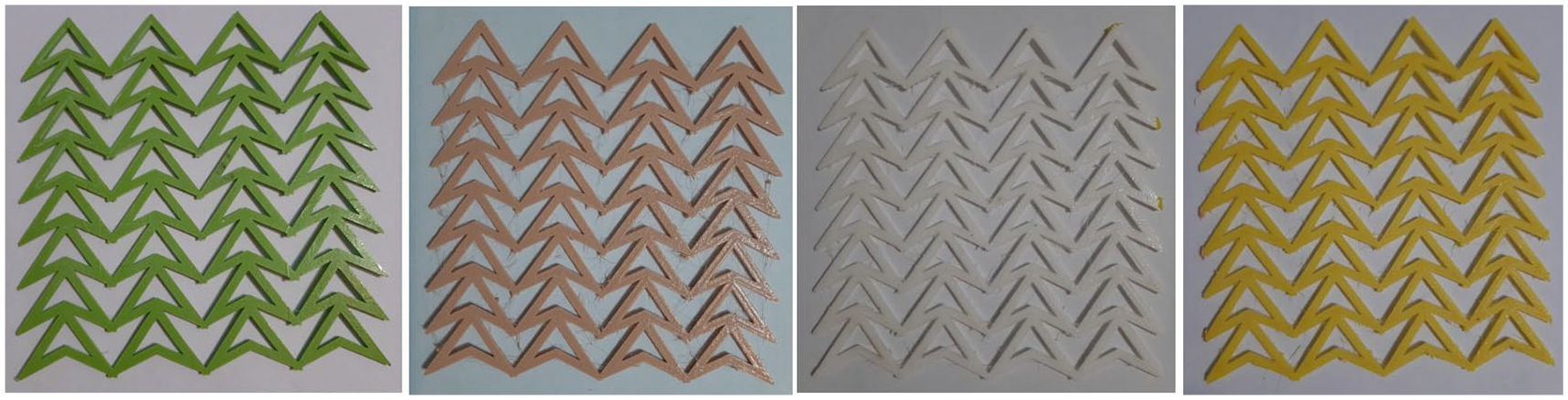
Structures 3D printed with FilaFlex material in four different colors.
Combining an auxetic structure with FilaFlex material makes the 3D printed dress more comfortable and usable. Figure 6 depicts the 3D printed structure fixed in clamps and stretched by hand to visualize changing of dimensions.

Behavior of the 3D printed structure during stretching process.
Joining the single printed structures to a whole dress is not an easy task due to the small contacting areas between the single structures. In Figure 7, a joining test with the 3D pen is visible, here combining structures with different colors for better visibility.

3D printed parts assembled by 3D pen.
The dress is designed, and the parts are exported for the 3D printing process. The 3D model is personalized with main dimensions of size 36. According to the area of dress patterns and taking into account the dimensions of the single structure of 130 mm × 130 mm, the total number of 3D printed structures is 33 pieces. Dress patterns around the 3D model as part of the process for virtual simulation are depicted in Figure 8.

Picture of the dress model designed in CLO 3D software.
The time needed to 3D print the dress is approx. 75 h. Figure 9 shows pictures (a) of 3D printed parts assembled by needle stitched on a mannequin, (b) the whole dress where the single parts are assembled by 3D pen, and (c) the finished dress where on both sides set belts are added to make it dressing and undressing easier.

(a) 3D printed parts assembled by needle stitched on a mannequin, (b) the whole dress, and (c) the finished dress with belts on both sides.
3D printing in fashion industry is evident by different applications for garment, footwear, or accessories. The work presented here is part of a project to create garments through 3D printing. Moreover, part of this work is online survey undertaken to evaluate consumer behavior for 3D printed garments. From the data gathered and analyzed, 89 respondents have heard about 3D printing. The information is taken mainly through social media, newspaper, and TV. In total, 60 respondents gave examples of advantages of 3D printing such as rapid prototyping, personalization, less waste, easiness to be used, and so on. A total of 63 respondents know about the use of 3D printing in fashion industry, and 79 respondents accept to wear a 3D printed garment. Reasons to wear a 3D printed garment are, for example, more fashionable clothes, unusual designs compared to the traditional methods of manufacturing, and so on. The other 21 respondents disliked typical 3D printing materials which are less flexible and comfortable compared to the materials used in traditional ways of manufacturing clothes.
Moreover, 88 respondents think that 3D printing will be beneficial for garment production. The last advantages related to the wastage of garments and the possibility to produce personalized garments even at home. Figure 10 depicts graphs for the main questions of the survey.

The main results of the survey.
Conclusion
3D printing as an innovative technology implemented in different areas of production has gained an increased interest in fashion industry. The work presented here shows another application for garment production using the FDM technology which is less expensive compared to the other 3D printing technologies. Due to the flexibility of FilaFlex material, the final dress is easily wearable. Nevertheless, there is still a lot of work to be done regarding materials, as they are still far away from the properties of textile materials.
3D printed garment are seen as a complimentary to fashion products. In the survey conducted to evaluate consumer behavior for 3D printed garments, the majority of respondents believe that 3D printing will be beneficial for garment production. This can be related with the wastage of garments and the possibility to produce personalized garments even at home. Even though 3D printing is used to realize designs without boundaries, it cannot replace the traditional way of garment manufacturing, but the latter can be used as an innovative technology in apparel products.
Footnotes
Declaration of conflicting interests
The author(s) declared no potential conflicts of interest with respect to the research, authorship, and/or publication of this article.
Funding
The author(s) received no financial support for the research, authorship, and/or publication of this article.
