




Abstract
In this study, we fabricated para-aramid flexible angle-ply-laminated hybrid composites based on weft-knitted reinforcements. Here, four kinds of weft-knitted reinforcements with rib, interlock, punto di roma, and two-thread fleecy were prepared using para-aramid spun yarn. They were then compounded with silicone rubber and waterborne polyurethane–acrylate using the coating method. The layers were angle-plied to produce stab-resistant, weft-knitting-reinforced, flexible laminated hybrid composites. Tensile and tearing strengths of the para-aramid-knitted reinforcements were investigated. Relevant response analyses were chosen to evaluate the influence of three independent variables, including weft-knitted structures, matrix types, and ply orientations. The results showed that the mechanical properties of the composites were dependent on weft-knitted structures and matrix types. The fabric with high strength and the degree in approximate isotropy of stress in all composites was most suited for the reinforcement of the flexible stab-resistant composite. The optimum design with the best stab-resistant property was punto di roma/waterborne polyurethane–acrylate with a ply orientation angle of [0°/0°/0°/0°]. The interlaminar adhesion of flexible stab-resistant composite based on waterborne polyurethane–acrylate can be improved by increasing the surface roughness of fabric structure or modifying its surface.
Keywords
Introduction
Increased international and domestic travel and increasingly frequent incidences in global terrorist attacks, have increased demand for protective clothing. Research has focused on developing personal protective products, leading to the rapid production of security products both by military and civilian organizations. 1 Although rigid, 2 semi-rigid and semi-soft stab-resistant materials3–5 have exhibited stab-resistant properties, their use is curtailed by important disadvantages, including high weight, clumsy wearing, low comfort, and a high cost, that limits their large-scale production. Novel, flexible, and stab-resistant fabrics without these disadvantages are therefore urgently needed. Stab-resistant fabrics should resist extrusion and cutting effects caused by objects. 6 Therefore, materials used for puncture resistance reinforcement, should possess the following properties: high strength and modulus, shear resistance, and impact resistance. 7 Currently, the most commonly used stab-resistant fiber materials include ultra-high molecular weight polyethylene (UHWMPE), aramid, poly p-phenylene-2,6-benzobisoxazole (PBO), ceramic fiber, carbon fiber, silk sericin, spider silk, polybutylene terephthalate (PBT), and polyester fiber.2,8,9 Para-aramid is one of the fibers most widely used in high-performance personal protective materials.10,11 Because of its exceptionally high strength and remarkable thermal stability, it is widely used in stress-bearing applications such as bulletproof body armor, shielding for sports equipment, and fiber-reinforced polymer composites used in the aerospace industry.10,12–14 The commonly used matrix materials include thermoplastic resin as well as rubber and shear thickening fluids.11,12,15 A novel type of liquid protective material has been recently developed. Liquid armor is a soft protective composite made by combining shear thickening fluids (STFs) with fiber fabric, which significantly improves its puncture resistance.12,16,17
Stab-resistant products occur in various forms depending on the type of protection needed, including traditional woven fabric, triaxial woven fabric, non-woven fabric,3,18unidirectional (UD) fabric, 15 newly developed multi-axial warp-knitted fabric, and spacer fabric. Woven fabric is among the most popular fabrics used for puncture resistance. Its structure is relatively tight, and its shear resistance is higher than that of knitted fabrics. However, once a yarn is broken, the warp and weft interwoven structure unravels. The knitted structure is flexible, comfortable to wear, and has good energy absorption upon low-speed impact, hence it is widely used.19,20 A novel auxetic weft-knitted fabric, based on the rhombus-shaped grid re-entrant structure has been developed. Experimentally, this auxetic weft-knitted fabric possesses a higher peak load and energy absorption capacity at quasi-static loading.
Research on the use of weft-knitted structure fabrics in stab-resistant products is limited. The research group has done research on the mechanical properties of weft-knitted fabrics. Compared with the plain, swiss pique, and purl stitch, the mechanical properties of the interlock are more prominent and stable, and it has the characteristics of ductility, small raveling property, and no edge-rolling. The two-thread fleecy is tightly organized and has stereoscopic visual effects. Here, four kinds of contrasting weft-knitted reinforcements with rib, interlock, punto di roma, and two-thread fleecy were prepared by para-aramid spun yarn to fabricate reinforcement. They were then compounded with flexible reins including silicone rubber and waterborne polyurethane–acrylate (WPUA) using the coating method. The layers were angle-plied to produce stab-resistant, weft-knitting-reinforced, flexible laminated hybrid composites.
Experiment
Materials
Para-aramid spun yarn was purchased from New Materials for Jiangsu Aidun Co. Ltd, China and had a fineness of 20 Ne. It was plied yarn comprising of three-ply staple spun yarns. The para-aramid spun a yarn had a breaking strength of 60.77 N and a breaking elongation of 4.5%. Silicone rubber was purchased from Dongguan Hongfeng Silicone Technology Co. Ltd, China. The silicone rubber possesses good corrosion resistance, high tensile and tear strength, low shrinkage, and high adhesion strength. WPUA was supplied by Zhejiang Good-poly New Materials Co. Ltd, China. This matrix has the synergetic properties of polyurethane and acrylic acid.
Fabrication of para-aramid weft-knitted reinforcement
Para-aramid spun yarns were fabricated into four kinds of weft-knitted structures (rib, interlock, punto di roma, and two-thread fleecy) using a CMS 530HP flat knitting machine (Gauge 14, STOLL, Germany) and prepared for reinforcements. Running speed was set at 0.4 m/s with a sinking depth of 10.5 mm. The specifications of para-aramid weft-knitted reinforcements are presented in Table 1. Among the four reinforcements, the punto di roma offered the most compact and stable structure, followed by interlock stitch. Due to a laid-in thread, the transverse ductility of the two-thread fleecy is greatly reduced, improving its structural stability. Rib fabric has the highest permeability, which improves the composite effect of the matrix.
Specifications of weft-knitted para-aramid reinforcements.

Manufacturing of weft-knitted flexible composites
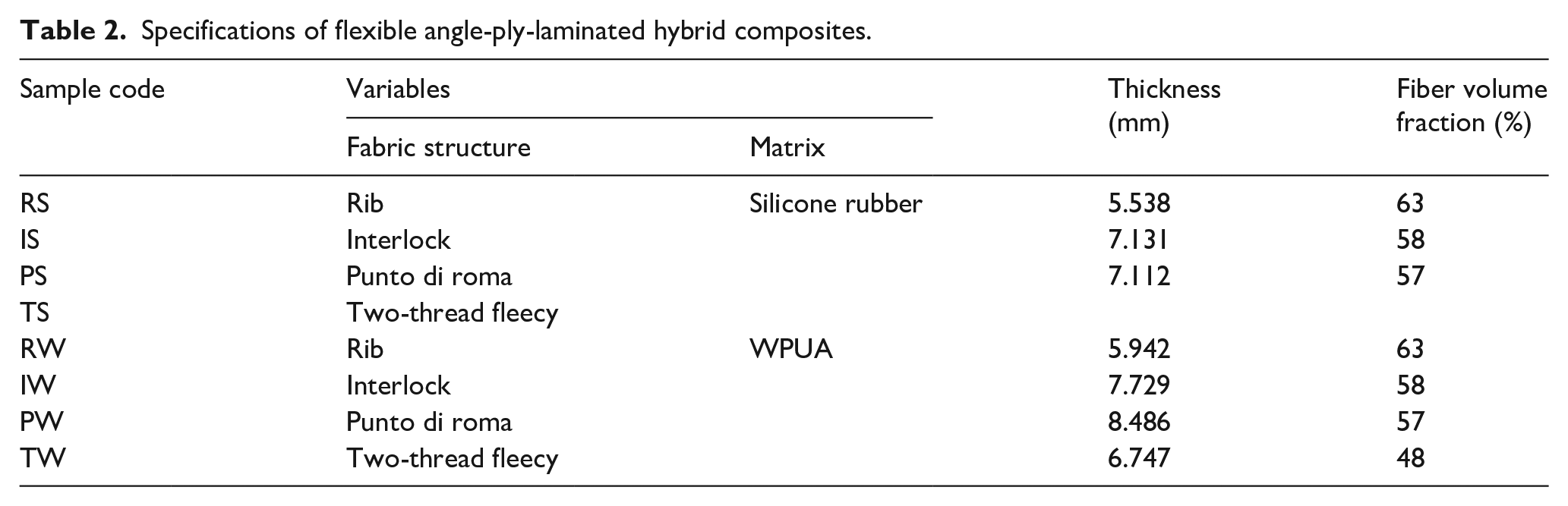
The flexible stab-resistant composites were manufactured in four main steps. Figure 1 is a schematic representation of flexible angle-ply-laminated hybrid composites and four weft-knitted structures. First, components A and B of the silicone rubber were mixed at a 1:1 weight ratio and defoamed for 30 min in a vacuum drying oven. Next, sufficient silicone rubber for the desired amount of matrix was prepared for a single coating compound according to the predetermined matrix mass fraction. The matrix was then evenly applied to the surface of the fabric. Next, the four layers of fabric were laid in turn following the specified angle-ply processing parameter. Each reinforcement structure had four different layering processes, [0°/0°/0°/0°], [0°/30°/60°/90°], [0°/45°/90°/−45°], and [0°/90°/0°/90°] (Figure 1(b)). Following lamination, thermosetting molding was done by incubating the materials in an oven at 120°C for 25 min. WPUA was defoamed in a vacuum drying oven for 20 min, and subjected to the same coating and laminating process. Because the two-thread fleecy exhibited serious edge rolling, it could not form an effective composite with WPUA, and the samples were discarded. Parameters for weft-knitted flexible angle-ply-laminated hybrid composites are shown in Table 2.

Structures of flexible angle-ply-laminated hybrid composites: (a) four weft-knitted structures and (b) stacking sequence of composites (e.g. taking 0°/45°/90°/−45°).
Specifications of flexible angle-ply-laminated hybrid composites.
Testing methods
Tensile testing
Tensile testing was done following the standard ASTM D5035-11 guidelines. Four kinds of single-layer weft-knitted fabrics were used in the tensile test. Five specimens were tested for each test condition. Testing was done using a universal testing machine (UTM5105, Sans, Shenzhen).
Tearing testing
Tearing testing was done following the standard ASTM D5587-15 guidelines. Four different types of single-layer weft-knitted fabrics were tested. Five specimens were tested for each test condition using a universal testing machine. The specimens were clamped in the shape of a trapezoid with 15-mm-long gaps in the middle. The trapezoidal area was regulated into an upper side length of 25 mm, the lower side length of 100 mm, and a height of 75 mm.
Peeling testing
Peeling resistance of weft-knitted flexible composites was evaluated using a UTM5105 electronic universal testing machine following ASTM D3936 guidelines. In this test, the composite material bound together using a double fabric into a 150 mm × 75 mm specimen (Figure 2). The gripper distance was 25 mm and the stretching speed 300 mm/min. On the peeling strength record curve, the average of peak values and valley values between 100 and 225 mm were recorded.

Test schematic of the peeling strength test.
Quasi-static puncture testing
The puncture resistance of para-aramid flexible angle-ply-laminated hybrid composites was evaluated using a Hongda universal strength machine at Tiangong University based on ASTM F1342 guidelines. The sample dimension was 100 mm × 100 mm. The diameter of the puncture probe was 4.5 mm. The punching speed was 1000 mm/min at a penetration angle of 0°. The fracture phenomenon after punching was evaluated by scanning electron microscopy (SEM) to study the interfacial bonding effect between fabric reinforcement and the matrix.
Results and discussion
Tensile properties analysis
Figure 3 shows the tensile load–displacement curves of weft-knitted reinforcements. Tensile load–displacement curves for the four samples revealed similar variation trends. After the deformation reaches a certain value, the rising trend of the load gets stronger and changes according to linear law until the specimen fails. Sample breakage resulted from structural characteristics of the fabric stitches and differences in transverse and longitudinal strength. This caused the yarns of the transversely stretched sample to break discontinuously, thereby increasing tensile deformation. However, longitudinal breaking strength decreased rapidly. The longitudinal tensile strength of the fabric was greater than the transverse direction because there were more longitudinally oriented yarns in the weft-knitted loops.

Tensile load–displacement curves of weft-knitted reinforcements in (a) transverse direction and (b) longitudinal direction.
In the process of tensile fracture, the external force gradually broke the elasticity and strength limits of the yarns, finally breaking the yarns one by one (Figure 4). The variation of fabric structure parameters was consistent with that obtained from the stress–strain curve of longitudinal tensile, indicating that different fabric structures and areal density greatly influence fabric tensile properties. In the longitudinal direction, tensile strength was highest in punto di roma at 694.08 N and was higher than that of two-thread fleecy by 64.45%. In the transverse direction, the tensile strength of the punto di roma–reinforced composite was the highest, 541.714 N, and was higher than that of the two-thread fleecy by 162.6%. Because each line is lined with yarn in the transverse, the breaking strength of the two-thread fleecy fabric is greatly improved. However, the tensile strain is too small, and the elongation is poor.

The breaking force of weft-knitted reinforcements in the transverse direction and longitudinal direction.
To meet puncture resistance requirements, a fabric needs good ductility, high strength, and should be quasi-isotropic. The punto di roma confers the fabric a compact structure, increasing the number of loops. The structure of interlock is relatively stable, tight in texture, and hard to ladder. The combination of the two structures further improves punto di roma’s tensile strength.
Tearing properties analysis
Figure 5 illustrates tearing load–displacement curves of weft-knitted reinforcements. There are many wave crests in the curves, indicating that the yarns broke one by one. Relative to the tearing form of woven fabrics, knitted fabrics possess good shear resistance and can attain a self-locking effect. It is apparent that elongation of the same weft-knitted structural reinforcement longitudinally is greater than transversal elongation which requires more stitches to withstand tensile forces, thereby making it hard to tear.
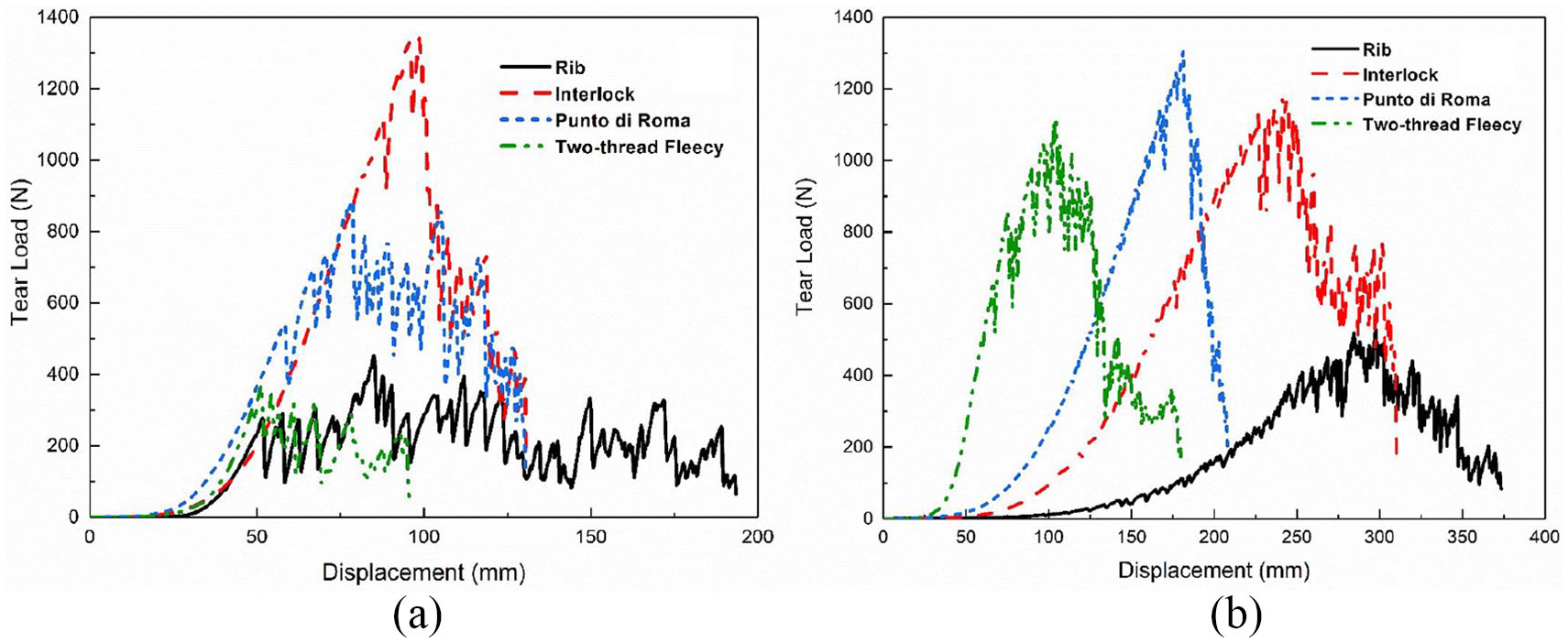
Tear load–displacement curves of weft-knitted reinforcements in (a) transverse direction and (b) longitudinal direction.
The transverse tearing strength of the interlock stitch was the highest, at 1342.05 N, followed by punto di roma at 922.69 N (Figure 6). In the longitudinal direction, the tearing strength of the punto di roma stitch was highest at 1261.39 N, followed by punto di roma at 1256.41 N. The tear deformation degree of punto di roma was smaller than that of interlock. Variation in fabric structure and areal density were consistent with those revealed by the stress–strain curve of longitudinal tearing. During tearing, fabric density affected the number of loaded yarn and yarn strength efficiency, and tear strength correlated with tensile strength. By comparing tear properties of the four reinforcements, the fabric structures best suited for reinforced composite materials are interlock structure and punto di roma structure.

Tearing force of weft-knitted reinforcements in transverse direction and longitudinal direction.
Peeling properties of weft-knitted structure-reinforced flexible angle-ply-laminated hybrid composites
Figures 7 and 8 show the peeling curves and strength of the weft-knitted structure, reinforced flexible angle-ply-laminated hybrid composites under various parameters. Various kinds of high and low peaks were apparent in the peeling curves of the various structures in the silicone rubber matrix composite (Figure 7). An imbalance in the interfacial adhesion was observed, indicating that the higher the difference between the high and low peaks, the poorer the material’s stability (Figure 7(a)). However, the adhesive force is larger, probably because the mechanical adhesive force between the resins plays a major role. The interlock silicone rubber matrix composites exhibited the strongest bonding in composite materials. A small difference between high and low peaks shows that WPUA forms a stable composite with para-aramid fibers (Figure 7(b)).

The peeling strength–displacement curves of flexible weft-knitted composites with (a) silicone rubber and (b) WPUA.

Peeling strength of flexible weft-knitted composites with different matrix types.
Composite materials were compounded by coating and laminating. The main bonding modes between interfaces were the mechanical adhesion between the reinforcement and the resin, the resin’s adhesion, and physical adsorption-diffusion. Three kinds of WPUA matrix composites of weft-knitted structures exhibit stable bonding properties (Figure 7(b)). Multiple polar groups, including urethane, ether, and ester groups are present in the main chain of the polyurethane molecule. These groups introduce a large number of chemically active hydroxyl groups and amide bonds on the fiber surface, significantly raising the surface oxygen content. This increases the bonding force between the reinforcement and the matrix. The characterizations of interfacing bonding force of composites through fiber surface modifying and resin modifying methods are worth further improvement and in-depth study.
Quasi-static puncture properties of weft-knitted structure–reinforced flexible angle-ply-laminated hybrid composites
This study had three variables, different weft-knitted structures, matrix types, and ply orientations. Therefore, sample names consisted of three letters, an initial for the structure name, an initial for the matrix material name, and a value representing the angle layer code. For instance, the ribbed silicone composite material layered with [0°/0°/0°/0°] was named RS-0.
Multivariate analysis of variance in SPSS revealed that the effects of reinforcement structure and matrix type were pronounced, and that the effect of the latter exceeded that of the former, while the influence of angle-ply parameters was not significant. After the puncture test, the fracture of the weft-knitted structural reinforcement composite was evaluated by SEM (Figure 9).

SEM images of (a) and (b) the surface composite of the PS-0 and PW-0, respectively; (c) and (e) punctured fracture morphology of the PS-0; and (d) and (f) punctured fractured morphology of the PW-0.
This analysis revealed that the bonding effects of the two matrixes on the fiber were different (Figure 9(a) and (b)). Because polyurethane possesses a high level of polar groups, which favors bonding with para-aramid fiber, it exhibited a stronger bonding effect. However, the surface of para-aramid fibers with coating silica gel was not closely combined. During the puncture process, the interface of PS-0 was subjected to shear stress, and the interface between the para-aramid fabric fiber bundle and the resin became clearly separated (Figure 9(c) and (d)). PW-0 produced matrix deformation and fiber slippage, but the bond between fiber and matrix was good and sturdy. The heat generated by the puncture shock caused the resin to melt and deform (Figure 9(e) and (f)). The fiber fracture was even, and a exhibited some fibrillation, indicating that failure was mainly through shearing.
Figure 10 illustrates the puncture performance of weft-knitted structure–reinforced flexible angle-ply-laminated hybrid composites with various parameters. The composite material with ply orientation angle of [0°/0°/0°/0°] had the best puncture resistance, and the composite material with a layering angle of [0°/30°/60°/90°] had the worst. The interlock and punto di roma had strong tensile and tear resistance, so the composite material has better puncture resistance. In terms of the composites, the highest tensile strength of flexible stab-resistant composite was punto di roma/WPUA with ply orientation angle of [0°/0°/0°/0°], which was 604.25 N.

Quasi-static puncture strength of flexible weft-knitted composites: (a) silicone rubber and (b) WPUA.
As shown in Figure 10, under the same treatment process, the puncture resistance of flexible composite has a great relationship with the material thickness. The thickness of the composite directly affects the absorption of puncture load. The composites with interlock and punto di roma structures have excellent properties. However, there is a big difference in puncture strength of composites under different matrix conditions.
In the process of puncture, when shear stress occurred at the interface, the flexible interface layer can effectively deflect the crack growth path, improve the interface failure mode and increase the interface energy absorption. In addition, when the fiber is pulled out, the deformation of the flexible interface layer will absorb a lot of energy, and ultimately can effectively improve the fracture energy of the composite. From Figure 8(a), compared with silicone rubber, WPUA had higher flexibility. As the bonding force between silicone rubber and yarn was higher, the loops were restricted by the rubber to form self-locking, resulting yarn breakage by puncturing. Therefore, the flexible weft-knitted composites based on polyurethane have a better performance on stabbing in general.
Conclusion
The aramid fiber used as the raw material belongs to the high-strength, low-elongation fiber, which has high specific strength, high specific modulus. Moreover, it has high heat resistance and provides excellent thermal properties for the composite materials. The effects of weft-knitted structures, matrix types, and ply orientations on the properties of flexible weft-knitted puncture resistant composites had been investigated. The results showed that the mechanical performances of the composites mainly depended upon the weft-knitted structures and the matrix types. Rib fabric had low strength, great difference in mechanical properties between transverse and longitudinal, and poor puncture resistance. The two-thread fleecy had poor elongation and serious curling phenomenon. The interlock and punto di roma structure had excellent mechanical properties, which can provide good puncture resistance. The stab-resistant properties of WPUA-based composites were better than those of silicone rubber. The ply orientation angles of the reinforcements had some influence on the mechanical properties of the composites. The composite material with ply orientation angle of [0°/0°/0°/0°] had the best puncture resistance. The optimum design obtained the best stab-resistant property was punto di roma/WPUA with ply orientation angle of [0°/0°/0°/0°].
Footnotes
Declaration of conflicting interests
The author(s) declared no potential conflicts of interest with respect to the research, authorship, and/or publication of this article.
Funding
The author(s) disclosed receipt of the following financial support for the research, authorship, and/or publication of this article: This work was supported by the Foundation of Hebei Education Department (QN2018038); the doctoral program of HEBUST(1181240); Hebei Natural Science Foundation (E2019208424); and Youth Talents Plan of Hebei Province.
