




Abstract
The effect of different stitch combinations, namely, knit, tuck and miss stitches, on some of the physical properties of single jersey derivative fabrics have been studied. Fabrics which are in common commercial use in the textile industry were selected, and they are used as clothing fabrics. Knitted fabrics from 100% cotton yarn of 19.67 Tex on circular knitting machines were used in the study. The effect of knit structure on areal density, fabric thickness, air permeability, drape ability, stretch and recovery, shrinkage, and low-stress mechanical properties are investigated, and it was found that these properties are significantly affected by loop shape or knit structure, even though other knitting parameters remained the same. It was also found that the presence of tuck and float stitches for a given structure have a significant effect on fabric drape ability, width-wise extensibility, length-wise shrinkage, thickness, areal density and low-stress mechanical properties.
Introduction
Plain, rib, interlock and purl are the four basic wefts knitted structures from which all other weft-knitted structures can be derived. The physical and mechanical properties of these basic structures differ widely. Due to the structural difference, knitted fabrics are used in different applications. 1 Different stitches and stitch combinations affect the properties of knitted fabric. The physical property of knitted fabric mostly depends on loop structure, stitch density, types of yarn ring, rotor, compact, type of raw material fiber, composition of yarn, twist level, and so on. 2 In addition to the knit structure, there are different factors, which affect the physical properties of weft-knitted fabrics. Some of them are:; yarn variables, such as yarn strength, count, evenness, twist, extensibility, rigidness and finishing treatment; machine variables such as machine gauge, speed, needle timing, needle arrangement, knitting elements and so on; knitting variables such as feeding type or input tension and fabric takedown tension; and state of a fabric, such as obtained just after production from knitting machine, dry relaxed state, fully relaxed state and finished state. 2
A loop is a stitch exhibiting four binding or interlacement zones, that is, two around the needle loop and two around the base. If however, the two zones of interlacement around the base are done away with, then a new structural element, namely the tuck is formed. Furthermore, if all the four binding zones are removed then evidently a straight segment of yarn, namely the float would materialize. A tuck stitch is composed of a held loop, one or more tuck loops and knitted loops. Tuck loops reduce fabric length and lengthwise elasticity because the higher yarn tension on the tuck loop causes them to rob yarn from adjacent knitted loops, making them smaller and providing greater stability and shape retention. 3 A miss stitch or float stitch is composed of a held loop, one of more float loops and knitted loops. Miss stitch (float stitch) fabrics are narrower than equivalent all-knit fabrics because the wales are drawn closer together by the floats, thereby reducing width-wise elasticity and improving fabric stability.
In knitting industries, many derivatives of single jersey construction can be developed by knit, tuck, float stitches and their combinations for different reasons mainly for design purposes, and they also give stability and improve some physical properties of knit fabrics. However, the different stitch combinations have a significant effect on dimensional and comfort properties of single jersey knitted fabrics. The tuck and miss loops have a significant effect on the bursting strength of weft- knitted fabric. As the number of tuck loop increased, the bursting strength gradually decreased on single pique, double pique, single lactose, double lactose and all-knit loop containing fabric (plain single jersey). Different stitches have different physical and mechanical properties. The effect of fabric structure on the fabric width was investigated and was found that the loop shape at the tuck stitch is distorted and has a wider base as the side wales are not pulled together. 4
It was also observed that fabric containing a tuck loop has lower bursting strength than fabric containing a miss loop. 5 The investigation showed that the number of tuck stitches and its position affect the bursting properties of knitted fabrics. The effect of stitch length on dimensional and mechanical properties of three different structures of knitted fabrics such as single jersey, single lactose and double pique were also studied. When the stitch length was increased, the dimensional stability of fabric gradually decreased. 6 One of the major problems in knitted fabrics is that it will curl on the edges when they are cut and laid free. That is due to the unbalanced loop structure and the yarn torque inside the fabric, which tends to recover the original shape of the yarn. Since the edges of a piece of fabric are free for movement, they are more likely to curl. The curling is one of the disadvantages of single jersey knitted fabrics. It results in cutting, sewing, and linking problems. The curling properties of the knitted fabric are highly dependent on knit structure and yarn twist. 7
Airflow through textiles is mainly affected by the pore characteristics or dimension and fabric construction parameters. Some of the fabric construction parameters that affect the air permeability of fabric are yarn fines, density and the type of knitted structure. The air space distribution influences a number of important fabric properties. The air permeability and the porosity of a knitted structure will influence its physical properties, such as the bulk density, moisture absorbency, mass transfer and thermal conductivity. 8
The effect of stitch length and yarn count on shrinkage and spirality, and areal density, that is, grams per square meter GSM were investigated. It is observed that the stitch length or loop length has the most significant effect on Spirality and GSM of cotton single jersey fabric. In the same way, the count of yarn also influences them. In fact, Spirality increases with the increment of Stitch length as well as yarn count with some exceptions. When yarn count increases Spirality increases and vice versa. 9 In addition to other knitting and yarn parameters, the effect of stitch type has an influence on the bursting strength of knitted fabrics. Wale-wise and course-wise increment of tuck loop reduces bursting strength gradually. 10 The type of knit structure has an effect on extensibility and strength of knitted fabrics. 11
The knitting parameters particularly yarn feeding load has an effect on fabric on fabric relaxation appearance and structures. Increasing the yarn feeding load builds up strains in the yarn, impacting loop formation as well as the fabric structure, appearance and behavior in relaxation. 12 The effect of twist multiplier (TM) on cotton ring and compact yarn were investigated, and it was understood that TM has a significant effect on drape properties of knitted fabrics. 13 In general, many researchers have done work on the effect of knitting parameters on some physical properties, and they studied the effect of yarn parameters mainly yarn count, types of raw material, and yarn twist on mechanical and dimensional properties of knitted fabric. Few researchers have also done work on the effect of knitting parameters mainly machine gauge, stitch density feeding and takedown tension on fabric dimensional and comfort properties, such as shrinkage, Spirality, bursting, pilling and air permeability.14,15 The present work is focused on the combined effect of three different types of stitches (knit stitch, tuck with knit stitch and knit with miss stitch in equal proportion) on some of the physical properties of single jersey knitted fabrics such as areal density, fabric thickness, air permeability, drape ability, stretch and recovery, and shrinkage.
Materials and methods
Materials
Knitting machine
Circular weft knitting machine equipped with different types of cams (knit, tuck and miss cams) was used in the study. The machine parameters are shown in Table 1.
Machine parameters.

Yarn
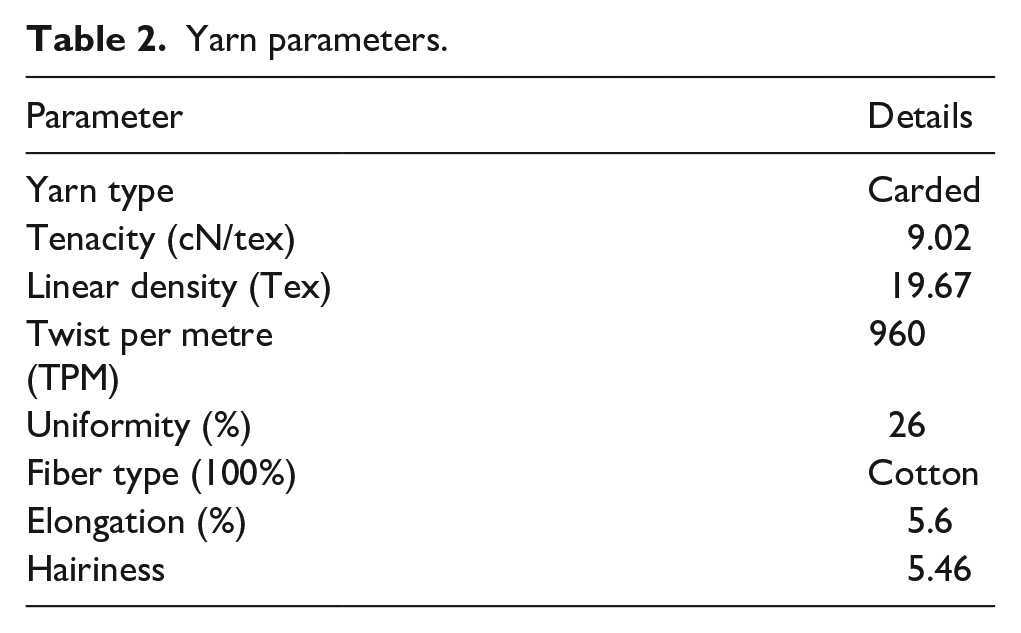
All structures were produced from a single type of yarn with parameters as shown in Table 2. The cotton yarn made out fibers that had Fiber bundle tenacity of 28.78 cN/tex, upper half mean length of 2.69 cm, uniformity index of 81.5, micronaire of 4.09 and short fiber content (%) by weight of 11.69 was used in the study.
Yarn parameters.
Methods
Sample production
Three different single jersey derivative structures made from tuck stitch, knit stitch and miss stitch incorporated with knit stitch were produced (Figure 1). The parameters were shown in Table 3.

Types of stitches: (a) knit stitch, (b) tuck stitch and (c) float stitch.
Fabric structures produced.

Single jersey structure
For single jersey, the structure was produced using a knit cam with the same butt position of needles as shown in Figure 2.

Cam and needle arrangement single jersey structure: (a) knit cam, (b) tuck cam and (c) miss cam.
Cross miss structure
For cross miss, the structure was produced by the following cam and needle arrangement as shown in Figure 3.

Cam and needle arrangement of cross miss structure: (a) design repeat, (b) feeders, (c) cam order (two truck level) and (d) needle arrangement.
Single pique structure
Single pique structure was produced by the following cam and needle arrangement as shown in Figure 4.
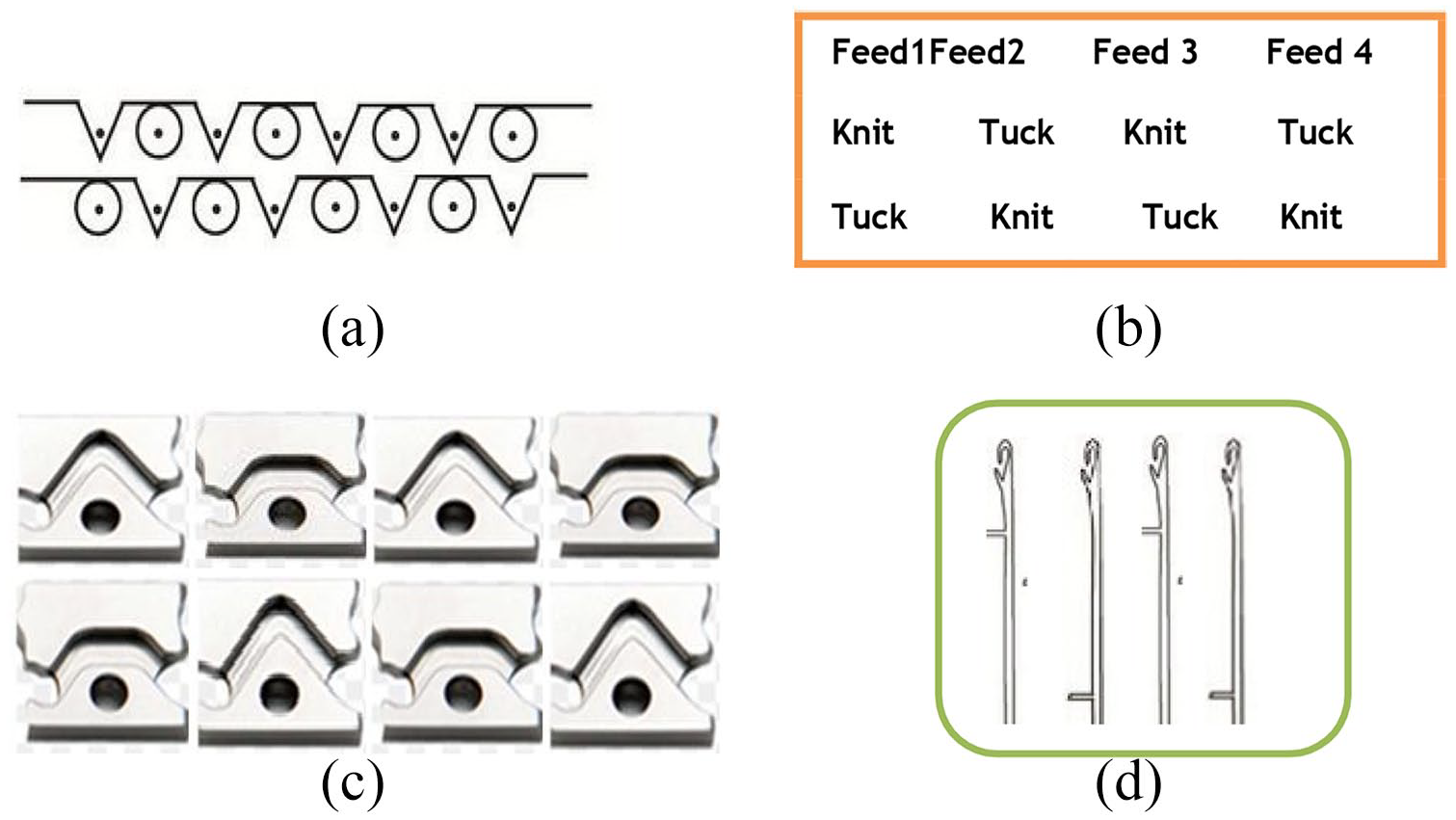
Cam and needle arrangement of single pique structure: (a) design repeat, (b) feeders, (c) cam order (two truck level) and (d) needle arrangement.
Fabric evaluation
After knitting, the various physical properties of knitted fabric samples were tested in accordance with the relevant standards. Fabrics used for this study were selected based on common commercial use in the textile industry, and they are common in clothing fabrics and are commercially available. For example, single jersey, single pique and cross miss structures are used for making outerwear, active wear, under wear and so on. Pre-conditioning of all fabrics was carried out in a conditioning chamber at 65% relative humidity and 20°C for 24 h before each testing. In all tests, measurements of the fabric were carried out on seven samples for each structure and the average value was reported.
Stitch length
It is the length of yarn in millimeter (mm) for one loop. The loop value was measured by taking 70 wales. The wales are marked on the fabric surface, and then the yarn was unraveled, straightened and measured in mm. By substituting the measured values in the formula, the loop length was measured

Air permeability
Air permeability is defined as the volume of air (in liters) that is passed in 1 min through some specific area of fabric at a pressure difference of 10 mm head of water. Air permeability is an important factor in textile performance because it indicates the breathability of textile fabrics. Air permeability was measured according to the ES ISO 9237 using Tester FX3300.
Drape
The most widely accepted method of drape test, according to ISO 9073- 9 uses is the drape meter. Before measuring to relieve localized stresses caused by handling during preparation, the samples were conditioned. There are three diameters of spacemen (24 cm for limp fabric, 30 cm for medium fabric and 36 cm for stiff fabric) that can be used. For this work, a 30 cm diameter specimen used.
To measure the areas involved, the whole paper ring is weighed and then the shadow part of the ring is cut away and weighed. The stiffer a fabric is, the larger is the area of its shadow compared with the unsupported area of the fabric. The paper is assumed to have a constant mass per unit area so that the measured mass is proportional to the area (Figure 5). The drape coefficient can then be calculated using the following formula


Drape ability of knit fabrics.
The higher the drape coefficient is, the stiffer is the fabric.
Fabric weight (GSM)
This test was carried out according to ISO3801. Using a Metler make digital measuring balance, it was measured by using a cutting device (round, area 100 cm2).
Fabric thickness measurement
A Digital thickness gauge (MESDAN, model: D-2000) was used to measure the thickness of the fabric samples in accordance to ASTM D1777-96. 100 KPa was used for the testing.
Dimensional properties
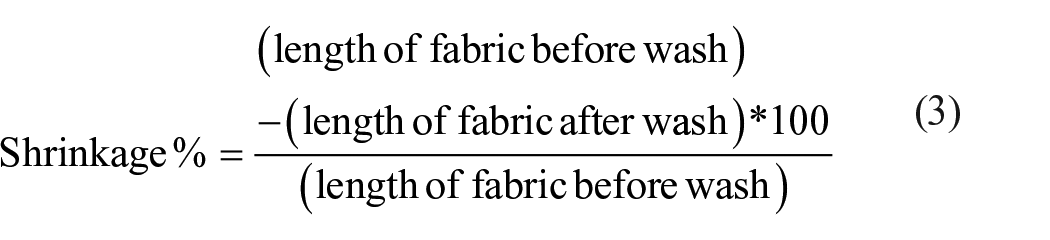
There are different factors that affect the dimensional property of knitted fabrics, such as fiber type, relaxation/finishing route, yarn linear density, fabric structure and twist level. However, for this study only fabric structures were considered. The dimensional stability (shrinkage) test was measured according to ISO 6330. In the test method, a washing machine to wet out (swell) the fiber/fabric under tensionless conditions was used. For the three structures, seven samples each were prepared with a dimension of 65 mm × 65 mm and was washed for one hour at 60º C using standard detergent (soap 5 g/l). Finally, the samples were dried using mini drying machine and shrinkage percentage calculated using the following formula
Extensibility (stretch and recovery) test
Extensibility was measured according to ASTMD2594 using Extensometer. Specimens were prepared using a template size of 75 mm × 85 mm. After transferring the specimen to the clamp of the tester, by adding 3 kg of load that is recommended for knitted fabric, the specimens were allowed to stretch and recover (Figure 6), and finally the results were measured, calculated and reported.

Experimental setup for stress and recovery test.
Results and discussion
Some of the properties such as thickness, areal density, air permeability, and drape coefficient of the single pique cross miss and single jersey fabrics knitted with 19.67 Tex cotton yarns are presented in Table 4.
Some fabric properties of different knitted structures.

Effect of different stitches on air permeability
Air permeability is an important factor in the comfort of a fabric as it plays a role in transporting moisture vapors from the skin to the outside atmosphere. It provides clothing comfort to the wearer. Air permeability is often used in evaluating and comparing the “breathability” of various fabrics for end-uses, such as T-shirts, jackets, underwear and some outerwear garments, raincoats, tents and uniform shirtings. An experiment to determine the air permeability is very important as it defines the properties of keeping warm, protection against the wind, breathability and so on of knitted fabrics used as clothing.14,15
Table 4 shows that all the three structures have different air permeability value even though some knitting parameters, such as yarn count, loop length, machine gauge, and so on remain the same. The values obtained from these three different types of structures are significant ranging from 88.8 cm3/cm2/s for a single jersey to 122 and 116.3 cm3/cm2/s for single pique and cross miss, respectively. The air permeability values obtained from single pique knit fabric is significantly higher than single jersey structures. This is due to the presence of tuck stitch and in general, when the amount of tuck stitch in a given fabric increases, the fabric becomes open and more porous. 16
In the same manner, cross miss structures are highly permeable than single jersey fabrics, and this is due to the presence of held loop, which makes the fabric open than normal knitted loop structures. It is also more permeable than a single jersey due to the presence of held loop, which makes the loop tighten and porous. However, the air permeability value of a single pique structure is not significantly higher than cross miss structures. This is due to the fact that like single pique, cross miss structure also has held loop, which makes the fabric open and permeable.
Effect of knit structure on fabric thickness
From Table 4, it can be observed that the thickness of cross miss fabric is higher than single pique and single jersey fabric structures. This is due to the presence of the float stitch that is having missed (float) yarn floating freely on the reverse side of the held loop, which increases the fabric thickness by providing additional yarn, which is not intermeshed through the old loop. This is also the reason for cross miss structure showing more thickness than single pique and single jersey structures. Single pique is also thicker than single jersey due to tucked yarn over the held loop, which increases fabric thickness than a normal knitted loop. A tuck stitch is composed of a held loop, one or more tuck loops, and knitted loops. It is produced when a needle holding its loop also receives the new loop, which becomes a tuck loop because it is not intermeshed through the old loop, but is tucked-in behind it on the reverse side of the stitch. In single jersey, there is an extra yarn that neither floats nor tucked on to the knitted loops. The structure contains only knitted stitches. As a result, it has a lower thickness compared to single pique with tuck stitches and cross miss structures with miss stitches.
Effect of fabric structure and thickness on air permeability
It is known that the fabric thickness has an indirect correlation with air permeability, that is, when fabric thickness increases, air permeability decreases, and the reverse is true. However, the above test result did not show this correlation, as occasionally, thick fabric might be highly permeable than thin fabric. This is due to the difference in fabric construction (the way the loop is arranged and the loop shape). From the results shown in Table 4, cross miss structure is thicker than single jersey and single pique fabrics. This is because of the presence of float yarn, which is not knitted, but rather floats on the back of held loop and provides additional thickness. However cross miss structures are highly permeable than single jersey due to the presence of the held loop, which makes the fabric open and porous than the normal knitted loop. A held loop that is found on cross miss structure is an old loop that the needle has retained. It is not released and knocked-over until the next, or a later, yarn is fed. A held loop can only be retained for some knitting cycles. This action makes the loop tighter/longer that makes the structure porous. Similarly, on a single pique structure, there is a held loop that has the same effect on air permeability even though there are different stitch arrangements. Therefore, the changing of stitch combination shows held and tuck loop and held and float loop that influences the air permeability value. In general, we can conclude that the air permeability of knitted fabric is highly influenced by loop arrangement or loop shape and always might not have an indirect relation with fabric thickness.
Effect of knit structure on fabric weight (areal density)
Test results have shown that knitted structures have a crucial influence on fabric areal density even if the processing parameters remain the same. It can be seen that fabric with tuck loops is heavier than fabric having knit loops due to the accumulation of yarn at the tucking place. Therefore, single pique has a higher areal density than cross miss and single jersey structures. In the same manner, due to the presence of float yarn, cross miss structure shows higher GSM value than single jersey structures. A tuck stitch contains a held loop, more tuck loops and knitted loops. Therefore, there is an additional tucked or accumulated yarn, which is not knitted over the old loop that increases the mass of the knitted fabrics. Single pique has a higher areal density than cross miss and single jersey structures. In the same manner on cross miss structures, as mentioned above, there is a floated yarn on the reverse side of the stitch. The float used to connect the adjacent wales and make the fabric narrower. Due to these reasons, cross miss structure shows higher GSM value than single jersey structures.
Effect of fabric structure on drape ability
As discussed above, drape is an essential parameter to decide both appearance and handle of fabrics. It is also a secondary determinant of fabric mechanical properties and influenced by the low-stress mechanical properties, such as bending rigidity, formability, tensile and shear properties, and compressibility of the fabric. The way in which a fabric drapes or hangs depends largely on its stiffness, that is, its resistance to bending and its own weight. Fabric bending behavior has been the focus of many investigations. A fabric’s bending characteristics contribute to differences in the way it conforms to the body. The drape coefficient (F) is the most fundamental parameter for quantifying drape and the most widely used for textile materials. It is observed over a decade that consumers prefer to wear lightweight fabrics. At the same time, fabric comfort has gained priority over fabric durability. The test result shown in Table 4 indicates that the drape ability of a knitted fabric is significantly influenced by knit structure even if the other knitting parameters remain the same.
It is also clear that cross miss structures have higher drape coefficient value than single jersey and single pique structures. This is due to the presence of floating yarn (float stitch) that connects adjacent wales close to each other. This provides greater fabric stability and less flexibility than single jersey and single pique structures. The higher the drape coefficient, the stiffer is the fabric. Similarly, the drape coefficient value of a single pique structure is significantly higher than single jersey. However, the drape coefficient value of cross miss structure is not significantly higher than single pique. On a single pique structure, there are many tuck loops, which make the fabric more stable. This is due to the higher yarn tension on the tuck loop that causes yarn robbing from adjacent knitted loops, making them smaller and providing greater stability than normal knit structures. Like float stitch, the presence of a tuck stitch provides greater fabric stability on a given knitted fabric as compared to knitted stitch. In general, all structures have a good drape coefficient as this value anywhere between 30% and 85% is always considered good.
Effect of fabric structure and areal density on drape ability
Drape is the term used to describe the way a fabric hangs under its own weight but according to the present study, fabric weight has a lesser role in fabric drape ability. As it was mentioned above, a single pique structure has higher areal density than single jersey and cross miss structure but lower drape coefficient value than cross miss structure. This is due to the difference in loop shape and its arrangement, which makes the fabric stable. The fabric drape ability and fabric weight values are shown in Table 4. Therefore, drape ability or flexibility of a given knitted structure is not only dependent on the fabric weight, rather the way in which the loop is arranged and also the loop shape that affects the drape ability of the knitted fabric.
Effect of tuck and miss stitches on dimensional properties
It is well known that weft knitted fabrics tend to undergo large changes in dimensions and are often prone to distortion upon laundering. It is also a fact that consumers are becoming increasingly concerned about fabric quality on dimensional stability. A large number of factors are responsible for causing these undesirable effects in knitted structures; these are all associated with the yarn, finishing and making-up of the fabrics, but for this work, only knit structure was investigated. Shrinkage is the process in which a fabric becomes smaller than its original size, usually through the process of laundry. Cotton fabric suffers from two main disadvantages of shrinking and creasing during subsequent washing. Shrinkage can be negative or positive and this expressed (shrinkage) by means of a minus sign (-) or increased (extension) by means of a plus sign. There are two types of shrinkage that occurs during washing such as Length-wise and Width-wise shrinkage. Both width-wise and length-wise shrinkage were analyzed in the present study and the mean changes in dimensions in both the length and width directions are shown in Table 5.
Shrinkage value of different knitted fabrics (sample size 65 mm × 65 mm).

Drying shrinkage is defined as a dimensional change in a fabric when “de-swelling” of fiber, yarn and construction occurs in the drying step. The structure shrinks upon itself because of the physics of drying. This confirms that any dimensional changes (shrinkage) that occurred during washing and drying treatments caused due to changes in loop shape rather than yarn or loop length shrinkage. Knitted structures have an important influence on the dimensional stability of the knitted fabric.
The results obtained for the dimensional stability tests are significantly different for the three fabric structures, due to the distinct nature of each structure. Moreover, there was a considerable amount of change within the structure. Single pique was reduced by 3.4% in width-wise and 6.5% in wale-wise which is almost comparable to the values obtained for cross miss structure. This is due to the higher yarn tension on tuck loop causes then to rob yarn from adjacent knitted loops, making them smaller and providing greater stability and shape retention.
Cross miss structures have high length-wise shrinkage than single pique and single jersey. This is due to high yarn tension during the preparation of fabric, which results in the excess stretch in yarn, and due to swelling of fibers on float yarn. These provide more variation due to the higher potential relaxation possible in the length direction. Float yarn caused shrinkage in both course and wale-wise of knitted fabrics due to drawn-closer together-loops by the floats. Sometimes yarn overlapping caused release in course-wise and shrinkage in wale-wise. Single jersey structure shows positive and negative shrinkage in width and length-wise direction respectively. The unbalanced nature of the loop structure causes the fabric to be more susceptible to distortion as it was shown above. The shape of the loop before washing and after washing was different. After washing, the loop reduces its height and becomes wider. Consequently, the fabric shows high dimensional instability in both directions. The plain single-jersey fabric appeared to spiral significantly after washing.
In all structures, the largest percentage of shrinkage was observed length-wise. This is generally indicated by the loops becoming wider and shorter, and they even overlap as the loops distort into the third dimension. Therefore, it would appear that all three fabrics were susceptible to length shrinkage. Normally, shrinkage of less than 5% is acceptable. Width-wise shrinkage of all structures is within the acceptable limit. In general, after washing the length of knitted loops become smaller or larger and the fabric will shrink positively or negatively in the width and length direction. However, the magnitude of the change (shrinkage) highly depends on the shape of the loop which constitute a fabric.
Fabric extensibility (stretch recovery) property
Once a knitted structure has been stretched in use, a fabric should contract or recover to its original dimension. This study has shown that knitting structure has a significant influence on wale and course-way extensibility even though other knitting parameters remain the same. Table 6 shows the effect of knit structure on fabric extensibility (stretch recovery) property. It was noticed that, when the structure has tuck stitch, there is a significant increase in width-wise extensibility values, but a significant decrease in length-wise extensibility values. The results show that single jersey structure has higher extensibility and recovery value as compared to single pique and cross miss structures. This is due to the geometry or shape of the knitted loop and its arrangement, which makes the fabric highly extensible and recoverable, than other loop structures (tuck and float stitch). Comparatively, single pique has higher width-wise extensibility and recovery values but lower length-wise extensibility and recovery value. This is due to the fact that, tuck loops reduce fabric length and length-wise elasticity because of the higher yarn tension on the tuck and held loops that cause them to rob yarn from adjacent knitted loops, making them smaller. Therefore, the fabric width is increased because of tuck loops pulling the held loops downward, causing them to spread outwards and make extra yarn available for width-wise extensibility and recovery.
Stretch and recovery value of different knit fabrics.

The length-wise extensibility and recovery of cross miss structure are relatively lower than single pique and single jersey. This is because of floating yarns, which connect the adjacent wales closer together, and reducing width-wise elasticity and improving fabric stability. Float yarn has reduced the course-wise elasticity and increased the wale-wise elasticity of knitted fabrics; however, overlapping of yarn reduced elasticity in both directions. The stretch value in course-wise is influenced by yarn floating, rather than loop overlapping while the stretch value in wale-wise is caused by loop overlapping versus yarn floating.
Conclusion
Knit, tuck and miss stitches can be combined to produce different stitch designs. From this study, it was shown that almost every stitch has a significant effect on dimensional and comfort properties even when other knitting and yarn parameters remain the same. It was found that the presence of a tuck stitch in a given structure increases air permeability, areal density, width-wise extensibility and length-wise shrinkage. The tuck stitch also gives moderate drape ability, thickness and reduces length-wise stretchability. Float stitch has a significant effect on fabric drape ability, width-wise extensibility, fabric weight, length-wise shrinkage, thickness and areal density. Compared to single jersey and single pique, it has lower width-wise extensibility and recovery. Float stitch also gives high bending rigidity, bulkiness and smoother fabric surface. Knit stitch has no significant effect on fabric air permeability, areal density and thickness. However; it has higher drape ability, extensibility and recovery values than tuck and miss stitches. It has positive shrinkage in width direction due to the change of knitted stitch after washing. In all stitch designs, there is a high percentage of length-wise shrinkage. After washing (wet relaxed state) loops become wider and shorter. The length of knitted loops becomes smaller or larger and the fabric shrinks positively or negatively in the width and length direction. However, width-wise shrinkage of all structures is within the acceptable limit. In general, tuck and miss stitches increase fabric stability, and knit stitch increases fabric flexibility and extensibility.
Footnotes
Declaration of conflicting interests
The author(s) declared no potential conflicts of interest with respect to the research, authorship, and/or publication of this article.
Funding
The author(s) received no financial support for the research, authorship, and/or publication of this article.
