




Abstract
This article presents the results of research in selecting the most appropriate natural fibers to be used as reinforcement (normally in the hybrid form) in polymer composites for the automotive crash box by carrying out the materials selection process using the Six Sigma method. The judgment based on results from Six Sigma integrated two decision methods, which were applied using two different approaches in decision making: qualitative method and quantitative method. In this study, oil palm fiber had been proposed as the most appropriate natural fiber to be selected as reinforcement in composite automotive crash box. The DMAIC approach from the Six Sigma method performed an important role by providing various tools for each phase in the material selection process. The final selection process led to selection of oil palm fiber as the best natural fiber to reinforce polyurethane as polymeric matrices due to the satisfaction of all the selection criteria.
Keywords
Introduction
Material selection is one of the most important activities in the design process, and this has drawn the awareness of researchers for more than 20 years. 1 An unsuitable selection of materials may result in the destruction or failure of an assembly and can substantially decrease its performance. It has been found that the cheapest price might not be the encouraging approach to achieve the optimum material, and this is why multi-criteria decision making (MCDM) methods have become popular in this field.
In this study, a method called Six-Sigma (
From the above review summary, it can be seen that the
Description of the ACB
The crash box is a device assembled at the front end of a car side frame to absorb the kinetic energy during collisions. This device is expected to collapse with the crash energy absorbed to reduce the damage of the main cabin frame, as well as to save the occupants.37,38
Figure 1 shows the schematic diagram of a vehicle frontal structure crash management system which consists of a bumper cover at the outermost part assemble to the hood, a bumper energy absorber, a bumper rail, and a crash box connected to the longitudinal beams of the car.

The schematic diagram of a vehicle frontal structure. 37
Methodology of materials selection of natural fibers for the composite ACB
Figure 2 describes the

Process flow of materials selection using the
Step 1: define
Materials selection is one of the most important processes, which determines the quality of the design from both an engineering and an economical point of view. It is vital to know the factors affecting materials selection as shown in Figure 3 before commencing the materials selection process. Cost is a critical factor to consider when selecting materials for certain products due to economic constraints. Cost always fluctuates based on competition and availability of the material in the market. The high capability of biodegradability, recyclability, reuse capability, and the use of corrosion-free materials are other selection factors which were considered to ensure the longer life span of the product.

Mind mapping of material criteria needs for ACB.
The crashworthiness department of the automotive industry is continuously attempting to reduce the product weight by selecting the lightest material to obtain high-performance ACBs. The most important criterion for crash box material is toughness, where higher toughness provides better energy absorption capability. 43 Toughness properties require stability of strength and ductility. 44 Materials with good toughness properties are required, where toughness is the energy of mechanical deformation per unit volume prior to fracture, and it can be defined as the ability to absorb kinetic energy up to the point of failure. In addition, there are several other requirements in materials selection to select the most appropriate natural fibers in ACB, as summarized in the product design specification (PDS) of Table 1. The material selection process analyzed important design parameters based on the PDS, which is a specification document on the product (ACB), prepared at the outset of the research. However, it has not been presented here for the sake of brevity. The material must demonstrate an improvement in density to acquire the lightweight part, that is, lower than 2.81 g/cm3 or below the total weight of 1.5 kg. 45 The material must also have a high value of elongation at break to provide better toughness properties. In addition, the candidate material must be available (no shortage of resources), must have low moisture content to protect from the formation of cracks in the fiber, must have high tensile strength for durability, and must have a high percentage of hemicellulose to be able to produce an environmentally friendly product with high biodegradability.
Summary of the product design specification for the selection of natural fibers.

Step 2: measure
In the “measure” stage, the hierarchical framework was divided into five levels as depicted in Figure 4; the rank criteria in this hierarchy framework was extracted from Figure 3 and Table 1 where the top level of hierarchy specified the overall goals, which was to select the best natural fiber material for ACB. The second level specified the main criteria or factors influencing the goal defined, such as the high performance of the material, lightweight material, and material with high sustainability to protect health as well as being environmentally friendly, where the detailed definition for each criterion has been provided in Table 2. The third hierarchy level was sub-criteria 1, where this level narrowed down the specific criteria to achieve the goal. The fourth hierarchy level was the sub-criteria 2, which listed all natural fibers constraints based on the sub-criteria 1 and these needed to be prioritized. The fifth level was a set of alternatives which recognized possible solutions that were used to select the most appropriate natural fiber in order to achieve the desired goal.
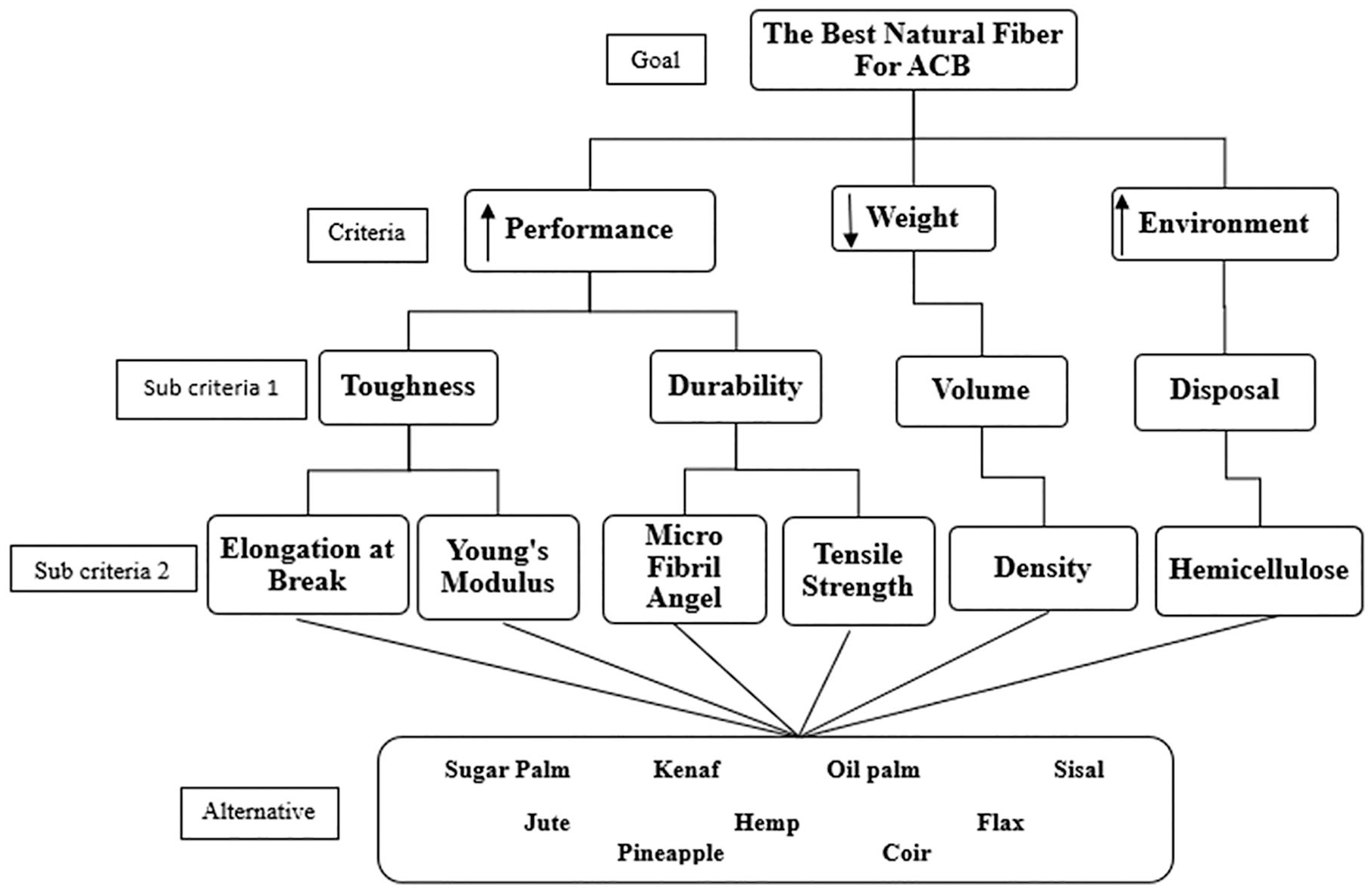
The hierarchy framework for the selection of the materials of natural fibers for ACB.
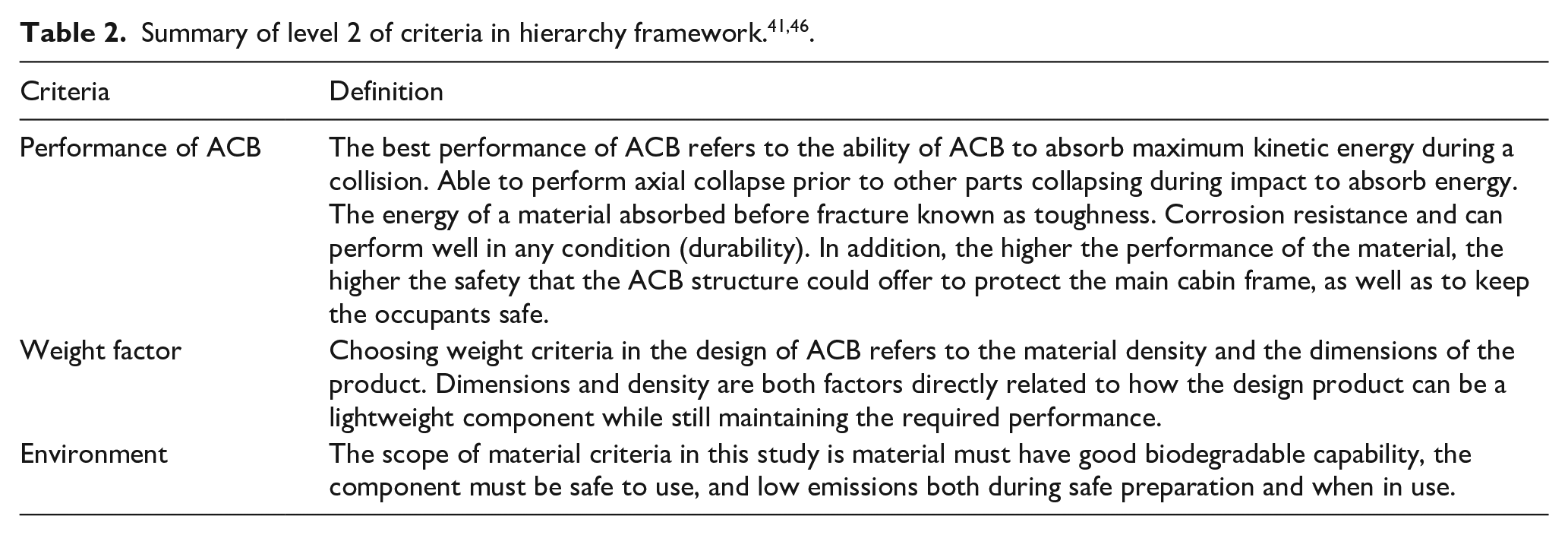
Table 3 provides a description of natural fiber properties listed at the bottom level of the hierarchy framework. The description is the voice of the customer and the voice of environment summarized by Mastura et al. and Joshi et al.46,47 The properties description helps to comprehend the priority of natural fiber properties during the pairwise judgment evaluation.

Step 3: analysis
The “analyze” phase identifies the capability of natural fibers material properties candidates as shown in Table 4 before conducting the process of material selection. This phase helps to spot the advantages and disadvantages of certain materials properties, as well as the problems, which could occur during the production process. Nine natural fiber materials and steel were selected as candidates for their material properties to be analyzed such as density, Young’s modulus, tensile strength, and specific energy absorption (SEA).

Step 4: improve
The “improve” stage evaluated nine natural fibers materials with aluminum as a datum. Aluminum, which is one of the existing materials currently used for ACB fabrication, was selected as a datum due to the high SEA capability, where it has 23.04 kJ/kg compared to steel, which is another common material used to fabricate ACB, which only has 15.77 kJ/kg of SEA capability. 53 Final results in Table 5 by using the Pugh method qualitative technique show that oil palm should be chosen as the best material to fabricate ACB. Oil palm obtained the highest total number of 8+ when compared to other natural fiber materials such as hemp and flex, which took the second place jointly with 7+. The Pugh method depends on a series of pairwise similarities between material candidates against a reference of common ACB materials. As mentioned earlier in step 2, six material properties with additional two relevant selection criteria of low cost and availability had been listed in Table 5 to compare with datum material properties.
Final material selection.

(++) = much better than datum; (+) = better than datum; (s) = similar with datum, (–) = worse than datum. Al = aluminum.
Note: Final results are obtained by using the Pugh Method qualitative technique which shows that oil palm should be chosen as the best material to fabricate ACB. Oil palm obtained the highest total number (8 +), it also indicated oil palm is the most preferred material when compared to other natural fiber materials such as hemp and flex, which took the second place jointly with (7 +).
Step 5: control
Based on the result in the “improve” phase, oil palm fiber was suggested as the most suitable candidate material for ACB. The advantage of the Pugh method technique over other decision-making tools is its ability to handle many decision criteria. However, the quality of the decision using the Pugh method is basically associated with the “quality” of the selection criteria. This quality has three aspects: first, incorrect selection criteria could lead to the wrong decision. Naturally, incorrect criteria could happen from using opinions when identifying the criteria. Second, incomplete selection criteria is where the set of selection criteria is not complete. Third, inadequate selection criteria is where criteria that can have multiple interpretations are poorly defined. Therefore, the analytical hierarchy process (AHP) was used in this control phase to monitor and verify the result’s accuracy from the “improve” phase.
In this control stage, the data extracted from the measurement and analysis process had been simulated to verify the results obtained from the “improve” phase to select the most appropriate natural fiber material for the ACB. After the judgment on the pairwise comparison, all priority weightage values were presented in Figure 5, known as the hierarchy framework for natural fiber properties. Meanwhile, Figure 6 presents the priority vectors and the inconsistency ratio. Based on the graph presented in Figure 6, oil palm fiber is consistently suggested as the most suitable candidate material for ACB, with similar results obtained earlier in the “improve” phase. Oil palm fiber scored the highest priority value of 0.129% or 12.9%, followed by sugar palm (0.121), flax fiber (0.119), and then followed by other types of natural fibers. The overall inconsistency ratio value equaled to 0.00, which was less than 0.1, proving that the judgment made throughout the analysis was very consistent and the proposed analysis results were acceptable.

Hierarchy framework for natural fiber properties.

Results of the selection judgment.
The process verified the results obtained from the “improve” phase beginning with the development of a pairwise comparison matrix, where the software Expert Choice 11.5 at this stage was used to judge a pairwise comparison. The software uses relative scale pairwise comparison or numerical comparison as a selection principle to perform the judgment.48,55 The value of scale intensity explains that the performance criteria were graded with an extremely strongly preferred scale intensity, followed by quality and weight. The detailed scale intensity values are shown in Table 6.

From the numerical assessment shown in Figure 7, the performance criteria was represented by the value of 1.286 or 9/7. This value defined that the performance was strongly preferred to the weight and environmental criteria. Meanwhile, the weight and environmental criteria were equally preferred, represented by the value of 1 or 7/7 when compared to each other. The example of assigned values shown in Figure 8 was based on the comparison ratio values for sugar palm and kenaf with respect to elongation at the break. The value with red color addresses the reciprocals ratio acquired from the inverse comparison, while Table 4 shows the assigned value for the natural fiber comparison with respect to sub-criteria 2. Each natural fiber came with a range value such as jute (1.5%–1.8%), where the mean value of 1.65 was considered in the calculation (22.3 / 1.65 = 13.515).
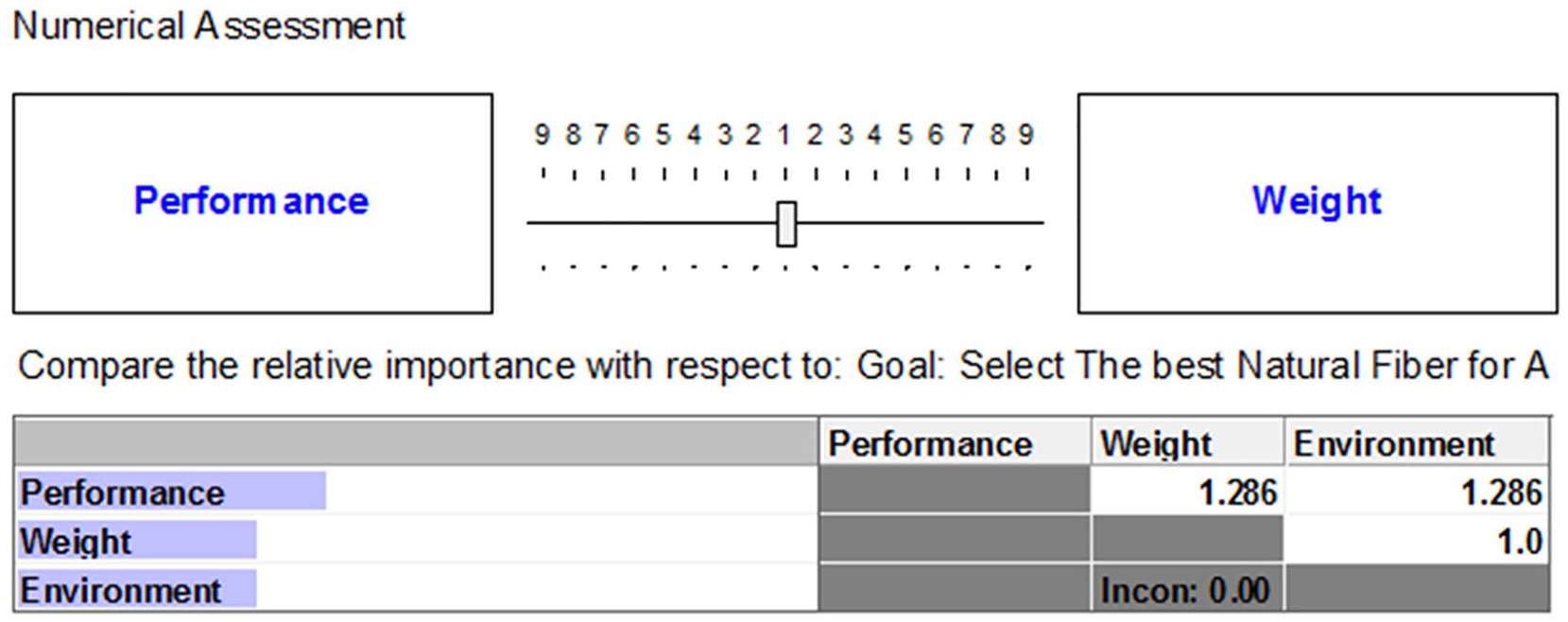
Pairwise numerical comparison.

Sugar palm relative comparison with kenaf with respect to elongation at break.
Results
“Improve” was the fourth step in the selection of the materials of the
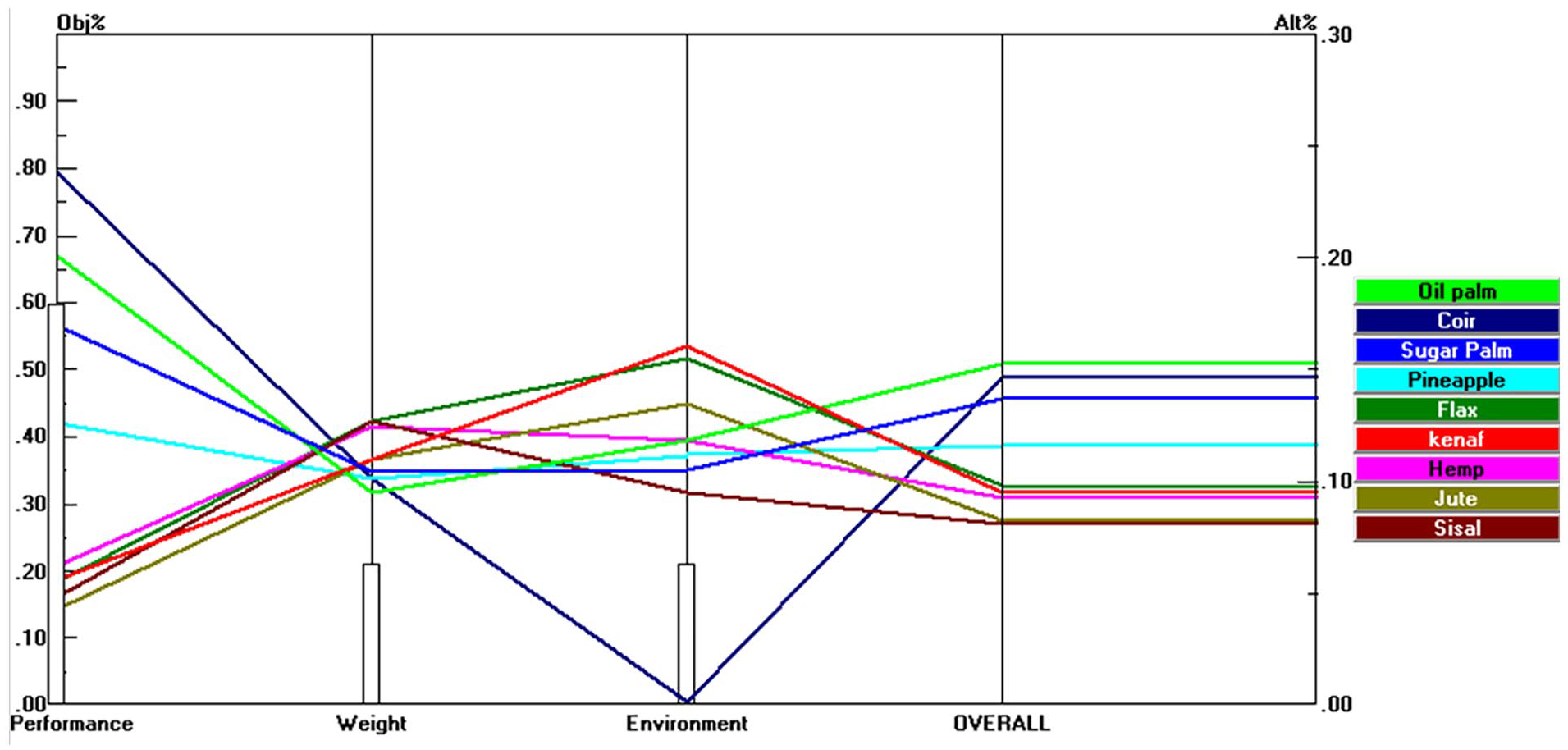
Sensitivity graph of the main criteria with respect to goal when priority vector of performance was increased by 20% (from 39.1% to 59.1%).
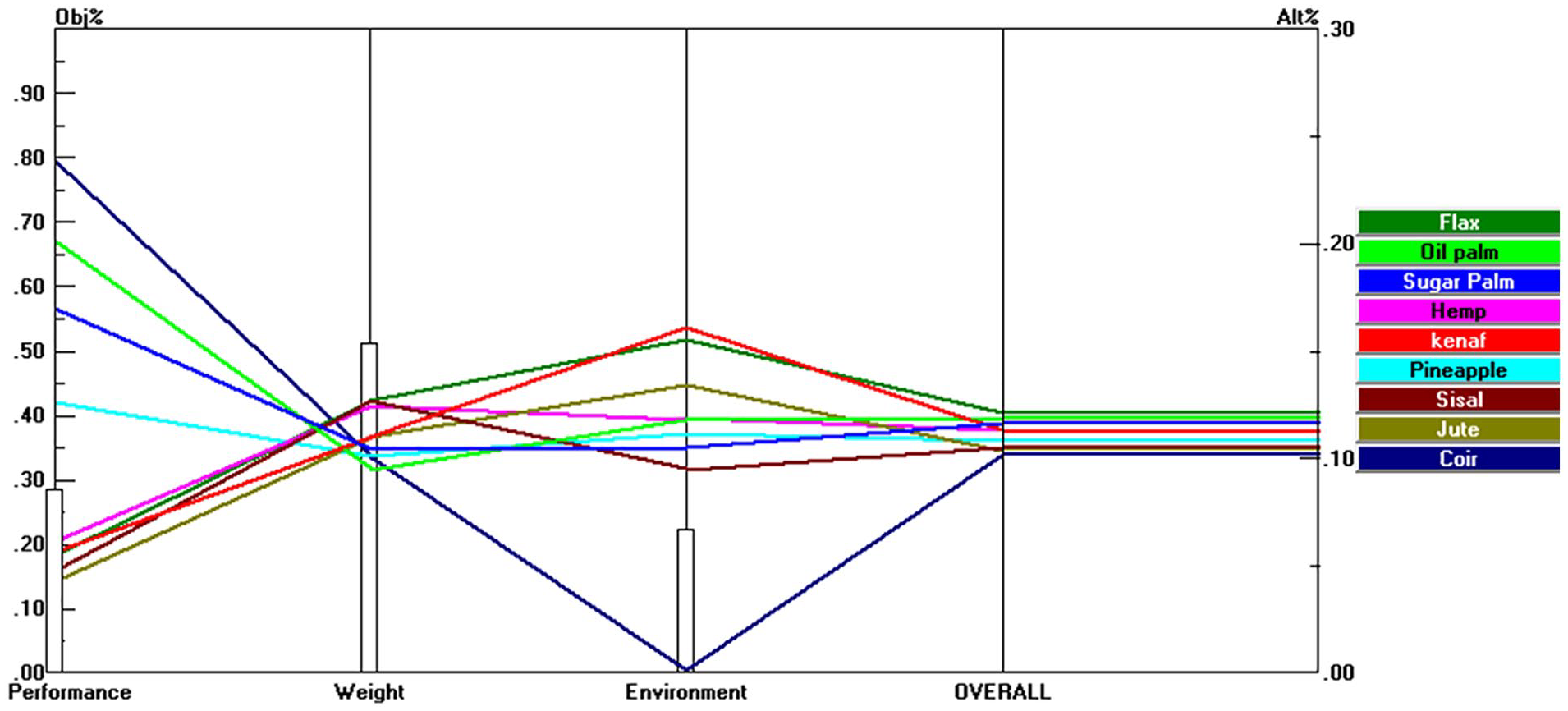
Sensitivity graph of main criteria with respect to goal when priority vector of weight was increased by 20% (from 30.4% to 50.4%).

Sensitivity graph of main criteria with respect to goal when priority vector of environment was increased by 20% (from 30.4% to 50.4%).
However, flax fiber was also recommended as the most suitable material for ACB for the scenario where the weight criteria priority vector value was increased by 20%, followed by oil palm fiber and others as shown in Figure 10.
Similarly, for the scenario where the environment criteria priority vector value was increased by 20% as shown in Figure 11, flax fiber was determined to be the most appropriate fiber for ACB, followed by kenaf fiber and oil palm fiber.
Discussion
A sensitivity analysis was conducted to study the consequences of the different factors on determining the best option. The final priorities of the material selection were highly dependent on the priority vectors attached to the main criteria. If the results from the “improve” and “control” stages were inconsistent, researchers would have to review the parameters and variables given for both stages. However, in this study, both phases of “improve” and “control” using two different methods consistently showed that oil palm was the best natural fiber material for selection to reinforce the polymer composite for ACB fabrication. The selection of oil palm as the most appropriate natural fiber is supported by several research studies. Yap et al. 59 reported that the experimental results of composite reinforcement by oil palm natural fiber showed the highest improvement in toughness (energy absorption during collision) index and residual strength factor. In addition, Shinoj et al. 60 had concluded that oil palm fiber reinforced with some polymeric matrices improved the strength and toughness properties whereas the strength of composite was lower in some cases. Ahmad 61 did a comparison study and said that oil palm natural fiber was found to be appropriate as reinforcement because it possesses a high tensile strength of 300–600 N/mm2, which is considered high when compared with other natural fibers. The results met the study expectations where the natural fibers selected must be a balance where both ecological and economical needs can be satisfied. The selected fibers must be required to offer advantages such as high energy absorbtion, low cost, high availability specifically in a country such as Malaysia, low density, high toughness, acceptable specific strength, and biodegradability.
Conclusion
The process of selection for the best natural fiber material through the
Footnotes
Acknowledgements
The authors wish to thank various individuals and institutions that made the publication of this article possible. The cooperation by Universiti Putra Malaysia is highly appreciated. The contribution of Management & Science University (MSU) is highly appreciated.
Declaration of conflicting interests
The author(s) declared no potential conflicts of interest with respect to the research, authorship, and/or publication of this article.
Funding
The author(s) disclosed receipt of the following financial support for the research, authorship, and/or publication of this article: The project is funded by the Ministry of Higher Education Malaysia through HiCOE (Higher Institutions Centres of Excellence) grant vote number 6369107.
