




Abstract
An experimental study of bending properties of composites reinforced with triaxial and quadaxial warp-knitted glass fabrics was carried out in the 0°, 45°, and 90° directions at −30°C, 0°C, 20°C, and 40°C, respectively. The relationships between the stress–strain curves, bending strength, bending modulus, and temperature were obtained. The failure mechanisms at different temperatures were also analyzed based on the fracture morphologies and scanning electron microscope (SEM) images. The results indicated that the bending properties decrease slightly with the increase in temperature from −30°C to 20°C and decrease dramatically from 20°C to 40°C. The ultimate bending strength of triaxial and quadaxial warp-knitted composites decreases approximately 31.34% and 34.29%, respectively. In particular, the relationships between bending strength and temperature were also obtained by nonlinear fitting with the experimental data, which could be used to predict the bending behavior at different temperatures.
Introduction
Multiaxial warp-knitted fabrics (MWF) are manufactured from multiple layers of straight fiber bundles with different orientations stitched together by a warp-knitting process. Composites reinforced with MWF, that is, multiaxial warp-knitted composites (MWC) are widely used in the aerospace, marine industries, and wind turbine blade1,2 due to their excellent mechanical performances such as high strength and stiffness, anti-delamination, as well as impact resistance. In particular, the use of through-thickness stitching in fabric allows the handling stability and delamination toughness, good tensile, bending, shearing, and impact resistance properties. The absence of undulations provides better in-plane mechanical properties than woven fabrics, and the use of warp-knitted yarns allows handling stability and delamination toughness. These advantages make the composites a kind of attractive engineering structure2 –6 materials.
Recently, the mechanical behavior of the typical textile composites and MWC attracts more interests.7–10 Ma et al. 11 investigated the classification and properties of three-dimensional (3D) textile fabrics, which are used as the reinforcing phase in textile structural composites, and their geometry affects the physical and mechanical properties of composites. Wilkinson et al. 9 investigated the tension-tension fatigue behavior of polymer matrix composite at elevated temperatures. The results showed that the elevated temperatures have little effect on the on-axis tensile properties; however, the off-axis tensile strength decreases slightly with the increase in temperature. Cormier et al. 12 evaluated the effects of cold climate exposure on the tensile and compressive quasi-static properties as well as tensile and fully reversed fatigue behavior of glass-epoxy composites. The results showed that the quasi-static and fatigue performance have been increased at low temperatures. Jia et al. 13 conducted an experimental investigation of the temperature effect on the mechanics of carbon fiber–reinforced polymer (CFRP) composites under static and dynamic bending tests. The results revealed that CFRP composites had good flexural strength, maximum deflection, and energy absorption at lower temperature and poor performance at a higher temperature. Khalili et al. 14 studied the effect of thermal cycling on the tensile behavior of polymer composite in an ambient environment. The tensile strength has been decreased after a certain number of thermal cycles. Tang et al. 15 prepared the lightweight carbon/carbon fiber composite and investigated the effect of high temperature on the thermal and conductivity properties. Zhai et al. 16 investigated the thermos-mechanical performance of 3D braided composites by means of multiscale method. The effect of braiding angle and temperature difference was also studied.
As for the MWC, Li et al.17,18 characterized the effect of temperatures on the bending properties and failure mechanism of 3D multiaxial warp-knitted carbon/epoxy composites at elevated temperatures. The results showed that the bending properties have been decreased significantly with the increase in temperature. Yang et al. 19 investigated the influence of temperatures on the compression property of MWC. The results indicated that the compression performance has been decreased with the increase in temperature.
In this article, the influence of temperature on the bending behavior of MWC is investigated. Bending properties are tested and analyzed at different temperatures (−30°C, 0°C, 20°C, and 40°C) in the specific 0°, 45°, and 90° directions, respectively. The stress–strain curves, bending strength, and bending modulus are obtained and discussed. In addition, the relationships between bending behavior and temperatures are also obtained by nonlinear fitting with the experimental data, which could be used to predict the bending properties at different temperatures. Moreover, the failure mechanisms are also analyzed based on the fracture morphologies and scanning electron microscope (SEM) images of composites.
Experiments
Specimen preparation
In this study, the bending behavior of MWF manufactured by Taishan Fiberglass Inc. (China) is investigated. The composites reinforced with the triaxial and quadaxial warp-knitted glass fabrics are fabricated. The photographs and structural parameters of the MWF are shown in Figure 1 and listed in Table 1, respectively.

Photographs of MWF: (a) triaxial fabric and (b) quadaxial fabric. 19
The structural parameters of the MWFs.

MWF: multiaxial warp-knitted fabrics.
The used epoxy resin and curing agent are E-128 and m-PDA, respectively, and supplied by Shenzhen NO.1 Advanced Materials Co., Ltd. The specifications of glass fiber, epoxy resin, and curing agent are listed in Table 2.
Specifications of the fiber, epoxy resin, and curing agent.

The composite samples were manufactured by VARTM (vacuum assisted resin transfer molding) process. The stacking sequence of triaxial and quadaxial fabrics were (0/+45/−45/−45/+45/0) s and (0/+45/90/−45/−45/90/+45/0)s, respectively. For bending testing, a ratio of span to thickness of 16:1 was used according to ASTM D790 standard. The overall length was taken as 20% more than the span length and each end was more than 6.4 mm. The fiber volume fraction of composite specimen was obtained by applying burning method according to standard of GB/T 2577-2005. The specimen was burned in muffle at temperature of 450°C–650°C. The fiber volume fraction was calculated with respect to equation (1) 20

where
Bending tests
The ratio of length to depth of the coupon was 16. The size of the MWC specimens for three-point bending tests was 100 mm (length) × 12.7 mm (width) × 2.6 mm (thickness). Before bending test, the samples were conditioned in the ROSENYI chamber for 24 h at −30°C and 0°C, respectively. Then the bending experiments were conducted immediately with the temperature error less than ±3°C. As for the high temperatures, the specimens were put in the constant temperature testing box for 24 h. The bending tests were performed on Shimadzu® AG-250kNE tester at the speed of 1 mm/min with five samples at least in each direction at each temperature. The bending testing devices at different temperatures are shown in Figure 2.
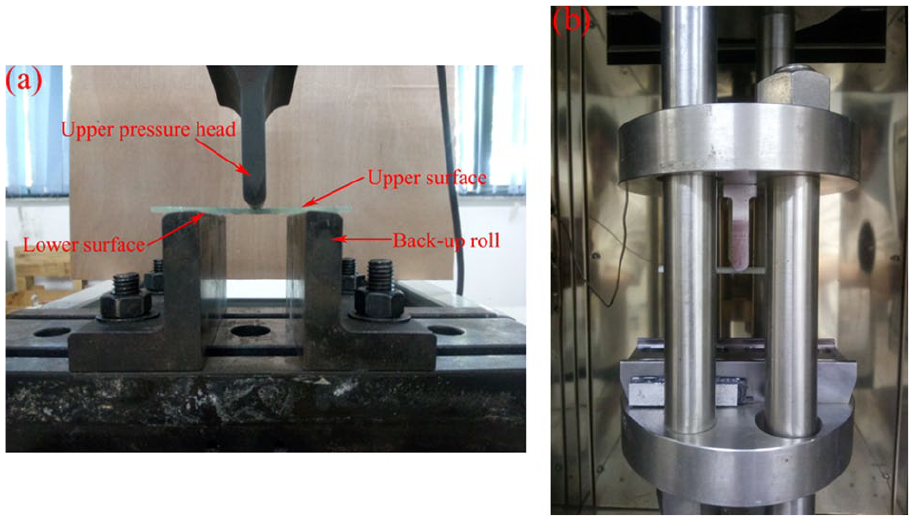
Bending tests: (a) −30°C, 0°C, 20°C and (b) 40°C.
Results and discussions
Temperature effect on bending property
The stress–strain curves of composites in 0°, 45°, and 90° directions at different temperatures are shown in Figure 3.
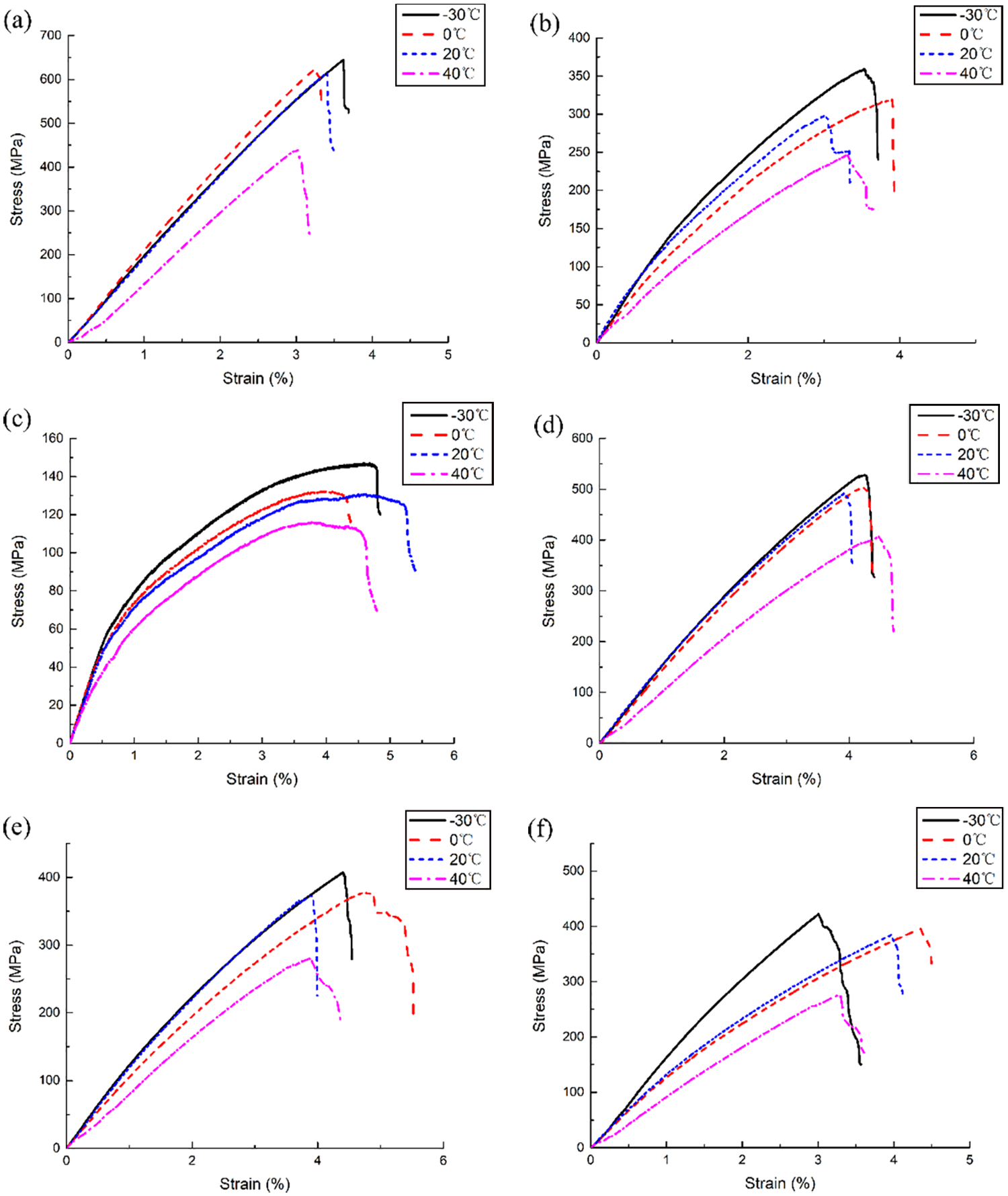
Stress−strain curves: (a) triaxial/0°, (b) triaxial/45°, (c) triaxial/90°, (d) quadaxial/0°, (e) quadaxial/45°, and (f) quadaxial/90°.
Figure 3 shows that the stress−strain curves have the similar pattern. The stress has a linear relationship with strain except of the triaxial samples in the 90° direction, which indicates a nonlinear characteristic. There are not any fiber layers in 90° direction as for the triaxial composites, and the load is mainly dependent on the matrix at the initial stage. As the matrix fracture, the fibers in ±45° directions will play auxiliary role, and the fibers in ±45° directions present no significant fracture failure, so there are not any rapid fracture failures. The maximum stress decreases with the increase in temperature from −30°C to 40°C. When the stress reaches the maximum value, there are drastic fluctuations, and then the fracture specimen fails quickly at −30°C.
The difference of reinforcement structure influences the fiber volume fraction of the composite samples. The experimental result was normalized at a fiber volume fraction of 45% using an approximate formula 21 in order to compare the mechanical behavior derived from reinforced structure. The normalized strength and modulus formulas are follows


where
As shown in Figure 4 and Tables 3 and 4, it can be found that the bending strength decreases with the increase in temperature. The bending strength decreased by 4.59%, 11.12%, and 17.10% for triaxial composites, as well as 6.62%, 8.84%, and 8.29% for quadaxial composites in three directions at 20°C compared with that at −30°C, respectively. However, the temperature has a significant influence on bending strength when the temperature increases from 20°C to 40°C.
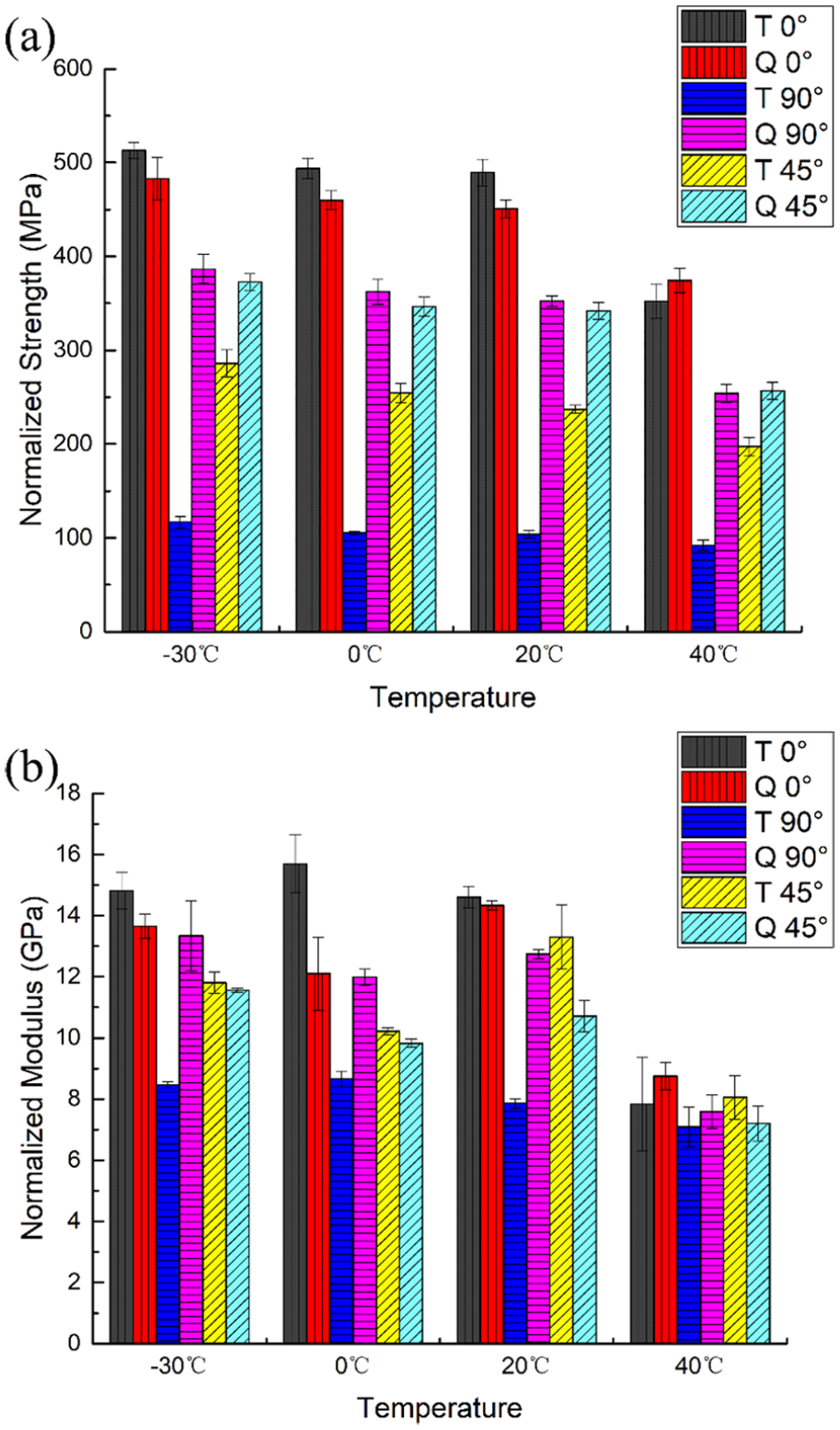
Comparison of bending performance between triaxial and quadaxial warp-knitted composites at different temperatures: (a) strength and (b) modulus.
Bending performance of triaxial warp-knitted composites at different temperatures.

Bending behavior of quadaxial warp-knitted composites at different temperatures.

The bending strength for both composites at different temperatures has similar trends with different initial values y0, which could be calculated by using equations (4) and (5).
The influence of temperature on the bending modulus is similar to that of the strength. There is not any obvious growth or decrease rule as the temperature ranges from −30°C to 20°C. The bending modulus decreases by 47.13%, 16.26%, and 31.74% for the triaxial specimens, as well as by 35.86%, 43.14%, and 37.69% for the quadaxial specimens at 40°C compared with that at −30°C.
Since the fluidity of molecular chain in the epoxy resin is reduced and the bonding force between the molecules is increased at lower temperature, the strength of matrix has been increased. Moreover, the frictional force at interfaces between fiber and matrix is increased and the bending behavior is improved due to the transverse shrinkage of the glass fiber less than that of the epoxy resin. As for high temperatures, the combination between molecular is reduced due to the movement of molecular chain in polymer. At the same time, the thermal expansion coefficient of the glass fiber is larger than that of the epoxy resin, and the matrix has been destroyed at bonded surface and the bonding force at matrix/fiber interface has been weakened with the increase in temperature, and thus the bending behavior has been decreased.
Fitted bending strength versus temperature curves
The fitted curves for bending strength versus temperature for triaxial and quadaxial warp-knitted composites are shown in Figure 5 (Table 5).

Fitted curves for bending strength versus temperature.
Relevant parameters for fitting curves.

Fitting functions


Fracture morphologies
Figure 6 shows the upper surface, lower surface, and lateral surfaces of bending failure pattern of the triaxial composites in 45° direction at different temperatures. It aims to analyze the influence of temperature on the bending property of composite at microscopic scale by using high-power microscope and comparing the differences in failure morphology.

Fracture morphologies of bending specimens in 45° direction for the triaxial composites: (a) −30°C, (b) 0°C, (c) 20°C, and (d) 40°C.
Figure 6 shows that failures are mainly located in upper bending position. There are some obvious fracture delamination in 45° direction. The fracture area decreases with the increase in temperature. The triaxial composites have similar failure pattern in the 0° direction at different temperatures, and the fiber fracture is accompanied by delamination failure. From lateral view, the specimen shows delamination fracture at −30°C, 0°C, and 20°C, as well as the fracture of fiber bundles in 45° direction.
The temperature effect on the bending performance is analyzed with respect to fracture morphologies at microscopic scale. The fiber debonding surface is shown in Figure 7.

SEM morphologies of yarn breakage at different temperatures: (a) −30°C, (b) 0°C, (c) 20°C, and (d) 40°C.
Figure 7 shows the fracture morphologies. The effect of temperature on the bending property is observed from the fiber fracture surface and the bonding interface with the matrix. There is a large amount of matrix debris at the fracture area, which indicates that the matrix is plasticity fractured at −30°C and 0°C. The matrix plasticity is weakened, the fibers appear jagged, and the fiber surface is smooth at 20°C. The fibers have obvious extraction and a large number of fiber bundles have been pulled out from the matrix, and the surface of fiber adheres to the softened epoxy at 40°C.
Conclusion
The quasi-static bending behavior of MWC in the 0°, 45°, and 90° directions were conducted in different temperatures (−30°C, 0°C, 20°C, and 40°C). The influences of temperature variations on the bending property and failure mechanism were analyzed with respect to bending strength, bending modulus, and fracture morphologies. The obtained conclusions are follows:
The bending strength and bending modulus of the triaxial and quadaxial composites were decreased continuously as the temperature increases from −30°C to 20°C. However, the bending strength of the triaxial and the quadaxial composites in different directions was decreased by 31.34%, 20.99%, 30.97% and 22.52%, 34.29%, 31.15% at 40°C in comparison with that at −30°C. The bending modulus was decreased by 47.17%, 16.29%, 37.15% and 35.90%, 43.18%, 37.12%, respectively.
With respect to the fracture morphologies, it could be concluded that the bending behavior of composite at different temperatures was mainly influenced by the matrix and the bonding strength between fiber tows and resin. With the temperature increases from −30°C to 0°C, the matrix was softened and the bonding surface was destroyed. The difference of thermal expansion coefficients between epoxy resin and glass fibers and the molecular chain variation in the epoxy resin with the variation of temperature directly results in the change of the matrix performance and the bonding force between the matrix and fibers and in the change of bending behavior of MWC at different temperatures.
According to the fitting curves, the relationship between bending strength and temperature was obtained for the triaxial and quadaxial composites, respectively. It could be used to predict the bending strength of MWC at different temperatures.
Footnotes
Declaration of conflicting interests
The author(s) declared no potential conflicts of interest with respect to the research, authorship, and/or publication of this article.
Funding
The author(s) disclosed receipt of the following financial support for the research, authorship, and/or publication of this article: This work was supported by the Open Project Program of Key Laboratory of Yarn Materials Forming and Composite Processing Technology of Zhejiang Province (No. MTC2019-09); the Open Project Program of Key Laboratory of Eco-textiles, Ministry of Education, Jiangnan University (No. KLET1802); and the National Natural Science Foundation of China (No. 51765051 and the Natural Science Foundation of Inner Mongolia (Nos 2017MS0102 and 2018MS05055).
