



Abstract
Design of experiments was adopted to evaluate the effect of selected test parameters on the viscoelastic behaviors of polyester tire cords through dynamic mechanical analysis systematically. Design of experiments results showed that temperature, static load, and dynamic amplitude had significant effects on the responses of complex modulus (E*) and Tan δ. Furthermore, temperature had significant interactions with static load and dynamic amplitude factors on the responses. None of the test parameters had any significant effect on the response of glass transition temperature (Tg). Below Tg, thermoplastic tire cords exhibited a high and constant dynamic modulus, whereas, beyond this point, the modulus decreased dramatically. The thermosetting tire cords exhibited a constant performance due to an ordered and tight molecular chain arrangement. The magnitude of Tan δ reached its peak value at Tg due to the increase in internal friction as a result of increasing temperature. The dynamic modulus increased and Tan δ decreased with the increasing static load as a result of restricting the mobility of chain segments. The reverse was true when the dynamic amplitude increased, most probably because of higher chain segment mobility and early stage of polymer chain slippage. Activation energy (Ea), derived from Arrhenius equation, can be used to predict its long-term performance. Tg shifted to a higher temperature as the frequency increased. In addition, by increasing the twist level of the polyester tire cord, the dynamic modulus decreased and Tan δ increased. Tg was evaluated as the upper limit working temperature, Tan δ was related to energy dissipation, and E* determined the overall performance of the tire cord. By displacing Tg to a higher temperature, reducing the magnitude of Tan δ and increasing the dynamic modulus are of great importance to a tire cord’s performance.
Keywords
Introduction
Textile fiber–reinforced rubber composites have been widely used in the field of pneumatic tires, transmission belts, hoses, and conveyor belts due to their outstanding properties such as strength-to-weight ratio, flexibility, fatigue resistance, and anti-corrosion.1,2 In these mechanical rubber goods, fibers are incorporated into the rubber matrix serving as a skeleton component to stand the large scale of load and maintain its shape, which have a great influence on the physical and mechanical properties of the entire composites.1,3,4 Tire might be one of the most predominating fiber-reinforced rubber composites. There are five major kinds of synthetic organic fibers available as the carcass tire cord material: regenerated cellulose (Rayon), polyester (polyethylene terephthalate (PET)), polyethylene naphthalate (PEN), nylon (PA6, PA66), and aramid. The use of polyester has grown due to its excellent properties such as high modulus and strength, low shrinkage, and good dimensional stability in recent years. 1
In the actual driving conditions, tires are periodically subjected to loading and unloading cycles during running; the temperature of a tire could easily soar up to 100°C or even higher due to the combined effect of hysteresis and operation conditions. 5 At elevated temperatures, polymer molecular chain segments acquire adequate energy and free volume to perform conformational change. The mobility of chain segments is activated, and intermolecular forces such as Van der Waals become weak. Macromolecular chains lose their tough structure, and thermophysical properties of polymer such as enthalpy, heat capacity, volume, and modulus behave differently from glassy state to rubbery state.3,6–8 Dynamic mechanical and major characteristic properties of these five common carcass tire cords are depicted in Figure 1 and Table 1, respectively. During glass transition, the complex modulus of thermoplastic tire cords (nylon 6, PET, PEN) decreases rapidly and energy dissipation due to internal friction increases, thus making Tan δ reach its peak value. 9 Aramid and rayon cords are thermosetting materials, in which the arrangement of molecular chains is in a perfectly ordered and tight form. They do not have an obvious Tg, and thus thermosetting cords exhibit almost constant performance. 10 For thermoplastic polymers, the glass transition temperature is considered as the upper limit working temperature. Beyond this point, polymer matrices lose their strength and stiffness dramatically, ultimately leading to the failure of structural integrity. 9

Dynamic mechanical properties of five major types of carcass tire cords.
Characteristic properties of five common types of tire cords.
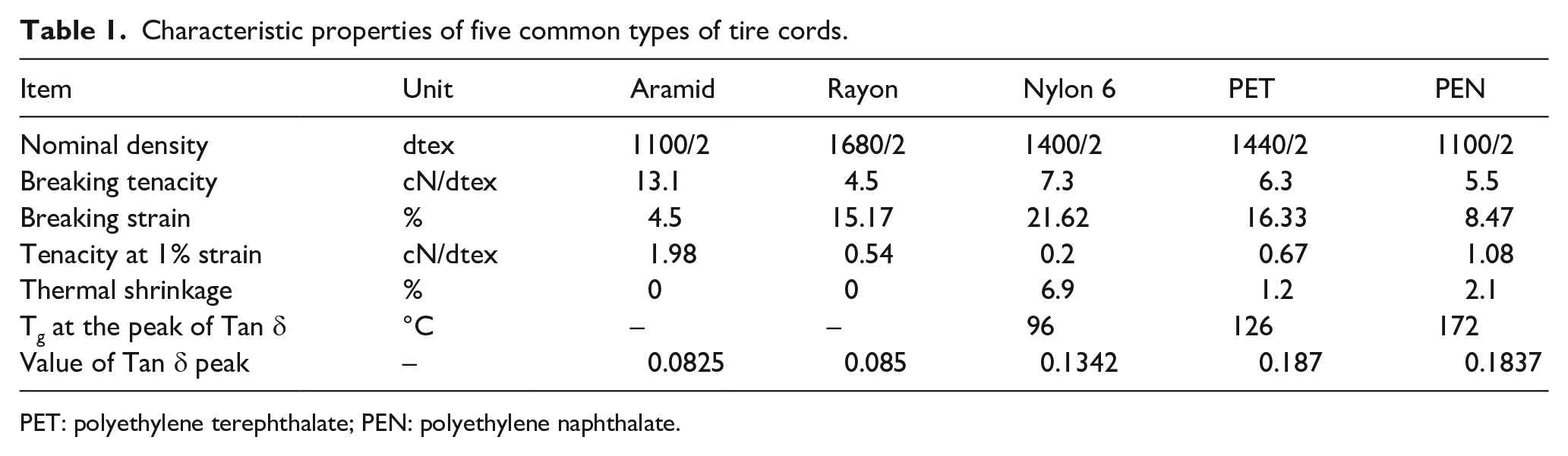
PET: polyethylene terephthalate; PEN: polyethylene naphthalate.
There are several techniques available to determine Tg of a polymer, such as differential scanning calorimetry (DSC), thermomechanical analysis (TMA), and dynamic mechanical analysis (DMA).2,3 DSC is a conventional way to characterize Tg by identifying the variance of calorific capacity, while DMA detects the changes in the modulus and energy dissipation during glass transition. During transition from glassy to rubbery states, there is an obvious decrease in the magnitudes of moduli, and hence DMA is more sensitive and capable of determining Tg than DSC.3,7 Given the different techniques employed, the discrepancy of Tg obtained from DSC and DMA can be up to 25°C.3,11 Even within the DMA technique, Tg can be derived from the storage modulus curve, the peak of loss modulus curve, and the peak of Tan δ curve.3,6–9 According to ASTM D4605, Tg is advised to be acquired from the peak of loss modulus;8,12 however, the peak of Tan δ is most widely adopted as Tg in several studies.2,3,6,7 Goertzen and Kessler 8 studied the correlation of apparent activation energy (Ea) with Tg obtained from Tan δ and loss modulus curves, respectively, showing that Tg acquired from the peak of Tan δ had a better correlation to activation energy. In this study, Tg was obtained from the peak of Tan δ.
Viscoelastic characteristics of a tire cord can alter the entire performance of the tire. 13 DMA is an effective method to study the viscoelastic properties of a material by applying a sinusoidal excitation (load or displacement) to the specimen and measuring its corresponding response. As shown in Figure 2, because of the viscoelasticity, applying an oscillating loading to a specimen, the corresponding displacement will be lagging behind by a phase angle δ (0°< δ < 90°). 14

Schematic of applying sinusoidal load and its corresponding displacement of specimen.
For the sythentic fiber, deformation could be devided into two parts: one is linear viscoelatic, the other is non-visoelatic. Normally the deformation below 1% of strain can be reviewed as the linearl visoelatic deformation. To a linearly viscoelastic material, the stress and its corresponding displacement will oscillate at the same frequency. 14 σ(t) is the stress applied to a specimen at a given frequency, ω (ω = 2πf)

where σ0 is the maximum stress applied, 8 and its corresponding strain lagging behind a phase angle δ is depicted in equation (2)

where ε0 is the maximum strain amplitude. According to Hooke’s law, the dynamic modulus (complex modulus) could be depicted in equation (3)8,14
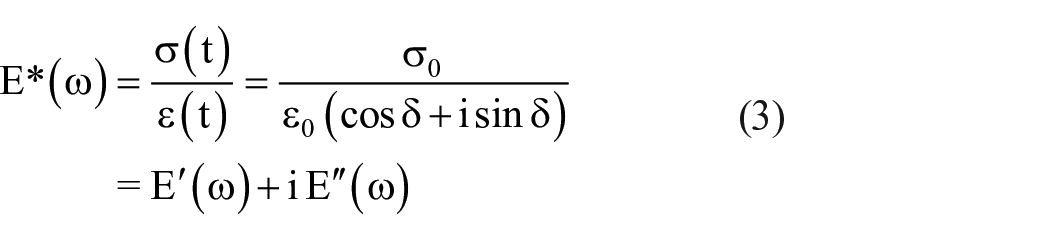
where the storage modulus E′ represents the rigidity and the ability of the viscoelastic material to store energy per cycle. The loss modulus E″ characterizes the viscous component of the viscoelastic material and the energy dissipation as heat due to viscous motions 2

The ratio of E″ to E′ is defined as the damping factor, Tan δ, demonstrating how efficient the energy dissipation due to the molecular movement and internal friction is.7,15 The area under the Tan δ curve could be used to calculate the energy dissipation during the deformation. 15 The dynamic (complex) modulus E* actually determines the overall performance of a material. The magnitude of the Tan δ peak is typically used to report the loss modulus. 14 Furthermore, Tan δ of the tire cord can be deployed to design the performance of a tire. A lower Tan δ is believed to be a favorable characteristic relating to roll resistance.13,16 Tg is the upper limit working temperature.14,17 Hence, the complex modulus E*, Tan δ, and Tg are the three crucial factors to characterize a viscoelastic material, and other parameters such as storage modulus E′ and loss modulus E″ can be derived based on the above equations.
Viscoelastic properties of the polymer material rely on experimental parameters such as temperature, frequency, heating rate, and environmental conditions.6,8,11,17–19 Toumpanaki et al. 6 studied the effect of the moisture content, thermocouple position, static strain applied, ratio of static to dynamic strain, and geometry of the sample on the value of Tg. The effect of frequency has been well studied. The peak of Tan δ will shift to a higher temperature with the increasing test frequency due to the principle of time–temperature superposition.8,18,19
The effect of temperature on the frequency of conformation changes such as glass transition relaxation can be explained by the Arrhenius equation8,18

where A0 is a pre-exponential factor, R is the Planck gas constant, and Ea. is the apparent activation energy.
By equation (6), Ea. can be derived from the DMA test at different frequencies and the obtained corresponding Tg values8,18

Although there were many studies published on viscoelastic properties of different materials with DMA, there have not been many studies conducted in the field of tire cords.20–25 Demšar et al. 20 studied the viscoelastic properties of nylon 66 cord yarns with DMA to detect subtle changes in the molecular level. Le Clerc et al. 21 studied the effect of temperature and frequency on the viscoelastic properties of polyester fiber, and the results showed that the complex modulus dropped sharply at Tg, and the peak of Tan δ shifted to a higher temperature with the increasing frequency. Barun and Manikanda 22 studied the hysteresis characteristics of polyester yarn and cord, and set up a correlation between work loss and Tan δ. Wiliett 23 studied the effect of temperature, moisture, and geometric structure on viscoelastic properties of tire cords. Prevorsek et al.24,25 studied the nonlinear viscoelasticity of nylon fibers with a high-strain dynamic viscoelastometer, revealing that the modulus of nylon fibers increased with strain but decreased with the increasing strain amplitude; the loss factor increased and Tg decreased with the increasing strain amplitude. The objective of this work is to study the effect of selectively chosen factors on the viscoelastic properties of tire cords systematically and provide a comprehensive understanding of viscoelasticity of tire cords.
Materials and methodology
All tire cords used in this work were designed and produced in Performance Fibers (Kaiping) Company Limited.
Tensile test
The tensile test of the tire cord was carried out in an Instron 3367 tester according to ASTM D885 at ambient room temperature. The working length of the specimen was 254 mm at the speed of 254 mm/min. The value compiled in this work was an average of 10 specimens.
Twist level test
The twist level test of tire cords was carried out in an USTER ZWEIGLE TWIST TESTER according to ASTM D885. The value compiled in this test was the average of three specimens.
Thermal shrinkage test
Thermal shrinkage of tire cords was measured using a TESTRITE shrinkage tester according to ASTM D4974. The test condition was set at 177°C for 2 min with a pre-load of 0.05 g/D. The value compiled in this experiment was the average of three specimens.
DMA
Dynamic properties of tire cords were estimated using the Bose 3230 Series II tester in the tensile model (Figure 3). By simulating the service conditions experienced of a tire cord, the testing parameters were set at the frequency of 10 Hz, the static load of 0.5 cN/D, the dynamic load of 0.1 cN/D (for the aramid tire cord, the static load of 40 N and the dynamic load of 8 N), and the temperature range of 30°C–200°C. The working length of the specimen was 30 mm. The specimen dwelling time in the temperature setting condition was 1 min before acquiring the data. The result compiled in this experiment was the average of three specimens. Results shown in Figures 1 and 10 were obtained under these testing parameters.

Schematic of the dynamic mechanical analysis (DMA) instrument.
Results and discussion
Experimental design of testing parameters on dynamic properties
Polyester tire cord is one of the prevailing tire cords used in carcass, and its use has been increasing in recent years. Hence, polyester was chosen among the synthetic organic fibers as the material to evaluate in this study. Characteristic properties of the polyester tire cord are listed in Table 1. Design of experiments (DOE) can be employed to identify significant variables and the interaction effect on responses, optimizing process parameters, and scientifically screening out unnecessary experimental runs.1,22,26 A two-level full fractional DOE was applied to study the effect of test variables on E*, Tan δ, and Tg of the polyester tire cord shown in Tables 2 and 3, respectively.
Effect of selected test variables on the responses of E* and Tan δ.
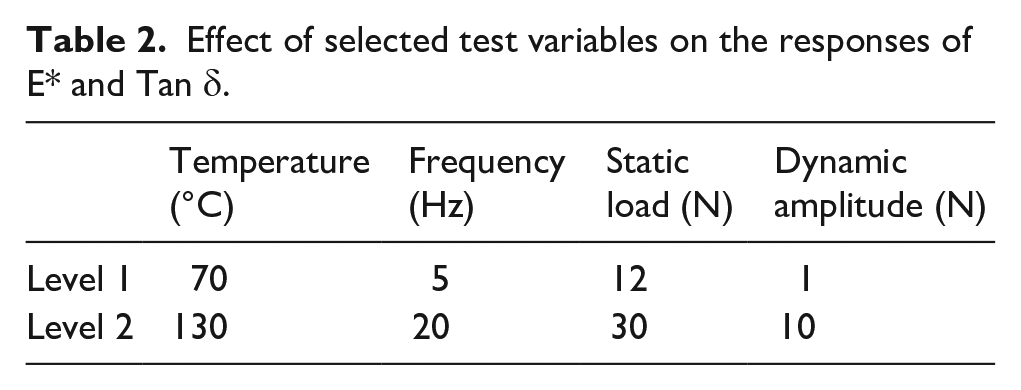
Effect of selected test variables on the response of glass transition temperature Tg.

Pareto chart was deployed to analyze the significant variables and the effects of possible interactions among the testing parameters on the responses of E*, Tan δ, and Tg. Results (Figure 4) demonstrated that temperature, static load, and dynamic amplitude had a significant influence on the responses of E* and Tan δ. Furthermore, temperature exhibited significant interactions with static load and dynamic amplitude. None of these variables had any significant effect on the response of Tg in this study.

Pareto chart of selected variables on the responses of dynamic modulus E*, Tan δ, and Tg.
Effect of temperature and static load on dynamic modulus E* and Tan δ
As indicated in Figure 5, at low temperatures, molecular chain segments were “frozen” and the polyester tire cord exhibited a glassy state. As the temperatures were increased, polymer molecular chain segments acquired adequate energy and free volume to perform conformational change, mobility of chain segments was activated, the intermolecular force weakened, and the tough, ordered polymer chain structure was disrupted. Energy dissipation increased due to internal friction.6,7 During the transition from glassy to rubbery state, there was a sharp drop in the dynamic modulus related with the α relaxation of polymer chains. 6 Tan δ reached its peak in this transition region due to the increasing internal friction of a large scale of chain segment motions. In a rubbery state, although the polyester tire cord was in the solid form, its molecular chain segment motion became easier and the internal friction decreased. 7 As a result, Tan δ decreased beyond Tg. With the increase in static load, the polymer chain motility was restricted due to the higher orientation of polymer chains induced by tensile loading (Figure 6). In accordance to previous research, 25 with the increase in static load applied to specimens, the polyester tire cord exhibited a higher dynamic modulus and a lower Tan δ.

Effect of temperature and static load on dynamic modulus E* and Tan δ.

Hypothesized structure model of loading (left) and unloading (right) of a polymer.
Effect of temperature and dynamic amplitude on dynamic modulus E* and Tan δ
As shown in Figure 7, the dynamic modulus decreased and Tan δ increased with the increase in dynamic load amplitude. The effect of restricting the mobility of chain segments by static load can be compromised due to the application of dynamic load amplitude. A high static load with an increasing dynamic load amplitude could lead to an early state of molecular chain slippage. 6 As a result, a higher chain segment mobility, greater energy dissipation, and early stage of slippage among polymer chains were expected to occur. Furthermore, the linear viscoelastic region of a fiber was believed to be within 1% of strain. The load of this polyester tire cord at 1% of strain was 19 N. When applying the dynamic load amplitude of 7 and 9 N, the deformation was beyond the linear viscoelastic region, and the discrepancy of Tan δ was more prominent.

Effect of temperature and dynamic load on dynamic modulus E* and Tan δ.
Effect of temperature and frequency on dynamic modulus E* and Tan δ
Although frequency was not a significant factor, it was still meaningful to analyze the effect of frequency on the responses. In Figure 8, as the dynamic modulus increased, Tan δ decreased and the peak of Tan δ shifted to a higher temperature with the increase in testing frequency. The effect of temperature on frequency could be well explained by Arrhenius equation.6,18

Effect of temperature and frequency on dynamic modulus E* and Tan δ.
Activation energy estimation
As indicated in equation (6), the activation energy of glass transition relaxation could be obtained from the slope of the plot of ln(f) against 1/Tg, where Tg was obtained from the peak of Tan δ (Figure 9)

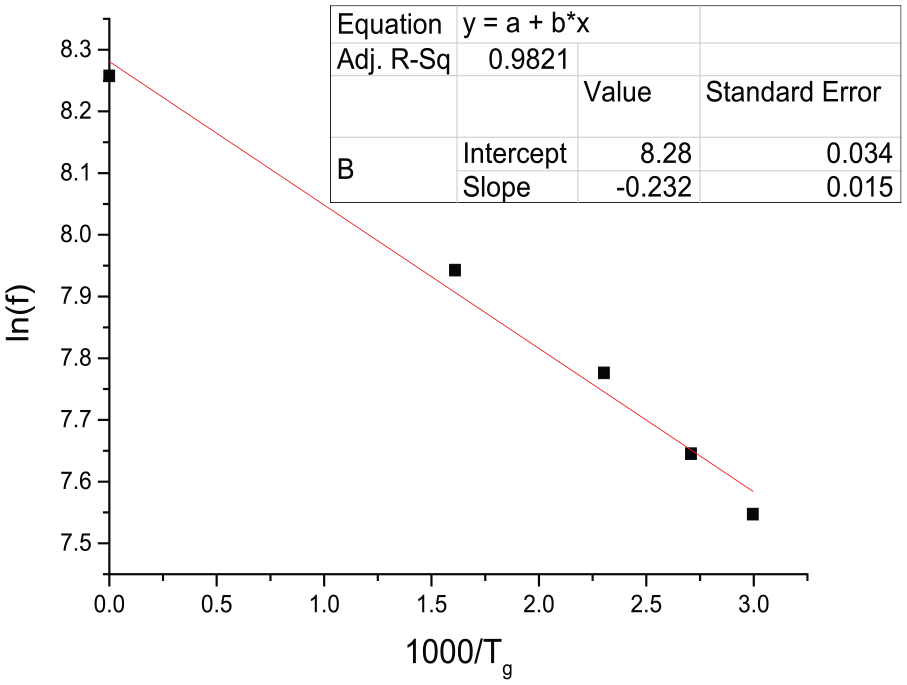
Linear relationship between ln(f) and 1000/Tg.
Activation energy estimation could be used to calculate the temperature shift factors for the time–temperature superposition, rather than completing the construction of master curves. 8 Through activation energy estimation, the long-term performance of the tire cord could be predicted by carrying out experiments at elevated temperatures.
Effect of twist level on dynamic modulus E* and Tan δ
Twist level had a great impact on the performance of the tire cord such as breaking strength, breaking elongation, and adhesion and fatigue properties.1,27,28 Breaking strength decreased and breaking strain increased due to the increase in twisting helix angle as a result of increasing the twist level. 27 Fatigue and adhesion properties were improved by increasing twist level. 5 It can be seen from Figure 10 that the twist level also played a role in the viscoelastic properties of a tire cord. By increasing the twist level, the dynamic modulus decreased and Tan δ increased. Tan δ is related to energy dissipation; therefore, an increase in Tan δ is a negative factor to the tire cord, resulting in a high rolling resistance of a tire. When designing a twist level, Tan δ was another factor to be taken into consideration.

Effect of twist level on dynamic modulus E* and Tan δ.
Conclusion
In this article, the effects of DMA testing parameters were studied by DOE on the responses of dynamic modulus, Tan δ, and glass transition temperature Tg. With the increasing temperature, polymer chain segment motions were activated, the polymer chain’s tight structure was compromised, and the dynamic modulus decreased. Tan δ reached its peak value in the glass transition region due to the increasing internal friction of large-scale polymer chain motions. The mobility of polymer chains was restricted by increasing the static load, which resulted in an increase in dynamic modulus and a decrease in Tan δ. However, the situation was reversed by increasing the dynamic load amplitude. An increase in testing frequency led to the shift of the peak of Tan δ to a higher temperature. This phenomenon can be explained by time–temperature superposition. From a practical application standpoint, the ideal working conditions for a tire are as follows: high inflation pressure (high static load), good road conditions and a light load (low dynamic amplitude), high running speed (high frequency), and low working temperature, where the tire exhibited a good handling stiffness and a lower hysteretic effect. Activation energy estimation could be used to predict the long-term performance of a tire cord. Twist level also played a role in viscoelastic behaviors of the tire cord; the dynamic modulus decreased, and Tan δ increased as a result of increasing twist level. Tan δ could be applied to design the twist level of a tire cord.
Footnotes
Declaration of conflicting interests
The author(s) declared no potential conflicts of interest with respect to the research, authorship, and/or publication of this article.
Funding
The authors disclosed receipt of the following financial support for the research, authorship, and/or publication of this article: This work was financially supported by the 111 Project (B17021), National First-Class Discipline Program of Light Indsutry Technology and Engineering (LITE2018-21), and the program of China Scholarship Council ([2017]7751-201706790089)