




Abstract
In recent years, the application of membrane structures in industrial storage buildings has been widely praised due to its light weight, high transparency, self-cleaning, and other advantages. The textile membranes consist of polyester fiber substrate and polyvinyl chloride or polyvinylidene fluoride flame-retardant coatings. It occupies the main market of architectural membrane materials in China. However, the fabric membrane material has high heat transfer coefficient, poor thermal insulation, and high light transmittance performance, being affected significantly by solar radiation intensity. These thermal optical properties are lead to a poor indoor thermal environment of industrial storage buildings. This article aims to overcome the difficulties in analyzing the fabric membrane materials solar radiation heat transfer. The complexity of heat transfer is mainly caused by the hourly solar radiation and the curved roofing of fabric membrane structure industrial storage building. Therefore, a solar radiation heat transfer model was established using MATLAB program. In this article, the different directions hourly heat gained of an actual membrane structures storage building located at Wuhan in China was calculated. The calculation results of solar radiation heat gained between the grid generation method with MATLAB and the projection method were compared. This study may provide a reference for analyze the solar radiation heat transfer and design of the practical fabric membrane structures building application.
Introduction
Environmental pollution is becoming more and more serious, fog and haze weather occurs frequently in many cities in China. Pollution not only seriously affects health and life of people, but also is harmful to the natural environmental and weather. Dust pollution caused by open storage area mainly comes from electric, metallurgy, building materials, and other heavy pollution industry. In particular, particulate pollution has become a significant part of air pollution and occupied about 40%–80% of the total emission particulate matter.1–3 In order to control the dust emissions and reduce the material loss, scholars and enterprises have begun to pay attention to the membrane structure used as storage for coal or other mineral aggregate, 4 such as a membrane structure coal storage was used by Shenhua Bayan Nur Energy Ltd. 5 Li and Li 6 analyzed the advantages of the closed fabric membrane structure coal storage, and concluded that the initial investment of the fabric membrane structure using polyvinyl chloride (PVC) saved 50%, the membrane structure has good self-cleaning performance and short construction period compared with the conventional spherical grid structure. Hu et al. 7 designed a building integrated photovoltaic-thermal (BIPV/T) collector ethylene tetrafluoroethylene (ETFE) cushion structure system, the structure feasibility was validated by system temperature and pressure performance, the study reveals that the technical feasibility of ETFE cushion membrane structure integrated photovoltaic. Li 8 shows that the air-supported structure coal storage shed has excellent environmental protection characteristics, efficient energy utilization, high intelligent monitoring system, and low construction cost, and the enclosed air-supported membrane structure coal storage will be widely used in the coal industry. However, the fabric membrane material has high heat transfer coefficient, poor thermal insulation, and high light transmittance performance, being affected significantly by solar radiation intensity. These thermal optical properties are lead to a poor indoor thermal environment of industrial storage buildings. As a result, the health and efficiency of indoor staff are seriously affected, which limits the development of fabric membrane structure industrial storage building.
At present, a great deal of research studies on fabric membrane structure storage building is mainly concentrated on structure, materials, and applicability. In one of these previous studies, Hu et al. 7 mainly investigated the transparent materials with ETFE foil cushions for solar energy utilization, and it also proposed a way to expand the application of BIPV/T to cushion structures. Escoffier et al. 9 designed the stadium with a flat single layer ETFE roof and gave some typical figures for ETFE structural evaluation to assist the design engineers of the fabric membrane structure. Al-Mahdouri et al. 10 developed a radiation heat transfer model and evaluated the thermal optical properties of different greenhouse covering materials, and the results show that the highest inside air and surface temperatures are performed by silica glass greenhouse. Hua et al. 11 studied the thermal–physical behavior in air-supported membrane sports halls, evaluated the double-layered fabric winter energy performance, and analyzed the envelopes dynamic behavior and energy balance. The results show that the heating energy of double layer envelopes reduced by 11%–18% compared to single layer. Hu et al. 12 researched the thermal performance assessment of two-layer ETFE cushions integrated flexible photovoltaics through experimental study and theoretical analysis, the modified equation was proposed to determine the heat transfer coefficient. The calculated results show that the average heat transfer coefficients of PV and ETFE foil were 4.89 and 4.39 W/(m2·K). Yamaguchi and Sano 13 investigated the changes of the poly tetrafluoroethylene (PTFE) membrane materials self-cleaning with time in the membrane structures. Karwath 14 and Forster and Mollaert 15 focused on improving the thermal protection of membrane structures, and considered that the double-layer, three-layer, or multi-layer membrane materials could effectively improve the thermal performance.
In addition, extensive studies on indoor thermal environment of fabric membrane structures mainly focused on public buildings. He and Hoyano16,17 conducted field measurements in a semi-enclosed space, analyzed the vertical distributions of air temperature and velocity, and established a simulation method to improve the thermal environment. Kim et al.18,19 researched indoor environments in arcade-type markets with wind tunnel experiments and numerical simulations. Kumar and Suman 20 evaluated the influence of composite insulation materials on indoor thermal comfort through experiments. However, there are few studies on solar radiation heat transfer analysis of fabric membrane structure storage buildings. Therefore, it is very necessary to study the heat gained characteristics of industrial membrane structure buildings. In this article, the solar radiation heat transfer model was established using MATLAB program, the heat gained of the fabric membrane structure storage building in summer was theoretically calculated.
Analysis of solar radiation heat transfer
Solar radiation heat transfer
The solar radiation heat gained of fabric membrane structure storage building mainly includes three parts as follows:
1. Direct transmission heat gain of solar radiation;
2. Solar radiation heat gain absorbed by the fabric membrane materials. (This heat gain warmed the fabric membrane materials, and then transfer into indoor and outdoor via convective heat transfer and radiation heat transfer.)
The heat gained transfer into the indoor can be calculated as 21


where qα is the solar radiation heat gained absorbed by the unit area fabric membrane materials; γin and γout are the surface heat transfer coefficient of indoor and outdoor, respectively.
3. Heat gained caused by indoor and outdoor temperature difference

where K is the heat transfer coefficient of fabric membrane materials, tw is the outdoor temperature, and tin is the indoor temperature.
In conclusion, the heat gained of fabric membrane structure storage building mainly comes from solar radiation transfer of fabric membrane materials. The solar radiation irradiates to the membrane surface, and the radiation heat is absorbed, reflected, and transmitted. A part of the solar radiation heat absorbed by the membrane materials enters the indoor, and a part is scattered to outside. At the same time, the angle between the rays of sun and the normal of membrane material surface changes with time, then the absorption ratio, reflectance ratio, and transmittance ratio are also vary dynamically. Therefore, the indoor solar radiation heat gain through the membrane material surface also varies over time, and the roof of membrane structure building is curved. All these factors increase the complexity of the indoor solar radiation heat gained theoretical calculation.
Solar radiation heat transfer program
In this article, the grid generation method was adopted to generate quadrilateral grids on the arched roof. Through a large number of calculations, the grid node spacing is determined to be 1 cm, and each quadrilateral grid is approximately a flat quadrilateral. The solar radiation of arbitrary direction on quadrilateral flat surface was calculated with MATLAB. Then, the solar radiation heat gained by fabric membrane can be obtained by calculating and superposing the solar radiation heat gained of each quadrilateral flat surface.
The unit area solar irradiation of an arbitrary azimuth flat surface is defined as 22
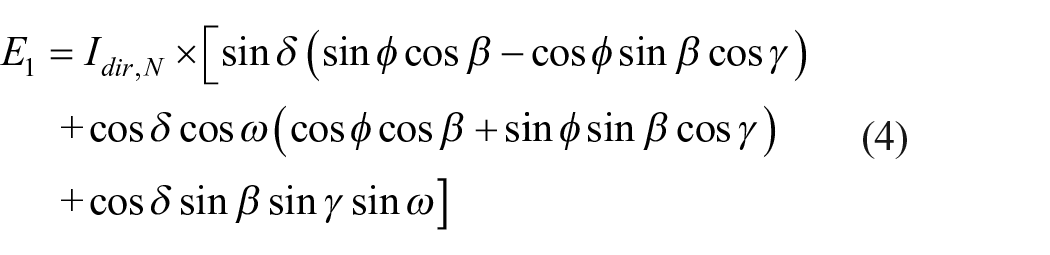
where
Assume that the sky scattering is isotropic, then the unit area solar radiation scattering of an arbitrary azimuth flat surface could be expressed as equation

where Idif,s is the solar scattering radiation intensity.
For any kind of arched surface, divide it into a quadrilateral surface, which is approximated by a small flat surface Di,j, and the four vertex coordinates of flat surface could be derived as

The normal line of the four vertices is

The β and γ can be obtained based on the small flat surface normal vector was solved.
Based on American Society of Heating, Refrigerating and Air-Conditioning Engineers (ASHRAE) standard, the normal direct solar radiation intensity vector of solar radiation reaching the ground on sunny days is proposed as

where A and B are constants related to the month; CN is the atmospheric transparent coefficient; and h is the solar altitude angle and is expressed as

Based on ASHRAE standard, the solar scattering radiation intensity is defined as

where C is the coefficient and can be obtained from ASHRAE standard.
The hourly solar radiation heat gained of unit area membrane material could be expressed as equation

The hourly solar radiation heat gained of fabric membrane structure storage building can be obtained as follows

Calculation and discussion
In this article, a fabric membrane structure storage building located at Wuhan in China was selected as the object, the size of the building is 274 m long, 56 m wide, and 30.8 m high, as shown in Figure 1.

Fabric membrane structure storage building.
The thermophysical parameters of fabric membrane materials are shown in Table 1.
Thermophysical parameter.

PVC: polyvinyl chloride; PVDF: polyvinylidene fluoride.
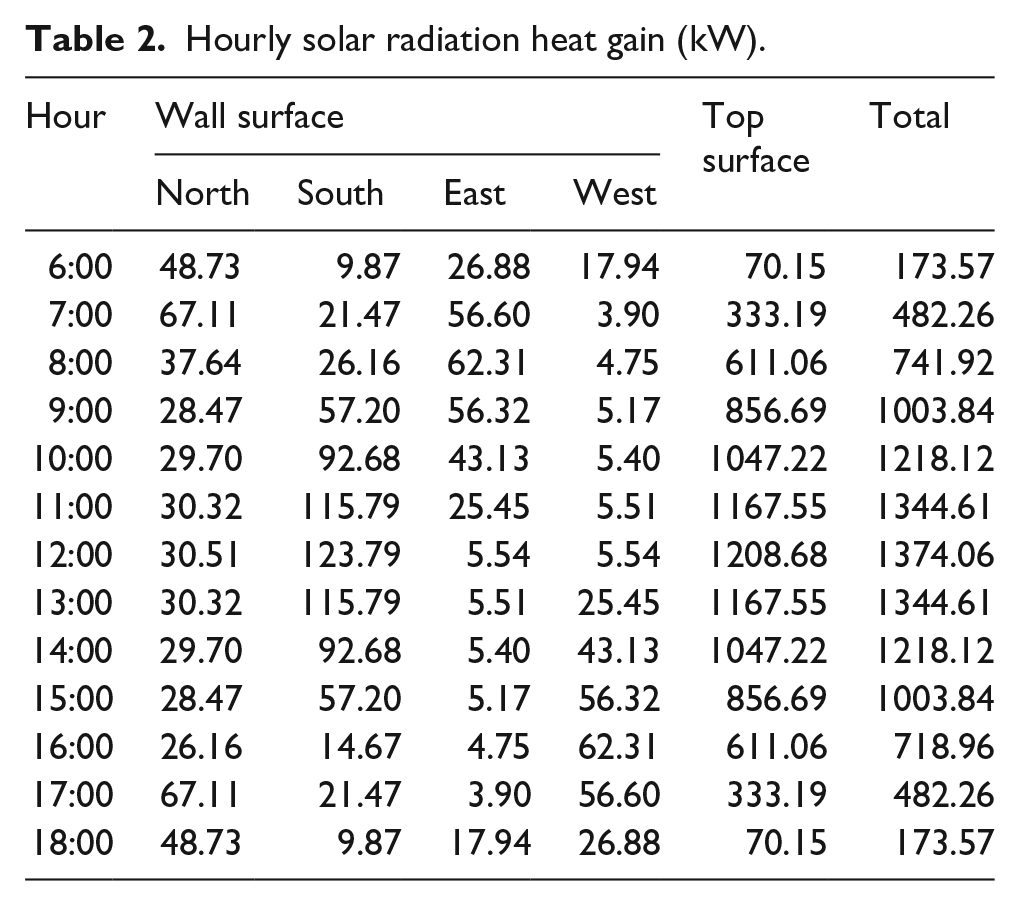
The solar radiation heat gained was calculated with MATLAB based on the meteorological data of a typical summer day 31 July (outdoor average temperature is 36.5°C, outdoor wind speed is 3 m/s), 23 the hourly solar radiation heat gained result of the fabric membrane structure storage building is shown in Table 2 and Figure 2.
Hourly solar radiation heat gain (kW).

Hourly solar radiation heat gain.
Figure 2 shows that the solar radiation heat gain and indoor heat gain reached maximum at 12:00, the maximum heat gain caused by indoor and outdoor temperature difference was obtained at 15:00. The heat gain of unit area fabric membrane materials could be attained to 42 W/m2. Due to the fabric membrane material has a high solar radiation transmittance and absorption rate, the solar radiation heat gain is greater than the heat gain caused by the indoor and outdoor temperature difference.
At present, the calculation method of the solar radiation heat gained about arched roof of fabric membrane structure storage building has not been found. Then, the projection method is frequently used to estimate the solar radiation heat gain in engineering design stage. In view of this, the solar radiation heat transfer calculation program is established using MATLAB in this article. The solar radiation heat gained of the building is calculated by the grid generation method with MATLAB and the projection method, respectively, as shown in Figure 3. The calculated results also showed that the solar radiation heat gain calculated by the grid generation method is larger than the calculation results by projection method. The maximum error is 24%, and the greater the roof curvature, the larger difference in solar radiation heat gain.

Solar radiation heat gain comparison.
The fabric membrane material is a special new-type building material. Compared with traditional building materials, it has significant architectural physical properties: light weight, flexibility, and self-cleaning. 24 The fabric membrane has high light transmittance, and it can make full use of sunlight for natural daylight. But a roof with textile covering has large heat transfer coefficient, high absorption rate, and poor thermal insulation performance. These material properties lead to the indoor thermal environment much more affected by environmental conditions,21,25 especially significantly affected by the solar radiation intensity. 21 Results show that the heat gain of fabric membrane structure storage building mainly comes from solar radiation transfer of fabric membrane materials as shown in Figure 2. Typically, the fabrics materials are 0.9 mm thick and have a mass of around 1 kg/m2, so there is no significant time lag between a temperature change on their outside surface and the resulting change in their inside surface. 21 As a result, the heat gain obtained by the temperature difference is much smaller than the heat gained from the solar radiation from Figure 2.
In addition, when calculating the heat gain of solar radiation, there is a certain error in the calculation of the arched roof simplified as a horizontal plane roof. The greater curvature of the roof, the greater error in solar radiation heat gain. Therefore, in the engineering design stage, the arched roof should not be directly simplified as a horizontal plane roof.
Conclusion
In this article, the solar radiation heat gained about arched roof of maintenance structure was calculated using the MATLAB program. The high solar radiation transmittance and absorption rate of the fabric membrane materials increases the solar radiation heat gain. The results indicated that the solar radiation heat gain program can be applied to thermal environment analysis and design of fabric membrane structure storage buildings.
The maximum calculation error is 24% of the arched roof solar radiation heat gained between the grid generation method with MATLAB and the projection method. Therefore, the influence of solar heat transfer on the indoor heat gain cannot be ignored. Especially in the engineering design stage, when calculating the indoor solar radiation heat gain in the arched roof buildings, the arched roof should not be directly simplified as a horizontal plane roof.
As a result, the fabric membrane materials are particularly sensitive to changes in environmental conditions and being affected much more significantly than other building materials, especially affected by the intensity of solar radiation. Therefore, the sunshade measures can be taken to reduce the solar radiation heat gain in the summer, or a double-layer fabric membrane material can be used to reduce heat transfer through the material into the building.
Footnotes
Declaration of conflicting interests
The author(s) declared no potential conflicts of interest with respect to the research, authorship, and/or publication of this article.
Funding
The authors disclosed receipt of the following financial support for the research, authorship, and/or publication of this article: This work is financially supported by the National Natural Science Foundation of China (No. 51808430), the National Key Research and Development Program of China ( No. 2016YFC0206100), and also supported by the Talent Scientific Research Foundation of Xi’an University of Architecture and Technology (No.RC1711).
